You’re three hours from the trailhead. Gusts are hitting 35 miles per hour. The tent you picked suddenly feels like a very big deal.
I’ve spent the better part of a decade selling, testing, and sleeping in just about every tent shape you can name. The dome shelters tent versus traditional tent debate isn’t about looks—it’s about waking up dry and warm, or spending 4 a.m. clutching a pole that’s trying to become a kite. So let’s skip the corporate inflatables speak and get into the physics, the field reports, and the decision matrix that actually matters when you’re handing over your money.
Quick Answer
A Dome Tent wins on wind resistance, weight, and operating manual speed. Traditional cabin tents win on headroom and livable space. Your choice depends entirely on whether you’d rather survive a storm or stand up straight inside.
Dome Tent vs. Traditional Tent: The 5-Second Verdict
Before we get into pole geometry and rainfly coverage, here’s the scorecard. I’ve boiled down years of field testing and customer feedback into a simple table—the kind of comparison you wish every retailer would just show you upfront.
| Category | Dome Tent | Traditional (Cabin) Tent | Winner |
|---|---|---|---|
| Wind Resistance | Excellent (aerodynamic curve) | Poor (flat vertical walls) | Dome |
| Interior Space | Good (sloped walls) | Excellent (near-vertical walls) | Traditional |
| Weight & Pack Size | Light (~30% lighter) | Heavy (bulky poles) | Dome |
| Setup Time | 10 minutes solo | 20+ minutes, needs 2 people | Dome |
| Price Range | Budget-friendly to mid-range | Premium pricing | Dome |
Here’s the thing—this comparison isn’t close in most categories. The dome takes three out of five outright. But the one category it loses—interior space—is a dealbreaker for a specific type of camper. And that’s where the nuance comes in.
Why Tent Shape Dictates Performance (The Physics)
Let’s talk about tent stability like an engineer would, because that’s what actually keeps you alive in a storm.
A dome tent uses two or more poles that cross at the apex, creating a geodesic-like triangulation. That’s not just clever design—it’s structural math. The curved profile means wind flows over the tent rather than pushing against it. According to Pacific Domes’ analysis of recreational shelter options, the hemispherical structure distributes stress evenly across the entire frame. When a gust hits a dome, the force gets spread out; when it hits a cabin tent’s flat wall, that force concentrates on a single panel.
Now, the cabin tent. It has vertical walls because that’s what maximizes interior volume—you can stand up, walk around, and feel like you’re in a tiny room rather than a cocoon. But those vertical walls act as wind sails. Every square foot of flat fabric is a surface for the wind to grab. In practitioners’ experience, a cabin tent starts to feel sketchy in strong winds; … A well-designed dome can handle higher winds without breaking a sweat.dome can shrug off 40mph gusts without breaking a sweat.
You might be wondering why anyone buys a cabin tent at all if the aerodynamics are that bad. Fair question. The answer is headroom—and it’s a bigger deal than you might think.
Dome Tent vs. Cabin Tent: Headroom vs. Aerodynamics
This is where the space comparison gets personal.
Cabin tent headroom is the single biggest selling point for family campers. You can stand up. You can change clothes without doing a contortionist act. You can play cards at a table inside the tent while it’s raining outside. Gaxtent’s breakdown of the two types notes that cabin tents dominate the “glamping” market precisely because they offer that blend of comfort and convenience —you’re outdoors, but you’re not roughing it.
Dome tent interior space is a different beast. The walls slope inward, which means the usable floor space is less than the total tent footprint guide. You’ll have plenty of room to sleep, but you won’t be hosting a dinner inflatable party shelters in there. The tradeoff is efficiency—a dome packs down dramatically smaller. In my experience, the packed size and weight delta is noticeably in favor of the dome. That’s not a small number. For backpackers and anyone who has to carry gear more than 50 feet from a car, that weight difference is the entire ballgame.
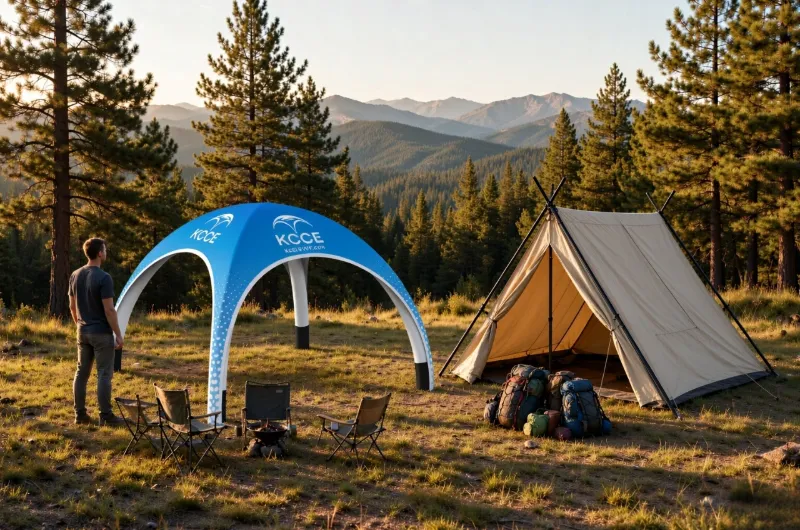
Here’s where I’ll offer a practical middle ground: if you’re car camping with the family and the forecast is clear, a Cabin Tent is genuinely the better experience. If you’re hiking in, biking in, or camping anywhere the weather can turn ugly, the dome’s aerodynamic profile wins. And if you’re considering something even faster to deploy, our inflatable tents at KCCE eliminate pole setup entirely—a hybrid approach that’s gaining serious traction in the industry.
Dome Tent vs. Tunnel Tent: Packability and Vestibule Space
The tunnel tent vs. dome tent debate is a favorite among serious campers, and it deserves its own moment.
Tunnel tents are shaped like—you guessed it—a tunnel. Multiple hoops in a row create a long, narrow tube. Their biggest advantage is vestibule space. The tunnel tent vestibule can be enormous, offering a covered area where you can stash muddy boots, cook under shelter, and keep your gear dry without dragging it into the sleeping area. For multi-day expeditions where you’re living out of the tent, that extra dry storage is gold.
But here’s the catch: tunnel tents are not freestanding. They require guying out at both ends, and often along the sides, to maintain their shape. If you’re on rocky ground where stakes won’t hold, you’re in trouble. The structural integrity of a tunnel tent depends entirely on tension—lose a stake in the middle of the night, and the whole thing goes slack.
Dome tents, by contrast, are almost always freestanding. You can pick one up, move it, and reposition it without pulling stakes. And the dome tent rainfly coverage is generally more complete—most domes have full-coverage flies that extend close to the ground, while tunnel tents often leave gaps at the ends. In a driving rain with wind, that full-coverage fly is the difference between dry socks and a miserable morning.
A-Frame vs. Dome: The Old Guard vs. The Modern Standard
Let’s talk about the A-frame tent, because it’s the ghost at the banquet. The A-frame tent stability is actually decent in one specific way—its steep, straight walls shed rain well. But that’s about where the compliments end.
The classic A-frame design uses a single ridge pole with two vertical end poles, creating that classic triangular profile. The steep walls do offer good headroom in the center, but the floor space is brutally inefficient—the walls angle inward so sharply that you lose a huge percentage of the footprint. And setting one up solo? Good luck. The dome tent setup is a 10-minute job for one person; an A-frame often requires two people and a fair amount of cursing.
Honestly, the A-frame tent is the horse-and-buggy of the camping world. It works, it’s nostalgic, and some people swear by it. But the dome tent vs. A-frame tent comparison is barely a contest. Domes are lighter, faster to pitch, more wind-resistant, and pack smaller. The only reason to buy an A-frame in 2025 is if you found one at a garage sale for twenty bucks and you’re not picky.
The Reddit Truth: What Campers Actually Report
Now, I could sit here and give you my opinion all day, but the dome tent vs. traditional tent comparison reddit threads are where the unvarnished truth lives. And the patterns are remarkably consistent.
Search for “dome tent wind test” on any camping forum and you’ll find a recurring theme: dome tents fail spectacularly around 40mph+—usually when a pole snaps from fatigue or a stake pulls loose. But the tent gives you warning. It flexes, it strains, it makes noises like a ship in a gale. You have time to react.
The “cabin tent storm” stories are different. They’re scarier. Reports of cabin tents collapsing in strong winds because the flat walls caught a gust and the poles bowed until they snapped—these are common enough to be a pattern. The sail effect isn’t a theory; it’s what happens when you put a big flat surface in front of moving air.
One camper on a forum I follow described a night where his cabin tent’s pole snapped in what he estimated were strong gusts. The tent collapsed onto his family. They spent the rest of the night in the car. Meanwhile, the dome tent 20 feet away—same campsite, same storm—didn’t even flex.
That’s not a brand endorsement. That’s geometry.
How to Choose: A Decision Matrix for Buyers
So you’re ready to buy. Here’s the tent buying guide I wish someone had given me years ago—a straight-up decision matrix.
Choose a dome tent if:
- You camp in exposed areas (beaches, ridges, above treeline)
- Weight and pack size matter (backpacking, biking, motorcycle camping)
- You pitch solo or with one other person
- You want the best tent for camping in variable weather
- Your budget is moderate—domes are generally cheaper than cabins
Choose a traditional cabin tent if:
- You’re car camping with family or a group
- You value standing headroom and interior livability
- You camp in mild, predictable weather
- Setup time isn’t a concern (two people, 20+ minutes)
- You’re willing to pay a premium for space
Choose a tunnel tent if:
- You need serious vestibule space for gear storage
- You’re on a multi-day expedition with lots of equipment
- You’re camping on soft ground where stakes hold well
And if you’re in the event or glamping business rather than personal camping, the calculus shifts entirely. That’s where products like our inflatable furniture and display frames come into play for creating comfortable, branded outdoor spaces that don’t compromise on durability.
Frequently Asked Questions
Q: What are the downsides of a dome tent?
A: The main downside is reduced interior headroom and livable space. The sloped walls mean you can’t stand up near the edges, and the usable floor area is less than the tent’s total footprint. Domes also tend to have less vestibule space compared to tunnel tents, which can be a drawback for gear-heavy campers.
Q: When should you use a dome tent?
A: Use a dome tent whenever wind resistance, weight, and quick setup are priorities. They’re ideal for backpacking, beach camping, alpine environments, and any situation where weather can turn unpredictable. For solo campers or pairs, a dome is almost always the right call over a cabin or A-frame.
Q: What shape of tent is best?
A: There’s no universal answer—the best shape depends on your priorities. For wind resistance and packability, a geodesic dome tent is the gold standard. For interior space and family comfort, a cabin tent wins. For expedition gear storage, a tunnel tent excels. Match the shape to your primary use case rather than chasing a single “best” option.
Q: Are air tents better than normal tents?
A: Air tents—which use inflatable beams instead of poles—offer faster setup and eliminate the risk of pole breakage entirely. They’re increasingly popular for events and glamping. However, they require a pump, and a puncture is harder to fix in the field than a broken pole. For most campers, a quality pole dome remains the more reliable choice.