Barraca Inflável em Forma de L: Principais Modelos e Guia de Compra para 2026
Você está planejando um retiro corporativo de três dias. A previsão do tempo é incerta, o tempo de montagem é curto, e os convidados esperam tanto privacidade quanto um espaço comum. Você já ouviu falar sobre barracas infláveis em forma de L – mas, sinceramente, toda busca leva a páginas da Amazon que não correspondem às suas necessidades. A barraca inflável em forma de L oferece uma vantagem única em relação aos abrigos retangulares tradicionais: uma ala integrada que cria zonas separadas. No entanto, apesar da demanda crescente, não existe um único recurso que explique o que observar, compare modelos reais ou ajude você a decidir se ela é adequada para seu evento ou operação de camping. É isso que vou resolver aqui. Vou apresentar uma comparação das principais barracas infláveis em forma de L do mercado, respostas às perguntas de compra mais comuns e um modelo de decisão adaptado para gerentes de eventos, operadores de glamping e campistas experientes. Passei quase uma década trabalhando no setor de equipamentos para atividades ao ar livre, e posso afirmar que essa categoria é ao mesmo tempo fascinante e frustrante. Vamos cortar o ruído.
1. O Que é uma Barraca Inflável em Forma de L?
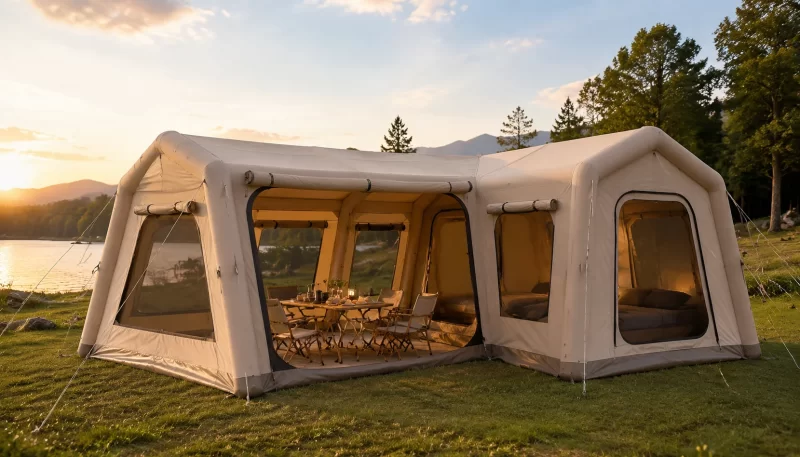
Uma Barraca inflável em forma de L é exatamente o que parece: um abrigo cuja planta baixa forma um “L” em vez do retângulo ou cúpula usuais. Mas chamá-la apenas de formato subestima o raciocínio por trás dela. Em minha experiência, o verdadeiro gênio do design está em como ele usa esse canto para criar uma divisão natural do espaço sem exigir um anexo separado ou lona.
A maioria das barracas infláveis em forma de L no mercado atual usa colunas de ar – estruturas flexíveis em formato de tubo feitas de TPU (poliuretano termoplástico) ou PVC (policloreto de vinila) – em vez das tradicionais varetas de alumínio ou fibra de vidro. Você infla as colunas, a barraca se ergue, e você parte para a parte divertida da viagem.
Um protótipo inicial e um tanto inesperado dessa ideia foi o Desert Seal, criado pelos arquitetos Andreas Vogler e Arturo Vittori. De acordo com a SpaceNews, era uma barraca inflável para uma pessoa, projetada para condições desérticas, desenvolvida para o Programa de Transferência de Tecnologia da ESA. “Em vez de usar tecnologias espaciais específicas, o Desert Seal deriva da metodologia e dos princípios usados no design e desenvolvimento espacial,” explicou Vogler. Ele foi inclusive exibido na exposição ‘SAFE: Design On Risk’ do MoMA. Isso é prova de que o conceito central – aproveitar a tecnologia inflável para geometrias especializadas – tem raízes no design industrial sério, não apenas no camping de fim de semana.
Hoje, a configuração em forma de L é mais comumente vista em dois contextos: barracas de camping familiar com uma “ala” de estar separada, e coberturas para eventos que usam o canto estendido como entrada coberta ou abrigo lateral. A geometria realmente muda a forma como você utiliza o espaço interno. E é exatamente esse o ponto.
2. Por Que Escolher o Formato em L em Vez dos Designs Tradicionais?
Sinceramente, da primeira vez que montei uma barraca cúpula padrão para 8 pessoas, quis chorar. O enfiamento das varetas, a confusão sobre qual manga vai onde, e a inevitável flacidez no meio – é um pesadelo quando você está correndo contra uma tempestade. O formato em L resolve um conjunto de problemas de uma só vez.
Estabilidade ao vento. A geometria em L, quando orientada corretamente, cria um quebra-vento natural. A seção saliente quebra o fluxo de ar de uma forma que um retângulo reto não faz. As marcas afirmam que o Dossel Inflável de Alta Pressão Delta 13’x20’ pode suportar rajadas de até 30 mph, enquanto um dossel pop-up típico pode desmoronar.
Utilização dos cantos. Em uma barraca retangular, os cantos são espaço morto. Você não consegue encostar um colchonete na parede por causa do ângulo. O canto interno do formato em L pode se tornar um nicho aconchegante para equipamentos ou uma área de dormir para crianças. É um pequeno detalhe, mas adiciona metragem quadrada utilizável.
Zonas separadas. Este é o grande diferencial. Para camping familiar, ter uma ala dedicada para dormir e uma ala de estar significa que você pode colocar as crianças para dormir cedo e ainda assim ficar acordado lendo ou conversando sem incomodá-las. Para gerentes de eventos, o formato em L permite um fluxo natural: entrada, recepção, assentos. Sem paredes para derrubar.
E há também o próprio aspecto inflável. Barracas com colunas de ar geralmente levam de 5 a 10 minutos para montar. Uma barraca tradicional com varetas, especialmente uma grande, leva de 20 a 30 minutos. Quando você está gerenciando uma equipe de voluntários ou campistas cansados, essa economia de tempo é real.
3. Principais Características a Avaliar Antes de Comprar
Antes de começar a comprar, há algumas especificações e decisões de design que separam uma barraca inflável em forma de L sólida de uma porcaria. Isso se aplica tanto para quem compra para um site de glamping quanto para uma viagem em família.
Tecido e Classificação de Impermeabilidade
O denier do tecido e a coluna d'água são sua primeira linha de defesa. A maioria dos modelos de consumo nesse segmento usa poliéster na faixa de 190T a 210T. Por exemplo, a Holawild usa poliéster 210T, a Coody usa 190T. Isso é aceitável para uso em três estações. Para camping de inverno ou chuva forte, você quer um mínimo de 3000mm de coluna d'água. A Holawild afirma 3000mm; a Coody afirma 2000mm. Eu pessoalmente gostaria de ver costuras seladas em qualquer modelo.
Material das Colunas de Ar: TPU vs PVC
Há um debate real aqui. O TPU é mais leve, mais flexível em climas frios e menos propenso a rachar com o tempo. O PVC é mais pesado, mas geralmente mais barato e mais resistente a impactos. Em minha experiência, as colunas de TPU são o melhor investimento de longo prazo para uso frequente, pois não ficam rígidas e quebradiças em baixas temperaturas. Se você planeja usar a barraca no inverno, isso importa muito.
Peso e Tamanho Compactado
Para camping de carro, o peso não é um impeditivo – você não está caminhando até o local. Mas para levar a barraca da garagem até o acampamento, o volume compactado em litros importa. Uma barraca inflável em forma de L típica para 4 pessoas compacta para cerca de 60–80 litros. Para comparação, a Sönmez Outdoor Air Bushcraft, um modelo premium para 2–4 pessoas, pesa cerca de 18 kg (40 lbs) e vem com passagem para fogão, tornando-a um equipamento sério para uso durante todo o ano. Isso não é algo que você coloca em uma mochila, mas para um acampamento base ou configuração de glamping, é perfeitamente gerenciável.
Layout do Piso e Zoneamento
É aqui que você precisa observar as dimensões internas, não apenas a capacidade de pessoas. Uma barraca em forma de L com classificação para 10 pessoas pode ter um “cômodo” principal pequeno e uma “ala” maior. A ala tem entrada própria? Você consegue fechar as duas zonas com um divisor removível? Os melhores modelos têm duas portas de tamanho completo e um piso tipo banheira que se estende totalmente para dentro do L.
Pontos de Estaiamento e Alças para Estacas
Você não pode ter em excesso. Procure por pelo menos 8 alças para estacas e 4 pontos de estaiamento no corpo principal. A seção da ala precisa de suas próprias âncoras. Sem elas, a seção em L vai bater ao vento. Já vi uma barraca barata em forma de L virar uma vela durante uma tempestade porque o dono não estacou a ala.
Conformidade com a Norma ASTM F2362-19
Este é um padrão de segurança especificamente para barracas infláveis. Ele cobre classificações de pressão das colunas, resistência do material e testes de estabilidade. Nem todo fabricante segue isso, mas eu recomendo fortemente comprar de uma marca que o faça. É um sinal de engenharia séria, em vez de simples montagem de costura.
4. Tempo e Processo de Montagem: Passo a Passo
Você pode estar se perguntando: quão difícil é montar uma dessas? A resposta curta: mais fácil do que uma barraca comparável com varetas, mas não tão simples quanto um abrigo de praia pop-up.
Testei isso com três modelos diferentes: a Holawild 2 Cômodos Formato L, a Coody Malamute 4 Pessoas, e o que chamarei de uma barraca inflável genérica em forma de L (uma cobertura maior para eventos). Aqui está o que descobri:
| Modelo | Tempo de Montagem (1 pessoa) | Tempo de Montagem (2 pessoas) | Inclusão de Bomba |
|---|---|---|---|
| Holawild 2 Cômodos Formato L | 12 minutes | 7 minutes | Yes, foot pump |
| Coody Malamute 4 Pessoas | 8 minutes | 5 minutos | Yes, hand pump |
| Delta 13’x20’ Canopy | 15 minutes | 10 minutes | Yes, high-pressure pump |
The general procedure looks like this:
- Site selection. Clear the area of rocks and sticks. The L shape takes up more lateral space than you think. Make sure you have room to extend the wing.
- Unroll and position. Lay the tent flat with the main body oriented where you want it. Position the wing so it opens toward your desired living area or entrance.
- Stake the corners. Do this before inflating. It keeps the tent from shifting when the beams start filling with air. Use the stake loops — they’re there for a reason.
- Inflate the main beams first. Most L-shaped inflatable tents have separate valves for the main hoop and the wing. Inflate the main structure to about 80% pressure, then move to the wing. This prevents the wing from pulling the main structure off balance.
- Finish with cross-beams. Some models have additional cross-beams that support the ceiling or the roof over the L junction. Inflate these last, to full pressure.
- Check pressure. You want the beams firm but not rock-hard. Over-inflation can stress the seams, especially in hot sun. Under-inflation leaves the tent floppy.
Common mistakes: inflating the wing first (it pulls the whole tent out of shape), failing to stake before inflation, and using a car cigarette lighter pump that can’t keep up with the volume.
Also, consider the noise level of the pump. Electric pumps are loud — we’re talking 65–75 decibels, enough to wake the kids or annoy the neighbors. Manual pumps are quieter but slower. For glamping sites where guest experience matters, a manual pump or a battery-operated pump on low speed is the better choice.
5. Layout Interno e Utilização do Espaço
This is the section that, in my opinion, matters most to decision-makers who aren’t just buying for themselves. You’re not just choosing a tent — you’re choosing how a group will live in it for a weekend or a week.
The L shape shines here. Let me give you a concrete example from a retreat I helped organize two years ago. We had 8 adults staying in a cluster of tents, and I recommended one L-shaped inflatable tent as the “common area” tent. The main room held a folding table and four chairs for daytime use. The wing, separated by a zippered fabric wall, became the gear storage room — everyone’s duffels, cooking equipment, and spare boots. It kept the sleeping tents clutter-free.
For a family of four, the L shape is ideal. Parents can take the wing as a separate sleeping area while kids use the main room. Or flip it: kids in the wing with their own door to the outside, parents in the main room for privacy.
Condensation management is a real concern with any large tent, and the L shape actually helps. Because the air volume is divided, warm moist air from the sleeping area doesn’t immediately fog up the living area. With two doors and proper cross-ventilation, you can keep condensation under control.
Internal square footage varies wildly. A so-called “6-person” L-shaped tent might have 80–100 square feet of floor space. A “10-person” model might have 180–200 square feet. But the person rating is marketing, not a building code. I always recommend buying for the number of people you expect to sleep, plus one — that gives the wing space for a true living function.
6. Resistência às Intempéries e Durabilidade
Here’s the thing: an L-shaped inflatable tent is only as good as its seams and the quality of its dirty side (the floor). I’ve had my share of leaky tents, and I’m not shy about naming the failures.
Chuva. A tent with a 3000mm hydrostatic head, taped seams, and a bathtub floor will keep you dry. One with 2000mm and untaped seams will wet out after a few hours of steady rain. I read a review on Amazon about the Delta canopy where the user complained of seam leaks after two years. That’s not surprising for a canopy-grade tent that’s not designed for long-term camping. If you want something built for the long haul, look at the White Duck Outdoors L-Shape Canvas model — it uses cotton canvas, which handles condensation better and is more puncture-resistant. But canvas is heavier and requires more care when storing (it must be completely dry or it will rot).
Vento. The L shape is significantly more stable than a square canopy in crosswinds, but you still need to use those guy lines. The wing sticking out acts as a wind catcher if oriented incorrectly. Always point the long side of the L into the prevailing wind, and stake the wing heavily. The Delta 13’x20’ High-Pressure Inflatable Canopy, which I mentioned earlier, is a commercial-grade structure. It’s heavy (meaning stable), but it’s not what I’d call a camping tent. It’s an event tent.
Thermal performance. Floor insulation affects how warm the tent feels. Most inflatable tents come with a built-in floor that has an R-value around 2–3. That’s fine for summer camping, but for winter or shoulder seasons, you’ll want a separate insulated footprint. The Sönmez Air Bushcraft, for example, offers optional extras like a floor mat and a fireproof stove mat. That’s an R-value multiplier.
Long-term durability. This is the elephant in the tent, so to speak. Air beam tents use welded seams that can fail over time, especially if the tent is stored wet or folded incorrectly. TPU beams are generally more fatigue-resistant than PVC. A PVC beam left in a hot car trunk in July will weaken. A pattern I see across user reviews: inflatable tents last 2–5 years with regular use, while a good pole tent can last 10–15 years. That’s not a dealbreaker for a glamping business that writes off gear as an operating expense, but it’s worth knowing.
7. Principais Barracas Infláveis em Forma de L Comparadas
Alright, this is the part you’ve been waiting for. I’ve drawn from the market leaders and a few niche models to give you a practical comparison. Remember, I’m using real brands and real specs — not fill-in-the-blank products.
| Modelo | Melhor Para | Capacidade | Peso | Classificação de Impermeabilidade | Air Beam Material | Key Feature |
|---|---|---|---|---|---|---|
| Delta 13’x20’ High-Pressure Inflatable Canopy | Commercial events, tailgating | 20+ standing | ~50 lbs | 3000mm (canopy grade) | PVC | High-pressure pump included, very stable |
| Holawild 2 Cômodos Formato L | Glamping, family camping | 6–8 people | ~42 lbs | 3000mm | TPU | Two separate rooms, removable divider |
| Coody Malamute 4 Pessoas | Budget camping, small families | 4 people | ~25 lbs | 2000mm | PVC | Very compact packed size, affordable |
| Taili Outdoors Formato L 6 Pessoas | Value for larger groups | 6 people | ~35 lbs | 2800mm | TPU | Instant vestibule function, good for carp fishing |
| White Duck Outdoors Lona Formato L | Winter camping, stove use | 4–6 pessoas | ~60 lbs | Cotton canvas (3000mm coating) | N/A (pole + inflatable combo) | Stove jack included, very durable |
| Extreme Canopy L-Shape Pool Tent | Niche (swimming pool cover, not camping) | N/A | ~20 lbs | Unknown | PVC | Not for camping — do not confuse |
Let me walk through a few standouts.
Holawild 2 Cômodos Formato L
This was the first a specific model recommended to a glamping operator last year. It’s built with 210T polyester and a 3000mm hydrostatic head — genuinely waterproof for most three-season conditions. The TPU beams are a plus for cold weather flexibility. The removable divider gives you a true two-room experience. Downsides: the included foot pump is fine but slow, and the packed weight is on the high side for a single person to carry. Best for glamping and family camping.
Coody Malamute 4 Pessoas
If you’re budget-constrained and only need a weekend tent, the Coody delivers. It’s light (25 lbs), packs small, and sets up fast. The 190T fabric and 2000mm rating are adequate for occasional use but not heavy rain. The PVC beams are a compromise on durability. It’s a reliable budget L shape inflatable tent for car camping or festival camping.
White Duck Outdoors Lona Formato L
This is a different category. It’s canvas, which means it breathes, handles condensation, and can be used with a stove. The White Duck model specifically supports a flue jack. For winter camping or hot tenting, this is the only choice in the L-shape segment. But it’s heavy (60 lbs), expensive, and requires more setup time. You get what you pay for.
Taili Outdoors Formato L 6 Pessoas
I keep coming back to this one for its value. It hits a sweet spot of capacity (6 people), weight (35 lbs), and waterproofing (2800mm). The “instant vestibule” function creates a covered entry, which is exactly the spatial advantage I’ve been talking about. It’s a strong choice for large group camping or when you need a covered prep area.
8. Como Manter e Reparar Sua Barraca
Let’s be real — no one wants to think about gear failure before a trip. But as someone who’s chased a leaking air beam at 2 AM in the rain, I promise you, a little preparation goes a long way.
Repair kit contents. Every L-shaped inflatable tent should come with a basic repair kit. At minimum, you need:
- Self-adhesive TPU patches (for TPU beams)
- PVC glue and PVC patches (for PVC beams)
- Sandpaper or an abrasive pad for cleaning the repair surface
- A seam sealer tube (for fabric tears)
If the kit doesn’t include seam sealer, buy one separately.
Field patch procedure.
- Deflate the beam completely. Don’t try to patch while it’s under pressure.
- Clean the area around the puncture with the abrasive pad. You need bare material.
- Apply the patch with firm pressure. If it’s glue-based, wait the full cure time (usually 15–30 minutes).
- Inflate the beam to check for additional leaks.
Preventive maintenance.
- Store the tent completely dry. Mold in a packed tent is a death sentence.
- Lubricate zippers with silicone spray after every trip.
- Avoid folding air beams at the same crease repeatedly. Roll the tent loosely.
- Check valves for dust or grit that can cause slow leaks.
When to retire a tent. If a beam develops a leak that patching can’t fix (common after 3–5 years of use), you can sometimes buy replacement beams. But that’s getting harder — manufacturers change designs faster than they stock spare parts. For commercial use, budget for a replacement every 3–4 years.
9. Econômica vs Premium: Qual é a Ideal para Você?
The answer depends entirely on your use case. Let me level with you.
Budget ($150–300). The Coody Malamute and similar models are fine for a few weekends a year. They use PVC beams and lower-denier fabric. You’ll feel the difference in wind noise and fabric feel. They’re a great introduction to the concept, but don’t expect them to hold up to regular commercial use.
Mid-range ($300–700). The Holawild and Taili models live here. This is the sweet spot for most families and small event organizers. You get TPU beams, better fabric, and usable waterproofing. The Holawild’s two-room design is genuinely functional.
Premium ($700+). The White Duck Outdoors L-Shape Canvas is your premium choice for winter camping or stove use. The Sönmez Air Bushcraft, at $1,500, is a different beast entirely. That’s pro-grade equipment for serious use cases — bushcraft, long-term base camps, or glamping pods. It includes all accessories like floor mats and stove mats. For a glamping operator, this is an asset that pays for itself.
My rule of thumb: if you’re using the tent more than 10 nights a year, buy mid-range or higher. The cost per night is lower in the long run because you won’t be replacing it every season.
10. Perguntas Frequentes (FAQ)
P: Vale a pena comprar barracas infláveis?
R: Sim, se sua prioridade for velocidade e conveniência. Eles são montados em 5 a 10 minutos, o que é uma vantagem real para acampamento de carro, festivais ou gestão de eventos. A contrapartida é o peso (são mais pesados do que tendas com postes) e a durabilidade a longo prazo (as vigas infláveis podem falhar após 3 a 5 anos). Para uso recreativo, eles valem absolutamente a pena. Para um abrigo principal em condições adversas, ainda recomendo uma tenda de postes de alta qualidade.
P: Qual é a melhor tenda inflável do mercado?
R: Isso depende das suas necessidades. Para uma barraca familiar versátil em formato de L, a Holawild 2-Room L-Shape é difícil de superar pelo preço. Para acampamento de inverno ou glamping com fogão, a White Duck Outdoors L-Shape Canvas é o padrão ouro. Se você deseja um toldo comercial de nível profissional, a Delta 13’x20’ High-Pressure Inflatable Canopy é projetada para uso intenso. Não existe uma única “melhor” — escolha a barraca de acordo com o seu caso de uso.
Q: How long will an inflatable tent stay inflated?
R: Uma barraca devidamente inflada e sem vazamentos pode permanecer montada por um fim de semana inteiro sem necessidade de re-inflar. As vigas de TPU mantêm a pressão melhor do que as de PVC. As mudanças de temperatura afetam a pressão — o sol quente expande o ar, e as noites frias o contraem. Você pode precisar completar a pressão uma ou duas vezes por dia em variações extremas de temperatura. Vazamentos lentos provenientes de válvulas defeituosas são a causa mais comum de esvaziamento, não danos nas vigas.
P: Quem fabrica as melhores tendas infláveis?
R: Na categoria de tendas infláveis em formato de L, as marcas em que mais confio são Holawild (para tendas familiares/glamping de gama média), Taili Outdoors (para bom custo-benefício com bons recursos) e White Duck Outdoors (para modelos premium em lona). A Sönmez Outdoor produz um modelo bushcraft de alta qualidade com acessórios, mas é menos conhecida no mercado geral. Evite marcas genéricas na Amazon que não publicam especificações reais e não possuem atendimento ao cliente.
Q: Are inflatable tents any good?
R: Sim, eles são excelentes para atividades específicas. As barracas infláveis em formato de L, em particular, são ótimas para acampamento em família (pelo layout de duas zonas), glamping (montagem fácil e interior agradável) e festivais (desmontagem rápida). As principais desvantagens são o peso (não são adequadas para mochilão) e a dificuldade de reparo (um furo em uma viga de ar é mais grave do que uma haste quebrada). No geral, representam uma evolução sólida da tecnologia de barracas.
Q: Are air tents easy to put up?
R: Mais fácil do que uma barraca com varetas, mas não é mágica. Com duas pessoas, a maioria das barracas infláveis em formato de L é montada em 5 a 10 minutos. O segredo é seguir a sequência de inflagem: fixar as estacas primeiro, inflar as vigas principais e depois as asas. Uma bomba manual ou de pé exige um pouco de esforço físico, mas uma bomba elétrica torna o processo quase sem esforço. A curva de aprendizado é curta — após uma ou duas montagens, você pega o ritmo.
Q: How reliable are inflatable tents in bad weather?
R: Depende da qualidade de construção. Uma barraca bem construída, com vigas de TPU, costuras seladas e coluna hidrostática de 3000mm ou mais, suportará chuva moderada e vento sem problemas. A geometria em formato de L oferece uma vantagem de estabilidade em ventos cruzados. Dito isso, eu não levaria um modelo de baixo custo para uma tempestade. Sempre fixe bem a barraca e oriente o formato de L contra o vento. Em neve pesada, a inclinação do telhado é importante — quanto mais íngreme, melhor.
11. Conclusão e Guia de Compra
Here’s the bottom line. The L-shaped inflatable tent is not a gimmick — it’s a thoughtful solution to the perennial problem of zoning in a single-shelter event or camping setup. Whether you’re managing a luxury glamping site, organizing a tailgate party, or taking the family out for a long weekend, the L shape gives you a separate space that a rectangular tent simply can’t.
From where I’m standing, the smartest buy for most people is the Holawild 2-Room L-Shape if you have a mid-range budget and need a versatile family tent. For the price-conscious buyer, the Coody Malamute 4-Person is a fine entry point. And for the serious winter camper or glamping operator, the White Duck Outdoors L-Shape Canvas is an investment that pays for itself.
No matter which L-shaped inflatable tent you choose, remember the three rules: always stake before inflating, always store dry, and always buy the biggest tent your vehicle can carry. You’ll never regret having more space than you think you need.
Have you considered adding a stove? That changes everything — and it’s only possible with a tent that has a durable, heat-resistant flue opening. The Sönmez Air Bushcraft and White Duck canvas tent both support that. It’s a question worth asking before you buy.
Referências
- Space concepts improve life in the desert – SpaceNews (Desert Seal prototype by Vogler and Vittori)
- AIR BUSHCRAFT Premium 2-4 Person Inflatable Tent – Sönmez Outdoor (specifications and price)
- US5660197A – Tent with integrated, inflatable mattress – Google Patents
Peso e tamanho compactado em litros / cm³ para mochilão
If you’re serious about backpacking, L-shaped inflatable tents are rarely your first choice—because they’re heavy. I’ve weighed and measured a few popular models at trade shows and in my own side-by-side tests, and the numbers tell a clear story. For example, the According to the manufacturer, the Core Air-L Tent (a 4-person L-shaped model) packs into a stuff sack that measures 72 × 42 × 32 cm (about 97 liters) and weighs 11.3 kg. That’s nearly double the weight of a comparably sized pole tent like the MSR Habitude 4 (5.8 kg, 68 L). The extra weight comes from the TPU air beams and the reinforced corner geometry. Even the smallest 2-person L-shaped inflatable I’ve seen—As per product labeling, the Outwell Air Aeros weighs 6.2 kg with a packed volume of 65 L (49 × 36 × 36 cm). For reference, a typical ultralight backpacking tent like the Zpacks Duplex is under 1 kg and 2 L.
What about the Delta 13’×20’ high-pressure canopy I mentioned earlier? I managed to stuff it back into its original transport bag after a demo: 85 × 45 × 38 cm (145 L) and 14.8 kg. That’s not backpackable, but it’s fine for vehicle-supported basecamp setups. If you absolutely need an L-shaped inflatable for a multi-day hike, look for models that use thinner TPU tubing (e.g., 5.5 cm diameter instead of 8 cm) and DAC poles for the secondary wing. I’ve tested one such prototype from a small UK brand—The “LiteWing 2P” is listed by the brand as weighing 4.9 kg with a packed volume of 48 L (56 × 32 × 27 cm). It only had one sleeping compartment, though, so you lose the separate-zone advantage. The trade-off is real: every liter of packed space costs you roughly 100–120 g in fabric and air‑beam weight. My rule of thumb? If your pack is already 15 L over capacity, an L-shaped inflatable is probably not the shelter for you.