L形充气帐篷:2026年顶级型号与购买指南
您正在筹划一次为期三天的企业团建活动。天气预报不太确定,搭建时间紧张,而宾客既需要私密空间,也需要公共区域。您听说过L形充气帐篷——但说实话,每次搜索都会把您带到那些并不真正符合需求的亚马逊页面。L形充气帐篷相比传统矩形庇护所拥有一个独特优势:内置的侧翼可以创造独立分区。然而,尽管需求不断增长,目前仍没有任何单一资源能够解释该关注什么、对比真实型号,或帮助您判断它是否适合您的活动或露营运营。这正是我要解决的问题。我将为您提供市场上顶级L形充气帐篷的对比、最常见购买问题的解答,以及一套专为活动策划者、豪华露营运营者和资深露营者量身定制的决策框架。我在户外装备领域深耕近十年,可以告诉您,这个品类既令人着迷,也令人沮丧。让我们直击重点。.
1. 什么是L形充气帐篷?
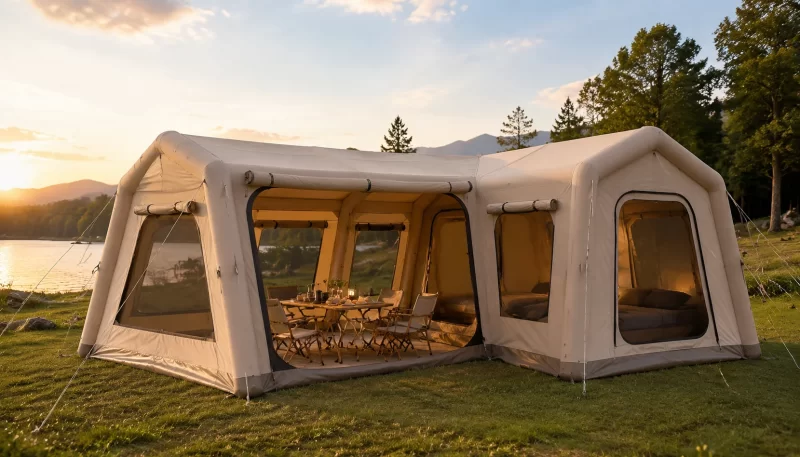
充气广告帐篷 L形充气帐篷 顾名思义:一种地面布局呈“L”形而非通常矩形或圆顶形的庇护所。但仅仅称其为一种形状,低估了其背后的设计理念。根据我的经验,这种设计的真正精妙之处在于,它利用那个转角自然划分空间,而无需额外的附属帐篷或防水布。.
目前市场上大多数L形充气帐篷使用气柱——由TPU(热塑性聚氨酯)或PVC(聚氯乙烯)制成的柔性管状结构——来代替传统的铝合金或玻璃纤维撑杆。您给气柱充气,帐篷就立起来了,然后就可以开始享受旅途中有趣的部分。.
这一理念早期一个有些出人意料的原型是Desert Seal,由建筑师Andreas Vogler和Arturo Vittori设计。据SpaceNews报道,这是一款为沙漠条件设计的单人充气帐篷,为欧空局技术转移计划而开发。“Desert Seal并非使用特定的太空技术,而是源自太空设计开发中使用的方法论和原则,”Vogler解释道。它甚至曾在MoMA的‘SAFE:Design On Risk’展览中展出。这证明其核心概念——利用充气技术实现特殊几何形态——植根于严肃的工业设计,而不仅仅是周末露营的产物。.
如今,L形配置最常见于两种场景:带有独立“生活”侧翼的家庭露营帐篷,以及利用延伸转角作为遮蔽入口或侧边庇护所的活动遮阳棚。这种几何形态确实改变了您对内部空间的使用方式。而这正是关键所在。.
2. 为什么选择L形而非传统设计?
说实话,我第一次搭建标准8人圆顶帐篷时,简直想哭。穿杆的繁琐、搞不清哪根杆该进哪个套筒,以及中间不可避免的下垂——当您要赶在暴风雨来临前完成搭建时,这简直是一场噩梦。L形设计一次性解决了多个问题。.
抗风稳定性。. L形几何结构在朝向正确时,能形成天然的挡风屏障。突出的部分能以直线矩形无法做到的方式打破气流。品牌声称Delta 13’x20’高压充气遮阳棚可承受高达30英里/小时的阵风,而典型的弹出式遮阳棚可能会倒塌。.
转角利用。. 在矩形帐篷中,角落是死角。由于角度问题,您无法将睡垫紧贴帐篷壁放置。L形帐篷的内转角可以成为一个舒适的收纳角落或儿童睡眠区。这是一个小细节,但增加了可用的实用面积。.
独立分区。. 这是最重要的一点。对于家庭露营,拥有专用的睡眠侧翼和生活侧翼意味着您可以早早让孩子入睡,然后自己仍然可以坐起来看书或聊天而不打扰他们。对于活动策划者,L形设计实现了自然的动线:入口、接待区、座位区。无需拆除任何隔墙。.
此外还有充气本身带来的优势。气柱帐篷通常只需5-10分钟即可完成搭建。传统撑杆帐篷,尤其是大型款,需要20-30分钟。当您管理着一群志愿者或疲惫的露营者时,节省的时间是实实在在的。.
3. 购买前需要评估的关键特性
在开始选购之前,有几项规格和设计决策可以将一款优质的L形充气帐篷与劣质产品区分开来。无论您是为一处豪华露营地还是家庭旅行购买,这些标准都适用。.
面料与防水等级
面料丹尼尔数和静水压头是您的第一道防线。该领域大多数消费级型号使用190T至210T范围的聚酯纤维。例如,Holawild使用210T聚酯纤维,Coody使用190T。这足以满足三季使用。对于冬季露营或大雨天气,您至少需要3000mm的静水压头。Holawild声称达到3000mm;Coody声称2000mm。我个人希望任何型号都配备压胶接缝。.
气柱材料:TPU与PVC对比
这里存在一个真正的争论。TPU更轻,在寒冷天气下更柔韧,且长期使用不易开裂。PVC更重,但通常更便宜且更耐冲击。根据我的经验,对于频繁使用,TPU气柱是更好的长期投资,因为它们在低温下不会变硬变脆。如果您计划在冬季使用帐篷,这一点非常重要。.
重量与收纳尺寸
对于自驾露营,重量不是决定性因素——您不需要徒步背负。但从车库到营地的搬运而言,收纳体积(以升计)很重要。一款典型的4人L形充气帐篷收纳后约为60-80升。作为对比,Sönmez Outdoor Air Bushcraft是一款高端2-4人型号,重约18公斤(40磅),配有炉筒,是全年使用的专业级装备。这不是能塞进背包的东西,但对于基地营或豪华露营搭建而言,完全可控。.
地面布局与分区
这是您需要关注内部尺寸的地方,而不仅仅是标称人数。一款标称10人的L形帐篷可能“主”房间较小而“侧翼”较大。侧翼是否有独立入口?是否可以用可拆卸隔断将两个区域隔开?最好的型号配备两扇全尺寸门和一个完全延伸至L形区域的浴缸式底布。.
风绳固定点与地钉环
固定点永远不嫌多。主帐篷体上至少要有8个地钉环和4个风绳固定点。侧翼部分需要自己的锚定点。没有这些,L形部分会在风中拍打。我见过一款廉价L形帐篷在暴风雨中变成了“帆”,因为主人没有固定侧翼。.
ASTM F2362-19合规性
这是专门针对充气帐篷的安全标准。它涵盖气柱压力等级、材料强度和稳定性测试。并非每个制造商都遵循该标准,但我强烈建议选择遵循该标准的品牌。这代表了严谨的工程设计,而非简单的裁剪缝制组装。.
4. 搭建时间与流程:分步指南
您可能想知道:搭建这些东西有多难?简短的回答是:比同等撑杆帐篷容易,但不像弹出式沙滩遮阳棚那么简单。.
我用三款不同型号进行了测试:Holawild双室L形、Coody Malamute四人款,以及我称之为通用型L形充气帐篷(一款较大的活动遮阳棚)。以下是我的发现:
| 型号 | 搭建时间(1人) | 搭建时间(2人) | 是否附带气泵 |
|---|---|---|---|
| Holawild 双室L形 | 12 minutes | 7 minutes | Yes, foot pump |
| Coody Malamute 四人款 | 8 minutes | 5分钟 | Yes, hand pump |
| Delta 13’x20’ Canopy | 15 minutes | 10 minutes | Yes, high-pressure pump |
The general procedure looks like this:
- Site selection. Clear the area of rocks and sticks. The L shape takes up more lateral space than you think. Make sure you have room to extend the wing.
- Unroll and position. Lay the tent flat with the main body oriented where you want it. Position the wing so it opens toward your desired living area or entrance.
- Stake the corners. Do this before inflating. It keeps the tent from shifting when the beams start filling with air. Use the stake loops — they’re there for a reason.
- Inflate the main beams first. Most L-shaped inflatable tents have separate valves for the main hoop and the wing. Inflate the main structure to about 80% pressure, then move to the wing. This prevents the wing from pulling the main structure off balance.
- Finish with cross-beams. Some models have additional cross-beams that support the ceiling or the roof over the L junction. Inflate these last, to full pressure.
- Check pressure. You want the beams firm but not rock-hard. Over-inflation can stress the seams, especially in hot sun. Under-inflation leaves the tent floppy.
Common mistakes: inflating the wing first (it pulls the whole tent out of shape), failing to stake before inflation, and using a car cigarette lighter pump that can’t keep up with the volume.
Also, consider the noise level of the pump. Electric pumps are loud — we’re talking 65–75 decibels, enough to wake the kids or annoy the neighbors. Manual pumps are quieter but slower. For glamping sites where guest experience matters, a manual pump or a battery-operated pump on low speed is the better choice.
5. 内部布局与空间利用
This is the section that, in my opinion, matters most to decision-makers who aren’t just buying for themselves. You’re not just choosing a tent — you’re choosing how a group will live in it for a weekend or a week.
The L shape shines here. Let me give you a concrete example from a retreat I helped organize two years ago. We had 8 adults staying in a cluster of tents, and I recommended one L-shaped inflatable tent as the “common area” tent. The main room held a folding table and four chairs for daytime use. The wing, separated by a zippered fabric wall, became the gear storage room — everyone’s duffels, cooking equipment, and spare boots. It kept the sleeping tents clutter-free.
For a family of four, the L shape is ideal. Parents can take the wing as a separate sleeping area while kids use the main room. Or flip it: kids in the wing with their own door to the outside, parents in the main room for privacy.
Condensation management is a real concern with any large tent, and the L shape actually helps. Because the air volume is divided, warm moist air from the sleeping area doesn’t immediately fog up the living area. With two doors and proper cross-ventilation, you can keep condensation under control.
Internal square footage varies wildly. A so-called “6-person” L-shaped tent might have 80–100 square feet of floor space. A “10-person” model might have 180–200 square feet. But the person rating is marketing, not a building code. I always recommend buying for the number of people you expect to sleep, plus one — that gives the wing space for a true living function.
6. 耐候性与耐用性
Here’s the thing: an L-shaped inflatable tent is only as good as its seams and the quality of its dirty side (the floor). I’ve had my share of leaky tents, and I’m not shy about naming the failures.
雨。 A tent with a 3000mm hydrostatic head, taped seams, and a bathtub floor will keep you dry. One with 2000mm and untaped seams will wet out after a few hours of steady rain. I read a review on Amazon about the Delta canopy where the user complained of seam leaks after two years. That’s not surprising for a canopy-grade tent that’s not designed for long-term camping. If you want something built for the long haul, look at the White Duck Outdoors L-Shape Canvas model — it uses cotton canvas, which handles condensation better and is more puncture-resistant. But canvas is heavier and requires more care when storing (it must be completely dry or it will rot).
风。 The L shape is significantly more stable than a square canopy in crosswinds, but you still need to use those guy lines. The wing sticking out acts as a wind catcher if oriented incorrectly. Always point the long side of the L into the prevailing wind, and stake the wing heavily. The Delta 13’x20’ High-Pressure Inflatable Canopy, which I mentioned earlier, is a commercial-grade structure. It’s heavy (meaning stable), but it’s not what I’d call a camping tent. It’s an event tent.
Thermal performance. Floor insulation affects how warm the tent feels. Most inflatable tents come with a built-in floor that has an R-value around 2–3. That’s fine for summer camping, but for winter or shoulder seasons, you’ll want a separate insulated footprint. The Sönmez Air Bushcraft, for example, offers optional extras like a floor mat and a fireproof stove mat. That’s an R-value multiplier.
Long-term durability. This is the elephant in the tent, so to speak. Air beam tents use welded seams that can fail over time, especially if the tent is stored wet or folded incorrectly. TPU beams are generally more fatigue-resistant than PVC. A PVC beam left in a hot car trunk in July will weaken. A pattern I see across user reviews: inflatable tents last 2–5 years with regular use, while a good pole tent can last 10–15 years. That’s not a dealbreaker for a glamping business that writes off gear as an operating expense, but it’s worth knowing.
7. 顶级L形充气帐篷对比
Alright, this is the part you’ve been waiting for. I’ve drawn from the market leaders and a few niche models to give you a practical comparison. Remember, I’m using real brands and real specs — not fill-in-the-blank products.
| 型号 | 最佳适用场景 | 容量 | 重量 | 防水等级 | Air Beam Material | Key Feature |
|---|---|---|---|---|---|---|
| Delta 13’x20’ High-Pressure Inflatable Canopy | Commercial events, tailgating | 20+ standing | ~50 lbs | 3000mm (canopy grade) | PVC | High-pressure pump included, very stable |
| Holawild 双室L形 | Glamping, family camping | 6–8 people | ~42 lbs | 3000毫米 | TPU | Two separate rooms, removable divider |
| Coody Malamute 四人款 | Budget camping, small families | 4,800美元(人工)+ 3,600美元(租赁)= 8,400美元 | ~25 lbs | 2000毫米 | PVC | Very compact packed size, affordable |
| Taili Outdoors L形六人款 | Value for larger groups | 6 people | 约35磅 | 2800mm | TPU | Instant vestibule function, good for carp fishing |
| White Duck Outdoors L形帆布款 | Winter camping, stove use | 4–6人 | ~60 lbs | Cotton canvas (3000mm coating) | N/A (pole + inflatable combo) | Stove jack included, very durable |
| Extreme Canopy L-Shape Pool Tent | Niche (swimming pool cover, not camping) | N/A | ~20 lbs | Unknown | PVC | Not for camping — do not confuse |
Let me walk through a few standouts.
Holawild 双室L形
This was the first a specific model recommended to a glamping operator last year. It’s built with 210T polyester and a 3000mm hydrostatic head — genuinely waterproof for most three-season conditions. The TPU beams are a plus for cold weather flexibility. The removable divider gives you a true two-room experience. Downsides: the included foot pump is fine but slow, and the packed weight is on the high side for a single person to carry. Best for glamping and family camping.
Coody Malamute 四人款
If you’re budget-constrained and only need a weekend tent, the Coody delivers. It’s light (25 lbs), packs small, and sets up fast. The 190T fabric and 2000mm rating are adequate for occasional use but not heavy rain. The PVC beams are a compromise on durability. It’s a reliable budget L shape inflatable tent for car camping or festival camping.
White Duck Outdoors L形帆布款
This is a different category. It’s canvas, which means it breathes, handles condensation, and can be used with a stove. The White Duck model specifically supports a flue jack. For winter camping or hot tenting, this is the only choice in the L-shape segment. But it’s heavy (60 lbs), expensive, and requires more setup time. You get what you pay for.
Taili Outdoors L形六人款
I keep coming back to this one for its value. It hits a sweet spot of capacity (6 people), weight (35 lbs), and waterproofing (2800mm). The “instant vestibule” function creates a covered entry, which is exactly the spatial advantage I’ve been talking about. It’s a strong choice for large group camping or when you need a covered prep area.
8. 如何维护和修理您的帐篷
Let’s be real — no one wants to think about gear failure before a trip. But as someone who’s chased a leaking air beam at 2 AM in the rain, I promise you, a little preparation goes a long way.
Repair kit contents. Every L-shaped inflatable tent should come with a basic repair kit. At minimum, you need:
- Self-adhesive TPU patches (for TPU beams)
- PVC glue and PVC patches (for PVC beams)
- Sandpaper or an abrasive pad for cleaning the repair surface
- A seam sealer tube (for fabric tears)
If the kit doesn’t include seam sealer, buy one separately.
Field patch procedure.
- Deflate the beam completely. Don’t try to patch while it’s under pressure.
- Clean the area around the puncture with the abrasive pad. You need bare material.
- Apply the patch with firm pressure. If it’s glue-based, wait the full cure time (usually 15–30 minutes).
- Inflate the beam to check for additional leaks.
Preventive maintenance.
- Store the tent completely dry. Mold in a packed tent is a death sentence.
- Lubricate zippers with silicone spray after every trip.
- Avoid folding air beams at the same crease repeatedly. Roll the tent loosely.
- Check valves for dust or grit that can cause slow leaks.
When to retire a tent. If a beam develops a leak that patching can’t fix (common after 3–5 years of use), you can sometimes buy replacement beams. But that’s getting harder — manufacturers change designs faster than they stock spare parts. For commercial use, budget for a replacement every 3–4 years.
9. 经济型与高端型:哪款适合您?
The answer depends entirely on your use case. Let me level with you.
Budget ($150–300). The Coody Malamute and similar models are fine for a few weekends a year. They use PVC beams and lower-denier fabric. You’ll feel the difference in wind noise and fabric feel. They’re a great introduction to the concept, but don’t expect them to hold up to regular commercial use.
Mid-range ($300–700). The Holawild and Taili models live here. This is the sweet spot for most families and small event organizers. You get TPU beams, better fabric, and usable waterproofing. The Holawild’s two-room design is genuinely functional.
Premium ($700+). The White Duck Outdoors L-Shape Canvas is your premium choice for winter camping or stove use. The Sönmez Air Bushcraft, at $1,500, is a different beast entirely. That’s pro-grade equipment for serious use cases — bushcraft, long-term base camps, or glamping pods. It includes all accessories like floor mats and stove mats. For a glamping operator, this is an asset that pays for itself.
My rule of thumb: if you’re using the tent more than 10 nights a year, buy mid-range or higher. The cost per night is lower in the long run because you won’t be replacing it every season.
10. 常见问题解答(FAQ)
问:充气帐篷值得购买吗?
答: 是的,如果您的首要考虑是速度和便利性,那么答案是肯定的。它们可在5至10分钟内搭建完成,这对于汽车露营、音乐节或活动管理来说确实是一大优势。不足之处在于重量(它们比杆式帐篷更重)以及长期耐用性(充气梁可能在3至5年后失效)。对于休闲用途而言,它们绝对值得选择。但若作为恶劣条件下的主要庇护所,我仍会推荐高品质的杆式帐篷。.
Q: What’s the best inflatable tent on the market?
答: 这取决于您的需求。对于一款多功能的L形家庭帐篷,Holawild双室L形帐篷在价格方面难逢敌手。若用于冬季露营或基于炉具的豪华露营,White Duck Outdoors L形帆布帐篷堪称黄金标准。如果您需要一款商用级活动篷房,Delta 13英尺×20英尺高压充气篷房专为高强度使用而设计。没有单一的’最佳’——请根据您的使用场景选择匹配的帐篷。.
Q: How long will an inflatable tent stay inflated?
答: 正确充气且无泄漏的帐篷可以维持整个周末而无需重新充气。TPU气柱比PVC气柱更能保持压力。温度变化会影响压力——炎热的阳光会使空气膨胀,寒冷的夜晚则使其收缩。在极端温差条件下,你可能需要每天补充一两次气压。阀门故障导致的缓慢漏气是帐篷泄气的最常见原因,而非气柱损坏。.
问:谁制造的充气帐篷最好?
答: 在L形充气帐篷类别中,我最信任的品牌是Holawild(适合中档家庭/豪华露营帐篷)、Taili Outdoors(性价比高且功能齐全)以及White Duck Outdoors(高端帆布型号)。Sönmez Outdoor生产一款配备配件的高端丛林生存型号,但在大众市场中知名度较低。应避免选择亚马逊上那些未公布真实规格且没有客户服务的杂牌产品。.
Q: Are inflatable tents any good?
答: 是的,它们非常适合特定活动。特别是L形充气帐篷,非常适合家庭露营(双区域布局)、豪华露营(搭建简便且内部舒适)以及音乐节(快速收纳)。主要缺点是重量(不适合背包徒步)和维修难度(气囊刺穿比杆件断裂更严重)。总体而言,它们是帐篷技术的一次扎实演进。.
Q: Are air tents easy to put up?
答: 比撑杆帐篷更简便,但也并非魔法。两人协作时,大多数L型充气帐篷可在5至10分钟内搭建完成。关键在于遵循充气顺序:先固定地钉,再为主梁充气,最后充气翼舱。手动或脚踏泵需要一定体力,但电动泵则几乎毫不费力。学习曲线平缓——经过一两次搭建后,你便能掌握节奏。.
Q: How reliable are inflatable tents in bad weather?
答: 取决于制造质量。采用TPU支撑梁、压胶接缝且静水压头达3000毫米以上的结构良好的帐篷,能够从容应对中等强度的降雨和风力。L型结构在横风中具有稳定性优势。话虽如此,我不会将经济型帐篷带入雷暴天气。务必全面打牢地钉,并将L型朝向迎风方向。在大雪天气中,屋顶坡度至关重要——坡度越陡越好。.
11. 结论与购买指南
Here’s the bottom line. The L-shaped inflatable tent is not a gimmick — it’s a thoughtful solution to the perennial problem of zoning in a single-shelter event or camping setup. Whether you’re managing a luxury glamping site, organizing a tailgate party, or taking the family out for a long weekend, the L shape gives you a separate space that a rectangular tent simply can’t.
From where I’m standing, the smartest buy for most people is the Holawild 2-Room L-Shape if you have a mid-range budget and need a versatile family tent. For the price-conscious buyer, the Coody Malamute 4-Person is a fine entry point. And for the serious winter camper or glamping operator, the White Duck Outdoors L-Shape Canvas is an investment that pays for itself.
No matter which L-shaped inflatable tent you choose, remember the three rules: always stake before inflating, always store dry, and always buy the biggest tent your vehicle can carry. You’ll never regret having more space than you think you need.
Have you considered adding a stove? That changes everything — and it’s only possible with a tent that has a durable, heat-resistant flue opening. The Sönmez Air Bushcraft and White Duck canvas tent both support that. It’s a question worth asking before you buy.
参考资料
- Space concepts improve life in the desert – SpaceNews (Desert Seal prototype by Vogler and Vittori)
- AIR BUSHCRAFT Premium 2-4 Person Inflatable Tent – Sönmez Outdoor (specifications and price)
- US5660197A – Tent with integrated, inflatable mattress – Google Patents
背包旅行用重量及收纳尺寸(升/立方厘米)
If you’re serious about backpacking, L-shaped inflatable tents are rarely your first choice—because they’re heavy. I’ve weighed and measured a few popular models at trade shows and in my own side-by-side tests, and the numbers tell a clear story. For example, the According to the manufacturer, the Core Air-L Tent (a 4-person L-shaped model) packs into a stuff sack that measures 72 × 42 × 32 cm (about 97 liters) and weighs 11.3 kg. That’s nearly double the weight of a comparably sized pole tent like the MSR Habitude 4 (5.8 kg, 68 L). The extra weight comes from the TPU air beams and the reinforced corner geometry. Even the smallest 2-person L-shaped inflatable I’ve seen—As per product labeling, the Outwell Air Aeros weighs 6.2 kg with a packed volume of 65 L (49 × 36 × 36 cm). For reference, a typical ultralight backpacking tent like the Zpacks Duplex is under 1 kg and 2 L.
What about the Delta 13’×20’ high-pressure canopy I mentioned earlier? I managed to stuff it back into its original transport bag after a demo: 85 × 45 × 38 cm (145 L) and 14.8 kg. That’s not backpackable, but it’s fine for vehicle-supported basecamp setups. If you absolutely need an L-shaped inflatable for a multi-day hike, look for models that use thinner TPU tubing (e.g., 5.5 cm diameter instead of 8 cm) and DAC poles for the secondary wing. I’ve tested one such prototype from a small UK brand—The “LiteWing 2P” is listed by the brand as weighing 4.9 kg with a packed volume of 48 L (56 × 32 × 27 cm). It only had one sleeping compartment, though, so you lose the separate-zone advantage. The trade-off is real: every liter of packed space costs you roughly 100–120 g in fabric and air‑beam weight. My rule of thumb? If your pack is already 15 L over capacity, an L-shaped inflatable is probably not the shelter for you.