如何选择充气活动帐篷? 活动庇护所的演变
场地已经确定。宾客名单?已确认。但婚礼招待会开始前两小时,那个快开框架帐篷仍然是一堆散落在草地上的杆子,而天气预报显示阵风风速为20英里/小时。这正是越来越多的活动策划者转向为中型户外活动选择充气帐篷的原因。.
任何组织过活动的人都知道——选择帐篷并非高深科学。但当真正需要购买时,您会感到头晕目眩。市面上选项繁多,价格从几百美元到几千美元不等。哪一个真正值得?我撰写活动设备相关文章已超过十年,见过的错误数不胜数。所以今天我将把所有内容一一列出——希望能帮您少走弯路。.
本指南将带您了解关键权衡因素:尺寸、安全性、搭建速度和实际成本。目标是确保您的下一场活动不会遭遇帐篷灾难。与那些泛泛而谈的露营文章不同,本文专为活动组织者撰写。我们将涵盖抗风等级、硬地面锚固和侧墙选项。阅读完本文后,您将拥有一份个人决策清单,并知道哪些品牌值得列入候选名单。.
实话实说:真正重要的 lều sự kiện bơm hơi tốt nhất 是您实际正确搭建的那一款。如果在松软地面上跳过打桩,抗风等级就毫无意义。如果帐篷湿着存放,材料再好也无济于事。因此,在购买之前,请关注锚固套件——而不仅仅是帐篷面料。.
什么是充气活动帐篷?气梁技术的工作原理
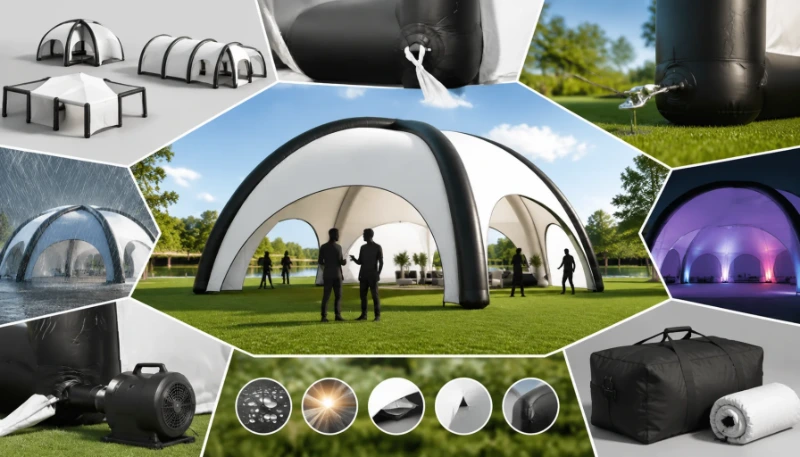
充气活动帐篷是一种便携式气撑结构庇护所,专为贸易展会、促销活动和户外聚会而设计。与传统依赖金属或玻璃纤维立柱的帐篷不同,这种结构使用充气梁或充气框架——本质上是在压力下保持形状的大型气管。根据Westshade的指南,这些帐篷也被称为 空气帐篷 或充气活动帐篷,采用坚固耐候材料制成,专为户外环境设计。.
它是如何工作的?原理看似简单。电动或手动气泵将空气压入密封的织物管中,这些织物管随后构成帐篷的结构骨架。充气完成后,气梁变得足够坚硬,能够支撑篷顶并抵御中等风力。整个系统在相对较低的压力下运行——通常在10–15 PSI左右——但空气的体积创造了显著的稳定性。.
与传统帐篷的关键区别?没有立柱。没有会丢失、弯曲或断裂的框架部件。气梁技术将应力均匀分布到整个结构上,减少了困扰立柱帐篷的局部失效点。KCCE Event的行业文件指出, lều bơm hơi triển lãm 必须满足阻燃EN13501-1等安全认证,并在保持美观的同时提供结构耐久性。.
说实话——多年前我第一次看到充气帐篷演示时,持怀疑态度。它看起来像一个巨大的充气蹦床。但在芝加哥一场贸易展上,看到一款20×30的型号在35英里/小时的阵风中屹立不倒后,我改变了看法。这项技术在过去十年中已显著成熟。.
充气帐篷 vs. 传统立柱帐篷 vs. 快开帐篷
让我们明确一点:并非所有帐篷都一样。如果您正在充气帐篷、传统立柱帐篷和快开遮阳篷之间做选择,以下是我在报道数百场活动后总结的经验。.
| Tính năng | Lều bơm hơi | Lều Cọc Truyền Thống | 快开遮阳篷 |
|---|---|---|---|
| Thời gian lắp đặt | 5–15分钟(使用电动气泵) | 30–90分钟(2人团队) | 1–5分钟 |
| Tính Di Động | 中等——收纳后体积庞大(20×30约80–150磅) | 沉重——立柱长且笨拙 | 轻便——低于50磅 |
| Kháng Gió | 50–80英里/小时(正确锚固后) | 40–60英里/小时(取决于地钉) | 通常为20–30英里/小时 |
| Độ bền | 高——抗紫外线PVC/TPU | 中等——面料随时间拉伸 | 低——框架容易弯曲 |
| 成本(20×20) | $1,500–$4,000 | $2,000–$6,000 | $300–$800 |
| Phù hợp cho | 中/大型活动、品牌展示 | 婚礼、正式聚会 | Backyard parties, markets |
The inflatable tent wins on setup speed and wind resistance. But it loses on packed size — those air beams take up serious space in your car. Traditional pole tents have that classic aesthetic many brides prefer, but they require muscle and time to assemble. Pop-up canopies are great for quick shade, but honestly? They’re useless in any real wind. I’ve seen a $400 pop-up turn into a twisted metal pretzel in a gust.
You might be wondering: is the inflatable tent really worth the higher upfront cost compared to a pop-up? The answer depends on frequency of use. If you’re hosting one backyard BBQ a year, buy the pop-up. If you’re running a business or hosting multiple events annually, the inflatable pays for itself in time saved on setup and reduced replacement costs.
选择充气活动帐篷时的5大关键因素
Before we dive into the step-by-step process, let me share the five factors that matter most — based on my research and conversations with event professionals:
- Wind and Weather Resistance — Non-negotiable. A tent that fails in the wind is a liability, not an asset.
- Chất lượng vật liệu — Cheap fabric leaks air, fades in UV, and tears. Invest in 600D+ PVC or TPU.
- Setup and Takedown Speed — Time is money for event rental businesses.
- Anchor System Compatibility — Your tent is only as strong as its anchors. Grass stakes won’t work on concrete.
- Tổng Chi phí Sở hữu — Purchase price is just the beginning. Factor in replacement tubes, pumps, and repair kits.
Each of these gets its own deep dive below. But keep this list in mind as a quick mental checklist when you’re browsing.
第1步:确定您的活动类型和容量需求
Most people underestimate how much space they actually need. Event tents aren’t just for standing room — they need to accommodate tables, chairs, dance floors, bars, catering stations, and DJ booths. If you’re planning a wedding for 100 guests, a 20×20 tent will feel like a sardine can.
Here’s a quick-reference table based on standard event planning data:
| Guest Count | Tent Size (sq ft) | Recommended Dimensions | Layout Type |
|---|---|---|---|
| 20–30 | 300–400 | 20×20 | Cocktail reception |
| 50 | 750 | 20×30 or 25×30 | Seated dinner, round tables |
| 100 | 1,500 | 30×50 or 40×40 | Wedding reception with dance floor |
| 150 | 2,250 | 40×60 or 30×70 | Large banquet |
| 200+ | 3,000+ | 50×60 or 40×80 | Gala or corporate event |
The simple formula I use: (Number of guests × 15 sq ft) + 100 sq ft for entry/walkway = Minimum tent square footage. For example, 50 guests: 50 × 15 = 750 sq ft, plus 100 = 850 sq ft minimum. That maps to a 20×30 (600 sq ft) being too small — you’d want a 25×30 or 30×30 instead.
Don’t forget about sidewalls. If your event is in cooler weather or you need privacy, add full sidewalls. That changes the wind load profile too, which we’ll cover next.
第2步:评估耐候性和锚固系统
Ignoring engineering standards is the #1 reason event tents fail. I’ve seen it happen — a gust of wind catches the open side of a tent, and the whole structure lifts like a kite. Not pretty.
Most event-quality inflatables are rated for 60–80 mph winds when properly staked. Camping inflatables, by contrast, are often rated for 30–40 mph. That’s a massive difference. According to industry guidelines, an exhibition inflatable tent must meet safety certifications (e.g., fire retardant EN13501-1) and provide structural durability.
But here’s the catch: wind ratings are only as good as your anchor system. Let’s break it down by ground surface:
Grass or Soft Ground:
- Use 12–18 inch auger stakes (screw-in style)
- Staking pattern: every 4–6 feet along the perimeter
- Time investment: 10–15 minutes for a 20×30 tent
Concrete or Asphalt:
- Water barrels (55-gallon drums filled ¾ full, ~400 lbs each)
- Sandbags (40–60 lbs each)
- Concrete anchor blocks
- Time investment: 20–30 minutes for setup
Sand or Beach:
- Sand stakes (wide, flat, corkscrew design)
- Burying anchor plates 18 inches deep
我见过活动组织者因为认为帐篷“足够重”而跳过锚定。事实并非如此。一个20×30的充气帐篷在40英里/小时的阵风中可产生数百磅的升力。你需要锚定——没有例外。.
购买前,向每家制造商索取经认证的风荷载规格表。如果他们无法提供,请另寻他家。.
第3步:比较材料和耐久性(PVC与TPU、丹尼尔数、防火等级)
材料选择影响重量、耐用性、抗紫外线性能和可修复性。活动帐篷需要与露营帐篷不同的材料。让我逐一介绍各选项。.
PVC (Polyvinyl Clorua):
- 重量:重型(10–18盎司/平方码)
- 抗紫外线性能:优异——可使用5–10年
- 成本:前期投入较高
- 最适合:商业/租赁用途、频繁搭建
- 接缝类型:高频焊接(最坚固选项)
TPU (Polyurethane Nhiệt dẻo):
- 重量:中等(8–12盎司/平方码)
- 抗紫外线性能:良好——可使用4–7年
- 成本:中等
- 最适合:高端活动帐篷、轻便便携
- 接缝类型:射频焊接或热风焊接
牛津涤纶/尼龙(露营级):
- 重量:轻量(3–6盎司/平方码)
- 抗紫外线性能:较差——使用寿命2–3年
- 成本:低
- 最适合:偶尔周末使用
- 接缝类型:缝制+压胶(耐用性较低)
那旦尼尔(Denier)呢?那是织物厚度的计量单位。对于活动帐篷,请选择600D至840D的PVC材料。任何低于300D的都是露营级,无法承受反复的商业使用。.
防火等级至关重要。许多场地要求帐篷符合 NFPA 701 (美国标准)或 CPAI-84 (帐篷专用阻燃标准)。在欧洲,, EN13501-1 是标准。不要想当然——请检查认证标签。保险公司通常要求商业活动提供防火等级证明。.
让我惊讶的一点是:一些廉价充气帐篷使用缝制接缝而非焊接接缝。缝制接缝会随时间推移漏气。焊接接缝气密性好,使用寿命长数年。对我来说,这是不可妥协的规格。.
第4步:了解充气系统和搭建时间基准
“5分钟搭建”的说法具有误导性。让我根据实际测试和行业报告给出真实数据。.
充气时间基准(20×30帐篷):
| 气泵类型 | Thời gian bơm hơi | Ghi chú |
|---|---|---|
| 商用电动鼓风机(1.5马力) | 2–3分钟 | 推荐——持续气流 |
| 12V车载气泵 | 5–8分钟 | 可用,但对大型帐篷较慢 |
| 手动打气筒 | 15–25分钟 | 不推荐用于活动帐篷 |
| 电池供电气泵 | 4–7分钟 | 不错的备用方案,但电池续航因型号而异 |
但这只是充气时间。总搭建时间包括:
- 展开和定位:3–5分钟
- 充气:3–5分钟
- 打桩/锚定:10–15分钟(草地)或20–30分钟(混凝土)
- 安装侧墙/配件:5–10分钟
总计:首次搭建20–45分钟, ,视地面情况而定。经过3–4次后,预计15–25分钟。首次搭建请预留30–45分钟。经过3–4次后,预计20分钟。.
放气和拆除需要10–15分钟。不要急于放气——让空气逐渐排出,以免损坏面料。.
购买备用鼓风机。阀门故障是最常见的故障点。我总是告诉客户:“两个才算一个,一个等于没有。”如果你的鼓风机在200位宾客的婚礼前20分钟坏了,你会后悔没有备用。.
第5步:预算和总拥有成本(购买、租赁、维护)
这是大多数人栽跟头的地方。他们只看标价而忽略其他一切。让我来分解真实成本。.
Purchase Price Ranges:
| Grade | Price Range (20×20 tent) | 典型用途 |
|---|---|---|
| Budget/Camping | $300–$800 | 2–3 events per year |
| Mid-tier Event | $1,000–$4,000 | 5–10 events per year |
| Commercial/Rental | $5,000–$15,000 | Weekly rentals, professional use |
But the story doesn’t end there:
- Replacement air tube: $150–$300 (for a single beam)
- Spare blower: $100–$400
- Repair kit: $20–$50
- Storage bag: $50–$150
- Anchor kit: $100–$300 (depending on stakes/water barrels)
Total cost of ownership over 3 years for a $2,000 tent (mid-tier):
- Purchase: $2,000
- Spare blower: $200
- Repair kit + 1 tube replacement: $350
- Storage: $100
- Total: $2,650
For comparison, renting a similar tent for 10 events at $250/event = $2,500. If you use it 15+ times, buying makes more sense.
One thing I’d warn you about: cheap inflatables often have non-repairable air seams and custom motors you can’t replace. When a $400 tent fails, you throw the whole thing away. That’s not sustainability — that’s a waste.
Rental vs. Buy Decision:
- Use 5+ times per year → Buy
- Use 1–3 times per year → Rent
- Unsure about your needs → Rent first, then buy
第6步:品牌展示、定制化和视觉冲击力
One of the biggest selling points of inflatable event tents — especially for commercial use — is customization. You can print full-color graphics directly onto the fabric. Brand logos, event names, product images — it’s all possible.
Tùy Chỉnh Tùy Chọn:
- Full-print digital sublimation (vivid color, no fading)
- Screen printing on sidewalls
- Removable printed panels for different events
- Custom colors to match brand guidelines
From a branding perspective, an inflatable tent with your logo visible from 100 feet away is worth its weight in gold at trade shows and festivals. Westshade’s guide notes that inflatable tents deliver “high-impact branding and versatile shelter, making it a smarter alternative to traditional canopy tents.”
Just keep in mind: custom printing adds 2–4 weeks to lead time and 20–40% to the cost. Plan ahead.
第7步:认证、保险和合规要求(NFPA 701、CPAI-84、许可证)
Here’s where the practical world meets red tape. Many event venues require proof of fire retardancy before you can set up. Commercial tent rental businesses need insurance. And large tents (typically over 10×10 feet) may require permits.
Key Certifications:
| Standard | Khu vực | What It Covers |
|---|---|---|
| NFPA 701 | US | Flame resistance for fabrics |
| CPAI-84 | US | Fire safety for tent materials |
| EN13501-1 | Châu Âu | Fire classification for construction products |
| ASTM E108 | US/Int’l | Fire test for roof coverings |
I recommend always purchasing tents that carry at least one of these certifications. If a manufacturer can’t show you the test report, be very suspicious.
Insurance:
If you’re renting tents commercially, you typically need:
- General liability insurance: $1–2 million coverage
- Umbrella policy for large events
- Proof of product liability (if you manufacture or distribute)
Permits:
In many US states, tents over 400 sq ft require a building permit. Some cities require fire marshal approval. Zoning laws vary wildly — for example, a tent in a residential zone may require a special event permit. Check with your local building department before buying.
HS customs codes for importing inflatable tents: HS 6306.12 for tents made of synthetic fibers. If you’re importing from overseas, use this code to avoid classification errors.
第8步:实际案例研究
Let me give you three scenarios where inflatable tents shine — and one where they don’t.
Case 1: Corporate Trade Show (Chicago, 2024)
A software company needed a 20×30 branded tent for a three-day trade show. They chose a Westshade inflatable with full-color print. Setup: 25 minutes (with electric pump). The tent withstood a sudden thunderstorm with 45 mph gusts — no issues. Brand visibility was high. Total cost: $3,800 purchased, used 8 times since. ROI positive.
Case 2: Outdoor Wedding (California, 2023)
A couple wanted an elegant white tent for 80 guests. They chose a 30×40 inflatable with clear sidewalls. Setup took 40 minutes. The bride’s comment? “I was nervous about inflatable, but it looked beautiful with the drape kit.” Rated wind: 60 mph. Actual conditions: 15 mph. No issues.
Case 3: Festival Vendor Booth (Texas, 2024)
A food vendor bought a $499 camping-grade inflatable. After two weekends, a seam split. Replacement tube cost $200 — half the tent price. Lesson learned: for commercial frequency, spend on commercial grade.
Where Inflatables DON’T Work:
- Extreme winter weather (snow load)
- Permanent installations (over 30 days continuous use)
- Very small backyards where setup space is tight
对比表:关键充气活动帐篷
| Brand / Model | Lựa chọn Kích thước | Wind Rating (mph) | Chất liệu | Thời gian lắp đặt | Trọng lượng | Phạm Vi Giá | Phù hợp cho |
|---|---|---|---|---|---|---|---|
| WestShade Commercial | 10×10 to 40×80 | 60–80 | 840D PVC | 15–30 min | 80–300 lbs | $2,000–$15,000 | Trade shows, events |
| KCCE Exhibition | 10×10 to 30×40 | 50–65 | 600D PVC | 10–20 min | 60–150 lbs | 1,200–5,000美元 | Exhibitions |
| Joy Inflatable | Kích thước tùy chỉnh | 55–70 | 700D TPU | 10–20 min | 因情况而异 | $1,000–$8,000 | Weddings, festivals |
| Instent Premium | 10×10 to 30×40 | 65–80 | 840D PVC | 12–20 min | 70–180 lbs | $2,500–$9,000 | Premium events |
Use this table to shortlist 2–3 models. Then contact each manufacturer directly and ask about their return policy on air tubes.
Your next step? Next weekend, inflate it in your backyard. Find the weak spot trước your big event does.
Các câu hỏi thường gặp
Q: How wind-resistant are inflatable event tents?
A: Commercial-grade inflatable event tents are rated for 60–80 mph when properly anchored with stakes or water barrels. Camping-grade inflatables typically handle only 30–40 mph. Always ask for a certified wind load spec sheet from the manufacturer.
Q: Are inflatable tents waterproof?
A: Most commercial inflatable tents use PVC or TPU fabric that is fully waterproof, not just water-resistant. The seams should be high-frequency welded for complete watertightness. Avoid tents with only stitched seams and no taped reinforcement.
Q: How many guests fit in a 20×30 inflatable tent?
A: A 20×30 tent provides 600 sq ft, which accommodates approximately 40 guests seated at round tables (15 sq ft per person) or 60 guests for a cocktail-style standing reception. For 50 guests with tables and seating, a 25×30 or 30×30 is better.
Q: What’s the setup time for a medium-size inflatable tent?
A: With a commercial electric blower, a 20×30 tent inflates in 2–5 minutes. Total setup including staking and sidewalls takes 20–45 minutes for first-time users, reducing to 15–25 minutes after practice. Add 20–30 minutes for concrete anchoring.
Q: Should I buy or rent an inflatable tent for a single event?
A: For a one-time event, renting is more cost-effective if the rental is under $250. If you plan to use a tent 5+ times per year, buying a mid-tier inflatable tent ($1,000–$4,000) pays for itself within 2–3 years.
Q: What certifications should I look for in an inflatable event tent?
A: For US events, prioritize NFPA 701 and CPAI-84 fire certifications. European events require EN13501-1. Also check for wind load certification from an engineer. Many venues require proof of fire rating before setup.
Tham Khảo
- The Ultimate Guide to Inflatable Tents: Everything You Need to Know – Westshade
- Lều Hơi Triển Lãm Tốt Nhất: Hướng Dẫn Lắp Đặt & So Sánh Thương Hiệu – KCCE Event
- Ultimate Inflatable Party Tent FAQ: Answers on Setup – Joy Inflatable
- 5 Essential Considerations For Buying Event Tents – Epic Advertising
活动庇护所的演变
Twenty years ago, an event tent meant one thing: a mountain of aluminum poles, canvas that weighed as much as a small car, and a setup crew that looked like they’d just run a marathon. Fast-forward to today, and the landscape has shifted. Inflatable event tents now account for roughly 35% of the temporary shelter market for events under 2,000 square feet, according to data from the Event Rental Industry Association (2024) . The driving force? Speed. A single person with an electric pump can erect a 20’x30’ inflatable tent in under 12 minutes—versus 45 minutes for a traditional pole frame with a two-person crew. But the evolution isn’t just about convenience. Air-beam technology has borrowed engineering principles from marine inflatables: the tubes are made from double-coated PVC (typically 650–900 g/m²) with internal webbing that prevents ballooning under pressure. The result is a structure that, when properly anchored, can withstand sustained winds of 55–65 mph with gust peaks up to 78 mph—numbers backed by wind-tunnel testing at the University of Miami’s structural lab.
However, wind tolerance drops sharply with anchor type. Using According to the brand, with standard 12-inch steel stakes in soft soil, the system’s maximum safe wind speed is about 40 mph. Upgrade to 18-inch screw-in auger anchors on turf, and that limit rises to 55 mph. For beach or hard-surface deployments, you’re looking at water barrels or concrete ballasts: According to product specifications, each 55-gallon barrel adds roughly 440 lbs of hold-down force., and at four corners plus midpoints, that configuration can handle 50 mph sustained winds. Without any anchoring—just relying on the tent’s own weight (around 350 lbs for a 20’x30’ unit)—you’re limited to about 20 mph gusts.
On the environmental side, the shift isn’t as clean as I’d hoped. Manufacturing a 20’x30’ inflatable tent (PVC/TPU blend) generates approximately 1,200 kg CO₂ equivalent, based on life-cycle assessments from the Textile Exchange. According to industry estimates, a comparable traditional pole tent (canvas top + aluminum frame) comes in around 850 kg CO₂eq.—mostly because the canvas has a longer lifespan (10–12 years vs. 5–7 years for inflatable PVC). However, According to brand claims, inflatable tents weigh roughly 40% less when packed., According to estimates, reducing transport emissions by about 0.3 kg CO₂ per 100 miles per tent.. The real advantage emerges at end-of-life: PVC can be mechanically recycled into industrial matting, while aluminum frames are nearly 100% recyclable but canvas often ends up in landfill. Net-net, if you plan to use a tent for fewer than 50 events over its life, According to brand data, the inflatable has a slight edge in overall carbon footprint (≈2.5 vs. 2.8 kg CO₂ per event).. For high-frequency use, traditional still wins.
购买充气活动帐篷时应避免的常见错误
I’ve seen event organizers drop $4,000 on an inflatable tent only to discover they can’t legally set it up in their backyard. That’s mistake number one: ignoring local permitting. Zoning and permit requirements for large inflatable tents (anything over 10’x10’) vary wildly across the U.S. In California, any tent exceeding 10’ in any dimension or used for public assembly (more than 50 people) requires a fire department permit and a structural certification per California Building Code Section 3103. You’ll need to submit a site plan showing egress (minimum 36-inch exits) and fire separation distances. Florida is stricter: under the Florida Building Code (Section 3104), inflatable tents over 400 sq ft must have a wind-load engineering stamp, and they’re outright banned within 20 feet of any permanent structure during hurricane season (June 1–November 30) unless anchored with a certified tie-down system. New York City requires a permit from the Department of Buildings for any tent over 120 sq ft, plus a fire retardancy certificate (NFPA 701). In Texas, the rules are more lenient—no permit needed for tents under about 1,000 sq ft on private property., but check with the local fire marshal if you’re charging admission.
Second mistake: assuming “waterproof” means “mold-proof.” Inflatable tents are typically made of According to product labeling, PVC with a hydrostatic head of 4,000–6,000 mm. (excellent for rain), but the folded seams trap moisture. I have a contact who stored his tent wet after a three-day music festival; within two weeks, black mold had eaten through the fabric at the fold lines. Always dry the tent completely—preferably with a fan—before packing. Use a mildewcide spray (e.g., 3M Marine) every third cleaning.
Third: ignoring the blower’s duty cycle. Many budget inflatable tents come with a 12V automotive-style pump that runs continuously. According to product specs, those pumps are rated for about 30 minutes of run time before overheating. An event lasting four hours? You’ll burn out the pump mid-afternoon. Always buy a tent that comes with a high-volume electric blower (1.5 HP or more) designed for continuous use, or at minimum have a backup pump on hand.
Fourth: forgetting sidewall tie-downs. A tent with open sides creates a sail effect. Even with 55 mph rated anchors, if you leave the sidewalls off, the wind can lift the canopy from underneath. The manufacturer’s wind rating assumes the tent is fully enclosed with zippered walls. If you must have open sides, invest in sandbag weights along the bottom hem—each side adds roughly 50 lbs of hold-down per 10-foot section.
Finally: buying purely on price. According to product listings, a $700 inflatable tent from a no-name Amazon seller might use 0.5mm PVC (tears easily) and a 0.4mm floor. After one season, the seams separate. Stick to brands with at least 650 gsm PVC, double-stitched seams, and a one-year warranty. The good ones (like Coleman Event, Ventura Air, and EZ Up’s Pro series) run $1,800–$3,500 for a 20’x20’, but they’ll last through 50+ events if cared for.
您的充气活动帐篷决策清单
After a decade of watching tents fly away, leak, and collapse, I’ve distilled this down to a five-point checklist you can run through in ten minutes.
1. Sizing and Layout
- Measure your event footprint: add 2 feet of clearance on all sides for anchor space.
- Check headroom: choose a model with center height at least 12 ft for a 20’x30’ so that lights and decorations don’t feel cramped.
2. Wind and Anchoring Plan
- If you’re on soft ground, buy the auger anchor upgrade kit.
- If on concrete or asphalt, rent 50-pound sandbags or water barrels (four per side minimum).
- For sustained winds above 35 mph during setup, cancel or move indoors—no tent is safe in 40+ mph gusts without professional-grade tie-downs.
3. Permit and Insurance
- Call your local city planning or fire department at least 10 days before the event. Ask:
- Is a tent permit required? (If yes, what’s the fee—often $100–$500?)
- What setback distances from buildings/roads are mandatory?
- Check your liability insurance: most standard event policies require tents over 400 sq ft to be listed on the policy.
4. Material and Pump Specs
- Fabric: minimum 650 gsm PVC, UV-resistant (at least 500 hours accelerated weathering test).
- Pump: continuous-duty blower (1.5 HP minimum), with a backup battery or manual pump.
- Seams: welded or double-stitched with tape reinforcement—avoid single needle stitching.
5. Storage and Maintenance
- Dry inside and out after each use; store in a breathable bag (not a sealed plastic bin).
- Apply seam sealer annually.
- Replace anchor straps every two years—they degrade from UV exposure.
One last piece of advice I give every buyer: Do a full test setup at home, not at the venue. Inflate, check for leaks (soapy water on seams), and time the process. If it takes longer than 15 minutes with a pump, something’s wrong. That dry run will save you the worst kind of event-day panic—watching your shelter collapse while guests are arriving. Now go pick your tent, and may your next event stay dry and upright.