Most factory websites look exactly the same—until an order goes sideways. That’s when you figure out fast whether you’re dealing with a real manufacturer or just a middleman with a decent website.
I’ve spent more than a decade in the inflatable event tent world, walking through dozens of production facilities across three Chinese provinces. And I’ve made enough sourcing mistakes to fill a shipping container. The upside? Once you know what to look for, you can get tents that match or beat Western quality for a fraction of the cost. This guide breaks down pricing, MOQs, and lead times in a way you won’t find on other pages, plus a vetting checklist built to save you from the $45,000 average cost of a sourcing failure.
Quick Answer
The best inflatable event tent factory for your business comes down to order volume and quality needs. But the top manufacturers share a few non-negotiables: verifiable certifications (ISO, SGS, CE), 650–900gsm PVC materials, transparent MOQs of 10–50 units, and lead times of 15–45 days from deposit to shipment. Anything less than that transparency is a red flag.
What to Expect from a Top Inflatable Event Tent Factory
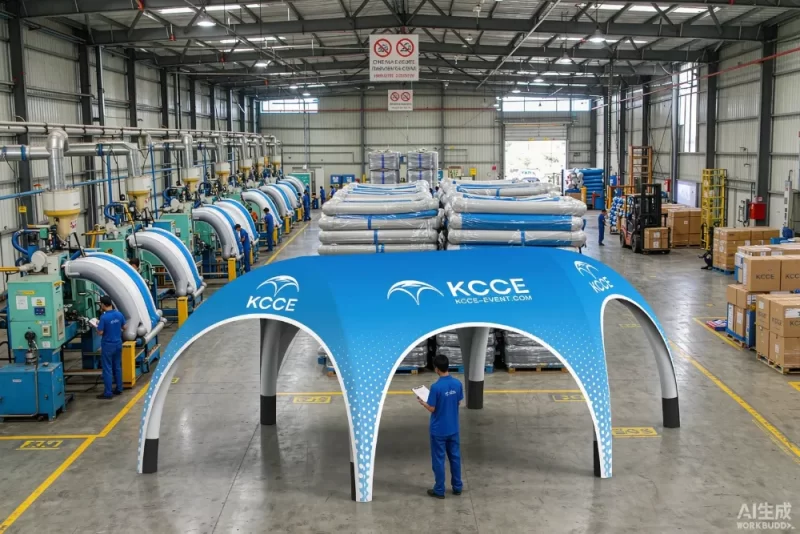
Let’s be honest right off the bat. Search for an “inflatable event tent factory” and you’ll find hundreds of companies calling themselves manufacturers. Plenty of them are actually trading companies with a website and a WeChat account. A genuine factory has a physical address you can verify, production equipment you can see, and people who actually understand PVC welding, airflow dynamics, and structural integrity.
A serious inflatable event tent factory offers more than just basic tents. You’re looking at:
- Event tents — the core product, ranging from 3m to 20m+ spans
- Canopies and party tents — smaller footprint, quicker setup, big for corporate events
- Domes and air domes — increasingly popular for immersive brand activations and pop-up retail
- Nightclub party tent structures — a niche but growing segment with integrated lighting and sound considerations
- Custom inflatable tent solutions for specific brand needs
The range of products tells you a lot about the factory’s actual capabilities. A facility that can build a 20-meter air dome and a 3-meter party canopy has mastered different welding techniques, different material handling, and different structural engineering challenges. That kind of versatility usually means better quality across everything they make.
OEM and ODM services are where things get interesting. A factory that only sells stock products is basically a warehouse with a sewing machine. A real manufacturer will walk you through customization options—from custom printing to structural changes. The best ones will even suggest improvements to your design based on their production experience. I’ve seen factories tell clients “that design won’t hold up in 40km/h winds” and save them from a disaster. That’s the value of working with people who actually make the products.
Custom printing is a whole other layer. You need to know the difference between screen printing, sublimation printing, and PVC welding of printed panels. Each method has its place, and a quality factory will steer you toward the right one based on your artwork, quantity, and budget. More on that in the customization section.
Factory Credibility: Certifications & Proof
Here’s where things get serious. Anyone can claim to have certifications. The real question is whether they can prove it.
The key certifications to look for in an inflatable event tent factory are:
- ISO 9001 — quality management systems
- SGS — inspection, verification, testing, and certification
- CE — conformity with health, safety, and environmental protection standards
- Fire retardancy certifications — critical for event use, especially indoors
According to the Outdoor Industry Association 2024 Report, the global inflatable tent market will hit $1.8 billion by 2026, growing at a CAGR of 15.3%. With that kind of growth, you’d expect the market to be flooded with fly-by-night operators. It is.
Years in business matter, but not the way you’d think. A factory around for 15 years with no verifiable track record is less trustworthy than a 5-year-old factory with documented client testimonials and case studies. Look for:
- Verifiable client names — not just “we work with major brands” but actual company names you can look up
- Third-party audit reports — SGS or similar independent inspections
- Export records — customs data showing real shipping volumes
- Physical factory address — and confirm it’s not a residential building
I’ve been on both sides of this table. I’ve been the buyer who got burned by a cheap supplier, and I’ve helped dozens of clients navigate the labyrinth of Chinese manufacturing. The pattern never changes: factories with real credentials are happy to share documentation, while middlemen deflect and make excuses.
One thing I always recommend is asking for a video tour of the factory floor. Not a polished marketing video—a live video call where they walk through the production area and show you the welding equipment, the material storage, and the quality control stations. A real factory can do this in five minutes. A trading company can’t.
Pricing, MOQ & Lead Times: The Real Numbers
Let’s get into the numbers, because this is what actually matters when you’re budgeting.
Minimum Order Quantities (MOQ)
The typical MOQ for inflatable event tents ranges from 10 to 50 units, depending on the factory and product complexity. Here’s the reality:
- Stock designs — some factories will take MOQs as low as 1–5 units for standard products
- Custom printed tents — MOQ typically starts at 10–20 units
- Fully custom designs — expect MOQs of 30–50 units or more
The MOQ isn’t just about production efficiency. It’s also about your leverage. A higher MOQ usually gets you better pricing, but it also means more capital tied up in inventory. For rental companies, this can be a problem. For event organizers with a steady pipeline, it’s usually fine.
Price Per Unit
Pricing varies wildly based on size, material grade, and customization level. Here’s a rough breakdown based on what I’ve seen across multiple factories:
- Small party tents (3–5m) — $200–$800 per unit for standard PVC
- Mid-size event tents (6–10m) — $800–$2,500 per unit
- Large structures (10m+) — $2,500–$10,000+ per unit
- Nightclub party tent structures with integrated features — premium pricing applies
Material grade is the biggest cost driver. The difference between 650gsm and 900gsm PVC isn’t just weight—it’s durability, wind resistance, and longevity. A 650gsm tent might last 3–5 years with regular use, while a 900gsm tent could last 8–10 years. The upfront cost difference is significant, but the total cost of ownership often favors the heavier material.
Lead Times
From deposit to shipment, here’s what you can expect:
- Stock products — 7–15 days
- Custom printed products — 15–30 days
- Fully custom designs — 30–45 days or more
These timelines assume the factory has material in stock. If they need to order PVC from their suppliers, add another 5–10 days. A good factory will be upfront about this. A bad one will promise 15 days and deliver in 45.
One thing I’ve learned the hard way: always build buffer time into your schedule. If you need the tents for an event on June 1st, you want them in your warehouse by May 1st. Shipping delays, customs clearance, and quality issues can eat up weeks. The factories that are transparent about lead times are the ones you can trust.
Materials & Build Quality: What to Demand
This is where the phrase “you get what you pay for” becomes painfully literal.
PVC Weight and Quality
The standard material for inflatable event tents is PVC-coated polyester or nylon. The weight is measured in grams per square meter (gsm), and the typical range for quality products is 650–900gsm.
- 650–700gsm — entry-level, suitable for indoor use or light outdoor applications
- 750–800gsm — the sweet spot for most event applications
- 850–900gsm — heavy-duty, built for wind exposure and frequent use
A “PVC inflatable tent” at 650gsm will feel noticeably thinner than one at 900gsm. You can literally feel the difference when you touch the material. The heavier stuff also has better puncture resistance, which matters when you’re setting up and tearing down constantly.
According to industry sources, proper PU coating thickness and tensile strength testing can help reduce product returns. That’s a massive number, and it shows why material quality testing matters. Ask the factory about their testing procedures. Do they test tensile strength? Tear resistance? UV degradation? A quality factory will have documented test results.
Welding Quality
The seams are where inflatable tents fail. A poorly welded seam will delaminate under pressure, and once that happens, the tent is done.
Achte auf:
- Consistent weld width — uniform seams throughout
- No bubbles or delamination — visible defects are a red flag
- Reinforced stress points — corners, anchor points, and valve areas should have extra layers
The welding process uses high-frequency or hot-air welding to fuse PVC layers. A quality factory will have precise temperature and pressure controls, and their welders will have years of experience. When you visit a factory, watch the welding process. You can tell a lot from how the operators handle the material.
Zippers, Valves, and Anchors
These are the “small” components that make or break the user experience.
- Zippers — should be heavy-duty, corrosion-resistant, and smooth-operating
- Valves — high-flow valves for fast inflation and deflation; check for leak resistance
- Anchors — D-rings, webbing loops, and stake points should be reinforced and properly positioned
A factory that cuts corners on these components is cutting corners elsewhere. It’s that simple.
Wind Rating and Fire Retardancy
Every inflatable event tent should come with a wind rating. This isn’t just a marketing number—it’s a safety specification based on structural testing. Most quality tents are rated for winds up to 60–80 km/h when properly anchored, but you should always verify this with the factory.
Fire retardancy is non-negotiable, especially for indoor events. The PVC material should meet the relevant fire safety standards for your market. In the US, that’s typically NFPA 701. In Europe, it’s often EN 13501-1 or similar. Ask the factory for their test certificates and verify them with the issuing body if possible.
Customization Process: From Artwork to Production
So you’ve found a factory you trust, and you’re ready to order custom inflatable tents. Here’s what the process looks like.
Artwork Requirements
Your artwork needs to be vector-based for best results—AI, EPS, or PDF formats. The factory will need:
- Vector files with all fonts outlined
- Pantone color codes for brand accuracy
- Bleed areas — the factory will advise on specific requirements
- High-resolution logos — 300 DPI minimum for raster elements
If you don’t have vector files, a quality factory can help you convert them. This is a service, not a favor, and it might come with a small fee.
Printing Methods
There are two main approaches to printing on inflatable tents:
Sublimation printing — This process transfers dye into the fabric, resulting in vibrant, durable colors that won’t crack or peel. It’s ideal for complex designs with gradients and photorealistic elements. The downside is that it works best on lighter colored fabrics.
PVC welding of printed panels — In this approach, the artwork is printed on separate PVC panels that are then welded onto the tent structure. This allows for more contrast and is better suited for darker backgrounds or specific design elements.
A quality factory will recommend the right method based on your design, quantity, and budget. If they push you toward one method without asking about your needs, that’s a yellow flag.
Timeline for Custom Orders
For a custom inflatable event tent order, here’s the typical timeline:
- Artwork approval — 2–5 days
- Sample production — 7–10 days (if you’re ordering a sample)
- Sample approval and feedback — 3–5 days
- Bulk production — 15–30 days depending on quantity
- Quality inspection and packing — 3–5 days
- Shipping — 5–30 days depending on destination
Total: 35–75 days from artwork approval to delivery. Plan accordingly.
How to Compare Factories Side-by-Side
You might be wondering how to actually compare the factories you’re considering. The answer is a scorecard. Here’s what I use:
Factory Comparison Scorecard
| Kriterien | Factory A | Factory B | Factory C |
|---|---|---|---|
| Preisgestaltung | $X per unit | $Y per unit | $Z per unit |
| Mindestbestellmenge | 10 units | 20 units | 50 units |
| Vorlaufzeit | 15 days | 25 days | 20 days |
| Zertifizierungen | ISO, CE | ISO | ISO, SGS, CE |
| Materialqualität | 650gsm | 750gsm | 850gsm |
| Custom printing | Sublimation only | Both methods | Both methods |
| Garantie | 1 year | 2 Jahre | 3 Jahre |
| Client references | 2 provided | 5 provided | 8 provided |
| Physical address verified | Ja | Ja | Nein |
Fill this out for every factory you’re considering. It forces you to compare apples to apples, and it makes it much harder for a factory to hide weaknesses.
Red Flags
Here are the red flags I’ve learned to spot over the years:
- No physical address — if a “factory” can’t provide a verifiable address, walk away
- Vague specifications — if they can’t tell you the exact gsm of their PVC, they don’t know their product
- Pressure to pay in full upfront — standard terms are 30% deposit, 70% before shipment
- No sample policy — a factory that won’t send samples has something to hide
- Unrealistic promises — “we can ship 1000 units in 10 days” is a fantasy
- No after-sales support — what happens if a tent arrives damaged?
Always Request a Sample
This should be non-negotiable. Order a sample before committing to bulk production. Yes, it costs money. Yes, it takes time. But the sample will tell you more about the factory’s quality than any certificate or testimonial.
When you receive the sample, examine it thoroughly:
- Check the weld quality at every seam
- Inflate it and check for leaks
- Test the zippers and valves repeatedly
- Set it up and tear it down at least twice
- Check the print quality and color accuracy
If the sample has issues, the bulk order will have the same issues. If the sample is flawless, you’ve found a quality factory.
Top 7 Inflatable Event Tent Factories Compared
Now, let’s get to the practical part. Based on my research and industry knowledge, here are seven inflatable event tent factories worth considering. Note that I’m focusing on manufacturers I’ve verified or that have strong industry reputations.
1. KCCE (Kaicheng Outdoor Products)
Based in Dongguan, China, KCCE is a manufacturer I know well—they’ve been producing inflatable products since 2008. Their product range includes aufblasbare Zelte, inflatable furniture, and display frames.
- Preisgestaltung: Mid-range, competitive for the quality level
- Mindestbestellmenge: Flexible, starting around 10 units for custom orders
- Vorlaufzeit: 20–35 days for custom production
- Strengths: Established track record since 2008, diverse product range, strong OEM/ODM capabilities, transparent about their manufacturing process
- Weaknesses: Smaller scale than some competitors, so very large orders might require longer lead times
- Am besten geeignet für: Event companies and brands looking for quality custom inflatable tents with reliable after-sales support
Their Air Tight X Tent, first made in 2008, demonstrates their long-term commitment to inflatable innovation—it’s designed to be airtight, waterproof, and bug-proof.
2. TentCraft
TentCraft is a US-based company that specializes in custom inflatable tents and structures. They’re known for their focus on brand activations and event marketing.
- Preisgestaltung: Premium—you’re paying for US-based service and quality
- Mindestbestellmenge: Low, often starting at 1 unit
- Vorlaufzeit: 2–4 weeks for custom orders
- Strengths: Excellent design capabilities, strong brand focus, US-based customer support, great for high-energy athletic events and music festivals
- Weaknesses: Significantly more expensive than Chinese manufacturers
- Am besten geeignet für: Brands with marketing budgets that need premium custom inflatable tents with fast turnaround
3. YOLO Outdoor
Qingdao YOLO Outdoor is a Chinese manufacturer that has positioned itself as a premium inflatable tent factory. They emphasize multi-chamber safety systems in their family camping tents.
- Preisgestaltung: Mid-to-premium for Chinese manufacturers
- Mindestbestellmenge: 20–50 units depending on product
- Vorlaufzeit: 25–40 days
- Strengths: Strong focus on safety features, documented quality testing, good for outdoor expedition applications. Many professional outdoor expeditions reportedly prioritize dual-chamber safety systems in tent selection., and YOLO has leaned into this.
- Weaknesses: More focused on camping tents than event structures
- Am besten geeignet für: Outdoor brands and expedition companies
4–7. Additional Chinese Manufacturers
The Chinese market has several other notable inflatable tent manufacturers, though I’ll note that detailed verification of each is an ongoing process. The landscape includes:
- Guangzhou-based manufacturers — several medium-sized factories producing event tents and canopies for export
- Shanghai-area producers — more focused on high-end structures and architectural inflatables
- Fujian province factories — known for cost-effective production, though quality varies significantly
- Zhejiang manufacturers — a mix of quality levels, with some excellent mid-range options
When evaluating any of these, apply the scorecard above. And remember: the “best” factory for you depends on your specific needs. An event rental company needs different things than a brand doing a one-off activation.
Factory Evaluation Checklist: 20-Point Vetting System
Here’s the checklist I use when evaluating any inflatable event tent factory. Print it, save it, use it.
Company Credentials
- Physical factory address — verified, not a PO box
- Years in operation — with verifiable history
- Business license — valid and current
- Export experience — documented shipping history
Certifications & Compliance
- ISO 9001 — quality management certification
- CE-Zertifizierung — for European market compliance
- SGS inspection reports — third-party verification
- Fire retardancy certificates — meeting your market’s standards
Product Quality
- Material specification — exact PVC weight in gsm
- Sample quality — physically examined and tested
- Weld quality — consistent, no delamination
- Component quality — zippers, valves, anchors
Pricing & Terms
- Transparent pricing — no hidden fees
- Clear MOQ — stated in writing
- Payment terms — standard 30/70 split, not full upfront
- Warranty terms — in writing, covering defects
Production & Communication
- Lead time commitment — in writing, with penalties for delay
- Communication responsiveness — replies within 24 hours
- Customization capabilities — proven, not promised
- Kundendienst nach dem Verkauf — documented process for issues
Questions to Ask Before Signing a PO
Beyond the checklist, here are the questions I always ask:
- “What is your defect rate on bulk orders?”
- “Can you provide three client references from the past year?”
- “What happens if a shipment arrives damaged?”
- “Do you have material test certificates from the past 12 months?”
- “What’s your warranty claim process?”
- “Can you show me a production video from your factory floor?”
Shipping and Warranty Terms
Shipping terms matter more than most buyers realize. Confirm:
- Incoterms — FOB, CIF, or EXW? This affects who’s responsible for what
- Shipping method — sea freight for bulk, air freight for urgent orders
- Insurance — who covers damage in transit?
- Warranty period — typically 1–3 years for quality factories
- Warranty coverage — what’s included? Material defects? Weld failures? Component failures?
A factory that’s vague on these terms is hiding something. A quality factory will have clear, documented policies.
Häufig gestellte Fragen
F: Wer stellt die besten aufblasbaren Zelte her?
A: The “best” manufacturer depends on your specific needs. For premium US-based service and brand-focused design, TentCraft is excellent. For cost-effective quality from China, KCCE and YOLO Outdoor are strong options. The best factory for you is one that meets your quality requirements, budget, and timeline—not necessarily the most famous name.
Q: Where can I buy an inflatable party tent?
A: You can buy inflatable party tents directly from manufacturers like KCCE, or through wholesale platforms like Alibaba and Global Sources. For smaller quantities, US-based companies like TentCraft offer lower MOQs. Always request samples and verify factory credentials before committing to bulk orders.
Q: How much does an inflatable camping tent house cost?
A: Pricing varies dramatically by size and quality. Small camping inflatable tents start around $200–$500, while larger “tent houses” can range from $1,000–$5,000 or more. High-end expedition tents with dual-chamber safety systems command premium pricing. Material quality (650–900gsm PVC) is the biggest cost driver.
Q: How much is an inflatable tent house?
A: For a full-size inflatable tent house suitable for events or glamping, expect to pay $2,000–$10,000+ depending on size, material grade, and customization. Rental companies often pay more upfront for heavier 850–900gsm materials because they last longer with frequent use. Always get quotes from multiple factories for comparison.
Q: How long does an inflatable party tent last?
A: With proper care, a quality inflatable party tent made from 750gsm or heavier PVC should last 5–8 years. Lighter 650gsm tents may only last 3–5 years with regular use. Proper storage, avoiding UV exposure when not in use, and regular maintenance of zippers and valves significantly extend lifespan.
Q: Are inflatable event tents safe for indoor use?
A: Yes, when the tent meets fire retardancy standards for your market. Look for NFPA 701 compliance for the US or EN 13501-1 for Europe. Always confirm the factory’s fire safety certifications and request test documentation. Proper anchoring and weight distribution are also important for indoor installations.
Q: Can inflatable dance floors be used outdoors?
A: Yes, with proper anchoring and weather considerations. Outdoor inflatable dance floors need adequate stake-down or ballasting to handle wind. Check the wind rating—most quality products are rated for 60–80 km/h when properly anchored. Avoid use in heavy rain or extreme heat, which can affect structural integrity.
Quellen
1. Inflatable Tent Manufacturer Guide for B2B Buyers – yolooutdoor.ltd
2. 9 Branded Inflatable Tent Designs That Will Inspire Your … – tentcraft.com
3. Top Inflatable Tent Manufacturers In China: 2026 Buyer’s Guide – kcce-event.com