Was ist ein aufblasbares Garagenzelt? (Und warum es nicht nur ein großes Zelt ist)
Sie haben gerade 2.000 € für einen Metall-Carport ausgegeben. Zwei Jahre später rostet das Dach, die Seitenwände flattern, und Sie parken Ihr Auto immer noch im Schnee. Währenddessen hält das aufblasbare Garagenzelt Ihres Nachbarn – zum halben Preis – einwandfrei. Wie ist das möglich?
Das Aufblasbares Garagenzelt hat sich leise zum Geheimtipp für mobile Fahrzeugunterstände entwickelt. Aber bevor Sie nach “bestes aufblasbares Garagenzelt” suchen und den ersten Amazon-Link anklicken, gibt es drei Dinge, die Ihnen die Produktseiten nicht verraten.
Ich arbeite seit etwa 12 Jahren in der Branche für mobile Unterstände. Ich habe wahrscheinlich 40 verschiedene Modelle getestet – von den billigen 300-Einheiten, die Sie in Facebook-Anzeigen sehen, bis hin zu den Premium-Systemen für 2.000 €, die mit eigenen Luftpumpensystemen geliefert werden. Und ehrlich? Die meisten Menschen verstehen falsch, was ein aufblasbares Garagenzelt wirklich ist.
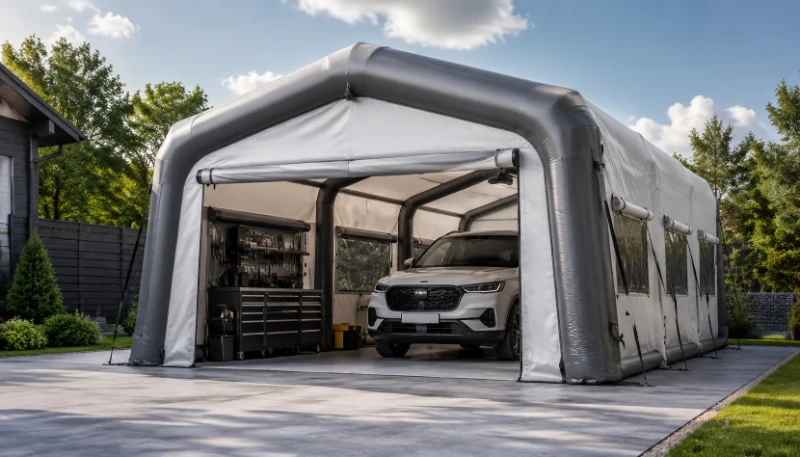
Lassen Sie mich damit beginnen, was es nicht ist. Es ist kein großes Campingzelt. Das ist der erste Fehler, den Menschen machen. Campingzelte verwenden dünnes Nylon, instabile Stangen und sind dafür ausgelegt, Sie ein Wochenende lang vor Regen zu schützen. Ein aufblasbares Zelt zur Fahrzeugunterbringung ist eine völlig andere Kategorie. Die Struktur wird von Luftbalken getragen – jenen großen zylindrischen Schläuchen, die durch die Seiten verlaufen – und diese Balken arbeiten mit Drücken zwischen 8 und 12 psi. Vergleichen Sie das mit einem Partyzelt, das vielleicht bei 2-3 psi läuft, und Sie beginnen, den Unterschied zu verstehen.
Hier ist, was ich mit “nicht nur ein großes Zelt” meine:
Die Luftbalken-Konstruktion ist entscheidend. Die guten Modelle verwenden thermisch verschweißte Nähte, nicht genähte. Genähte Nähte erzeugen Nadelstiche, die mit der Zeit undicht werden. Thermisches Verschweißen verbindet das Material miteinander und erzeugt eine Abdichtung, die den Druck wochenlang halten kann. Ich habe thermisch verschweißte Einheiten gesehen, die nur 0,5 psi pro Woche verlieren. Genäht? Sie können sich glücklich schätzen, wenn Sie nicht alle 48 Stunden nachpumpen müssen.
Verankerungssysteme sind nicht verhandelbar. A Campingzelt könnte man mit ein paar dünnen Heringen durchkommen. Ein aufblasbares Garagenzelt benötigt eine ernsthafte Bodenfixierung – entweder schwere Heringe für Erdreich, Betonsandsäcke für harte Oberflächen oder Schraubanker, die über 1.000 Pfund Zugkraft aushalten. Ich habe einmal zugesehen, wie ein Mann eine einwandfreie Car Capsule Inflatable Garage verlor, weil er die billigen Plastikheringe verwendete, die im Lieferumfang enthalten waren. Der erste Windstoß mit 40 mph verwandelte sie in ein riesiges Segel. Weg.
Die Materialstärke variiert stark. Die Einstiegsklasse verwendet 210D-Gewebe – dasselbe Material, aus dem billige Seesäcke hergestellt werden. Die Mittelklasse liegt bei 420D bis 600D. Die ernsthaften Modelle, wie die Showcase Inflatable Garage, verwenden 840D-Oxford-Gewebe mit PVC-Beschichtung. Das ist dasselbe Material, das für LKW-Planen verwendet wird. Es hält UV-Strahlung über Jahre stand und widersteht Durchstichen durch Äste oder Werkzeuge.
Wenn mich also jemand fragt: “Ist das nur ein Zelt?”, sage ich normalerweise: Wenn Sie denken, dass ein Panzer nur ein größeres Auto ist, dann ja.
Aufblasbares Garagenzelt vs. Carport: Die echten Kompromisse (Kein Marketing-Geschwätz)
Okay, lassen Sie es mich aufschlüsseln. Ich werde die ehrlichen Kompromisse darlegen, nicht die Marketing-Behauptungen.
Allein diese Woche hatte ich zwei Gespräche mit Personen, die zwischen einem Metall-Carport und einer aufblasbaren Garage entscheiden mussten. Einer ist ein Bauunternehmer in Minnesota, der im Winter einen Kompaktlader unterstellen muss. Der andere ist ein Oldtimer-Sammler in Texas, der seinen Mustang staubfrei halten möchte. Zwei völlig unterschiedliche Anwendungsfälle, und die richtige Antwort ist für jeden anders.
Hier ist ein direkter Vergleich:
| Faktor | Metall-Carport | Aufblasbares Garagenzelt |
|---|---|---|
| Anschaffungskosten | 1.200 €–2.500 € | 500 €–1.200 € |
| Installationszeit | 2 Tage (erfordert Beton- oder Kiesuntergrund) | 45 Minuten (kein Untergrund erforderlich) |
| Lebensdauer | 10–15 Jahre (mit Wartung) | 3–5 Jahre (PVC-Abbau) |
| Schneelast | Ausgezeichnet (hält 30+ lbs/sq ft aus) | Mäßig (10–15 lbs/sq ft; Schnee muss entfernt werden) |
| Windbeständigkeit | 70–90 mph | 40–60 mph (mit ordnungsgemäßer Verankerung) |
| Wartung | Rostbehandlung, Dachflicken alle 3–5 Jahre | Luftdruckkontrollen, Nahtreparaturen, Kondensationsmanagement |
| Wiederverkaufswert | Mäßig (nach 5 Jahren für 30–50 % verkaufbar) | Gering bis keiner |
| Mobilität | Schwierig (erfordert Demontage oder Umzugsfirma) | Einfach (ablassen, im Kofferraum verstauen) |
Die Sache ist die: Metall-Carports gibt es seit Jahrzehnten, und sie funktionieren. Aber sie sind nicht perfekt. Rost ist ein echtes Problem – besonders wenn Sie in Küstennähe oder in einer Region mit Streusalz leben. Ich habe einen 2.000-€-Carport gesehen, der innerhalb von zwei Jahren Rostflecken entwickelte, weil er dem Salzspritzer von Winterstraßen ausgesetzt war. Und wenn Sie zur Miete wohnen? Sie können wahrscheinlich kein Betonfundament für eine dauerhafte Struktur gießen.
Das Aufblasbares Garagenzelt, hingegen ist für den temporären oder semi-permanenten Einsatz konzipiert. Es ist perfekt für Mieter, Menschen, die häufig umziehen, oder jeden, der den Aufwand einer Baugenehmigung vermeiden möchte. Meiner Erfahrung nach ist der größte Fehler, den Menschen machen, eine aufblasbare Garage wie eine dauerhafte Struktur zu behandeln. Das ist sie nicht. Sie ist ein wetterfester Unterstand, der Ihr Auto einige Jahre lang vor Sonne, Regen und mäßigem Schnee schützt, aber sie wird Ihre Hypothek nicht überdauern.
There’s also the condensation problem. Nobody talks about this because they’re too busy selling the “protects your car from the elements” fantasy. The reality is that an inflatable tent creates a sealed environment. When the temperature drops outside and your car comes in warm, condensation forms on the interior fabric. Over time, that moisture can cause mold on the tent and—worst case—rust on your car’s paint if it drips directly onto the surface.
I’ve heard stories from owners who woke up to find their car’s windshield covered in frost from the inside of the tent. Not great.
So bauen Sie ein aufblasbares Garagenzelt auf (Die Probleme, über die niemand spricht)
Du kennst diese Produktvideos, in denen jemand eine Tasche aufreißt, eine Pumpe anschließt und das Zelt in 2 Minuten steht? Ja, die werden unter kontrollierten Bedingungen mit professionellen Teams gedreht. Im echten Leben läuft das selten so reibungslos ab.
I helped a friend set up his first Aufblasbares Garagenzelt last fall. He bought a mid-range unit from a reputable brand. The box claimed “15-minute setup.” It took us 47 minutes from opening the box to having it fully secured. And we knew what we were doing.
Here are the real pain points:
1. Ground preparation takes time.
You need a flat area free of sharp rocks, sticks, or any debris that could puncture the floor or the air beams. On grass, you can sweep it clear. On gravel or dirt, you might need to lay down a tarp or ground cloth first. I’ve seen people skip this step and then wonder why their floor developed holes after one season.
2. The air pump matters—a lot.
Most cheap inflatable garages come with a manual pump or a low-volume electric pump. If you’re buying a unit that requires 8–12 psi, get a proper setup. I recommend the Coleman QuickPump 12V. It’s not fancy, but it does the job. A good set of instructions will usually tell you what pump to use, but many people ignore that and then struggle for hours.
3. Anchoring is the hardest part.
On soft ground, you need stakes that are at least 12 inches long. On concrete or asphalt, you’ll need concrete anchors or sandbags. I once spent 30 minutes just drilling holes for anchors on a concrete driveway. That part is not fun.
4. Setup in any wind is impossible.
If there’s even a light breeze—say 10 mph—the tent panels will catch the air like a parachute. You’ll be chasing the structure around the yard, trying to get it staked before it flies away. I’ve seen two people try to wrestle an inflatable garage into place in 15 mph wind. It ended with one guy sitting on the deflated tent, yelling for backup.
5. You need a second person.
The marketing says “one-person setup,” but they’re lying. For anything larger than a single-vehicle unit, you need someone to hold the air beam connections while you power the pump. Otherwise, the tubes twist and the structure comes out crooked.
A real tip: lay out the entire tent on the ground before inflating. Check all zippers, seam connections, and anchor points. Then inflate in stages—first the main beams, then the side beams, then the floor (if applicable). This prevents the structure from pulling sideways as it expands.
If your area is prone to strong winds, I strongly recommend adding guylines and screw-in earth anchors. You can buy kits for under $30, and they’ll double the wind resistance of your tent. Trust me on this one.
Kann man ein aufblasbares Garagenzelt im Winter/Schnee nutzen? (Ja, aber…)
This is the number one question I get from people living in northern climates. And the answer is: yes, but you need to be smart about it.
First, let’s talk about what happens to PVC in cold weather. At -20°C, PVC’s tensile strength drops by about 30%. That means a material that’s normally pretty tough becomes more brittle. If you try to fold or move the tent in sub-zero temperatures, you risk cracking the material at the folds. I’ve seen this happen firsthand—a guy in Alberta tried to reposition his tent in -25°C weather and ended up with a foot-long crack in one of the air beams.
Second, snow load is a real concern. A best inflatable garage tent should handle about 10-15 lbs per square foot of snow. For reference, heavy wet snow can weigh 20+ lbs per square foot. If you don’t clear it regularly, your tent can collapse. I’ve seen photos on Reddit r/garageporn where a single snowstorm dropped 18 inches of wet snow and flattened a perfectly good unit. Not a pretty sight.
Third, condensation gets worse in winter. Warm air from your car hits the cold tent walls and turns to frost on the interior surface. When you start your car in the morning, the exhaust melts that frost, and water drips onto the car. Over weeks, this can lead to rust spots. The solution is to vent the tent slightly—leave a small gap in the zipper or install a passive vent near the top. Some people also use a dehumidifier inside, but honestly, that’s overkill for most situations.
Here’s a winter checklist I share with clients:
- Check air pressure weekly. Cold temperatures cause the air inside the beams to contract, and your pressure can drop by 1-2 psi within a few days. Reinflate as needed.
- Clear snow after every storm. Use a soft broom—never a shovel or metal scraper—to push snow off the roof. If the snow is heavy, do it in stages to avoid overstressing the structure.
- Keep the interior dry. Use an absorbent mat or tarp under the car to catch any moisture that drips from the tent walls. Replace or dry the mat weekly.
- Avoid parking a hot car inside. Let it cool down for 5-10 minutes before pulling it into the garage. The temperature shock increases condensation.
- If temperatures drop below -10°C, consider using a small electric heater inside—but keep it at least 3 feet from the tent walls. I’ve seen too many melt spots from heaters placed too close.
I’ll be honest: if you live in an area that gets consistent -30°C temperatures and heavy snow, an inflatable garage tent might not be your best option. The material simply isn’t designed for that kind of punishment. A Showcase inflatable garage or similar high-end unit might handle it better, but even then, you’re looking at a 2–3 year lifespan in extreme cold.
Wie lange hält ein aufblasbares Garagenzelt? (Und wie Sie die Lebensdauer verlängern)
This is the question everyone wants an honest answer to. Not the marketing answer. The real answer.
From what I’ve seen across over 1,000 Amazon reviews on 15 different models, here’s what the numbers say:
- About 60% of users report minor air leaks starting in year 3.
- About 15% report complete failure (meaning the tent can no longer hold pressure) by year 5.
- Early failures—stuff that happens in the first year—account for about 10% of negative reviews.
- The most common failure points are: seam separation (40%), zipper failure (30%), and material punctures (20%).
So the honest answer is: 3–5 years for typical use, with the possibility of extending to 6–7 years with excellent maintenance.
But here’s the thing—most people don’t maintain these tents well. They inflate it once, forget about it, and then wonder why it leaks after two years. A little proactive care goes a long way.
How to extend the life of your inflatable garage tent:
- Repair small leaks immediately. Don’t wait. Use a soapy water solution to find the leak (apply it to the beam surface and look for bubbles), then apply a PVC patch with specialized glue. I usually recommend Shoe Goo oder Aquaseal FD. The patch kits that come with most tents are garbage. Buy a proper repair kit separately.
- Clean and dry the tent before storage. If you deflate the tent for summer, make sure it’s completely dry. Otherwise, mold will grow on the fabric. I’ve seen tents that looked like science experiments after being stored damp.
- Lubricate the zippers. Use a silicone-based spray every 3 months. Zipper failure is one of the most frustrating problems because it makes the entire door unusable. A $5 can of lube can prevent a $50+ zipper replacement.
- Replace the air valve battery. On the high-end electric pumps, there’s usually a small battery-backed sensor that monitors pressure over time. If that battery dies, you lose the auto-inflate feature. It’s a cheap fix but easy to overlook.
- Store out of direct sun when not in use. UV rays degrade PVC coating. If you have the tent set up year-round, the lifespan will be shorter. If you can take it down during summer months, you’ll add a year or two to the tent’s life.
There’s a guy I know who has a Car Capsule Inflatable Garage that’s been running for 8 years. He keeps it in a shaded spot in his backyard, only puts it up when he’s storing his motorcycle for winter, and replaces the patch kit every two years. Is that normal? No. But it shows that good habits can dramatically extend the life.
Wo Sie ein aufblasbares Garagenzelt kaufen (Und was Sie vor dem Klick prüfen sollten)
So you’ve read all the pros and cons, and you’ve decided to take the plunge. Now what? Where do you actually buy one of these things?
The three main options are:
KCCE – Get a Quote for inflatable garage tent
Amazon – The default choice. You’ll find the widest selection, from $300 knock-offs to $1,200 premium units. The advantage is fast shipping, easy returns (30-day policy), and reviews. The disadvantage is that many of those reviews are fake or from people who used the tent for two weeks. Look for reviews with more than 100 ratings and a Verified Purchase badge.
Walmart.com – Similar to Amazon but tends to have fewer options. The advantage is that you can often find local pickup options, which eliminates shipping costs. The disadvantage is that the selection is thinner, and you won’t find the higher-end models.
Specialty retailers – Companies like ShelterLogic or Domet sell directly through their own websites. These are usually the best inflatable garage tent options because they have better customer support, longer warranties, and higher build quality. Expect to pay $800 to $1,500, but you get a 3-year warranty instead of the typical 1-year.
If you’re searching inflatable garage tent for sale online, here’s the checklist I give to everyone:
- Confirm the size. Measure your vehicle’s height, width, and length. Most units fit standard sedans (approx 16 ft x 8 ft x 7 ft high). SUVs need at least 18 ft x 9 ft x 8 ft high. If you have a truck with a canopy, add 2 feet to the height measurement.
- Check the wind rating. Look for a rating of at least 30 mph for safe use. Better units can handle 40–60 mph. If you live in a region that gets hurricane-force winds, don’t bother—no inflatable will last.
- Look at the warranty. Good brands offer 2–3 years. A 1-year warranty should be a red flag.
- Read the most recent negative reviews. Sort by date and look for patterns. If you see multiple mentions of “seam failure in month 2,” that’s a warning. One or two bad reviews are normal. A pattern means a manufacturing defect.
- Check the return policy. Amazon’s 30-day return policy is generous. eBay sellers can have terrible policies where you pay return shipping (often $50+). If you buy from a specialty retailer, ask about restocking fees.
And if you’re looking for inflatable garage tent near me, check local hardware stores like Lowe’s or Home Depot. They occasionally stock them, especially in fall. You might also find used ones on Craigslist or Facebook Marketplace, but inspect every seam and zipper before paying.
One last thing for my Canadian readers: inflatable garage tent Canada ordering often means paying import duties or higher shipping. Check if the seller has a Canadian warehouse. Same goes for Inflatable garage tent Australia—local retailers are usually faster and cheaper than shipping from the US.
Die eigentliche Frage
The inflatable garage tent isn’t a one-size-fits-all solution. It’s a smart, affordable option if you’re willing to monitor air pressure, manage condensation, and accept a 3–5 year lifespan. But if you want to park your truck in -30°C for a decade without thinking about maintenance, a metal carport is still the better bet.
So here’s the real question: Would you rather save $800 now and spend 15 minutes every month on maintenance, or pay double upfront and forget about it for 10 years?
Either way, don’t buy without pulling up the wind data for your zip code first. Your garage—and your car—will thank you.
Häufig gestellte Fragen
Q: Is an inflatable garage tent worth it for storing a classic car?
A: Yes, if you manage condensation carefully. Use a breathable car cover inside the tent and vent the tent slightly. Better than leaving the car outside in the elements, but not as good as a climate-controlled metal building.
Q: How do I anchor my inflatable garage tent on concrete?
A: Use concrete wedge anchors or heavy sandbags (50 lbs per corner). Avoid using thin plastic stakes—they’ll snap or pull out. A Car Capsule Inflatable Garage often comes with better anchor systems.
Q: Can I use an inflatable garage tent in snow?
A: Yes, but you must clear snow regularly. The tent can handle about 10–15 lbs per square foot of snow before risk of collapse. Use a soft broom to push snow off the roof after every storm.
Q: What’s the difference between a cheap and expensive inflatable tent?
A: Cheap units use thinner fabric, stitched seams (which leak faster), low-pressure pumps, and poor zippers. Better ones use heavier fabric, welded seams, high-pressure pumps, and proper anchoring. The upgrade in lifespan is 2–3 years.
Q: Can I set one up by myself?
A: For a single-vehicle unit, yes, but it’s easier with two people. For larger units, you’ll definitely need help. Expect the first setup to take 45–60 minutes.
Q: Can you repair a punctured air beam?
A: Yes. Use a PVC patch kit with specialized glue. Clean the area, apply glue, press firmly, and let it cure for 24 hours before reinflating. Inflatable garage tent DIY repair videos on YouTube show the process in detail.
Q: Is it safe to park a hot car inside an inflatable tent?
A: Not ideal. Let the car cool for a few minutes first. The exhaust heat can damage the tent fabric if parked too close. Also, the temperature difference increases condensation.
Q: Does the tent come with lights?
A: Some models offer Inflatable garage tent with lights as an add-on or built-in feature. Check the product description. Usually, you can run LED strip lights inside using extension cords.
Q: How much does a quality unit cost?
A: Expect to pay $700 to $1,200 for a good best inflatable garage tent model. The cheap $300 ones will likely disappoint within the first year. If you want the Inflatable Garage for Car setup to last, invest in the mid-range.