
Inflatable Marquee Supplier Australia
Printed marquees built in our own works and handed over FOB at the port your Australian forwarder names — Brisbane, Sydney, Melbourne or Fremantle. Your artwork set at proof stage, MOQ from 1 unit, and 20 years of building marquees.

KCCE is an inflatable marquee supplier for Australia working from the factory gate, not from a Sydney warehouse: canopies in Oxford cloth over welded TPU air tubes, printed with your logo, then handed over FOB at the Chinese port your forwarder books from. Your Australian importer lodges the declaration and answers the biosecurity questions; we supply the commercial invoice, packing list and ISPM 15 compliant packing the shipment needs.
Inflatable Tents Delivered into Australia
Delivered inflatable tents photographed at Australian sites — set up on ovals and show grounds where the ground surface and the season both shape the setup.

Four-Leg Canopy Printed for a Beach Activation
A blue and white inflatable canopy with four arched legs, printed for a seaside brand activation. The arched legs keep the print panel readable from the side.

Peak Spider Tent for Open-Air Events
A white spider tent with a high central peak and pointed legs, set on a lawn where a low-clearance structure would not fit the crowd.
Pair of Printed Half-Dome Tents on a Show Field
Two branded half-dome tents standing side by side on grass, each carrying the same artwork so a pair reads as one set.

Large Printed Event Tent Over a Trade Stand
A wide printed canopy tent covering an exhibition stand, with visitors walking through the middle. The flat roof panel carries the brand across the whole frontage.

Dome Tent with Repeated Print for Roadside Promotion
A purple inflatable dome tent with the same artwork printed repeatedly on every panel, so the brand is visible from any approach.

Multi-Colour Inflatable Tunnel on a Sports Ground
A brightly coloured inflatable tunnel spanning a sports field, printed panel by panel in different colours to suit the event palette.
What an Inflatable Marquee Supplier for Australia Actually Does
A factory that ships to Australia and an importer holding stock in Sydney are two different trades. This page covers the factory side, because that is the only side we sit on — and it suits Australian buyers who already run a forwarder and want factory pricing.
Uma inflatable marquee supplier shipping to Australia sits at the front of your freight chain. We build and print the canopy, pack each unit against its manual, and hand the shipment over FOB at the port of loading. Everything after that — the sailing, the import declaration, the inland leg to your depot — belongs to the forwarder and broker you nominate. Buyers who already import from Asia find that division of labour familiar; first-time importers get the paperwork conversation before the order, not after it.
Two things make the Australian run distinct. The first is biosecurity: arriving sea containers are screened, and timber packing is regulated in a way few other destinations require. That changes how a marquee is packed and what documents travel with it, so it is settled before the booking rather than discovered at the wharf. The second is the calendar: your season peaks across our winter, and the factory slows for Chinese New Year in the middle of your planning window. Both are handled in the sections below.
Where we stop is clear: no stock held in Australia, no landed duty-paid quotes, no acting as importer of record. That line keeps the price at factory level and marks exactly where your responsibility begins.
Principais Conclusões
Inflatable Marquee Tent Models We Supply to Australia
These six cover most Australian orders, from a single branded dome at a markets stall to a wide span over a showground stage. Each card opens the model page with its own size list taken from the printed manual.

X
Connector-linked modules with awnings and banner walls. The series Australian agencies pick when one marquee has to grow into two for the next season without a fresh order.

X6
Inflate through six ports in stages and a small crew can stand the span up on an oval or a forecourt without extra hands on site.

XII
Nine ports inflated in numbered order raise the widest span we build — the model festival stages and showground mains ask for when the footprint cannot be split.

N
Rectangular footprints up to 5x10M that sit neatly inside a plotted site boundary and line up along a market row or a stall frontage.

XL-A
Awnings in wide and narrow options plus connecting cloth, for branded frontages that follow a building line instead of an open field.

AII
A single-port dome with a Velcro-mounted canopy, so a campaign refresh means new artwork rather than a new marquee.
Who in Australia Orders Inflatable Marquees From Us
Four kinds of buyer account for most enquiries from Australia, and each one loads a different part of the order. That is where the specification talk should start.
Festivals and event producers
Marquees that tour between summer dates and get re-skinned between seasons. A removable canopy on the same air frame is usually worth more here than a second full unit.
Councils and civic events
Citizenship ceremonies, markets, Carols-style outdoor programmes: units that are installed, packed down and installed again by a rotating casual crew, so simple inflation matters.
Agricultural show societies
Showground briefs where the marquee stands for a week beside ring events and livestock traffic. Sidewalls and door walls turn an open span into a usable room.
Brands and resellers
Marketing teams buying their own kit after years of renting, and Australian rental or promotional products resellers ordering against an approved layout season after season.
Custom Inflatable Marquee Printing for Australian Programmes
Most print problems on imported marquees are not printing problems, they are proofing problems. Four things get settled before anything is cut.
Full-canopy print, not a banner
Colour is dyed into the canopy fabric across every panel, so the logo reads the same from the ground, from a grandstand and from a drone. The X series canopy is the documented 400D Oxford cloth.
Australian English set at proof
Marquee, colour, organise, metre. The proof you sign is written the way your customers read, and it is signed before any fabric is cut — a reprint for one word is an expensive fix.
Colour matched to your brand guide
Send the guide or a physical swatch and the print is matched against it. Blocked colour panels and two-tone splits turn up regularly on Australian sponsorship and retail briefs.
Swappable canopies between campaigns
The AI and AII hold their canopy on Velcro, so one air frame carries several campaigns and only the print gets reordered between them.
Large Inflatable Marquee Sizes, Straight From the Manuals
One column in this table gets misread so often it is worth stating up front: the installer column is the crew the manual specifies to inflate the marquee, not a seating or storage capacity.
| Modelo | Optional sizes | Installers to inflate | Inflation ports |
|---|---|---|---|
| AI | 2.5M / 3M | 1 | 4, reducible to 1 |
| AII | 3M / 4M | 1 | 1 |
| U | 3M / 4M / 5M | 1 to 2 | 2 |
| VI | 4M / 5M / 6M | 1 to 3 | 3 |
| VII | 5M / 6M | 1 to 3 | 3, reducible to 1 |
| F | 3x3M / 4x4M | 2 to 3 | 2 |
| N | 3x3M / 4x4M / 5x5M / 4x6M / 5x10M | 3 to 4 | 2 |
| X | 3M / 4M / 5M / 6M / 7M / 8M | 2 to 5 | see manual |
| X6 | 5M / 6M / 7M / 8M | 2 to 4 | 6 |
| XII | 4M / 6M / 8M / 10M | 1 to 6 | 9, in numbered order |
| XL-A | 4.5x3M / 6x4M / 7.5x4.8M | 1 to 3 | 5, reducible to 3 or 1 |
| XL-B | 8x4.5M / 9.4x5.5M | 2 to 3 | 7, reducible to 3 or 1 |
If the footprint you need is not listed, that is a conversation rather than a refusal. Send the site plan or the boundary you have to fit and we will confirm in writing which listed size comes closest.
Shipping an Inflatable Marquee to Australia: Ports and Handover
For freight to Australia the one decision that really moves cost is who books the sailing. We quote FOB, so the carrier, the routing and the inland delivery stay with your forwarder, in their system, on their rates.
| Mode | Melhor para | Who arranges what |
|---|---|---|
| Sea freight, LCL | A first unit or a small trial | Groupage to the Australian port your forwarder picks; the sailing and the inland leg are theirs to book. |
| Sea freight, FCL | A season of events or a fleet | One container, one packing list, handed over at the port of loading you nominate. |
| Air freight | Fixed launch dates that outrun the water | For units that cannot wait for a sailing; quoted per project. |
Australian buyers nominate the port that suits their depot. Melbourne and Port Botany in Sydney carry the deepest schedules and suit most groupage; Brisbane serves Queensland programmes; Fremantle and Adelaide cover the west and the south. The port is your call, not ours — the handover happens wherever your forwarder asks for it.
The sea leg to Australia is a long one, which makes the packing list more important than it looks. Each marquee is packed the way its own manual sets out: canopy and detachable legs travel in the storage bag; ground stakes, guy ropes, repair patches and spare valves ride in the accessory bag, with a printed setup sheet tucked inside. What gets marked on the outside is set to whatever your depot needs to read when the container lands.
Biosecurity and Packing: the Step Other Suppliers Skip
Australia screens arriving sea cargo for biosecurity risk, and the rules bite on things most suppliers never think about: timber packing, container cleanliness and honest declarations. None of it is hard; all of it has to be planned before the booking.
| Step | Who owns it | What it needs |
|---|---|---|
| Importer of record | Your Australian company or your forwarder | Registered for the import declaration before the first shipment moves. |
| Import declaration | Your licensed customs broker | Built from our commercial invoice: each line described, valued and classified on its own. |
| GST on arrival | Accounted for on the entry by your broker | We do not add Australian GST at the factory; the tax side belongs to your entry. |
| Biosecurity screening | Administered by the federal agriculture department (DAFF) | Arriving containers are screened; timber packing and cleanliness are what get looked at. |
| Documents we supply | Commercial invoice, packing list, packing marks, treated-timber declaration | Checked against your broker’s checklist before the container is sealed. |
The practical rule is simple: any timber in the shipment — crates, pallets, dunnage — must be ISPM 15 treated and carry the treatment mark. Where a buyer would rather remove the question entirely, units can travel on plastic packing with no timber component, and we confirm the packing spec with your broker at order stage.
The two delay causes we see most often are both avoidable. The first is a packing list that no longer matches the container because spares were added after it was issued — we reissue the list whenever the load changes. The second is a container that arrives dirty or with undeclared wood, which is a packing discipline question, so ours are cleaned and checked against the manifest before they leave the works. If your broker needs a document we have not listed, raise it at quotation and it is prepared with the order, not after the vessel sails.
The Australian Season Runs Opposite to the Factory
This is the part of an Australian import that catches buyers out. Your busiest months are our quietest, and the one factory closure of the year lands inside your planning window. The order date has to be worked backwards from both.
| Driver | When | What it changes |
|---|---|---|
| Southern summer season | Roughly October to April, when festivals, shows and civic programmes stack up | The marquee should be in your depot before the season opens, which pulls the order back several months. |
| Trade show and expo dates | Set by the venue calendar your industry runs on | Order date comes from the first build-up, not from the day the quote is signed. |
| Chinese New Year | The factory pauses over the holiday each year | Orders placed too close to the closure queue behind it; plan the container around it. |
| Re-orders | Off-season, against an approved layout | Same panels, no fresh proofing; spares ship on their own without a full re-order. |
Worked back from an October season opening, a sea freight order usually needs to be confirmed mid-year: proof approved, production finished and the container sailing with enough water between it and your first date. Add the Chinese New Year closure into the same window and the safe answer is to lock the artwork before the year turns, not after it.
Tell us the first date the marquee has to be standing and we will tell you honestly whether a sailing still works — and if it does not, whether air freight closes the gap. Both answers are better given at quotation than discovered at the wharf.
Setting Up on Australian Sites: Turf, Pavement and Heat
Australian events split between greenfield ovals and paved city pitches, and the fixing kit differs more between those two than it does between tent models. It belongs in the first conversation, not the last.
Ovals and showgrounds take stakes
On turf the manual’s standard fixing applies: guy ropes and stakes driven in at a slant, so the load runs along the line instead of landing on one point. Most showground and oval briefs are exactly this.
Paved CBD sites take ballast
Forecourts, squares and decked venues take no stakes. Sand bags, water ballast and bar bags are the documented fixes; on certain models a bar bag comes as standard equipment.
Window walls for light and airflow
The manuals list lateral, window and door walls. Window walls keep an enclosed span bright and ventilated — the configuration Australian summer briefs usually end up choosing.
Inflation in the manual’s order
Ports open in the sequence the manual sets; on the XII that sequence is numbered and it matters. Stop at the safety valve, cap it, then continue to the next.
Tell us the surface when you enquire — turf, asphalt, paving, decking or indoor floor — and the fixing kit gets quoted together with the marquee rather than improvised on site.
From First Enquiry to a Marquee Standing in Australia
Six stages from the first email to the first installation. Nothing advances until the stage before it is signed off in writing; that discipline is what makes an import feel routine, even with your goods inside and the sailing on your forwarder’s booking.
| Stage | What happens | What is confirmed |
|---|---|---|
| Enquiry | Purpose, footprint and unit count — three answers are enough to quote. | A quote or a clarification inside 24-48 hours. |
| Artwork and proof | Your logo laid onto the real canopy panels, wording and colour checked. | Proof approved by you in writing before anything is cut. |
| Production | Printing, air-frame welding and final assembly against the approved proof. | Lead time confirmed in writing after proof approval. |
| Embalagem | Storage and accessory bags per unit, packing spec matched to Australian biosecurity. | Timber and packing choices settled with your broker before the booking. |
| FOB handover | Units delivered to your forwarder at the named port of loading. | Your broker lodges the declaration and controls the inland leg. |
| Re-order | Same layout, same panels, no re-proof from scratch. | Spares and single replacement units orderable on their own. |
Pricing, MOQ and What Moves the Number
Every marquee on this page is for sale direct from the factory, and there is no list price for a printed one — any supplier who quotes one is pricing one exact setup. Four variables decide the number, and this is how they move it.
| Item | Detail | Note |
|---|---|---|
| What sets the price | Model, footprint, printed panels, accessories | Four variables, and the quote is built from them line by line. |
| What does not | Quantity discounts on a first unit | A single unit is priced as a single unit, not discounted to look competitive. |
| Currency and terms | Quoted per project (FOB) | No Australian GST is added at our end; tax on the entry is your broker’s side. |
| Prazo de entrega | Confirmed in writing after design approval | We will not put a number on it before the proof is approved. |
Custom printing carries an MOQ of 1 unit, so ordering one branded marquee is a normal way to start, not a special favour. A single unit never earns a container rate; when the budget is tight, the honest levers are the footprint and how many panels you print, not the quantity.
Where These Marquees Get Installed
Three site types, photographed on location. Turf, paved halls and activation pitches are what most Australian briefs fall into, and each changes the fixing kit more than it changes the marquee.

Trade shows and expos
A wide span standing inside a paid exhibition, where the footprint has to match a plotted booth boundary and the build has to happen in the venue’s own window.
Ovals, parks and showgrounds
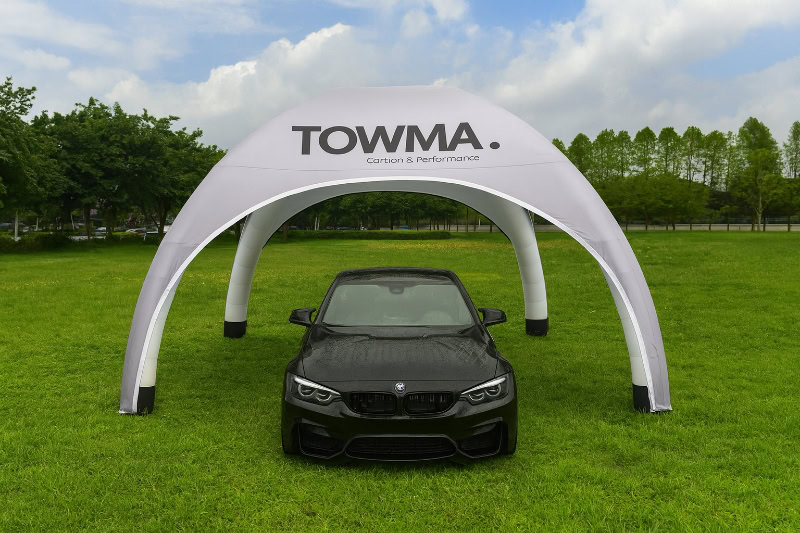
Grass sites take the standard stake fixing, which keeps the kit light and the install quick. This is the layout most outdoor Australian briefs start from.

Roadshows and retail promos
A single dome carrying one brand across a promo tour. Small footprint, fast setup, and the kind of unit that tours from site to site in the back of a van.
Configurations We Have Shipped
Delivered units, photographed on site. Australian programmes follow the same build and the same print process; these three are the configurations most often specified for Australian briefs.

A clean VI series unit
One rectangular span with the canopy printed edge to edge. The configuration most first-time Australian buyers start with before scaling into a fleet.

A dome in a two-colour scheme
A round span split into blocked colour panels with the brand across the crown. Domes read from a distance, which is why they anchor event villages and festival sites.

An arch over a fixed water feature
An arch set beside a pool, where the ground under it is paved and every fixing decision is a ballast decision. Ordered alongside the marquees it marks.
Perguntas Frequentes
A: Yes. We build and print in our own works, quote FOB in China and hand the shipment to the forwarder you nominate. A first marquee travels as groupage, a season travels as one container, and when a fixed date outruns the water the answer is air freight.
A: There is no single figure: the model, the footprint, the printed area and the accessories each move the price, so the quote is built line by line from those four. Send them through and it comes back in 24-48 hours.
A: No. We sell ex-works China on FOB terms and are not an Australian-established business, so no Australian GST is added at our end. GST is accounted for on your import declaration by your broker, through whatever method they use.
A: That depends mostly on packing, which is why we plan it with you. Any timber in the shipment is ISPM 15 treated and marked, and where you prefer to avoid timber entirely the units travel on plastic packing. The invoice, packing list and marks your broker needs are prepared before the container is sealed.
A: Whichever one your forwarder names. Melbourne and Port Botany take most deep-sea groupage, Brisbane serves Queensland, and Fremantle and Adelaide cover the west and south. We hand over FOB at the port of loading; the inland leg is yours.
A: The XII series is the widest span we build at 10M, and the rectangular N series runs to 5x10M. The full size list on this page is copied from the product manuals; anything beyond it starts with a conversation about your site plan.
A: Yes. The MOQ for custom print is 1 unit, so one unit is a normal first order rather than a special case. Most Australian agencies and rental companies start exactly that way and re-order against the approved layout.
A: Yes. Wholesale and OEM supply, private-label packing included, is a standard part of the offer alongside custom printing; the terms are set programme by programme rather than fixed in advance.
A: Work backwards from your first date, then add the sea leg and the Chinese New Year closure. For an October season opening the container usually needs to be confirmed mid-year. Give us the date and we will tell you whether a sailing still works.
A: We will not quote a sun rating we cannot put in writing. What we can specify honestly is configuration: window walls for light with airflow, door walls for through-traffic, and sidewalls to close the span down when conditions turn. Ask us what the manual documents for your model.


