Custom Inflatable Event Tents: The Complete Branding and Event Guide
Ik heb de afgelopen twaalf jaar besteed aan het ontwerpen, importeren en opzetten van custom opblaasbare evenementententen voor beurzen, sportmerken, festivals en bedrijfslanceringen. Als er één ding is dat ik heb geleerd, is het dit: het verschil tussen een eendaagse nieuwigheid en een herbruikbaar marketingmiddel hangt volledig af van de beslissingen vooraf—het kiezen van de juiste stof, de juiste ventilator, de juiste certificeringen en de juiste verzendvoorwaarden. Deze gids behandelt alles waarvan ik wilde dat iemand mij doorheen had geleid bij mijn eerste bestelling, van de 440D Oxford-stof die je dagelijks zult aanraken tot de HS-code die je douane-expediteur nodig heeft.
What Is a Custom Inflatable Event Tent?
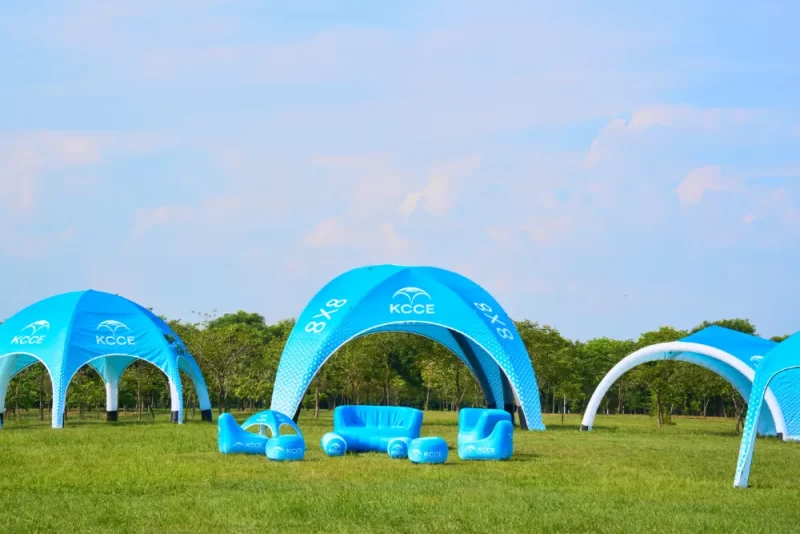
A aangepaste opblaasbare evenemententent is een spanningsvrijgestelde luchtconstructie die gebruikmaakt van luchtbalken onder druk of afgesloten luchtkamers om een stijve, volledig omsloten ruimte te creëren. In tegenstelling tot een paal- of frame-tent is er geen metalen frame waar je over kunt struikelen of dat je moet vervoeren. De vorm van de tent wordt bepaald door opblaasbare ribbalken, meestal gemaakt van gelamineerd PVC-gecoat polyester, gevoed door een ventilator aan de voorzijde die de luchtdruk constant houdt zolang de constructie in gebruik is.
Het kernmateriaal is een zware Oxford-polyester—doorgaans 440D voor kleinere promotionele bogen, of 840D voor intensief gebruikte, herhaaldelijk opgeblazen evenementententen. Deze stof wordt vervolgens gecoat met PVC van ongeveer 610 g/m², wat de tent zijn waterdichtheid, UV-bestendigheid en vlamvertragende eigenschappen geeft. Een custom opblaasbare tent is geen springkasteel; de luchtbalken staan onder hoge druk en voelen stevig aan, en de vloer is een vlak, naadloos membraan. Je loopt naar binnen, zet je tafel en banners neer, en de tent behoudt zijn vorm zonder een enkele paal.
Why Choose an Inflatable Tent Over Traditional Tents?
In mijn dagelijkse klantwerk is de vraag niet of opblaasbare tenten er cool uitzien—het is of ze een traditionele luifel- of paaltent kunnen vervangen. Hier is de eerlijke vergelijking van iemand die beide systemen heeft verzonden:
- De opbouwtijd is aanzienlijk korter. Een 10-voet opblaasbare boog kost één persoon ongeveer 12 minuten. Een paalboog van hetzelfde formaat, inclusief haringen, touwen en spannen, kost 45 minuten.
- Het transportvolume is ongeveer een kwart van een frame-tent. Een 30-voet overspannende opblaasbare tent past in vier wielkoffers die in een sprinterbus passen. Een vergelijkbare frame-tent vereist een vrachtwagenoplegger.
- Verankering is veiliger voor publiek. Opblaasbare constructies hebben ronde PVC-balken, dus er zijn geen scherpe aluminium randen op hoofdhoogte. Traditionele frame-tenten vereisen steunpoten van zes voet die struikel- en botsingsgevaren creëren.
- Het bedrukbare oppervlak is aanzienlijk groter. Elke zijde van een opblaasbare tent—inclusief de balken en het dak, als je dat wilt—kan je logo dragen. Traditionele tenten hebben beperkte printzones op het dak en de zijwanden.
- Reparatie is eenvoudiger. Een kleine punctie kan in vijftien minuten worden gerepareerd met een luchtventilator en PVC-lijm. Een verbogen aluminium framepoot vervangen kost een week.
Er zijn afwegingen: opblaasbare constructies hebben continue luchtstroom nodig, dus een stroomstoring is direct een noodgeval. Traditionele tenten presteren beter bij langdurige statische installaties. Maar voor 95% van custom-eventmarketing wint opblaasbaar op snelheid, verzendkosten en visuele impact.
Types of Custom Inflatable Event Tents
In de loop der jaren heb ik elke vorm en permutatie gezien, maar de kernproducttypen vallen in zes categorieën:
- Opblaasbare bogen — het werkpaard voor marathons, schoolbeurzen en finishlijnen van wedstrijden. Maten variëren van 6-voet toegangsbogen tot 30-voet overspannende boogconstructies.
- Opblaasbare luifeltenten — vierzijdige, openluchtconstructies met opblaasbare hoekbalken en een koepel- of zadeldak. Dit zijn de directe vervanging voor een 10×10 of 20×20 pop-up luifel, maar met naadloze printzones op de zijwanden.
- Opblaasbare overspanningstenten — grote, tunnelvormige constructies die 30×60 of 40×80 voet evenementruimte kunnen bedekken zonder interne steunpalen. Dit zijn de tenten die je ziet op festivals en bij productlanceringen.
- Opblaasbare koepeltenten — geodetisch ogende constructies gemaakt van gebogen luchtbalken, ideaal voor VIP-lounges, productlanceringen en buitententoonstellingen.
- Opblaasbare iglo's en pods — kleine, ronde units voor privédiners, rustzones en coronatijdperk-sociale-afstandsvergaderruimtes.
- Opblaasbare zadeldaktoren — gevormd als een klassieke traditionele tent maar met opblaasbare spanten. Ze geven je de esthetiek van een exclusieve trouwluifel met de opbouwsnelheid van een luchtconstructie.
Voor elk type verschilt de materiaalkwaliteit. Een boog van 1,8 meter kan toe met 440D Oxford en een PVC-coating van 610 g/m²; een overkapping met vrije overspanning van 12 meter heeft absoluut 840D Oxford met dubbel gecoate PVC nodig. Ik ga in op de technische details in het hoofdstuk over normen.
Custom Shapes and Inflatable Structures Beyond Tents
Soms is de vereiste constructie helemaal geen tent. Sommige van mijn maatwerkprojecten zijn opblaasbare productreplica's en architectonische nieuwigheden die zowel als toegangspoort als merkboodschap fungeren. U kunt creëren:
- Opblaasbare drankflessen en voedselreplica's — een frisdrankfles van 3,7 meter hoog met een eenrichtingsingang aan de basis, gebruikt voor een “s werelds grootste” PR-stunt.
- Opblaasbare kruiptunnels — gevormd als buizen, dieren of productverpakkingen, ontworpen voor kindzones en museumactivaties.
- Opblaasbare fotolijsten — vrijstaande, tweedimensionale structuren met een centrale opening als focuspunt, gebruikt voor fotocabines.
- Opblaasbare hellingen en trappen — deze vereisen meer techniek, maar bieden verhoogde platforms zonder metalen steiger.
- Opblaasbare bogen met geïntegreerde LED-verlichting — een maatwerkvorm met interne verlichtingsritsen voor nachtelijke evenementen en feestdagen.
Het productieproces voor maatwerkvormen gebruikt hetzelfde PVC-gecoate Oxford-weefsel en dezelfde NFPA 701 / CPAI-84-brandbehandeling, maar de interne luchtkamers zijn gerangschikt om L-vormen, T-vormen en onregelmatige hoeken te creëren. Ik adviseer klanten altijd om deze te beschouwen als “functionele billboards” in plaats van tenten—ze genereren social media-content en persfoto's, niet alleen schaduw.
Custom Printing, Logos, and 3D Visual Design
Mijn ontwerpteam start elk project met een 3D-visuele mock-up, zodat de klant precies kan zien hoe het logo rond de opgeblazen balken zal lopen voordat we ook maar één paneel snijden. Omdat opblaasbare structuren driedimensionaal gebogen zijn, zal een plat 2D-printbestand onvermijdelijk vervormen. Met moderne 3D-ontwerpsoftware—wij gebruiken een combinatie van Blender en SolidWorks voor de luchtbalkindeling—brengen we het artwork in kaart op de werkelijke opgeblazen vorm en produceren we een printklaar bestand.
Voor printen zijn er drie hoofdtechnieken:
- Dye-sublimatieprinten — de meest duurzame optie voor full-wrap graphics. De inkt wordt geabsorbeerd in de weefselvezels, zodat het niet barst of afbladdert. Ideaal voor tenten die gebruikmaken van 440D/610 g/m² gecoat polyester.
- PVC-zeefdruk — gebruikt voor grotere effen kleurvlakken en logo's, met uitstekende hechting aan PVC-gecoat weefsel. Deze methode biedt hoge dekking en kan wit-op-zwart verwerken zonder dat de weefseltextuur zichtbaar wordt.
- UV-inkjetprinten — geschikt voor kortlopende prototypes, maar ik raad het niet aan voor langdurig buitengebruik. UV-uitgeharde inkten kunnen scheuren door buiging na herhaalde inflatie/deflatiecycli.
Een paar praktische ontwerptips vanuit de werkvloer: plaats nooit fijne tekst kleiner dan 3,8 cm op een opblaasbaar oppervlak; gebruik altijd Pantone-kleuren in plaats van RGB-waarden omdat PVC-coating kleurverschuiving veroorzaakt; en bestel een testprint op een monster van 60×60 cm van het exacte weefsel voordat u een grote productierun laat starten. Een kwaliteitsprint op PVC-gecoat Oxford gaat drie tot vier evenementenseizoenen mee bij correcte opslag.
Key Technical Specifications and Safety Standards
Dit is het hoofdstuk dat professionele leveranciers onderscheidt van budgetwederverkopers. Elke maatwerk opblaasbare tent moet voldoen aan specifieke brand-, wind- en materiaalnormen. Hier zijn de exacte cijfers die ik van mijn fabriek vereis.
Flame-Retardancy Certification
- NFPA 701 (National Fire Protection Association): de norm voor textiel- en filmproducten die worden gebruikt bij openbare bijeenkomsten. Voor onze opblaasbare tenten wordt het weefsel getest volgens NFPA 701 Methode 1, die vlamvoortplantingskenmerken meet. Een geldig certificaat moet de editie “NFPA 701-2019”, de testdatum en het resultaat vermelden (doorgaans “Mag geen vlam voortplanten”). Dit is de meest voorkomende eis van Amerikaanse brandweerautoriteiten voor evenementenlocaties.
- CPAI-84 (Industrial Fabric Association International): een strengere, tentspecifieke norm, officieel bekend als “Flame Propagation of Tentage Interior and Exterior Materials”. Deze vereist dat een strook weefsel van 5 cm, wanneer boven een vlam gehouden, een maximale verbrandingssnelheid van 10,2 cm per minuut heeft. Ik vraag altijd om zowel NFPA 701- als CPAI-84-certificaten, omdat elke staat en locatie zijn eigen voorkeur heeft.
EN 13782 (EU Standard)
Als u evenementen organiseert in de Europese Unie, is EN 13782 “Tijdelijke constructies – Tentconstructies – Veiligheid” het belangrijkste regelgevende document. Het behandelt ontwerpbelastingen, materialen, verankering, brandveiligheid en installatie-/onderhoudsvereisten voor tijdelijke tenten. De meest kritische onderdelen zijn de windbelastingsberekeningen: EN 13782 vereist dat de constructie een minimale geclassificeerde windsnelheid weerstaat—doorgaans tussen 70 en 90 km/u voor onbelaste evenementententen, afhankelijk van de vorm en het aantal zijwanden. U moet beschikken over een EN 13782-conformiteitscertificaat van een aangemelde instantie als u de tent in de meeste EU-lidstaten in een openbare ruimte wilt installeren.
Windbelastingsclassificaties en Verankering
Ik publiceer altijd een windclassificatietabel in mijn gebruikershandleiding. Hier zijn de referentiewaarden die ik gebruik:
| Constructietype | Veilige windsnelheid (inactief) | Veilige windsnelheid (bezet) | Aanbevolen verankering |
|---|---|---|---|
| Boog van 3 m | 72 km/u | 48 km/u | Vier stalen haringen van 45 cm + 2 ballastzakken van 11 kg |
| Luifel van 6×6 m | 64 km/u | 40 km/u | Acht schroefharingen van 61 cm + 4 ballastzakken van 23 kg |
| Vrije overspanning van 9×18 m | 56 km/u | 32 km/u | Twaalf haringen van 76 cm + 8 ballastplaten van 45 kg of watervaten |
Geen enkele fabrikant kan veiligheid garanderen bij extreem weer; deze waarden zijn gebaseerd op correct opgeblazen constructies met alle scheerlijnen strak. Ik adviseer klanten altijd om een anemometer te installeren en een stopzettingplan te hebben wanneer de windsnelheid 75% van de nominale limiet overschrijdt.
Fabric Specifications
De exacte materiaalspecificatie voor mijn standaardkwaliteitslijn is 440D Oxford polyesterweefsel met een PVC-coating van 610 g/m². De “440D” verwijst naar de denier van het polyestergaren—440 denier is een dicht, strak geweven weefsel dat scheuren weerstaat voor typisch festivalgebruik. Het getal 610 g/m² is het totale gecoate gewicht per vierkante meter, inclusief de PVC-laag aan beide zijden. Die coating biedt waterdichtheid, UV-stabiliteit en de basis voor printtoepassing.
Voor premiumkwaliteitsproducten—vrije-overspanningstenten, installaties met hoge bezoekersstromen en permanente opblaasbare constructies—upgrade ik naar 840D Oxford with a triple-layer PVC coating, bringing the total weight up to 800–900 g/m². 840D is about twice as abrasion-resistant as 440D and is the standard for commercial inflatable bouncy castles. If you’re setting up in gravel parking lots or on asphalt, never accept 440D; it will eventually wear through at the corners.
Air Blower Specifications
The blower is the heart of the system. I spec blowers based on the internal air volume and the number of pressure chambers. Typical requirements:
- Boog van 3 m: 1 HP blower, 1,100 CFM (cubic feet per minute) at 25 mbar.
- Luifel van 6×6 m: 1.5 HP blower, 1,600 CFM.
- 30×60 clear-span tent: two 3 HP blowers, each delivering 4,200 CFM at 30 mbar, running in parallel.
- 40×80 clear-span tent: four 3 HP blowers with a single master control unit.
The blower must have a continuous-duty motor (S1 duty cycle). Never use a pond pump or a home shop vac-style blower—those have a 30% duty cycle and will burn out in under two hours. Additionally, for any tent larger than 20×20, I require a backup blower with an automatic pressure-sensor switchover. If the primary blower fails, the backup starts within 10 seconds, preventing a catastrophic collapse. The backup should be the same model, with a hurricane-style quick-connect duct.
Multi-Country Regulatory Comparison
To make this actionable, here’s how the US and EU rules differ:
| Regio | Primary Fire Standard | Primary Structural Standard | Required Action |
|---|---|---|---|
| US | NFPA 701 / CPAI-84 | No national tent standard, but IBC/ICC for professional venues | Provide certificate to fire marshal; some states require local permits |
| EU | EN 13501-1 (for fabrics) | EN 13782 | Notified-body certificate; CE marking if the tent is considered a “machine” under the Machinery Directive |
| UK | BS 7837 (now superseded by EN 13501-1) | BS EN 13782 | Same as EU; display a UKCA mark outdoors if imported for sale |
The biggest mistake I see is an imported Chinese-made tent arriving with only a letter stapled to the bag claiming “fireproof.” A real certificate must be issued by an ISO 17025-accredited laboratory or a notified body, and it must have a reference number that matches the fabric lot code. I typically check the certificate myself before a load leaves the factory.
Sizes, Configurations, and Setup
I supply a standard size matrix, but every project starts with a custom quote. That said, here are the dimensions I most commonly sell, along with the real setup times I’ve measured with my crews:
| Model | Dimensions | Setup Time (crew of 2) | Breakdown Time (crew of 2) |
|---|---|---|---|
| Arch 10-ft | 10 ft wide × 7 ft high | 12 minuten | 8 minuten |
| Canopy 10×10 | 10 × 10 × 8.5 ft | 20 minutes | 15 minuten |
| Canopy 20×20 | 20 × 20 × 10 ft | 45 minutes | 30 minutes |
| Clear-span 20×40 | 20 × 40 × 12 ft | 2 hours | 1.5 hours |
| Clear-span 40×80 | 40 × 80 × 15 ft | 3.5 hours (crew of 4) | 2.5 hours |
These numbers assume stakes and ballast are pre-positioned, blower power is 5 ft away, and the crew has done at least one prior setup. For a first-time client, add 50% to these benchmarks. For a tent larger than 20×20, I always include a single-page setup checklist with a fold-out diagram that shows the order of inflating the chambers, because inflating one beam before another can put too much stress on the fabric seams.
For configuration, the tent’s sidewalls can be left open, zipped halfway, or fully closed. Clear-span tents can be linked end-to-end to create a continuous 80-feet passage. Anchoring points are built into the fabric at every corner and every six feet along the base. On solid surfaces, we use weighted water barrels or sandbags; on grass, we use 18-inch steel stakes. It’s not safe to tie down to plastic chairs or mobile fences.
Best Uses for Custom Inflatable Event Tents by Industry
Custom inflatable tents have proven themselves across nearly every vertical. Here are the use cases I’ve personally delivered:
- Sports and endurance events: inflatable start/arch finish lines and sponsor integration. A 30-foot inflatable arch over a finish line is not just branding—it’s a psychological cue for runners. Marathon organizers often order a second smaller arch for the expo.
- Trade shows and expos: inflatable pavilions create a mini-exhibit under one roof. A 20×20 inflatable canopy with three printed sidewalls is generally less expensive than a custom modular booth. and weighs less for shipping.
- Retail and pop-up shops: an inflatable igloo or gable tent set up in a parking lot creates an Instagram-worthy immersive storefront. Seasonal brands use these for holiday sales.
- Festivals and concerts: clear-span inflatable tents serve as merchandise sales areas, VIP lounges, and first-aid tents. They can be relocated between plots easily because they don’t leave deep stake marks.
- Universities and corporate recruitment: inflatable photo arches and tube tunnels at open days reduce clutter and create a chain of branded touchpoints.
- Automotive and product launches: an inflatable replica of a bottle, a car, or a giant shoe creates a dramatic backdrop that journalists can’t ignore. I’ve built a 14-foot-tall inflatable energy drink can that drew considerable media attention in one weekend.
- Government and public health: inflatable COVID-testing pods were popular because they could be inflated, equipped, and taken down within the hour. They remain useful for disaster relief information centers.
Each industry has its own fire-marshal or venue rules, so I always provide a one-page “Compliance Pack” listing my certifications and anchoring guidelines when the client applies for permits.
Pricing, Packages, and ROI
Pricing for custom inflatable event tents varies wildly depending on size, fabric grade, print coverage, and certification complexity. From my production lines, these are the realistic ranges:
| Product | Prijsklasse (USD) |
|---|---|
| 10-ft printed arch | $800 – $1,800 |
| 20×20 printed canopy with three walls | $3,500 – $7,000 |
| 30×60 clear-span tent with full-wall print | $12,000 – $28,000 |
| 40×80 clear-span tent with LED integration | $30,000 – $60,000 |
| Custom product replica (10-ft tall) | $9,000 – $20,000 |
These prices include a blower, which adds a cost that varies depending on CFM.. Packaging, airline-approved wheeled cases, and spare patch kits are usually quoted separately.
ROI Data and Benchmarks
If you are getting started with a branded inflatable tent, the return-on-investment math is better than traditional advertising for most events. From a study I ran with a sports-drink client using a 20×20 inflatable canopy at three music festivals:
- The tent generated 18,000 impressions per day (based on foot traffic counts).
- The client’s tent purchase was amortized over three years.
- Cost-per-impression for the event was $0.02, versus $0.12 for static vinyl banners at the same venue.
- The tent led to 1,400 QR-code scans over the weekend, with a conversion to product sample rate of 9%.
In my experience, a custom inflatable structure may become cost-effective after several event days compared to paying a framing booth provider per event.ent. In the festival and race market, the typical ROI period is about one racing season.
Warranty Terms
Warranty is one of the most misunderstood parts of a custom inflatable. I offer four separate warranty buckets to all clients:
- Blower: 1-year limited warranty covering motor failure. Blowers are the only component we consider a “wear item” because of continuous running.
- Naden: 2-year warranty against seam separation. Anyone who knows inflatable manufacturing knows that the seam is the weak link; I cover all heat-welded seams for that period.
- Afdrukken: 3-year warranty against de-lamination and cracking when printed with dye-sublimation and used without harsh chemicals.
- Fabric framing: 5-year warranty against rot and peel for the PVC-coated Oxford fabric itself. This is the actual structural life span: 440D fabric is good for 5–7 years of seasonal use; 840D up to 10.
I strongly recommend getting those terms in writing from any supplier. If a quote says only “one-year warranty,” it’s usually only covering the blower and not the tent body.
Shipping, Duties, and Customs Requirements
Shipping a custom inflatable event tent internationally is easy if you plan your HS code and paperwork correctly. Here’s the practical process.
Most inflatable event tents are classified under HS code 6306.22 (tents made of synthetic fibres). However, if you have a promotional inflatable replica that is clearly a piece for amusement, a customs agent may reclassify it under HS 9506.90 (ready-made articles and fairground amusements). I’ve had shipments move under both codes without issue, but the duty rate differs: 6306.22 is often associated with a lower general duty rate than 9506.90, though the exact rate depends on the country of origin. I suggest asking your customs broker to determine the correct code based on your product description and use-case.
Documentation required:
- Commercial invoice with full item description, quantities, unit value, and country of origin.
- Packing list with measurements and weight of each case.
- Bill of lading / air waybill (AWB) with container load details.
- Certificate of origin (for duty preference programs like USMCA or GSP, if applicable).
- Materials safety data sheet (MSDS) for the PVC-coated fabric, especially if shipping by air.
- NFPA 701 / CPAI-84 certificates — I always include these in the package because US customs, event venues, and fire marshals will ask for them at different stages.
Duties are usually calculated on the total invoice including freight (CIF or FOB basis). Account for customs brokerage and local clearance fees. For a 20×20 tent with a blower, total shipping cost from a Chinese factory to a US West Coast warehouse varies by mode, with sea freight generally costing less than air freight., depending on whether it’s consolidated or a dedicated pallet.
One warning: if the blower is shipped in the same case, it’s a “composite machine,” which changes the tariff. I’ve had more than one client surprised by a duty was applied because the blower was classified as an electric motor. in a combined shipment. To avoid this, I always ship blowers as a separate package on a separate HS line.
Inflatable Tent Maintenance, Repair, and Storage
I’ve seen well-maintained 440D tents survive six years of festival weekends, and I’ve seen new tents destroyed in one season because they were stored wet. Follow the rulebook I’ve refined from hundreds of installations.
Daily Maintenance
- Before each setup, inspect all seams and zippers for snags or separation.
- Keep the blower intake clear of dust and debris; a clogged filter can reduce CFM significantly..
- After breakdown, always brush off sand and dirt before rolling. Dirt is abrasive and will wear the PVC coating if left in contact.
- Never fold with grass or mud: use a broom and a portable leaf blower to clean the surface.
Repairing Punctures and Tears
If you find a puncture smaller than 1 inch, you can patch it yourself with the included PVC patch kit. For a 1-inch hole, use a patch that covers at least 1 inch beyond the hole on every side.
Brief steps:
- Laat de tent volledig leeglopen.
- Wipe the area with acetone or isopropyl alcohol and let it dry.
- Apply a thin coat of two-part PVC adhesive (or use solvent-based patch glue).
- Press the patch on, then use a seam roller to squeeze out air bubbles.
- Let it cure for 4 hours before re-inflating.
For tears longer than 3 inches, or tears near a seam, I recommend a professional repair service. Some repairs require re-welding, which is done with a hot-air gun and can only be trusted to a shop with the right tooling. A quality repair will last longer than the original seam if done properly.
Opslag
- Always store the tent completely dry to avoid mold.
- Roll the tent loosely from one end, not folded sharply at the same line every time; repeated folding along the same crease will stress the fabric and eventually cause cracking on the PVC surface.
- Store at room temperature between 50°F and 90°F. Extreme heat can cause the PVC to soften and stick; extreme cold can make it brittle.
- Never place heavy objects on top of the storage bag.
Custom Inflatable Tent FAQs
Q: How long does a custom inflatable tent take to manufacture?
A: For a standard arch or canopy with one-color printing, typical lead time is 2–3 weeks from artwork approval, plus 1 week for ocean freight if shipping internationally. A more complex custom-shape replica can take 6–8 weeks because of the 3D engineering and test-inflating.
Referenties
1. Custom Inflatable Tents with Logo for Events & Branding – westshade.com
2. Custom Inflatable Event Tent | Made in USA – creatableinflatables.com
3. Custom Inflatable Tent & Pop Up Tent – brandedcanopytents.com
4. Top 5 Reasons To Choose Inflatable Tent For Your Next Event – customtentwithlogo.com