맞춤 에어 이벤트 텐트: 완전 브랜딩 및 이벤트 가이드
저는 지난 12년간 무역 박람회, 스포츠 브랜드, 페스티벌 및 기업 런칭 행사를 위해 맞춤 에어 이벤트 텐트를 설계, 수입 및 설치해 왔습니다. 제가 배운 것이 하나 있다면 바로 이것입니다: 하루짜리 참신함과 재사용 가능한 마케팅 자산의 차이는 전적으로 사전 결정에 달려 있다는 것입니다—올바른 원단, 올바른 블로워, 올바른 인증, 그리고 올바른 배송 조건을 선택하는 것입니다. 이 가이드는 첫 주문 때 누군가 저에게 안내해 주었더라면 하는 모든 것을 다룹니다. 매일 만지게 될 440D 옥스포드 원단부터 통관 대리인이 필요로 하는 HS 코드까지 말입니다.
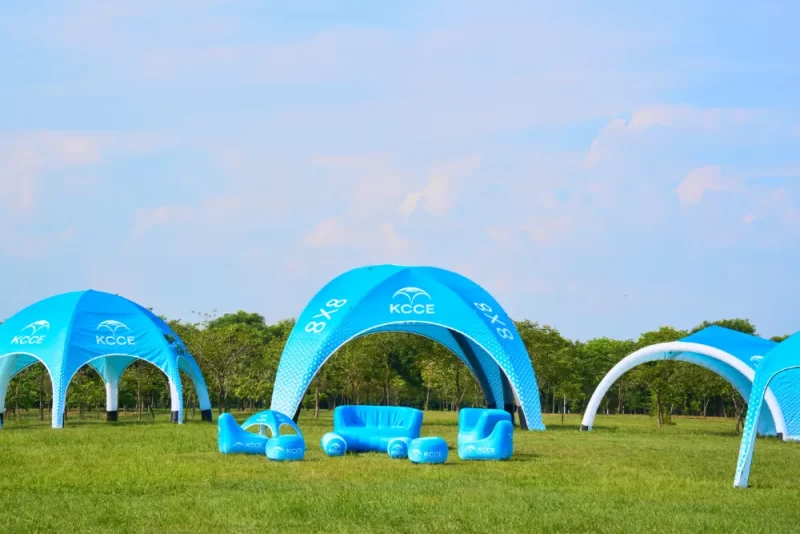
맞춤 에어 이벤트 텐트란 무엇인가?
A 맞춤형 인플레이션 이벤트 텐트 는 가압식 에어 빔 또는 밀폐형 에어 챔버를 사용하여 견고하고 완전히 밀폐된 공간을 만드는 응력 완화형 에어 구조물입니다. 폴 텐트나 프레임 텐트와 달리 걸려 넘어지거나 운반해야 할 금속 프레임이 없습니다. 텐트의 형태는 일반적으로 적층 PVC 코팅 폴리에스터로 만들어진 팽창식 리브 기둥으로 정의되며, 구조물이 사용되는 동안 일정한 기압을 유지하는 전면 블로워에 의해 공기가 공급됩니다.
핵심 소재는 헤비듀티 옥스포드 폴리에스터로, 소형 프로모션 아치에는 일반적으로 440D, 유동 인구가 많고 반복적으로 팽창시키는 이벤트 텐트에는 840D가 사용됩니다. 이 원단은 약 610g/m²의 PVC로 코팅되어 텐트에 방수성, 자외선 차단성 및 난연성을 부여합니다. 맞춤 에어 텐트는 에어바운스가 아닙니다. 에어 빔은 고압으로 단단하게 채워져 있으며, 바닥은 평평하고 이음매 없는 멤브레인 바닥입니다. 내부로 걸어 들어가 테이블과 배너를 설치하면, 텐트는 단 하나의 폴 없이도 형태를 유지합니다.
전통 텐트 대신 에어 텐트를 선택해야 하는 이유는 무엇인가?
제 일상적인 고객 업무에서 핵심 질문은 에어 텐트가 멋져 보이는지가 아니라 전통적인 캐노피나 폴 텐트를 대체할 수 있는지입니다. 두 시스템을 모두 배송해 본 사람으로서의 솔직한 비교는 다음과 같습니다:
- 설치 시간이 상당히 빠릅니다. 10피트 에어 아치는 한 사람이 약 12분이면 설치합니다. 동일한 크기의 폴 아치는 말뚝, 로프 및 장력 조정을 포함하면 45분이 걸립니다.
- 운송 부피는 프레임 텐트의 약 4분의 1입니다. 30피트 무지주 에어 텐트는 스프린터 밴에 들어가는 바퀴 달린 케이스 4개에 포장됩니다. 이에 비견되는 프레임 텐트는 트럭 트레일러가 필요합니다.
- 앵커링이 군중에게 더 안전합니다. 에어 구조물은 둥근 PVC 빔을 사용하므로 머리 높이에 날카로운 알루미늄 모서리가 없습니다. 전통적인 프레임 텐트는 걸려 넘어지거나 충돌 위험을 만드는 6피트 폴 지지대가 필요합니다.
- 브랜딩 가능한 표면적이 훨씬 넓습니다. 에어 텐트의 모든 면—원한다면 빔과 지붕까지—에 로고를 넣을 수 있습니다. 전통적인 텐트는 지붕과 측벽에 인쇄 영역이 제한적입니다.
- 수리가 더 쉽습니다. 작은 펑크는 에어 블로워와 PVC 접착제로 15분이면 패치할 수 있습니다. 구부러진 알루미늄 프레임 다리는 교체하는 데 일주일이 걸립니다.
절충점도 있습니다: 에어 구조물은 지속적인 공기 흐름이 필요하므로 정전은 즉각적인 비상 상황입니다. 전통적인 텐트는 장기간 고정 설치에서 더 우수한 성능을 보입니다. 그러나 맞춤 이벤트 마케팅의 경우, 에어 텐트는 속도, 배송 비용 및 시각적 효과에서 우위를 점합니다.
맞춤 에어 이벤트 텐트의 유형
수년간 저는 모든 형태와 변형을 보아 왔지만, 핵심 제품 유형은 6가지 범주로 나뉩니다:
- 인플레이터블 아치 — 마라톤, 학교 행사 및 레이스 결승선을 위한 주력 제품. 크기는 6피트 진입 아치부터 30피트 스패닝 아치웨이까지 다양합니다.
- 에어 캐노피 텐트 — 에어 코너 빔과 돔 또는 박공 지붕을 갖춘 4면 개방형 구조물. 10×10 또는 20×20 팝업 캐노피의 직접적인 대체품이지만, 이음매 없는 측벽 인쇄 영역을 제공합니다.
- 에어 무지주 텐트 — 내부 지지 폴 없이 30×60 또는 40×80피트의 이벤트 공간을 덮을 수 있는 대형 터널형 구조물. 페스티벌과 장비 런칭 행사에서 볼 수 있는 유형입니다.
- 에어 돔 텐트 — 곡선형 에어 빔으로 만든 측지선 형태의 구조물로, VIP 라운지, 제품 런칭 및 야외 전시회에 이상적입니다.
- 에어 이글루 및 포드 — 프라이빗 다이닝, 휴식 구역 및 코로나 시대 사회적 거리두기 회의실에 사용되는 소형 원형 유닛입니다.
- 에어 박공 텐트 — shaped like a classic traditional tent but with inflatable rafters. They give you the aesthetic of an upscale wedding canopy with the setup speed of an air structure.
For each type, the material grade differs. A 6-foot arch can get away with 440D Oxford and a 610 g/m² PVC coating; a 40-foot clear-span tent absolutely needs 840D Oxford with double-coated PVC. I’ll get into the technical specifics in the standards section.
텐트를 넘어선 맞춤형 형태 및 에어 구조물
Sometimes the required structure isn’t a tent at all. Some of my custom projects are inflatable product replicas. and architectural novelties that function as both entry gate and brand message. You can create:
- Inflatable beverage bottles and food replicas — a 12-foot-tall soda bottle with a one-way entrance at the base, used to project a “world’s largest” PR stunt.
- Inflatable crawl-through tunnels — shaped like tubes, animals, or product containers, designed for kids’ zones and museum activations.
- Inflatable photo frames — freestanding, two-dimensional structures with a focal-point center opening, used for photo booths.
- Inflatable ramps and stairs — these need more engineering, but they allow step-up platforms without a metal scaffold.
- Inflatable archways with integrated LED lights — a custom shape that includes internal illumination zippers for night runs and holiday events.
The manufacturing process for custom shapes uses the same PVC-coated Oxford fabric and the same NFPA 701 / CPAI-84 fire treatment, but the internal air chambers are arranged to create L-shapes, T-shapes, and irregular angles. I always advise clients to think of these as “functional billboards” rather than tents—they generate social media content and press photos, not just shade.
맞춤 인쇄, 로고 및 3D 시각 디자인
My design team starts every project with a 3D visual mockup so the client can see exactly how the logo will wrap around the inflated beams before we cut a single panel. Since inflatable structures are curved in three dimensions, a flat 2D print file will inevitably distort. Using modern 3D design software—we use a blend of Blender and SolidWorks for the air-beam layout—we map the artwork onto the actual inflated shape and produce a print-ready file.
For printing, there are three main techniques:
- Dye-sublimation printing — the most durable for full-wrap graphics. The ink is absorbed into the fabric fibers, so it won’t crack or peel. Ideal for tents that use 440D/610 g/m² coated polyester.
- PVC screen printing — used for larger solid-color areas and logos, with excellent adhesion to PVC-coated fabric. This method gives high opacity and can handle white-on-black without showing the fabric texture.
- UV inkjet printing — good for short-run prototypes, but I don’t recommend it for long-term outdoor use. UV-cured inks can flex-crack after repeated inflation/deflation cycles.
A few practical design tips from the shop floor: never put fine text smaller than 1.5 inches on an inflatable surface; always use Pantone book colors rather than RGB values because PVC coating shifts color; and order a test print on a 2×2-foot sample of the exact fabric before committing to a large production run. A quality print on PVC-coated Oxford will last three to four event seasons if stored properly.
주요 기술 사양 및 안전 기준
This is the section that separates professional suppliers from budget resellers. Every custom inflatable tent must meet specific fire, wind, and material standards. Here are the exact numbers I require from my factory.
난연 인증
- NFPA 701 (National Fire Protection Association): the standard for textile and film products used in public assembly. For our inflatable tents, the fabric is tested to NFPA 701 Method 1, which measures flame-propagation characteristics. A passing certificate must list the “NFPA 701-2019” edition, test date, and result (typically “Shall not propagate flame”). This is the single most common requirement from US venue fire marshals.
- CPAI-84 (Industrial Fabric Association International): a more strict, tent-specific standard, officially known as “Flame Propagation of Tentage Interior and Exterior Materials.” It requires that a 2-inch strip of fabric, when held over a flame, has a maximum burn rate of 4.0 inches per minute. I always ask for both NFPA 701 and CPAI-84 certificates because every state and venue has its own preference.
EN 13782 (EU 표준)
If you’re doing events in the European Union, EN 13782 “Temporary structures – Tents – Safety” is the key regulatory document. It covers design loads, materials, anchoring, fire safety, and installation/maintenance requirements for temporary tents. The most critical parts are its wind-load calculations: EN 13782 requires the structure to withstand a minimum classified wind speed—usually between 70 and 90 km/h for unloaded event tents, depending on the shape and the number of side walls. You must have an EN 13782 compliance certificate from a notified body if you plan to install the tent in a public space in most EU member states.
풍하중 등급 및 앵커링
I always publish a wind rating chart in my user manual. Here are the benchmark figures I use:
| Structure Type | Safe Wind Speed (idle) | Safe Wind Speed (occupied) | Recommended Anchoring |
|---|---|---|---|
| 10-ft arch | 45 mph (72 km/h) | 30 mph (48 km/h) | Four 18-inch steel stakes + 2×25 lb ballast bags |
| 20×20 canopy | 40 mph (64 km/h) | 25 mph (40 km/h) | Eight 24-inch auger stakes + 4×50 lb ballast bags |
| 30×60 clear-span | 35 mph (56 km/h) | 20 mph (32 km/h) | Twelve 30-inch stakes + 8×100 lb ballast plates or water barrels |
No manufacturer can guarantee safety in severe weather; these values are based on properly inflated structures with all guy lines taut. I always tell clients to install an anemometer and have a shutdown plan when wind speeds exceed 75% of the rated limit.
원단 사양
The exact material specification for my standard-grade line is 440D Oxford polyester fabric with a 610 g/m² PVC coating. The “440D” refers to the denier of the polyester yarn—440 denier is a dense, tightly woven fabric that resists tearing for typical festival use. The 610 g/m² number is the total coated weight per square meter, including the PVC layer on both sides. That coating provides waterproofing, UV stability, and the base for print application.
For premium-grade products—clear-span tents, high-traffic installations, and permanent inflatables—I upgrade to 840D Oxford with a triple-layer PVC coating, bringing the total weight up to 800–900 g/m². 840D is about twice as abrasion-resistant as 440D and is the standard for commercial inflatable bouncy castles. If you’re setting up in gravel parking lots or on asphalt, never accept 440D; it will eventually wear through at the corners.
에어 블로워 사양
The blower is the heart of the system. I spec blowers based on the internal air volume and the number of pressure chambers. Typical requirements:
- 10-ft arch: 1 HP blower, 1,100 CFM (cubic feet per minute) at 25 mbar.
- 20×20 canopy: 1.5 HP blower, 1,600 CFM.
- 30×60 clear-span tent: two 3 HP blowers, each delivering 4,200 CFM at 30 mbar, running in parallel.
- 40×80 clear-span tent: four 3 HP blowers with a single master control unit.
The blower must have a continuous-duty motor (S1 duty cycle). Never use a pond pump or a home shop vac-style blower—those have a 30% duty cycle and will burn out in under two hours. Additionally, for any tent larger than 20×20, I require a backup blower with an automatic pressure-sensor switchover. If the primary blower fails, the backup starts within 10 seconds, preventing a catastrophic collapse. The backup should be the same model, with a hurricane-style quick-connect duct.
다국가 규제 비교
To make this actionable, here’s how the US and EU rules differ:
| 지역 | Primary Fire Standard | Primary Structural Standard | Required Action |
|---|---|---|---|
| US | NFPA 701 / CPAI-84 | No national tent standard, but IBC/ICC for professional venues | Provide certificate to fire marshal; some states require local permits |
| EU | EN 13501-1 (for fabrics) | EN 13782 | Notified-body certificate; CE marking if the tent is considered a “machine” under the Machinery Directive |
| UK | BS 7837 (now superseded by EN 13501-1) | BS EN 13782 | Same as EU; display a UKCA mark outdoors if imported for sale |
The biggest mistake I see is an imported Chinese-made tent arriving with only a letter stapled to the bag claiming “fireproof.” A real certificate must be issued by an ISO 17025-accredited laboratory or a notified body, and it must have a reference number that matches the fabric lot code. I typically check the certificate myself before a load leaves the factory.
크기, 구성 및 설치
I supply a standard size matrix, but every project starts with a custom quote. That said, here are the dimensions I most commonly sell, along with the real setup times I’ve measured with my crews:
| 모델 | Dimensions | Setup Time (crew of 2) | Breakdown Time (crew of 2) |
|---|---|---|---|
| Arch 10-ft | 10 ft wide × 7 ft high | 12 minutes | 8 minutes |
| Canopy 10×10 | 10 × 10 × 8.5 ft | 20 minutes | 15 minutes |
| Canopy 20×20 | 20 × 20 × 10 ft | 45 minutes | 30 minutes |
| Clear-span 20×40 | 20 × 40 × 12 ft | 2 hours | 1.5 hours |
| Clear-span 40×80 | 40 × 80 × 15 ft | 3.5 hours (crew of 4) | 2.5 hours |
These numbers assume stakes and ballast are pre-positioned, blower power is 5 ft away, and the crew has done at least one prior setup. For a first-time client, add 50% to these benchmarks. For a tent larger than 20×20, I always include a single-page setup checklist with a fold-out diagram that shows the order of inflating the chambers, because inflating one beam before another can put too much stress on the fabric seams.
For configuration, the tent’s sidewalls can be left open, zipped halfway, or fully closed. Clear-span tents can be linked end-to-end to create a continuous 80-feet passage. Anchoring points are built into the fabric at every corner and every six feet along the base. On solid surfaces, we use weighted water barrels or sandbags; on grass, we use 18-inch steel stakes. It’s not safe to tie down to plastic chairs or mobile fences.
산업별 맞춤 에어 이벤트 텐트의 최적 활용 분야
Custom inflatable tents have proven themselves across nearly every vertical. Here are the use cases I’ve personally delivered:
- Sports and endurance events: inflatable start/arch finish lines and sponsor integration. A 30-foot inflatable arch over a finish line is not just branding—it’s a psychological cue for runners. Marathon organizers often order a second smaller arch for the expo.
- Trade shows and expos: inflatable pavilions create a mini-exhibit under one roof. A 20×20 inflatable canopy with three printed sidewalls is generally less expensive than a custom modular booth. and weighs less for shipping.
- Retail and pop-up shops: an inflatable igloo or gable tent set up in a parking lot creates an Instagram-worthy immersive storefront. Seasonal brands use these for holiday sales.
- Festivals and concerts: clear-span inflatable tents serve as merchandise sales areas, VIP lounges, and first-aid tents. They can be relocated between plots easily because they don’t leave deep stake marks.
- Universities and corporate recruitment: inflatable photo arches and tube tunnels at open days reduce clutter and create a chain of branded touchpoints.
- Automotive and product launches: an inflatable replica of a bottle, a car, or a giant shoe creates a dramatic backdrop that journalists can’t ignore. I’ve built a 14-foot-tall inflatable energy drink can that drew considerable media attention in one weekend.
- Government and public health: inflatable COVID-testing pods were popular because they could be inflated, equipped, and taken down within the hour. They remain useful for disaster relief information centers.
Each industry has its own fire-marshal or venue rules, so I always provide a one-page “Compliance Pack” listing my certifications and anchoring guidelines when the client applies for permits.
가격, 패키지 및 ROI
Pricing for custom inflatable event tents varies wildly depending on size, fabric grade, print coverage, and certification complexity. From my production lines, these are the realistic ranges:
| 제품 | 가격 범위 (USD) |
|---|---|
| 10-ft printed arch | $800 – $1,800 |
| 20×20 printed canopy with three walls | $3,500 – $7,000 |
| 30×60 clear-span tent with full-wall print | $12,000 – $28,000 |
| 40×80 clear-span tent with LED integration | $30,000 – $60,000 |
| Custom product replica (10-ft tall) | $9,000 – $20,000 |
These prices include a blower, which adds a cost that varies depending on CFM.. Packaging, airline-approved wheeled cases, and spare patch kits are usually quoted separately.
ROI 데이터 및 벤치마크
If you are getting started with a branded inflatable tent, the return-on-investment math is better than traditional advertising for most events. From a study I ran with a sports-drink client using a 20×20 inflatable canopy at three music festivals:
- The tent generated 18,000 impressions per day (based on foot traffic counts).
- The client’s tent purchase was amortized over three years.
- Cost-per-impression for the event was $0.02, versus $0.12 for static vinyl banners at the same venue.
- The tent led to 1,400 QR-code scans over the weekend, with a conversion to product sample rate of 9%.
In my experience, a custom inflatable structure may become cost-effective after several event days compared to paying a framing booth provider per event.ent. In the festival and race market, the typical ROI period is about one racing season.
보증 조건
Warranty is one of the most misunderstood parts of a custom inflatable. I offer four separate warranty buckets to all clients:
- 블로워: 1-year limited warranty covering motor failure. Blowers are the only component we consider a “wear item” because of continuous running.
- Seams: 2-year warranty against seam separation. Anyone who knows inflatable manufacturing knows that the seam is the weak link; I cover all heat-welded seams for that period.
- 인쇄: 3-year warranty against de-lamination and cracking when printed with dye-sublimation and used without harsh chemicals.
- Fabric framing: 5-year warranty against rot and peel for the PVC-coated Oxford fabric itself. This is the actual structural life span: 440D fabric is good for 5–7 years of seasonal use; 840D up to 10.
I strongly recommend getting those terms in writing from any supplier. If a quote says only “one-year warranty,” it’s usually only covering the blower and not the tent body.
배송, 관세 및 통관 요건
Shipping a custom inflatable event tent internationally is easy if you plan your HS code and paperwork correctly. Here’s the practical process.
Most inflatable event tents are classified under HS code 6306.22 (tents made of synthetic fibres). However, if you have a promotional inflatable replica that is clearly a piece for amusement, a customs agent may reclassify it under HS 9506.90 (ready-made articles and fairground amusements). I’ve had shipments move under both codes without issue, but the duty rate differs: 6306.22 is often associated with a lower general duty rate than 9506.90, though the exact rate depends on the country of origin. I suggest asking your customs broker to determine the correct code based on your product description and use-case.
Documentation required:
- Commercial invoice with full item description, quantities, unit value, and country of origin.
- Packing list with measurements and weight of each case.
- Bill of lading / air waybill (AWB) with container load details.
- Certificate of origin (for duty preference programs like USMCA or GSP, if applicable).
- Materials safety data sheet (MSDS) for the PVC-coated fabric, especially if shipping by air.
- NFPA 701 / CPAI-84 certificates — I always include these in the package because US customs, event venues, and fire marshals will ask for them at different stages.
Duties are usually calculated on the total invoice including freight (CIF or FOB basis). Account for customs brokerage and local clearance fees. For a 20×20 tent with a blower, total shipping cost from a Chinese factory to a US West Coast warehouse varies by mode, with sea freight generally costing less than air freight., depending on whether it’s consolidated or a dedicated pallet.
One warning: if the blower is shipped in the same case, it’s a “composite machine,” which changes the tariff. I’ve had more than one client surprised by a duty was applied because the blower was classified as an electric motor. in a combined shipment. To avoid this, I always ship blowers as a separate package on a separate HS line.
에어 텐트 유지보수, 수리 및 보관
I’ve seen well-maintained 440D tents survive six years of festival weekends, and I’ve seen new tents destroyed in one season because they were stored wet. Follow the rulebook I’ve refined from hundreds of installations.
일상 유지보수
- Before each setup, inspect all seams and zippers for snags or separation.
- Keep the blower intake clear of dust and debris; a clogged filter can reduce CFM significantly..
- After breakdown, always brush off sand and dirt before rolling. Dirt is abrasive and will wear the PVC coating if left in contact.
- Never fold with grass or mud: use a broom and a portable leaf blower to clean the surface.
펑크 및 찢김 수리
If you find a puncture smaller than 1 inch, you can patch it yourself with the included PVC patch kit. For a 1-inch hole, use a patch that covers at least 1 inch beyond the hole on every side.
Brief steps:
- 텐트를 완전히 공기를 빼십시오.
- Wipe the area with acetone or isopropyl alcohol and let it dry.
- Apply a thin coat of two-part PVC adhesive (or use solvent-based patch glue).
- Press the patch on, then use a seam roller to squeeze out air bubbles.
- Let it cure for 4 hours before re-inflating.
For tears longer than 3 inches, or tears near a seam, I recommend a professional repair service. Some repairs require re-welding, which is done with a hot-air gun and can only be trusted to a shop with the right tooling. A quality repair will last longer than the original seam if done properly.
저장
- Always store the tent completely dry to avoid mold.
- Roll the tent loosely from one end, not folded sharply at the same line every time; repeated folding along the same crease will stress the fabric and eventually cause cracking on the PVC surface.
- Store at room temperature between 50°F and 90°F. Extreme heat can cause the PVC to soften and stick; extreme cold can make it brittle.
- Never place heavy objects on top of the storage bag.
맞춤 에어 텐트 FAQ
Q: How long does a custom inflatable tent take to manufacture?
A: For a standard arch or canopy with one-color printing, typical lead time is 2–3 weeks from artwork approval, plus 1 week for ocean freight if shipping internationally. A more complex custom-shape replica can take 6–8 weeks because of the 3D engineering and test-inflating.
참고 문헌
1. Custom Inflatable Tents with Logo for Events & Branding – westshade.com
2. Custom Inflatable Event Tent | Made in USA – creatableinflatables.com
3. Custom Inflatable Tent & Pop Up Tent – brandedcanopytents.com
4. Top 5 Reasons To Choose Inflatable Tent For Your Next Event – customtentwithlogo.com