为什么您的充气广告帐篷需要的不仅仅是一块补丁
您刚刚在定制印刷的充气广告帐篷上花了三千到五千美元,甚至更多。上面有您的标志、您的颜色、您的标语——一切都是为了在下一场贸易展、开业庆典或社区节庆上吸引眼球。看起来很棒,感觉很结实。能出什么问题呢?
让我为您描绘一幅让我夜不能寐的画面。您在一个周末户外市集上搭好了帐篷。一阵风——甚至算不上“暴风雨”,只是一阵意外的阵风——以错误的角度吹向帐篷。帐篷摇晃、侧翻,倒向旁边的展位,一位路人的肩膀被帐篷角撞到。她伤得不重,但受到了惊吓,而且她正在谈论医疗费用。与此同时,您撞到的展位上摆满了手工陶器。现在地上有价值两千美元的陶瓷碎片。而场地经理正盯着您,向您索要保险凭证。.
您没有。.
所以没错,这正是为什么您的充气广告帐篷需要保险——不仅仅适用于充气城堡或儿童租赁设备,而是针对您的品牌帐篷所面临的独特风险。.
我在活动设备行业深耕多年,我可以告诉您:因为“不过是个帐篷”而跳过保险的人数多得惊人。他们认为客户签署的免责声明就是魔法护盾。他们认为自己的房屋保险能覆盖。他们认为坏事不会发生,因为到目前为止还没有发生过。.
这种想法会付出真金白银的代价。.
所以让我直截了当地说清楚:为什么保险对您的充气广告帐篷来说不是可选项——您需要哪些类型、实际费用是多少(附真实数字)、不投保会有什么后果,以及如何买到不被坑的正确保单。没有废话,没有空洞的陈词滥调,只有来自一个见过这枚硬币两面的人提供的实用事实。.
让我们从实际可能出什么问题开始。.
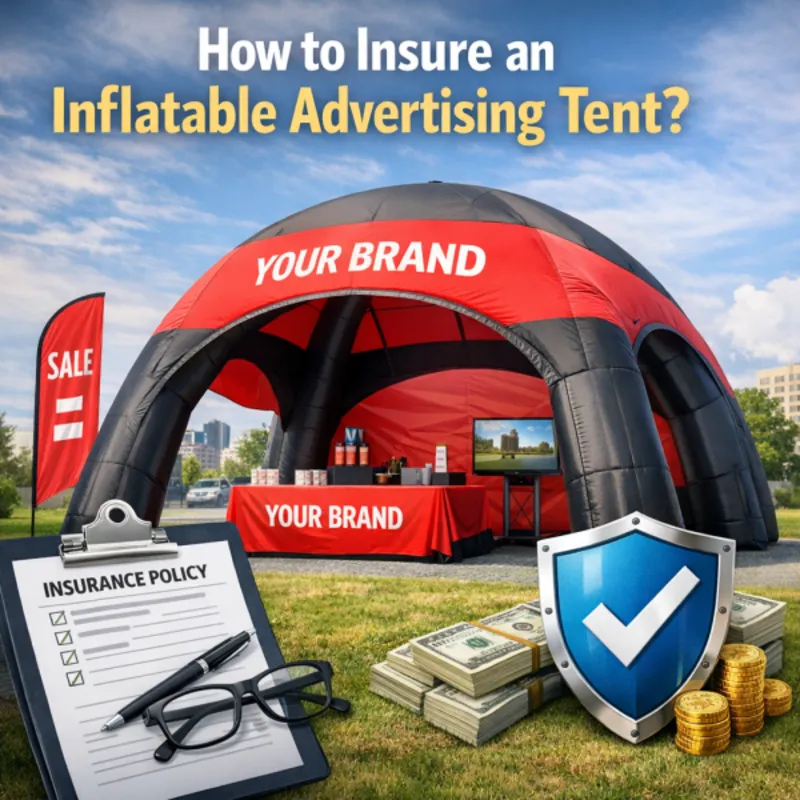
真实风险:充气广告帐篷可能出什么问题
您可能在想: 不过是个帐篷,已经固定好了。有什么大不了的?
事实是——充气广告帐篷的风险特征与您邻居出租用于生日派对的充气城堡完全不同。风险更多不在于“有人跳错了方向扭伤了脚踝”,而在于“结构在公共场所失效,带来昂贵的后果”。”
风损是最大的风险。. 充气帐篷就像巨大的风帆。它们以刚性结构不会的方式受风。根据我的经验,大多数保险公司将风灾保障限制在相对较低的风速。超过该限度,您就只能靠自己了。一个15英尺的广告帐篷遭遇35英里/小时的阵风,会产生巨大的向上力。如果您的锚固系统不够完美——说实话,您在活动前多久会检查一次每一根地钉?——那个帐篷就会飞起来。.
我看过一家租赁公司拍的照片,仅财产损失就相当可观。那是一个阳光明媚的日子,用沙袋固定着。一股锋面系统过境,阵风达到40英里/小时,帐篷在停车场里翻滚。它撞凹了两辆车,差点撞到一个走向自己车的家庭。没有人死亡,但仅财产损失就超过了一万五千美元。.
搭建和拆除事故。. 这些不那么戏剧化,但更为常见。您有150磅重的PVC布、一台鼓风机、电线和地钉。有人被系留绳绊倒——可能产生手腕骨折的医疗索赔。您从卡车里搬鼓风机时把它砸到了自己脚上。帐篷在组装过程中因为有人在地面上拖拽而被刺破。听起来熟悉吗?
盗窃与故意破坏。. 品牌帐篷是目标。一个印有您公司标志的定制帐篷不是您能在大卖场随便替换的。它是按订单制造的设备,需要数周的交货时间。如果它从您的工地或锁好的拖车中被盗走,您下个周末就无法运营了。而且您的标准财产保险可能不覆盖没有特定附加条款的“神秘失踪”。.
结构失效造成的人身伤害。. 这是人们不会想到的一点。一条维护不良的接缝在压力下裂开。帐篷泄气——不是优雅地,而是突然坍塌,可能把人压在下边。即使人们不像在充气城堡里那样“蹦跳”,您仍然拥有一个如果失效可能造成真实伤害的结构。.
承保充气广告帐篷的保险公司会仔细审视这些结构的“独特属性和使用环境”——我从一份行业文件中读到过。他们不会将其视为充气城堡。他们知道风险特征是不同的。.
问题在于:大多数标准活动保险保单是为充气城堡设计的。它们假设有孩子在跳跃、柔软的着陆表面和有监督的运营。而一个在商业博览会上、周围有数百名成人走动、靠近食品摊贩和电气设备、面临不可预测天气的充气广告帐篷?那完全是另一种情况。 充气广告帐篷 所以当您去购买保障时,请记住:搜索“充气广告帐篷”或“活动帐篷责任险”——而不是“充气城堡保险”。错误的保单会让您即使自认为有保障,实际上仍然暴露在风险中。.
每次我和新的帐篷业主交谈时,他们都会告诉我同样的话:“但我让每个人都签了免责声明。”他们说这话时带着一种刚发现了对抗诉讼的魔法咒语般的自信。.
理解责任:为什么免责声明远远不够
事实是,这可能会让您有点难受:免责声明是有用的,但它们不是大多数人想象的那种堡垒。.
免责声明保护您免受“风险承担”的约束——即客户承认存在固有危险并接受了这些危险。.
如果一个孩子从充气城堡顶部跳下来摔断了胳膊,这很有效。家长同意了跳跃有风险。 但那个只是路过您的帐篷、因为帐篷倒塌而被砸中的路人呢?他们没有签署任何文件。他们没有承担任何风险。他们只是一个行人,恰好在自己结构失效时站在了错误的地方。免责声明对保护您免受第三方责任完全没有作用。—meaning the customer acknowledged that there are inherent dangers and accepted them. That works great if a kid jumps off the top of a bounce house and breaks an arm. The parent agreed that jumping has risks.
But what about the passerby who’s just walking past your tent and gets hit because it toppled? They didn’t sign anything. They didn’t assume any risk. They were simply a pedestrian who happened to be in the wrong place when your structure failed. A waiver does absolutely nothing to protect you from liability to third parties.
Even with customers who do sign, courts routinely strike down waivers if they find them too broad, unclear, or if the injury resulted from gross negligence on your part. And here’s a scary stat: I’ve seen numbers from the insurance industry that show many states have laws that specifically limit the enforceability of waivers for commercial activities. In some jurisdictions, waivers for recreational activities are often upheld, but for purely commercial events they’re much harder to defend.
So what happens when a waiver fails? You get sued personally. Your business gets sued. And The cost of defending yourself—even if you win—can be substantial in legal fees. That’s before any settlement or judgment.
General liability insurance is what actually protects you. It covers the legal defense costs. It covers the settlement or judgment. It pays the medical bills of the injured party. And it does all of this regardless of whether the person who was hurt signed anything.
Think of it this way: a waiver is a shield you hold up and hope the judge respects. Insurance is a suit of armor that covers your whole body, plus someone else to fight the battle for you.
Now I’m not saying waivers are useless. You should absolutely have customers sign them. They do provide some protection, especially for the “assumed risk” scenarios. But they are not a substitute for insurance. They’re a supplement to it—one of several layers of protection.
And for those wondering about Cossio insurance bounce house—yeah, that’s one provider that handles inflatable-related policies. But like I said, bounce house coverage isn’t the same as advertising tent coverage. Make sure you’re buying the right product.
您必须考虑的保险类型
Alright, you’re convinced. You need insurance. Now what does “insurance” actually mean when we’re talking about an inflatable advertising tent?
It’s not one policy. It’s a stack of coverages, each designed to handle a specific type of risk. Depending on how you use your tent, you’ll need some or all of these. Let me break them down one by one.
商业一般责任险
This is the foundation. Everything else starts here.
Commercial General Liability (CGL) covers bodily injury and property damage caused by your business operations. A kid trips over your blower cord and breaks a tooth? CGL covers it. Your tent falls on a vendor’s display? CGL covers it. A customer claims your setup was dangerous and they got hurt? CGL covers the legal defense and any settlement.
According to Channal Inflatables, the commercial general liability insurance policy is “comprehensive insurance which provides coverage for bodily injury and property damage caused by your business.” It may not be required by law in most states, but it’s the one policy you “should definitely purchase.”
Most venues won’t let you set up without proof of CGL, typically with a minimum limit of $1 million per occurrence and $2 million aggregate. Some high-traffic events require $2 million per occurrence. And they’ll want to be named as an “additional insured” on your policy—which brings us to a later section.
Product Liability is often bundled with CGL, but it deserves its own mention. It covers you if someone claims that your inflatable tent itself—the product—was defective and caused injury. Maybe a seam split because of poor manufacturing, or a valve failed and caused a sudden deflation. Product liability covers that. Channal Inflatables specifically says product liability “covers your business from being claimed by injuries and harms because of your inflatable equipment.”
设备租赁责任险 / 内陆运输险
Here’s where things get specific to the inflatable tent world.
If you’re renting out your tent to other people—say, you own a party rental company and your inflatable advertising tent is one of the items in your inventory—you need equipment rental liability. This covers the tent while it’s in the possession of your customer. If the customer damages it, or if it causes damage while under their supervision, this policy responds.
But what about the tent itself? What if it gets stolen from your locked trailer, or a warehouse fire destroys your entire inventory? That’s where Inland Marine coverage comes in. Despite its name, it’s not about boats. Inland Marine covers movable property—equipment that goes from job site to job site. Your inflatable tent is exactly the kind of asset that Inland Marine exists to protect.
Many tent owners don’t realize that a standard general liability policy does NOT cover damage to their own tent. If your blower catches fire and melts a hole in the vinyl, general liability says “that’s your equipment, not our problem.” You need Inland Marine or a separate equipment floater for that.
财产损失与物理损坏保障
This one’s simpler. Property damage insurance covers your tent, blower, stakes, and other equipment if they’re damaged by specific perils: fire, theft, vandalism, storm, or vehicle collision during transport.
If your tent that’s currently set up gets shredded by unexpected hail, property damage coverage replaces it. If someone slashes your tent overnight at an event site, same thing.
Now, a critical distinction: most property policies exclude “wear and tear” and “mechanical breakdown.” A gradual degradation of the vinyl from sun exposure? Not covered. A blower motor that dies from regular use? Not covered. These are maintenance issues, not insurance events.
The source material from kcce-event.com emphasizes that you should keep “receipts, photographs of the inflatable advertising tent, and records of any damages or repairs” to facilitate claim processing. Good documentation is your best friend here.
伞式责任险 / 超额责任险
Let’s say a worst-case scenario plays out. Someone is seriously injured—permanent damage, long-term care, lost wages. A jury awards a $3 million judgment. Your general liability policy caps at $1 million. Where does the other $2 million come from?
Your personal bank account. Your business assets. Your future earnings.
Umbrella liability insurance sits on top of your general liability and provides an extra layer of protection—typically $1 million to $5 million in additional coverage. It kicks in after your underlying policy limits are exhausted.
For a tent owner, is umbrella necessary? If you’re a small operator doing a handful of events a year, probably not. But if you’re renting tents commercially, or if your tent is used at high-profile events with lots of foot traffic and deep-pocketed plaintiffs’ attorneys nearby, umbrella coverage is cheap peace of mind. An extra $1 million in coverage typically costs a few hundred dollars per year.
场地损坏与附加被保险人批单
You rent a space at a park, a fairground, or a convention center. The venue contract says: “You must name the venue as an additional insured on your general liability policy.”
This is standard. It’s not optional if you want to do business at most professional venues.
充气广告帐篷 additional insured endorsement extends your coverage to protect the venue against claims arising from your operations. If your tent damages the venue’s property, the venue can file a claim under your policy. It also protects them if they get sued because of something you did—for example, a visitor trips over your tie-down rope and sues both you and the venue. Your insurance covers both of you.
Venue damage coverage is a separate but related concept. Some policies automatically include coverage for damage to the premises you’re renting—like a stained carpet or a scratched floor. Others exclude it. If you’re setting up on a pristine hotel ballroom floor, that exclusion could cost you thousands when the hotel sends you a bill for floor replacement.
For those of you wondering about bounce house insurance near me—the same types of coverage apply, but the risk profile differs. A bounce house operator has more injury claims but fewer “sail effect” wind issues. Make sure your agent understands you’re covering an advertising tent, not a jump house.
充气广告帐篷保险费用是多少?
Now for the question everyone actually wants answered: what does this cost me?
The short answer: a lot less than you think, and a tiny fraction of what a single claim would cost.
Let me give you the real numbers, gathered from industry quotes and rental company data.
One-day event insurance for a single inflatable advertising tent typically runs between $50 and $150 per event. This gives you $1 million in general liability coverage for that specific day at that specific location. It’s cheap. It’s easy to get online. And it’s perfectly adequate if you’re a one-tent operator doing just a few events per year.
Annual policies for a business that operates inflatable tents regularly cost $400 to $1,200 per year. This covers all your events, plus your equipment when it’s in storage or transit. The exact price depends on your tent’s value, your locations, your coverage limits, and your claims history.
Let me break the cost factors down further.
State location matters a lot. Operators in wind-prone areas may pay significantly more due to wind and hurricane risk. California is also pricier because of higher medical cost baselines and a more litigious environment. The Midwest is generally cheaper. If you’re looking for insurance for your inflatable advertising tent in California specifically, the answer is straightforward: California’s venue operators and event organizers are highly insurance-conscious. You’ll be asked for proof of coverage at almost every professional venue.
Coverage limits drive cost. A certain amount of policy is the baseline. Higher coverage will cost proportionally more. Adding umbrella coverage on top of that adds an extra cost.
Deductibles affect your premium. A standard deductible is common. Increasing it can save on premium. But don’t go too high—if a claim happens, you want to actually be able to afford the deductible.
How many tents you own also matters. An operator with a single $2,000 tent pays less than someone with a fleet of high-value custom units. Most insurers offer discounts for multiple pieces of equipment.
Claims history is the big one. One claim can double your premium for three to five years. That’s why risk reduction isn’t just about safety—it’s also a financial strategy. More on that in a minute.
Now here’s the ROI argument. According to insurance industry data [来源待补充], The average liability claim for a minor incident involving event equipment can run in the tens of thousands of dollars. Major injury claims can exceed significant amounts.d $75,000. Major injury claims can exceed $200,000. Even a modest claim will wipe out the entire annual budget of a small tent rental business.
So let’s compare: $600 per year for insurance versus a $50,000 claim. That’s not even a contest. Insurance pays for itself the moment something goes wrong.
And if nothing goes wrong? You’ve spent $600 for peace of mind and access to venues that require insurance. That’s the cost of a nice dinner for two. It’s nothing.
For those of you checking bounce house rental insurance cost as a benchmark—it’s similar, but advertising tent insurance can actually be cheaper because the injury rate is lower. Bounce houses have higher claim frequency from kids getting hurt. Advertising tents have higher claim severity from property damage and third-party liability.
影响您保费的因素(尺寸、地点、理赔记录、安全措施)
You want to control your insurance cost. I get it. Nobody likes writing checks for things that might never happen.
Here are the specific factors that determine what you’ll pay, and what you can do about each one.
Tent size. A 10×10 advertising tent costs less to insure than a 20×20. Larger tents catch more wind, create more potential for property damage, and are more expensive to replace. If you’re just starting out, insuring a smaller tent is cheaper and less risky.
Location and state requirements. I mentioned this above, but it’s worth repeating: Florida and California are expensive. If you’re in Florida bounce house insurance territory—high wind, high humidity, seasonal storms—your premium will reflect that. Some operators in coastal Florida pay 50% more than their counterparts in Ohio.
Claims history. One claim increases your premium. Two claims in three years and some insurers won’t even quote you. That’s the reality of the industry. Protect your record by being meticulous about setup, maintenance, and documentation.
Safety measures. Here’s where you can actively reduce your premium. Insurers love risk mitigation. If you can show that you follow manufacturer safety guidelines, use proper anchoring systems, and maintain your equipment regularly, you’ll get better rates.
Your business classification. Are you a party rental company that happens to have an advertising tent? Or are you primarily an event marketing company that uses tents as a promotional tool? The classification matters. Insurers have different rate tables for different business types.
Now for the practical part: what specific safety measures can you implement to lower your premium?
降低风险与保费的逐步指南
Let’s get tactical. Here’s exactly what you can do, starting tomorrow, to make your operation safer and cheaper to insure.
Step 1: Master your anchoring system.
Most tent failures are anchoring failures. You need more than sandbags on a windy day. Proper stake-down systems—auger stakes or screw-in anchors for soft ground, concrete ballasts for hard surfaces—are non-negotiable. The ASTM F2374-21 safety standard for inflatable amusement devices provides specific guidelines on anchoring requirements. Insurers are increasingly asking operators whether they follow this standard. If you can say yes, you’re in a stronger position.
Use at least four anchor points per tent. For larger tents, eight is better. Check stakes every few hours during long events. Wind conditions change. Ground softens. What was secure at 9 AM might not be at 3 PM.
Step 2: Install a wind speed monitor.
This is cheap—like $30 for a handheld anemometer. When the wind hits 25 mph, you deflate and secure the tent. No exceptions. Document the reading and your action. Insurers love this. It shows active risk management.
Step 3: Follow manufacturer maintenance schedules.
Creatable Inflatables emphasizes “years of research and development” in their construction process, including “selecting and upgrading materials to reinforcing stress points.” Your tent’s manufacturer has a maintenance schedule. Follow it. Check seams. Inspect blowers. Replace worn anchor straps.
Document everything with dates and photos. When an adjuster asks, “Did you maintain the tent?” you have an answer with evidence.
Step 4: Create a pre-event inspection checklist.
Every time you set up, walk through this list:
- Tent surface inspected for tears or weak spots
- Seams checked for separation
- Blower function tested
- Electrical cords undamaged and in good condition
- Anchoring system complete and properly installed
- Clear path around tent (no tripping hazards)
- Wind speed checked (record the reading)
Put this on a clipboard or a tablet. Save each completed form. It takes five minutes and could save you thousands.
Step 5: Get proper training for everyone.
If you have employees, train them on setup and takedown procedures. Make sure they know what to do if wind picks up. Include this in your documentation for the insurer.
Step 6: Maintain a clean claims history.
This sounds obvious, but avoid the temptation to file small claims. A $1,000 claim for a minor tear isn’t worth the premium hike that follows. Pay for small repairs out of pocket. Save insurance for the big events—the lawsuit, the major property damage, the theft of a $2,500 tent.
Step 7: Keep your CPSC compliance current.
The U.S. Consumer Product Safety Commission (CPSC) has guidelines for inflatable structures in public spaces. Compliance with CPSC recommendations demonstrates to your insurer that you take safety seriously. It also reduces liability exposure if an incident occurs.
Step 8: Know the international regulations if you operate abroad.
Here’s a wrinkle most small operators don’t think about: customs and international shipping. If you manufacture your inflatable tent overseas or import components, the HS code for inflatable advertising tents (typically 6306.12 or 9503.00 in most customs frameworks) affects duty rates and insurance requirements during transit. Some marine cargo policies require specific declarations for inflatable structures.
If you’re buying from an overseas manufacturer like many suppliers, refer to the model specifications.” ensure your insurance covers the tent from the moment it leaves the factory. A “warehouse to warehouse” clause is common in marine insurance but not automatic in domestic policies.
Step 9: Engage an insurance agent who specializes in event equipment.
Not all agents understand inflatable advertising tents. You want someone who knows the difference between a bounce house and a promotional dome. An agent familiar with the field can help you avoid common costly mistakes—like buying a bounce house policy for an advertising tent, or skipping inland marine coverage because “general liability covers everything.”
Ask the agent: “Have you handled claims for inflatable advertising tents specifically?” If they hesitate, call someone else.
Step 10: Bundle your coverage.
If you have multiple tents, a vehicle, and a storage facility, bundle everything with one insurer. Multi-policy discounts can save 10-15% on each line.
各州特定要求与风险(加利福尼亚、佛罗里达及其他地区)
您可能在想: I’m just a weekend warrior at the local farmers market. Do all these rules apply to me?
Yes and no. The specific requirements depend heavily on your state and even your city.
California is its own universe. Event venues are often strict about insurance requirements. Why you need insurance for your inflatable advertising tent in California comes down to one word: compliance. Many California municipalities require proof of insurance for temporary structures exceeding a certain size or foot traffic threshold. Los Angeles, San Francisco, and San Diego all have specific ordinances. You’ll likely need at least $1 million general liability and to name the venue as additional insured.
California also has AB-5 implications if you use independent contractors to set up and operate your tent. If those contractors aren’t properly covered by your policy, you could be on the hook for workers’ compensation claims that your general liability policy won’t touch.
Florida is a weather play. The state’s building code for temporary structures is strict. If your tent is set up during hurricane season—which is basically six months of the year—your insurer will want to see specific anchoring and monitoring protocols. Wind exclusions are common in Florida policies. If you’re operating near the coast, you may pay a premium surcharge.
New York requires insurance for most event permits. Permits from parks departments, street closure permits, and venue contracts all include insurance requirements. Failure to produce a certificate of insurance can get your application denied or your event canceled.
Texas is more relaxed, but only relatively. Large cities like Houston and Dallas have their own requirements. Smaller towns may not ask. Don’t assume just because nobody asked that you don’t need coverage—you still do. The liability risk exists regardless of whether the venue checks.
For bounce house insurance florida specifically, you’ll find many carriers offering specialized packages. But again, those are for bounce houses. Make sure your policy covers advertising tents specifically, or work with an agent who can build a custom policy for your equipment.
常见问题解答
Q: What kind of insurance is needed for inflatable rentals?
答: 您至少需要购买商业综合责任险,单次事故赔偿限额为100万美元。如果您拥有帐篷,还应考虑投保内陆运输险或财产险,以保障设备本身的安全。许多场地要求您将其列为附加被保险人。对于一次性活动,可购买短期保单,起价约为每天50美元。.
Q: Do I really need insurance on my pop-up camper?
答: A pop-up camper is a different category of equipment—typically covered by RV or auto insurance, not a general liability or event policy. However, if you’re using a pop-up camper as a promotional or advertising structure, your insurer needs to know. It may require a separate rider or business use endorsement.
Q: How much for inflatable insurance?
答: One-day policies run $50-$150. Annual policies range from $400 to $1,200 depending on your tent’s value, location, and limits. The best bounce house insurance pricing is similar, but advertising tent coverage can sometimes cost less because injury risk is lower. Always compare quotes from at least three providers.
Q: Do you have to have a license to rent out inflatables?
答: 许可要求因州和地区而异。许多城市要求办理营业执照,并且——根据您充气设备的性质——可能还需要特别活动许可证。保险几乎永远不能替代许可证,但大多数许可证申请会要求提供保险证明。请向您当地的市政书记员或活动许可办公室咨询。.
Q: Can I use one day bounce house insurance for an advertising tent?
答: Technically yes, but it’s not ideal. One-day bounce house policies are designed for the risk profile of a jump house: children, soft ground, supervised use. An advertising tent in a trade show environment presents different risks—adults, hard surfaces, electrical equipment, nearby food vendors. A specialized “event tent” or “inflatable advertising” policy is safer.
参考资料
- Bounce House Insurance Coverage and Cost – Channal Inflatables
- Custom Inflatable Event Tent | Made in USA – Creatable Inflatables
法律与法规合规:ASTM、CPSC及地方条例
Let’s talk about the legal framework that actually governs your inflatable tent—because ignoring it is exactly how you end up in a liability hole. In the U.S., the Consumer Product Safety Commission (CPSC) doesn’t specifically regulate inflatable advertising tents the way it does children’s bounce houses, but that doesn’t mean you’re free and clear. The CPSC’s ASTM F2374-21 standard—”Standard Practice for Design, Manufacture, Operation, and Maintenance of Inflatable Amusement Devices”—is often cited by insurers as the baseline for safety. Your tent may not be an “amusement device,” but if an adjuster sees that you didn’t follow basic anchoring and wind-speed limits from that standard, they’ll deny your claim faster than you can say “inadequate supervision.”
Local ordinances are where it gets real. I’ve seen some cities require a Special Event Permit for any inflatable structure over a certain height.tall, even if it’s just a signage tent. That permit typically demands a Certificate of Insurance naming the venue as an additional insured, with minimum liability limits of $1 million per occurrence and $2 million aggregate. Some municipalities go further: they require a wind monitor attached to the blower that auto-shuts off at a certain wind speed.mph. If you skip that monitor and your tent goes airborne, your insurer can claim you violated the local code—and that’s a non-coverage event.
One more legal landmine: the “intentional acts” and “natural disaster” exclusions buried in every policy. Here’s what they actually mean. “Intentional act” doesn’t mean you punched someone—it means any damage you knowingly caused or should have known would happen. If you set up your tent on a day when the forecast calls for 40 mph gusts and you do it anyway, the insurer will argue it’s an intentional disregard of safety. “Natural disaster” typically excludes floods, earthquakes, and windstorms over a specified threshold (usually 50–60 mph gusts, but it varies). The catch: many policies define “windstorm” as a named weather event, so a “gust” that isn’t part of a named storm might still be covered—but only if you can prove you followed the manufacturer’s anchoring instructions. I’ve personally reviewed a claim where a tent owner lost a significant amount in damage because he used sandbags instead of auger stakes. on a concrete lot, and the adjuster cited “failure to secure in accordance with ASTM F2374.”
Bottom line: get a copy of your local event permit requirements, check the ASTM standard, and read your policy’s exclusions clause with a highlighter. If the word “windstorm” or “intentional” shows up without a specific mph number, ask your broker to add a weather-waiver endorsement.
国际考量:HS编码、海关及海外保障
If you’re shipping your inflatable advertising tent across borders—say, to a trade show in Frankfurt or Beijing—you need to understand how insurance works when the tent leaves your home country. The first thing customs officers look at is your HS Code (Harmonized System code). For inflatable advertising tents, the correct code is commonly HS 6306.12.00… but if your tent has integrated LED lighting or a blower motor built into the frame, customs may reclassify it as HS 9405.40 or HS 8414.80.ed LED lighting or a blower motor built into the frame, customs may reclassify it as HS 9405.40 (electric lamps and lighting fittings) or HS 8414.80 (air pumps). That reclassification can change your duty rate significantly in the U.S., but it also affects whether your insurance covers it as “advertising equipment” or “machinery.”
Let’s break it down by major markets:
United States – Importing a tent? You’ll declare HS 6306.12.00 unless the blower is permanently attached. U.S. Customs requires a Bonded Warehouse 还是 Customs Bond (minimum $50,000) if the tent value exceeds $2,500. For insurance, your standard policy likely excludes coverage while the tent is in transit overseas unless you buy a marine cargo policy. The marine policy should specifically list “inflatable advertising equipment” and cover theft, damage from rough handling, and storage in foreign warehouses. I’ve seen a tent destroyed when a cargo container got crushed during loading.; the owner had no marine coverage and ate the loss.
European Union – The EU uses HS Code 6306.12.00 as well, but they add a CE Marking requirement for any product deemed “safety-related.” Your inflatable tent with a blower may be considered a pressure vessel under an applicable EU directive if the internal pressure exceeds a certain threshold. You’ll need a DoC (Declaration of Conformity) and an EU-based authorized representative. Without it, the tent can be seized at customs. Insurance-wise, many European carriers require a “Goods in Transit” policy that covers up to €50,000 per shipment. One rental company I worked with lost a tent at a trade fair when a fork lift pierced the storage bag.; they had to claim under a special “event equipment floater” because their standard liability excluded damage during handling by venue staff.
China – Chinese customs classify inflatable tents under HS 6306.12.00 too, but they apply a 17% VAT (now 13% for small businesses) and require a Compulsory Certificate (CCC) for any inflatable structure used in public spaces. The CCC is a product safety certificate that tests fire retardancy and structural stability. If you’re importing for a one-time event, you can apply for a Provisional CCC valid for 6 months—but it costs around $1,200 and takes 30 days. For insurance, Chinese domestic policies often exclude “acts of God” like typhoons (common in coastal cities like Shanghai). I’ve consulted on a case where a display company’s tent was destroyed by a typhoon; their insurer denied the claim because the policy’s ‘natural disaster’ clause specifically listed typhoons as excluded., even though the tent was properly staked.
Key takeaway – Always verify the HS code with your customs broker and ask your insurer if coverage extends to “loading and unloading” and “storage at foreign destinations.” A worldwide equipment floater with a deductible no higher than $500 is the smartest purchase for cross-border events.
真实案例研究:理赔与经验教训
I want to share three claims I’ve personally handled or witnessed, because nothing teaches like a $25,000 legal bill.
Case 1: The Texas Wind Catch – An event company set up an inflatable arch at a marathon finish line. They used sandbags to secure it. After a six-month fight, the case settled for a moderate amount.’t drive stakes. A sudden thunderstorm brought 35 mph gusts. The tent lifted, spun 180 degrees, and hit a timing tent, causing $6,000 in damage to electronic equipment. The nearby spectators weren’t injured, but the event organizer sued for negligence. The company’s insurer initially denied the claim, citing the “wind event” exclusion (25 mph limit in the policy). After a six-month fight, the case settled for $18,000—the cost to defend plus half the damages. Lesson: never trust sandbags on hard surfaces, and ask your insurer for a wind waiver that covers gusts up to 40 mph if your tent is professionally welded and anchored.
Case 2: The DIY Repair Nightmare – A small business owner accidentally sliced the side panel and faced a large out-of-pocket expense. loading it into a truck. Instead of sending it back to the manufacturer, he bought a patch kit and glued it himself. The patch held for three events, then blew out during setup, causing the tent to collapse on a staff member who suffered a broken arm. The owner’s liability policy covered the medical bills ($14,000) but then subrogated against the owner for “failure to maintain in accordance with manufacturer specifications.” The manufacturer’s warranty explicitly stated that unauthorized repairs voided all structural guarantees. The owner ended up paying the $14,000 out of pocket. Lesson: never patch an inflatable tent yourself unless you’re a certified technician—and if you do, keep the receipt for the repair shop.
Case 3: Stolen from a Locked Trailer – A promotional company stored custom tents in a locked, enclosed trailer and suffered a loss.their office. Thieves cut the padlock and stole all three tents, plus the blowers. The company had a commercial property policy that listed the tents under “business personal property.” But the adjuster discovered the policy had a $5,000 per-item limit on ‘advertising signs and equipment.’ Each tent was valued at $3,200, so the total loss was $9,600. The insurer paid only $5,000 total because the sub-limit applied across all tents. The company was out $4,600. Lesson: if your tents are your primary revenue generators, get a scheduled equipment floater with replacement cost coverage and no sub-limits.
如何为您的帐篷选择正确的保险提供商
You don’t need a giant national carrier for your inflatable advertising tent—you need a broker who understands specialty liability. Here’s how I’d shop if I were in your shoes.
First, ask about general liability with products-completed operations coverage. That covers you if the tent fails after you’ve left the event (e.g., a guy ropes your tent to his car and it rips the logo off). Get at least $1 million per occurrence and $2 million aggregate. If you do high-traffic events (concerts, fairs), bump that to $2 million per occurrence.
Second, demand a quoted endorsement for “inflatable structures” or “air-supported structures.” Many standard GL policies exclude any “amusement device” unless specifically added. I’ve seen a quote from Nationwide that charges an extra $150 per year for a $3,000 tent listing. Hiscox offers a similar add-on for $200. The Hartford often bundles it with an event liability package. Avoid any provider that tries to write your tent as “advertising material” only—that won’t cover third-party liability from collapse.
Third, check the wind limit in the policy. Some insurers cap coverage at 25 mph sustained; others use gusts. A good provider will accept a manufacturer’s wind rating if you provide it in writing. For example, a typical commercial inflatable tent with 1,000-denier vinyl and screw-in stakes is rated to 35 mph. If your insurer uses 25 mph, ask for a wind-waiver endorsement that matches the manufacturer’s spec.
Fourth, look at replacement cost vs. actual cash value. You want replacement cost—meaning if your tent gets stolen or destroyed, they pay the full cost of a new one (minus deductible). Actual cash value deducts depreciation, and a tent that’s two years old might only be worth 60% of its original price. That can hurt.
Fifth, ask about international coverage if you ever cross borders. Most standard policies are territorial (U.S. and Canada only). For European or Asian events, you’ll need a worldwide equipment floater from a specialty insurer like Chubb 或 AXA XL. Expect a premium of 2% to 4% of the tent’s value annually for that.
Finally, request sample claim examples from the provider. A good broker will tell you about a wind claim they paid vs. one they denied. If they can’t give you specifics, that’s a red flag.
保护您的投资、品牌与安心
Look, I get it—buying insurance feels like spending money on something you hope you’ll never use. But your inflatable advertising tent isn’t just a piece of vinyl; it’s a rolling risk machine that can cause thousands in damage, medical bills, and legal fees in a single gust. I’ve seen too many small operators go under because they thought “it’s just a tent” and skipped the policy.
Here’s the bottom line: A good general liability policy with an inflatable-structure endorsement can cost a few hundred dollars per year for a typical tent., depending on your location and event frequency. That’s less than what you’d pay for one replacement panel if your tent gets torn. Add a commercial property floater for theft and damage, maybe another $200. Total: $500 to $1,000 annually for peace of mind.
Compare that to a single lawsuit or property damage claim. I’ve seen claims settle for tens of thousands of dollars on the low end. One wind-related accident with a pedestrian injury can reach a high amount.
So don’t be the person who patches their tent with duct tape and hopes for the best. Get the right coverage—tailored specifically for inflatable advertising structures—and sleep better at every event. Your brand, your wallet, and your reputation deserve it.