Most Christmas inflatable tents sold online collapse in week one. That’s not an exaggeration—it’s what happens when a $200 retail decoration meets a 30 mph gust, a frosty morning, and the relentless weight of snow that nobody factored into the design. I’ve been in the inflatable structures business for over a decade, and I’ve seen the aftermath of cheap holiday purchases more times than I can count. Finding a reliable inflatable tent manufacturer for xmas isn’t like ordering decor from a catalog. It’s a supply chain decision that can make or break your holiday event, winter market, or glamping pop-up.
Here’s the thing: the market is flooded with options. Some are legitimate factories with decades of experience. Others are resellers who don’t know a blower from a compressor. And the difference between them? That’s what this guide is about. I’m going to walk you through exactly what separates commercial-grade winter tents from disposable holiday novelties, give you a vetting framework that actually works, and point you toward manufacturers that have proven their mettle in cold weather conditions.
Quick Answer
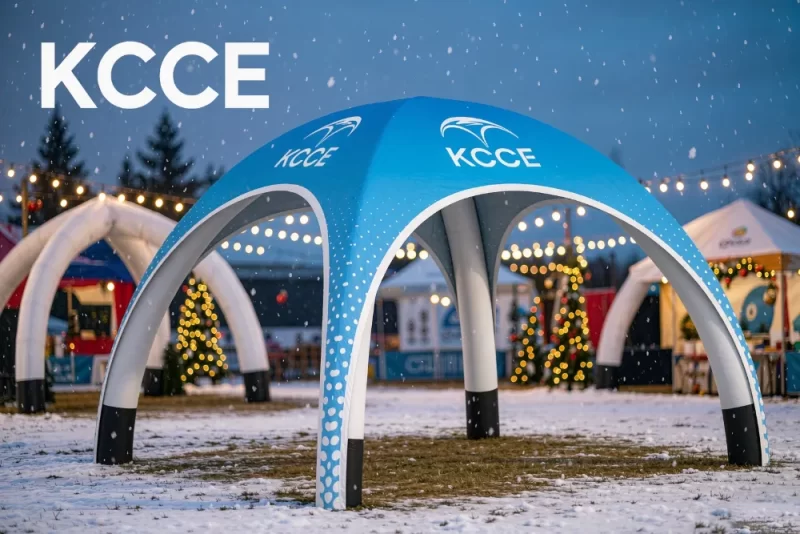
The best inflatable tent manufacturer for xmas is one that proves winter capability—not just holiday theming—through material specs, wind/snow load testing, certifications, and references from events that survived real winter storms, not just product photos with snowflake graphics.
Why Most “Christmas Inflatable Tents” Fail Commercial Use
Let’s start with the uncomfortable truth. The inflatable Christmas decorations you see at big box retailers—the giant Santa, the inflatable snowman, the reindeer with the blinking nose—those are not tents. They’re decorative balloons with a blower keeping them upright. They’re designed to survive a suburban front yard, not a commercial event.
The gap between retail and commercial is enormous. And I’m not just talking about price, though that’s part of it.
The Retail vs. Commercial Grade Divide
Retail-grade inflatable tents and decorations typically use materials around 300D polyester or even lighter. The stitching is standard, the seams aren’t reinforced, and the blower is barely adequate for the volume of air needed. These products have a lifespan measured in weeks, not seasons. According to a buying guide published by KCCE Event, a basic printed inflatable tent in the commercial tier starts with 300D polyester fabric as the baseline—but that’s where commercial quality begins, not where it ends. The same guide notes that setup for these commercial units takes 5-10 minutes with one person, and the printed sidewalls act as a 10-foot-tall billboard visible from 100+ yards away.
Now think about what a Christmas event demands. You’re putting this tent up in December. Temperatures are hovering around freezing or below. The wind is whipping through the site. Maybe there’s snow accumulation. The blower has to run continuously—sometimes for days on end. A retail-grade blower may have a shorter lifespan than a commercial-grade blower, which is designed for extended use.
That’s the difference between “works for one weekend” and “works for the entire holiday season.”
Material Denier: The First Thing to Check
When I talk to event planners about inflatable tents, the first question I ask is about denier. That’s the thickness of the fabric. Higher denier means thicker, more durable material. Commercial inflatable tents often use oxford fabric with a PVC coating for added weather resistance.
The Chinese manufacturer Guangzhou Sayok, for instance, lists their inflatable igloo dome tents as using “durable oxford cloth” with accessories like air blowers, ropes, sandbags, and repair cloth included. That’s the kind of specification you want to see—a manufacturer who’s thinking about the complete package, not just selling you a piece of fabric.
The Stitching and Seam Question
Here’s where many inflatable tents fail in winter conditions. The seams. High-frequency welding is the gold standard for commercial inflatable products. It creates a molecular bond between fabric layers that’s essentially airtight. Stitched seams, on the other hand, create needle holes that can leak air slowly over time. In cold weather, that leak rate increases as materials contract.
If you’re buying from an inflatable tent manufacturer for xmas events, ask about their seam technology. If they can’t tell you whether they use HF welding or stitching, walk away.
Air Pump Duty Cycle: The Unsung Hero
The blower is the heart of any inflatable structure. And here’s a fact that surprises most buyers: the blower needs to run continuously. There’s no “on and off” cycle for most inflatable tents. The air pressure inside the beams is what keeps the structure standing, and that pressure needs constant maintenance.
Commercial-grade blowers are rated for continuous duty. They have better bearings, more efficient motors, and thermal protection. Retail blowers? They’re rated for intermittent use. Run one for 48 hours straight and you’re playing Russian roulette with your event.
For Christmas events specifically, you also need to think about cold-weather performance. Blowers don’t like freezing temperatures. The lubrication inside the motor thickens, and the motor has to work harder. A quality manufacturer will spec a blower that’s rated for the temperature range you’ll be operating in.
What to Verify Before Choosing an Inflatable Tent Manufacturer for Xmas
Okay, so you understand the quality gap. Now let’s talk about the vetting process. Because here’s the reality: you can’t just look at a website and know if a manufacturer is legit. You need to ask the right questions and verify the right things.
Certifications: CE, ISO, ASTM
Certifications aren’t just paperwork—they’re your first line of defense against substandard manufacturing. For inflatable tents, you want to see:
- CE certification for European markets
- ISO 9001 for quality management systems
- ASTM standards for North American markets, particularly for flame retardancy
A legitimate manufacturer will happily provide these certificates. They’ll also be able to explain what each certification covers. If a manufacturer gets vague or defensive when you ask about certifications, that’s a red flag.
MOQ: Minimum Order Quantities
Here’s a question that separates the real manufacturers from the resellers: what’s your MOQ? A genuine factory has a minimum order quantity because they need to justify production runs. It might be 10 units, it might be 50, it might be 100 depending on the product complexity.
Resellers and middlemen often have lower MOQs—sometimes even one unit. That sounds great, but it means you’re paying retail prices with extra markup layered on top. And you have no direct relationship with the people actually making the product.
For Christmas inflatable tents specifically, MOQs tend to be higher because of the custom printing involved. If you want Santa graphics and snowflake patterns printed on the fabric, that requires setup time on the printing equipment. The manufacturer needs to justify that setup cost.
Sample Policy: Don’t Skip This Step
I cannot stress this enough: always order a sample before committing to a full production run. A reputable inflatable tent manufacturer for xmas events will have a clear sample policy. They’ll charge you for the sample (usually at a premium over bulk pricing), ship it to you, and let you inspect the quality firsthand.
What should you check with your sample?
- Fabric weight and feel
- Seam quality—both visual and tactile
- Zipper and door quality
- Stitching density
- Overall workmanship
If a manufacturer offers free samples with no conditions, be suspicious. Quality samples cost money to produce and ship. A free sample often means they’re cutting corners somewhere.
Custom Design Lead Times
Christmas is a seasonal business. You can’t order tents in November and expect them by December. Custom inflatable tents with holiday graphics require a design approval process, printing setup, production, and shipping. Realistic lead times for custom Christmas tents are typically several weeks, and that’s before shipping time.
A manufacturer who promises 2-week turnaround on custom designs is either lying or they’re not actually doing the customization themselves.
Warranty Terms and Spare Parts
What happens when a blower fails at your event? What if a seam splits after six months of use? A quality manufacturer typically stands behind their product with a warranty for commercial inflatable tents. They should also maintain an inventory of spare parts: blowers, repair kits, replacement fabric panels.
Ask about their spare parts policy before you buy. If they can’t supply replacement blowers or repair materials, you’re taking a significant operational risk.
Top Inflatable Tent Manufacturers for Xmas & Year-Round Events
Now let’s get to the part you’ve been waiting for—actual manufacturers worth considering. I’m going to be upfront: this isn’t an exhaustive list, and I have my own biases based on years of experience. But these are companies that have demonstrated capability in commercial inflatable structures.
Sönmez: The Turkish Heavyweight
Sönmez is one of the larger inflatable structure manufacturers in the world, based in Turkey. They’ve been in business for decades and have a strong track record with event tents, including winter applications. Their product line includes a range of inflatable tents suitable for Christmas markets and winter events.
What I like about Sönmez: they’re a true manufacturer with their own production facilities. They have the engineering depth to handle custom designs, and they understand cold-weather applications. Their shipping from Turkey to Europe is efficient and cost-effective.
Coody: The Budget-Conscious Option
Coody is a name that comes up frequently in discussions about inflatable tents. They’re known for offering competitive pricing while maintaining acceptable quality levels. For businesses that need to watch their budget, Coody inflatable tents can be a viable option.
That said, I’d recommend ordering a sample before committing to a large order. Their quality control has improved over the years, but it’s not at the level of premium manufacturers. If you’re planning a high-profile Christmas event where tent failure would be catastrophic, you might want to look at higher-end options.
RBM: The Industrial Approach
RBM inflatable tents have carved out a niche in the industrial and commercial sector. They focus on durability and functionality rather than aesthetics. For Christmas events that need rugged, reliable shelter—think equipment storage, staff facilities, or vendor booths—RBM is worth considering.
Their tents tend to be more utilitarian in design, which can be an advantage in winter conditions. They prioritize structural integrity over visual appeal.
Heimplanet: The Premium Innovator
Heimplanet is a German manufacturer known for their geodesic inflatable tent designs. Their “Inflatable House Tent for adults” concept pushes the boundaries of what inflatable structures can be. They’re not the cheapest option, but their engineering is exceptional.
For high-end Christmas events or glamping experiences during the holiday season, Heimplanet offers premium solutions. Their tents handle wind exceptionally well due to their multi-chambered air beam design.
Vango: The Outdoor Retailer’s Choice
Vango is a well-known name in the camping world, and their inflatable tents have gained a solid reputation. While they’re primarily known for consumer camping products, their larger inflatable tents have found use in event applications.
Vango’s strength is in their understanding of outdoor conditions. Their tents are designed to handle rain, wind, and cold weather—essential for Christmas events. They’re not a custom manufacturer per se, but their off-the-shelf options are reliable.
Custom Shops: The Wild Card
Beyond the big names, there are numerous custom inflatable tent manufacturers scattered across China, Turkey, and Eastern Europe. These shops can produce highly customized Christmas inflatable decorations and tents at competitive prices.
The key is finding the legitimate ones. Look for manufacturers with a physical factory address you can verify, video proof of their production capabilities, and references from past clients. Sites like Alibaba are full of both real factories and resellers—you need to do your due diligence.
One manufacturer worth mentioning is Guangzhou Sayok, a Chinese company that produces inflatable tents including igloo dome options. Their product listings show a range of sizes and configurations suitable for various events.
And of course, I’d be remiss not to mention my own company’s work. At KCCE, we’ve been manufacturing inflatable structures since 2008. Our inflatable tents collection covers everything from basic event tents to fully customized Christmas structures. We’re based in Dongguan, China, and we’ve shipped products to events worldwide.
Christmas-Specific Customization Options You Must Ask For
Now we’re getting into the fun stuff. Christmas inflatable tents aren’t just regular tents with a different color scheme. There are specific customization options that can transform a standard tent into a holiday experience.
Custom Printing: Santa, Reindeer, Snowflakes
The most obvious customization is the printing. A commercial-grade inflatable tent can be printed with any graphics you can imagine. Full-color dye sublimation printing allows for photographic quality images on the tent fabric.
For Christmas events, popular graphics include:
- Santa Claus scenes
- Reindeer and sleighs
- Snowflake patterns
- Winter wonderland landscapes
- Holiday greetings and messages
The key is to work with a manufacturer who has in-house printing capabilities. This ensures quality control and faster turnaround times. If a manufacturer outsources their printing, you’re adding a middleman to the process.
Winter-Grade Fabric Coatings
This is where Christmas-specific tents differ from standard event tents. Winter-grade fabric coatings provide:
- UV resistance for those bright winter days
- Waterproofing for snow and rain
- Cold-weather flexibility so the fabric doesn’t become brittle in freezing temperatures
- Mold and mildew resistance for extended storage
Ask your manufacturer about their winter-grade options. Not all inflatable tent fabric is created equal when it comes to cold weather performance.
Heated Floor Options
If you’re planning a Christmas market stall or glamping experience, heated floors are a game-changer. Some inflatable tent manufacturers offer integrated heating solutions—either through heated floor mats or through HVAC integration.
This isn’t just about comfort. In freezing temperatures, the ground can draw heat away from the tent interior, making it feel much colder than the air temperature suggests. A heated floor can extend your usable season significantly.
Internal Lighting
Christmas is a festival of lights. The right internal lighting can transform an inflatable tent from a basic shelter into a magical space. Ask your manufacturer about:
- Integrated LED lighting systems
- Light loops or attachment points for hanging lights
- Power distribution systems for lighting and heating
- Battery backup options for power outages
Stove Jack Compatibility
For winter camping or glamping applications, stove jack compatibility is essential. A stove jack is a fireproof opening in the tent ceiling that allows you to run a wood stove chimney through the tent.
This is a specialized feature that requires careful engineering. The stove jack needs to be positioned correctly, sized appropriately, and made from fireproof materials. Not all inflatable tent manufacturers offer this option, so you’ll need to ask specifically.
Anchor Systems for Winter Conditions
Standard tent stakes are useless in frozen ground. For winter events, you need anchor systems designed for cold weather:
- Snow stakes that are longer and wider for better holding power in snow
- Ice screws for events on frozen surfaces
- Weighted anchors for paved surfaces where stakes can’t be driven
- Ratchet straps for additional wind resistance
Ask your manufacturer about their winter anchor options. A tent that can’t be properly anchored is a liability in winter conditions.
Cost Breakdown: Retail vs. Wholesale vs. Fully Custom
Let’s talk money. Because that’s ultimately what separates the feasible from the fantasy.
The Price Tiers
Inflatable tents come in three broad price tiers:
Retail Tier ($200-$1,000): These are the inflatable tents you find on Amazon or at camping stores. They’re consumer-grade products with limited durability. For a single weekend of light use, they might be fine. For commercial Christmas events, they’re a gamble.
Wholesale Tier ($1,000-$5,000): This is where commercial-grade inflatable tents start. You’re getting better materials, more reliable blowers, and better construction. The KCCE Event guide mentions that basic printed inflatable tents range from $900-$2,500 for standard sizes like 10×10 or 10×20. These tents are often less expensive than fully custom inflatable structures while delivering a similar visual impact.
Fully Custom Tier ($5,000-$50,000+): This is where you get exactly what you want. Custom shapes, custom printing, integrated lighting, heating compatibility, and all the bells and whistles. These are typically used for major events, corporate holiday parties, and premium glamping experiences.
The Hidden Costs Nobody Tells You About
Here’s where budgets go to die. Beyond the tent itself, you need to factor in:
Shipping Crates: Commercial inflatable tents don’t come in a box you can carry under your arm. They ship in large crates that can weigh several hundred pounds. Shipping costs vary dramatically based on distance and shipping method.
Customs and Import Duties: If you’re importing from overseas manufacturers, customs fees and import duties can add to your total cost. This varies by country and product classification.
Installation Crews: While many inflatable tents can be set up by one person in 5-10 minutes (per the KCCE guide), larger structures may require professional installation. Factor in labor costs if you’re not handling setup yourself.
Spare Parts Inventory: You should always have spare blowers and repair kits on hand. This isn’t optional for commercial operations.
存放: Inflatable tents need proper storage between uses. If you don’t have space, you’ll need to rent storage or factor in the cost of a storage facility.
The RFQ Template That Gets You Accurate Quotes
If you want accurate quotes from manufacturers, you need to provide complete information. Here’s what your Request for Quotation should include:
- Tent dimensions (length, width, height)
- Intended use (event type, expected capacity)
- Season and climate (winter conditions, expected temperatures)
- Custom printing requirements (graphics, colors, placement)
- Accessories needed (blowers, anchors, lighting, heating)
- Quantity (number of units)
- Delivery location and timeline
- Budget range (this helps manufacturers suggest appropriate options)
The more specific you are, the more accurate your quotes will be. Vague RFQs get vague answers.
Red Flags to Avoid in Inflatable Tent Manufacturers
I’ve been doing this long enough to spot the warning signs. Here’s what should make you walk away.
No Physical Factory Address
A legitimate manufacturer has a physical location. They should be proud to share their factory address. If a company only has a P.O. box or won’t provide a physical address, that’s a massive red flag.
Even better, ask for a video tour of their facility. A real manufacturer will be happy to show you their production floor, their equipment, and their team.
No Video Proof of Production
Photos can be faked. Videos are harder to fake. If a manufacturer can’t provide video proof of their production process, be suspicious.
This is especially important for custom Christmas inflatable tents. You want to see their printing equipment, their welding machines, and their quality control processes.
Vague Lead Times
A legitimate manufacturer can give you specific lead times for production and delivery. They understand their production capacity and can commit to timelines.
If a manufacturer gives you vague answers about lead times, they’re either overbooked or they’re not actually manufacturing anything.
Unrealistic Low Quotes
If a quote seems too good to be true, it probably is. This is especially true for custom products. Quality materials cost money. Skilled labor costs money. Equipment maintenance costs money.
A quote that’s significantly below market rates usually means one of three things: they’re using inferior materials, they’re cutting corners on labor, or they’re a reseller who will disappear if something goes wrong.
No Third-Party Testing
Reputable manufacturers test their products. They have their tents tested for wind resistance, snow load, flame retardancy, and material strength. These tests are often conducted by third-party laboratories.
If a manufacturer can’t provide test reports, they’re not meeting industry standards.
Poor Communication During the Quoting Phase
The quoting phase is your first interaction with a manufacturer. If they’re slow to respond, vague in their answers, or dismissive of your questions, that’s how they’ll treat you after you’ve paid.
A good manufacturer treats the quoting phase as part of their sales process. They respond promptly, answer questions thoroughly, and provide helpful guidance.
How to Shortlist & Request Quotes Efficiently
You’ve done your research. You’ve identified potential manufacturers. Now it’s time to narrow things down and get serious.
The 3-Step Vetting Checklist
Step 1: Certificates. Request copies of their CE, ISO, and ASTM certifications. Verify these are current and cover the products you’re interested in.
Step 2: Samples. Order samples from your top 2-3 candidates. Compare them side by side. Look at material quality, stitching, and overall workmanship.
Step 3: References. Ask for contact information for past clients, especially those who’ve used the manufacturer for winter or Christmas events. Follow up with those references and ask about their experience.
Timeline Planning for Christmas Delivery
Here’s the timeline I recommend for Christmas events:
- 6 months before event: Start research and shortlist manufacturers
- 5 months before event: Request quotes and samples
- 4 months before event: Place your order
- 3 months before event: Approve design proofs
- 2 months before event: Production and quality control
- 1 month before event: Shipping and delivery
- 2 weeks before event: Setup and testing
Ordering 4-6 months ahead of your Christmas event gives you a comfortable buffer. Rush orders are possible, but they come with premium pricing and increased risk.
Negotiation Levers
Manufacturers are more flexible than you might think. Here are the levers you can pull:
Bulk Orders: The more units you order, the better your per-unit pricing. If you need multiple tents, bundle them into a single order.
Repeat Business: If you’re planning to be a long-term customer, say so. Manufacturers value recurring revenue and will often offer better pricing for committed relationships.
Off-Season Orders: If you can take delivery outside the peak season (summer for most inflatable tent manufacturers), you’ll get better pricing. Christmas tents ordered in January for delivery in mid-year will be significantly cheaper than orders placed in October.
常见问题解答
问:谁制造的充气帐篷最好?
答: The “best” depends on your needs. For premium engineering, Heimplanet stands out. For commercial reliability at scale, Sönmez and RBM have strong track records. Coody offers competitive pricing for budget-conscious buyers. The best approach is to define your requirements first, then evaluate manufacturers against those specific criteria.
Q: What’s the best inflatable tent on the market?
答: For winter and Christmas applications, look for tents with high-denier fabric (600D or higher), HF-welded seams, and commercial-grade blowers. The best tent for you is one that’s appropriately sized, properly equipped for your climate, and backed by a manufacturer with solid warranty support.
Q: Who has the best Christmas inflatables?
答: For Christmas-specific inflatable decorations and tents, custom manufacturers like Guangzhou Sayok and KCCE offer specialized capabilities. These companies can produce tents with Santa graphics, snowflake patterns, and winter-themed designs. For off-the-shelf options, Vango and Heimplanet offer quality products that perform well in winter conditions.
Q: What is the best inflatable tent for winter camping?
答: A 4 season inflatable tent with a stove jack, winter-grade fabric, and a high-capacity blower is ideal for winter camping. Look for models with multiple air chambers for redundancy, and ensure the manufacturer rates their product for below-freezing temperatures.
参考资料
1. Printed Basic Inflatable Tent: Smart Buying Guide For 2025 – kcce-event.com
2. FEAMONT Large Inflatable Celebration Tent for Holiday Parties … – alibaba.com
3. Inflatable Tent manufacturer from china – sayok-inflatables.com