
Inflatable Tent for France: Decided Before It Ships
The search says inflatable tent for France; the real work is five decisions: which documented frame fits the site, which walls each face carries, what the print says on an approved proof, how the set is fixed to the French ground, and how it ships — Quoted per project (FOB) to your French port. This page walks all five, in the order they should be decided. Custom orders begin at one unit. 20 years of manufacturing experience.
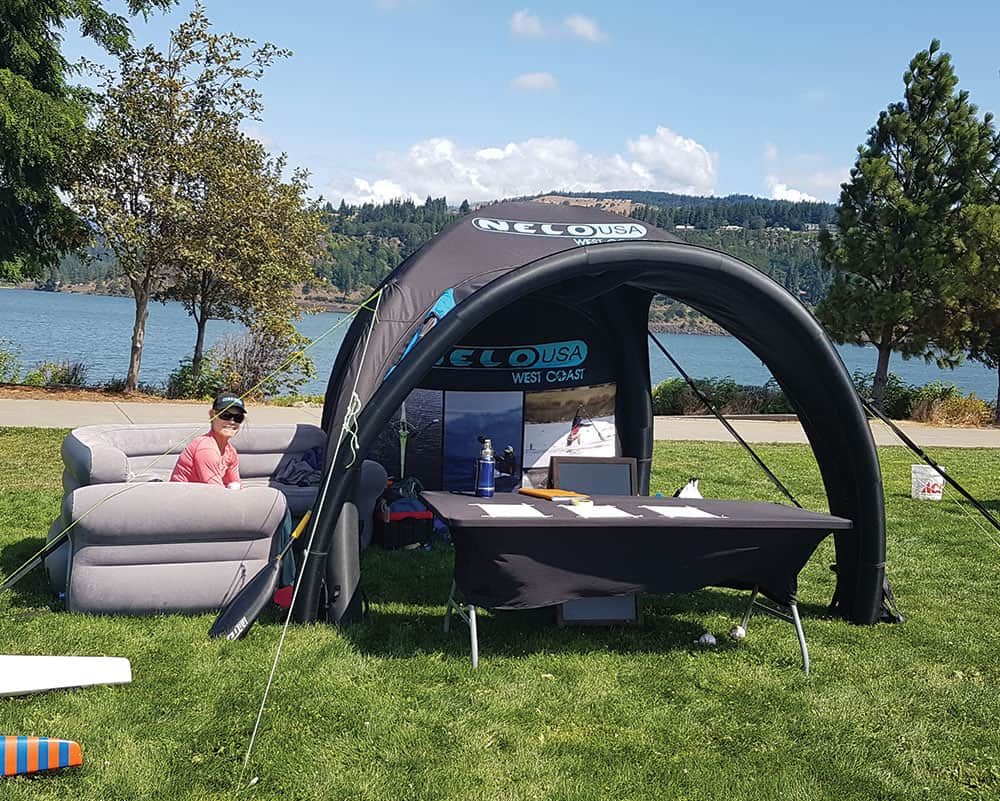
Quick Answer: what does an inflatable tent for France order involve?
充气广告帐篷 inflatable tent for France is ordered against five written decisions: the frame on a documented size (the F range's 3×3M or 4×4M bay for squares, N rectangles from 3×3M through 4×6M to 5×10M for fairground rows, compact AII for salons, XL-A up to 7.5×4.8M for long frontages); the wall set named per face — lateral, window, door, reversible double-sided, double or triple; the print approved on a proof sheet before production; the fixing line per French floor — sand bags on paved squares, ground stakes on fairground grass, named range kits where the manuals record them; and the terms: written quotation in 24-48 hours, Quoted per project (FOB) to your French port, custom orders from one unit, schedule confirmed after design approval.
What You’ll Learn
- 01From Quote to a French Site
- 02Where French Sets Stand
- 03Five Ranges by Footprint
- 04Six French Sites, Mapped to Models
- 05Print for a Season of Events
- 06France Buying Red Flags
- 07From Enquiry to French Ground
- 08What Comes Back With the Quote
- 09Pricing & Minimum Order
- 10Three Sets Already Standing
- 11常见问题
- 12Customer Cases
From Quote to a French Site
A France order crosses more distance than a local one, so the decisions that cannot be fixed later must be fixed early — in writing, against a documented frame. This page is that order of decisions: frame, walls, print, fixing, delivery, each written where the next reader can check it.
An inflatable tent for France lands on documented geometry, not a rendering: the F range's 3×3M and 4×4M bays, N rectangles from 3×3M through 4×6M to 5×10M, compact AII at 3M and 4M, and XL-A within its 4.5×3M to 7.5×4.8M range — air frames of welded TPU tubes with the wall panels hung around them. Across the thirteen air-frame families the wall vocabulary is recorded, not improvised: lateral side walls, window walls, door walls, reversible double-sided walls, double walls and triple walls, with the F range adding Back Wall Reversible and Double-Back Wall of its own.
The French ground does more deciding than buyers expect. Paved squares and quays take guy ropes with sand bags; fairground grass takes guy ropes with ground stakes; covered salons forbid drilling outright and reward the ranges whose weight kits are named — bar bags for U, VI and VII, iron blocks for AII, strip sand bags for XII. A France quote without a fixing line per floor zone is a drawing, not a plan.
Claims here are drawn from the manuals and from nowhere else — any figure this page states, a manual states first, and where a wind load or a thermal value has no written basis behind it, the page says so rather than inventing one. Those judgement calls get settled where they belong: in the written schedule and on the proof sheet, face by face, with your approval.
Key Takeaways
- Five decisions make a France order buildable: frame by footprint, walls per face, print on an approved proof, fixing per French ground, terms and delivery in the open.
- Frames come from documented geometry: F 3×3M / 4×4M, N rectangles to 5×10M, AII compact, XL-A to 7.5×4.8M, XL-B at 9.4×5.5M.
- The wall vocabulary is recorded in the manuals — lateral, window, door, reversible double-sided, double, triple, plus the F back-wall set.
- French ground decides the fixing line: sand bags on paved squares, ground stakes on grass, named range kits where recorded.
- Custom MOQ is 1 unit; written quote in 24-48 hours, Quoted per project (FOB) to your French port, schedule confirmed after design approval.
Where French Sets Stand
The same set does different work depending on where it stands: an anchor bay on waterfront ground reads from every side, a printed frontage works a paved site, and a brand set in a public park lives on two lines written in advance. Whether the enquiry is one bay for a town square or a joined run for a festival frontage, the logic is the same three photographs.
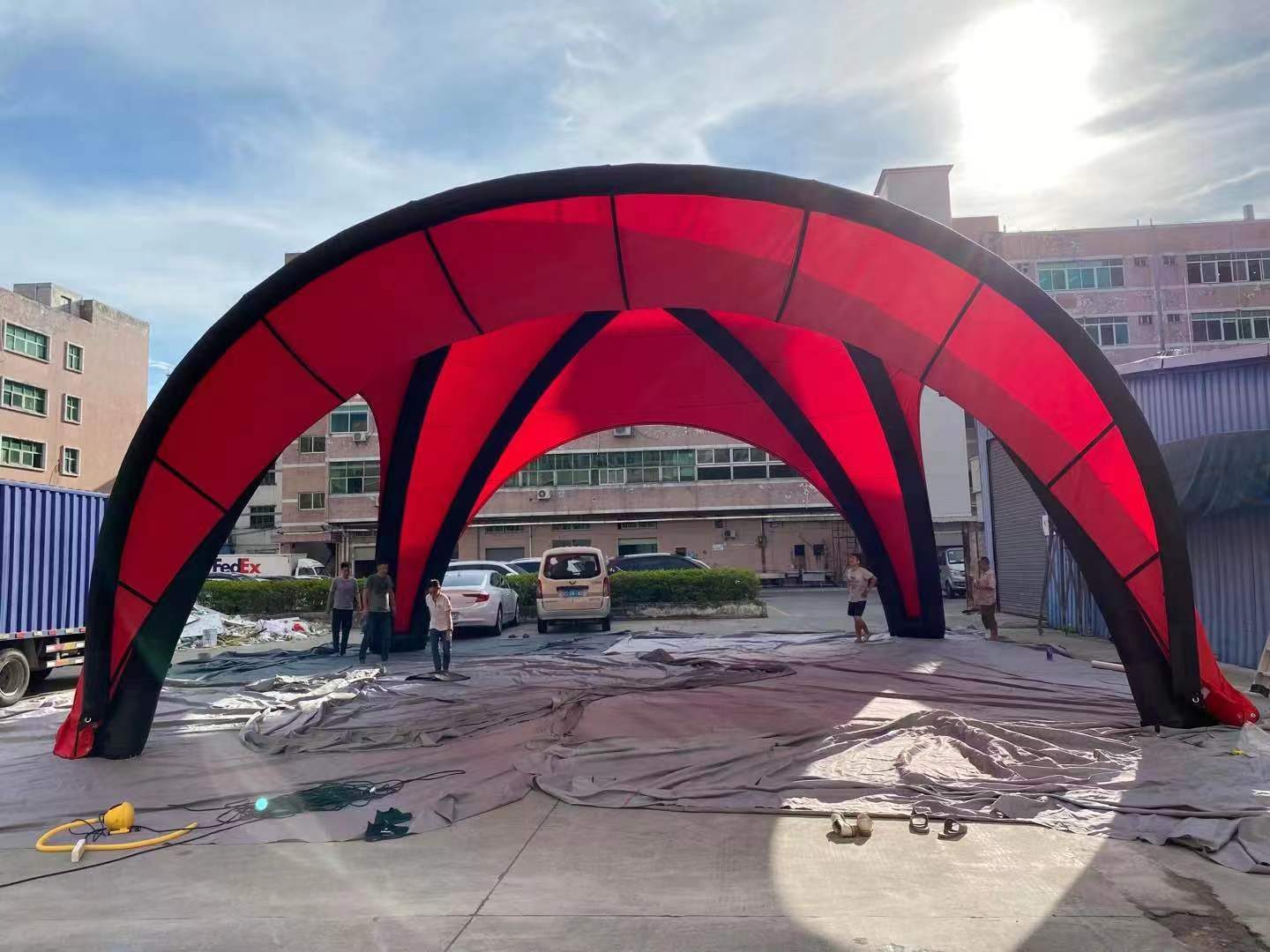
What Ships, and What Decides on Site
An airtight structure laid out on concrete before it travels. A France order reads the same way: the frame, the wall set and the print are decided against the site brief before anything ships, and only the fixing waits for the ground it will actually meet. Buyers who leave those decisions until the truck arrives buy twice.
- Decided against the brief
- Before it ships
- Fixing waits for ground
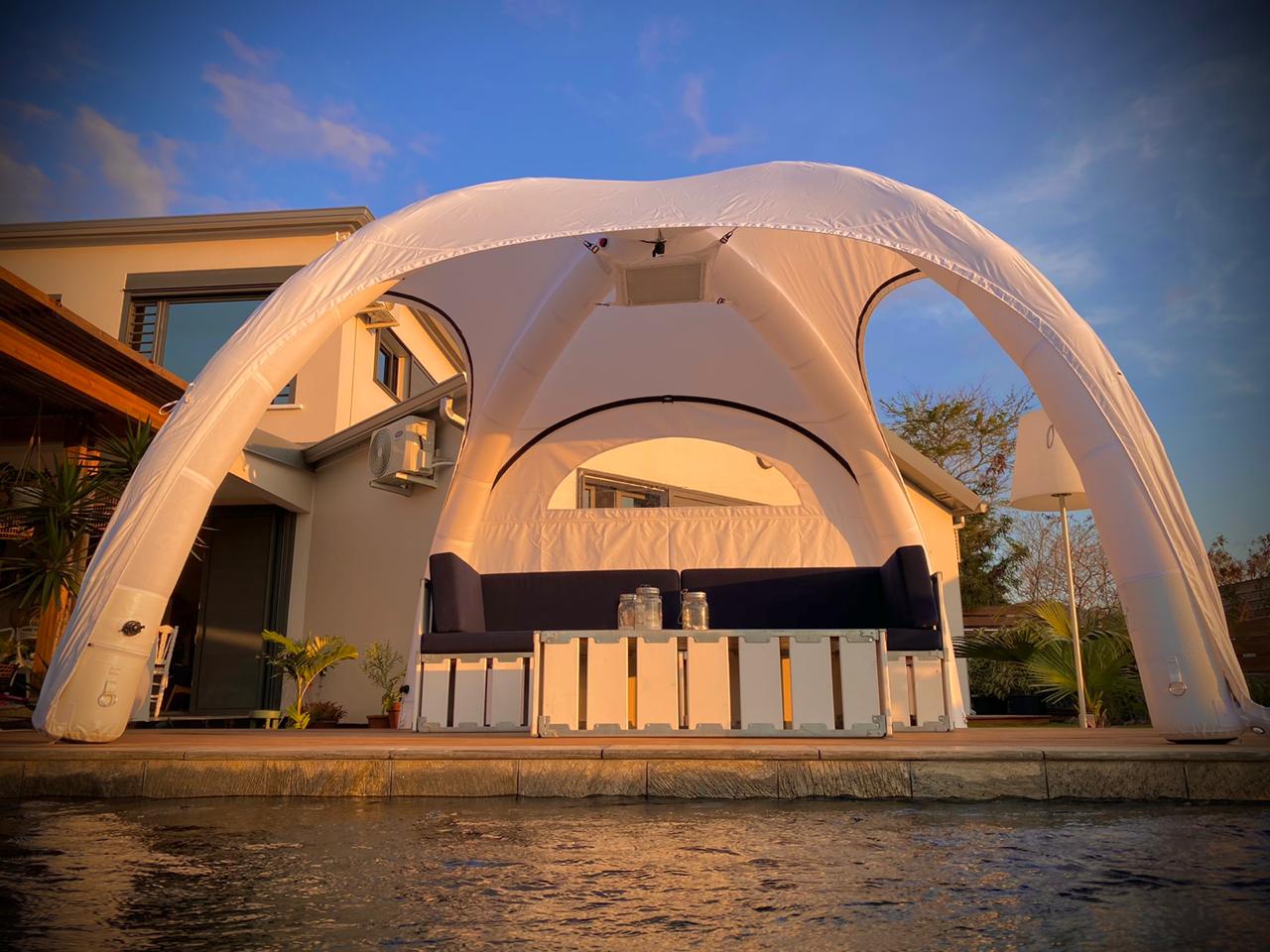
A Bay on Ground That Cannot Be Drilled
An open-front bay on a paved terrace beside a building. Much of the French event map is paved squares, quays and courtyards — surfaces that cannot be drilled take guy ropes with sand bags, and the fixing line belongs in the quote, not in a phone call on the morning of the event. Enclosure and floor protection are settled together, on paper.
- Paved terrace
- Guy ropes with sand bags
- Fixing written first
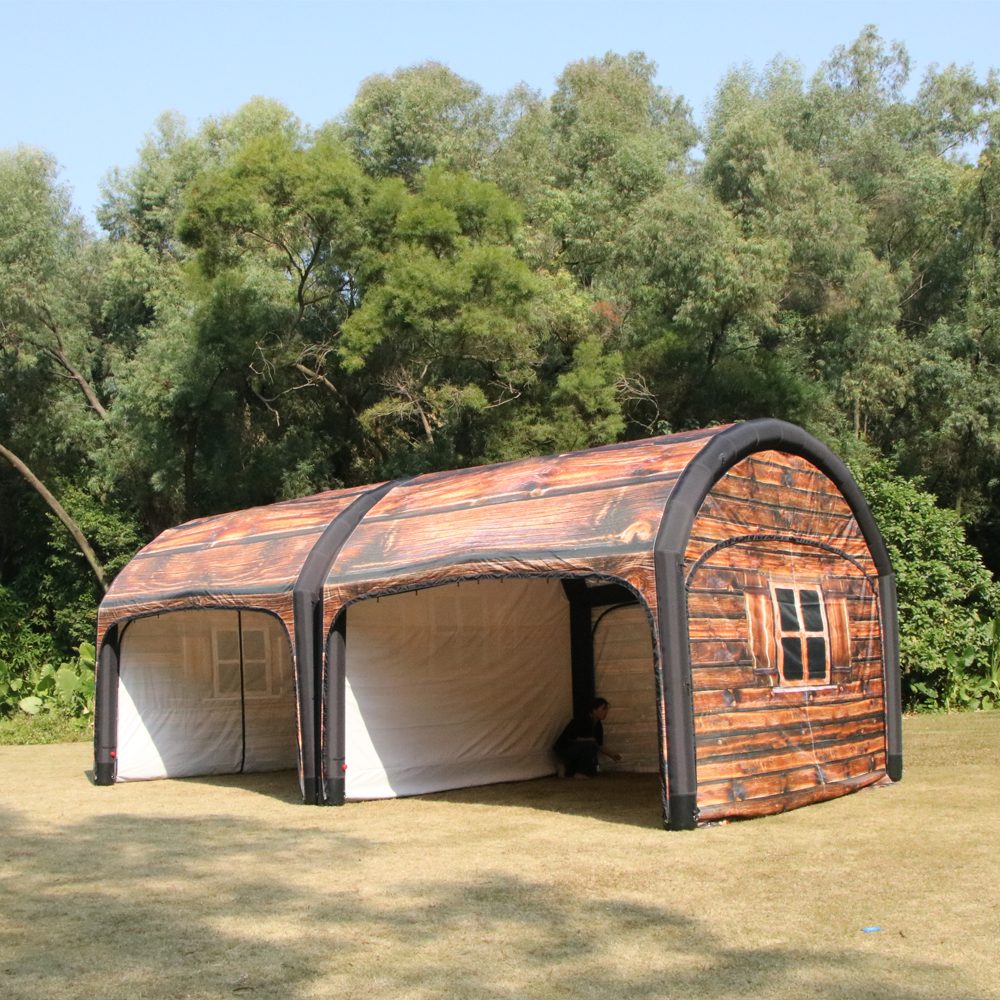
Print Carried Across the Whole Set
A full-graphic structure on open grass carries its print across roof and walls alike. French festival audiences meet the set from every side — there is no back of a fairground bay — so the print plan is written per face before production, and the proof sheet shows every face in position and in direction.
- Print across walls
- Reads from every side
- Proof per face
The site brief is the first specification
A town square in Lyon and a lakeside festival pitch are different projects wearing the same keyword. The brief that makes a France order buildable names four things: the city and the ground, the frontage the public actually walks, the date, and what the brand has to say from the set. Everything else — frame, walls, print, fixing — is answered against those four lines.
- City and ground
- Frontage and date
- Brief before catalogue
Walls follow the French event map
Paved squares take weighted fixing; fairground grass takes stakes; covered salons take named weight kits and forbid drilling outright. The manuals record the wall vocabulary — lateral, window, door, reversible double-sided, double, triple — and the site decides which of it the schedule uses, face by face, before the set ships.
- Surface decides fixing
- Wall set per face
- Schedule before shipping
One order, one paper trail
A France delivery crosses customs, a carrier and a site manager who did not write the order. The paper trail that survives that chain is the same one our quotes carry anyway: the written schedule, the proof sheet per printed face, the fixing line per floor zone, and the terms in the open. Nothing on that list is optional.
- Schedule as anchor
- Proof per face
- Terms in the open
Five Ranges by Footprint
Five KCCE ranges appear below because each one answers a different French site: the square class with its own back walls, the rectangles that grow with a fairground, the compact bay for covered halls, the frontage that works the street, and the long run that reads as one building. These are recorded specifications, not marketing lines.
F Inflatable Tent

The F manual documents 3×3M and 4×4M bays — the class most town squares and pedestrian pitches in France actually have room for. It is also the range whose documentation adds a back-wall set of its own: Back Wall Reversible and Double-Back Wall. For a French activation that must read from the square it occupies, F starts the conversation at a size the site already agrees with.
N Inflatable Tent

The N manual writes down rectangles from 3×3M through 4×6M to a 5×10M span, with the full wall vocabulary recorded along the range. A French fairground or lakeside festival that grows year over year — a longer frontage next season, a joined run after that — starts on a rectangle whose walls are documented at every size.
AII Inflatable Tent

AII is documented in 3M and 4M compact formats, and its manual names iron blocks as the leg weight. Indoor salons and covered halls — the venues a French winter calendar fills — reward a compact bay whose weight method is already written beside it, because hall floors dictate the fixing and the schedule should say so by name.
X型充气帐篷

The X-series manual records 400D Oxford cloth with heat transfer printing, and names awnings, banners and column patches alongside the wall set, with modular aluminium connectors for joining same-size units into one structure. A French street activation lives on its frontage — the awning pulls people in, banners work the approach, and the fabric is named, not guessed.
XL-A型充气帐篷
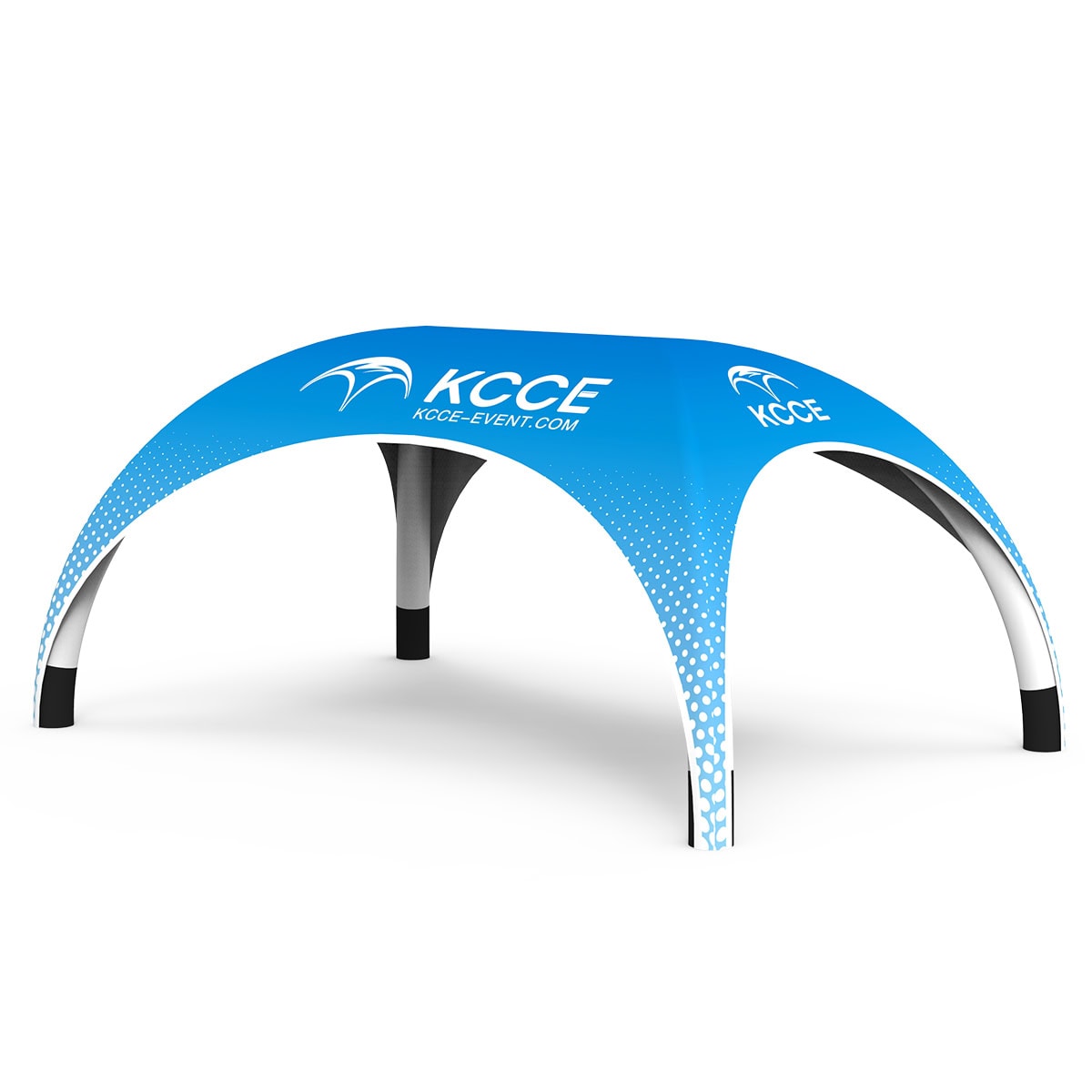
XL-A runs from 4.5×3M up to 7.5×4.8M, and its manual names wide and narrow connecting cloth. Where a French festival wants one long frontage instead of a row of boxes, the connecting cloth is what keeps the wall line continuous across joined bays — the detail that decides whether the run reads as one building or a flea market.
Six French Sites, Mapped to Models
A France order starts from the site, and the documented range covers the map: squares, fairground rows, covered salons, street frontages, continuous runs and anchor builds. Six site types, six documented answers.
Town square or pedestrian pitch: the F class
Paved, weighted fixing, frontage open to the street. The F manual documents 3×3M and 4×4M bays — the class a French square actually has room for — with the back-wall set named in its own documentation. Walls per face: lateral on the windward flank, a door wall where the crowd arrives, window walls where the product should stay visible.
Fairground or festival row: the N rectangles
Grass, stake fixing, bays in a row. The N range writes down rectangles from 3×3M through 4×6M to 5×10M with the full wall set recorded at every size, so a row of French fairground bays repeats one schedule instead of improvising one per pitch.
Covered salon or winter hall: the AII compact
Indoor floors forbid drilling and reward a bay whose weight method is written beside it — AII's manual names iron blocks. Compact 3M and 4M formats fit hall stands where every centimetre of aisle is negotiated.
Street activation with product to show: the X frontage
The X-series manual records 400D Oxford cloth with heat transfer printing and names awnings, banners and column patches. A French street activation lives on its frontage: the awning pulls people in, window walls keep stock visible, and every printed face lands on the proof.
One long frontage: XL-A with connecting cloth
Where a festival wants a continuous building line instead of a row, XL-A runs from 4.5×3M up to 7.5×4.8M and its manual names wide and narrow connecting cloth — the part that keeps walls continuous across joined bays.
The anchor build: XL-B at 9.4×5.5M
The documented large rectangle for a festival anchor or a brand pavilion that must hold several zones inside one footprint. Zones are separated with the documented double and triple walls, and the whole set is scheduled, not improvised.
Print for a Season of Events
A French season rarely is one event — it is a square, then a fairground, then a salon, on one set that travels. Four habits keep that set readable from the first date to the last.
A France activation is read from every side
A fairground bay has no back — the audience walks around it. That makes the wall set the largest print area the buyer controls: every face the public can stand in front of is a face to schedule. The X-series print route, 400D Oxford cloth with heat transfer printing, is the named process behind those faces where the range records it.
Proof before production, for a set that ships abroad
A print correction discovered after the container leaves is a correction paid for twice. Every printed face lands on the proof sheet — in position, in direction, both faces of a reversible panel — and nothing is produced before the sheet is approved. That habit costs one email; its absence costs an event.
The reversible wall is two French campaigns in one panel
A reversible double-sided panel carries one message to the street and another to the queue — hung one way for the launch, the other way for the restock. For a brand running a season of French events on one set, it is the highest-value panel in the documented wall vocabulary.
Roof says the name, walls explain, banners work the approach
At festival distance the roof and valance do the recognition work; walls do the explaining for people who stay; the X range adds banners and column patches as named surfaces for the approach. Ranking the layers before the set is drawn keeps the activation from turning into a wall of noise.
France Buying Red Flags
None of these signs proves a bad product on its own, but each one moves the order away from the French site it has to work on — or moves a decision to a place where it cannot be checked. Four cards, four habits.
A quote with no documented model
A France quote should name the model and one of its published sizes — an F bay at 3×3M or 4×4M, an N rectangle, an XL-A within its range. "Inflatable tent, 5x5 metres, price on request" is a size that belongs to no manual, and a set that belongs to no schedule.
A fixing line left for the site day
Paved French squares take weighted fixing; fairground grass takes stakes; halls forbid drilling outright. If the holding method is not written per floor zone in the quote, it will be improvised on the morning of the event, by whoever is standing there.
Print approved from a render, not a proof
A render is a promise; a proof sheet is a specification — every printed face in position and direction, approved before production. For a set that ships to France, a print correction discovered after the container leaves is a correction paid for twice.
Delivery terms that live in a phone call
The delivery line — the figure, the port, who books what — belongs in the written quote: Quoted per project (FOB) to your French port, lead time confirmed in writing after design approval. A delivery argued at the dock is a delivery already delayed.
From Enquiry to French Ground
Six steps take a one-line enquiry — an inflatable tent for France — to a set that stands on the site it was bought for. All six can be run by email, and none of them requires a decision to be made twice.
Write the site brief first
City, ground, frontage, date, message — the five lines that make every later decision checkable. A custom inflatable tent for France ordered without a site brief is ordered against a photograph, and photographs never argue back about windward sides or aisle widths. Every inflatable tent France project that arrives with those five lines quoted back is a project that ships without surprises.
Choose the frame by footprint
Match the documented geometry to the site: the F class for squares, N rectangles for rows, AII for halls, XL-A for long runs, XL-B for the anchor build. The frame is chosen against the published sizes, not against a rendering.
Choose walls per face
Lateral on the windward flank, window where the product should stay visible, door where the approach arrives, reversible where two crowds share one panel. The schedule uses the manuals' own vocabulary, so the quote and the site plan stay comparable across the whole project.
Settle print on the proof
Every printed face — roof, valance, walls, banners — lands on the proof sheet in position and direction, with the process named where the range records one. Approve once; the set, the spares and next season's campaign all inherit it.
Write the fixing line for the French ground
Paved squares take guy ropes with sand bags; fairground grass takes guy ropes with ground stakes; named range kits where the manuals record them — bar bags for U, VI and VII, iron blocks for AII, strip sand bags for XII. The fixing line is written beside the wall set, per floor zone.
Get the delivery line in the open
The reply closes with the terms: written quotation within 24-48 hours, the figure Quoted per project (FOB) to your French port, lead time confirmed in writing after design approval, custom orders from one unit. A France order whose delivery line lives in a phone call is a delivery that gets re-argued at the dock.
What Comes Back With the Quote
The reply to a France enquiry is four things: a written schedule anchored to a documented model, a fixing line per floor zone, one proof sheet for every printed face, and terms in the open. An order that crosses a border is judged by whether those four arrive without being chased — so we put them in every first reply.
A written schedule anchored to a documented model
The reply names the frame by its documented size first — an F bay in the 3×3M and 4×4M class, an N rectangle out to 4×6M and 5×10M, or an XL-A inside its published 4.5×3M to 7.5×4.8M span — then lists every wall by type and face against that anchor. Carrier, site manager and brand all read the same sheet, and nothing in it depends on memory.
The fixing line per floor zone
Paved square, fairground grass or hall floor — each gets its holding method in writing: guy ropes with ground stakes on grass and sand, guy ropes with sand bags where the floor cannot take stakes, and the named range kits. An inflatable tent in France quoted without a fixing line is a drawing, not a plan.
One proof sheet for every printed face
Where any face carries print, the proof shows it in position and in direction — the street face, the queue face, the reversible panel both ways — with the process named where the manual records it. Approve the sheet once and everything downstream inherits it.
Terms and delivery in the open
Written quotation within 24-48 hours, Quoted per project (FOB) to your French port, lead time confirmed in writing after design approval, and custom orders starting at one unit. The same terms hold whether the order is one bay or a joined run for a festival frontage.
Pricing & Minimum Order
The figure follows the schedule: which model and published size, which faces carry which panels, how the set meets the French ground, and how many units repeat it. The terms below are the ones our figures always carry, and they do not change with the distance.
| 项目 | MOQ | Terms |
|---|---|---|
| One documented bay, built to the approved schedule | 1件 | Quoted per project (FOB) |
| Additional identical bays on the same schedule | 1件 | Quoted per project (FOB) |
| Joined run with walls continuous across the connecting cloth | Named as lines | Quoted per project (FOB) |
| Re-faced panels for next season on the same frame | Named as lines | Quoted per project (FOB) |
| Lead time | — | Confirmed in writing after design approval |
Every quotation is answered in writing within 24-48 hours and the figure is fixed once the schedule is approved. When an inflatable tent for France enquiry has a fixed event date, put the city, the ground and the date in the first message so the reply lands while the site plan is still open. Decisions made after the venue is booked are decisions made in a hurry.
Three Sets Already Standing
Three builds photographed where they really stand: an anchor bay on waterfront ground, a printed frontage working a paved site, and a brand set placed where the crowd passes. Read them for the two lines that had to be written before delivery: what each face does, and what holds the structure to its ground.
An Anchor Bay on Waterfront Ground
A white dome stands at a lakeside event site with the shoreline behind it. Waterfront sites are exactly the kind of brief a France order starts from: one anchor build the whole site organises around, a frontage that reads from every side, and a fixing line written for the ground it actually meets — not for the photograph in the catalogue.
- Waterfront anchor
- Reads from every side
- Fixing per ground

A Printed Frontage Working a Paved Site
A dome with a printed frontage stands on paved event ground. Paved French sites take weighted fixing — guy ropes with sand bags — and reward a print plan written per face: the frontage does the recognition work while the set stays open where the crowd moves. The proof sheet shows that frontage in position before production.
- Paved ground
- Weighted fixing
- Frontage on the proof
A Brand Set Placed Where the Crowd Passes
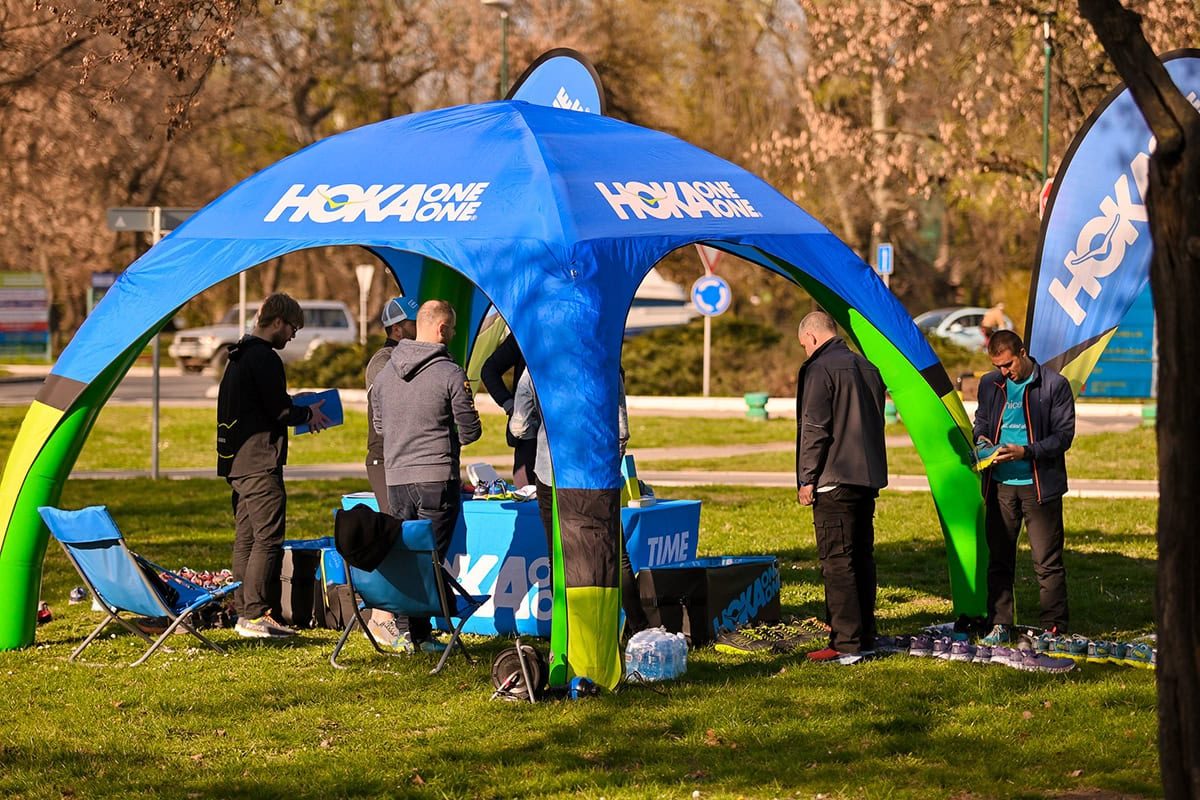
A blue and green canopy works a brand activation in a public park. Public-park placements live or die by two lines written in advance: where the crowd actually passes — which decides the door wall — and what the ground takes — which decides the fixing. Both lines are site decisions, and both belong in the schedule that ships.
- Door on the passing crowd
- Fixing per ground
- Lines in the schedule
常见问题解答
Sets Photographed Where They Work
Three cases, three standards a set had to meet: one standard repeated across a civic set, an enclosure that manages a queue on a public square, and the same standard holding on open grass.

A Set That Repeats One Standard
Three bays stand to one front in front of a colonnaded building. What reads from across the square is repetition: the same faces closed, the same fronts presented, the same footprint logic under every bay. Municipal buyers in France tend to specify that repetition before the first site visit, and the habit shows — the set works on a busy day because it was decided before anyone arrived.
An Enclosure That Manages a Queue
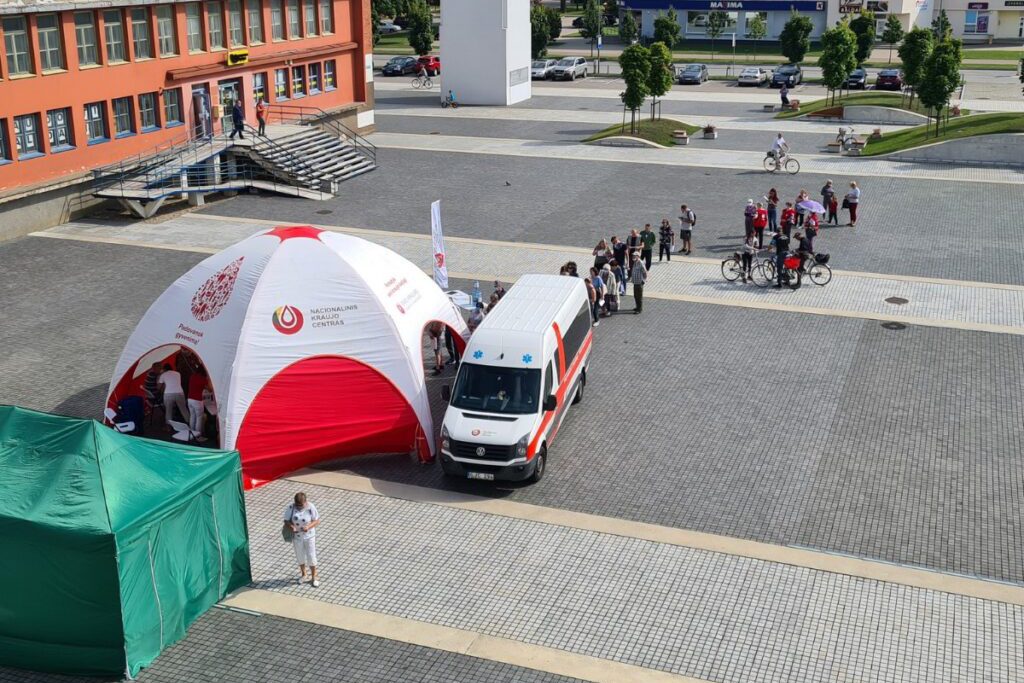
One unit on a public square holds a queue beside an ambulance. Service bays live or die by the wall logic: the route in, the counter behind the flank, the enclosure that keeps the line orderly. That is a configuration decided on a schedule, and it shows in how calmly the square works.
The Same Standard on Grass
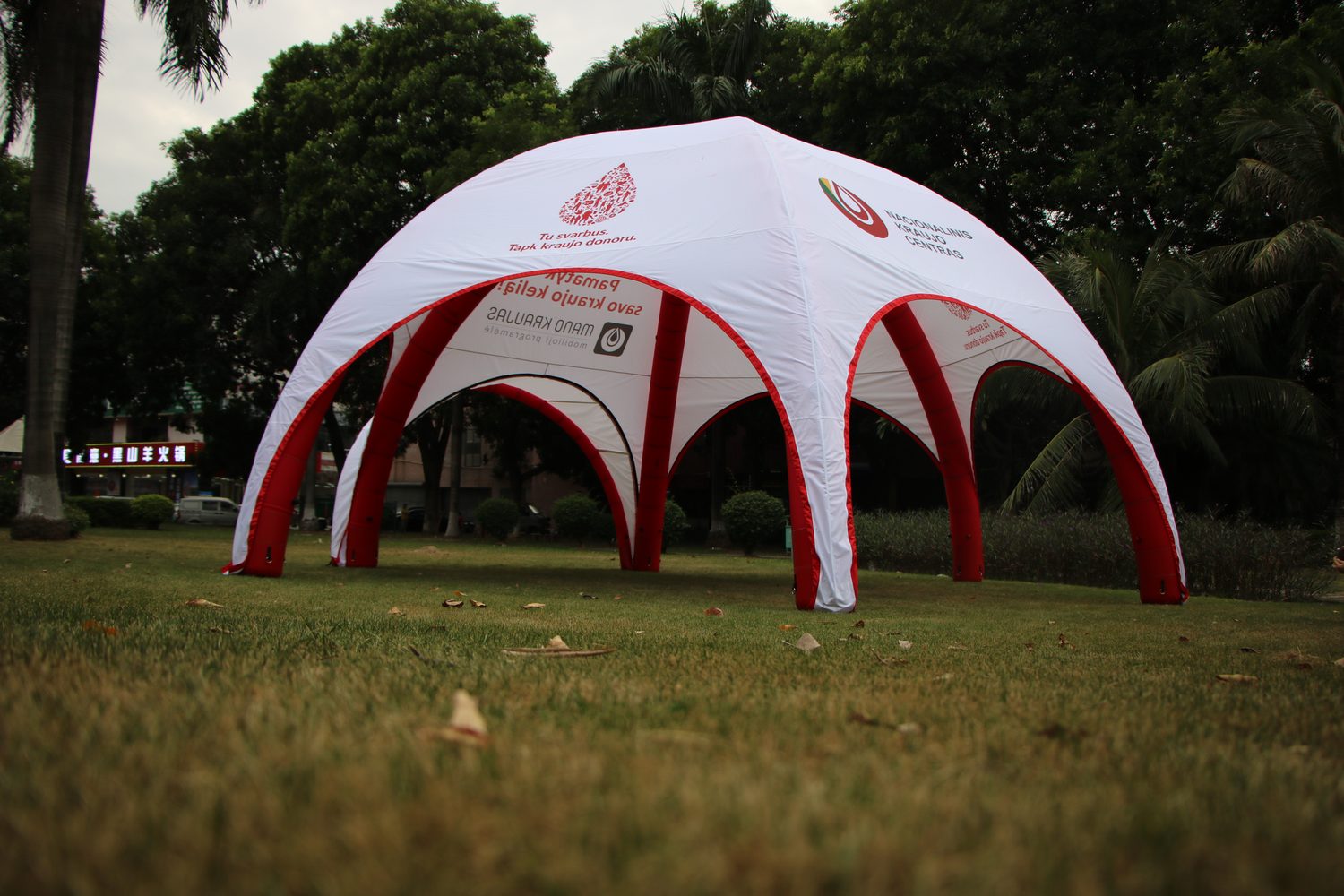
A dome with its institutional mark printed through the faces, standing on open grass with treeline behind. What the civic square built on paving, this lawn site rebuilds on stakes: the panels still sit where the job needs them, and the whole set was approved before it travelled. The standard moves; the fixing follows the floor.


