Hızlı Cevap
An inflatable isolation tent is a rapidly deployable, air-beam or frame-supported shelter used to contain patients, contaminated materials, or sensitive operations. Medical-grade versions run on negative pressure with HEPA filtration, set up in minutes, and are reusable if cleaned properly.
Let me start with something that bugs me about this niche.
Search “inflatable isolation tent” on Google and what do you get? Page after page of vendor listings. Product photos, “contact us for quote,” maybe a spec sheet if you’re lucky. What you don’t get is anyone telling you what actually matters when you’re the one signing the purchase order.
I’ve spent years around inflatable structures — event tents, medical shelters, military rapid-deploy units — and I can tell you the buying process is messier than vendors admit. Pressure ratings get hand-waved. “Negative pressure” becomes a marketing phrase instead of an engineering spec. And pricing? Nobody wants to put a number on paper.
So this guide is my attempt to fix that. If you’re a hospital administrator, an emergency management director, or a procurement officer trying to compare options, here’s what you actually need to know.
What Is an Inflatable Isolation Tent?
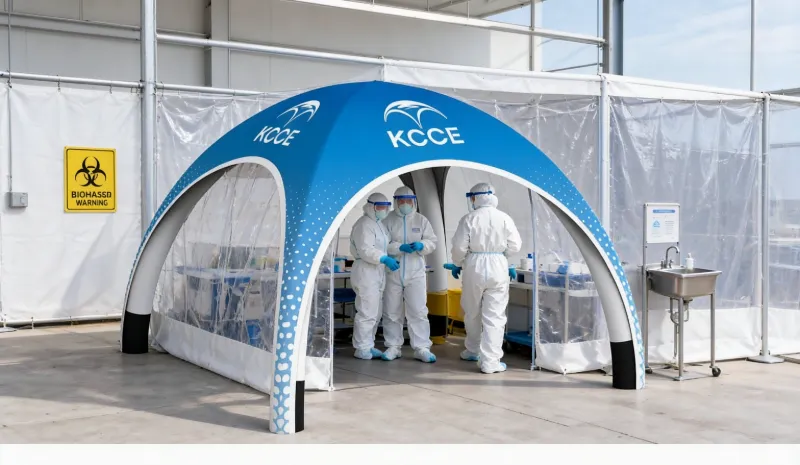
An inflatable isolation tent is a portable, air-supported or air-beam structure designed to create a controlled, enclosed environment — typically for medical isolation, quarantine, decontamination, or emergency response. Unlike a camping tent, it’s built to maintain air pressure differentials, support HEPA filtration, and meet healthcare or military-grade standards.
The distinction matters. A camping tent keeps rain off you. An isolation tent keeps pathogens, contaminants, or airborne particles contained — or keeps them out. That’s a completely different engineering problem.
Most units fall into two structural camps:
- Air-beam (inflatable frame) tents — the structure itself is inflated; beams form the skeleton. These pack small but need continuous or periodic inflation.
- Frame-supported tents — aluminum or steel frames with an inflatable or tensioned skin. Heavier, but they hold shape without constant air pressure.
Then there’s the airtight variant. Some manufacturers, including KCCE, build air-tight chambers that hold pressure far longer than standard inflatables — a big deal if you’re running negative pressure or operating in areas without reliable power.
How Does It Work?
Here’s where most vendor pages go quiet, and it’s honestly the most important part.
An isolation tent works by controlling airflow direction. In a negative pressure setup, the tent maintains lower internal air pressure than the surrounding space. Air flows in when doors open — never out. Contaminated air gets pulled through a HEPA filter (sometimes with UV treatment as a secondary stage) before being exhausted.
Why does this matter? Because if you’re isolating an infectious patient, you don’t want their exhaled particles drifting into the hallway when someone walks in. The pressure differential is the whole point.
The materials side is simpler. You’ll see three common fabrics:
- PVC — durable, easy to disinfect, heavier. Common in medical and military units.
- TPU — lighter, more flexible, good for airtight bladders.
- Oxford cloth — lighter still, often coated for waterproofing. Fine for general shelters, less ideal for clinical use.
In my experience, the fabric choice is where budgets quietly get blown. A PVC medical unit and an Oxford cloth event tent can look similar in a photo and be nothing alike in the field.
Key Use Cases
Where do these things actually get deployed? More places than you’d think.
Medical isolation and hospital overflow. During COVID-19, hospitals ran out of isolation rooms fast. Research out of the University of Merdeka Malang (Budiyanto et al.) specifically addressed this — the team developed an inflatable tent prototype for COVID-19 isolation and health clinic posts, powered by independent solar energy. The problem they were solving was real: not enough isolation rooms, and conventional tents weren’t built for clinical use.
Emergency response and disaster relief. When infrastructure collapses, you need shelter in hours, not weeks. Inflatable structures deploy fast and don’t require skilled labor to assemble.
Military and defense. Rapid-deploy field hospitals, decontamination stations, command posts. Military inflatables are typically built to harsher specs — heavier fabrics, faster setup, tougher frames.
Quarantine vs. decontamination vs. oxygen — know the difference. A quarantine tent houses people who may have been exposed. A decontamination tent is for washing down personnel or equipment before they leave a hot zone. An oxygen tent is a smaller, patient-focused enclosure for oxygen therapy. Same family, very different jobs. More on this below.
Types: Isolation vs. Quarantine vs. Oxygen vs. Decontamination
This is the table I wish existed when I started. Here’s how the four main categories compare:
| Tür | Primary Function | Typical Size | Key Feature | En Uygun |
|---|---|---|---|---|
| Isolation tent | Contain infectious patients | Single to multi-patient | Negative pressure + HEPA | Hospitals, outbreaks |
| Quarantine tent | House exposed individuals | Multi-person | Separate airflow zones | Border control, group monitoring |
| Oxygen tent | Deliver concentrated O₂ | Single patient | Sealed oxygen environment | Respiratory therapy |
| Decontamination tent | Wash down people/equipment | Multi-station | Water containment, drainage | Hazmat, military, industrial |
Which one fits your scenario? If you’re a hospital planning surge capacity, you want a medical isolation tent with verified negative pressure. If you’re managing a group of potentially exposed people, a quarantine tent with compartmentalized airflow makes more sense. Oxygen tents are clinical tools — smaller, patient-specific. Decontamination tents belong to hazmat and defense teams.
Don’t let a vendor sell you one when you need another. I’ve seen it happen.
What to Look For When Buying
Specs first. Marketing second. Here’s my checklist:
Pressure control. Can it maintain negative pressure? What’s the rated differential? What happens when the power cuts? If a vendor can’t answer these in writing, walk away.
Setup time. Some units claim 30-second deployment. Instent, a manufacturer of negative pressure tents, states their frames are designed for tool-free setup in 30 seconds. That’s the benchmark to test against — and you should test it, not just trust the brochure.
Reusability. Are inflatable medical tents reusable? Yes, generally — but “reusable” comes with conditions. PVC and vinyl surfaces can be cleaned and disinfected. The real question is how many cycles before seams or bladders fail. Ask for that number.
Certifications. Look for ISO, CE, and where relevant FDA registration. KCCE, for example, is stated to hold CE and RoHS compliance and to ship to 75 countries. — that’s a trust signal worth checking against your own regulatory requirements.
Air filtration. HEPA is the baseline for medical isolation. UV stage is a bonus. Ask for filter specs and replacement intervals.
One more thing: weight and bulk. Social media is full of people complaining that inflatable tents are “bulky and heavy” and “hard to transport.” That’s fair criticism. A wet tent weighs significantly more. If portability is your priority, factor this in before you buy.
Ne Kadara Mal Oluyorlar?
Ah, the question nobody answers. Let me be honest: pricing varies wildly, and any vendor quoting you a firm number without a site survey is guessing.
That said, here’s the rough landscape based on what I’ve seen in the market:
- Small oxygen tents / single-patient units: entry-level pricing, often the cheapest category.
- Standard medical isolation tents: mid-range, with cost scaling by size, pressure system, and filtration.
- Military-grade and large decontamination units: premium pricing, driven by fabric spec, frame grade, and certifications.
What actually drives the price up? Fabric (PVC vs. Oxford), pressure control systems, HEPA/UV filtration, certification costs, and customization. OEM vs. branded matters too — buying direct from an inflatable isolation tent manufacturer in China typically costs less than a branded Western supplier, but you take on more verification work yourself.
My advice: get quotes from at least three vendors, and make them itemize. If a quote is a single lump number, that’s a red flag.
Vendor Landscape
Two main axes here: OEM vs. branded, and geography.
China-based manufacturers dominate on cost and customization. KCCE (Dongguan Dacheng Outdoor Products), established in 2006, is described as running a facility of approximately 2,800 square meters with 70+ production machines and around 40 skilled staff. Their MOQ is often just 1 piece. which is unusually flexible for this industry. If you’re sourcing inflatable medical tents at scale, Chinese manufacturers are hard to ignore.
USA and EU suppliers cost more but often come with local certification support and faster lead times for domestic buyers. If you’re searching for an “isolation tent supplier USA,” you’re paying for proximity and compliance familiarity.
Lead times and MOQ. Custom orders take longer. Standard units ship faster. MOQ varies — some suppliers want container loads, others will do single units. Ask early, because this shapes your whole procurement timeline.
For a deeper look at how one manufacturer operates, KCCE’s background is documented in their founder’s story — useful if you’re evaluating whether a supplier actually builds what they claim.
How Negative Pressure Isolation Tents Work
The engineering is straightforward once you see the numbers. A negative pressure isolation tent maintains an internal pressure of roughly -10 to -30 Pascals relative to the surrounding space. — enough to keep air moving inward, not outward. Air changes per hour (ACH) are often cited as around 12 to 15 for medical-grade units, which may be described as aligning with CDC guidance for airborne infection isolation rooms (AIRs). Some high-end chambers are said to push 20+ ACH.
The airflow path matters as much as the pressure. Air enters through a pre-filter, passes through a HEPA filter rated at 99.97% efficiency for particles ≥0.3 microns (H13 or H14 per EN 1822), according to product specifications. and is exhausted either outside the structure or recirculated after UV-C treatment. A single HEPA stage handles most pathogens; two-stage units with UV are common in biocontainment.
Pressure monitoring is non-negotiable. Good units ship with a digital differential pressure gauge and audible alarm that triggers if pressure drops below setpoint — say, when a door is left open. Without that alarm, you don’t have a negative pressure room. You have a tent with a fan.
Medical and Quarantine Applications
Hospitals use these for three main jobs: airborne infection isolation (AII), patient overflow, and decontamination triage.
During COVID-19, the University of Merdeka Malang team (Budiyanto et al.) built a negative pressure isolation tent specifically for hospitals running short on AII rooms — The design targeted 12 ACH and HEPA exhaust, which may be described as matching WHO interim guidance for COVID-19 patient isolation. Similar deployments have been reported at field hospitals in Italy and New York in 2020.
For quarantine, the tent serves a different role: cohorting. You can place multiple confirmed cases in one negative pressure structure rather than burning individual rooms. The CDC’s 2007 Guideline for Isolation Precautions covers the pressure and filtration requirements these units are designed against. Decontamination triage is the third leg. In a chemical or radiological event, a negative pressure tent at the hospital entrance lets you strip and wash patients before they enter the clean zone. The pressure differential keeps aerosolized contaminants from migrating into the ER.
Industrial and Emergency Response Applications
Medical use gets the attention, but industrial and hazmat deployments are where these tents earn their keep.
Asbestos and lead abatement is a big one. A negative pressure containment tent with HEPA exhaust keeps fibers and dust inside the work zone, meeting OSHA 29 CFR 1926.1101 requirements for regulated areas. Contractors use them for small jobs where building a rigid containment is overkill.
Emergency response covers everything from chemical spills to wildfire smoke shelters. FEMA’s Urban Search and Rescue teams carry inflatable isolation units for victim triage in contaminated environments. The same principle applies: negative pressure in, HEPA out.
Pharmaceutical and lab work is a smaller but growing niche. Cleanroom-compatible inflatables with positive pressure (the reverse setup) protect sensitive processes from outside contamination.
The common thread: any situation where you need a controlled air boundary but can’t build a permanent room.
Key Features and Accessories
Three features separate a real isolation tent from a glorified camping shelter.
Pass-through transfer boxes. A sealed chamber built into the wall that lets you move supplies, samples, or waste in and out without breaking negative pressure. Typically double-doored with an interlock — you can’t open both sides at once. Medical units usually have at least one; biocontainment units have two or more.
Ducted pipe interfaces. Standard 4-inch or 6-inch ports for connecting HEPA exhaust ducting. to an external scrubber or to atmosphere. The port must seal airtight when not in use, or your pressure differential leaks out the wall.
HEPA filtration. Either integrated into the tent (a mounted unit with its own fan) or external (ducting to a standalone HEPA cart). Integrated is faster to deploy; external is easier to service and swap. Most medical-grade units use H13 or H14 filters with a pre-filter stage to extend filter life.
Materials and Frame Quality
Fabric choice drives everything — durability, cleanability, pressure retention, and price.
Military-grade units typically use PVC-coated polyester at 600-1000 denier, often with a flame-retardant (FR) treatment that may be claimed to meet standards such as NFPA 701 or CPAI-84. These hold pressure for days, survive rough handling, and wipe down with hospital disinfectants. They cost more and weigh more.
Commercial-grade units often use lighter PVC or TPU, commonly around 300-600 denier. Fine for short deployments and indoor use. Less abrasion resistance, shorter service life.
FR vinyl sits in the middle — flame-retardant, decent durability, common in hospital and event-medical applications. The FR treatment is not optional in most hospital procurement specs; check for the certification number, not just the marketing claim.
Frame-wise: air-beam structures have no frame to fail, but they deflate if power is lost. Aluminum-frame units hold shape without air, which matters in a blackout. Know which failure mode you can live with.
Rapid Deployment and Tool-Free Assembly
The deployment claim is where vendors get loose with language. “Sets up in minutes” can mean five minutes with four trained people, or forty-five minutes with two.
Realistic numbers: A two-person team can typically inflate a standard 10×10 air-beam medical tent in about 8-12 minutes using a supplied electric pump. Frame-supported units may take longer — around 20-30 minutes — because you’re assembling poles. Airtight chambers with pressure testing may add another 10-15 minutes to verify the seal.
Tool-free means tool-free: quick-connect valves, snap-fit frame joints, and Velcro or zipper duct collars. If you need a wrench, it’s not tool-free.
One thing I’d flag for procurement: ask for a timed deployment video, not a spec sheet. Vendors who won’t send one usually have a reason.
Sıkça Sorulan Sorular
Q: Do inflatable tents really work?
A: Yes, for the right applications. Medical-grade inflatable isolation tents maintain negative pressure and HEPA filtration, and research from the University of Merdeka Malang validated inflatable tent prototypes for COVID-19 isolation and disaster response. They work best as rapid-deploy solutions — not permanent replacements for built infrastructure.
Q: Do they still use oxygen tents in hospital?
A: Yes. Oxygen tents remain in use for specific respiratory therapy scenarios, particularly with pediatric patients or where a controlled oxygen environment is needed. They’ve been supplemented by other delivery methods, but they haven’t disappeared. Portable oxygen tent options are also common in field and emergency settings.
Q: Is there a soundproof tent that is suitable for sleeping?
A: True soundproofing is difficult with any fabric structure — inflatable walls dampen sound but don’t eliminate it. If noise is your concern, look for units with thicker inflatable wall panels and double-layer skins. For medical or quarantine use, acoustic privacy matters less than airflow control, so prioritize pressure specs over sound ratings.
Q: How long will an inflatable tent stay inflated?
A: It depends on the build. Standard air-beam tents may need periodic top-ups, especially in temperature swings. Airtight models with TPU bladders hold pressure much longer — some for days or weeks without re-inflation. Always ask the manufacturer for their rated pressure-hold time.
Q: Are inflatable medical tents reusable?
A: Generally yes. PVC and vinyl surfaces can be cleaned and disinfected between uses. The limiting factor is seam and bladder durability over repeated inflation cycles — ask vendors for cycle-test data. A wet tent also weighs significantly more, so drying and storage discipline matters.
Q: Can an inflatable tent be used for medical isolation?
A: Yes, provided it’s designed for it — meaning verified negative pressure, HEPA filtration, and cleanable surfaces. A generic event inflatable won’t meet clinical requirements. Look for units built to healthcare standards, like the negative pressure tents Instent developed for alternate care facilities during COVID-19.
Q: What’s the difference between a quarantine tent and an isolation tent?
A: A quarantine tent houses people who may have been exposed but aren’t confirmed sick — often group settings with separate airflow zones. An isolation tent contains confirmed infectious patients, usually with stricter negative pressure and single-patient or small-cohort capacity. The engineering overlaps, but the use case differs.
Q: Where can I buy an inflatable isolation tent?
A: Direct from manufacturers (often China-based, like KCCE), through branded Western suppliers, or via medical equipment distributors. If you’re searching “inflatable medical tent near me,” local distributors may offer faster delivery but limited customization. For custom specs, going direct to an inflatable isolation tent manufacturer usually gives more control.
Son Düşünceler
Here’s my one ask: before you talk to a single vendor, write down your pressure requirements and your certification needs. Everything else — price, lead time, customization — flows from those two decisions. Get them wrong and no amount of haggling saves you.
So, does your current emergency plan actually cover surge isolation? If the answer is “we’d figure it out,” that’s not a plan.
Next step: request full specs and certification documents from two or three vendors. Compare them side by side. And if something doesn’t add up, ask harder questions.
Referanslar
1. Inflatable Tent for COVID-19 Isolation and Disaster Response with Independent Solar Energy – jurnal.unmer.ac.id
2. Quarantine & Isolation Canopies – Negative Pressure Tents – instent.com
3. Inflatable Tent for Covid-19 Isolation and Disaster Response with Independent Solar Energy – ijlrhss.com
4. Inflatable Isolation Tent: Rapid Medical Isolation For Emergencies – kcce-event.com
5. Dongguan City Dacheng Outdoor Products Co. Ltd. (KCCE) – kcceinflatable.en.made-in-china.com