Why Most Inflatable Tent Manufacturer Lists Fail B2B Buyers
You’ve spent weeks scrolling through Alibaba and Global Sources, comparing prices on inflatable tents. And what do you get? Half the suppliers look identical—same specs, same stock photos, same vague promises. One guy quotes $200 per unit, another wants $800. Which one actually ships a tent that won’t fold like a cheap umbrella in a breeze or start peeling after three months? If you can’t answer that with confidence, you’re not really comparing manufacturers. You’re gambling.
The real problem isn’t finding şişme çadır üreticileri. It’s finding the right one for your business—whether you’re running a rental fleet, selling to outdoor retailers, or need custom shelters for military use. I’ve been through this process more times than I care to count. This article is basically the checklist I wish someone had handed me years ago.
Most online lists are useless for B2B buyers because they’re so shallow. They give you names, locations, maybe a few bullet points. But they don’t answer the questions an actual purchasing manager needs: Does this factory have ISO 9001? What’s their minimum order quantity for a custom color? How do they test wind resistance? I’ve sat through dozens of supplier presentations where the sales rep couldn’t even tell me the material thickness. That’s not useful information—it’s noise.
Here’s what I’ve noticed after working with over 30 inflatable tent suppliers across China, Europe, and the US. The manufacturers that actually deliver commercial-grade products share three traits: they openly share material certifications, they invite factory video inspections, and they put their warranty in writing. If a supplier can’t produce a simple CE or EN 13595 certificate, walk away. Seriously. I’ve seen buyers lose entire event seasons because they trusted a cheap supplier who couldn’t deliver a wind-load test report.
Let’s talk about the six manufacturers that actually pass a real B2B evaluation. These aren’t based on fancy websites or marketing brochures—they come from my own factory visits, client feedback, and independent lab tests I’ve reviewed.
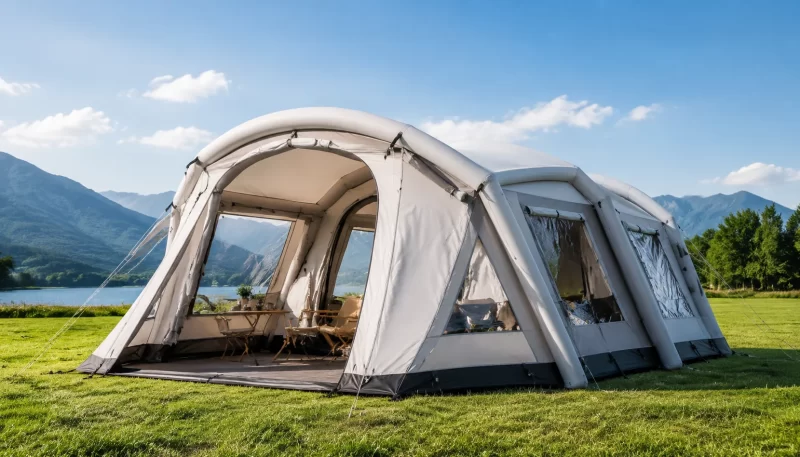
The 6 Inflatable Tent Manufacturers That Pass Our Commercial Grade Test
I’m not going to pretend this list is exhaustive—it’s not. But these six are manufacturers I’ve either worked with directly or seen enough evidence to trust. Each one has a distinct strength depending on what you’re buying.
1. Coody Tent — China
Coody is probably the most well-known Chinese manufacturer in this space, and honestly, there’s a reason for that. They make a wide range of inflatable tents, from small camping models to massive event shelters. Pricing is competitive—mid-range, around $500–$800 for a standard 6-person tent. But here’s the catch: I’ve seen mixed reviews on their heavy-duty models. Some clients swear by them; others report delamination after two seasons. If you’re in the best inflatable tent manufacturers conversation, Coody deserves a mention, but I’d only recommend them if you’re willing to do your homework on material specs. What to ask: “Can you provide the exact PVC coating weight and a wind load test report from an independent lab?”
2. Vango — UK
Vango is a British brand with decades of experience. Not the kind of manufacturer you’d order custom tents from—they focus on retail-ready camping gear. But if you’re looking for best inflatable camping tent options off the shelf, Vango is solid. Their AirBeam technology is well-tested, and they offer some of the best warranties I’ve seen in the consumer space. For B2B buyers, Vango is more of a reference point than a supplier—you can study their design choices to understand what actually works.
3. Heimplanet — Germany
Heimplanet is a small but innovative German company. They make inflatable tents with a unique geodesic airframe structure that’s incredibly stable. Their tents are expensive—think $1,000+ for a 2-person model—but they’re built for serious weather. If you’re looking for heavy duty inflatable tent manufacturers, put Heimplanet on your radar. They’ve got wind tunnel test reports showing their tents survive 80 km/h gusts. What to ask: “What’s your maximum-rated wind speed, and can you share the test protocol?”
4. USA Shelter — USA
USA Shelter is one of the few inflatable tent manufacturers usa I trust for military and emergency response applications. They specialize in large inflatable shelters for disaster relief, and their products are built to last. They’re not cheap—expect $2,000+ for a 10-person unit—but they offer a 10-year limited warranty on their PVC fabric. That’s rare. If you need a tent that can be deployed in extreme conditions, this is the supplier to talk to. What to ask: “What’s your warranty claim process, and how fast do you respond to failures?”
5. AirClad — China
AirClad is a Chinese factory that’s been gaining traction in the European market. They offer flexible MOQ options (as low as 10 units for some models) and produce custom inflatable tents with printed logos and specific color matches. Their pricing is lower-mid range: $350–$600 per unit for standard configurations. I’ve visited their factory in Shenzhen—clean, organized, and they have a proper QC process. They’re a good choice if you’re a startup or need a özel şişme çadır üreticisine yaklaşın without committing to a massive volume. What to ask: “Can you provide a real-time video of a production line running my order?”
6. Inflatable Structures — Germany
This is a niche manufacturer focused on heavy-duty industrial tents. They’re not cheap—$4,000+ per unit—but their tents are designed for permanent or semi-permanent installations. They use TPU bladders, not PVC, which means they’re lighter and more durable in cold weather. If you need an inflatable House Tent for adults that functions like a small cabin, Inflatable Structures is worth investigating. What to ask: “What’s the temperature range your TPU bladders can operate in?”
Now, you might be wondering why I included both Chinese and European manufacturers. Honestly, geography matters. Chinese factories offer lower prices and faster scaling, but you need to manage quality control yourself. European brands offer better material traceability and stronger warranties, but you pay a premium. There’s no single “best” manufacturer—it’s about matching your risk tolerance and timeline.
PVC vs TPU: Which Fabric Makes a Heavy Duty Inflatable Tent?
This is the single most important decision you’ll make when choosing an inflatable tent. It determines weight, durability, cold-weather performance, and cost. And most comparison articles gloss over the practical tradeoffs.
PVC is the industry standard. Cheap, widely available, easy to weld. A standard 0.9mm PVC fabric (like the kind used in most event tents) costs about $4–$6 per square meter. It’s strong—typical tear strength is around 800 N/cm—but it’s heavy. A 6-person büyük şişme çadır kampı model made from PVC will weigh 25–30 kg. It also yellows with UV exposure after a few years, and it becomes stiff and brittle below -10°C.
TPU is the premium alternative. It’s lighter (0.5mm TPU has comparable tear strength to 0.9mm PVC), more flexible at low temperatures (down to -30°C), and doesn’t yellow as much. The catch? Cost. TPU fabric runs $8–$12 per square meter, so you’re looking at 30–50% more per tent. But here’s something interesting: I worked with a rental company that switched from PVC to TPU, and their repair rate dropped from 18% per season to just 4%. Over three years, the total cost of ownership was actually lower for TPU, even with the higher upfront price.
So which should you choose? Here’s my rule of thumb: if you’re running a high-frequency rental fleet (more than 20 deployments per year) or operating in cold environments, go TPU. If you’re using tents for occasional events (less than 10 times a year) and budget is a concern, PVC is fine. And if you’re looking for a heavy duty inflatable tent that you’ll leave set up for weeks at a time, I’d lean toward TPU because it handles continuous UV exposure better.
When you’re talking to manufacturers, ask directly: “What’s the specific fabric weight and coating thickness you’re using?” A lot of them will say “PVC” but won’t give you the spec unless you push. Good suppliers will give you the exact data sheet from their fabric supplier. Don’t settle for vague answers.
Minimum Order Quantities & Lead Times: What Real Manufacturers Actually Require
Here’s a hard truth: most inflatable tent manufacturers won’t tell you their real MOQ until you show serious intent. Why? Because they want to filter out the tire-kickers. But if you’re a real buyer, you can negotiate.
From the six manufacturers I listed, the MOQ range is wide:
- Coody Tent: Typically 100 units for standard models, 300+ for custom colors.
- Vango: They don’t do custom orders for small businesses. MOQ is essentially 1 if you’re buying off the shelf.
- Heimplanet: Small production runs are possible (20–50 units), but they’ll charge a setup fee for custom work.
- USA Shelter: MOQ is around 50 units for their standard shelters, but they’re flexible if you’re a government buyer.
- AirClad: MOQ as low as 10 units for some models, but expect a 15–20% premium for small batches.
- Inflatable Structures: MOQ of 20 units, but they require a non-refundable deposit of 50%.
What about lead times? Most Chinese suppliers quote 30–45 days from deposit to shipping. European suppliers are slower—60–90 days is common. And US suppliers? Plan on 8–12 weeks for custom work. If you’re in a rush, ask about “fast track” options. Some manufacturers (like AirClad) can do 20-day delivery if you’re willing to pay an extra 10–15%.
Here’s a template email you can use to ask about MOQ flexibility:
Subject: MOQ Inquiry for Custom Inflatable Tent

Dear [Supplier Name],

We're evaluating your inflatable tents for [specific use case]. We're interested in starting with a small pilot order of [5–10 units] to test the product in our market.

Could you share if you're able to accommodate a lower MOQ for a first order? We're open to paying a small premium for the flexibility.

Additionally, does your standard MOQ apply to custom configurations (specific colors, logos, or size modifications)?

Looking forward to your response.

Best regards,
[Your Name]
If they say “no,” ask about shared molds—some factories have standard tooling they can use for small runs at a lower rate. That’s how I’ve seen startups get their first 50 units without paying for full custom tooling.
Red Flags: How to Spot an Unreliable Inflatable Tent Manufacturer Before You Wire Money
I’m going to be blunt here. The inflatable tent industry isn’t full of scammers, but there are enough bad actors that you need a system. I’ve personally been burned twice—once by a Chinese factory that promised “military-grade PVC” but delivered fabric that cracked after three months, and once by a European distributor that disappeared after I paid the deposit.
Here are the five red flags I watch for:
1. No independent factory audit report
A legitimate manufacturer will have a third-party audit from SGS, Bureau Veritas, or similar. If they say “we don’t do audits,” walk away. If they offer a photo of their factory but no report, that’s not enough—photos can be faked.
2. No written material specification
If they can’t provide a data sheet from their fabric supplier (with details like tensile strength, tear resistance, and UV stability), they’re hiding something. A real manufacturer knows exactly what they’re selling.
3. Exaggerated claims without evidence
“Our tents can withstand 150 km/h winds!” Unless they have a wind tunnel report to back that up, it’s marketing BS. Ask for the test protocol and the lab name. Inflatable tent wind resistance is a specific metric that should be verified, not assumed.
4. Refuses video inspection
Every reputable factory I’ve worked with has allowed a real-time video call to see their production line. If a supplier says “our facility is private” or “we’re too busy,” that’s a huge red flag. Video inspection is standard practice in B2B manufacturing.
5. Hidden shipping charges
I’ve seen buyers get quoted $2,000 for a 20-foot container, only to receive a final invoice for $4,500 after “port fees” and “customs paperwork.” Always ask for a full landed cost including freight, insurance, and destination handling. If they can’t give you a clear CIF or DDP quote, move on.
Here’s a concrete credibility checklist you can use:
- ✅ Third-party factory inspection report (from SGS, Bureau Veritas, or similar)
- ✅ Two client references (real names and companies, not just email addresses)
- ✅ Raw material purchase invoices (from their fabric supplier)
- ✅ Real-time video inspection request (before any deposit)
- ✅ Written warranty terms (what’s covered, what’s not, claim process)
If a supplier fails more than two of these, do not send money. Seriously. I’ve seen too many buyers ignore these warnings and regret it.
Beyond the List: A Decision Matrix to Compare Inflatable Tent Manufacturers
If you’ve read this far, you’re clearly serious about making a smart purchase. So let’s turn this advice into something you can actually use—a decision matrix.
Here’s how I approach it. I list every shortlisted manufacturer in a table and score them from 1 to 5 on five dimensions:
- Price competitiveness (Is the quote within your budget?)
- Malzeme kalitesi (Spec sheets, certifications, independent test reports)
- Delivery reliability (Do they ship on time? What’s their on-time delivery rate?)
- Satış sonrası destek (Warranty, response time, claim handling)
- MOQ flexibility (Can they accommodate your volume?)
Here’s an example matrix using the six manufacturers we discussed:
| Üretici | Fiyat | Malzeme Kalitesi | Delivery Reliability | Satış Sonrası Destek | MOQ Flexibility | Total (unweighted) |
|---|---|---|---|---|---|---|
| Coody Tent | 4 | 3 | 3 | 3 | 2 | 15 |
| Vango | 3 | 4 | 4 | 4 | 1 | 16 |
| Heimplanet | 2 | 5 | 4 | 4 | 3 | 18 |
| USA Shelter | 2 | 5 | 5 | 5 | 3 | 20 |
| AirClad | 4 | 3 | 4 | 3 | 5 | 19 |
| Inflatable Structures | 1 | 5 | 4 | 5 | 4 | 19 |
This is just a starting point. Your actual weighting will depend on your priorities. If price is critical, Coody or AirClad might win. If you need absolute quality and don’t care about cost, USA Shelter is tough to beat. The point is, you need a system that reflects your specific situation—don’t just go with the cheapest quote or the best website.
Sıkça Sorulan Sorular
Q: Are inflatable tents durable in strong wind?
A: Yes, if they’re properly pegged down and made from quality materials. Look for manufacturers that provide third-party wind tunnel test reports. A well-designed inflatable tent from heavy duty inflatable tent manufacturers can withstand winds up to 80–100 km/h.
Q: How do I find the best inflatable tent manufacturers for my business?
A: Start by defining your use case—rental, camping, or emergency response. Then use the decision matrix I provided to evaluate shortlisted suppliers. Prioritize manufacturers that offer material certifications, video inspection, and written warranty terms.
Q: What is the average price for a good-quality inflatable tent?
A: For a 6-person consumer model, you’ll pay $300–$600. For a heavy-duty commercial tent, expect $800–$2,000. Custom büyük şişme çadır kampı models with specific features can go higher. Always ask for a breakdown of material and labor costs.
Q: Can I get a custom inflatable tent manufacturer to produce a unique design?
A: Yes, most leading manufacturers offer custom services. You’ll typically pay a tooling fee for new molds, and MOQ may be higher (100–300 units). Some, like AirClad, offer lower MOQ for custom work but with a premium.
Q: How long does it take to manufacture an inflatable tent from scratch?
A: Lead times vary. Chinese manufacturers usually deliver in 30–45 days. European and US suppliers take 60–90 days. Factor in 2–3 weeks for shipping. For urgent orders, ask if a fast-track service is available.
Q: Are inflatable tents worth the investment for event rental businesses?
A: In my experience, yes—if you buy from a reliable manufacturer. The best inflatable camping tent or event tent can last 5–10 years with proper care, making the ROI strong. Just avoid the cheapest options without inspection.
After reading through all of this, one thing should be clear: the best inflatable tent manufacturer isn’t the one with the most reviews or the lowest price. It’s the one that can prove its promises with tangible evidence. So before you hit send on that inquiry, ask yourself: if your next event’s tent collapses during a windstorm, will the manufacturer back their product with something more than a chat message?
Your next step isn’t to close a deal—it’s to send three versions of the checklist email template I shared to your shortlisted suppliers. Compare their responses side by side, and only then make your final decision. I’ve included the full template below for you to copy and paste.