Your yard is the only dark house on the block. Every December, the neighbors across the street have their static reindeer lit up, the guy two doors down has the projector snowflakes going, and your front lawn sits there looking like a black hole in the middle of a Christmas postcard. I get it. I’ve been there. You want the spectacle, but the thought of hauling a ladder out in freezing temperatures to string lights along the roofline makes you want to skip the whole season. That’s exactly why I started looking into an inflatable tent for xmas, and honestly, it changed how I approach holiday decorating completely.
Here’s the thing about product pages, though. They’ll tell you a tent is “huge” and “festive” and “easy to set up,” but they never actually compare anything. You’re left bouncing between a dozen tabs, trying to figure out whether a 12-foot inflatable Christmas house will fit in your yard, whether it’ll survive a snowstorm, or whether you’re about to waste two hundred bucks on something that deflates by New Year’s Eve. I’ve spent years in the inflatable products industry, and I’ve watched buyers make the same mistakes over and over. So let me break down what actually matters, what’s genuinely worth your money, and what’s going to leave you with a pile of sagging vinyl in January.
Hızlı Cevap
The best inflatable tent for xmas is one that matches your specific space and use case—a compact snow globe tent for small yards, a house-style inflatable Christmas house for curb appeal, or a heavy-duty commercial-grade air tent for events—with proper anchoring gear and a blower rated for continuous operation.
Why an Inflatable Tent for Xmas Beats Static Decor
Let’s start with the obvious: setup speed. A static display means ladders, hooks, extension cords, and at least a full Saturday afternoon of your life that you’ll never get back. An inflatable tent for xmas, on the other hand, goes from a crumpled pile in a storage bin to a fully erected centerpiece in roughly five to fifteen minutes. You pull it out, spread it on the ground, attach the blower, plug it in, and watch it rise like a festive soufflé. No tools. No climbing. No frozen fingers.
But here’s what the marketing doesn’t tell you: there’s a fundamental difference between how these things stay inflated. Most Christmas inflatable decorations use a continuous airflow system. The blower runs nonstop, pushing air into the structure while vents let it escape, maintaining pressure through constant flow. These are the ones you see in every front yard from Thanksgiving to mid-January, and they’re designed to run for weeks at a time. Then you have the sealed air tents, which are more like giant air mattresses. You inflate them once, seal the valve, and they hold their shape until you deflate them. That’s a completely different product category, and it matters for how you use it.
For Christmas displays specifically, the continuous blower style dominates. It’s what allows for those massive, detailed inflatable Christmas house designs with chimneys, windows, and Santa climbing out of the roof. The constant airflow keeps every detail crisp. Sealed air tents, meanwhile, are better for temporary setups—say, a weekend Christmas market stall or a one-night party shelter where you don’t want a blower humming in the background.
Storage and reuse value is where inflatables really pull ahead of traditional decor. That static nativity scene? It takes up half your garage and only works for one season. A quality inflatable Christmas house folds down to roughly the size of a large suitcase. You’re looking at three to five seasons of use if you treat it right, which makes the upfront cost a lot more palatable when you do the math per holiday. And unlike lights that burn out or blow fuses, an inflatable either works or it doesn’t—there’s no gradual degradation.
The social media angle is worth mentioning too. I’ve seen posts from users on platforms like Lemon8 showing off their Christmas bubble tents, and the engagement is off the charts. People love photographing these things. A well-placed inflatable tent for xmas doesn’t just decorate your yard—it becomes a neighborhood attraction. Kids want to see it. Neighbors stop to take pictures. It’s passive entertainment that makes your house the one people drive past slowly.
Best Inflatable Christmas Tents for Home Yards
When it comes to residential use, the market basically splits into two camps: the house-style inflatables and the snow globe or bubble tents. Both have their place, but they serve different purposes, and knowing which one fits your yard is half the battle.
House-Style Inflatable Christmas Houses
These are the showstoppers. We’re talking structures that look like gingerbread houses, Victorian homes, or Santa’s workshop, complete with lit windows, snow-covered roofs, and animated figures. The Green Monster Inflatable Christmas House Tent, which is listed on Made-in-China for holiday event decoration, is a good example of the category—these range from modest 8-foot models to very large 20-foot models that can dominate an entire front yard.
For most homeowners, a common recommendation is to start in the 10 to 14-foot range. That size is often sufficient to make an impression without overwhelming a standard suburban lot. You typically need about two feet of clearance on each side for the anchoring system, plus room for the blower and electrical connection. Measure your space before you buy. I can’t stress this enough. So many people order the biggest option available, then realize they can’t even fit it between the driveway and the fence.
The price tier for these typically ranges from about $100 to $500, depending on size, detail level, and build quality. The budget end of that spectrum gets you a basic house shape with printed details. The premium end gets you multiple animated scenes, higher-denier fabric, and better stitching that actually survives a season or two of rough weather. My honest take: if you’re buying for home use, aim for the middle of that range. The cheapest options tend to have thin fabric that tears at the seams, and the most expensive ones are honestly overkill unless you’re running a business.
Snow Globe Options for Small Spaces
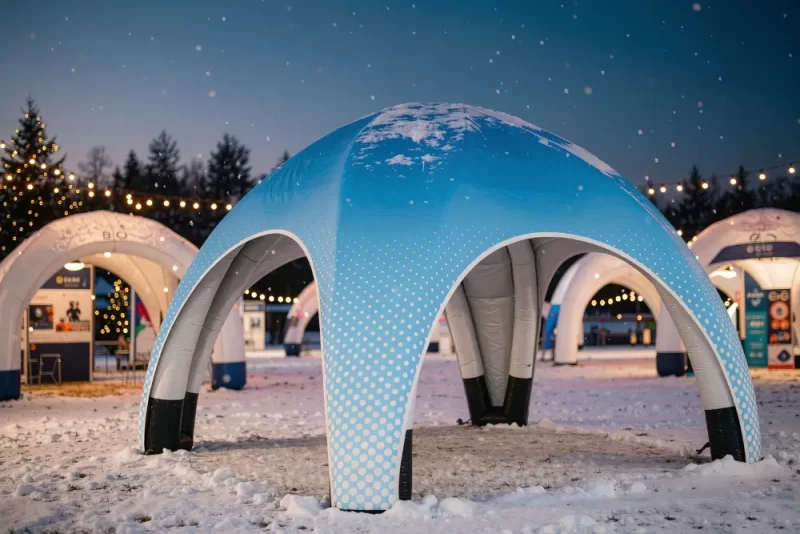
Now, if your yard is more “cozy” than “sprawling,” the inflatable snow globe tent is your friend. These are exactly what they sound like—a dome-shaped clear or semi-transparent tent that looks like a giant snow globe, often with a scene inside and artificial snow that blows around when the fan runs. They’re compact, typically 6 to 8 feet in diameter, and they fit beautifully in small front yards, porches, or even balconies.
The snow globe option is also a fantastic choice if you’re renting or have HOA restrictions. Because they’re smaller and less visually intrusive than a massive house structure, they tend to fly under the radar with homeowners associations that might otherwise object to a giant inflatable dominating the landscape. And they’re genuinely charming—the effect of the snow swirling inside the clear dome is something that static decorations simply can’t replicate.
One thing I’ll note from the social media chatter: bubble tents for Christmas have become a genuine trend. I’ve seen users describing them as a “game-changer for the holidays,” and the photos are undeniably beautiful, especially at night when the internal lighting glows. If you’re looking for something that photographs well and creates that magical winter feel, this is the direction I’d point you.
Price Tier Summary
Let me lay this out simply. Under $100, you’re typically looking at small, simple pieces—maybe a 5-foot snowman or a basic star shape. The $100 to $250 range is where you often find decent house-style inflatables and quality snow globes for residential use. Above $250, you’re entering what is often considered commercial-grade territory, with larger sizes, better materials, and features like remote-controlled lighting or multiple inflation chambers. For the vast majority of homeowners, the $150 to $300 sweet spot is where you’ll find the best balance of size, durability, and price.
Best Inflatable Christmas Tents for Events & Businesses
Here’s where things get interesting. If you’re reading this because you run a business—a Christmas market, a holiday event, a retail space that wants a Santa experience—you’re in a completely different buying category than the homeowner. And the stakes are higher, because a failed tent at a commercial event isn’t just an inconvenience. It’s lost revenue and a bad reputation.
Santa Grotto Tents for Hire
The Santa grotto inflatable tent is a staple of the holiday event industry. These are purpose-built structures designed to create an immersive Santa experience—think a large, themed tent with a throne area, decorative interior, and enough space for children to visit with Santa while parents take photos. What you’re looking for in this category is size, durability, and setup efficiency.
For event hire specifically, you want a tent that one or two people can set up in under fifteen minutes. Every minute you spend wrestling with a tent is a minute you’re not setting up the rest of your event. Look for tents with reinforced anchor points, heavy-duty zippers, and fabric rated for commercial use. The cheap residential models will not survive a season of weekly events. I’ve seen it happen—tents that tear at the seams, blowers that overheat, zippers that jam. It’s not pretty.
The commercial market also demands more from the inflation system. You’re running these things for eight to twelve hours a day, sometimes in cold weather, and the blower needs to handle that workload. Consumer-grade blowers are typically rated for intermittent use. Commercial units are designed for continuous operation. That difference matters when you’re running a grotto from 10 AM to 8 PM every day in December.
Wholesale Sourcing via Alibaba and Made-in-China
If you’re buying multiple units—say, five identical grottos for a mall tour or a dozen smaller tents for a Christmas market—you should absolutely be looking at wholesale sourcing. Platforms like Made-in-China and Alibaba are where the manufacturers actually are. You can find the Green Monster Inflatable Christmas House Tent and similar products directly from factories, often at a fraction of the retail price.
The tradeoff is lead time and quality control. You’re not going to get a wholesale order in two days. You’re looking at three to eight weeks for manufacturing and shipping, so you need to plan months ahead for the holiday season. And you need to be careful about which factory you’re buying from. The industry has a wide range of quality, from factories that produce genuinely commercial-grade products to ones that are essentially making disposable decorations with a wholesale sticker on them.
My advice for wholesale buyers: request samples before you commit to a large order. A sample will cost you some money, but it’s a fraction of what you’ll lose if you order fifty tents and discover they can’t handle wind or the stitching fails after three uses. Also, ask about the fabric denier and the blower specs. These are the two things that most determine whether a tent will survive commercial use.
Custom Branding Options
Here’s a feature that most residential buyers don’t think about but commercial buyers absolutely need: custom branding. Many manufacturers can print your logo, brand colors, or custom artwork directly onto the tent fabric. This is huge for businesses. A branded inflatable tent for xmas at a Christmas market doesn’t just provide shelter—it’s a marketing asset.
If you’re considering custom branding, factor that into your timeline. Custom printing adds lead time, usually a week or two on top of standard manufacturing. And there’s usually a minimum order quantity for custom work, so it might not make sense unless you’re buying several units. But if you’re running a business, the branding potential is one of the strongest arguments for going with an inflatable tent over a traditional framed structure.
Inflatable Tent for Xmas: Sizing & Setup Guide
Let’s talk numbers, because this is where most buyers get confused. The size chart on a product page is usually just the inflated dimensions—length, width, height. What it doesn’t tell you is how much space you actually need around the tent for anchoring, electrical access, and safe clearance.
Square Footage to Guest Count
For event use, a common industry guideline is about 10 to 12 square feet per person for a standing reception, and about 15 to 20 square feet per person for seated events like a Christmas dinner. A 20-foot by 20-foot inflatable tent provides 400 square feet, which typically accommodates around 30 to 40 standing guests or 20 to 25 seated guests. If you’re planning a Santa grotto, you need less space per person—kids don’t take up much room—but you need dedicated space for the throne, the photo area, and the queue.
For residential use, the math is simpler. You’re not accommodating crowds; you’re creating a visual display. A 10-foot inflatable Christmas house is plenty for most front yards. A 12 to 14-foot model makes a bigger statement but needs a correspondingly larger space. Measure your yard, subtract the space needed for anchoring and clearance, and that’s your maximum tent size.
Setup Time: 5 to 15 Minutes
Here’s the pitch that sells most people on inflatables: setup time of five to fifteen minutes. And that’s genuinely accurate for most models, provided you’ve done it once or twice and know what you’re doing. The first time you set up any inflatable tent, it’ll take longer while you figure out the orientation, the blower attachment, and the anchoring. By the third time, you’ll have it down to a routine.
The setup process is straightforward. You lay the tent out flat, locate the inflation port, attach the blower duct, secure it with the strap or clamp, and plug it in. The tent typically inflates in about one to two minutes for smaller models, and up to five minutes for large commercial units. While it’s inflating, you’re placing your anchors—stakes for grass, sandbags for hard surfaces, screw anchors for high-wind areas.
Blower Placement and Electrical Needs
The blower placement matters more than most people realize. You want it positioned so the airflow isn’t obstructed, but you also want it somewhere that won’t collect water or snow. Many tents have a designated blower pocket or sleeve that keeps the blower somewhat protected while still allowing airflow.
Electrical needs are straightforward but non-negotiable. You need a grounded outdoor-rated extension cord, and you need to check the amperage draw of your blower. Most consumer blowers draw 1 to 2 amps, which is generally fine on any standard household circuit. Commercial blowers may draw more, and if you’re running multiple tents, you need to be mindful of circuit loading. A single 15-amp circuit can usually handle a few consumer blowers, but you should check the specs and plan accordingly.
One tip from years in the field: invest in a heavy-duty outdoor extension cord, even if the included cord is technically sufficient. The cheap cords from the big-box store are fine for a string of lights, but they’re not built for continuous use with a blower running 24/7 for six weeks. A 12-gauge cord rated for outdoor use will last for years and won’t overheat.
How to Anchor Inflatable Christmas Tents in Wind & Snow
This is the question I get more than any other, and it’s the one that separates the satisfied owners from the horror stories. The social media comments are full of people asking: “Are inflatable tents durable in high winds and heavy rain?” And the honest answer is: it depends entirely on how you anchor them.
Stakes vs. Sandbags vs. Screw Anchors
You have three main anchoring options, and each has its place.
Stakes are the standard for grass or soft ground. They’re essentially large metal or plastic pins that you drive through the anchor loops on the tent and into the soil. They work great for residential yards and are the cheapest option. The downside is that they’re useless on hard surfaces, and they can pull out of saturated or frozen ground.
Sandbags are the go-to for hard surfaces like concrete, asphalt, or patios. You place the anchor loops on the ground, position sandbags over them, and the weight holds the tent down. They’re portable and reusable, but they require you to haul sandbags around, which is a pain for large setups.
Screw anchors are the heavy-duty option. These are corkscrew-shaped metal anchors that you twist into the ground, then attach the tent’s anchor lines to them. They provide significantly more holding power than stakes, especially in wind, and they’re the standard for commercial installations. The downside is that they require a drill or a specialized tool to install, and they’re more expensive.
For residential use in moderate conditions, stakes or sandbags are usually sufficient. For anything exposed to serious wind, or for any commercial use, screw anchors are the way to go. I’ve seen too many tents take flight because someone relied on the flimsy stakes that came in the box.
Snow Load Limits
Snow is a different challenge than wind. Wind pushes on the tent from the side. Snow accumulates on top and adds weight. Most inflatable tents are designed with sloped roofs that shed snow reasonably well, but a heavy, wet snowfall can still accumulate faster than it slides off.
The key is to monitor your tent during snow events. If you see significant accumulation, gently brush it off—don’t use a metal shovel, which will puncture the fabric. A soft broom or a leaf blower works well. Most consumer inflatables can handle a few inches of light, fluffy snow without issue. Heavy, wet snow is where you need to be proactive.
I’ll be direct with you: if you live in an area that gets serious snow—we’re talking repeated heavy snowfalls—an inflatable may not be the right choice for outdoor use. The continuous blower keeps the tent inflated, but the fabric isn’t designed to support significant snow weight long-term. Some manufacturers rate their tents for snow load, but those are typically the commercial-grade models with higher-denier fabric and steeper roof angles.
Wind Speed Ratings
Wind is the real enemy of inflatables. A blower maintains internal pressure, but a strong gust can overcome that pressure and collapse the tent. Many manufacturers rate their consumer tents for winds up to about 30 to 35 mph, with commercial models rated higher, sometimes up to 50 mph or more.
Here’s the thing, though: those ratings assume proper anchoring. An unanchored tent will blow away in a 15 mph breeze. A properly anchored tent with screw anchors and guy lines can handle significantly more. And you should always deflate and store your tent if severe weather is forecast. No inflatable is designed to survive a severe thunderstorm or a blizzard with 60 mph winds. I don’t care what the marketing says.
One practical tip: if you’re running a commercial event and the forecast calls for high winds, have a contingency plan. Know how quickly you can deflate and secure your tents. Have extra sandbags or anchors on hand. The event organizers who handle this well are the ones who’ve been through a wind event before and learned from it.
Indoor Use, Safety & Maintenance Checklist
Not every inflatable tent for xmas is destined for the front yard. Indoor use is a legitimate application—Christmas markets in convention centers, mall displays, church events, even indoor parties where you want a festive photo backdrop. But indoor use has its own set of considerations.
Indoor Clearance and Fire Safety
The first thing to check is ceiling height. An inflatable Christmas house that’s 12 feet tall outside becomes a problem when your indoor ceiling is 10 feet. Measure your indoor space before you buy, and don’t assume the tent will fit just because it fits outside.
Fire safety is the bigger concern. Inflatable tents are made of vinyl or nylon, which is flammable. If you’re using one indoors, you need to keep it away from any heat sources—space heaters, open flames, hot lights. The blower itself generates some heat, but it’s typically not enough to be a concern as long as the blower has proper ventilation.
Most commercial venues will have their own regulations about inflatable structures indoors. Check with the venue before you commit. Some venues prohibit inflatables altogether due to fire codes. Others require a fire retardant treatment on the fabric. If you’re buying a tent specifically for indoor use, look for one that’s explicitly rated as fire retardant.
Repair Patches for Punctures
Here’s the reality of owning an inflatable: at some point, you will get a puncture. It might be a branch that falls on the tent, a dog that gets too curious, or a stray spark from a fire pit. When it happens, you have two options: repair it yourself or send it out.
Self-repair is surprisingly easy. Most inflatable tents come with a repair kit that includes patches and adhesive. You clean the area around the puncture, apply the adhesive, place the patch, and let it cure. The key is to make sure the area is completely dry before you apply the patch—moisture will prevent the adhesive from bonding. For larger tears, you might need to stitch the fabric first, then apply the patch over the seam.
I’ve repaired more inflatables than I can count, and the process is the same whether it’s a $50 budget decoration or a $2,000 commercial tent. The quality of the repair depends on the quality of the patch material and the adhesive. Don’t use duct tape as a long-term fix. It’ll hold for a few days, but it won’t survive the elements.
Lifespan: 3 to 5 Seasons
With proper care, a quality inflatable tent for xmas is often expected to last three to five seasons. That’s a reasonable estimate. The cheap ones might last one season. The premium commercial ones can last longer, but three to five is a common expectation for a well-maintained consumer product.
The factors that determine lifespan are: fabric quality, stitching quality, how often you use it, and how you store it. Direct sunlight is the biggest enemy—UV radiation degrades vinyl over time. If you’re using your tent for a full month of Christmas displays, try to position it so it’s not in direct afternoon sun, or accept that you’ll get fewer seasons out of it.
Storage matters enormously. A tent that’s folded and stored in a dry, temperature-controlled space will last much longer than one that’s crammed into a damp garage corner. Make sure the tent is completely dry before you store it. Any moisture trapped inside will lead to mold and mildew, which will destroy the fabric from the inside out.
And one more thing: check your blower before each season. The blower is the most likely component to fail, and it’s the one that’s hardest to repair. Clean the intake vents, check the power cord for damage, and listen for any unusual noises when you first power it up. A blower that’s running rough at the start of the season is a blower that will die in the middle of December.
Inflatable Tent for Xmas: Comparison Table
Let me give you a practical comparison that covers the main categories you’ll encounter. This isn’t a specific product ranking—it’s a framework for understanding what you’re looking at when you browse.
| Kategori | Typical Size | Fiyat Aralığı | Kurulum Süresi | Best Use Case |
|---|---|---|---|---|
| Residential House-Style | 8–14 ft | $100–$300 | 5–10 min | Front yard display, curb appeal |
| Snow Globe / Bubble | 6–8 ft | $80–$200 | 5–8 min | Small yards, porches, indoor |
| Commercial Grotto | 12–20 ft | $500–$2,000+ | 10–15 min | Santa visits, events, retail |
| Market Stall Shelter | 10×10'dan 20×20 ft'ye | $300–$1,500 | 10–20 min | Christmas markets, vendors |
| Custom Branded | Various | Varies by order | 10–20 min | Corporate events, marketing |
The consumer vs. commercial distinction is the most important takeaway from this table. Consumer products are designed for occasional use—a month of display, maybe a weekend event. Commercial products are designed for continuous use—daily operation, repeated setup and teardown, exposure to the elements for extended periods. If you’re buying for a business, buy commercial. If you’re buying for your home, consumer-grade is fine, and you’ll save a significant amount of money.
When you’re comparing specific products, the specs that matter most are: fabric denier (higher is better), blower wattage (higher means better inflation, but also more electrical draw), and anchor point count (more is better for stability). Ignore the marketing claims about “premium quality” and look at the actual specifications. A tent with 420-denier fabric is generally likely to last longer than one with 300-denier fabric, all else being equal.
FAQ — Inflatable Christmas Tents Answered
S: Şişme çadır satın almaya değer mi?
A: For most people, yes. The combination of quick setup, visual impact, and easy storage makes them a better value than static decorations that require ladders and take up significant storage space. A quality inflatable tent for xmas is often expected to last three to five seasons with proper care, which can bring the effective cost down to a range like $30 to $60 per year for a mid-range residential model.
Q: What is the best inflatable tent to buy?
A: It depends entirely on your use case. For residential yards, a house-style inflatable in the 10 to 14-foot range offers the best visual impact per dollar. For events and commercial use, look for commercial-grade tents with higher fabric denier and continuous-duty blowers. If you’re looking for the best inflatable tent for xmas in a small space, a snow globe or bubble tent is your best bet.
Q: Are inflatable tents good in winter?
A: Yes, with caveats. Inflatable tents are actually well-suited for winter use because the blower generates warm air that helps maintain internal pressure. However, you need to manage snow accumulation on the roof and ensure proper anchoring for wind. Most consumer models are rated for winds up to about 30 mph, and heavy snow requires proactive removal.
Q: Who has the best Christmas inflatables?
A: The answer depends on your budget and needs. For residential buyers, major retailers carry a wide range of options from budget to premium. For commercial buyers, wholesale platforms like Made-in-China and Alibaba offer direct factory sourcing, which is where you’ll find the best value for bulk orders. The “best” brand is less important than matching the product to your specific use case.
Q: How do you anchor an inflatable tent in snow?
A: For snow conditions, screw anchors are the most reliable option because they maintain their grip in frozen ground better than standard stakes. Place anchors at all designated anchor points, and consider adding sandbags over the anchor loops for extra weight. If heavy snow is forecast, clear accumulation from the roof regularly to prevent overloading.
Q: Can you use an inflatable tent indoors for Christmas?
A: Yes, but check ceiling height and venue regulations first. Keep the tent away from heat sources and open flames, as the fabric is flammable. Look for fire-retardant rated models if you plan on regular indoor use. Ensure the blower has adequate ventilation and isn’t obstructed by walls or furniture.
Q: How long do inflatable Christmas decorations last?
A: With proper care, expect three to five seasons from a quality product. The key factors are fabric quality, storage conditions, and sun exposure. Store your tent completely dry in a temperature-controlled space, avoid prolonged direct sunlight, and inspect the blower before each season to maximize lifespan.
Q: How do you repair a punctured inflatable Christmas decoration?
A: Most inflatables come with a repair kit containing patches and adhesive. Clean the area around the puncture, ensure it’s completely dry, apply the adhesive, and press the patch firmly. For larger tears, stitch the fabric closed first, then apply the patch over the seam. Allow 24 hours for the adhesive to cure before re-inflating.
Final Thoughts: Pick by Use Case, Not Price
Here’s my parting advice, and it’s the same thing I tell every client who asks me about inflatable tents: stop looking at price first and start looking at use case. A $100 tent that perfectly fits your small front yard and survives five seasons is a better purchase than a $300 tent that’s too big, gets damaged in the first storm, and ends up in the trash by February.
What’s your yard or event space size? That’s the question that should drive everything else. Measure it. Write down the dimensions. Then look at tents that fit that space with room to spare for anchoring and clearance. Once you’ve narrowed it down by size, then you can start comparing prices and features.
And don’t skip the anchoring gear. I’ve seen more inflatables destroyed by inadequate anchoring than by any manufacturing defect. A $50 investment in screw anchors and guy lines can save you a $300 tent. That’s the best return on investment you’ll find in the entire holiday decoration category.
If you’re looking for a place to start, I’d point you toward our inflatable tents to see what’s available in the residential and commercial ranges. We’ve been building inflatable products for years, and the Air Tight X Tent review gives you a sense of how much engineering goes into a quality air structure. The story of our founder is a good read if you want to understand the industry from someone who’s been designing these products since the beginning.
The right inflatable tent for xmas is out there. It’s the one that fits your space, matches your use case, and comes with the anchoring gear to survive the season. Measure first, buy second, and you’ll be the house on the block that everyone drives past slowly.
Referanslar
1. Green Monster Inflatable Christmas House Tent for Holiday … – m.made-in-china.com