
Custom Canopy With Logo: Placement Decided Before Printing
Almost every enquiry starts the same way: one logo, sometimes a tagline, and a question about where it should sit. This page answers that question as a decision, not a guess. A custom canopy with logo branding works when the mark is placed on surfaces a manual records — roof, valance, walls, banner positions — and the placement is written down before anything is printed. Send one vector file; get back a written layout, a proof sheet, and a quote. Custom print begins at one unit. 20 years of manufacturing experience.
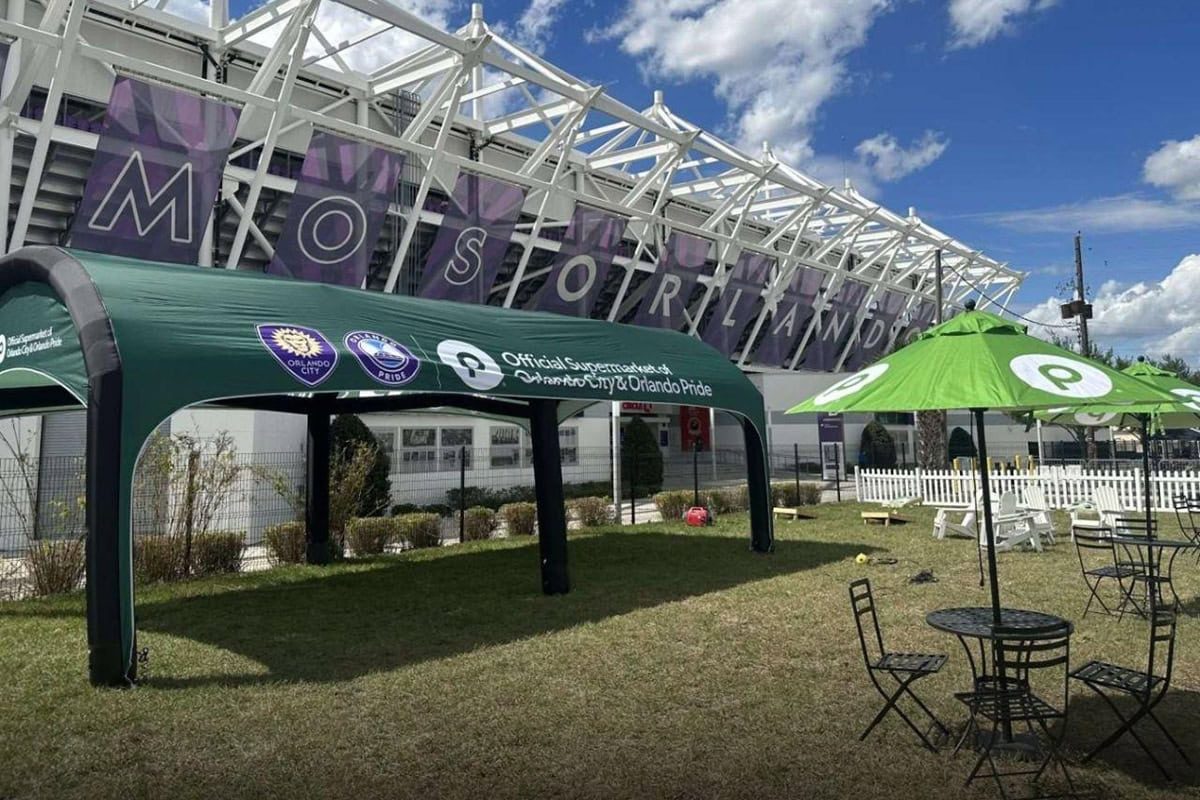
Quick Answer: what does a logo actually get on a canopy?
A logo canopy tent gives one mark six kinds of surface, each doing a different job: the roof field reads at distance, the valance line reads at eye level, the walls carry the detail for people who stay, and the banner positions angled at the approach do the earliest recognition. Where the range supports it, an awning, an arch banner and small column repeats extend the mark beyond the roof. Placement is decided on a written layout against a documented model, shown on one proof sheet for approval, and printed on a process the manual names — 400D Oxford cloth with heat transfer printing on the X series. Send one vector file: a written quotation returns within 24-48 hours, Quoted per project (FOB), custom print from one unit, schedule confirmed after design approval.
What You’ll Learn
- 01What a Logo Can Do on a Canopy
- 02Where a Logo Canopy Tent Works
- 03Five Ranges, Five Logo Surfaces
- 04Six Surfaces a Logo Can Live On
- 05What We Ask From Your Logo
- 06Placement Red Flags
- 07From Logo File to Approved Proof
- 08What Comes Back for One Logo File
- 09Pricing & Minimum Order
- 10Three Marks Already Working
- 11Часто задаваемые вопросы
- 12Customer Cases
What a Logo Can Do on a Canopy
A logo is the one asset every enquiry already owns. What separates a canopy tent with custom logo work from a canopy with a sticker on it is not the printing — it is the placement: which surface, for which reading situation, decided before the fabric is ordered. This page is that decision, written down.
The surfaces a mark can take are not invented per project. Across the thirteen air-frame families, each range's manual records them: the roof field, the valance, the wall panels, and — where the range names them — awnings, banners, arch positions and column patches. On the X series the print route is written down too: 400D Oxford cloth with heat transfer printing. That vocabulary is what turns "put our logo on it" into a plan a production team can execute and a service team can reproduce.
Placement also has a ground dimension. A mark planned for a surface the structure cannot occupy is not a plan: soft floors take guy ropes with ground stakes, surfaces that cannot be drilled take guy ropes with sand bags, and the reply carries that line beside the placement rather than after it.
Placement claims on this page stay inside what the manuals record — no figure goes on the page that a manual does not carry first, and where a reading distance or a colour tolerance has no written basis, we say so instead of supplying one. The proof sheet is where those judgement calls get settled, face by face, with your approval.
Key Takeaways
- A logo earns six kinds of surface on a canopy: roof field, valance line, walls, awning banner, arch banner, column patches — each recorded per range.
- Placement is a decision layer: approach first, surfaces second, single colour versus full print third, scale on the proof.
- One approved proof sheet governs every face and every repeat unit; connecting cloth carries the mark across joined frontages.
- Documented claims include 400D Oxford cloth with heat transfer printing (X series), TPU bladders, hook-and-loop canopy panels on AI, and published sizes from 2.5×3M to XL-B 9.4×5.5M and XII 10M.
- Custom print MOQ is 1 unit; the written quote returns in 24-48 hours, Quoted per project (FOB), schedule confirmed after design approval.
Where a Logo Canopy Tent Works
The same mark does three different jobs depending on where the structure stands: at an arrival point it has to be recognised early, in an open venue it has to be read from around, and inside a full graphic it becomes part of a larger atmosphere. Whether the enquiry says event canopy with logo, promotional canopy with logo или canopy tent with custom logo, the placement logic is the same three photographs.
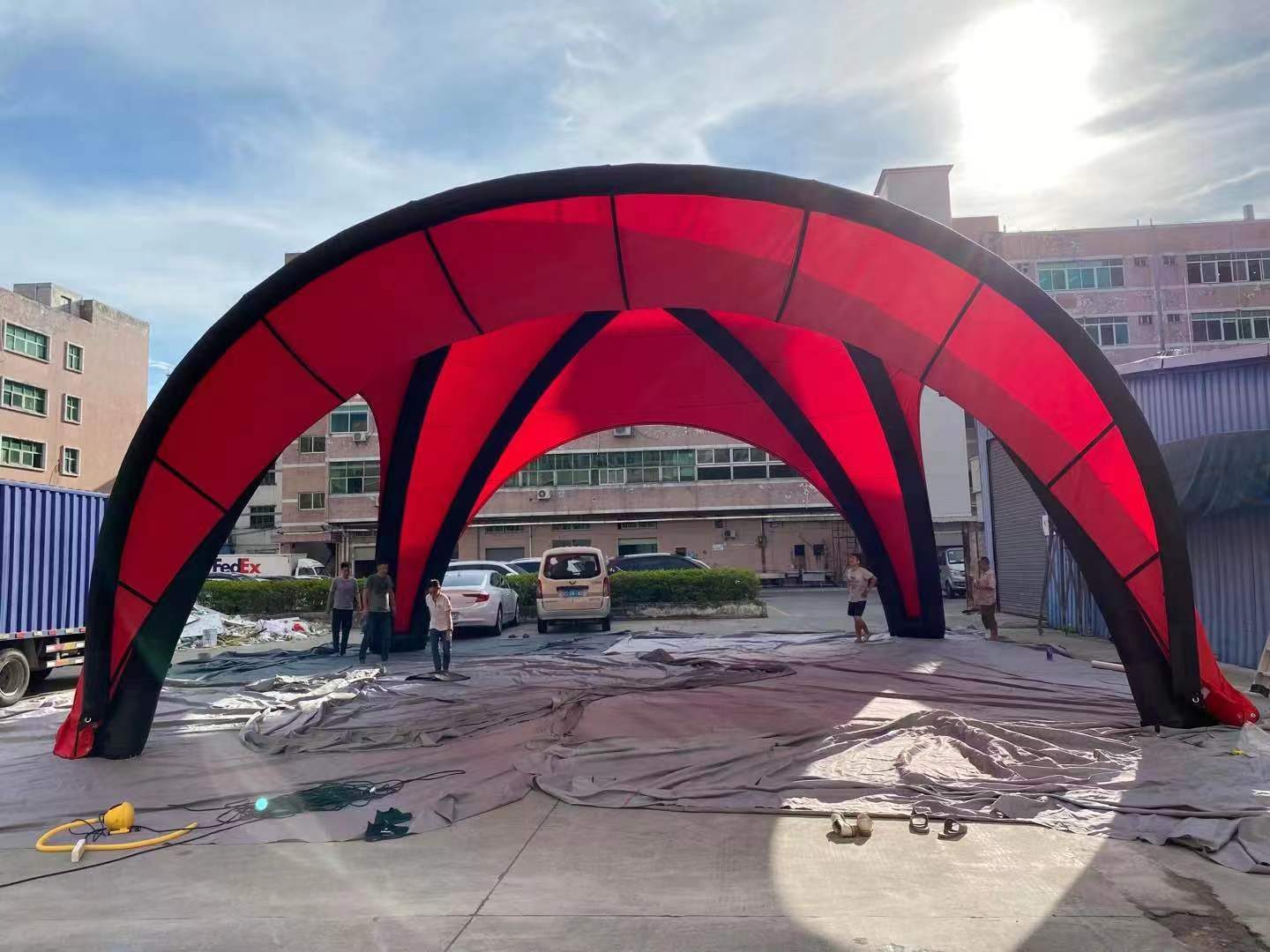
A Mark That Works Before the Visitor Decides
An airtight arch laid out on concrete before it travels. An arch is the one surface a visitor passes under rather than past, which makes it the natural home for the part of the mark that has to be recognised early — at the gate, at the compound entrance, at the edge of the site. Placement here is a routing decision, and it is written into the layout before any fabric is cut.
- Arrival point
- Read while passing under
- Written into the layout
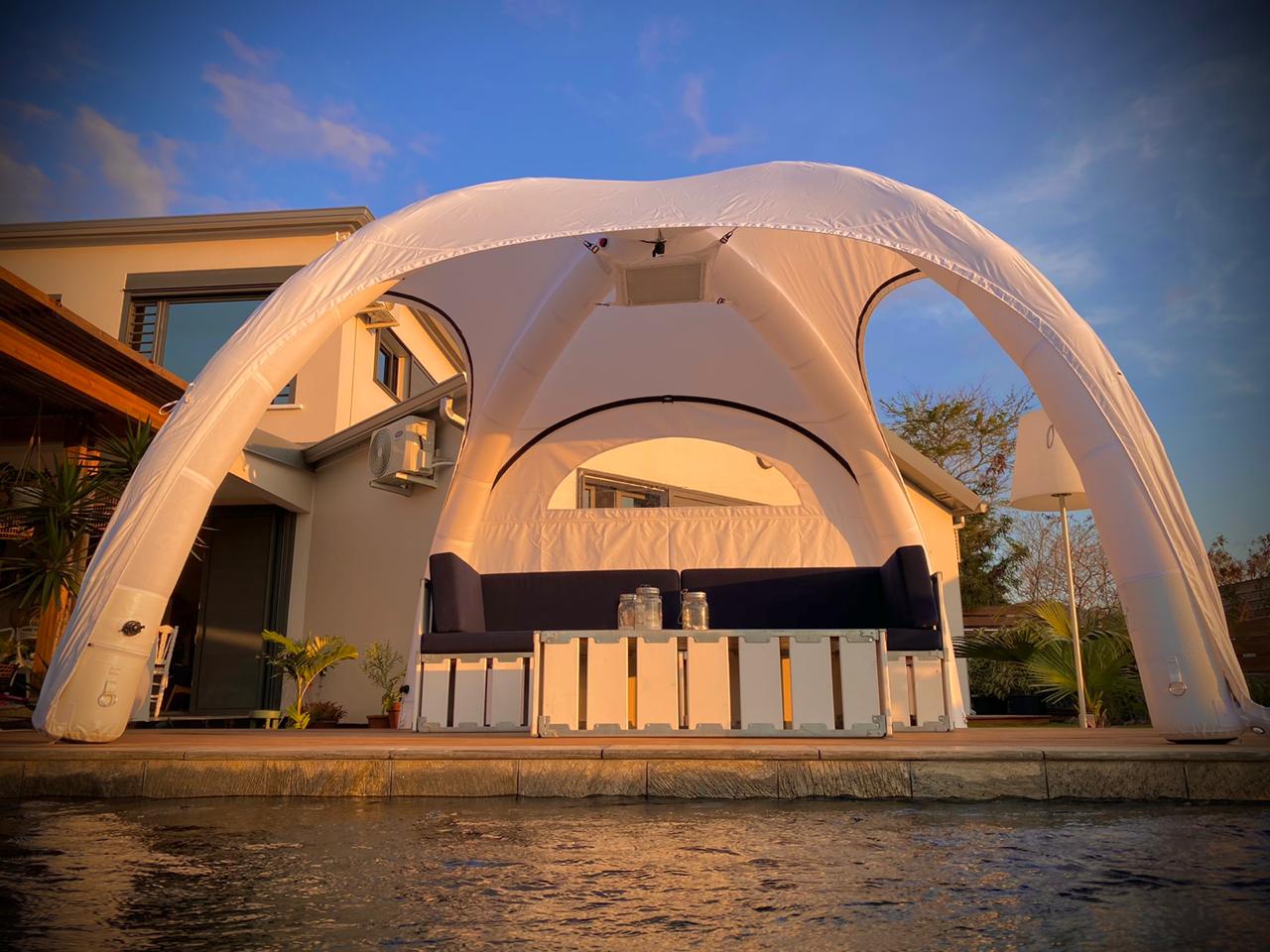
A Roof the Whole Venue Can See
An unprinted white canopy on a terrace with a building rising behind it. Roof marks earn their surface in venues with upper floors, terraces and cameras: the canopy becomes legible from positions no wall can reach. Surfaces that cannot be drilled take guy ropes with sand bags, and that line belongs beside the placement decision, not after it.
- Upper-floor sightlines
- No-drill terrace
- Weighted fixing named
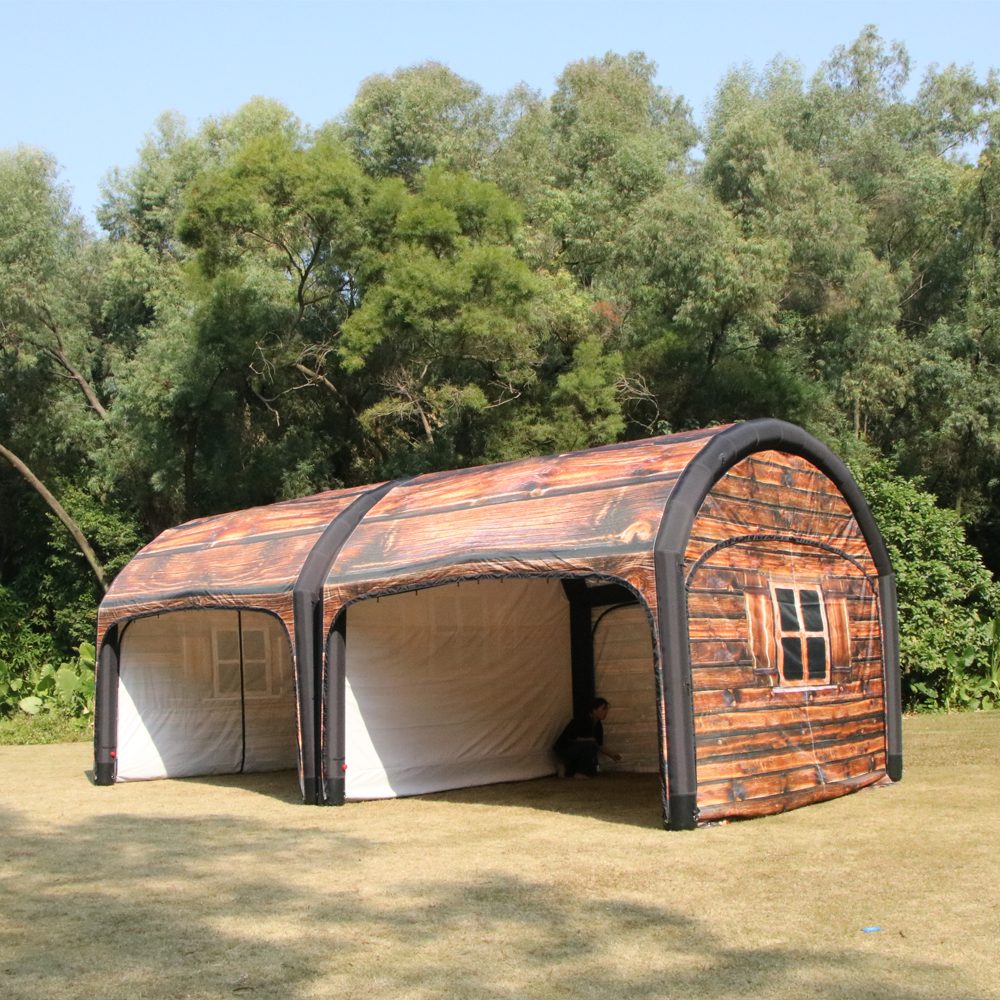
A Mark Inside a Larger Graphic
A full-graphic structure on open grass carries a texture across roof and walls. Full print changes what a mark means: the logo stops competing with an empty surface and sits inside an atmosphere the brand already owns. This is a brand decision more than a print decision, and it is settled on the proof, where both layers are visible at once.
- Full-graphic surface
- Mark inside texture
- Settled on the proof
A logo is not an artwork sheet
The mark is one element; the proof is the whole plan. One approved sheet lists every face the mark touches, the process that prints them, and the state each face was approved in. A canopy tent with custom logo work agreed verbally — the roof here, a wall there — is a plan that lives in one person's memory and dies at the first crew change.
- One proof sheet
- Every face listed
- Not from memory
One mark, many units
A mark repeated across units only works if the repetition is governed. The same approved sheet governs the second unit and the tenth, and the documented sizes keep each repeat on the same geometry. Where units join, connecting cloth carries the mark across the seam instead of restarting it at every edge.
- Same sheet governs
- Same geometry repeats
- Cloth crosses seams
What one file is worth
A single vector logo file, sent with a rough site description, is enough to start. It comes back as a written layout naming the documented model and one of its published sizes, a proof with the mark placed on each chosen surface, a fixing line per floor zone, and terms in the open. Nothing is cut before the sheet is approved.
- Vector file in
- Layout and proof out
- Approved before cutting
Five Ranges, Five Logo Surfaces
Five KCCE ranges appear below because each manual records a different fact about where an inflatable canopy with logo work can go: which panel comes off, which unit reads at close range, which surfaces are named beyond the roof, how the mark crosses a joined seam, and how large one unbroken roof field gets. These are recorded specifications, not marketing lines.
AI Inflatable Tent

The AI manual documents 2.5×3M and 3×3M bays and states that the canopy is held by hook-and-loop rather than a zip. For a mark that has to travel between campaigns, that detail matters more than any rendering: the printed canopy is a panel, and a panel can be serviced, swapped and re-approved without touching the air frame beneath it.
AII Inflatable Tent

AII is documented in 3M and 4M compact formats and its manual names iron blocks as the leg weight. A compact footprint puts visitors close to the fabric, so the mark reads at conversational distance rather than across a field. The quote should still name the weight method, because a close-range mark on a unit that moves is worth nothing.
Надувная палатка X

The X-series manual is the one that records a fabric and a print process — 400D Oxford cloth with heat transfer printing — and names awnings, banners and column patches as recorded items, with modular aluminium connectors for joining same-size units. For a mark, that is the widest vocabulary: surfaces angled at the approach, surfaces over the entry, and small repeats that tie a set together.
Надувная палатка XL-A
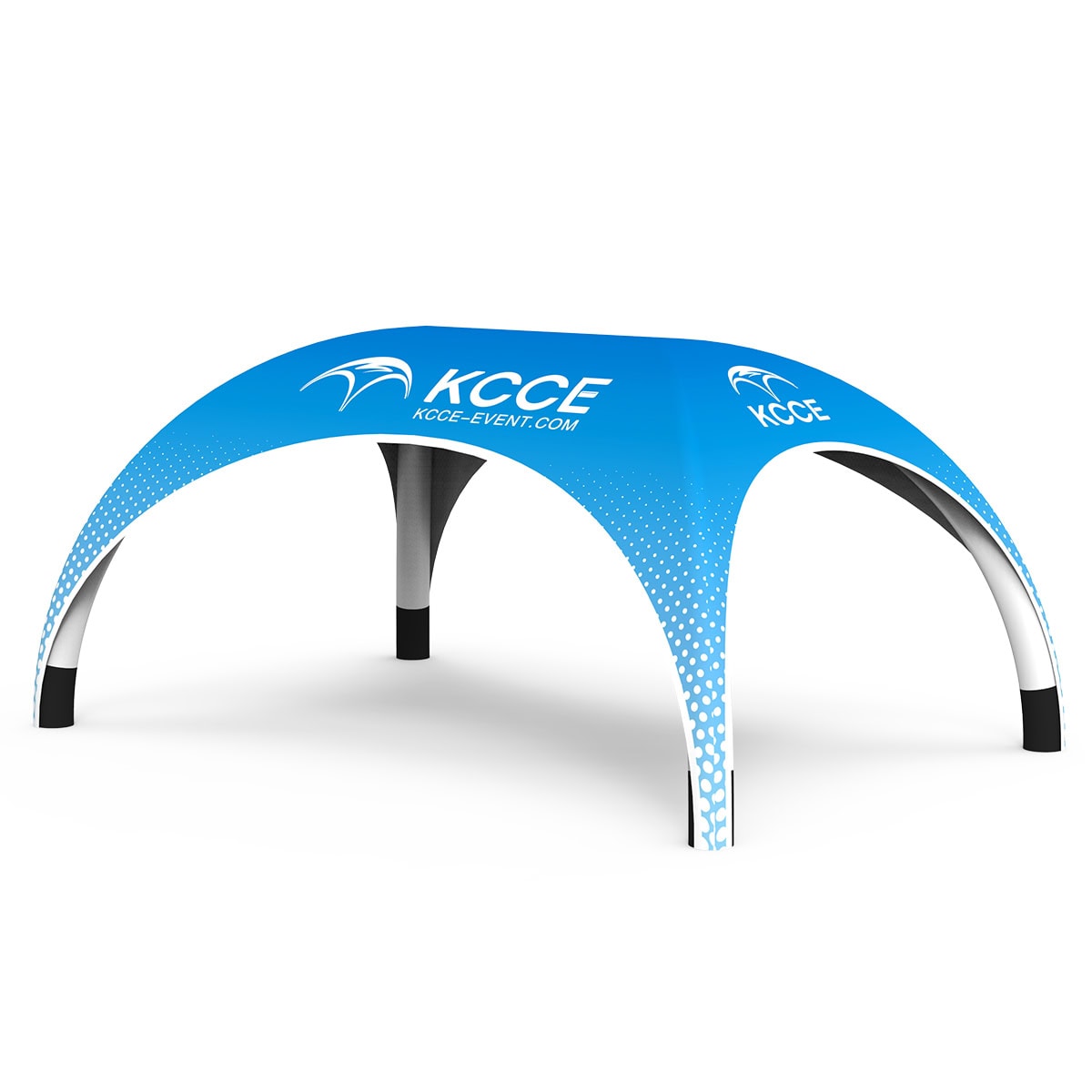
XL-A runs from 4.5×3M up to 7.5×4.8M, and its manual names wide and narrow connecting cloth alongside wide and narrow awnings. When units join into one frontage, the connecting cloth is what keeps the mark running across the seam instead of stopping at each canopy edge. Ask which entry in the range your frontage is drawn against.
N Inflatable Tent

The N manual writes down rectangles from 3×3M through 4×6M to a 5×10M span, and the documentation points higher still: an XL-B at 9.4×5.5M and a XII at 10M. A large, unbroken roof field is the strongest single surface a mark can take, and the rectangle you choose decides how far away that mark starts working.
Six Surfaces a Logo Can Live On
A mark needs a job before it needs a position. Six surfaces cover every reading situation a canopy tent with company logo branding meets, and each one is written into the layout by name so the plan can be checked against the manual page it comes from.
The roof field: the mark at distance
The largest unbroken surface, and the one read from upper floors, far corners and cameras. On a documented rectangle such as N 4×6M the roof carries the mark without competition; scale comes from published sizes, not from stretching a smaller canopy's graphic.
The valance line: the mark at eye level
The band that runs at the edge of the canopy is what a visitor standing metres away reads first. It suits the part of the identity that works in a single line — a wordmark, a name, a campaign phrase — rather than a detailed lockup.
The walls: the mark behind the counter
Where staff and visitors spend minutes rather than seconds, wall panels carry the close-range layer: the lockup, the service list, the co-brand. Faces are listed on the proof sheet like any other surface, approved before cutting.
The awning banner: angled at the approach
The X-series manual names awnings as recorded items. An awning tilts its surface toward the person walking in, which makes it the natural host for the element the approach should read — a welcome line, a campaign tag, a directional word.
The arch banner: over the entry
Where the range supports an arch, its banner is the only surface the visitor passes under. It earns the earliest recognition job: the mark, or the few words that must land before the site explains itself.
Column patches and small repeats
The X-series manual also names column patches. Small repeats along a structure tie a multi-unit set together and keep the mark present in photographs taken close up, where a roof mark alone would fall out of frame.
What We Ask From Your Logo
The input side of a placement decision is short: one file, one colour statement, one hierarchy. Four habits make the difference between a proof that can be approved in one pass and a campaign that re-decides itself at every step.
Send the mark as it is drawn
The vector file — the logo as it was built, not a screenshot of it on a slide — is the only version worth placing. Every surface decision is drawn against the file's real proportions, so the proof shows the mark as it will actually sit on fabric, not as a mock-up flattened to fit.
Name the colours; confirm them on the proof
Say which parts of the mark carry which colour, and the proof shows both together before anything is printed. Colour is settled by approval on the sheet; this page does not publish tolerance figures, because a promise made in numbers is only as good as the proof it was never attached to.
Decide the hierarchy before the surfaces
Most marks arrive with a tagline and a phone number attached. Rank them: the mark first, the campaign line second, contact details where minutes are spent — walls — rather than where seconds are. The placement follows the ranking, and the proof shows all three layers in position.
Single colour against full print
A one-colour mark on clean fabric reads farther and survives reprints simply; a full-print surface makes the mark part of a larger graphic and reads closer. Neither is a price answer — it is a brand answer, and the trade-off is visible on the proof before the decision is locked.
Placement Red Flags
None of these signs proves a bad product on its own, but each one moves the mark away from the people it is meant to reach — or moves the decision to a place where it cannot be checked. Four cards, four habits.
The mark sized to fit, not to read
A logo scaled down to squeeze between other elements stops doing its job long before it stops looking tidy. Sizing belongs on the proof, against the real geometry of a documented surface — the roof rectangle of an N 4×6M, not a rectangle invented for the presentation slide.
One face printed, every approach ignored
A mark on a single wall serves one direction of travel. Visitors arrive along paths, not toward walls. If the plan prints one face without naming the approach it serves, the mark is decoration; the layout should tie every printed face to a reading situation.
Placement agreed in conversation
"We'll put it on the roof and a couple of walls" is a plan that lives in one person's memory. Every face belongs on one approved proof sheet, with the print process named. Memory re-decides the campaign at every crew change; a sheet does not.
Colour promised in numbers, never shown
A colour tolerance quoted without a proof attached is a promise with no witness. Colour is settled by approval on the sheet that shows the mark in position on the real surface. Any supplier who resists showing that sheet is asking you to approve a decision you have not seen.
From Logo File to Approved Proof
Six steps take one logo file to a placement that survives contact with a venue. All six can be run by email, and none of them requires a decision to be made twice. The path is the same whether the enquiry is one unit or a programme of repeats.
Start from the approach, not the artwork
Draw the paths a visitor actually takes: the gate, the aisle, the queue, the road. The approach decides which surfaces do recognition work and which do detail work. A canopy tent with custom logo placement designed around the artwork file alone tends to print the mark where nobody looks.
Choose the surfaces the approach sees
Match each surface to a reading situation: roof for distance, valance for eye level, walls for dwell time, banners for the approach, small repeats for close photos. The written layout lists the surfaces by name, on a documented model, so the plan can be checked against the manual.
Settle single colour against full print
Decide the brand question early because it shapes every surface: one colour keeps the mark independent of the fabric; full print folds the mark into a larger graphic. Ask for both on the proof if the answer is not obvious.
Size the mark to its surface on the proof
Proportion is decided where the mark meets its actual surface: the roof rectangle, the valance band, the wall panel. The proof shows the real geometry of a documented size, so the mark is scaled to fabric that exists, not to a rectangle invented for the presentation.
Walk the proof against the ground
A mark lives on a structure that stands somewhere. Check the fixing line beside the placement: soft floors take guy ropes with ground stakes, surfaces that cannot be drilled take guy ropes with sand bags. A mark planned for a floor the unit cannot occupy is not a plan.
Keep the approved sheet as the campaign master
Once approved, the sheet governs every repeat: the second unit, the next city, the re-faced panel. The quote is Quoted per project (FOB) and the schedule is confirmed in writing after design approval — the same sheet makes the tenth unit a repeat of the first.
What Comes Back for One Logo File
The reply to a logo enquiry is four things: a written layout, one proof sheet, a fixing line per floor zone, and terms in the open. A custom logo canopy enquiry is judged by whether those four arrive without being chased — so we put them in every first reply.
A written layout naming the documented model
The reply places the mark on a real entry: an AI bay at 2.5×3M, an N rectangle through 4×6M and 5×10M, an XL-A within its 4.5×3M to 7.5×4.8M range, with XL-B 9.4×5.5M and XII 10M above when the programme outgrows them. The layout is the anchor every other line refers back to.
One proof sheet with the mark in position
Every surface the mark touches is listed together — roof field, valance line, wall panels, the banner positions and small repeats — with the X-series print route named where it applies: 400D Oxford cloth with heat transfer printing. Approve the sheet once and every repeat unit inherits it.
A fixing line per floor zone
The mark stands where the structure stands. The reply carries the holding method beside the placement: guy ropes with ground stakes on grass and sand, guy ropes with sand bags on surfaces that must not be drilled, and the named range kits — bar bags for U, VI and VII, iron blocks for AII, strip sand bags for XII.
Terms in the open
Written quotation within 24-48 hours, the figure Quoted per project (FOB), lead time confirmed in writing after design approval, and custom print starting at one unit. The same terms hold whether the enquiry is a single event canopy with logo or a multi-city repeat programme.
Pricing & Minimum Order
The figure follows the placement sheet: which model and published size, which faces carry the mark, how many units repeat it, and the fixing kit the floor needs. The terms below are the ones our figures always carry, and they do not change with the quantity.
| Предмет | MOQ | Terms |
|---|---|---|
| One documented unit with the mark placed on approved surfaces | 1 unit | Quoted per project (FOB) |
| Additional identical units on the same proof sheet | 1 unit | Quoted per project (FOB) |
| Joined frontage with the mark crossing on connecting cloth | Named as lines | Quoted per project (FOB) |
| Re-faced panels for a new campaign on the same frame | Named as lines | Quoted per project (FOB) |
| Lead time | — | Confirmed in writing after design approval |
Every quotation is answered in writing within 24-48 hours and the figure is fixed once the proof sheet is approved. When a custom logo canopy enquiry has a fixed event date, put the date and the surfaces you want in the first message so the reply lands while the campaign is still planning. A mark approved after the venue is chosen is a mark placed in a hurry.
Three Marks Already Working
Three builds photographed where they really stand: a roof mark read by a gathered crowd on grass, a frontage facing the approach on asphalt, and a dome carrying its print toward the path on a lawn. Read them for the two lines that had to be written before delivery: the surface doing the work, and the fixing method holding the structure.
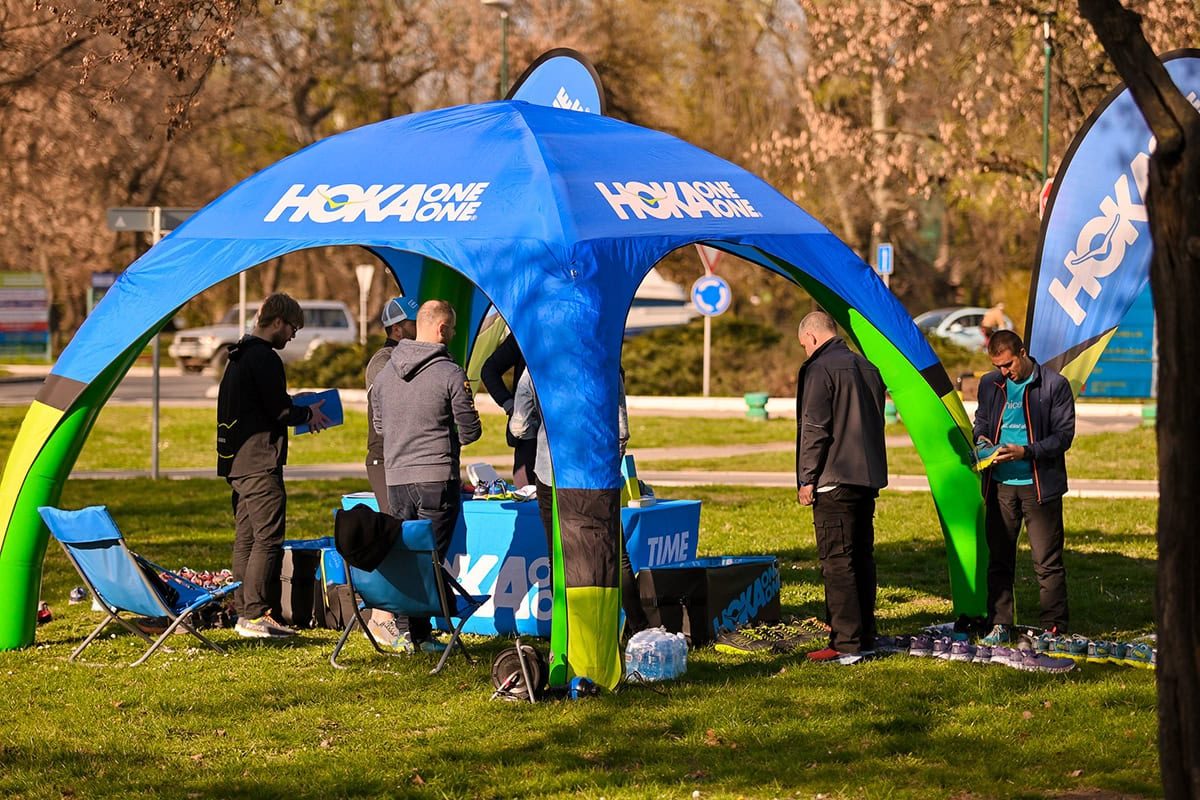
One Mark Read by a Gathered Crowd
A canopy carries its print across the roof while people gather beneath it on grass. The roof mark works here exactly as a placement plan intends: the surface read from distance does the recognition, the space underneath does the hosting, and the ground takes the documented stake fixing. Nothing in the photograph needed a decision made after delivery.
- Roof mark at distance
- Grass and stake fixing
- Recognition first
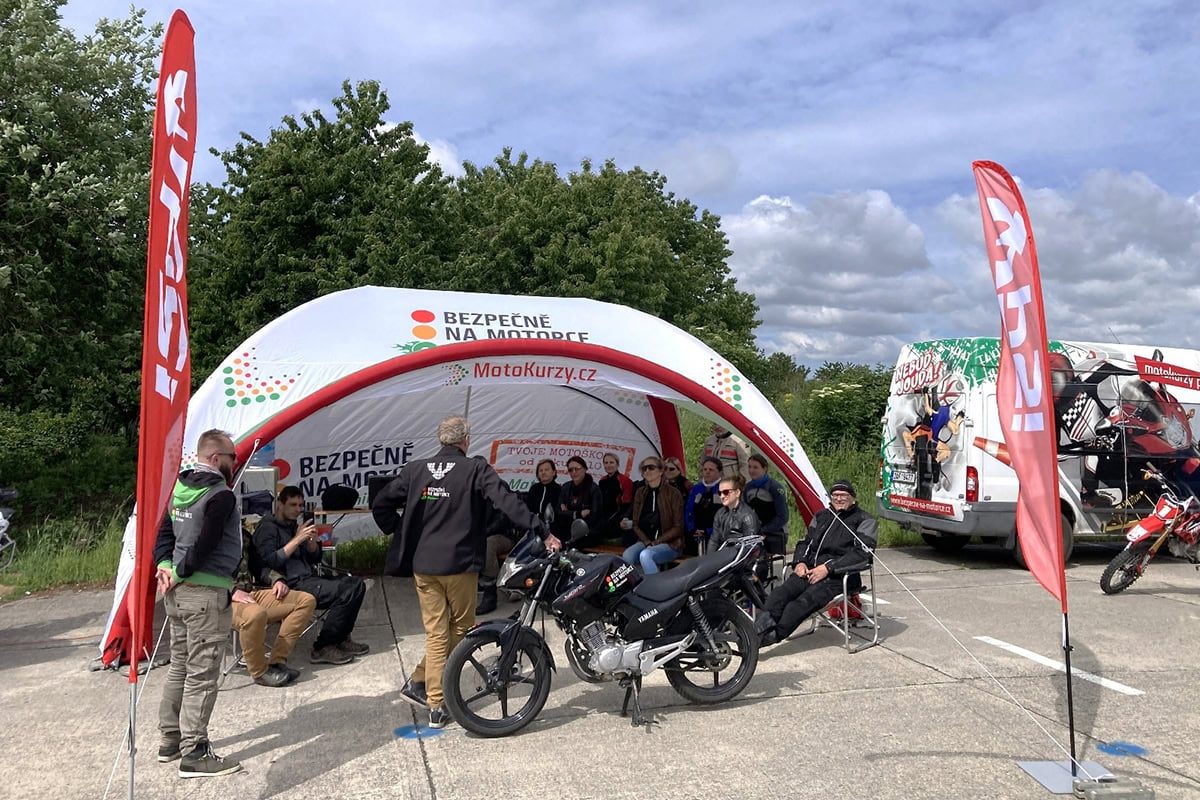
The Frontage That Faces the Approach
A dome stands on asphalt with its printed frontage doing the talking while the machines hold the attention beside it. Hard standing takes weighted fixing, so the fixing line was part of the plan, not a discovery on the day. The frontage reads from the approach — the placement layer doing its quiet work at a working event.
- Frontage at the approach
- Weighted fixing
- Placement as planned
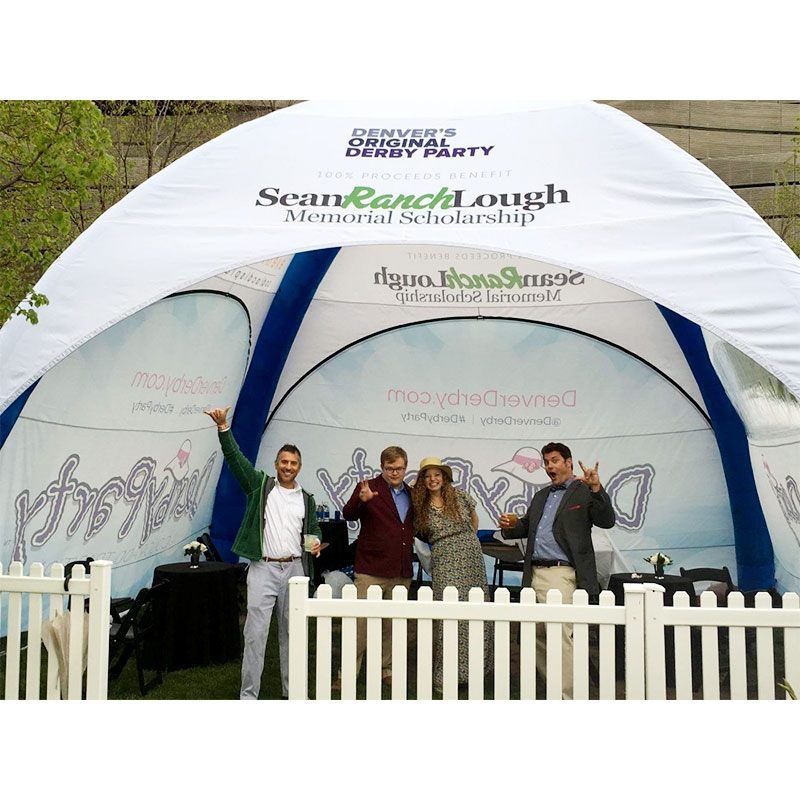
A Dome That Reads From the Path
On a mown lawn, a dome carries its frontage print toward the path people actually take. Soft ground takes guy ropes with ground stakes, and the mark sits where the approach puts it. This is the whole placement layer in one image: surface chosen for the reading, ground chosen for the structure, both written down before delivery.
- Mark faces the path
- Stake fixing on lawn
- Written before delivery
Часто задаваемые вопросы
Marks Photographed Where They Work
Three cases, three standards a mark had to meet: instant recognition in a public square, governed repetition across a set, and the institutional habit of placing the mark where the approach puts people.
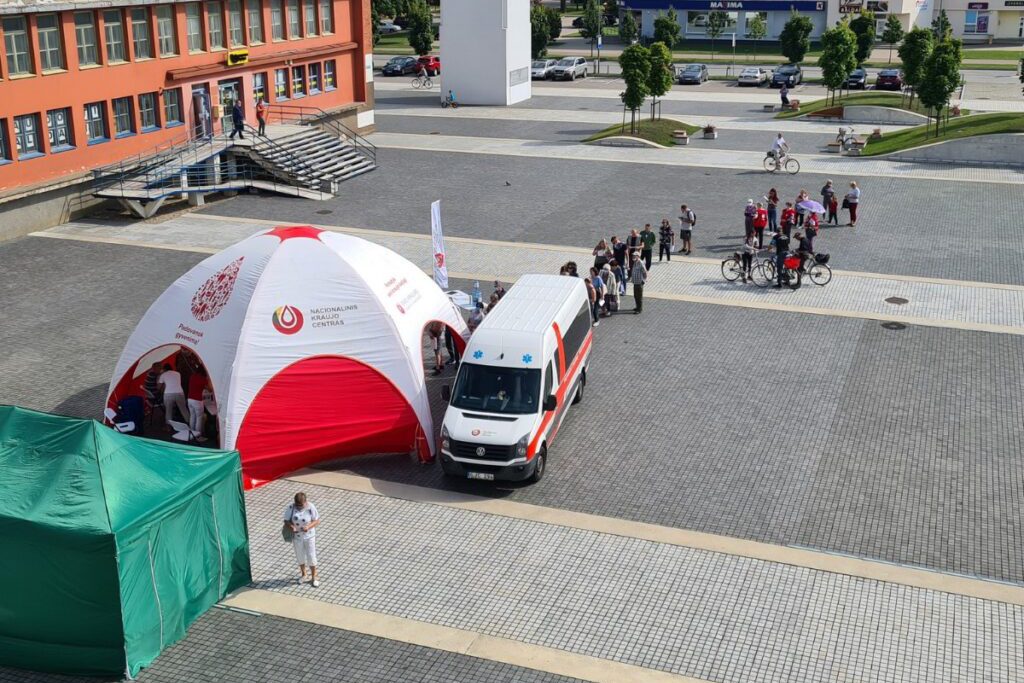
A Mark That Has to Be Recognised
One unit on a public square carries an institutional mark while a queue forms beside it. This is the hardest test a mark faces: it must be recognised instantly by people who did not choose to be there. Placement for recognition is a decision, and it was made on a sheet before the fabric was cut.
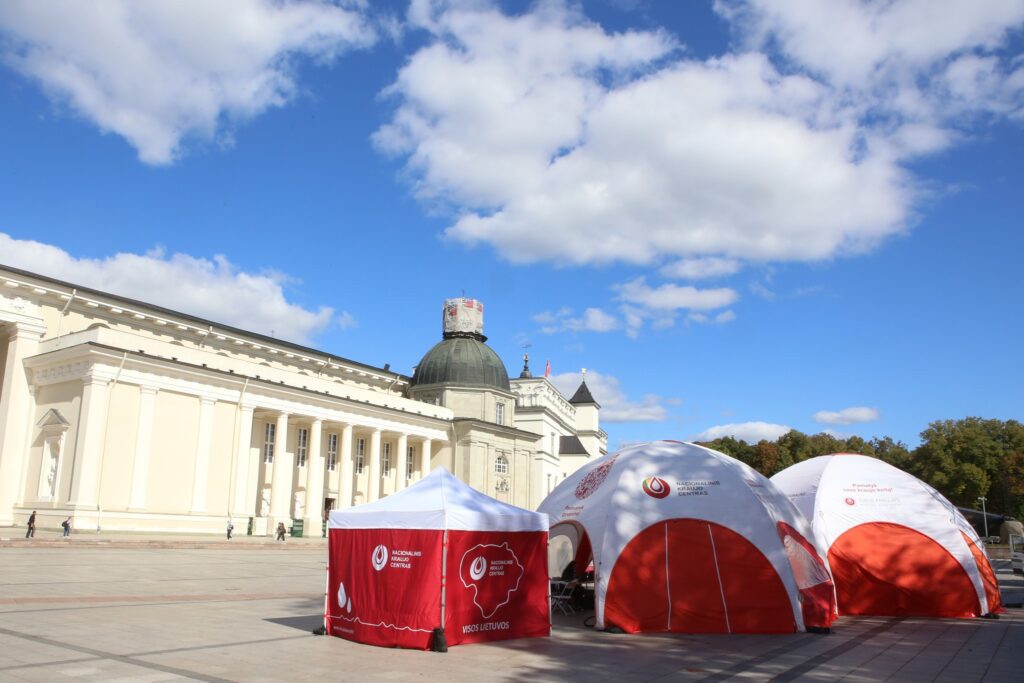
Three Units, One Mark Repeated
Three bays stand to one front in front of a colonnaded building, the mark repeated across each. Repetition reads as authority only when it is governed: one approved sheet, one documented geometry, every repeat identical. Drift between units is how a brand quietly loses the point of repeating itself.
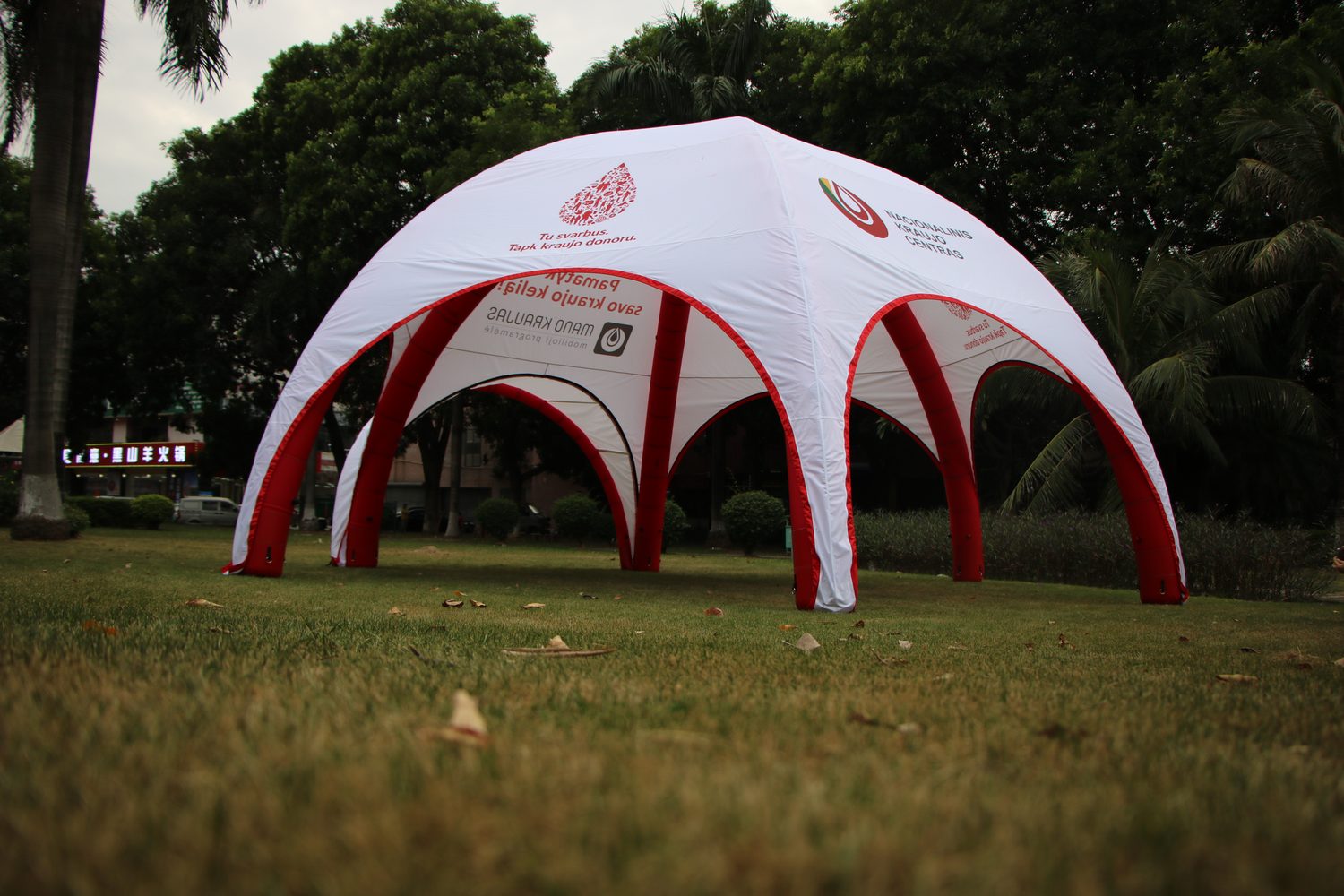
The Institutional Standard for Marks
On open grass with trees behind it, a dome carries its institutional mark through its faces. Institutional buyers hold marks to a standard: placed where the approach puts people, printed on faces a manual records, approved on a sheet before cutting. That standard travels well to any brand.


