
Inflatable Tent for Spain: Itinerary First, Then the Frame
The phrase says inflatable tent for Spain; the work starts with a list of dates. One set, several stops — a lawn, a paved square, an indoor hall — each with its own ground, its own fixing kit and the same approved print. This page walks the order those decisions should be made in, from the first row of the itinerary to one written FOB line for your Spanish port. Custom orders begin at one unit. 20 years of manufacturing experience.
Quick Answer: what does an inflatable tent for Spain order involve?
Un inflatable tent for Spain order is written as an itinerary: one row per stop naming the date, the ground, the frontage and who receives the set next. Each row then gets a documented frame at a published size (F 3×3M / 4×4M for squares, N rectangles through 4×6M to 5×10M for lawns, compact AII indoors, XL-A to 7.5×4.8M for the longest frontage); a face map reused at every address; a single proof sheet covering all printed faces and all dates; a fixing line per row — ground stakes on grass, sand bags on paving, named kits indoors; and the terms: written quotation in 24-48 hours, Quoted per project (FOB) to your Spanish port, custom orders from one unit, schedule confirmed once design is approved.
What You’ll Learn
The Itinerary Comes First
A set bought for one site is a specification; the same set bought for a circuit is a schedule. Dates, ground and handover decide more about the order than any single product photograph, because each stop can quietly ask for a different holding method while still wearing the same printed faces.
Frames here come from documented geometry. F publishes 3×3M and 4×4M bays; N sets out rectangles from 3×3M through 4×6M to 5×10M; AII is a compact 3M and 4M format; AI bays open at 2.5×3M; XL-A spans 4.5×3M to 7.5×4.8M, and XL-B records 9.4×5.5M. These are welded TPU air-frame tubes, with a wall vocabulary the thirteen air-frame families put in writing: lateral side walls, window walls, door walls, reversible double-sided walls, double walls, triple walls — and the F range adds Back Wall Reversible and Double-Back Wall on top.
Fixing is where a multi-stop brief most often comes apart. Grass rows take guy ropes with ground stakes; paved rows take guy ropes with sand bags; indoor rows refuse drilling and use the kits the manuals name — bar bags for U, VI and VII, iron blocks for AII, plus strip sand bags for XII. Printing is settled once: the X-series documentation records 400D Oxford cloth with heat transfer printing, its awnings, banners and column patches are named parts, and modular aluminium connectors join same-size units. Where a run needs one continuous wall line, XL-A's wide and narrow connecting cloth is the documented answer, and AI records a hook-and-loop canopy panel for servicing.
No figure appears on this page without a line in a manual behind it; where performance data is undocumented, the gap is named instead of filled. What rests on judgement rather than documentation is marked as judgement in the written itinerary, alongside the approved proof.
Key Takeaways
- Write the route before the model: one row per stop with date, ground, frontage and handover.
- Every frame is backed by published geometry — F 3×3M / 4×4M, N to 5×10M, AII 3M / 4M, AI 2.5×3M, XL-A to 7.5×4.8M, XL-B at 9.4×5.5M.
- One face map and one proof cover the whole circuit; a changed message means a re-approved panel, not a new frame.
- Fixing is written per row: ground stakes on grass, sand bags on paving, named kits indoors.
- MOQ starts at 1 unit; the written quote lands in 24-48 hours, the figure is Quoted per project (FOB) to your Spanish port, and the schedule is confirmed once design is approved.
One Set, Several Stops
Three moments from the same circuit: packed against the route sheet before it leaves, a paved stop that cannot be staked, and a printed structure that has to read identically at every address. The photographs differ; the paperwork behind them does not.
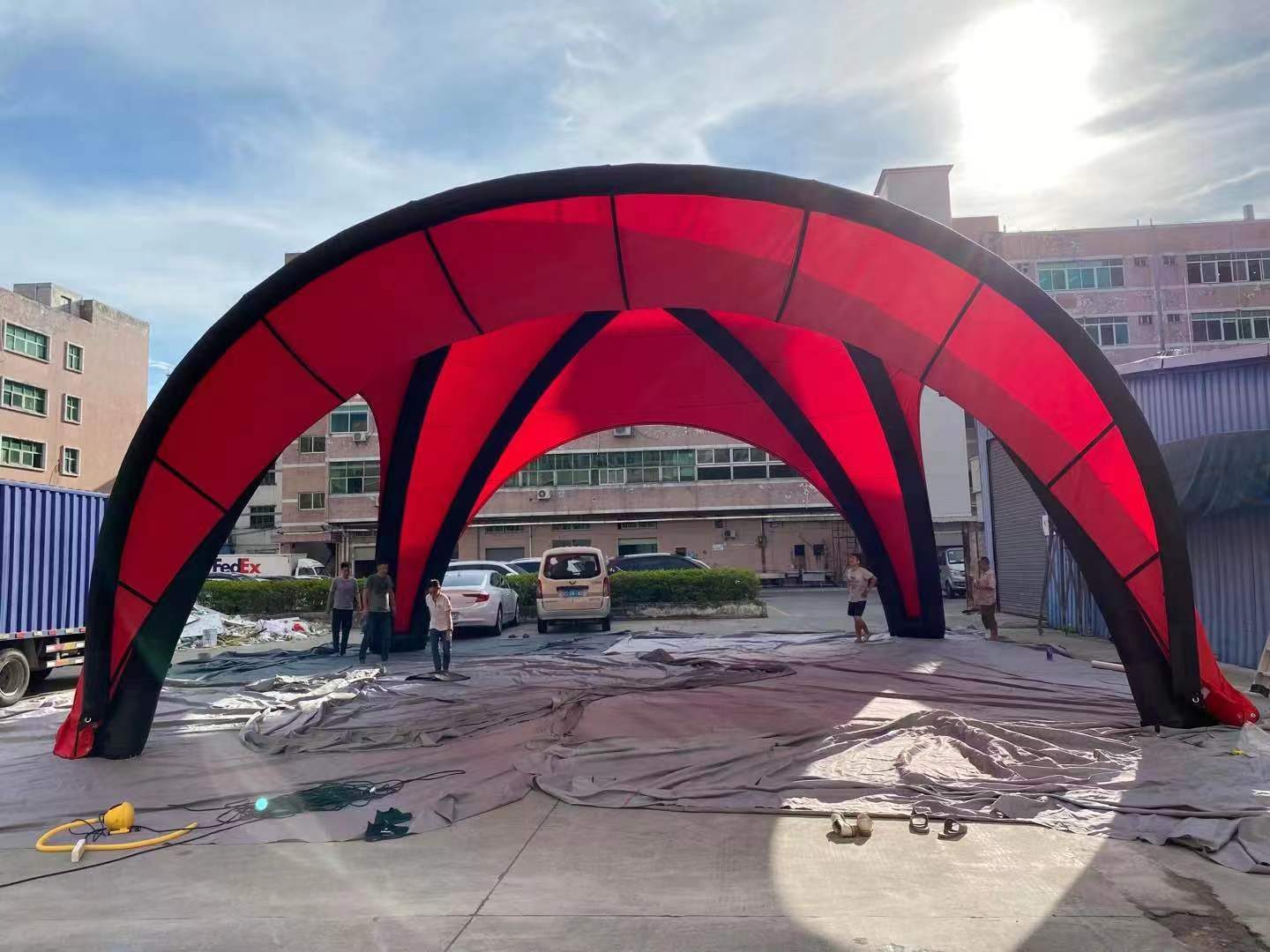
Packed Against the Route Sheet
An airtight structure laid out on hard standing, still at the workshop. A multi-stop order is packed the way it is planned: one row per date, panels and fixing kit assigned to that row, spares listed where a face will be changed. Anything left unspecified here gets decided at the second stop, by whoever happens to unload.
- One row per date
- Kit assigned before travel
- Spares listed
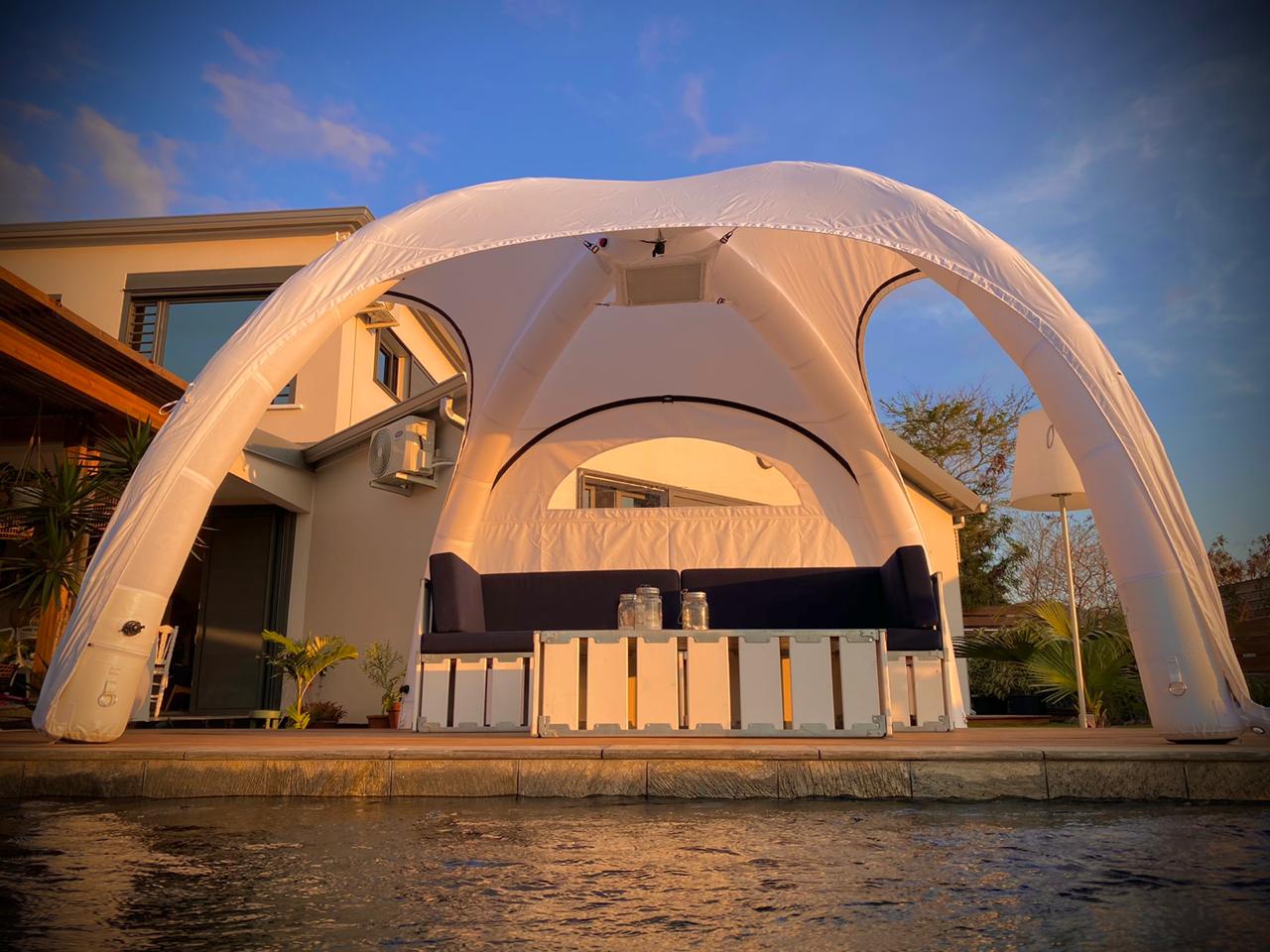
The Paved Stop Cannot Be Staked
An open-front bay on a paved terrace beside a building. Promenades and squares accept guy ropes with sand bags; a lawn stop two dates later accepts ground stakes. Those are two lines on one itinerary, not a phone call on the day — and the kit for each has to travel with the set.
- Paved terrace
- Guy ropes with sand bags
- Two fixing lines, one sheet
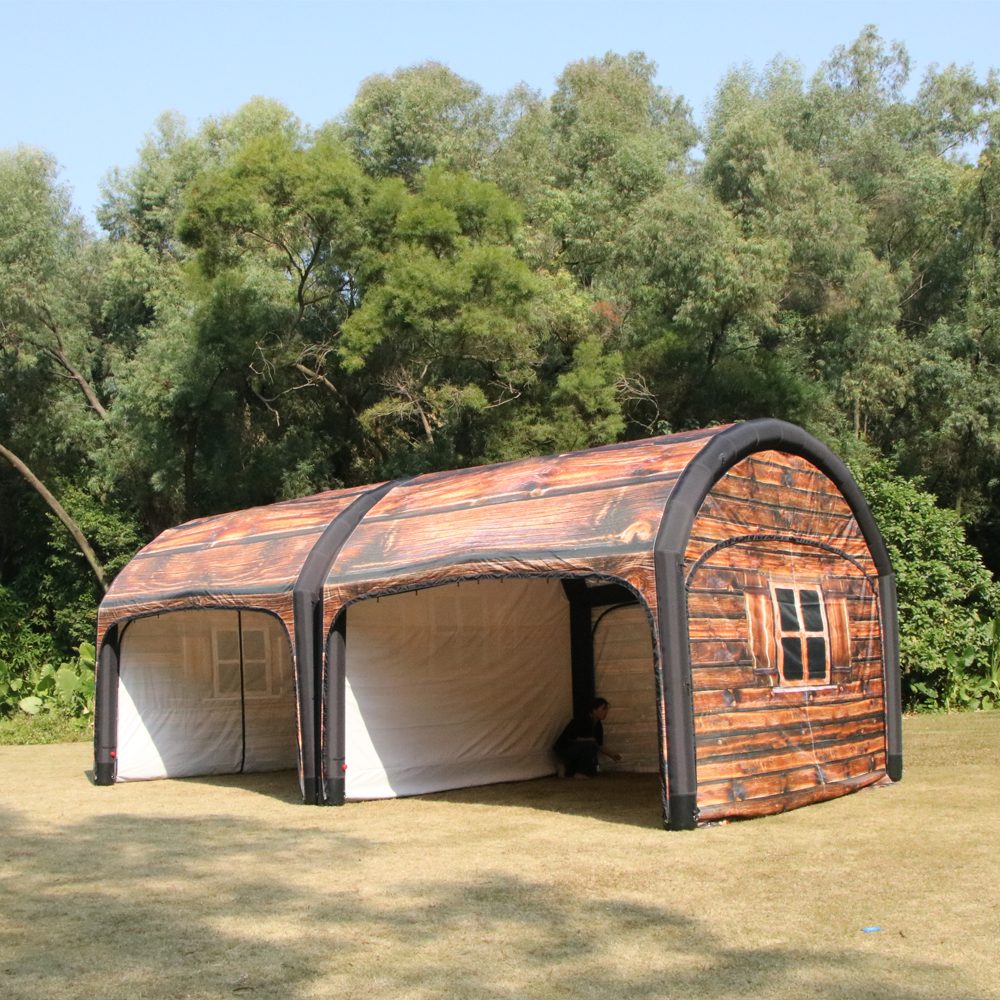
Print That Survives the Whole Circuit
A full-graphic structure on open grass, print running across roof and walls. Repeating one approved artwork at every date is cheaper in decisions than re-briefing each stop: the proof sheet places each printed face in position and direction once, and the route inherits it. Only a changed message needs a new panel.
- Print across roof and walls
- One proof for all dates
- Panels, not frames, change
The itinerary is the first specification
Before a model number is useful, four columns have to exist: the date, the ground under that date, the frontage the public walks, and who receives the set afterwards. A Spain-wide brief with four rows in it produces four comparable quotes; the same brief reduced to one photograph produces four different guesses.
- Date and ground per row
- Frontage and handover
- Comparable quotes
The same face does the same job at every stop
Windward flank closed with a lateral side wall, a door wall where the queue forms, window walls where stock stays visible. Recording those choices once, face by face, is what lets a crew rebuild the set identically at the third address without calling the office.
- One face map
- Rebuilt identically
- No call-back on site
Handover belongs in the paperwork
Between two dates sit a vehicle, a store room and a different crew. The artefacts that survive that gap are plain ones: the written itinerary, the proof per printed face, the fixing line per ground type, and the terms in the open. None is optional on a route.
- Itinerary as anchor
- Proof and fixing lines
- Terms in the open
Five Ranges on the Road
Five KCCE ranges, each earning its row on a circuit for a different reason: a square that fits a tight paved stop, rectangles that repeat as the list grows, a compact bay for the indoor date, named frontage parts that keep the brand consistent, and a joined run for the largest address.
F Inflatable Tent

F publishes two bays, 3×3M and 4×4M, and records a back-wall set of its own — Back Wall Reversible plus Double-Back Wall. On a route where the paved stop is the tight one, that documented square becomes the ceiling every other stop is measured against. One row of the itinerary, one published footprint.
N Inflatable Tent

The N manual walks from 3×3M through 4×6M out to 5×10M, with its wall vocabulary written at each size. A circuit that gains a new stop mid-season is really a question about whether the same rectangle can be repeated: here the sizes and the panels are both on paper, so the added row copies the one before it.
AII Inflatable Tent

Compact 3M and 4M formats, with iron blocks named as the holding method in the manual. A hall stop forbids drilling, so the weight line has to be settled while the route is still being priced rather than discovered on the morning of the indoor date. Documented kits, not improvised ballast.
Tenda Gonfiabile X

400D Oxford cloth with heat transfer printing is written into the X documentation, alongside awnings, banners, column patches and modular aluminium connectors that join same-size units. For a set that is photographed at four different stops, these named surfaces are what keep the brand reading the same in every photograph.
Tenda Gonfiabile XL-A
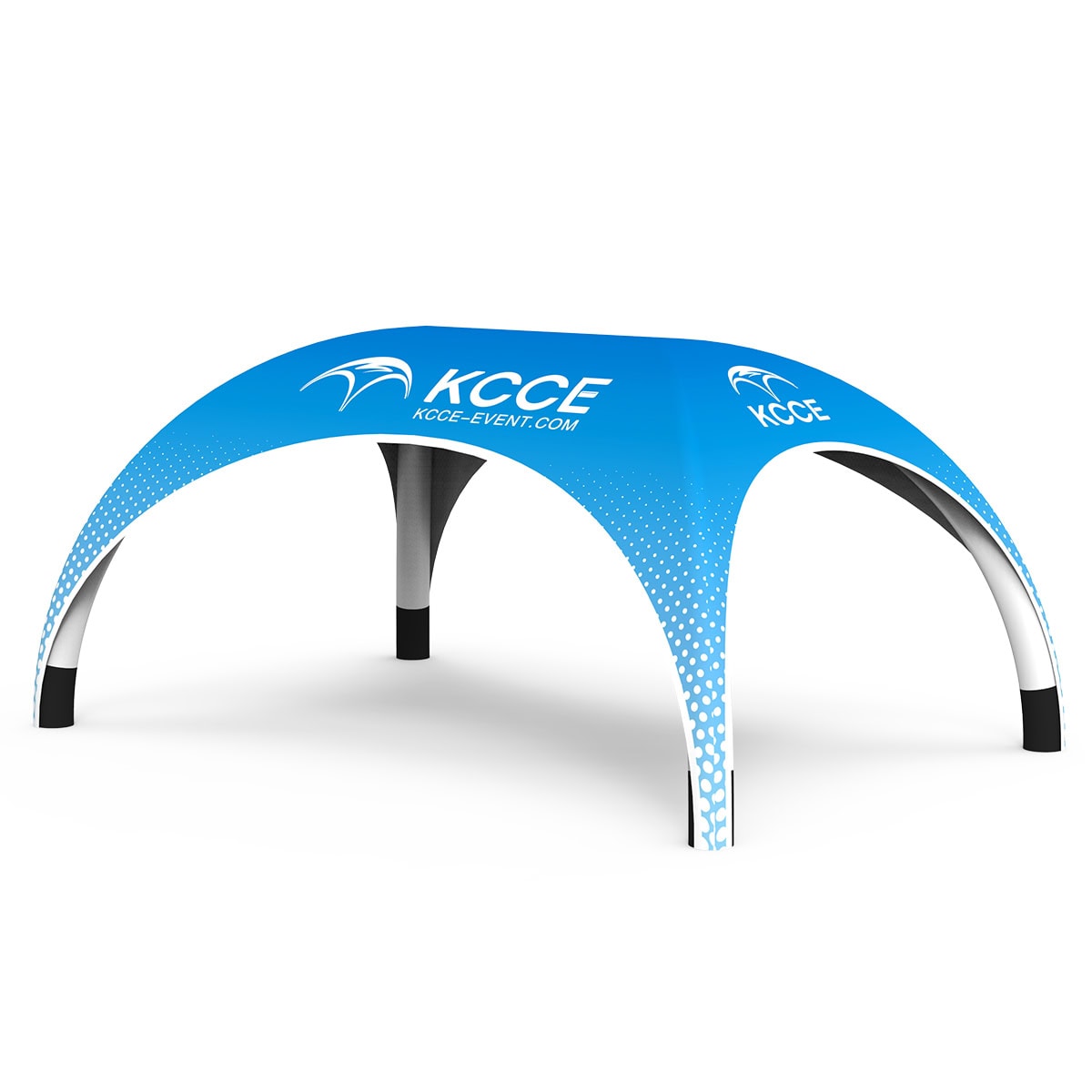
Published from 4.5×3M to 7.5×4.8M, XL-A names wide and narrow connecting cloth so the wall line stays whole across each join. When the largest stop on the circuit needs one continuous building rather than scattered bays, that cloth is the part that makes the row buildable instead of merely adjacent.
Six Stops on the Sheet
Six rows, six different questions for the same set — lawn, square, hall, street, the biggest date and the smallest pitch. Each answer names a published size and the wall logic that row needs.
Stop 1, park lawn: N rectangles in a row
Grass takes guy ropes with ground stakes; rectangles publish 3×3M, 4×6M and 5×10M with their wall set recorded at each size. Repeating one size down the row means the second date needs no new drawing — only a copy of the first row.
Stop 2, paved town square: the F class
Weighted fixing only. F publishes 3×3M and 4×4M bays and names Back Wall Reversible and Double-Back Wall; the face map for a square writes itself — lateral wall on the exposed flank, door wall at the approach, window walls on the display side.
Stop 3, indoor hall: compact AII
No drilling, so the manual's iron blocks have to be in the quote before the set leaves. AII's 3M and 4M formats suit a hall stand where aisle width is negotiated, and an indoor date is exactly why a route needs more than one fixing line.
Stop 4, street frontage: the X range
400D Oxford cloth and heat transfer printing are documented here, with awnings, banners and column patches named as parts. Where the public walks along rather than towards the set, the awning and the banner do the work a second wall would otherwise be asked to do.
Stop 5, the largest date: XL-A and XL-B
XL-A spans 4.5×3M to 7.5×4.8M and names wide and narrow connecting cloth; the documented XL-B rectangle at 9.4×5.5M holds several zones inside one footprint, separated with the recorded double and triple walls. One venue, one row on the itinerary.
Stop 6, a small pitch: the AI bay
AI bays open at 2.5×3M, and the AI range records a hook-and-loop canopy panel for servicing. A short stop with little frontage still gets its own row — and that row decides whether the smallest documented bay or a repeated F square is the honest answer.
One Proof, Many Dates
A circuit multiplies the chances to get a print wrong and removes the chances to fix it cheaply. Four habits keep one approved artwork intact from the first date to the last.
One artwork, several addresses
A set photographed at four stops should read as the same brand in all four frames. Roof and valance carry the name at distance, walls carry the explanation up close, and the X documentation records 400D Oxford cloth with heat transfer printing where that process is named. Decide the layers once; repeat them by row.
Approve the proof before the first date, not before each one
A print correction discovered at stop three is a reprint plus a missed date. Every printed face — both sides of a reversible double-sided wall included — goes on one proof sheet in position and direction, and production waits for that approval. Later dates inherit it without another round of emails.
Change panels, keep the frame
Panels hang on the frame as documented wall types: lateral side wall, window wall, door wall, reversible double-sided wall, double walls, triple walls, plus the F back-wall set. A new message at one stop is a new approved panel, not a new structure. The AI range's hook-and-loop canopy panel is the manual's own example of serviceable facing.
Name what travels between dates
Banners, column patches, awnings, spare panels and the fixing kit are all physical objects with a place on the itinerary. Listing them beside the printed faces stops the second stop being rebuilt from whatever happened to be loaded after the first.
Route Buying Red Flags
A single-site quote can hide a missing decision until the morning it matters. A multi-stop quote hides the same decision once per date. Four signs that the paperwork will not survive the handover.
A quote written for one address
If the reply names a model and a size but no dates, it has priced the first stop and guessed the rest. Ask for the itinerary back in writing, row by row, before comparing any two figures.
One fixing line for mixed ground
Stakes on the lawn, sand bags on the square, named kits and no drilling inside the hall. A single holding method for the whole circuit means somebody will be improvising at stop two with whatever was loaded.
A fresh proof briefed at each date
Re-briefing artwork per stop is how the third date ends up with a different roof. One proof sheet, in position and direction, approved before production, covers every face on every row.
Handover left to the driver
Who receives the panels, banners and fixing kit between dates belongs on the sheet, not in a phone call. Quoted per project (FOB) to your Spanish port and lead time confirmed in writing after design approval should be lines in the first reply.
From Route to First Stop
Six steps turn a list of dates into a set standing on the ground it was bought for. Each runs by email, and none asks the same question twice at a later stop.
Write the itinerary down
Date, ground, frontage, handover — one row per stop. An inflatable tent for Spain enquiry without those rows is a photograph, and a photograph cannot tell you whether the third date needs sand bags or stakes. Quotes built on rows can be compared line for line.
Map each row to a documented frame
A park lawn grows N rectangles, a square fits F's 3×3M or 4×4M, a hall takes compact AII, a street wants the X frontage, a long date asks for XL-A, a small pitch for the 2.5×3M AI bay. Published sizes only — never a rendering drawn for one stop and reused at the rest.
Fix the face map once
Close the exposed flank with a lateral side wall, put a door wall where the approach lands, keep window walls on the display side, hang a reversible panel where two crowds share one face. Because the itinerary borrows the manuals' own wall vocabulary, the same sheet works at every address.
Approve one proof for all dates
Roof, valance, walls, banners: each printed face appears on the proof in position and direction, with the process named where the range records one. One approval covers the set, its spares and any later date that repeats the artwork.
Assign fixing and handover per row
Guy ropes with ground stakes on grass, guy ropes with sand bags on paving, and the kits the manuals name — bar bags for U, VI and VII, iron blocks for AII, strip sand bags for XII. Each row states which kit travels and who receives it before the next date.
Put the delivery line in the open
The reply ends on terms: Quoted per project (FOB) to your Spanish port, written quotation within 24-48 hours, lead time confirmed in writing after design approval, custom orders from one unit. A route quoted with terms in a phone call gets re-argued at the first handover.
What the Reply Puts on Paper
Four artefacts answer a Spain-wide enquiry: a row-by-row itinerary, one face map reused everywhere, a fixing line beside each row, and a single proof with open terms. If they arrive unchased in the first reply, the second stop is a copy of the first.
A written itinerary, one row per stop
The reply reads your dates back to you, then sets a documented model against each ground: an F bay at 3×3M or 4×4M for the square, an N rectangle through 4×6M to 5×10M for the lawn, XL-A within 4.5×3M to 7.5×4.8M for the longest frontage. Carrier, crews and brand all work from that single sheet.
One face map, reused at every address
Walls are named by type and face once, not re-invented on site: lateral side wall on the exposed flank, window wall where stock stays visible, door wall at the approach, back-wall set where F is used. The itinerary records which faces change between dates and which carry over.
A fixing line beside each row
Ground stakes on grass, sand bags where staking is impossible, the named range kits where the manuals record them, and no drilling indoors. A multi-stop quote that names one holding method for the whole circuit has quietly ignored half its sites.
A single proof and open terms
One proof sheet per printed face, in position and direction, carrying all dates; then Quoted per project (FOB) to your Spanish port, written quotation within 24-48 hours, lead time confirmed in writing after design approval, custom orders from one unit.
Pricing & Minimum Order
The figure follows the sheet: documented model and published size per row, then the faces that carry panels, the fixing assigned to each ground, and how many units repeat. The terms below do not change with the number of stops.
| Articolo | MOQ | Terms |
|---|---|---|
| The first row, built to its approved itinerary | 1 unit | Quoted per project (FOB) |
| A further date repeating that row | 1 unit | Quoted per project (FOB) |
| A joined run held together by connecting cloth | Named as lines | Quoted per project (FOB) |
| Replacement panels for a changed message | Named as lines | Quoted per project (FOB) |
| Tempo di consegna | — | Confirmed in writing after design approval |
Written answers go out within 24-48 hours and the figure sets once the schedule is approved. If your inflatable tent for Spain enquiry has a fixed first date, send the number of stops and the ground under each in that first message — the reply then lands while the route is still open, not after the venues are booked.
Three Stops, Three Photos
Three real deployments, read as rows on one route: an indoor date, a lawn date and a paved date with two bays. Look for the two lines written before the set travelled — which faces repeat, and what holds each row down.

The Indoor Date Still Gets a Row
A printed canopy standing over a display table inside a shop. On a circuit this is the date that cannot be staked: the itinerary names the weight kit for it in advance, and the same roof print approved for the outdoor stops arrives here without a second briefing. One row, one exception, all of it on paper.
- Indoor row
- Weight kit named early
- Same approved print
The Grass Stop, Rebuilt From the Same Sheet
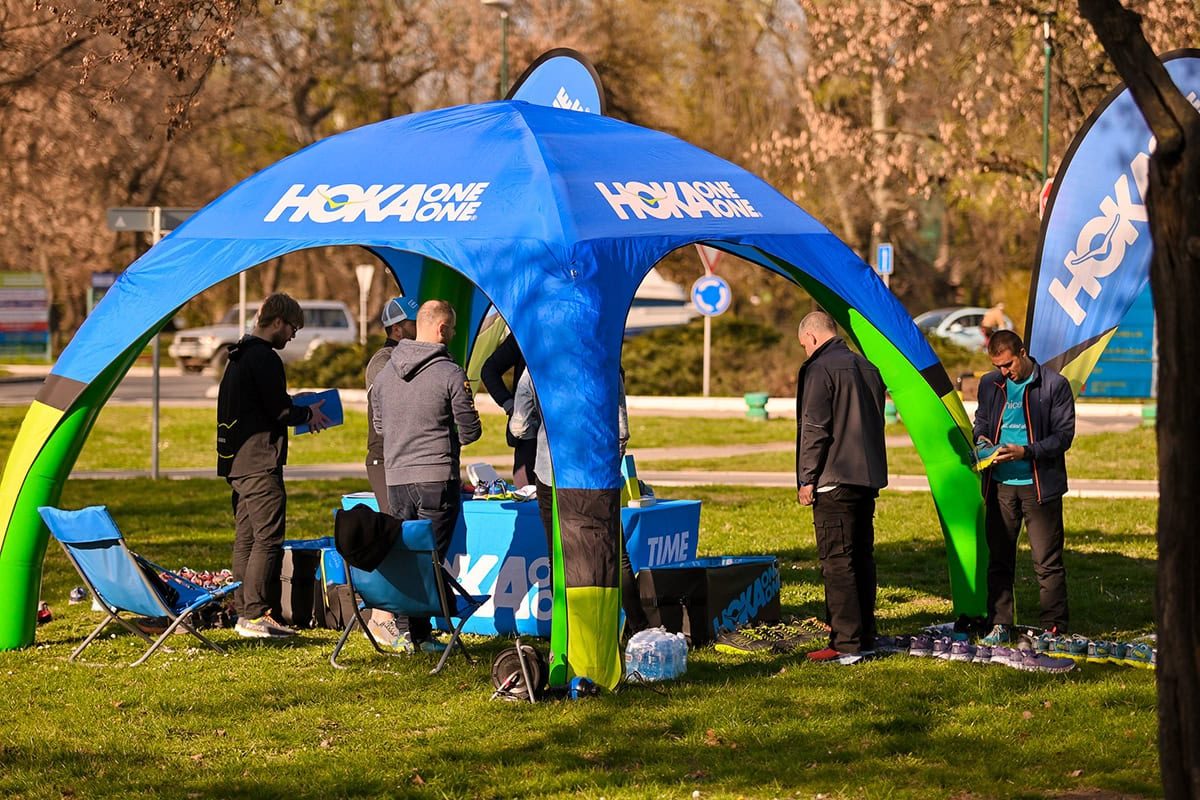
A canopy with a roof print on park grass, people at the table underneath. This date takes guy ropes with ground stakes, while the paved stop two rows later takes sand bags. The face map is unchanged between them — which is precisely why the crew can rebuild it without calling the office.
- Lawn row
- Ground stakes
- Unchanged face map

Two Bays, One Itinerary Line
Two printed canopies standing together on paved ground. Repeating a bay is where a written route earns its keep: same published size, same wall set, same proof, one fixing line for both. What looks like a pair of tents on the day is a single row that was settled weeks earlier.
- Paved row
- Repeated bay
- One line on the route
Domande Frequenti
Sets That Travel Well
Three cases that show what a repeated standard looks like: three bays on one frontage, a queue managed by wall choices, and the same printed dome moved from paving to grass.

A Standard Held Across Three Bays
Three units hold one frontage in front of a colonnaded building. Repetition on this scale only works when the second and third bays copy a written specification rather than the first bay's appearance. For a route, that same habit is what lets a later date be built from an earlier row.

A Queue Planned Before the Site Opened
One unit on paving manages a queue beside an ambulance. The route in, the counter behind the flank and the enclosure holding the line are wall choices, not crowd-control improvisation. On a multi-stop circuit those choices are written once and repeated wherever the queue forms.
The Next Date, a Different Floor
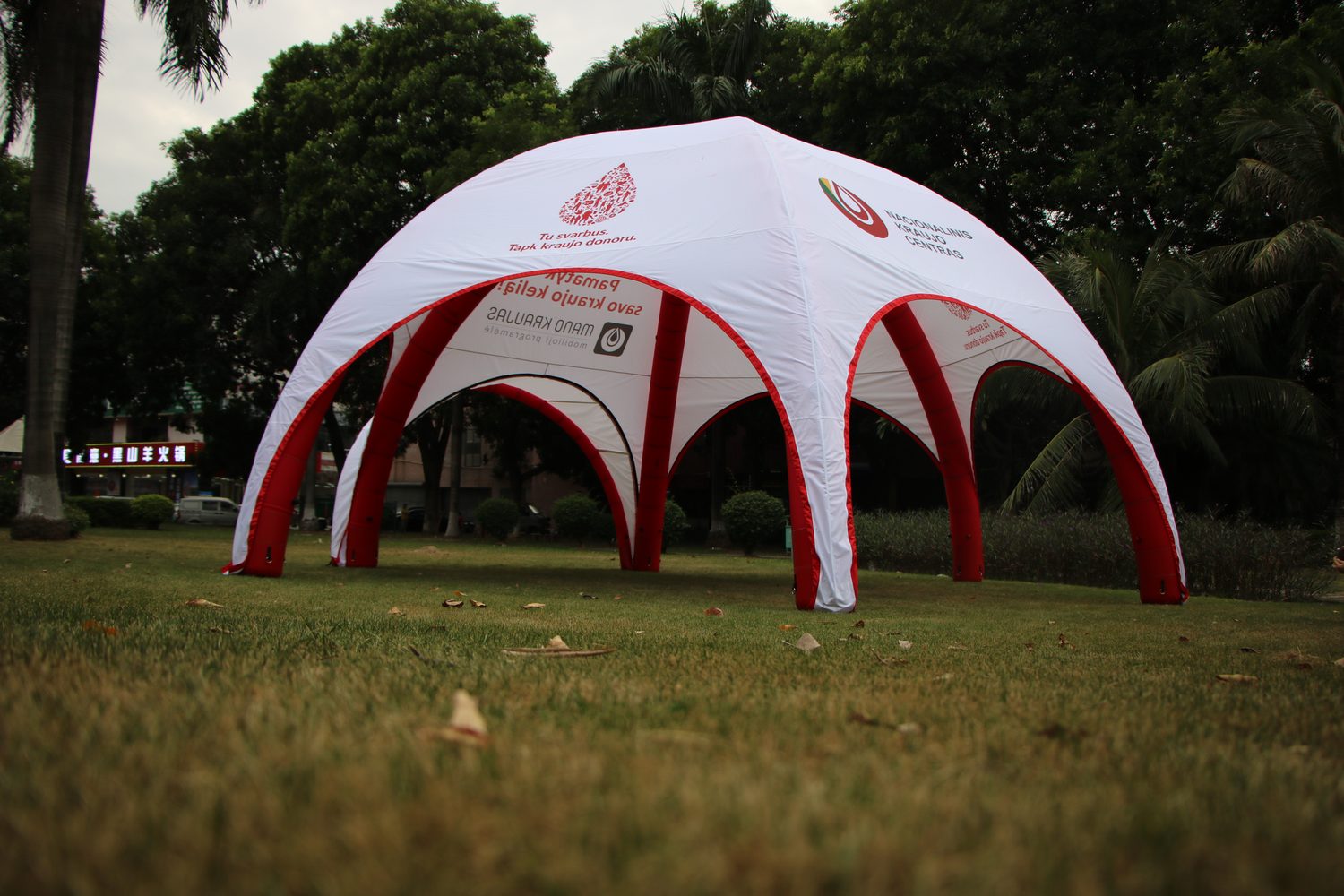
The same kind of printed dome on mown grass with a treeline behind. What the paved square held down with weight this lawn holds with stakes; the panels and the print stay put. A route is simply this change, written into the row before anyone travels.


