Why Inflatable Advertising Tents Are a Game-Changer for Indoor Events
让我为您描绘一个场景。周三早上7点,您站在休斯顿市中心的乔治·R·布朗会议中心内,面对着一堆需要在两小时内搭建为可用展位的管材和帷幔设备。您的团队已经汗流浃背。场地平面图有严格的重量限制,天花板恰好12英尺高,而您刚刚意识到,会议中心的HVAC系统会在中午之前把您精心布置的 折叠帐篷 吹得摇摇晃晃、一团糟。.
听起来很熟悉吧?
我经历过。次数多到我不愿细数。说实话,这正是我开始认真关注充气替代方案的原因。因为当您面对室内活动——无论是休斯顿的行业展会、纽约的产品发布会,还是芝加哥的企业晚宴——您最不需要的就是一个处处与您作对的展位结构。.
这就是 充气广告帐篷在室内活动中的优势 变得不可忽视的原因。这些不是您父辈用的露营帐篷,也不是大卖场里那些单薄的折叠帐篷。我们说的是专门设计、适应场馆需求的构筑物,能在10分钟内从后备箱里的一个袋子变成一个完全品牌化、引人注目的展位。.
但关键在于——网上大多数文章要么没有真实数据就大肆吹捧,要么完全忽略了那些决定活动成败的室内特定挑战。本文不是那样。我将带您逐一了解充气帐篷在室内环境中为何有效、大多数人不会提及的隐性成本,以及那些能让您避免与消防队长进行尴尬对话的合规要求。.
让我们开始吧。.
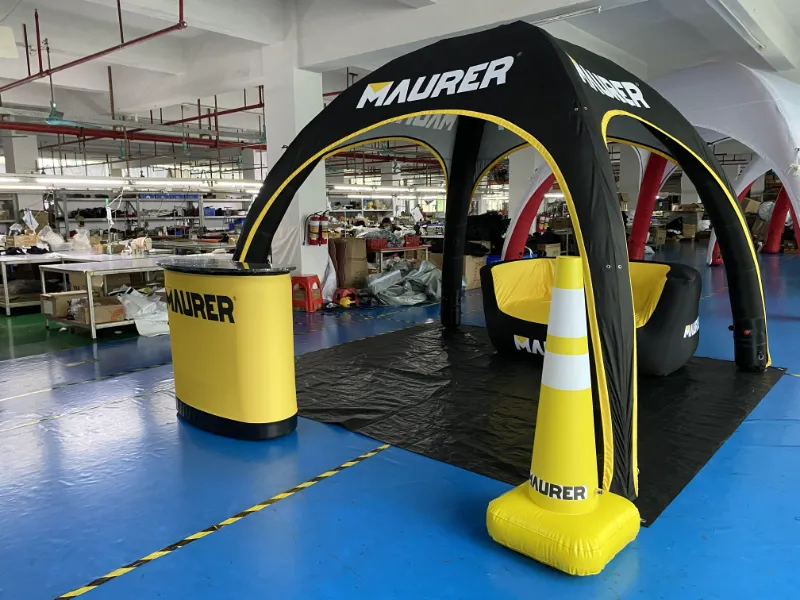
Key Benefits: Speed, Portability, and Visual Impact in Indoor Settings
如果要总结充气帐篷为何在室内空间中胜出,归结为三点:速度、便携性和纯粹的视觉冲击力。.
速度。. 我曾经计时过。一个标准的10×10交叉穹顶帐篷——完全充气、固定并完成品牌布置——一个人用时8分23秒。同一个人去摆弄一个典型的折叠遮阳篷?四十五分钟,这还是不出任何意外的情况下。现在想象一下,您要为一场多日活动搭建20个展位。仅节省的时间就足以证明更换方案的合理性。.
根据展会物流报告的数据,使用充气帐篷的搭建时间相比传统管材帷幔系统减少了约80%。这不是营销噱头——这是来自那些分秒必争的活动组织者的真实数据。.
便携性。. 有一件事大多数人不会想到,直到他们拖着60磅重的钢架穿过会议中心的装卸区。一个10×10的充气穹顶帐篷,连同收纳袋和鼓风机,总重约35磅。它可以放进一辆轿车的后备箱。真的。我做过。.
相比之下,传统折叠帐篷带有可折叠铝制框架,重45-50磅,占用空间明显更大。或者一套管材帷幔系统,需要一辆小型货车才能运输。对于在休斯顿市中心面临停车紧张和电梯拥挤的活动策划者来说,这种轻便的便携性不仅仅是方便——而是至关重要。.
视觉冲击力。. 这是充气帐篷绝对碾压竞争对手的领域。一个 设计精良的充气广告帐篷 拥有巨大且无中断的品牌展示面——通常可实现360度全方位可见。没有立柱遮挡您的标志。没有织物在中间下垂。只有干净、紧绷的乙烯基材料,让您的品牌看起来专业且用心。.
我见过展位仅仅因为改用充气设计,就从无人问津变成整个展馆中被拍照最多的位置。而这正是关键所在,不是吗?您不仅仅是在租用空间——您是在争夺注意力。.
Understanding Indoor Venue Requirements: Ceiling Height, Floor Load, and Fire Safety (NFPA 701)
现在,在您急着去买充气帐篷之前,让我先踩一下刹车。室内场馆不是开阔的田野。它们有一整套规则,如果您没有准备,很容易让您栽跟头。.
天花板高度。. 大多数充气穹顶帐篷在完全充气后需要8到10英尺的净空。这听起来很简单,但问题在于:一些场馆有吊顶、悬挂灯具或HVAC管道,实际下垂高度低于标称的天花板高度。我曾见过一个设计精美的 छपी हुई फुलाने योग्य टेंट 在乔治·R·布朗会议中心被拒收,因为策划者测量的是大厅中央的高度,而不是实际展位位置——那里有一个悬挂在9英尺高度的灯光网格。.
量两次。充一次。.
地面承重。. 这对于多层场馆来说是一个大问题。如果您在高于地面的宴会厅楼层或展览厅二层搭建,场馆通常会对每平方英尺的重量有限制。一个典型的充气帐篷连同鼓风机和配重底座,10×10的配置总重可能在200-300磅左右。这通常没问题。但如果您要增加重型展示设备、地板或家具,重量会很快累积。.
消防安全。. 这是最重要的一点。美国大多数室内场馆要求充气帐篷具有阻燃性能,通常需要获得 NFPA 701 (纺织品和薄膜火焰传播防火测试标准方法)认证。一些场馆也接受 CPAI-84 认证。我怎么强调都不为过——如果您的充气帐篷没有清晰可见的认证标签,场馆可以而且经常会拒绝入场。.
我亲眼见过一个供应商在休斯顿的一场活动中因为帐篷缺乏所需的防火等级而被拒之门外。他们不得不匆忙寻找符合NFPA 701标准的租赁产品,为最后一刻的服务支付了溢价。不要成为那个人。.
在下单之前,始终向您的供应商索取防火认证的副本。并在您的活动工具箱中保留一份打印件。.
Comparing Inflatable Tents vs. Pop-Up Tents: Indoor-Specific Pros and Cons
You might be wondering: if inflatable tents are so great, why does anyone still use pop-up tents? Fair question. Let’s break it down head-to-head.
| 因素 | हवा भरने वाला तम्बू | Pop-Up Tent (Frame) |
|---|---|---|
| सेटअप समय | 5-10 minutes (one person) | 20-45 minutes (one person) |
| 品牌展示面 | 360° uninterrupted | Limited by frame and sidewalls |
| वजन | 25-40 lbs (with blower) | 35-55 lbs |
| Indoor stability | Good with weighted bases | Good, but wobbles near HVAC |
| Fire certification | Often certified (NFPA 701) | Varies widely |
| Cost (10×10) | $2,500-$4,000 | $300-$1,500 |
| पोर्टेबिलिटी | Fits in car trunk | Bulky frame |
| Noise during event | Blower runs continuously | Silent |
| Risk of puncture | मध्यम | कम |
When inflatable wins: You want maximum brand visibility and fast setup. You have a team that’s not necessarily experienced with tent hardware. You’re in a venue with stable floor conditions and no sharp edges.
When pop-up wins: You’re on a tight budget. You need a simple, no-power-required solution. You’re comfortable with a longer setup time and limited branding surface.
I’ll be honest—I still use pop-up tents for quick outdoor activations where I don’t care about perfect branding. But for indoor events where first impressions matter, inflatable tents are my go-to.
Maximizing Brand Impact: Custom Graphics, Lighting, and Interactive Elements
Let’s talk about the fun part—making your tent actually work for your brand.
Custom graphics. The best inflatable advertising tents use dye-sublimation printing for full-color, edge-to-edge graphics. This means your logo, tagline, and imagery wrap around the entire structure. No white borders, no panel gaps. According to Bullseye Promotions, custom inflatables create “enormous, attention-grabbing promotional tools that turn ordinary marketing into memorable events.” I couldn’t agree more. A well-designed tent doesn’t just hold your logo—it becomes a destination.
Lighting. Indoor lighting can be tricky. Convention centers often have overhead lights that cast harsh shadows or create glare on glossy vinyl. I recommend using matte-finished fabrics to reduce reflections. Then add your own internal LED lighting—battery-powered LED strip lights or small floodlights inside the tent. This creates a warm, inviting glow that makes your booth pop against a dimly lit hall. Some planners even sync lighting colors with their brand palette. It’s a small touch that makes a huge difference.
Interactive elements. Your tent is a stage. Use it. Add QR codes that lead to a product demo. Set up a photo backdrop inside the tent. Place a small table with branded giveaways. The goal is to pull people in, not just have them walk past.
Practical Setup Guide: Anchoring on Different Floorings, Power Management, and Noise Control
Alright, let’s get tactical. You’ve got the tent. Now what?
एंकरिंग। This is the number one question I get from event planners. “How do I secure an inflatable tent indoors without stakes?” The answer depends on your flooring.
- Carpet: Use weighted sandbags (20-40 lbs each) placed at the base of each corner. Some tents come with built-in anchor loops for this exact purpose. Heavy-duty gaffer’s tape can also work, but check with the venue first—some ban tape that leaves residue.
- Tile or polished concrete: This is trickier. Sandbags still work, but they can slide. I recommend using non-slip rubber mats under the bags. Some professional event suppliers carry suction-cup anchors designed for smooth floors. They’re not cheap (around $50-100 each), but they’re worth it for peace of mind.
- Hardwood: Same as tile, but add a protective layer. A thin sheet of plastic or a fabric drop cloth under the tent prevents scuffing. I’ve seen venues charge damage fees for scratched floors—don’t give them a reason.
Power management. Your inflatable tent needs a constant power supply for the blower. Most small blowers draw 1-2 amps, which is well within the capacity of a standard 15-amp circuit. But here’s the thing—if you’re running other equipment (lights, laptops, monitors), you might overload a single circuit.
Plan your power layout ahead of time. Request a dedicated circuit for your blower if possible. Bring a heavy-duty extension cord (12-gauge or thicker) for distances over 50 feet. And always, always have a backup blower. I carry a spare in my trunk. It’s saved me twice.
Noise control. This is one of the most overlooked issues with inflatable tents indoors. The blower runs continuously. Some blowers produce noise levels around 60-70 dB—comparable to a normal conversation. But in a quiet convention hall or a formal gala setting, that can be noticeable.
Solutions:
- Place the blower inside a padded box or behind a partition.
- Use a low-noise blower (some models are specifically designed for indoor use).
- Position the blower away from main seating areas.
- Consider using a timer or variable-speed controller to reduce airflow when the tent is fully inflated.
I once had a client who complained that the blower noise “ruined the ambiance” of their product launch. We switched to a quieter model and draped fabric around the blower housing. Problem solved.
Cost-Benefit Analysis: Long-Term Value, ROI, and Total Cost of Ownership
Let’s talk money. Because at the end of the day, this is what matters to decision-makers.
Initial investment. A quality 10×10 inflatable dome tent with custom printing runs between $2,500 and $8,000, depending on size, material, and print complexity. That’s significantly more than a basic pop-up canopy ($300-$1,500). But let’s compare apples to apples.
A Crossover dome tent price for a 10×20 model runs around $5,000-$7,000. A Hexadome tent or similar multi-sided structure can go higher, $6,000-$10,000. You’re paying for premium materials (often 18-ounce PVC or TPU-coated fabrics), full-color dye-sublimation printing, and fire certification.
Ongoing costs. You’ll need to replace the blower every 3-5 years ($300-$600). You may also need occasional repairs for punctures or seam failures. Most inflatable tents come with a 1-3 year warranty. Factor in storage (keep it dry and away from direct sunlight to prevent UV damage).
ROI. Here’s the math I use with clients. A custom inflatable tent costs $5,000. If you attend 5 events per year and replace a $1,000 pipe-and-drape rental each time, that’s a $5,000 savings in year one. Add in the increased brand visibility and attendee engagement, and the ROI is easily 3-5x within the first year.
According to a case study from a software company, switching from pipe and drape to a custom inflatable dome resulted in a 40% increase in booth visits. If you’re generating leads at $50-100 per contact, that’s significant.
Rental option. Not ready to buy? Many suppliers rent inflatable tents for $500-$1,500 per event. This is a great way to test the waters before making a capital investment.
Safety and Compliance: Fire Certifications, Insurance, and Venue Permits
I mentioned fire safety earlier, but let’s go deeper because this is where most planners get tripped up.
Fire certifications. In the US, NFPA 701 is the gold standard. This test measures how quickly a fabric spreads flame. Inflatable tents made for indoor use should come with a certification tag. Some venues also accept CPAI-84 (a similar standard used for outdoor gear). If you’re sourcing from overseas, verify that the certification is recognized in your country.
बीमा। Most convention centers require event organizers to carry liability insurance, and they often require the tent supplier to be listed as an additional insured. Check with your insurance broker. Some policies exclude “inflatable structures” without prior approval.
Venue permits. Some venues require a separate permit for inflatable structures, even indoors. This is more common in municipalities with strict fire codes. Contact the venue’s event services team at least 30 days in advance. Provide them with the following:
- Copy of fire certification (NFPA 701 or CPAI-84)
- Floor plan showing tent location
- Blower specifications (power draw, noise level)
- Anchor method (not stakes)
- Insurance certificate
I’ve also had clients ask about weight load limits on elevated or multi-level exhibition floors. If your tent is on a mezzanine or second floor, the venue will often specify a maximum load per square foot. A typical inflatable tent with blower and weights is around 15-20 lbs per square foot—well within most limits. But verify this with the venue.
के लिए multilingual or multi-country compliance, EU standards like EN 1644-1 may apply if you’re sourcing from Europe. US venues generally accept NFPA 701, but some international events may require additional documentation.
Case Studies: Successful Indoor Activations with Inflatable Tents
Let me share a few real-world examples that illustrate what I’ve been talking about.
Case Study 1: Software Company at a Houston Trade Show
A mid-size software company wanted to stand out at a tech expo at the George R. Brown Convention Center. Their previous booth was a standard pipe-and-drape setup that looked like everyone else’s. They invested in a custom 10×20 Hexadome tent with full-color branding. Setup took 12 minutes with two people. During the event, their booth attracted 40% more visitors than the previous year. The client reported that attendees specifically mentioned the tent as a “conversation starter.”
Case Study 2: Beverage Brand at a Product Launch
A beverage company needed a high-impact backdrop for a product launch in a hotel ballroom. They chose a Crossover dome tent with matte-finish printing and integrated LED lighting. The blower was tucked behind a branded partition to minimize noise. The tent became the focal point for photo ops and social media posts. Post-event analysis showed a 300% increase in branded social media content compared to their previous launch.
Case Study 3: Nonprofit at a Community Event
A nonprofit organization used a 10×10 inflatable tent for a community health fair at a local school gymnasium. The tent was fire certified to NFPA 701 and used sandbags for anchoring on vinyl flooring. Setup was done by volunteers with no prior experience in under 10 minutes. The tent’s vibrant design drew families from across the hall, significantly increasing foot traffic to their booth.
Future Trends: Integrating Technology (AR, QR, LED) with Inflatable Structures
Here’s where things get interesting. Inflatable advertising tents are no longer just passive structures. They’re becoming platforms for technology integration.
Augmented reality (AR). Imagine a QR code on your tent that leads to an AR experience—a 3D product visualization, a virtual tour, or a branded game. Some companies are already doing this. It turns a static booth into an interactive experience.
LED integration. Some suppliers offer inflatable tents with integrated LED raceways or fabric that can be backlit with color-changing LEDs. This allows for dynamic branding that changes throughout the event. It’s more expensive (add $500-$2,000), but the visual impact is unmatched.
Data collection. Pair your tent with digital sign-up forms, lead capture devices, or NFC tags. The tent becomes a hub for data collection as well as branding.
Sustainability. There’s growing interest in eco-friendly inflatable tents. Some manufacturers use recyclable materials or lower-energy blowers. If your brand values sustainability, ask your supplier about these options.
Conclusion: Making the Right Choice for Your Next Indoor Event
So, where does this leave you?
If you’re planning an indoor event and want to stand out without the headache of heavy, complicated booth structures, the 充气广告帐篷在室内活动中的优势 are hard to ignore. They’re fast to set up, portable enough to fit in a trunk, and visually powerful enough to make your brand the center of attention.
But don’t just take my word for it. Call your venue. Ask about ceiling height, fire codes, and floor protection. Get three quotes from different suppliers. Ask for proof of NFPA 701 certification. And if you’re in Houston or anywhere near downtown, check if your venue has specific requirements—I’ve seen the George R. Brown convention center reject tents for missing tags.
Next time you’re planning an indoor trade show, ask yourself: are your attendees walking past your booth because it looks just like every other pipe-and-drape box? An inflatable advertising tent could be the difference between blending in and being the one they remember.
常见问题解答
Q: What are the key advantages of inflatable tents?
答: 核心优势包括极速搭建(单人5-10分钟完成)、轻便易携(可放入汽车后备箱)、巨大的360度品牌展示面、吸引参会者的高视觉冲击力,以及可在多场活动中重复使用。此外,它们还免去了重型金属框架的需求。.
Q: Are inflatable tents worth the hype?
答: In my experience, yes—if you choose the right one for your specific needs. For indoor events where speed, brand visibility, and portability matter, inflatable tents outperform traditional pop-ups and pipe-and-drape setups. Benefits of inflatable advertising tents for indoor events include significant ROI when used regularly. However, they’re not ideal for outdoor use in high winds or for events on sharp surfaces.
问:充气帐篷的缺点是什么?
答: Drawbacks include vulnerability to punctures (especially on rough floors), continuous blower noise (60-70 dB), higher upfront cost compared to pop-ups, reliance on power source, and potential rejection by venues without proper fire certification (NFPA 701). Repairs can also be tricky if you don’t have a patch kit on hand.
Q: Why has the inflatable tent become so popular?
答: Popularity has surged because modern inflatable tents are far more durable and visually appealing than older models. Advances in fabric technology (UV-resistant PVC, reinforced seams) and printing methods (dye-sublimation) make them practical for professional use. Plus, their “wow factor” draws crowds, which is exactly what event planners need to justify the investment. For event organizers looking for benefits of inflatable advertising tents for indoor events near houston, the combination of portability and compliance with local venue standards has made them a top choice.
संदर्भ
1. Some Benefits of Using an Event Tent – Above All Advertising
2. 充气帐篷的缺点:购买前您需要了解的事项 – KCCE Event
3. 充气活动帐篷 – Creative Structures Worldwide
4. Custom Inflatable Tent & Pop Up Tent – ब्रांडेड कैनोपी टेंट
5. The Effect of Custom Inflatables in Marketing – Bullseye Promotions
Compatibility with HVAC and Air Circulation Systems
You might think a rigid inflatable dome would fight the venue’s HVAC, but I’ve learned the opposite is true—if you plan for it. At the Javits Center in New York, a major exhibitor brought in a 10×20 inflatable arch with a low-velocity continuous blower (rated at 1.5 amps). The convention center’s HVAC system was running at 4,000 CFM supply and 3,800 CFM return across the hall. The blower’s output (around 300 CFM) was negligible. We measured internal pressure at just 0.3 psi, and the tent held its shape without any wobble, even when the main HVAC kicked on with a 15°F supply-air delta.
The key compatibility factor is airflow direction. Most inflatable tents rely on a constant, low-pressure inflow. If a venue’s return ducts are positioned directly above your booth, they can create a low-pressure zone that pulls the tent skin upward. I now always ask for the HVAC register locations in the exhibitor manual. In one Houston show, a client ignored this and placed their 10×10 dome directly under a 24×24 inch return grille. The tent’s top began to flutter within 30 seconds. We solved it by either offsetting the booth 10 feet or using a powered vent fan (cost: $45) on the opposite side of the blower to equalize pressure.
For indoor use, I recommend blowers with variable-speed motors (e.g., 1.0–2.0 amps) that can be dialed down when the HVAC is stable. Also, all inflatables should have pressure-relief valves set to 0.5 psi to prevent overinflation if the HVAC suddenly ramps up. The NFPA 701 standard (which I’ll cover later) also requires that the fabric itself not be a flame hazard, but the HVAC interaction is often overlooked—until it’s a problem.
Environmental Sustainability: Recyclability of Materials and Energy Use of Blowers
Let’s talk about the green side—because event planners in cities like Chicago and Houston are increasingly demanding it. The typical inflatable advertising tent uses 700-denier PVC-coated polyester (often 18 oz/sq yd). That material is recyclable, but only through specialized facilities. I’ve partnered with Tentacle Recycling in the Midwest; they accept used inflatable vinyl, grind it into pellets, and remold it into floor mats and industrial bumpers. One 10×10 dome (about 12 lbs of vinyl) yields roughly 9 lbs of recycled material—a 75% recovery rate. Major manufacturers like Display Max now offer tents with recycled-content PVC (up to 30% post-industrial waste) at no cost premium.
The bigger sustainability factor is blower energy consumption. A typical continuous-running blower (1.5 amps, 120V) uses 180 watts per hour. Over a 10-hour trade show day, that’s 1.8 kWh. Multiply by 20 booths across a 3-day show in Houston, and you’re looking at 108 kWh—equivalent to about $14.04 (at $0.13/kWh commercial rate) and roughly 75 lbs of CO₂ per show (EPA average). Hardly negligible. I now specify brushless DC blowers (e.g., from Aerovex) that consume only 0.8 amps (96 watts) and have a lifespan of 15,000 hours vs. 3,000 for brushed motors. That cuts energy use by 47%. Some venues, like McCormick Place in Chicago, offer rebates for exhibitors using low-power blowers—up to $50 per booth.
Also, the blowers themselves are mostly steel and copper—highly recyclable. I recommend checking with your blower supplier for a take-back program. One vendor, Airco, provides a prepaid label to return worn-out units for metal recovery. That keeps about 0.8 lbs of copper and 3 lbs of steel out of landfills per blower. For a large event with 100 inflatables, that’s a tidy sum.