Let me be straight with you upfront: I’ve been in the event industry for over a decade, and I’ve seen more than one event planner nearly lose their mind three weeks before a big race because the inflatable arch they ordered showed up looking like a deflated pool toy with a logo printed crooked.
That’s the reality of working with the wrong inflatable arch manufacturer. The arch looks simple — it’s basically a big fabric tube with a fan attached. But the difference between a supplier who gets it right and one who sends you a sagging disaster is massive. And by the time you realize you picked wrong, it’s too late. Your event date isn’t moving.
So let’s talk about how to vet an inflatable arch manufacturer like a professional procurement person, not like someone who just Googled “inflatable arch near me” and clicked the first link. I’ll walk you through the specs that matter, the questions you must ask, the red flags that should send you running, and the pricing reality you need to budget for. I’ve made these mistakes myself, and I’ve watched clients make them too. You don’t have to.
Respuesta rápida
The right inflatable arch manufacturer is one that provides verified material samples, documented wind ratings, clear lead times in writing, a real warranty with repair support, and references from events similar to yours — not one that just sends pretty photos and promises. Vet on specs and proof, never on promises.
What an Inflatable Arch Manufacturer Should Prove First
Here’s the thing about inflatable arches: they all look decent in a product photo. A photo of a shiny red arch against a blue sky tells you almost nothing about whether that arch will survive a breezy Saturday morning at a 5K race.
The first thing a legitimate inflatable arch manufacturer should be willing to prove is their material quality. And I don’t mean showing you a picture of a fabric roll. I mean sending you a physical sample swatch. If a supplier hesitates to mail you a piece of their PVC tarpaulin, that’s your first red flag.
Material Specs That Actually Matter
The industry standard for quality inflatable arches is PVC tarpaulin, and the weight of that material matters more than most buyers realize. You’ll hear numbers thrown around — 18 oz, 24 oz, sometimes heavier. In my experience, anything below the 18 oz range is getting flimsy for an arch that’s going to see wind, sun, and repeated setup and takedown. Heavier material costs more, but it also means the arch holds its shape better and resists punctures from rough handling or debris on the ground.
But material weight is only half the story. The welding quality is where cheap manufacturing shows its hand. High-frequency welding — where the PVC panels are fused together using radio frequency energy — creates seams that are stronger than the surrounding material when done right. Lower-end manufacturing might use stitching or gluing, which looks fine for a few months but starts to fail at stress points.
Ask your inflatable arch manufacturer about their seam construction. Ask about reinforcement at high-stress areas: the corners, the base, the points where the blower hose attaches. These are the places where arches fail. Not in the middle of a smooth panel — at the joints.
The Sample Test
Here’s a trick I’ve used with clients: request a material sample and then do the “stress test.” Fold it, twist it, try to stretch it with your hands. A quality PVC tarpaulin with proper welding should feel tough and flexible, not stiff and brittle. If a sample cracks or shows stress marks when you bend it, imagine what a full day in the sun will do to it.
Also, check the print quality on the sample. If the supplier does custom printing, the sample will show you how well the ink bonds to the PVC. You want vibrant color that doesn’t crack or peel. In my experience, solvent-based inks on properly treated PVC hold up much better than cheaper alternatives. And if you’re getting a custom inflatable arch manufacturer to print your event logo, this is exactly what you’re paying for — the difference between a crisp, vibrant logo that lasts for years and one that fades after two events.
Now, some of you might push back on this and say, “But the supplier is overseas, and getting a sample takes time.” That’s true. But here’s my counter: if a supplier can’t mail you a small swatch of material, how are they going to deliver a 30-foot arch on time? Shipping a swatch is the easiest thing they’ll ever do for you. If they can’t handle that, move on.
Inflatable Arch Types: Matching Shape to Your Event
Not all arches are created equal, and honestly, not all events need the same arch. The shape you choose affects everything from the visual impact to the setup complexity to the price. Let me break down the main types.
Standard Curve Arch
This is the classic rainbow-shaped arch you see at finish lines everywhere. It’s the workhorse of the industry. A standard curve arch with a flat base is what most people picture when they think of an inflatable arch for a marathon finish line. It’s simple, it’s reliable, and it’s usually the most affordable option.
The standard curve works well for most events because it frames the finish line or entrance clearly without being fussy. It’s also the easiest to set up — typically two people can have it inflated and anchored in 15 to 30 minutes.
Angled Arch
An angled arch is exactly what it sounds like — the arch leans to one side instead of standing straight up. This is popular for trade show booths and corporate events where you want a more dynamic look, or where the arch needs to fit into a space with limited vertical clearance.
Angled arches are a bit more complex to manufacture because the geometry isn’t symmetric. That complexity shows up in the price. But if you’re using an inflatable arch backdrop for a stage or a product launch, the angled look can be worth the extra cost.
Tunnel (Archway Tunnel)
Now we’re getting into bigger territory. An inflatable archway tunnel is essentially a series of connected arches that form a tunnel you walk through. These are popular for inflatable arch for grand opening events, school entrances, and sometimes as dramatic photo moments at festivals.
Tunnels are a different beast entirely. They require more material, more blower capacity, and more setup time. They also need more anchoring because they catch more wind. If you’re considering a tunnel, you need to be honest with yourself about your event’s wind tolerance. A tunnel in a gusty field can become a sail.
Custom Shapes
Some inflatable arch manufacturers offer fully custom shapes — arches that look like giant trophies, stars, or brand mascots. These are fun, and they can be incredibly effective for brand awareness. But they’re also the most expensive and the most risky from a production standpoint.
My take on custom shapes: they’re worth it when the arch is the centerpiece of your event and you’re using it across multiple events over time. They’re not worth it for a one-off 5K where a standard arch with your logo would do the job just fine.
Size Guide by Event Type
Here’s a rough guide based on what I’ve seen work in practice:
- 5K and fun runs: 12 to 15 feet wide, 8 to 10 feet tall. Plenty for runners to pass through.
- Marathons and half-marathons: 18 to 25 feet wide. The finish line needs to be wide enough to accommodate multiple runners finishing at once.
- Festivals and community events: 15 to 20 feet wide. Wide enough to feel grand, but not so wide that it dominates the space.
- Trade show booths: 8 to 10 feet wide. You want something that fits within a standard booth footprint.
These aren’t hard rules, but they’re a good starting point. The key thing is to think about your event’s flow. How many people need to pass through at once? What’s the visual sightline? What’s the wind situation at your venue?
The Real Cost of a Custom Inflatable Arch
Alright, let’s talk money. This is where I see the most confusion, and honestly, where some suppliers take advantage of buyers who don’t know what things should cost.
The Price Ranges
In my experience, here’s what you can expect to pay for a custom inflatable arch:
- Small arches (under 10 feet wide): Roughly $500 to $1,000. These are basic, no-frills arches suitable for small events or indoor use.
- Medium arches (10 to 20 feet wide): Roughly $1,000 to $3,000. This is the sweet spot for most events. You get good size, decent material, and room for custom printing.
- Large arches (20 feet and up): $3,000 and climbing. At this size, you’re paying for significantly more material, more complex engineering to handle wind load, and higher-capacity blowers.
Now, these are ballpark figures. The actual cost of a custom inflatable arch depends on several factors, and I want to be transparent that pricing varies widely by manufacturer and by your specific requirements.
What Drives the Cost Up
Tamaño is the biggest factor. Doubling the width of an arch more than doubles the material cost because you’re increasing the surface area on two axes, not just one.
Printing complexity is the second factor. A simple one-color logo on the side of the arch is going to cost less than a full-wrap print with gradients and photographic elements. The more colors and the more surface area you’re printing on, the more it costs.
Blower quality matters too. A good blower is the difference between an arch that stays up all day and one that starts sagging after an hour. You want a blower with enough CFM (cubic feet per minute) to maintain pressure, and you want one that’s built to run continuously for hours.
The Hidden Fees Nobody Tells You About
Here’s where buyers get burned. The quoted price for the arch itself is rarely the final number.
Shipping is the obvious one. A 20-foot arch is bulky, even when deflated and folded. It ships in a large box or crate, and that costs money. Domestic shipping is one thing; international freight is a whole other ballgame. If you’re working with an inflatable arch manufacturer usa, you’ll save on shipping and lead time. If you’re buying from overseas, factor in several hundred dollars for freight, plus potential customs fees.
Setup hardware is another cost. Anchors, sandbags, straps — these aren’t always included. Ask upfront what’s included in the price. Some suppliers include basic anchoring; others expect you to buy it separately.
Replacement blowers are a smart investment. If your blower dies mid-event, the arch deflates and your event looks broken. A backup blower is cheap insurance. Ask if the manufacturer offers a discount on a second blower when you buy an arch.
And here’s a tip: when you’re comparing what is the cost of a custom inflatable arch from different suppliers, ask for a complete breakdown. If one supplier quotes $1,500 and another quotes $1,800, the difference might just be that the second one included shipping and anchoring in their price. You’re not comparing apples to apples unless you’re comparing the full package.
Lead Times: What a Manufacturer Must Commit To
If there’s one thing that separates professional event planners from amateurs, it’s how they handle lead times. The amateurs order too late, panic, and end up paying rush fees or settling for an arch they don’t really want. The professionals plan ahead and get commitments in writing.
Standard Production Times
In my experience, a standard production run for a custom inflatable arch takes about 2 to 4 weeks. That includes design confirmation, printing, welding, quality control, and packing.
If you’re ordering a standard size with minimal customization, you might get closer to the 2-week end of that range. If you’re ordering a custom shape or a complex print, expect the full 4 weeks, maybe longer.
Rush Options
Some manufacturers offer rush production for an additional fee. A true rush order — getting an arch produced in about a week — is possible, but it’s expensive and it eats into the manufacturer’s quality control time. I’ve seen rush orders go fine, but I’ve also seen them arrive with minor imperfections because there wasn’t time for proper inspection.
My advice: don’t rely on rush options. Plan ahead. If your event is less than a month away and you haven’t ordered your arch yet, you’re already in risky territory.
Shipping Variables
Production time is only half the equation. Shipping adds its own timeline.
Domestic shipping within the US typically takes 3 to 7 business days for a ground shipment. If your manufacturer is on the opposite coast, add a couple of days. International shipping from a supplier in China or elsewhere in Asia can take 3 to 6 weeks by sea, or 5 to 10 days by air — but air freight on a bulky inflatable arch is expensive.
This is why many buyers prefer an inflatable arch manufacturer usa. Not because overseas manufacturers are necessarily worse, but because the logistics are simpler, the lead times are shorter, and if something goes wrong, you’re dealing with someone in your timezone.
Get It in Writing
Here’s the non-negotiable: get the delivery date in writing.
Not a vague “we’ll ship it within 3 weeks.” A specific date. And if the supplier is hesitant to commit to a date, that’s a red flag. A reputable manufacturer knows their production capacity and can commit to a timeline.
Even better, ask about penalties for late delivery. Some manufacturers will offer a partial refund or a discount if they miss the agreed delivery date. Not all will, but the ones who do are signaling that they take deadlines seriously. The ones who laugh at the question are signaling something else entirely.
Blower Specs and Setup Reality
Let’s talk about the unsung hero of the inflatable arch world: the blower.
An inflatable arch is essentially a fabric shell that relies on constant air pressure from a blower to maintain its shape. No blower, no arch. It’s that simple.
Do Inflatable Arches Need a Blower Running Constantly?
Yes, and this is a question I get all the time. The blower runs continuously for the entire duration of the event. It’s not like an air mattress that you inflate and seal. The arch has openings at the base where air escapes, and the blower is constantly pushing air in to maintain pressure.
This means you need a blower that’s designed for continuous operation. A cheap blower that’s meant for occasional use will overheat after a few hours. A quality blower, from a reputable inflatable arch manufacturer, is built to run for days if needed.
CFM Requirements
CFM, or cubic feet per minute, is the measure of how much air a blower moves. Bigger arches need more CFM.
A small indoor arch might only need a blower in the 200 to 400 CFM range. A large outdoor arch, say 20 feet wide, might need 600 to 1,000 CFM or more, especially if there’s any wind.
The best inflatable arch manufacturer will spec the blower to match the arch, not just throw in whatever they have lying around. Ask about the CFM rating of the included blower. If the manufacturer can’t tell you, that’s a red flag.
Power Needs
Here’s a practical consideration that trips up a lot of first-time buyers: power.
Most blowers run on standard 110V outlets in North America, which sounds simple. But if you’re setting up at a remote outdoor venue, you might not have access to standard outlets. You’ll need a generator, and you need to make sure the generator has enough capacity.
A typical inflatable arch blower draws somewhere in the range of 5 to 15 amps, depending on size. If you’re running multiple blowers — say, for an inflatable archway tunnel — you need to add up the amperage and make sure your power source can handle it.
Also, extension cords. You’ll need heavy-duty outdoor-rated cords, and you need to keep them short to prevent voltage drop. A long, thin extension cord can reduce the voltage reaching the blower, which makes it run slower and less efficiently.
Setup Time and Team
Here’s the good news: setting up an inflatable arch is not complicated.
In my experience, two people can have a standard arch inflated, anchored, and looking good in 15 to 30 minutes. The process is simple: lay the arch out flat, attach the blower, turn it on, and guide the arch as it inflates. Once it’s fully inflated, anchor it down.
The anchoring is the part you can’t skip. An uninflated arch is just a pile of fabric. An inflated arch is a sail. If the wind picks up and the arch isn’t anchored, it will move. It might tip over, it might drag across the ground, and it might take out a few spectators on the way.
Most inflatable arches come with anchor points at the base — loops or straps where you can attach sandbags, stakes, or weights. Use them. Every time.
Red Flags When Vetting Inflatable Arch Manufacturers
I’ve been through the vetting process more times than I can count, both for my own events and for clients. Here are the red flags that should make you walk away, no matter how good the price looks.
No Physical Address or Factory Tour Option
Any legitimate manufacturer has a physical location. If a supplier can’t provide a verifiable physical address, or if they’re cagey about letting you see their facility, walk away.
Now, I’m not saying every manufacturer will give you a live video tour of their factory — some will, and that’s a great sign. But at minimum, they should have a real address that you can verify, and they should be willing to provide references.
Vague Warranty Terms
A warranty is a promise, and promises need to be specific. If a manufacturer says “we guarantee our products” but can’t tell you what exactly is covered, for how long, and what the process is for making a claim, that’s not a warranty. That’s a marketing line.
A reasonable warranty on an inflatable arch covers manufacturing defects in materials and workmanship. It should specify the duration — typically 6 months to a year for commercial use — and it should cover the cost of repair or replacement.
No Repair Support
Here’s a scenario: your arch gets a small puncture at an event. It’s not a big deal — a patch kit can fix it. But who patches it?
Ask the manufacturer about their repair process. Do they offer repair services? Can they send you a patch kit? What’s the turnaround time for repairs?
Some manufacturers treat repairs as a separate revenue stream and charge exorbitant fees. Others include a basic repair kit with every arch and offer reasonably priced repair services. The latter is who you want to work with.
Stock Photos Instead of Real Event Images
This one drives me crazy. A manufacturer’s website should show their actual products at actual events. If every photo looks like a generic stock image, or if the photos don’t include real-world context, the manufacturer is hiding something.
Ask for photos and videos of their arches at real events. If they can’t provide those, they either don’t have much experience, or they don’t want you to see the quality of their work.
The “Too Good to Be True” Price
I get it. Budgets are real, and saving money feels good. But an inflatable arch that’s priced significantly below the market rate is priced that way for a reason.
Cheap material, weak seams, undersized blowers, poor print quality. These are the corners that get cut to offer a rock-bottom price. And when an arch fails at your event — when it sags, or tears, or the print starts peeling — you’ll spend more money and stress fixing the problem than you saved on the purchase.
How to Compare Quotes Like a Procurement Pro
You’ve found a few inflatable arch manufacturers that seem legitimate. Now what?
Request Identical Spec Sheets
This is the most important step, and it’s the one most buyers skip.
If you ask three suppliers for a quote and give them all slightly different information — or worse, if you let them interpret your needs on their own — you’ll get three quotes that aren’t comparable.
Instead, write a detailed spec sheet and send the exact same document to every supplier. Include:
- Arch width and height
- Material weight and type
- Print requirements (colors, coverage, file formats)
- Blower requirements (CFM, voltage)
- Anchoring needs
- Quantity
- Delivery date
When you get quotes back, you can compare them line by line. If one supplier is significantly cheaper, you can see exactly where they’re cutting corners — maybe they’re quoting a thinner material or a smaller blower.
Ask for Client References in Your Niche
A manufacturer who does great work for festivals might not be the best choice for a corporate event, and vice versa. Ask for references from clients who used their arches in settings similar to yours.
If you’re organizing a marathon, ask for references from other race organizers. If you’re planning a trade show booth, ask for references from corporate marketing teams. The manufacturer’s experience with your event type is valuable — they’ll know the quirks and requirements that a generalist might miss.
Verify Certifications
Depending on where you’re holding your event, you might need specific certifications.
Fire retardant is the big one. Many venues, especially indoor venues, require all decorations and structures to meet fire safety standards. Ask the manufacturer if their material is fire retardant and if they can provide documentation.
Clasificación de viento is another consideration for outdoor events. A quality manufacturer will have tested their arches and can tell you the maximum wind speed the arch can withstand. This isn’t a guarantee — wind behavior is unpredictable — but it’s a useful benchmark.
If a manufacturer can’t tell you the wind rating of their arches, that’s a concern. It means they haven’t tested them, which means they don’t know how their products fail.
Why Working with an Established Supplier Matters
Now, I’ve been talking a lot about what to look for in a manufacturer, but let me also talk about why the choice matters beyond the product itself.
A good inflatable arch manufacturer is more than a vendor. They’re a partner who can help you avoid problems you didn’t even know existed.
For example, a manufacturer with experience in outdoor events can tell you about wind load considerations you hadn’t thought about. They can recommend anchoring solutions that work for your specific venue. They can flag potential issues with your print design before it goes to production.
This is the value of working with a company that’s been in the business for years, not months. They’ve seen the problems. They know what works.
I’ve worked with manufacturers who treat every order like it’s their only order — they sweat the details, they communicate proactively, they ship on time. And I’ve worked with manufacturers who treat every order like a transaction — they take your money, they ship something, and if it’s wrong, good luck getting them on the phone.
The difference is night and day.
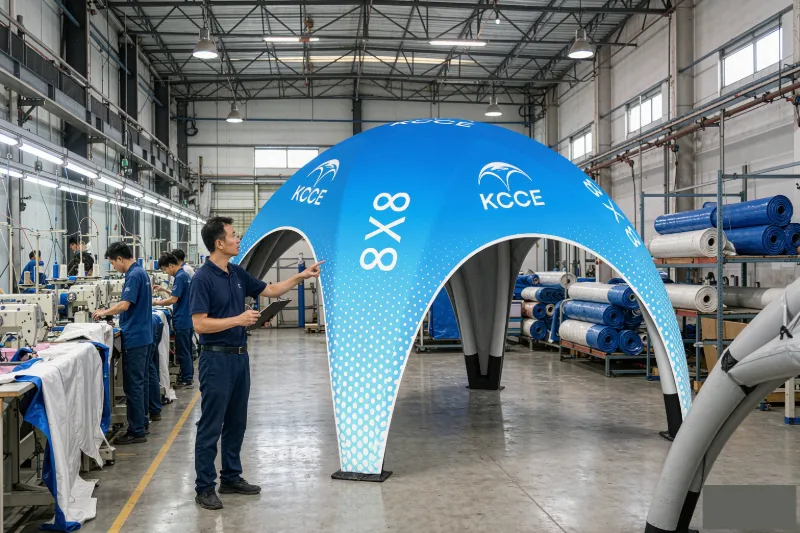
If you’re looking for a supplier, I’d suggest starting with manufacturers who have a proven track record and a visible physical presence. Companies like Dongguan Kaicheng Outdoor Products, for example, have been in the inflatable solutions space for years and have the kind of established operation that gives you confidence in their ability to deliver. Their website (kcce-event.com) showcases a range of inflatable products, from carpas inflables to formas inflables, which tells you they’re not a fly-by-night operation. You can also read about the story of KCCE’s founder and inflatable products designer to get a sense of the company’s history and approach.
Now, I’m not saying you should only work with one company — you should always get multiple quotes and do your own due diligence. But I am saying that established manufacturers with a visible track record are a safer bet than new entrants with no history.
Preguntas Frecuentes
Q: How long does an inflatable arch last?
R: With proper care, a quality inflatable arch from a reputable manufacturer can last 5 to 10 years or more. The key factors are material quality, how often it’s used, and how well it’s maintained. Store it clean and dry, avoid dragging it across rough surfaces, and repair small punctures promptly.
Q: What materials are used for inflatable arches?
R: The standard material is PVC tarpaulin, typically in weights ranging from 18 oz to 24 oz for commercial-grade arches. The material is welded at the seams using high-frequency welding, which creates a bond stronger than the surrounding fabric. Print is applied using solvent-based inks that bond to the PVC surface.
Q: Do inflatable arches need a blower running constantly?
R: Yes. The blower runs continuously for the entire event duration to maintain internal air pressure and keep the arch upright. Quality blowers are designed for continuous operation and can run for days without overheating. Always have a backup blower on hand in case the primary unit fails.
Q: Where to buy inflatable arches for events?
R: You can buy directly from manufacturers or through event supply distributors. Buying directly from a custom inflatable arch manufacturer typically gives you better pricing and more customization options. Look for manufacturers with verifiable physical addresses, material samples, and client references in your event type.
Q: What is the cost of a custom inflatable arch?
R: Prices vary widely based on size, complexity, and printing requirements. Small arches can cost around $500 to $1,000, medium arches $1,000 to $3,000, and large arches $3,000 and up. Always ask for a complete breakdown including shipping, anchoring hardware, and blower costs.
Q: How long does it take to get a custom inflatable arch?
R: Standard production typically takes 2 to 4 weeks, with rush options available at a premium. Add 3 to 7 days for domestic shipping or 3 to 6 weeks for international sea freight. Always get the delivery date in writing and plan your order well in advance of your event.
Q: Can an inflatable arch withstand wind?
R: Quality inflatable arches are designed to withstand moderate wind, typically up to 20-25 mph depending on size and anchoring. Proper anchoring is essential — use sandbags, stakes, or weights at all anchor points. For high-wind environments, consider a smaller arch or additional anchoring.
Q: What’s the difference between buying from a US manufacturer vs. overseas?
R: An inflatable arch manufacturer usa offers shorter shipping times, easier communication, and simpler warranty claims. Overseas manufacturers, particularly in China, often offer lower prices but require longer lead times and more complex logistics. The best choice depends on your timeline and budget priorities.