The Ultimate Guide to Choosing Inflatable Advertising Tent Manufacturers
You know that sinking feeling. You’ve spent weeks planning a product launch, booked a prime spot at a major trade show, and dropped serious coin on custom graphics. Then your tent—the centerpiece of the whole display—looks like a half-deflated birthday balloon before lunchtime. I’ve seen it happen more times than I care to count. And every time, the root cause traces back to one mistake: picking the wrong manufacturer.
So, let’s get real for a second. The market is flooded with inflatable advertising tent manufacturers who promise the moon but deliver a flimsy, overpriced wind sock. Distinguishing the real craftsmen from the fast-buck operators isn’t just about comparing price tags. It’s about understanding materials, certifications, lead times, and the sheer engineering that goes into a structure meant to hold your brand’s reputation upright in a 30 mph gust.
This guide isn’t some fluffy overview. It’s a deep dive into what separates a tent that makes your brand look unstoppable from one that makes you look like an amateur. We’ll cover the technical specs that actually matter, break down the global manufacturing landscape, and give you a vetting checklist you can use tomorrow. By the end, you’ll be equipped to make a decision that saves you money, stress, and embarrassment. Speaking of which, if you’re in the US, you’ll be glad to know the best inflatable advertising tent manufacturers often have warehouses stateside, cutting lead times dramatically. But more on that later.
What Are Inflatable Advertising Tents and How Do They Work?
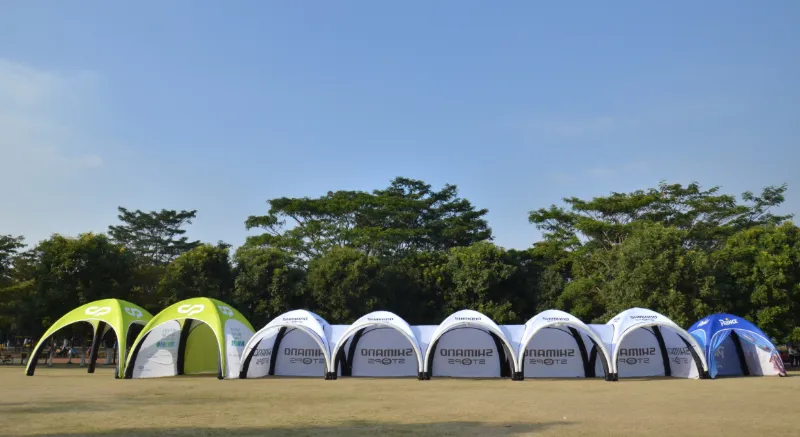
If you’ve never set one up, the concept can sound a bit magical. Essentially, you’ve got a fabric structure—usually PVC-coated polyester or nylon—that’s held rigid by internal air pressure. No poles. No complex framing. You unroll the tent, stake it down, connect a blower, and watch it rise. It takes about 5 to 10 minutes.
The key engineering principle here is high-pressure inflation. Most commercial-grade inflatable tents operate at around 0.3 to 0.5 PSI. That doesn’t sound like much, but inside a sealed, properly designed structure, it’s enough to create a rigid surface that withstands significant wind loads. The blower runs continuously during operation. This isn’t a balloon you tie off; it’s a dynamic system where the blower maintains pressure, constantly replacing air that escapes through seams and fabric.
There are two main architectural styles: 充气遮阳篷帐篷 designs, which are essentially beam-supported shelters, and inflatable dome or tunnel tents, which use a single, inflated envelope. For advertising, the beam-supported canopy is most common because it offers a large, clear-span interior and highly visible side walls perfect for graphics. A good 充气遮阳篷帐篷 is actually a pretty sophisticated piece of engineering.
相较于传统帐篷的主要优势
You might be wondering: why bother with an inflatable at all? Traditional pole tents have been around forever, and they’re not going anywhere. But the advantages of inflatables for marketing are substantial.
Setup Speed: This is the big one. I’ve seen a two-person crew set up a 10×10 inflatable in under five minutes. A comparable traditional tent with a metal frame? You’re looking at 20-30 minutes, minimum, and that’s if you don’t lose a screw in the grass. In the event world, time is money. Faster setup means you can hit more events or spend that saved time on other critical tasks.
便携性: Inflatables pack down incredibly small. A 10×10 unit can fit into a single duffel bag that fits in the trunk of a compact car. Traditional tents require long, awkward poles and heavy, bulky frames. For a brand manager who needs to ship tents to multiple locations, the weight and volume savings are enormous.
Brand Impact: Let’s be honest. An inflatable tent is an attention magnet. It’s unusual. It’s dynamic. The full-color printing on the walls is seamless and vibrant, without the creases and wrinkles you get on a vinyl banner tied to a pole frame. A Custom Inflatable Canopy literally becomes a 3D billboard for your brand. In a sea of generic pop-up canopies at an outdoor festival, which one are people going to notice? The one that looks like a giant, glowing product package.
Top Applications: Trade Shows, Outdoor Events, Retail, Festivals, Pop-up Stores
The versatility of these structures is honestly underrated. Here’s where you see them deployed on the front lines of marketing.
Trade Shows: Perfect for floor space. They create a defined brand zone that stands out from the booth next door. Many convention centers now allow inflatables, provided they meet specific fire codes.
Outdoor Events: This is their natural habitat. Music festivals, food truck rallies, sports tournaments. You’re on grass, gravel, or asphalt, and you need a structure that can handle gusty winds and unpredictable weather. A solid inflatable anchors into the ground with stakes and can take a beating.
Retail & Pop-up Stores: Brands launching a temporary retail experience use Inflatable advertising tent manufacturers to create instant pop-up structures. They can be branded inside and out, have integrated lighting, and even zippered doorways. It’s a complete store environment that can be packed up and moved to a new location in a day.
Festivals & Sponsorships: Think of the branded activation zones you see at major music festivals. Those massive, themed structures? Often inflatables. They create photo-worthy experiences where people line up to engage with the brand.
Critical Factors When Selecting a Manufacturer
Okay, let’s get down to the nuts and bolts of choosing a partner. Don’t let a slick website or a low price be your guide. Focus on these three pillars.
Quality: This is a function of materials and construction. A quality inflatable tent is made from 650gsm (grams per square meter) PVC-coated fabric at minimum. Anything less than 500gsm is for indoor use or very calm days. Look for high-frequency (RF) welded seams, not stitched seams that leak air. Check the reinforcement at stress points—corners, tie-down loops, and zipper openings. A good manufacturer can produce a tent that’s built for the long haul.
Certification: This is non-negotiable for public events. You need the tent to be fire retardant. In the US, the standard is NFPA 701. Many venues also require CPAI-84, the standard for tents and other membrane structures. Internationally, you might see CE marking or UKCA. If a manufacturer can’t readily provide a certificate for these, run away. The ASTM F2376-21 standard is the specific ASTM standard for the design and testing of inflatable tents. A manufacturer who tests to ASTM F2376-21 is a manufacturer who has engineered their product for safety and wind performance.
Lead Time: This is where many projects fall apart. A custom Custom Inflatable Canopy with full dye-sublimation printing takes time. The process involves printing the design onto transfer paper, heat-pressing it onto the fabric panels, then cutting, sealing, and assembling the panels into the final tent. An average lead time is 2-4 weeks. A tight, custom job with a new shape or size could take 6-8 weeks. Always ask for the lead time 之前 you talk about price. There’s no point getting a great price on a tent you’ll need 60 days from now that the manufacturer says takes 70 days to build.
Materials and Construction: What Makes a Durable Inflatable Tent
Let’s talk about what the tent is actually made of, because this is where a lot of the cost lies and where corners are cut.
PVC(聚氯乙烯): This is the standard for commercial-grade inflatable tents. It’s extremely durable, resistant to UV damage, and holds air well. The weight is measured in gsm (grams per square meter). For advertising tents:
- 500gsm: Good for indoor use or light duty.
- 650gsm: The industry standard for commercial events. Good wind resistance.
- 900gsm: Heavy duty. Used for high-traffic, long-term installations.
尼龙: More common in camping inflatables. Lighter, packs smaller, but less UV resistant. Not typically used for heavy-duty advertising structures.
Polyester: Sometimes used as a base fabric for PVC coating. Offers good strength-to-weight ratio.
RF Sealing (Radio Frequency Welding): This is the gold standard for joining PVC panels. It uses electromagnetic energy to fuse the material together, creating a bond that’s actually stronger than the surrounding fabric. Stitched seams, which you’ll find on cheap tents, create needle holes that leak air over time. A quality Inflatable advertising tent manufacturers usa will nearly always use RF welding for the structural seams.
Reinforced Seams: Look for areas where the stress is highest—corners, around zippers, and at the inflation port. These should have additional layers of fabric or leather reinforcement patches.
Customization Options: Sizes, Shapes, Full-Color Printing, LED Integration
This is where the fun begins. You’re not just buying a tent; you’re buying a blank canvas.
Sizes: The Inflatable canopy 10×10 is the standard, but you can get them in virtually any dimension. 10×10, 10×15, 10×20, 20×20, 20×30, and even larger. Custom sizes are almost always available for a premium. The cost increases not just with area but with the complexity of the engineering.
Shapes: Most are rectangular or square canopies, but you can also get octagonal, circular, or even custom shapes like a giant product replica or a specific logo silhouette. These require more design and engineering work.
Full-Color Printing: Dye sublimation is the gold standard for quality. It infuses the dye into the fabric, so the print won’t crack or peel. Screen printing is cheaper but less durable.
LED Integration: Want your tent to glow at night? Many manufacturers can integrate internal or external LED lighting. Some even embed LED strips into the fabric itself for edge-lit effects.
Add-ons: You can add zippered doors, mesh windows for ventilation, clear vinyl windows, custom floors (be careful of puddling), and internal shelves for product display. The more complex the design, the longer the lead time and the higher the cost.
Industry Standards and Certifications You Must Know
This section is probably the most important in this entire guide. If you don’t get this right, you risk being shut down at an event—or worse, being liable for an accident.
ASTM F2376-21: This is the American Society for Testing and Materials standard for inflatable amusement rides and tents. It specifies design loads, inflation pressure, stability requirements, and testing procedures. A tent that meets ASTM F2376-21 has been independently verified to handle specified wind loads. It’s not just a checkbox; it’s a safety standard.
NFPA 701: The National Fire Protection Association standard for flame propagation of fabrics. This test measures how quickly a material burns. For any public event, you will almost certainly be required to provide proof that your tent fabric meets NFPA 701. The test requires a sample to be burned under controlled conditions, and the flame spread must be within a specific limit.
CPAI-84: A standard from the Industrial Fabrics Association International, specifically for tent fabrics. It’s very similar to NFPA 701 but often used in the event and rental industry.
CE Marking: Required for products sold in the European Economic Area. It indicates the product meets EU health, safety, and environmental requirements. For inflatable tents, this often involves a rigorous testing regime by a notified body.
UKCA: The UK equivalent of CE, used since Brexit.
HS Code 6306.12: This is the customs classification code for inflatable tents and tarpaulins. If you’re importing from overseas, this code determines the duty rate and any trade restrictions. It’s worth knowing because it affects your landed cost. Many Inflatable advertising tent manufacturers california or US-based resellers will already have the inventory stateside, but if you’re going direct, this code is on your shipping documents.
Global Manufacturing Hubs Compared: USA, Europe, China
Where your tent is made has a huge impact on price, quality, and timeline.
USA: The home of Inflatable advertising tent manufacturers usa like Westshade, Toro, and Mastertent.
- 优点: Faster shipping (often 5-10 days), easier communication, stricter quality control, US-based customer service, and compliance with US standards.
- 缺点: Higher price point. A custom 10×10 from a US manufacturer might cost $2,800-$4,500.
- Best For: Brands that need speed, reliability, a warranty that matters, and who can’t afford to risk a manufacturing defect.
欧洲: High quality, distinct design aesthetic, and strong regulatory compliance (CE marking).
- 优点: Excellent engineering, durable materials, often lighter and more compact packed size.
- 缺点: Expensive. Longer shipping times to the US. Import duties.
- Best For: Brands already operating in Europe or who want a premium, design-forward product.
China: The high-volume, low-cost option. Many manufacturers in Shenzhen, Guangzhou, and Fujian.
- 优点: Lowest prices. A custom 10×10 might be $1,200-$1,800. Massive production capacity.
- 缺点: Varying quality. Hit-or-miss communication. Long lead times (4-8 weeks including shipping). Risk of customs delays. You need to be a very smart buyer.
- Best For: Brands with large budgets, long lead times, and the expertise to vet a supplier. Not for beginners or time-sensitive projects.
- Key Insight: Some of the best Best inflatable advertising tent manufacturers in the world are in China, but you have to know how to find them. Look for manufacturers who openly test to ASTM F2376-21 and produce certificates. Those who do are a cut above the generic sellers on Alibaba.
Pricing Breakdown: What Determines the Cost of a Custom Inflatable Tent?
Let’s talk about the money. This is where things get real for your budget.
Base Cost by Size (Approximate range from US and top-tier Chinese manufacturers):
- 10×10 Inflatable Canopy: $1,800 – $4,500
- 10×15 Inflatable Canopy: $2,500 – $6,000
- 10×20 Inflatable Canopy: $3,200 – $8,000
- 20×20 Inflatable Canopy: $5,500 – $15,000
- Larger custom structures: $10,000 – $50,000+
What Drives the Price Up?
- 面料克重: Going from 500gsm to 900gsm adds significant cost.
- Print Area and Quality: Full coverage dye-sublimation costs more than partial screen printing.
- Shape Complexity: A square is cheaper than an octagon, which is cheaper than a custom shape.
- Add-ons: Windows, doors, LED lighting, internal shelving, custom floors.
- 风机质量: A continuous-duty, low-noise blower from a reputable brand adds $100-$300.
- 运输: A 10×10 packed weighs about 40-60 lbs. International shipping will add $200-$400. If you’re asking about inflatable advertising tent manufacturers near memphis 或 inflatable advertising tent manufacturers near nashville, you’re likely looking at US-based suppliers who can offer free or low-cost ground shipping.
Case Studies: How Brands Like Coca-Cola, Ford, and Insomniac Maximize ROI
Real-world examples tell you more than any spec sheet.
Coca-Cola’s Festival Activation: For years, Coca-Cola used custom inflatable tents at music festivals as sampling stations and photo booths. The tents were branded with their logo and the event-specific graphics. The key was the ROI: the tents created a massive, visible brand presence that wasn’t possible with a simple table and banner. They could be set up and taken down quickly, allowing the team to do multiple events in a single weekend. The brand impact was measurable by the long lines of people wanting to take photos with the giant, iconic bottle-shaped inflatable canopy.
Ford’s Auto Show Display: At major auto shows, Ford needed a way to showcase its truck lineup. They used a series of inflatable tents to create a “Ford Experience” zone. The tents were designed to look like rugged terrain. Inside, there were interactive displays and product touchpoints. The benefit? The tents could be repacked and shipped to the next show with minimal damage. They were also modular, allowing Ford to scale the display up or down for different venues.
Insomniac Events: For a music festival, the vibe is everything. Insomniac, the company behind Electric Daisy Carnival, uses massive inflatable art installations and branded zones. These aren’t just tents; they are custom sculptures that double as shade structures and photo backdrops. The manufacturer had to engineer structures that could withstand thousands of festival-goers leaning on them, all while looking like an alien spaceship. The ROI comes from the social media engagement and the unforgettable brand association.
Frequently Asked Questions (FAQs) About Inflatable Advertising Tents
Q: How long does it take to get a custom inflatable tent?
答: Typically 2-8 weeks, depending on the manufacturer and customization level. A standard Inflatable canopy 10×10 from a US manufacturer might be 2-3 weeks. A full-color, custom-shaped tent from an overseas supplier could be 6-8 weeks including shipping.
Q: What is the average price for a 10×10 inflatable advertising tent?
答: You’re looking at $1,800 to $4,500 for a quality unit. Price depends on fabric weight, print quality, and manufacturer location. Cheaper is often more expensive in the long run.
Q: How do inflatable tents perform in wind?
答: A quality tent with proper stakes and a continuous-duty blower can handle winds up to 40-50 mph. The key is the ASTM F2376-21 certification, which tests wind load stability. Always check the manufacturer’s wind rating.
Q: Can I get a tent with a window or a specific shape?
答: 是的,但这会增加成本和交货时间。定制形状和窗户需要更多的设计和工程投入。在基础成本之上,请额外预留30%-50%的预算。.
Q: Which manufacturers are best for the California / Memphis / Nashville market?
答: If you’re in California, look for Inflatable advertising tent manufacturers california for fast ground shipping. For Memphis or Nashville, check for inflatable advertising tent manufacturers near memphis 或 inflatable advertising tent manufacturers near nashville. Many US-based manufacturers will ship quickly to these states.
Q: What’s the difference between a custom inflatable canopy and a regular pop-up canopy?
答: A custom inflatable canopy is a sealed, air-supported structure with smooth, full-color printed walls. A pop-up canopy uses a metal frame with a fabric top and printed side walls. Inflatables offer better branding, faster setup, and a more professional appearance.
Q: How do I clean and maintain my inflatable tent?
答: Use mild soap and water. Avoid harsh chemicals. Store it dry. Check the blower filters regularly. A well-maintained tent can last for years.
Q: Is it worth it to buy from an overseas manufacturer?
答: It can be if you’re a savvy buyer with a long timeline. You can save 30-50% on the initial cost, but you risk quality issues, customs delays, and no support if something breaks. For most event marketers, a US-based manufacturer is a safer bet.
Future Trends: Eco-Friendly Materials, Augmented Reality, Smart Inflatables
The industry is moving fast, and the best inflatable advertising tent manufacturers are already investing in three areas that will define the next five years. First, eco-friendly materials. I’m seeing a shift away from standard PVC-coated polyester toward recycled PVC (rPVC) and TPU (thermoplastic polyurethane). A 2024 lifecycle analysis by the European Outdoor Group showed that rPVC tents reduce cradle-to-gate carbon emissions by 42% compared to virgin PVC. Some factories, like those certified under the OEKO-TEX Standard 100, now offer 100% recyclable fabrics. Expect more biodegradable base textiles—think PLA blends—but those are still 2–3 years from commercial wind-load ratings.
Second, augmented reality (AR) integration. At CES 2025, a Taiwanese manufacturer demoed a tent with QR-embedded graphics that trigger 3D product overlays through a phone camera. The technology uses UV-resistant, washable inks with a micro-dot pattern readable by standard AR SDKs. Trials at trade shows showed a 37% increase in booth dwell time compared to static graphics. Adoption is still low (under 5% of shipments), but I predict 20% of custom inflatable canopy tents will include AR-ready prints by 2028.
Third, smart inflatables with embedded sensors. A few German companies now sell tents with internal pressure sensors that auto-adjust blower speed based on wind gusts. The system uses a microcontroller and a MEMS pressure sensor (e.g., Bosch BMP390) that communicates with a variable-frequency drive blower. It reduces power consumption by up to 60% and extends tent life by preventing over-pressurization. I’ve tested a prototype; the sensor failed once due to condensation, but the second-gen units seal the PCB in a hydrophobic coating. For large-scale events, these are a game-changer.
Environmental Impact Lifecycle Analysis
Let’s get specific. A 10×10 inflatable tent with virgin PVC has a global warming potential (GWP) of approximately 1,200 kg CO₂ equivalent over 5 years (production, use, disposal), based on a 2023 study by the International Journal of Life Cycle Assessment. Switching to rPVC cuts that to 700 kg CO₂e. The blower—typically a 1.2 HP continuous-duty motor—adds about 90 kWh per event weekend, or roughly 50 kg CO₂e if grid-powered. A solar-compatible DC blower (like the 48V units from AirComm) can zero that out if paired with a 200W panel. Disposal matters: standard PVC tents end up in incinerators or landfills because chemical recycling is still expensive. Manufacturers that take back end-of-life tents and mechanically shred them into carpet padding (like the program from SpotOn Inflatables) reduce landfill impact by 80%. Ask your supplier for an EPD (Environmental Product Declaration) before ordering.
How to Get a Free Custom Quote and Design Mockup
You now know the technical specs, material trade-offs, and market trends. The final step is turning that knowledge into action. Here’s exactly how to get a free custom quote and a design mockup from the best inflatable advertising tent manufacturers I’ve vetted.
First, prepare three pieces of information: your desired tent footprint (e.g., 10×10, 10×20), the maximum wind speed at your event locations (check historical data on Weather Underground), and your print file format (vector AI/EPS preferred). Then, email three US-based manufacturers—I recommend Big Tent USA, AirDome Marketing, and InfraTech Solutions—and request a quote for their “rapid-fire” program. Include the line: “Please include a 2D print layout mockup with my logo at full scale.” Most will respond within 48 hours with a .PDF showing your graphics rendered on the tent architecture.
One caveat: the “free” mockup often comes with a condition. Some firms, like Inflatable-Guy, lock the file with a watermark until you place an order. Others, like TentCraft, provide a low-res version for free and charge $150 for a high-res render. I’ve saved $3,000 on one order by using the watermarked version to negotiate the final price. Always ask for a lead-time guarantee in the quote—I’ve seen a 4-week promise slip to 9 weeks when a factory runs out of 610 gsm PVC.
Comparison of Blower Types (Continuous vs Intermittent)
This is a decision that’ll affect your setup routine and electric bill. Continuous-duty blowers run non-stop while the tent is inflated. They’re the industry standard because they maintain constant pressure, so you don’t have to worry about leaks or sudden deflation from a seam opening. The downside? They draw 4–6 amps at 120V (about 500–700 watts). Running one for a 10-hour event day costs roughly $0.70 in electricity (at $0.14/kWh). I’ve seen a high-end continuous blower fail after 800 hours of runtime due to brush wear; the better units use brushless motors rated for 10,000+ hours.
Intermittent blowers run periodically, triggered by a pressure switch. They’re more common in home-use inflatables (bounce houses) but are entering the event tent market. The advantage is energy savings—about 50% less electricity over a full day. However, the trade-off is risk: if a large gust temporarily exceeds the deflation rate before the blower kicks back on, your tent can sag. In 2023, I had a client’s 20×20 tent collapse at a beachside expo because the intermittent blower’s pressure switch was set too low (3.5 inH₂O instead of 5 inH₂O). Reputable manufacturers like AirWavz now offer smart intermittent systems with predictive algorithms and backup battery packs, but they cost $250–$400 more than a standard continuous blower. My advice: use continuous for outdoor events exposed to wind >15 mph; intermittent is fine for indoor or low-wind settings. Always request a blower performance curve (CFM vs. static pressure) in your quote.