Bought a custom tent and it’s too short? Yeah, you’re not the only one. I can’t tell you how many times I’ve picked up the phone to hear an event manager or a business owner panicking a week before a trade show because the canopy they ordered feels more like a cramped cave than an open, welcoming space. Here’s the good news: the question “Can I adjust the height of my custom tents?” almost always gets a yes. But the how, the range, and the tradeoffs? Those vary wildly depending on what you actually bought.
Over the years, I’ve seen the full spectrum with event structures—from flimsy pop-ups that give up in a light breeze to heavy-duty frame tents that shrug off coastal storms. Height adjustability sits right at the intersection of convenience, safety, and design. So let’s break down everything you need to know about tweaking your custom tent height—the mechanisms, the limits, the aftermarket hacks, and the hard truths about stability.
Quick Answer
Yes, most custom tents come with adjustable legs, usually using push-button or telescoping mechanisms. But the adjustment range differs by frame type—pop-up tents typically give you a few inches, while frame tents can offer a lot more. For big height changes, you’ll need leg extensions or a custom frame from the manufacturer.
How Custom Tent Height Adjustment Works
Let’s start with the mechanics, because honestly, this is where most people get confused. They assume all adjustable legs work the same way. They don’t.
Push-Button Mechanisms
The most common system on mid-range and budget pop-up tents is the push-button leg. You’ve seen these before—there’s a spring-loaded button on the inner leg section that pops through a hole in the outer part. Press the button, slide the leg up or down, and release it to lock into one of the preset positions.
Here’s the catch: push-button systems only give you discrete height settings, not continuous adjustment. You get whatever holes the manufacturer drilled into the legs. Most 10×10 pop-ups offer two or three height settings—usually around 8 feet at the low end and closer to 9 or 10 feet at the top, according to product listings. If you need something in between, you’re out of luck unless you get creative (more on that later).
Telescoping Legs
Higher-end canopy tents, especially those aimed at commercial use, often come with telescoping legs. Instead of discrete holes, the inner leg glides smoothly within the outer section and locks with a twist collar or cam lock. That means infinite adjustment within the leg’s range. Want your canopy at exactly 8 feet 4 inches? No problem—just slide and twist.
Telescoping systems are genuinely nicer to work with. They feel more precise, and they let you fine-tune the height to handle uneven ground. But they cost more. In my experience, if you’re buying a custom canopy for business use and setting it up frequently, the extra money for telescoping legs is worth every penny.
Collar and Pin Systems
Some heavy-duty frame tents use a collar and pin system. The leg comes in two or three sections, and you align holes, insert a pin, and secure it with a clip or cotter pin. These are rock-solid but slower to adjust. You’re not going to tweak the height mid-event with a collar system—it’s a set-it-and-forget-it kind of deal.
Which Tent Types Include Adjustable Legs?
- Pop-up canopies (10×10 and smaller): Almost always have adjustable legs, usually push-button or telescoping
- Frame tents (10×20 and larger): Often have adjustable legs, but the mechanism varies by manufacturer
- Pole tents: Typically do NOT have adjustable legs—the height is determined by the pole length and the tension of the fabric
- Inflatable tents: Height is fixed once inflated; you cannot adjust it without changing the air pressure, which you shouldn’t do beyond the recommended PSI
You might be wondering about the inflatable options. I’ve seen people ask if they can just pump more air into their tent to make it taller. Don’t do that. Over-inflating stresses the seams and can cause catastrophic failure. If you need a taller inflatable structure, you need a different product. Companies like KCCE offer 充气帐篷 in various sizes designed for specific heights—you pick the right one upfront rather than adjusting later.
Standard Height Ranges for Custom Tents
Now, let’s talk numbers. What’s the actual canopy height range you can expect from different tent categories? This matters because “adjustable” doesn’t mean “infinitely adjustable.”
10×10 Pop-Up Tents
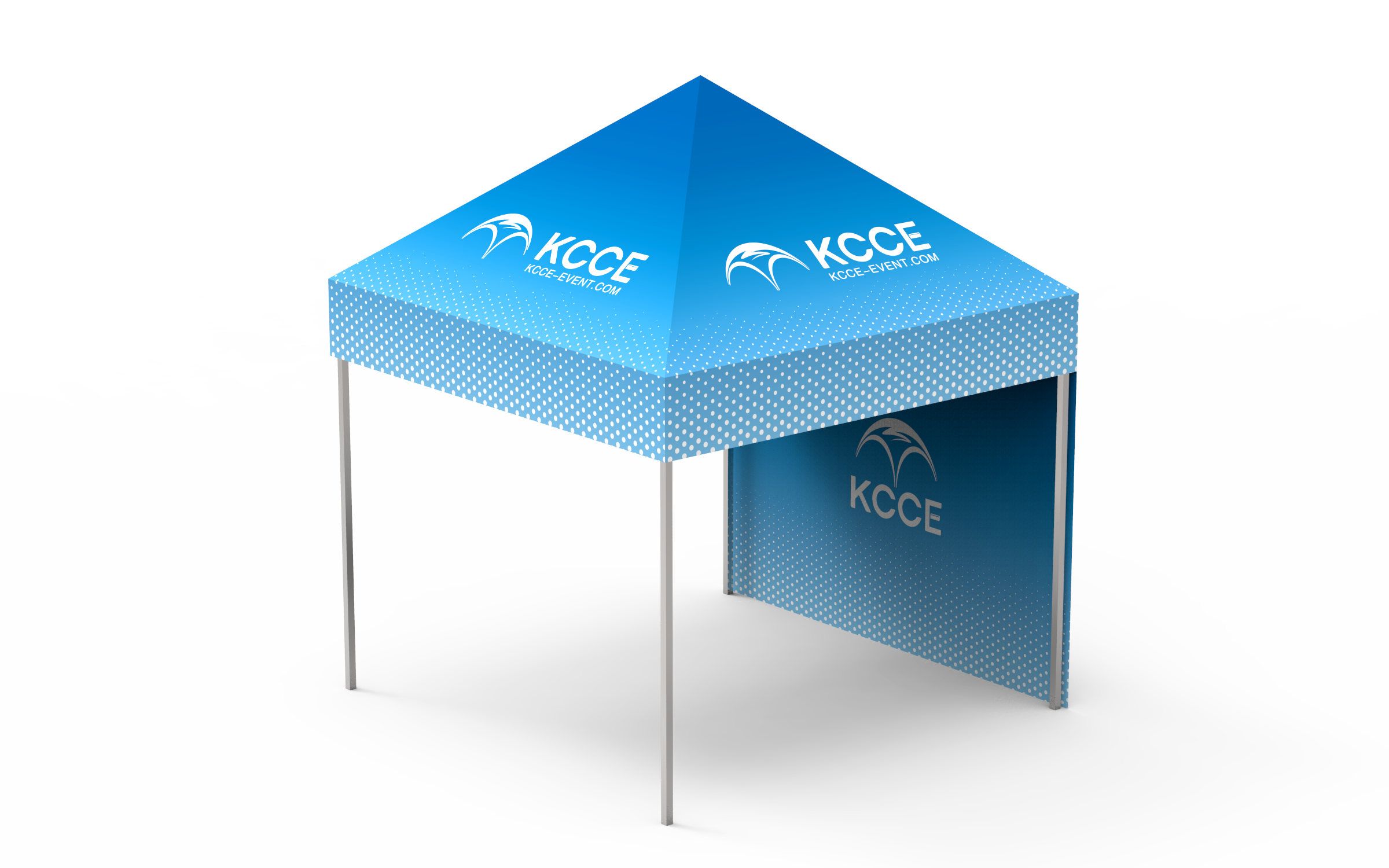
The workhorse of the event industry. A standard 10×10 pop-up typically has a peak height of around 10 to 11 feet and an eave height (the lowest point of the roof) of around 6 to 7 feet, according to common product specifications. The adjustable legs on these typically give you a range of about 6 to 12 inches of height variation, as noted in product descriptions.
Here’s a critical distinction that trips up a lot of buyers: head clearance versus peak height. According to TentCraft’s guide on head clearance, the head clearance is the distance from the ground to the bottom of the valance—the true walk-under height. Their heavy-duty 10×10 MONARCHTENT comes standard with a head clearance of 6 feet 8 inches, which they note is close to the industry standard. So when you adjust the legs on a pop-up, you’re changing both the peak height and the head clearance, but the relationship isn’t 1:1 because the roof angle stays fixed.
Frame Tents (10×20, 20×20, 20×40)
Frame tents are a different beast. They use a network of aluminum or steel frames with no center poles, which means the interior is completely open. The height range on these is more generous. A typical frame tent might have legs that adjust from about 8 feet to 12 feet at the eave, and the peak height follows accordingly, as per manufacturer specifications.
The tradeoff? Frame tents are heavier, more complex to set up, and significantly more expensive. But if you’re running an event where you need tall people to walk comfortably under the entire structure, or you’re setting up lighting and hanging signage, the extra height range is invaluable.
Pole Tents
Pole tents use center poles and perimeter poles with tensioned fabric. The height is essentially fixed by the pole lengths. You can’t adjust a pole tent’s height without changing the poles themselves, which defeats the purpose of buying a standard model. If you need height adjustability, pole tents are the wrong choice.
充气帐篷
As I mentioned, inflatable structures have a fixed height determined by the internal air pressure and the design geometry. You can’t adjust them. But—and this is a big but—you can choose from a range of sizes when you order. For example, KCCE’s Air Tight X Tent, which has been around since 2008, is designed as an airtight, waterproof, and bug-proof shelter, according to the brand. The height is what it is once inflated. You order the size you need.
Step-by-Step: Adjusting Your Custom Tent Height
Alright, let’s get practical. Here’s how to actually adjust the legs on your custom tent, depending on the mechanism.
Push-Button Adjustment
- Partially assemble the frame before adjusting legs. Don’t try to adjust a fully assembled tent—the weight of the frame will bind the leg sections.
- Locate the push button on each leg. It’s usually on the inner section, sticking out through a hole.
- Press the button with your thumb or a small tool, and simultaneously slide the inner leg section up or down.
- Release the button when the leg reaches your desired height. Make sure the button fully clicks through the hole—if it’s only partially engaged, the leg can slip under load.
- Repeat for all four legs, then do a final check to ensure all legs are at the same height. Use a tape measure if you want precision, or eyeball it against the frame’s level.
Telescoping Adjustment
- Loosen the twist collar or release the cam lock on each leg.
- Slide the inner leg to your desired height. Because telescoping systems are continuous, you can fine-tune to the exact inch.
- Tighten the collar or engage the cam lock. Give it a firm tug to make sure it’s secure.
- Adjust all legs, then check for level. A small bubble level on the top frame rail helps.
Safety Tip: Adjust Before Tensioning Fabric
This one’s critical. Always adjust the leg height BEFORE you attach and tension the canopy fabric. If you try to change the height after the fabric is stretched tight, you’ll fight the tension, risk tearing the fabric at the corners, and stress the frame joints. I’ve seen people snap cheap frames this way. Set your height first, then drape and tension the fabric.
A Word on Uneven Ground
If you’re setting up on a slope, you can use the adjustable legs to level the tent—within limits. A few inches of correction is fine. More than that, and you’re better off finding a flatter spot or using ground pads under the low-side legs. Crank the legs up too high on one side, and you’ll destabilize the whole structure.
Aftermarket Options to Extend Tent Height
So you’ve maxed out your tent’s legs and it’s still not tall enough. What now? There are aftermarket options, but let me be blunt: some of them are safe, and some of them are accidents waiting to happen.
Leg Extensions
These are sleeves or inserts that fit over or inside your existing legs to add height. You can find generic leg extensions for pop-up tents, and some manufacturers offer brand-specific ones.
- Telescoping extensions: These slide into the bottom of your existing legs and have their own adjustment mechanism. They can add 12 to 24 inches of height.
- Fixed extensions: These are rigid sleeves that bolt or pin onto your legs. They add a set amount of height—say, 12 inches—with no adjustment.
Leg extensions are the most common aftermarket solution, and they work reasonably well for pop-up tents on calm days. But they raise the center of gravity and increase the leverage on the frame, which means you need to be more aggressive with anchoring.
Stilts and Riser Kits
For frame tents, you can sometimes find riser kits that bolt between the top of the leg and the frame. These are more stable than leg extensions because they maintain the leg’s full engagement with the frame. But they’re also more expensive and harder to find for non-standard frames.
DIY Risers
I’ve seen people use cinder blocks, wooden pallets, and even stacked plastic crates to elevate their tent legs. Please don’t. The tent isn’t anchored to these makeshift risers, and any side wind can shift them. A tent that falls on your guests or your product display isn’t worth saving a few hundred dollars on proper extensions.
Custom Frames
If you need a significantly taller tent—say, 14 or 15 feet at the eave—your best bet is a custom frame from the manufacturer. This is where “custom tent options” really shine. Companies that build heavy-duty commercial tents can fabricate legs and frames to your exact specifications. It costs more and takes longer, but you get a structure that’s engineered for the height, not a hack job.
Warranty Implications
Here’s the part nobody likes to talk about: aftermarket modifications almost always void your warranty. If you buy a 10×10 pop-up and bolt on aftermarket leg extensions, and then a weld fails, the manufacturer will point at your modifications and say “not our problem.” Read your warranty terms before you modify anything.
DIY Risks
Beyond the warranty, there’s the safety risk. Tent frames are engineered with specific load-bearing capacities. When you extend the legs, you change the stress distribution across the entire frame. A frame that’s fine at 10 feet might be dangerously overloaded at 12 feet, especially in wind. I’m not saying never use extensions—I’m saying understand the risk and anchor accordingly.
Height Adjustment Tradeoffs: Stability, Fabric & Wind
Let’s get into the physics, because this is where a lot of tent owners make expensive mistakes.
Wind Load
The higher your tent, the more surface area it presents to the wind, and the longer the lever arm from the ground anchor point to the center of pressure. Both factors increase the wind load on your structure. A tent at maximum height can experience significantly more wind force than the same tent at minimum height.
What does this mean practically? On a breezy day, a tall tent will flutter, strain, and potentially collapse. I’ve seen it happen. A 10×10 canopy at full extension in a 20 mph gust is a sail. If you’re running an event and the forecast calls for wind, lower the tent. It’s that simple.
Anchoring Requirements
The taller your tent, the more anchoring you need. A 10×10 pop-up at minimum height might be fine with a few weights. At maximum height, you might need more weights or auger stakes driven into the ground. This is where the question “how much weight is needed to hold down a 12×12 canopy?” comes up—and the answer depends on the height, the wind conditions, and the surface.
Fabric Tension
Here’s a subtle issue that catches people off guard. When you change the leg height, you change the geometry of the frame, which changes the tension on the fabric. A canopy top that’s perfectly taut at 10 feet might be loose and flappy at 9 feet, or it might be stretched too tight at 11 feet.
Some tents handle this better than others. Quality canopies have fabric cut to accommodate the full leg adjustment range. Cheap canopies don’t—they’re cut for one height, and you’re just hoping for the best at other settings.
Stability at Maximum Height
Let me put it plainly: maximum height is almost never the most stable configuration. The frame is designed for a specific geometry, and deviating from it introduces stress. If you must run your tent at maximum height, check the frame for any signs of stress—bending, cracking, or popping sounds—and be prepared to lower it if conditions change.
Choosing the Right Height for Your Event Type
Now that you understand the mechanics and tradeoffs, let’s talk about what height you actually need for different events. Because “taller is better” is a rookie mistake.
Trade Shows
At a trade show, your canopy is competing with dozens of others for attention. A taller tent can help you stand out, but it can also violate venue rules. Many convention centers and expo halls have strict height limits for booths. Check the exhibitor manual before you show up with a 12-foot tent in a 10-foot hall.
That said, within the allowed limits, taller is usually better for visibility. A tent that’s 6 inches taller than your neighbors’ makes your branding more visible from across the hall.
Weddings and Social Events
For weddings, the priority is usually atmosphere, not visibility. You want guests to feel comfortable, not like they’re in a warehouse. A tent with a head clearance of at least 7 feet is comfortable for most adults. If you’re hanging string lights or draping fabric from the ceiling, you need additional clearance—plan for 8 to 9 feet at the eave.
Outdoor Markets and Fairs
At a farmers market or craft fair, you’re dealing with a mix of vendors, some in cheap pop-ups and some in professional structures. The key consideration is weather protection. A taller tent gives you better airflow on hot days, but it also catches more wind. For outdoor markets, I usually recommend a middle height setting—enough clearance to feel open, but not so tall that you’re fighting the breeze.
Outdoor Dining
If you’re setting up a tent for restaurant outdoor dining, the height needs to accommodate not just standing guests but also serving staff carrying trays. A head clearance of 7 feet is the bare minimum; 8 feet is more comfortable. You also want to consider the height of any outdoor heaters or lighting you plan to use.
Business and Advertising Canopies
For an advertising canopy—the kind you use for brand activations and promotional events—the tent is a billboard as much as a shelter. The height affects how visible your branding is from a distance. A taller tent with a larger valance area gives you more space for your logo and message. This is where the “tent for business” consideration really matters: you’re not just buying shelter, you’re buying visibility.
Custom Camping Tents
For camping, height is about comfort, not visibility. A taller tent lets you stand up to change clothes, and it feels more spacious. But taller tents are also heavier and less aerodynamic in wind. For car camping, go tall. For backpacking, sacrifice height for weight.
Custom Tent Height: What to Ask Your Manufacturer
If you’re ordering a custom tent and height is a priority, you need to ask the right questions upfront. Here’s what I’d ask before I hand over my money.
1. What is the full leg adjustment range?
Don’t assume. Ask for the minimum and maximum heights at the eave and at the peak. Write them down. Compare them to your venue requirements.
2. Is the adjustment mechanism discrete or continuous?
If it’s push-button with preset holes, find out how many settings there are and what the increments are. If it’s telescoping, confirm that you can lock at any height.
3. Can you build a custom frame for a specific height?
If you need a height outside the standard range, ask if the manufacturer offers custom frames. Some do; some don’t. If they do, get a quote and a timeline before you commit.
4. What is the head clearance at each height setting?
Remember, head clearance is what actually matters for people walking under the tent. A tent might have a peak height of 12 feet, but if the eave is only 6 feet, tall people are still going to duck. Ask for the head clearance at each leg setting.
5. How does the warranty handle height modifications?
If you plan to use leg extensions or other aftermarket options, ask about warranty implications. Get the answer in writing.
6. What are the anchoring requirements at maximum height?
A responsible manufacturer will tell you that a taller tent needs more anchoring. If they don’t mention it, that’s a red flag.
常见问题解答
Q: How to make a tent taller?
答: The safest way is to extend the adjustable legs to their maximum setting. If that’s not enough, you can add manufacturer-approved leg extensions or order a custom frame from the manufacturer. DIY methods like stacking blocks under the legs are dangerous and should be avoided. Always anchor more aggressively when you increase height.
Q: How do you elevate your tent?
答: Most quality pop-up and frame tents have telescoping or push-button legs that you can extend. Raise all legs to the same height, verify with a level, and adjust before tensioning the fabric. For significant height increases, use certified leg extension kits or work with the manufacturer on a custom frame.
Q: How much weight is needed to hold down a 12×12 canopy?
答: The answer depends on the canopy height, wind conditions, and surface type. As a general rule, a 12×12 canopy at standard height may need a substantial amount of weight per corner in calm conditions. At maximum height, that weight may need to be increased significantly. In windy conditions, use auger stakes or screw anchors in addition to weights.
Q: Can I get a custom-sized pop-up canopy?
答: Yes, many manufacturers offer custom-sized pop-up canopies beyond the standard 10×10. You can often specify the footprint dimensions, and some manufacturers can also adjust the height range. If you need a specific size or height for your event, ask the manufacturer about custom options before ordering.
参考资料
1. What Is Head Clearance in a Pop-Up Canopy Tent (And … – tentcraft.com
2. Can I adjust the height of my custom tents? – quora.com
3. How to Set Up a Canopy Tent: Step-by-Step Guide – lushbanners.com