

Inflatable Tent for Construction: Site Welfare & Shelter
A construction site is a compound that changes shape every week, and the welfare, the canteen and the first-aid point have to move with it. An inflatable tent turns one corner of the site into a covered, printed space — up in a morning, weighted rather than staked, and packed away when the phase ends. 20 years of manufacturing experience.

Quick Answer: What is an inflatable tent for construction?
Một inflatable tent for construction is a printed, self-standing structure a contractor pitches on its own site — a welfare unit, a crew break shelter, a toolbox-talk point, a first-aid post, a plant and material cover, or a gatehouse at the entrance. It stands on a welded TPU air tube inside an Oxford cloth cover, so there is no scaffold, no groundwork and nothing drilled into the ground: the legs are weighted with sand bags or water weights, and the whole unit packs into one bag when the phase finishes. Because the canopy is the largest printable surface on the compound, it carries the contractor's name and the project, not a generic mark.
What a Contractor Actually Buys
A contractor does not buy a tent because the site needs shelter. The site already has a welfare cabin, a stores unit and a canopy over the mixer. What the compound does not have is a printable surface at ground level, close to the work, that can be moved between phases.
That is the gap an inflatable tent for construction fills. It is a self-standing structure on a welded TPU tube inside an Oxford cloth cover: inflate it and it holds its own shape, with nothing to erect around it and nothing fixed to the ground. On a site that matters twice — the surface is rarely flat finished tarmac, and the footprint has to come down again without leaving a mark that the principal contractor will photograph.
Compared with a pop-up gazebo, the difference is size and print. A gazebo covers a table; an inflatable canopy covers a plant row, or a crew sitting down to eat, and the whole canopy takes print rather than just a front panel. Compared with a marquee, the difference is the crew: no frame sections, no ballast discussion with a hire company and no rigging certificate, which is why an inflatable tent for construction site use gets specified for short phases that a marquee could never justify.
Wording varies more than the product does. A principal contractor, a subcontractor, a builder or a group of builders and a plant hire firm all end up describing the same requirement, and an inflatable tent for construction workers brief read by one site is usually the same document another would call a site welfare tent or an event canopy. On most compounds the same unit is written three ways — a construction site inflatable tent, an inflatable tent for site welfare, or simply the welfare unit — and the print and the ground change between them, not the structure. The brief an inflatable tent for contractors team writes names the job, not the product.
The other reason sites keep one on the compound is the programme. Phase starts, possession dates, open days, inspections and handovers all need a covered branded space at short notice, on ground that cannot be dug up. The same unit covers a site welfare tent bay on a Monday and the gatehouse on the Friday, because what changes is the ground it sits on, not the structure.
When contractors compare suppliers, the questions that separate a supplier from a trading company are narrow and practical: which surfaces the legs can be weighted on, what fixing kit comes with the unit, how the print is proofed against the company's colour references, and whether a date is confirmed in writing rather than promised. A contractor buying for one project and a group buying for six tend to ask the same four questions — which is why a custom inflatable tent for construction use is normally specified once and then repeated across sites as the programme rolls on.
Key Takeaways
- It is a printed structure pitched on the contractor's own site — welfare unit, break shelter, first-aid post, plant cover or gatehouse.
- Legs are weighted with sand bags or water weights on hardstanding; nothing is staked into a finished compound.
- The canopy is the largest printable surface on site, so it carries the company name and the project rather than a generic mark.
- KCCE builds the X, X6, XII, XL-A and XL-B ranges to order, with a minimum order of one unit.
Six Places a Site Uses One
Every one of these happens on ground the contractor already controls. Whether the brief calls it an inflatable tent for construction site use, an inflatable tent for builders, an inflatable tent for site office, an inflatable tent for crew break, an inflatable tent for first aid, an inflatable tent for plant cover or an inflatable tent for construction gatehouse, it is the same structure brought out of the store and pitched on the compound — not brought in for a venue.
Site Office & Welfare Unit
The welfare unit is where the site manager signs in the day's crew, keeps the paperwork dry and runs the morning from. An inflatable tent becomes that room without a portacabin being delivered and craned in, so the office moves with the work as the compound changes shape.
- Dry sign-in & paperwork
- Supervisor base
- No portacabin needed
Crew Break & Canteen Shelter
A covered area for breaks keeps the canteen off the wet ground and the crew out of the weather. On a long job the same shelter is where the day shift hands over to the night shift without standing in the rain.
- Covered seating
- Dry canteen
- Off the wet ground
Toolbox Talk & Briefing
The daily briefing needs a point where the whole crew stands under cover and reads the boards. A tent at the compound entrance gives that point a roof, so the talk happens before anyone picks up a tool.
- Daily briefing point
- All crew under cover
- Readable boards
First-Aid & Medical Point
A covered first-aid post keeps treatment off the mud and private enough to do the job properly. It sits where the appointed person can reach an injured worker fastest, not where the welfare queue is.
- Covered first-aid post
- Off the mud
- Private enough to treat
Plant, Tool & Material Cover
Plant, power tools and bagged or board material all suffer in the weather. A tent over the lay-down area keeps them dry under one cover, which beats a flapping tarp that the wind takes by lunchtime.
- Plant & tool cover
- Materials kept dry
- No tarp flapping
Site Entrance & Reception
Visitors, delivery drivers and inspectors all need a point to sign in. A tent at the gate is the gatehouse and the delivery shelter in one, so the gate stays clear when two lorries arrive together.
- Visitor sign-in
- Gatehouse shelter
- Delivery point cover
Models & Sizes for a Site Compound
Five KCCE models cover the footprints a compound actually has. Every size below is the manufacturer specification for that model — nothing is rounded up. For an inflatable tent for construction workers welfare bay, the practical question is which footprint you repeat along the hardstanding; for a contractor running a construction site gatehouse off-site, it is which model still fits in a van.
X Lều bơm hơi

The short-cover option. Sizes from 3M to 8M with modular aluminium connectors, so one unit becomes a single welfare cabin, a gatehouse or a first-aid post without a portacabin being craned onto the site.
Lều bơm hơi X6

Five to eight metres on six air chambers. The wider footprint is the one that suits a crew break and canteen shelter where tables, seating and a kettle all sit under the same cover at once.
Lều bơm hơi XII

Four to ten metres with nine air chambers inflated in numbered order. This is the compound cover: it shelters a plant row, a material stack and the people working alongside them at the same time.
Lều bơm hơi XL-A
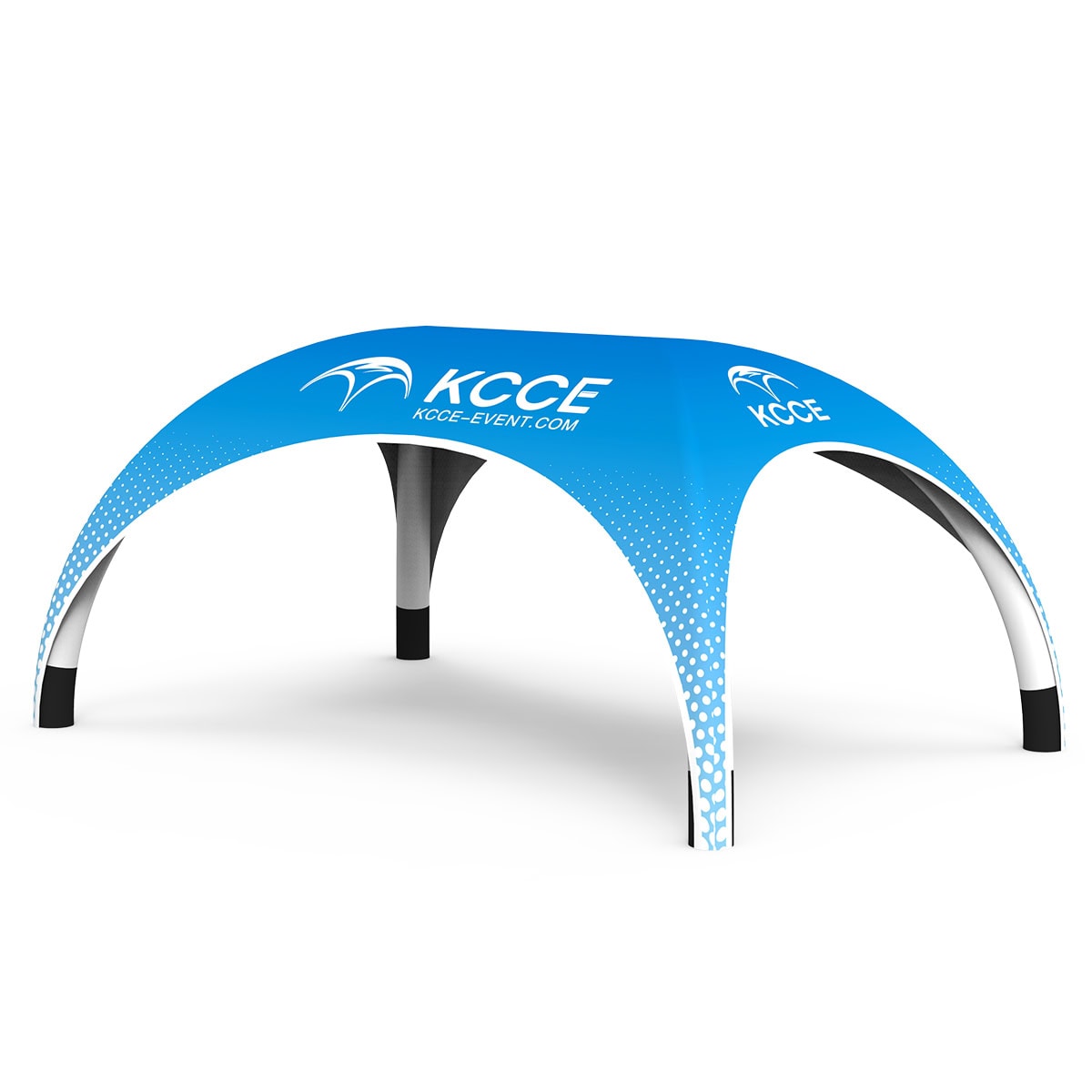
Rectangular sizes up to 7.5 by 4.8 metres, with wide and narrow awnings plus connecting cloth. Built for a site office or a row of joined units along a hardstanding rather than a single standalone pitch.
Lều bơm hơi XL-B

Eight by 4.5 and 9.4 by 5.5 metres on a six-leg frame. The extra legs are what make it sit still on an open, exposed compound where there is nothing to tie back to and plant moves past all day.
Matching the Footprint to the Job
Start from the job, then from the ground. A tent that straddles a haul route costs you a clear lane every day it stands. An inflatable tent for construction first-aid post and a inflatable tent for construction workers break shelter usually come out at the same size: one function, one desk or table, and the people using it.
Single welfare unit or gatehouse
A 3M to 4M unit covers one function: a sign-in desk, a first-aid corner or a gatehouse. This is the size that drops into a spare corner of the compound without redrawing the site plan, so the welfare unit can go up and come down around normal works.
Crew break and canteen
5M to 6M gives room for tables, seating and a kettle at the same time. If the crew numbers more than a dozen at one sitting, take the larger end of that range or join two units with connecting cloth.
Plant and material cover
Measure the machine or the pallet row, not the canopy you hoped for. A digger or a stack of board needs the footprint that spans it with a metre to spare on each side for access.
First-aid post
3M to 4M in a quiet corner of the compound, away from the welfare queue. Tell us where it sits in the quote request and we match the size to the space rather than the other way round.
Row along the compound
Two or more rectangular units in a line, joined with connecting cloth, read as one continuous welfare frontage. This is the arrangement that covers a long hardstanding without a single oversized structure in the middle of it.
Site Branding & Print
Site signage is not free-form design — it usually sits inside a company identity manual and a project's own rules at the same time. The print brief starts there, not at the colour wheel — and for an inflatable tent for construction site build it is written before the artwork is drawn, not after the proof comes back wrong.
Contractor name, not a generic mark
The canopy is the largest printable surface on the compound, and on most sites it carries the principal contractor's name rather than a reseller's logo. Print the company name on the canopy and keep the subcontractor marks for the fascia boards.
Project name and phase
A valance or a front panel is where the job lives: project name, phase, block and plot. Printed panels can be produced as separate pieces so the next phase's board replaces a panel rather than the whole canopy.
Health and safety messaging
Generic site-safety reminders print onto the same cover as the company name. Keep claims to what the site already displays in its inductions — the canopy repeats the site's own rules, it does not invent new ones.
Private label for plant hire firms
A hire company supplying sites, or a group buying for several projects, can order a white label inflatable tent for construction with its own packaging and insert card. The private-label minimum order is 100 units, discussed against the artwork.
The Site Rules Around a Compound Canopy
This is the section most tent suppliers cannot help with, and it is the one that sends a printed canopy back to the printer. A principal contractor's rules usually specify how the company name appears, how large it is relative to the project mark, and which claims may not be made. Those rules apply to a printed canopy exactly as they apply to a hoarding panel.
Get the identity rules before the artwork
Ask the principal contractor's site team for the current signage and branding rules for point-of-site material first. Clear space around the company name, minimum size and approved lock-ups all change between projects, and a canopy printed to last job's manual is a canopy that gets rejected at the gate.
Separate panels for a reason
Printing the phase or the plot on a removable panel, rather than into the roof, is what lets a site change the message without re-printing the canopy — and what keeps a project label from being locked into a structure that outlives the job.
Claims that need backing
Company name, project and phase printed on a canopy are site statements. Whatever goes on the fabric should already be approved for use on the site you work on, and the same wording should appear in the inductions — a canopy that contradicts the site board is a problem for the contractor, not the printer. On an inflatable tent for construction open day the message panel is the piece that gets scrutinised, which is why it is printed as a separate panel rather than into the roof.
One artwork for several sites
A group running the same canopy across projects wants one approved artwork and one proof, then repeats against it. Ask the printer to keep the file and the colour record, so project four is printed from the same reference as project one rather than from a photograph of project one.
What Goes Wrong on a Site
Almost every problem here is a site problem that shows up after the tent is up. All six are cheaper to settle before the order than after the structure is standing. An inflatable tent for construction site gatehouse adds a seventh: the principal contractor's own rules on temporary structures, which are written for the compound rather than for your yard.
Anchoring on hardstanding and uneven ground
A compound is rarely flat finished tarmac. Stake nothing into a surface you do not own; use sand bags or water weights on the legs, and state the ground in the quote request so the fixing kit is quoted with the tent rather than improvised on site.
Wind across an exposed compound
A building site is usually the most exposed ground for miles. No inflatable structure should be left standing in conditions the manufacturer has not rated — agree a deflate trigger before the structure goes up, not during the first gust.
Plant and vehicle movement
The tent has to sit outside the turning circle of dumpers, telehandlers and delivery lorries. Mark the footprint on the ground first and walk a machine round it; a canopy that blocks the haul route gets taken down on day one.
Power for lighting and welfare
Sealed models need air once. Blower-driven models need a live supply for the duration, so the pitch must be within reach of a site supply and the cable routed where no plant will run over it.
Overnight security on site
A printed canopy is site equipment and it is also a large piece of fabric sitting in an open compound overnight. Decide in advance whether the pitch stays up between shifts or comes down, and who is responsible for it either way.
Site rules on temporary structures
A temporary structure on a construction site is not always treated the same way as fixed welfare. Check what the principal contractor and the local authority require before the first inflate, particularly where the unit fronts a public highway or a footpath.
The Morning of the Phase
Plan backwards from the time the first crew walks in, not forwards from the time the lorry arrives. The inflation is the quick part; clearing the footprint is what eats the morning.
Confirm the ground and the access
Walk the spot the week before. Check the surface (tarmac, block paving, gravel, bare ground), the distance to a supply point, and whether the pitch sits inside a plant turning circle.
Move the plant and mark the footprint
Clear the area the night before if the programme allows it. Marking the footprint on the ground saves an argument on the morning, when the first lorry is already at the gate.
Inflate and fix
Sealed models inflate once from a pump and hold; blower-driven models run from a supply. Weight the legs before anything else — an inflated canopy with nothing on the legs is the one thing that goes wrong on a windy morning.
Dress the pitch before the shift starts
Tables, boards, lighting and the first-aid kit go in after the structure is fixed, never during inflation. Leave the last half hour empty: it is the buffer that absorbs a late delivery or a flat pump.
Pricing & Minimum Order
A quote is built from four things: the model, the footprint, how much of the canopy is printed, and the fixing kit for your ground. That is why an inflatable tent for construction price comes back as a project quote rather than a catalogue figure — the same model is a different job on grass than on a leased hardstanding.
| Mục | MOQ | Terms |
|---|---|---|
| Single printed tent, company branding | 1 unit | Quoted per project (FOB) |
| Multiple units, same artwork (compound row / group sites) | Discussed against quantity | Quoted per project (FOB) |
| OEM / ODM private label for hire firms and groups | 100 units | Discussed |
| Lead time | — | Confirmed in writing after design approval |
Final pricing is confirmed in writing after design approval, and quote requests are answered within 24-48 hours. If the canopy is going out for a fixed possession date or a phase handover, send the date with the enquiry so production and freight are planned against it. Groups and plant hire firms asking about white label inflatable tent for construction stock are quoted on a separate line, against packaging and insert cards.
Printed Canopies on Real Ground
Five deliveries photographed on working ground, ordered from the hardest surface inwards: an arch laid out on a concrete yard, a dome on a paved service compound, an arch beside a vehicle line-up, a matched row of units, and a full-graphic structure on open ground. Between them they cover the surfaces a site has to deal with — poured concrete, finished paving, hardstanding and open field — which is the part of a brief that decides whether the legs are weighted or staked.
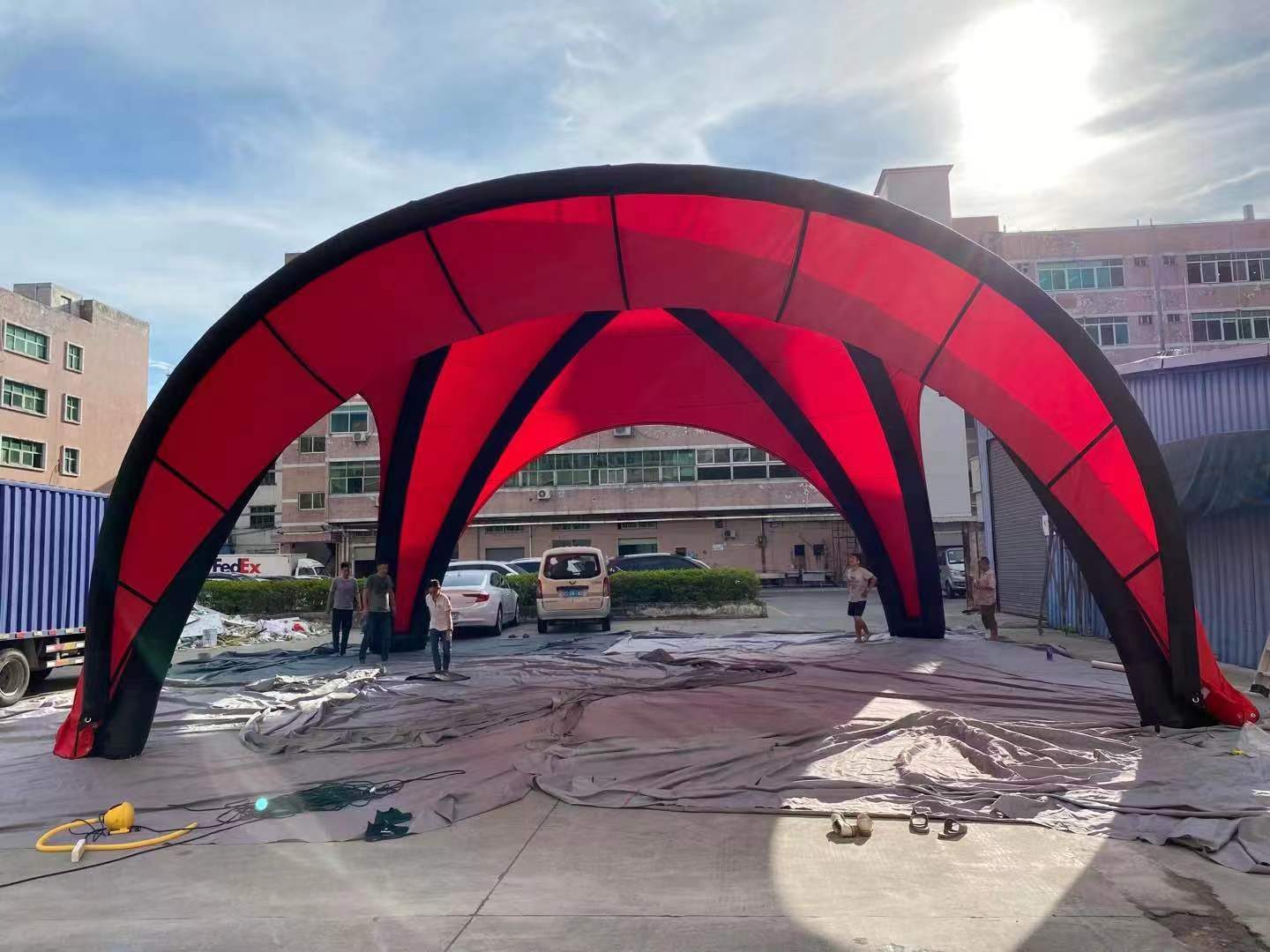
Large Span Arch, Industrial Yard
An arch laid out on a concrete yard while it is being unpacked. On poured concrete there is nothing to stake into, so the legs are weighted and the span is set to clear the vehicles moving through.
- Concrete surface
- Weighted legs
- Wide span
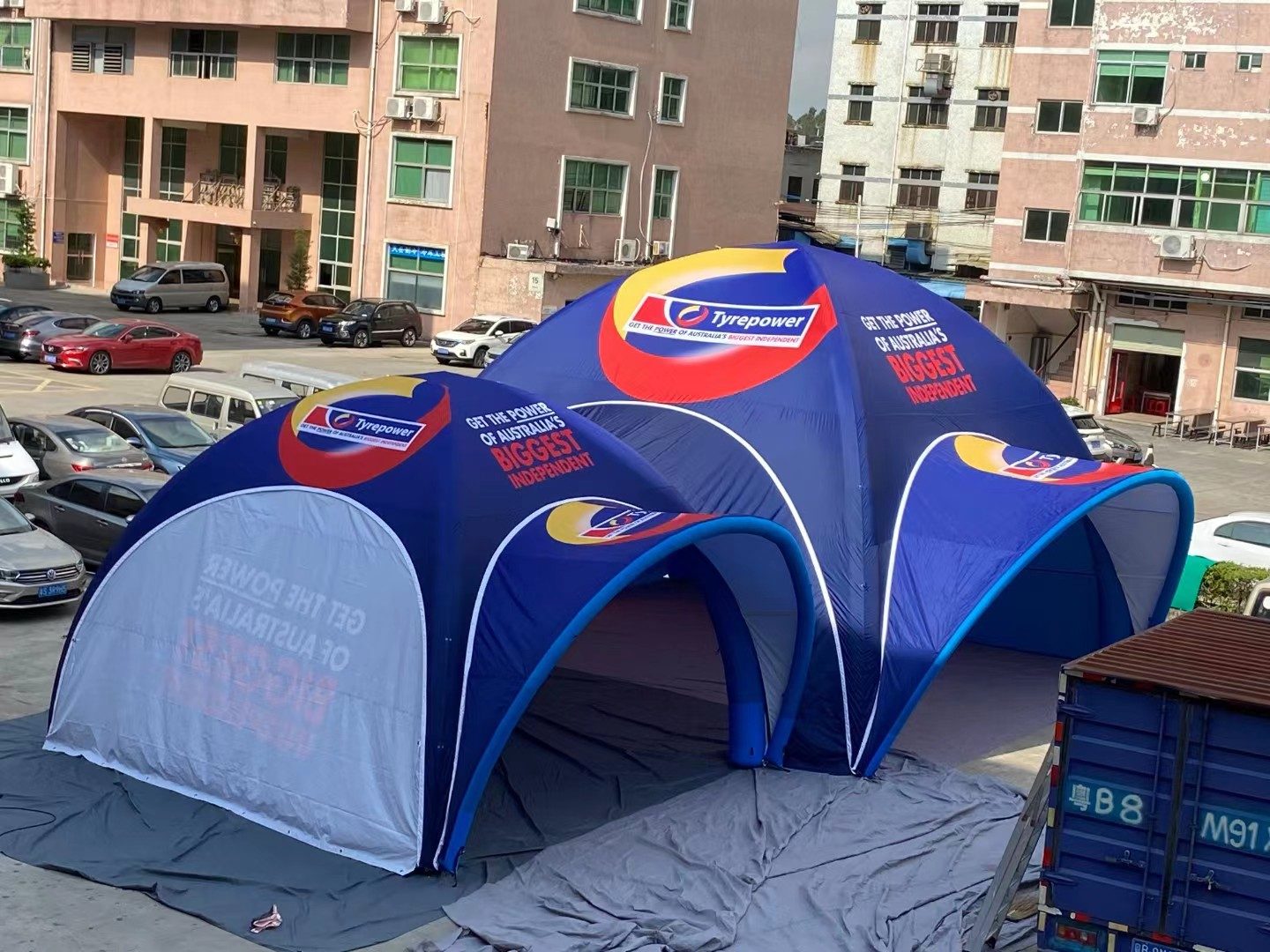
Blue Dome on a Service Compound
A dome pitched on finished paving inside a working compound. The canopy reads clearly against the buildings behind it, which is what a welfare or sign-in point needs when it has to be found quickly.
- Paved compound
- Full canopy
- Printed panels
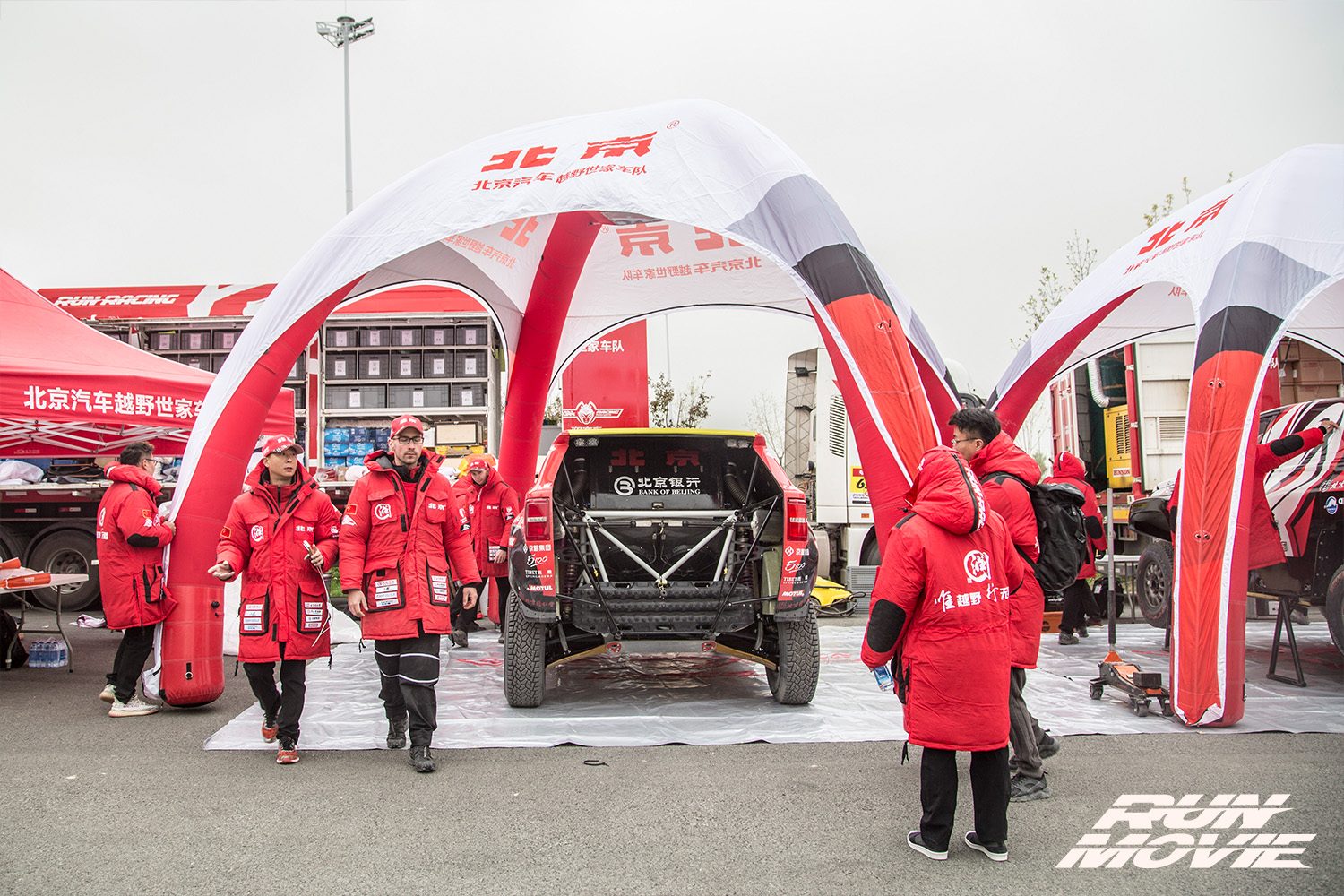
Arch Beside a Vehicle Line-Up
A red and white arch standing next to a row of vehicles on hardstanding. The same layout suits a site entrance, where vehicles pass under the span and the printed face is read on approach.
- Hardstanding
- Pass-through span
- Printed face
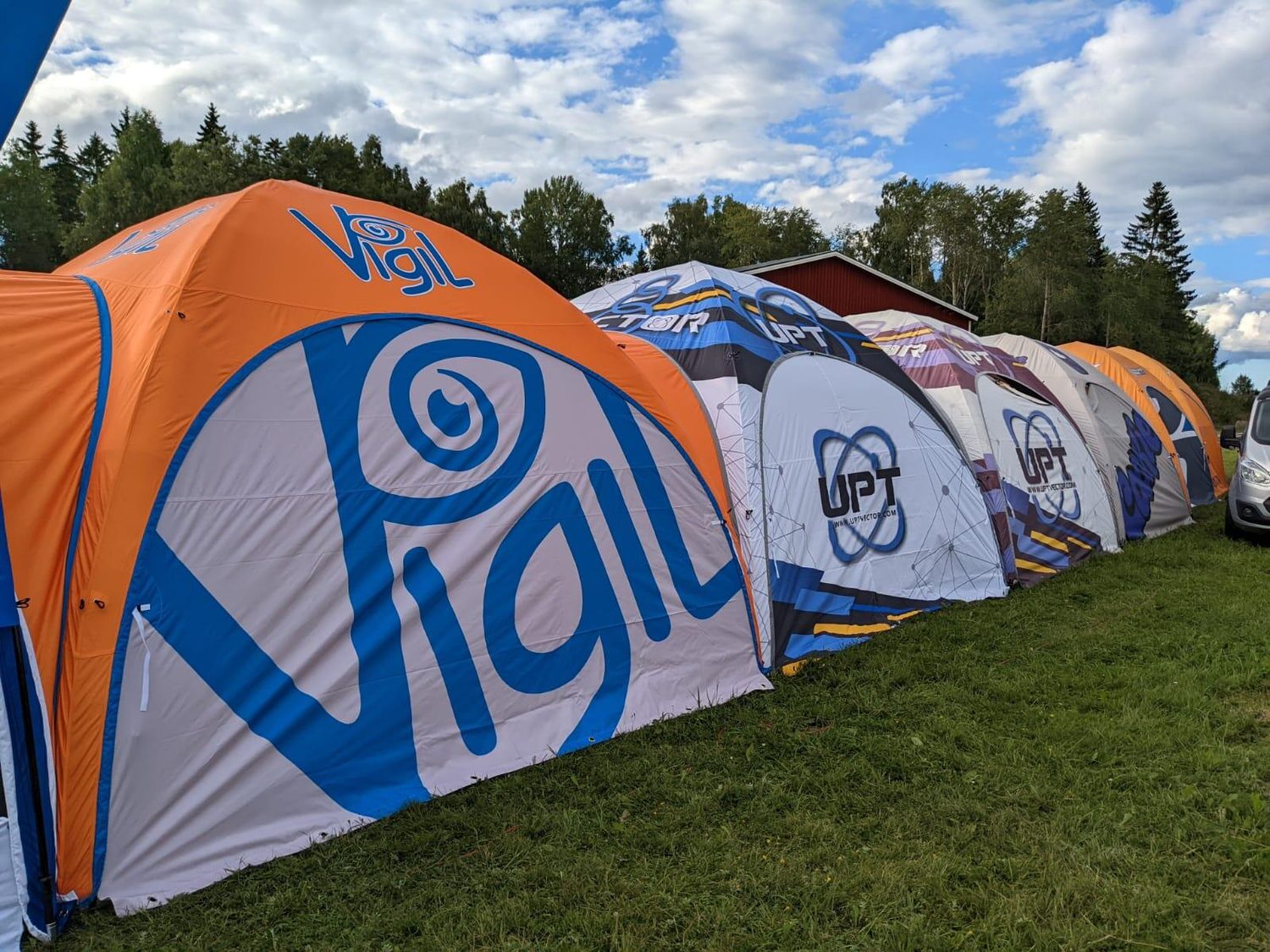
A Row of Units, One Print
Several domes set out in a line, each carrying the same print. Ordering a matched row is how a site covers several functions — welfare, first aid, storage — without each unit looking like a different supplier made it.
- Matched print
- Multiple units
- Grass ground
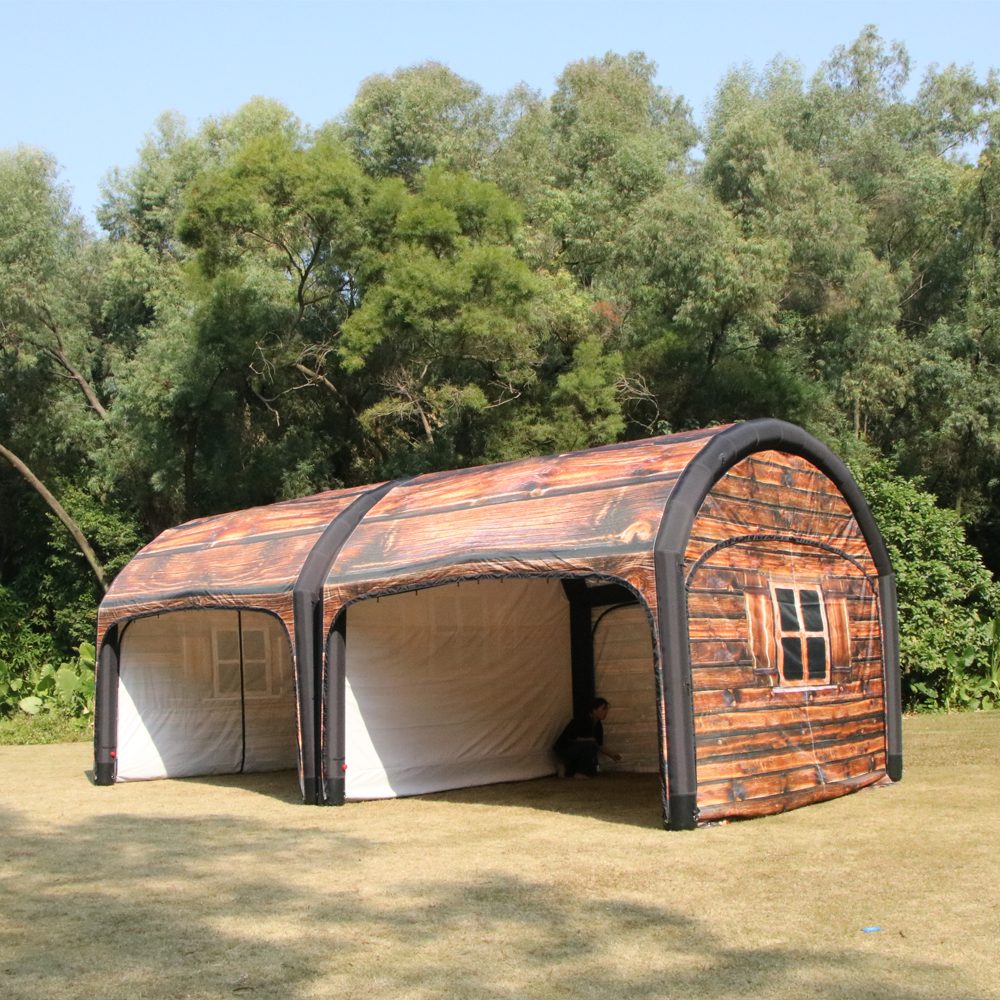
Full-Graphic Print, Whole Structure
A structure printed edge to edge with a wood-grain graphic rather than a logo on a flat colour. Full-graphic coverage is the option when the unit has to look like a cabin or a building from a distance.
- Full-graphic print
- Roof and walls
- Ground fixing
Các câu hỏi thường gặp
Canopies We Have Delivered
The first three are the ones to read closely, because they are site-side: an open-fronted dome used as a crew shelter, a high-visibility canopy used as a marshalling point, and a printed frontage doing the work of a sign-in desk. The rest are here for print coverage and ground. Read the surface under every one of them, because that is what decides whether the legs are weighted or staked; a compound is the harder case, since there is nothing to tie to and every leg has to carry weight on finished paving.
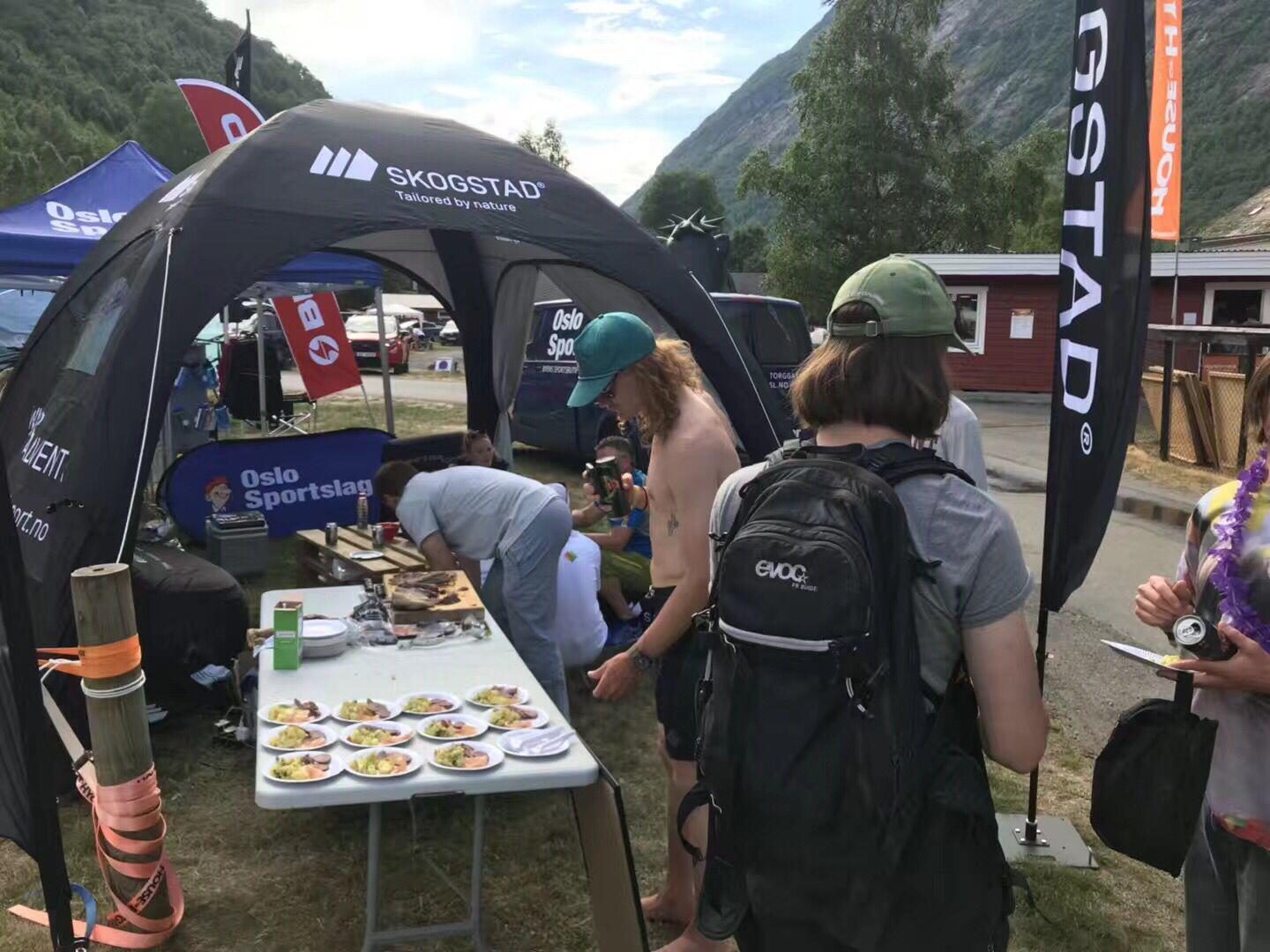
Dark Dome, Open Front
A dark dome left open at the front so people can walk in and out without a door. That open front is what makes it work as a crew break shelter rather than a closed unit.
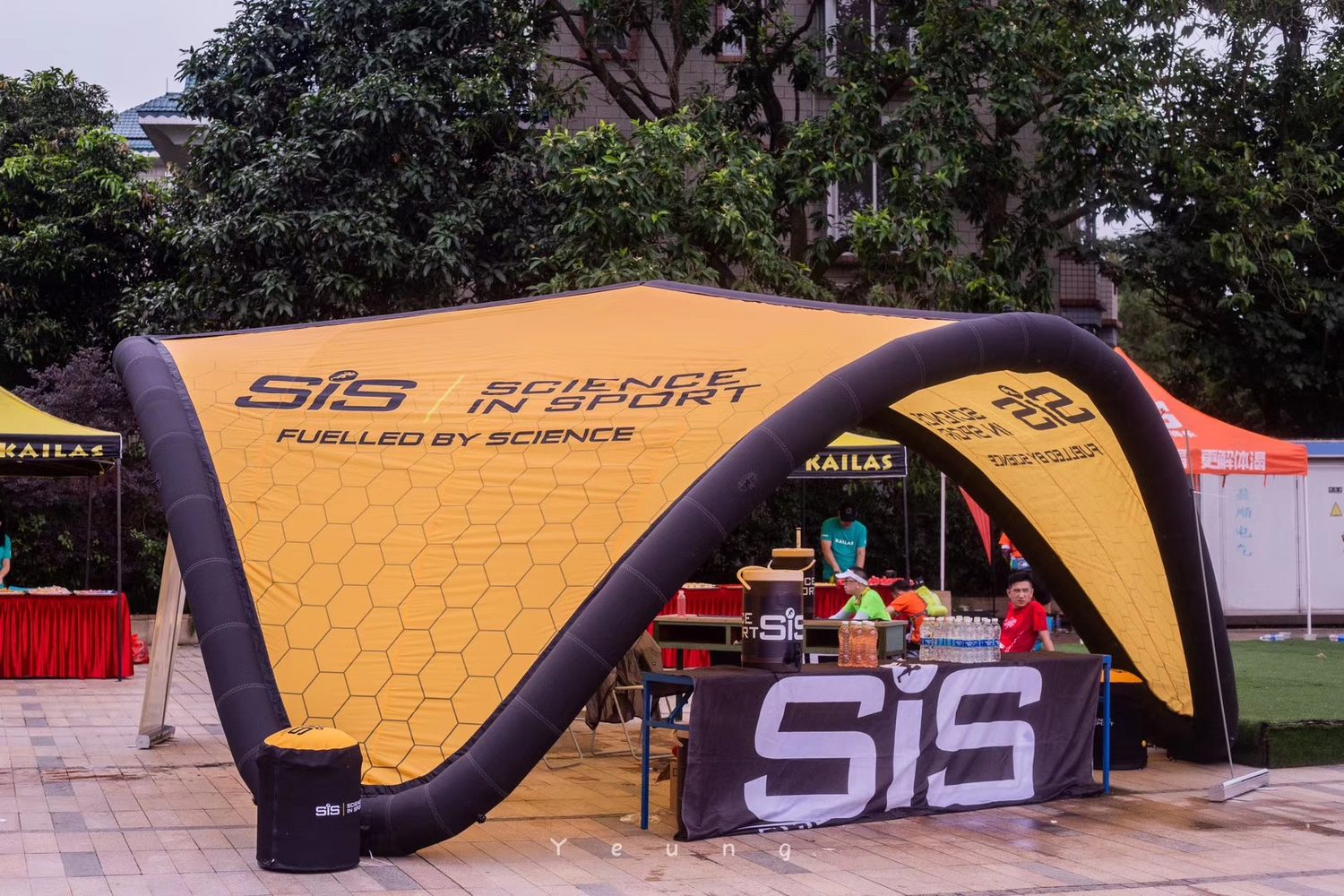
High-Visibility Print
An orange and black canopy chosen so the structure is seen before it is read. That matters where the tent doubles as a safety or marshalling point and has to stand out from plant and fencing.
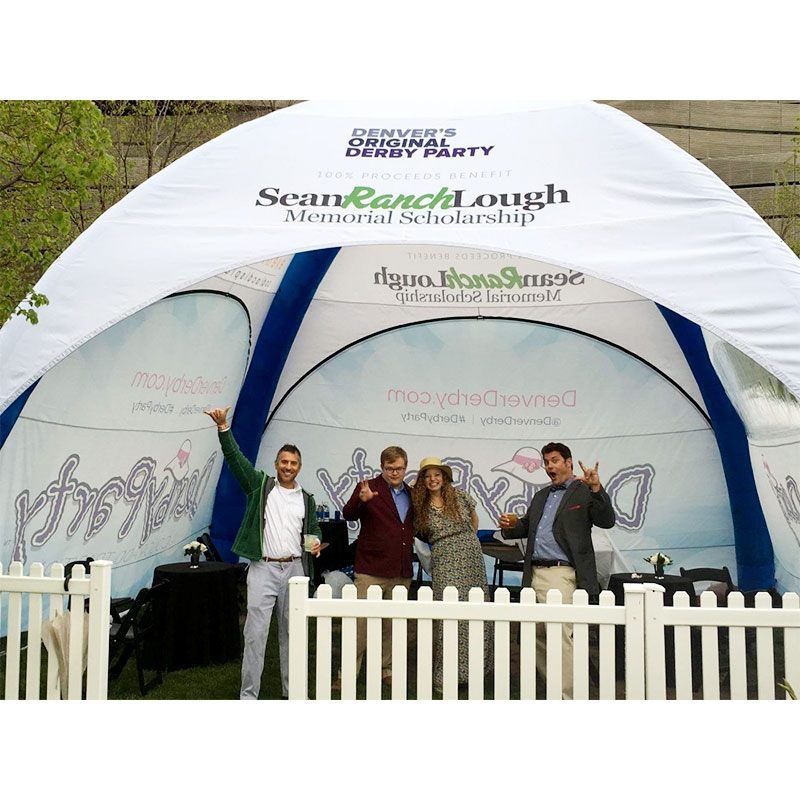
White Dome, Printed Frontage
A white dome with the print concentrated on the front panel. Keeping the roof plain and the message on the frontage is the cheaper print layout, and it keeps the interior bright.
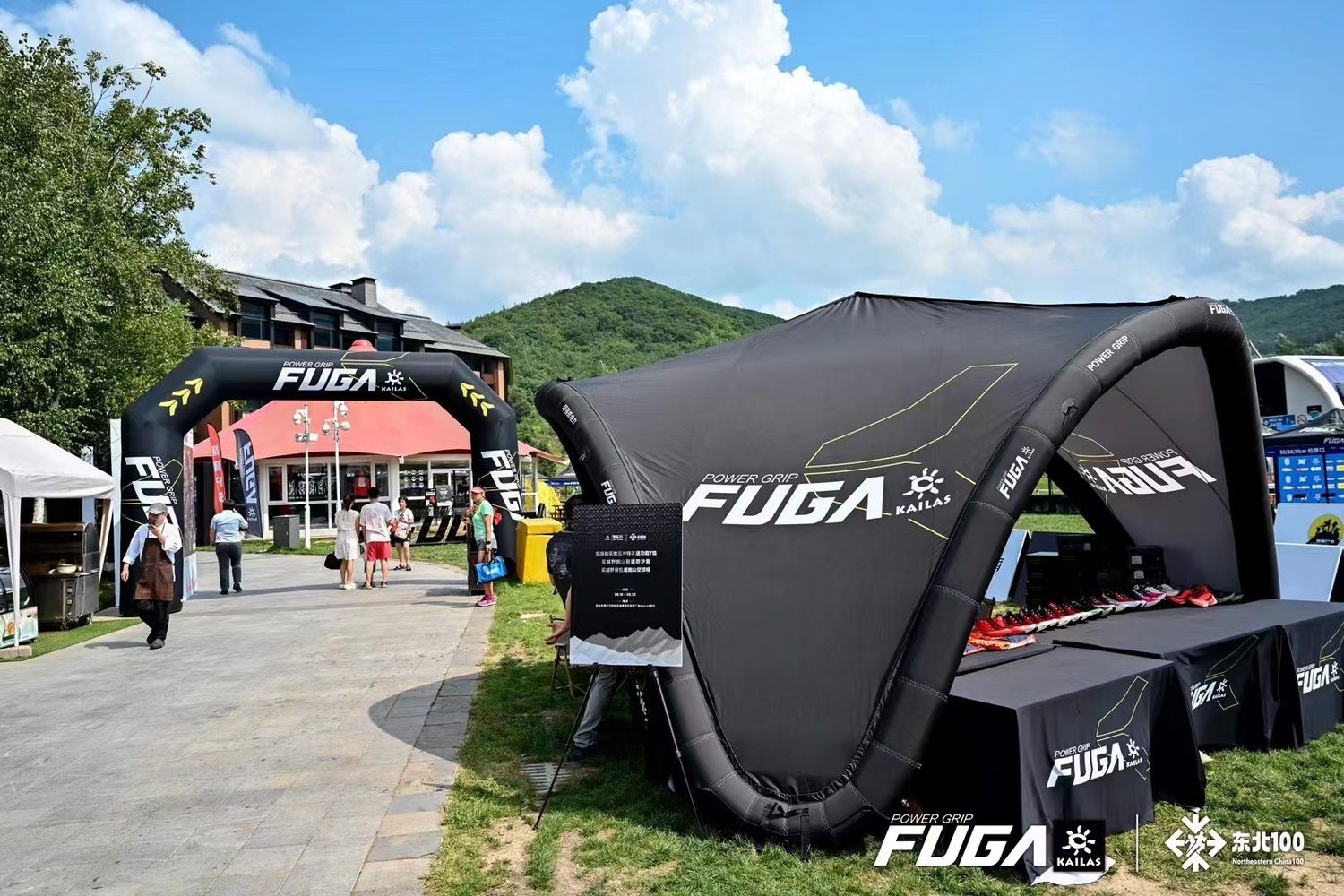
Black Canopy, Full Print
The whole canopy printed in one dark colour with the branding carried across the roof. A dark print hides site dirt better than white and still reads clearly from across a compound.

A Printed Pair for a Gate Display
Two canopies printed to the same design and set side by side. A matched pair gives a gate or forecourt display a frontage wide enough to be read by traffic passing at speed.
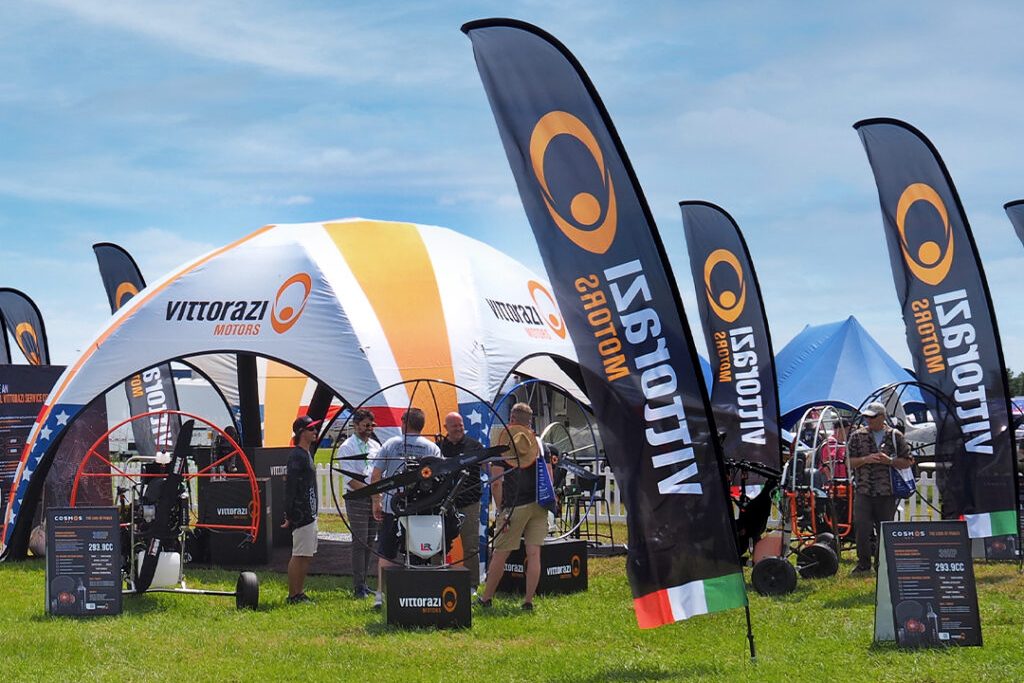
Canopy and Flags as One Frontage
A canopy paired with a set of feather flags in the same colours. On a site entrance the flags do the job of drawing the eye from the road while the canopy holds the covered space.
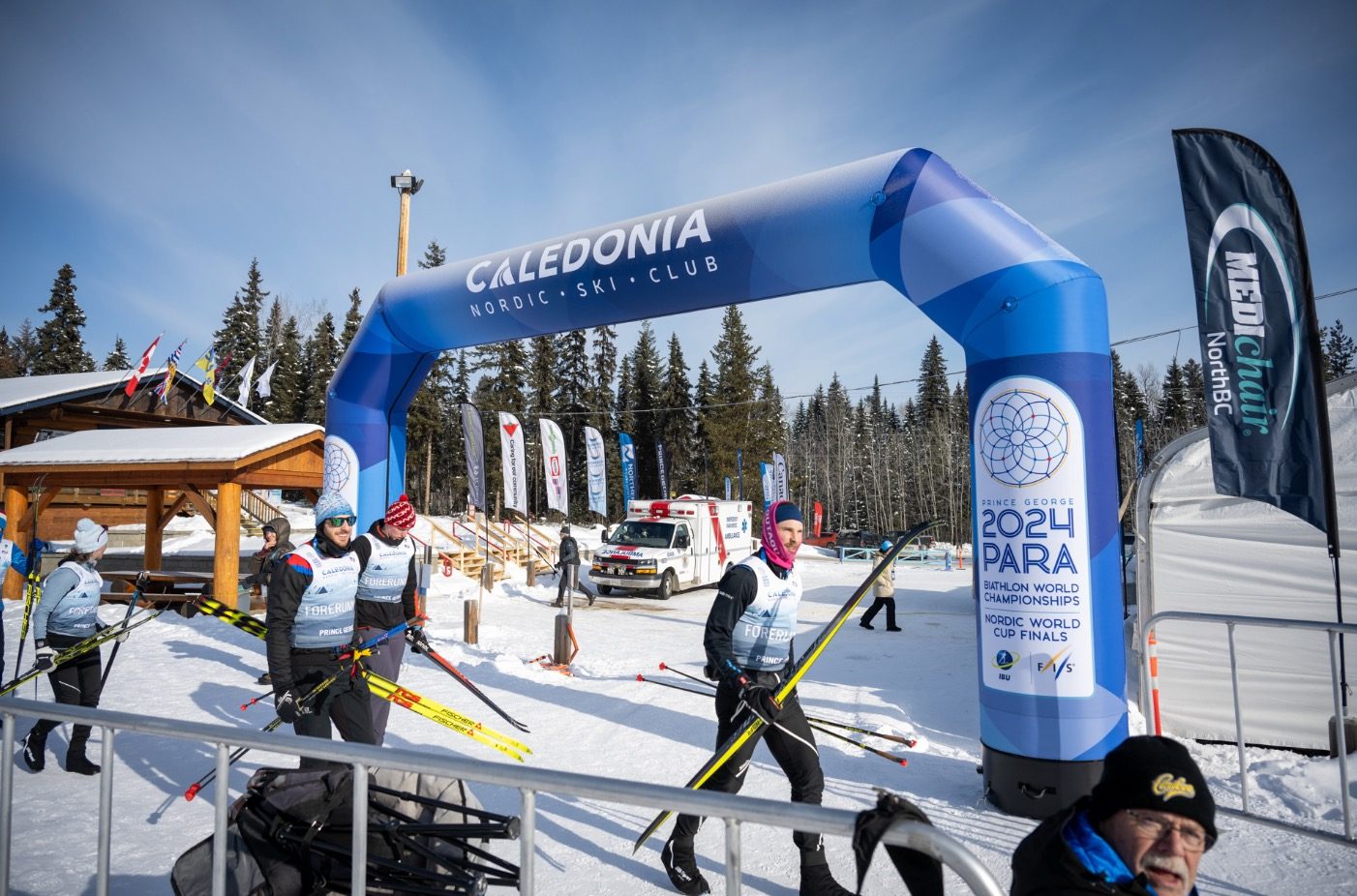
An Arch as a Site Gateway
An arch spanning an entrance rather than covering a space. Used as a gateway it marks the boundary of a compound and gives vehicles a printed frame to pass through.
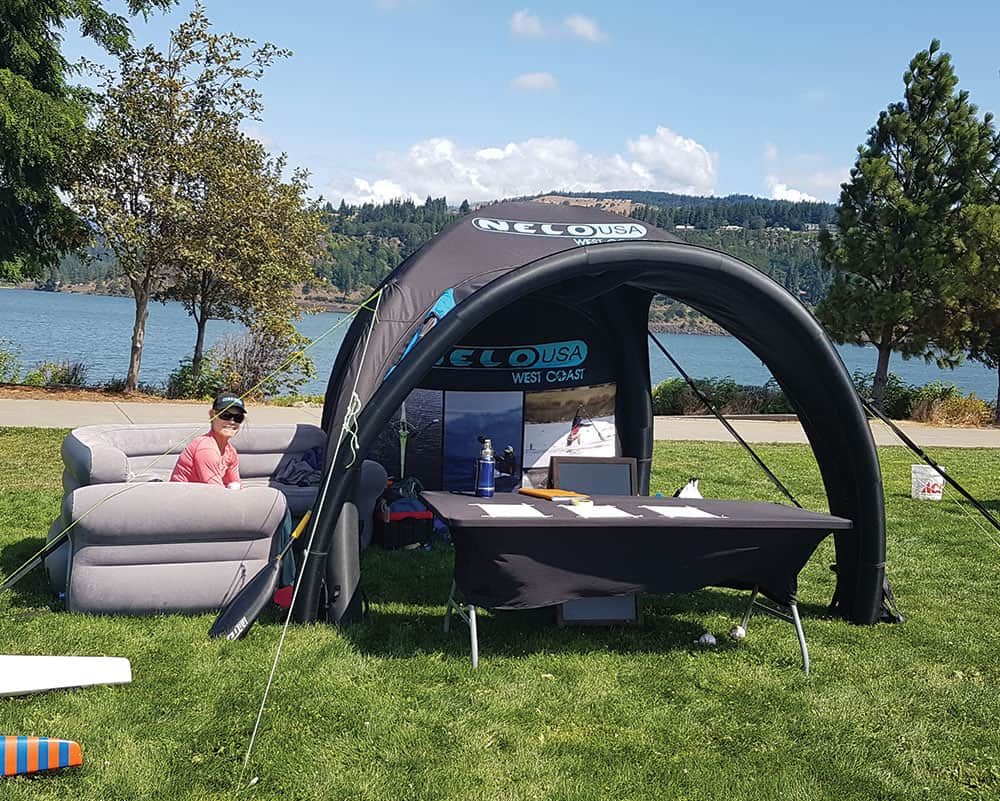
A Unit That Travels to the Ground
One dome pitched on open ground away from any hardstanding. When a site is temporary and the ground changes, a unit that packs down and re-pitches is what keeps the same print in use.

