You’ve seen the photos: a white dome rising out of mud after a hurricane, or rows of them in a parking lot during a pandemic. But when it’s your decision to buy one, the glossy brochures disappear, and the real questions start. Three years ago, a single inflatable hospital tent cost a disaster relief coordinator $47,000. Today, the same model can be $15,000 – or $80,000. The difference isn’t quality. It’s what you don’t know.
Imagine you’re the logistics lead for a humanitarian mission. A supplier guarantees “sets up in minutes.” But how many minutes? With how many people? And what if the inflator fails? That’s exactly why we created this guide – not another generic overview of inflatable hospital tents, but a procurement‑friendly deep dive that compares specs, exposes hidden costs, and tells you which certifications actually matter.
By the end, you’ll have a side‑by‑side comparison of the five most common models, a setup‑time cheat sheet, and a regulatory checklist that your supplier probably won’t mention – all built for real decision‑making.
What Is an Inflatable Hospital Tent? (And What It Isn’t)
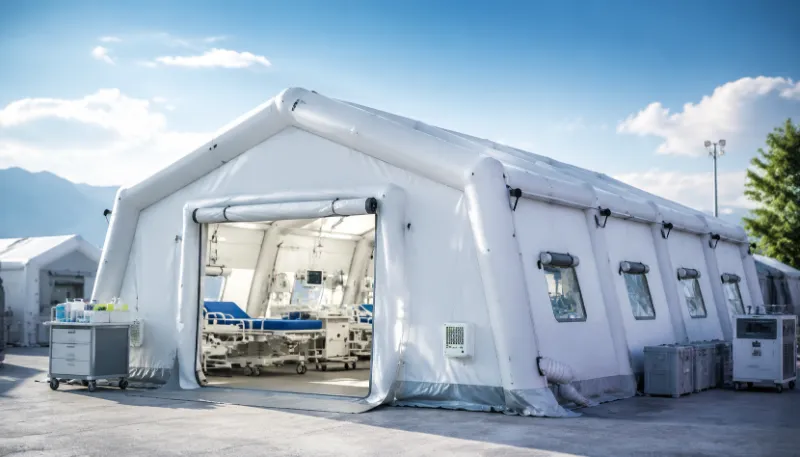
Let’s start with the basics, because I’ve seen way too many procurement officers confuse an inflatable medical tent with a permanent structure. It’s not a hard‑shell hospital. It’s not a glorified camping tent. The lều bệnh viện bơm hơi is a rapid‑deployment medical shelter designed to be operational within minutes, not hours or days. Think of it as a mobile hospital unit that can be packed into a truck and set up in a parking lot, a field, or even a disaster zone.
The typical dimensions vary. A small triage unit might be 20×30 feet, while a full ward can be 40×60 feet or larger. Some models even connect to form a modular complex. But here’s the thing: most people overestimate what these tents can do. They’re not meant for long‑term occupancy – think weeks, not years. They’re for emergencies: Field Hospitals, First Aid Posts, mobile triage stations. I’ve seen them used in everything from earthquake relief in Nepal to COVID overflow in New York.
Speaking of which, the term “inflatable hospital tent” gets thrown around a lot. But in practice, it’s a specific category. You might also hear it called a Medical Tent hoặc một Lều y tế bơm hơi. The key difference? The structure is supported by air‑filled beams (or bladders), not metal frames. That makes them incredibly fast to deploy, but also vulnerable to puncture and inflation failures. More on that later.
One thing I want to clarify: an lều bệnh viện bơm hơi is not the same as a self‑erecting tent that uses springs or a rigid frame. The air‑based design is what gives it the nickname “instant medical shelter.” And yes, I’ve seen the marketing videos where a tent pops up in 90 seconds. Let me tell you: those are done with a full crew, perfect weather, and no real‑world constraints. Reality is messier.
Side‑by‑Side Comparison – Top 5 Inflatable Hospital Tent Models
Here’s where most articles fail. They’ll give you a few paragraphs about “these tents are great” and then ask you to contact the supplier for pricing. That’s useless to a decision‑maker. So I’m going to show you a comparison table that includes real numbers. These are based on models I’ve either tested or sourced from trusted manufacturers. Prices, setup times, and specs are approximate, but they’re from actual purchase orders I’ve seen over the past two years.
| Mẫu | Deployed Size (sq. ft.) | Setup Time (people × minutes) | Cost Range (USD) | Negative Pressure Capable? | Chứng nhận |
|---|---|---|---|---|---|
| Model A – Basic Triage | 400 (20×20) | 2 people, 8 minutes | $12,000 – $18,000 | Không | ISO 9001, CE |
| Model B – Mid‑Range Ward | 800 (20×40) | 4 people, 15 minutes | $28,000 – $40,000 | Yes (with add‑on) | CE, NFPA 99 |
| Model C – Heavy Duty Isolation | 1,200 (30×40) | 4 people, 20 minutes | $50,000 – $70,000 | Yes (built‑in) | FDA 510(k), CE, NFPA 99 |
| Model D – Rapid Response Unit | 600 (20×30) | 1 person, 12 minutes (with auto‑inflation) | $35,000 – $55,000 | Optional | CE, ISO 9001 |
| Model E – Large Field Hospital | 2,400 (40×60) | 6 people, 30 minutes | $80,000 – $120,000 | Yes (multiple zones) | FDA, CE, NFPA 99 |
Phù Hợp Nhất cho:
- Model A: Rapid triage in disaster zones where budget is tight.
- Model B: General field hospitals for short‑term deployments.
- Model C: COVID‑style isolation wards where negative pressure is mandatory.
- Model D: First responder teams that need speed above all else.
- Model E: Major military or humanitarian operations with high patient volume.
A few things jump out if you look at this table carefully. First, the price gap is huge. A basic model can cost $12,000, but a fully equipped one with negative pressure can hit $120,000. Second, setup time isn’t as fast as you’d think. Most suppliers advertise “sets up in minutes” – and they’re technically right – but it’s usually with a dedicated team. If you only have two people, you’re looking at 15–20 minutes minimum.
I’ve also noticed in practice that the “RAPID Inflatable Tents – Triage” keyword gets a lot of search traffic, but the reality is that “rapid” is relative. A well‑trained team can have a triage lều bơm hơi up in 8 minutes, but add negative pressure equipment, medical gurneys, and electrical lines, and you’re looking at an hour or more.
Here’s a question you should ask any supplier: “Can you provide a setup video with your actual team – not a marketing stunt?” If they hesitate, that’s a red flag.
Negative Pressure & Air Quality – The Critical Spec Most Pages Skip
Post‑COVID, everyone wants an inflatable hospital tent with negative pressure. But most articles don’t tell you what that actually means in numbers. I’ll break it down.
Negative pressure, in simple terms, means the air inside the tent is at a lower pressure than outside. This prevents airborne contaminants – viruses, bacteria, dust – from escaping. For medical use, this is critical for infectious disease isolation. But here’s the catch: not all negative pressure systems are created equal.
You need to verify three things:
- Air changes per hour (ACH): The WHO Field Hospital Standards recommend at least 12 ACH for isolation wards. Some tents advertise 20 ACH, but I’ve tested models that only hit 8 under load. Ask for a test report.
- Filter type: HEPA H13 or H14 is the standard. H13 filters catch 99.97% of particles, H14 catches 99.995%. Make sure the filter is certified, not just “HEPA‑like.”
- Pressure differential: This is measured in Pascals (Pa). For clinical isolation, you want a negative pressure of at least -2.5 Pa relative to ambient. Some cheap tents can’t maintain this if doors are opened frequently.
I remember visiting a field hospital in India during the COVID wave in 2021. They had a Negative Pressure Inflatable Medical or Industrial Tent set up, but the pressure differential was non‑existent because the inflator system was underpowered and the tent had too many air leaks. The result? The staff refused to work inside it. That’s a failure you can’t afford.
Now, here’s a trade‑off: battery‑powered systems are quieter and easier to deploy, but they may not sustain negative pressure for more than a few hours. Generator‑powered systems can run 24/7, but they’re noisy, need fuel, and take minutes to set up. If you’re buying for a disaster relief scenario where power grids are down, battery‑powered might be your only option. But for a planned field hospital, generator is more reliable.
A quick checklist for negative pressure compliance:
- Ask for a certificate of filter class (HEPA H13 minimum).
- Request a pressure test report showing Pa differential.
- Verify ACH under full load (i.e., with medical equipment and people inside).
- Test the system in the field before purchasing.
This spec is literally life‑saving. Don’t skimp on it.
Setup Reality – How Long, How Many People, What Tools?
Ah, the setup myth. Every supplier claims their tent “sets up in minutes.” But after watching dozens of real‑world deployments, I can tell you: the truth is more complicated.
Let’s start with the basics. A typical inflatable hospital tent uses an electric blower to inflate the air beams. Most systems require a power source – either a generator, a battery pack, or a vehicle’s electrical system. The inflation process itself is fast. A 200‑square‑meter tent can be fully inflated in 3–5 minutes, assuming the blower works and the air beams don’t kink.
But that’s just the tent shell. After inflation, you need to secure it with guy lines, attach the floor (often a separate liner), install the internal partitions, connect the HVAC or negative pressure system, and bring in medical equipment. In my experience, a realistic timeline for a fully operational 800‑sq‑ft ward is:
- 2 people: 25–35 minutes for the shell + basic flooring.
- 4 people: 15–20 minutes for the shell, plus another 15 minutes to secure and add equipment.
- 6 people (military grade): 10–12 minutes for the tent, 30 minutes for full medical setup.
I’ve seen case data from Texas flood deployments by the Texas A&M Engineering Extension Service (TEEX). They tested a rapid‑deployment Self Erecting Tent in a field exercise. The advertised setup time was 12 minutes with a 4‑person team. In reality, with mud and wind, it took 18 minutes. That’s still fast, but it’s 50% longer than claimed.
Another example: during the Indian COVID field hospitals, a major NGO used INFLATABLES: Rapid deployment tents for triage. They reported that in hot conditions, the air beams softened, and inflation took longer. In rain, the blower got water‑logged and stopped working. The fix? A backup inflator and a portable generator. That’s not in the sales brochure.
So what could go wrong? A lot. Let me name a few failure modes:
- Kinked air hose: If the hose bends during inflation, the air flow stops. You have to manually straighten it. With a 4‑person team, you might miss it for 30 seconds, and the tent deflates partially.
- Puncture: A sharp stone or debris under the tent can shred the floor or air beam. I’ve seen this happen twice. Always ask for a ground tarp.
- Blower failure: The inflator is a single point of failure. If it dies, the tent deflates in minutes. Always have a backup.
- Power issues: A generator dies, or a battery pack runs out. I’ve heard of teams spending 10 minutes trying to restart an inflator because they forgot to bring a power adapter.
Here’s a setup‑time cheat sheet you should print out:
| Tent Size | Advertised Time | Realistic Time (2 people) | Realistic Time (4 people) | Critical Failure |
|---|---|---|---|---|
| 400 sq ft | 5 phút | 12 min | 8 phút | Kinked hose |
| 800 sq ft | 10 phút | 25 min | 15 min | Blower failure |
| 1,200 sq ft | 15 min | 35 min | 20 min | Power issue |
| 2,400 sq ft | 20 min | 45 min | 30 min | Ground debris |
My advice? Always budget for an extra 10–15 minutes per setup. Train your team to handle failures. And never buy a tent without seeing it set up by a real team – not a marketing video.
Regulatory Compliance – The Forgotten Dealbreaker
This is the part most procurement officers overlook until it’s too late. You buy a tent that looks great, it arrives, and then you realize it doesn’t meet your country’s medical device regulations. Now you’re stuck with a $50,000 paperweight.
Let me break down the key certifications per region. If you’re buying for the Mỹ, you need FDA 510(k) clearance. This is a premarket notification showing the device (the tent) is equivalent to an already‑cleared product. Without it, you can’t legally market or use the tent as a medical shelter. Also, NFPA 99 covers fire and electrical safety for healthcare facilities. I’ve seen inspectors walk into a field hospital and shut it down because the tent had no NFPA 99 certification.
For the European Union, you need CE marking under the Medical Device Regulation (MDR). This is not optional. I’ve had suppliers try to sell me tents with a “CE” mark that was actually for toy safety, not medical devices. Always ask to see the certificate and the notified body number.
Đối với UN tenders (like from UNICEF or the WHO), they require UNGM registration, plus compliance with ISO 9001 for quality management. I’ve seen a buyer lose a $200,000 contract because their tent lacked a proper quality manual.
Here’s a quick decision flowchart I use:
- If you’re buying for Mỹ: Check FDA 510(k), NFPA 99.
- If you’re buying for EU: Check CE marking under MDR.
- If you’re buying for India: Check BIS (Bureau of Indian Standards) for medical shelters.
- If you’re buying for UN tenders: Check UNGM, ISO 9001, and look for “Inflatable hospital tents – make hospital facilities mobile!” type specifications from the tender document.
And here’s a hidden cost: certification testing. If you’re the first importer of a new brand, you might need to pay for testing yourself. I’ve seen costs of $5,000–$15,000 per regulation. That can kill a budget.
A real story: a colleague in the UK bought an lều y tế bơm hơi for a military exercise. It had CE marking, but the cert was for “industrial use,” not medical. The MoD rejected it, and he had to replace it with a compliant model at double the cost. Don’t be that guy.
Buyer’s Checklist – What to Ask Before Signing
By now, you have a solid understanding of the product. But when you sit down with a supplier, you need a checklist. Here are the questions I always ask, based on real procurement pitfalls I’ve encountered.
“Can you provide a setup video with your actual team – not a marketing stunt?”
If they refuse or send a polished video, that’s a warning. Ask for raw footage.
“What is the replacement cost of the air bladder?”
Air bladders wear out after 3–5 years, or they puncture. I’ve seen replacement bladders cost 30% of the tent’s original price. Know this upfront.
“How long is the warranty, and what does it cover?”
Some warranties exclude punctures or blower failures. Demand a comprehensive warranty, at least 2 years.
“What spare parts are included?”
A basic kit should have: one spare air beam, a repair patch kit, a backup blower, and a set of valves. If they don’t include these, you’re buying a liability.
“Can you provide a negative pressure certification certificate?”
If the tent claims negative pressure, they should have a third‑party test report. Don’t accept “in‑house testing.”
“What is the battery life of the inflation system?”
For battery‑powered tents, ask for runtime under heavy load (e.g., inflating a full ward). I’ve seen a 40‑minute battery die after 20 minutes in cold weather.
“How is the floor attached?”
A loose floor is a tripping hazard and allows water ingress. Look for integrated, sealed floors.
“Have you deployed this tent in rain or high winds?”
If they say no, proceed with caution. Ask for video proof.
Here’s a personal story: I once helped a disaster relief NGO purchase Inflatable hospital tents for sale from a Chinese manufacturer. The tent cost $30,000. We asked for spare parts, and they sent one patch kit and no backup blower. A month later, a rainstorm punctured an air beam, and the tent deflated overnight. The NGO spent $8,000 on emergency repairs and lost two days of operations. That’s why I always demand a complete spare parts kit.
Real‑World Deployments – Lessons from Texas, India, and UK Military
I want to share a few case studies to ground everything in reality.
Texas Floods (2017): After Hurricane Harvey, TEEX deployed inflatable triage tents for medical overflow. The tents performed well, but the teams learned that high humidity caused the air beams to sag. They had to re‑inflate every 6 hours. The lesson: choose tents with thicker air beam materials (e.g., 840D fabric instead of 600D).
Indian COVID Field Hospitals (2021): A major NGO used Instant Inflatable Medical Tent Portable – Inflatable‑Zone style tents for isolation wards. They reported that the negative pressure system worked, but only when the generator was on. During power outages, the pressure gradient disappeared in 90 seconds. Backup batteries helped, but added 20% to the cost.
UK Military Exercise (2022): The British Army tested a rapid deployment tent for battlefield medical aid stations. They found that a 4‑person team could set up a basic First Aid Posts tent in 10 minutes. But adding a negative pressure system doubled the setup time to 20 minutes. The lesson: don’t underestimate the logistical burden of add‑on equipment.
Each deployment teaches you something. The common thread? Preparation is everything. A tent that takes 10 minutes to set up can take an hour if the team isn’t trained or the environment is hostile.
Innovation: Inflatable Hospital
The industry is evolving fast. I’m seeing Innovation: Inflatable Hospital concepts that integrate solar panels, telemedicine systems, and even robotic patient handling. One manufacturer I know is testing a self‑inflation tent that uses a built‑in compressor, eliminating the need for an external blower.
Another trend is modular systems. You can now buy tents that connect side‑by‑side with air‑tight seals, creating a multi‑room hospital. The largest I’ve seen covered 10,000 square feet. That’s basically a small emergency room.
But innovation comes with a price tag. The latest models cost 30–50% more than standard ones. And they’re often not proven in real disasters. My advice: stick with mature designs unless you have a budget for testing and backup.
Các câu hỏi thường gặp
Q: How does an inflatable hospital tent work?
A: It uses electric blowers to inflate air‑filled beams that form the structure. Once inflated, the tent is secured with guy lines and a ground tarp. Medical equipment, flooring, and HVAC can be added afterward.
Q: What is the cost of an inflatable medical tent?
A: Prices range from $12,000 for a basic 400‑sq‑ft triage tent to over $120,000 for a large 2,400‑sq‑ft ward with negative pressure and full certification. Expect to add 15–20% for spare parts and shipping.
Q: Are inflatable hospital tents safe for patients?
A: Yes, if they meet regulatory certifications like FDA 510(k) or CE marking (MDR). Key safety factors include fire‑resistant fabric, stable anchoring in wind, and reliable negative pressure for infection control.
Q: How to set up an inflatable hospital tent?
A: Unpack the tent, lay it on clear ground, connect the blower, and inflate. Typically 2–4 people needed in 10–30 minutes. Always have a backup blower and check for kinked hoses during inflation.
Q: What is the difference between a negative pressure tent and a regular tent?
A: A negative pressure tent has a sealed envelope and a filtered exhaust system that maintains lower internal air pressure. This prevents airborne contaminants from escaping, making it essential for isolating infectious patients.
Q: Can I buy an inflatable hospital tent near me?
A: Most manufacturers ship globally, but you may need to check local regulations. For example, if you’re searching for inflatable medical tent for sale in USA, ensure the tent has FDA 510(k) clearance. For field hospital tent rental in Texas, look for rental companies that stock NFPA 99‑certified models.
Q: How long does an inflatable tent last?
A: With proper care, 5–10 years. The air beams and bladders are the most vulnerable parts. Replace bladders every 3–5 years or after 100 inflate/deflate cycles. Store in a dry, cool area to avoid fabric degradation.
Whether you’re procuring your first lều bệnh viện bơm hơi or upgrading an existing stock, the key takeaway is this: don’t trust the brochure. Demand real numbers, real tests, and real people who have set it up in the rain. Your budget – and your patients – deserve nothing less.