The thing about event marketing in 2025 is that your audience barely has the attention span to finish this sentence. It is often said that the average person is exposed to thousands of marketing messages every day. Banners? Ignored. Billboards? Scrolled past. LED screens? Glanced at, then gone.
But a 30-foot inflatable replica of your product, swaying in the wind, lit up at dusk, towering over everything else in sight? That stops people cold. It makes them pull out their phones. It makes them walk across a crowded parking lot just to touch it.
I’ve been in the inflatable manufacturing and event marketing space for years, and I’ve watched businesses pour money into traditional advertising that evaporates without a trace. Meanwhile, the brands that get the custom inflatable game right are generating cost-per-impression numbers that would make a media buyer weep with envy.
This isn’t a puff piece. I’m going to break down real costs, real logistics, and real vendor red flags you need to watch for. Custom Inflatables: Boosting Brand Visibility Effectively is the goal — and I’ll show you exactly how to get there without burning your marketing budget.
Quick Answer
Custom inflatables boost brand visibility effectively by combining massive physical scale, three-dimensional movement, and photo-shareability to create memorable brand impressions that traditional static signage cannot match — delivering a lower cost-per-impression at live events, trade shows, and outdoor venues.
What Are Custom Inflatables? (Types & Applications)
Let’s get the basics down before we talk strategy. The Custom Inflatables Category is broader than most people realize. When a client tells me they want “an inflatable,” they usually mean one specific thing — but there are actually six main structural types, each with its own strengths.
The six core types:
- Arches — Entry statements for races, grand openings, and festivals. Some span 40+ feet wide.
- Balloons — The classic. Tethered, floating, impossible to miss. Great for long-term outdoor advertising.
- Replicas — Product replicas scaled up 20x or 30x. A giant beer can, a massive sneaker, an oversized pill bottle.
- Tunnels — Walk-through brand experiences. People literally enter your brand.
- Slides — Kid magnets. Family events, school fairs, community festivals.
- Towers — Directional beacons that guide traffic from highways and parking lots right to your door.
Now, where do these actually get used? Let’s look at the application landscape. According to market research from Dataintelo’s Custom Inflatables Market report, the industry segments by application into Events and Exhibitions, Amusement Parks, Sports, Advertising, and Others — with material types spanning PVC, Nylon, and Oxford Cloth.
Trade shows are the most obvious use case. You’re competing with 500 other exhibitors for attention in a hall the size of several football fields. A 15-foot inflatable arch over your booth changes the game. But I’ve also seen these deployed brilliantly at:
- Sporting events — inflatable tunnels for players to run through, giant team mascots
- Grand openings — arches and balloons that signal “something’s happening here”
- Festivals — branded replicas that become photo backdrops
- Real estate — directional towers that guide buyers to open houses
- Product launches — replicas that let people see your product at scale before they’ve even touched it
The beauty of custom inflatables is their versatility. The same basic technology — an air blower, a PVC shell, and a printed design — can be adapted to almost any marketing scenario you can dream up.
Why Custom Inflatables Boost Brand Visibility
Let’s talk about the actual mechanics of why these things work. Because they’re not just “big and colorful” — there’s real psychology and physics at play here.
Height and scale. A standard banner is maybe 8 feet tall. A billboard is high up but flat — it reads like a poster. An inflatable tower can reach 30, 40, even 60 feet into the air. It’s visible from a mile away. It changes the sightline geometry of an entire venue. From where I’m standing, that’s not just advertising — it’s reshaping the physical environment in your brand’s favor.
Movement. Here’s what static signage can’t do: move. Inflatables sway, bob, and shift with the wind. The human eye is hardwired to notice movement — it’s a survival instinct. Your brain filters out static objects (that’s why you stop noticing the banner after 30 seconds) but movement always registers. An inflatable keeps pulling the eye back, over and over, all day long.
Photo-shareability. This might be the most underrated factor. People don’t photograph banners. They DO photograph giant inflatables. They post those photos to Instagram, TikTok, and Facebook. Every photo is a branded impression that travels far beyond the event itself. Inflatable Design Group’s blog on promotional inflatables makes this exact point — these structures create lasting impressions that traditional advertising simply cannot match.
The visual retention factor. Research consistently shows that three-dimensional, dynamic visuals are retained significantly better than static two-dimensional ones. When you compare a flat banner to a 3D inflatable replica, the difference in recall isn’t marginal — it’s dramatic. The brain processes the inflatable as an “object” rather than “noise,” which means it actually gets stored in memory.
Now, let’s be honest about the comparison. Banners are cheap. Billboards reach a broad audience. LED screens are flashy. But here’s the thing:
- Banners — $200–$500, but they’re visual wallpaper. Nobody remembers them.
- Billboards — $1,500–$15,000 per month, but they’re static and easily ignored.
- LED screens — high cost, high power consumption, and they blend into the urban visual clutter.
- Custom inflatables — $500–$5,000 one-time cost, reusable for years, and they physically dominate their environment.
When you look at the Effect of Custom Inflatables in Marketing, the data points to one conclusion: inflatables win on engagement per dollar. They’re not a replacement for digital marketing — they’re the physical anchor that makes your digital campaigns feel real. And if you’re looking to create a fully immersive brand environment, pairing a large inflatable with our nội thất bơm hơi can turn a simple booth into a lounge that draws people in and keeps them there.
Real Cost Breakdown: What You’ll Actually Pay
Alright, let’s talk money. This is where most articles get vague, and I’m not going to do that to you.
Ballpark ranges for purchase:
- Small custom shapes (3–8 feet): $500–$1,500
- Standard arches (15–30 feet): $1,200–$3,000
- Large replicas and towers (15–40 feet): $2,500–$5,000+
- Custom inflatable advertising with complex designs or special effects: $5,000–$15,000+
These are purchase prices, not rentals. And before you balk at the numbers, consider this: a single billboard rental runs $1,500–$15,000 per month. A custom inflatable is a one-time purchase that can be used 50–200 times over several years. The math is not subtle.
But here’s where the hidden costs come in. And trust me, these sneak up on people:
- Shipping — Large inflatables ship via freight, not parcel. Shipping a 20-foot replica can be costly, depending on distance and weight.
- Setup crew — You can do it yourself with 2–3 people, but If you need professional installation, budget for an additional event cost.
- Blowers — Most inflatables require a continuous-duty blower. These typically cost a few hundred dollars each, and you may need at least one per unit, sometimes two for larger structures.
- Bảo quản — A deflated 30-foot tower still takes up a surprising amount of space. You’ll need a storage area that’s dry and rodent-free.
- Sửa chữa — Punctures happen. A patch kit is cheap, but Professional repair can be costly per incident.
Rental vs. purchase — the honest breakdown:
| Yếu tố | Thuê | Mua |
|---|---|---|
| Cost per event | 因情况而异 | Lower (amortized) |
| Tùy chỉnh | Limited to stock designs | Fully custom, your brand |
| Lead time | Typically shorter | Typically longer |
| Control | Vendor controls quality | You control everything |
| Break-even point | May not be reached | After a few events |
If you’re doing a one-off event, rent. If you’re doing three or more events per year — and especially if you’re doing trade shows, festivals, or openings regularly — buying is the financially smart move.
Durability & Lifecycle: How Long Do They Last?
You might be wondering: “If I’m spending $3,000 on this thing, how long will it actually last?” Fair question. The answer depends heavily on material quality and how you treat it.
Material quality tiers:
- Entry-level PVC (0.5mm–0.6mm) — Cheapest, thinnest. Good for indoor use and occasional events. Expect 20–50 uses.
- Commercial-grade PVC (0.7mm–0.9mm) — The industry standard for repeated use. Handles sun, wind, and regular setup/teardown. Expect 100–200 uses.
- Heavy-duty vinyl — The top tier. Used for permanent installations and harsh environments. Can last years with proper care.
According to the Dataintelo Custom Inflatables Market report, PVC remains the dominant material type in the market — and for good reason. It’s durable, printable, and cost-effective. Nylon and Oxford cloth are used for specific applications where weight or portability matters more than rigidity.
Maintenance realities:
Cleaning is simple — mild soap, water, and a soft brush. Do it after every event, especially if the inflatable was near dirt, dust, or food. Patching is straightforward: most manufacturers include a repair kit with matching material. A professional patch is nearly invisible if done correctly.
The blower is actually the component that fails most often. They run continuously for hours, sometimes in dusty environments. Keep a spare blower on hand — they’re not expensive, and a blower failure mid-event is a disaster you don’t want to experience.
What kills inflatables prematurely:
- UV damage — Prolonged sun exposure degrades PVC. Store indoors when not in use.
- Improper deflation — Folding wet or dirty material causes mildew. Dry completely before storage.
- Sharp objects — The #1 cause of punctures. Be careful with stakes, tent poles, and event equipment nearby.
- Oversized blowers — Too much air pressure stresses seams. Use the manufacturer’s recommended blower rating.
With proper care, a commercial-grade inflatable from a reputable custom inflatable manufacturer should give you years of service. That’s the durability math that makes the purchase decision so compelling.
Logistics: Shipping, Setup, and Storage Realities
Here’s where the romance meets the road. Inflatables are big, and big things have logistics requirements. Let me walk you through the real operational picture.
Vận chuyển:
Small inflatables (under 10 feet) can ship via standard parcel carriers. Anything larger goes freight. A 20-foot arch or a 15-foot replica will arrive on a pallet, typically 4–6 feet long when packed. Shipping costs vary widely by distance—regional shipments are cheaper, while cross-country can be significantly more expensive. Always get a shipping quote BEFORE you commit to a purchase.
Setup time — the honest numbers:
- Small shapes (under 10 feet): 5–10 minutes with 2 people
- Standard arches (15–30 feet): 15–30 minutes with 2–3 people
- Large replicas and towers: 30–60 minutes with 3–4 people
- Complex structures with multiple blowers: Up to 2 hours
The setup process is simple: lay out the deflated inflatable, attach the blower, zip up the openings, and turn it on. Inflation time varies depending on size, typically taking a few minutes. The time-consuming part is anchoring — staking down corners, attaching ballast weights, and checking wind stability.
Power requirements:
Every inflatable needs continuous airflow from a blower. Most blowers run on standard 110V outlets and draw a moderate amount of power. For a single inflatable, a standard outlet works fine. For multiple units, or if you’re in a remote location without power, you’ll need a generator. Budget for a generator that can handle your total blower wattage plus a safety margin.
Wind ratings — this is critical:
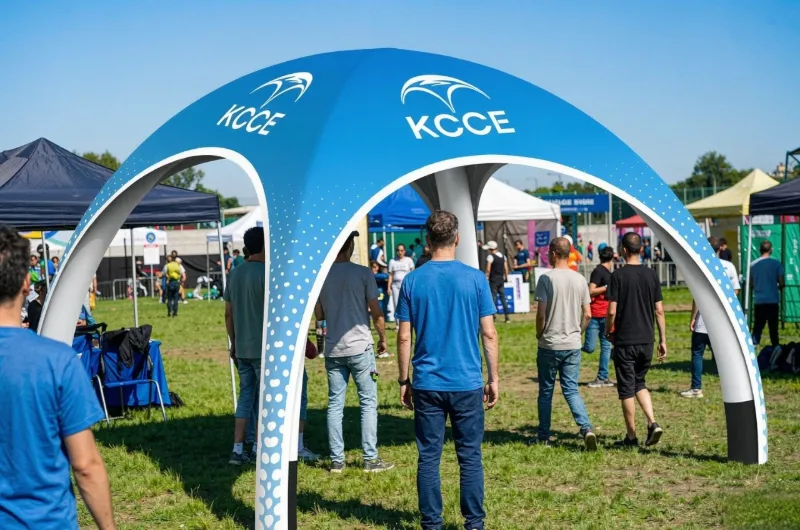
Every reputable manufacturer provides a wind rating for their inflatables. Typically, that’s around 20–25 mph for standard units, with heavy-duty versions rated higher. Beyond that, you MUST deflate and secure the unit. I’ve seen what happens when someone ignores wind ratings — it’s not pretty, and it’s a liability nightmare. For events where you need a reliable, weather-resistant structure, our Air Tight X Tent has been battle-tested since 2008 and offers superior airtight, waterproof, and bug-proof performance.
Lưu trữ:
Deflated, a 20-foot inflatable packs down to roughly the size of a large suitcase or small duffel bag — maybe 3–4 cubic feet. But it needs to be stored DRY and CLEAN. Mildew is the silent killer of inflatables. You need a storage space that’s climate-controlled or at least dry and well-ventilated. A garage corner or storage unit works fine.
Industry-Specific Strategies for Maximum ROI
Let’s get practical. How do different industries actually deploy custom inflatables for maximum return? I’ve seen these strategies work across dozens of campaigns, and here’s what the data supports.
Real Estate & Property Development
Directional towers at major intersections are the killer app here. A 20-foot inflatable tower with “OPEN HOUSE — THIS WAY” printed on it can attract more drive-by attention than a traditional sign. Real estate agents love these because they’re reusable for every open house, and the ROI is immediate — A single extra sale can more than cover the cost.
Beer, Beverage & CPG Brands
Branded product replicas at festivals, concerts, and sporting events are the standard play. A 30-foot inflatable beer can at a music festival becomes the backdrop for hundreds of photos — each one a branded impression shared across social media. These brands also use inflatables for in-store promotions and grand opening events at retail partners.
Technology & Product Launches
Tech companies use inflatable product replicas at launch events to give audiences a physical experience of a product they can’t yet touch. A giant inflatable smartphone or wearable device creates a photo moment that drives social sharing and press coverage. For a product launch, the inflatable IS the visual anchor of the entire event.
Automotive & Dealerships
Car dealerships have been using inflatables for decades — the giant inflatable car on the roof is a classic. Modern dealers use custom inflatable arches for sales events and inflatable replicas of specific models to draw attention to new releases.
Nonprofits & Community Organizations
Don’t overlook the nonprofit sector. Inflatables at charity runs, community fairs, and awareness events draw crowds and create the kind of visual energy that drives participation. The cost is manageable, and the visibility boost is substantial.
The common thread: the most successful campaigns treat the inflatable not as a standalone ad, but as a How Custom Inflatables Help Brands Stand Out at Events — the centerpiece around which the entire event experience is built. It’s the photo backdrop, the directional beacon, the conversation starter, and the brand anchor all in one. For events that need a permanent yet portable structure, our display frames offer a versatile complement to inflatables, providing a sturdy framework for banners and graphics.
How to Choose a Vendor: Red Flags & Checklist
This is where I see businesses make their most expensive mistakes. The custom inflatable market has some excellent manufacturers — and some that will sell you garbage that falls apart after two events. Here’s how to tell the difference.
Your vendor checklist:
- Portfolio — Ask for photos and videos of their actual work, not just stock images. Look for inflatables in real-world settings, not just studio shots.
- Chất liệu — They should specify the exact PVC material and thickness. “Commercial grade” isn’t good enough — ask for specifics.
- Lead time — A reputable manufacturer needs 4–8 weeks for custom work. Anyone promising 2-week delivery on a complex custom inflatable is cutting corners.
- Bảo hành — Look for at least a 1-year warranty on seams and materials. 90 days is a red flag.
- Wind rating specs — They should provide documented wind ratings for every product.
- Fire retardancy — Ask for certification. Most commercial venues require fire-retardant materials.
- CAD proof — Before manufacturing, you should receive a CAD rendering of your inflatable for approval. No CAD proof, no deal.
Red flags to walk away from:
- No CAD proof — If they can’t show you a design rendering before production, they’re not doing real custom work.
- Vague pricing — “It depends” is not a price. A real quote includes design, materials, blower, and shipping.
- No references — Any established manufacturer can provide client references. If they can’t, that’s telling.
- No wind rating data — This is a safety issue, not a convenience issue.
- Unrealistic lead times — Quality custom manufacturing takes time. If they promise the impossible, they’re lying.
Questions to ask before you commit:
- What’s the wind rating for this specific inflatable?
- What’s the blower requirement, and is it included?
- Can you provide a CAD proof before production?
- What’s the warranty on seams and materials?
- What’s the shipping cost to my location?
- How many events will this realistically survive?
A good custom inflatable manufacturer will welcome these questions. If they get defensive, that’s your answer — move on.
Emerging Trends: QR Codes, Eco-Materials, AR Integration
The inflatable industry isn’t standing still. Here’s what I’m seeing for 2025 and beyond — trends that are reshaping what’s possible.
QR-Code Printed Inflatables
Printing a QR code directly onto an inflatable surface, at a size that can be scanned from 50 feet away, turns your inflatable into a direct traffic driver to your landing page, promo code, or social channel. The inflatable becomes a physical gateway to your digital funnel.
Eco-Friendly Materials
The sustainability push is reaching inflatables. Inflatables in 2025: Creative Marketing Ideas to Boost Your brand while staying green — that’s the new frontier. PVC-free and recyclable materials are emerging, and brands that care about their environmental footprint are starting to demand them. The tradeoff is cost — Eco-materials may cost more than standard options. — but for brands with strong sustainability positioning, it’s worth it.
AR Integration
Augmented reality triggers printed on inflatable surfaces. Point your phone at the inflatable, and a 3D animation plays, or a game starts, or exclusive content unlocks. This turns a passive visual into an interactive experience — and it’s a massive driver of social sharing.
Modular and Multi-Use Designs
Manufacturers are getting smarter about designing inflatables that can be reconfigured for different events. One structure that works as an arch for a race, a tunnel for a festival, and a backdrop for a product launch — that’s the kind of versatility that makes the ROI math even more compelling. Our inflatable shapes are designed with this flexibility in mind, allowing you to adapt the same structure across multiple campaigns.
Smart Inflatables
Integrated LED lighting, sensors, and even digital displays on inflatable surfaces. These are still emerging, but the potential is obvious — an inflatable that changes color based on crowd movement, or displays real-time social media feeds at events.
Các câu hỏi thường gặp
Q: What are some effective ways to increase brand visibility?
Trả lời: The most effective approaches combine physical and digital presence. Custom inflatables at events, trade shows, and high-traffic locations create 3D brand anchors that static signage cannot match. Pair these with social media campaigns, influencer partnerships, and content marketing. The key is consistency — repeated exposure across multiple channels builds the recognition that drives recall and trust.
Q: How to increase brand exposure?
Trả lời: Focus on environments where your target audience already gathers. Trade shows, festivals, sporting events, and community functions offer concentrated audiences. Custom inflatables provide the scale and visual impact needed to dominate these spaces. Combine physical presence with digital amplification — encourage photo sharing, run contests, and use QR codes to bridge offline and online engagement.
Q: What are some effective tactics for increasing brand awareness?
Trả lời: The most effective tactics create memorable experiences. Inflatable product replicas that people can touch and photograph outperform passive advertising. Sponsorship of local events, strategic partnerships, and guerrilla marketing stunts all benefit from inflatable structures as visual anchors. The goal is to create moments worth sharing — that’s what turns one-time viewers into brand advocates.
Q: Can you provide some examples of effective brand awareness campaigns?
Trả lời: Real estate developers using directional inflatable towers at open houses, beverage brands deploying giant product replicas at festivals, and tech companies showcasing inflatable product models at launch events are proven examples. The common element is scale — these campaigns use inflatables to create visual dominance that drives photo sharing, press coverage, and word-of-mouth.
Tham Khảo
1. Elevating Your Brand Visibility with Inflatable Logos & Billboards — Boulder Blimp Company
2. Custom Inflatable Advertising: Complete Guide to Promotional Blow-Up Marketing — USA Blimp
3. Increase Brand Awareness with Various Promotional Inflatables — Inflatable Design Group
4. Custom Inflatables Market Research Report 2033 — Dataintelo
5. Inflatable Advertising Ideas That Work — Inflatable Products
6. Inflatable Signage & Displays — SignWeb