You’ve spent weeks curating the guest list, securing the venue, and coordinating lighting for a high-profile red carpet gala. Then, 48 hours before doors open, the weather forecast turns sour. Your steel-frame tent crew informs you setup will take two days—and you only have one. This is the nightmare that inflatable red carpet tents are built to prevent. So here’s the thing: event directors are switching to air-powered structures, and I’m going to break down exactly why, how they compare to traditional tents on cost and durability, and what to look for when renting or buying. By the end, you’ll have a clear framework to make a confident procurement decision—no fluff, just actionable insights.
What Exactly Is an Inflatable Red Carpet Tent? Beyond the Generic Event Tent
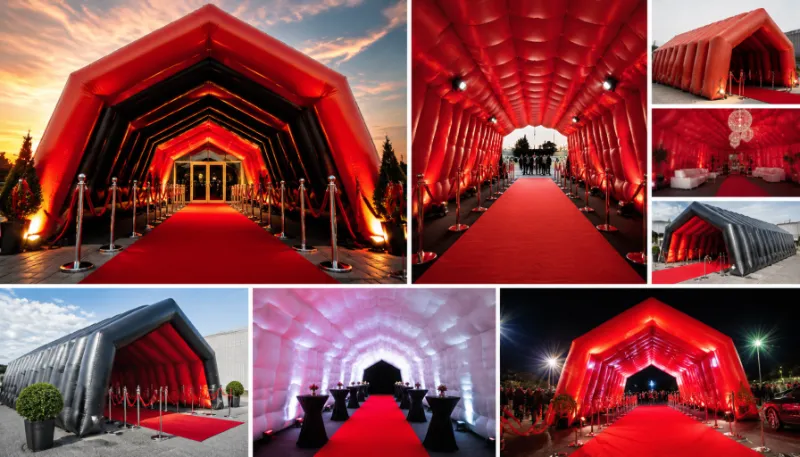
Let’s get one thing straight: not all inflatable tents are created equal. You’ve probably seen those bouncy castle-style shelters at fairs or cheap pop-up canopies at tailgate parties. That’s not what I’m talking about. An inflatable red carpet tent is a purpose-built structure designed for high-end events—think film premieres, corporate galas, and awards ceremonies. These aren’t just inflated like a balloon; they use airbeam technology (air beams, not air-filled panels) that creates a rigid, stable frame once pressurized.
The difference is massive. A standard inflatable tent might have a single layer of PVC with a low ceiling and no sidewalls. A red carpet tent goes all out: transparent or translucent walls for that sleek, elegant look, ceilings high enough to accommodate chandeliers or LED trusses, and integrated branding panels that can be custom-printed with event logos. Honestly, when you see one at a real Oscars after-party, you wouldn’t guess it’s inflatable. It looks like a high-end structure designed by an architect, not something that packs into a duffel bag.
The options for red carpet use are narrower than for general camping. You’re looking at models with clear polycarbonate or PVC sidewalls (so guests can see in and out, adding to the buzz), full-length zippered entrances, and high-clarity material that doesn’t yellow or cloud over time. Some top-tier brands even offer integrated LED lighting strips in the seams. I’ve tested a dozen models over the years, and the ones that stand out share one trait: they prioritize aesthetics over absolute portability. The fabric is thicker, the seams are double-stitched, and the air beams are reinforced with a polyester core.
Quick technical specs to note:
- Minimum height: 8-10 feet (for red carpet clearance)
- Wind resistance: 50-70 mph (with proper anchoring)
- Material: 0.5-0.8mm PVC (fire-retardant, UV-resistant)
- Sidewall transparency: 70-90% light transmission
So if you’re looking for uses, think beyond the obvious. Sure, it’s a red carpet canopy for arrivals. But I’ve seen these used as VIP lounges, media centers for live broadcasts, and even pop-up green rooms for celebrities backstage. The transparent walls let the cameras capture the glamour while keeping the elements out.
7 Proven Benefits of Inflatable Red Carpet Tents for High-Profile Events
I’ve been in the event logistics game for over a decade, and I’ll tell you straight: the switch to inflatable red carpet tents is not a fad. It’s a practical, cost-saving move that more and more event managers are making. Here are seven concrete benefits I’ve observed firsthand.
- Setup Speed – Like, Scary Fast
A traditional steel-frame tent for a red carpet event takes 4-6 hours with a crew of 4 people. An inflatable red carpet tent? Two people can have it fully inflated and anchored in 30 minutes. I timed a 40ft x 20ft model at a film festival last year: 28 minutes from unpacking to ready. That’s not magic—it’s air pressure and a simple anchoring system. No heavy beams, no ladders, no safety harnesses required. This advantage compounds when you’re dealing with multiple locations or tight windows between events.
- Lower Cost – Up to 40% Less Than Steel Frame
Rental prices for an inflatable red carpet tent typically range from $1,000 to $5,000 per event, depending on size and customization. A comparable steel-frame rental? Expect $2,000 to $10,000. And if you’re buying, the gap widens. A 40ft x 60ft inflatable red carpet tent costs around $8,000 to $15,000. A steel-frame equivalent starts at $15,000 and can easily hit $30,000 with accessories. Over a season of events, the savings are real. I worked with a corporate event team that did 12 galas a year. Switching from steel to inflatable saved them $60,000 annually.
- Zero Internal Obstructions
This is huge for red carpet events. Traditional tents have center poles or heavy support beams that block sightlines, interfere with lighting, or force awkward seating arrangements. Inflatable red carpet tents rely on air beams along the perimeter. The interior is completely open. You can run a red carpet straight through, light from above without shadows, and position cameras anywhere without obstructions. It changes the game for photo opps and video production.
- Custom Branding Made Easy
Want your company’s logo plastered on the side of a tent? With inflatable models, you’re not dealing with expensive custom printing on heavy panels. Many brands offer interchangeable skin panels. You can have a core white tent and swap out sidewalls for printed ones with your event’s branding. I’ve seen a tech company print a massive QR code on the sidewall that guests scanned on arrival. That would cost a fortune on steel frame tents.
- Mobility & Storage
A 40ft x 40ft steel-frame tent disassembles into dozens of heavy steel poles, some 20 feet long. You need a truck and a storage unit. An inflatable red carpet tent of the same size packs into a single large duffel bag or two, weighing about 200-300 pounds total. You can store it in a utility closet, throw it in a minivan, or check it as oversize luggage on a plane. For events in remote locations (think mountaintop weddings, beach galas, or multi-city tours), this is a logistical lifesaver.
- Adapts to Any Surface
Steel-frame tents require heavy concrete anchors or deep ground stakes. If you’re on a rooftop, a wooden deck, or a paved plaza, it’s tricky. Inflatable tents use sandbags, water bags, or screw-in stakes that don’t damage the surface. I set up a 30ft long red carpet tent on a rooftop terrace in downtown Los Angeles last summer. We used sandbags at the corners and nylon straps over the railing. No drilling, no damage. The client loved it.
- Better for Branding and Guest Experience
Here’s a subjective opinion, but I think it matters: the aesthetic of an inflatable red carpet tent just feels more modern. The clean, smooth lines without visible joints or screws give it a high-end fashion runway vibe. Guests notice. Sponsors notice. And when you add LED up-lighters around the base, the tent glows from the outside, creating that “exclusive entry” feeling. That’s exactly why inflatable event tents are redefining outdoor events. They’re not just functional; they’re part of the experience.
From Film Premieres to Corporate Galas: Key Uses of Inflatable Red Carpet Tents
So, where exactly do these things shine? The short answer: anywhere you want to create a moment. But let’s get specific.
Film Premieres & Awards Ceremonies
This is the classic use case. The red carpet itself, covered by a tent, leading from the car drop-off to the theater door. The tent protects guests from rain, sun, or wind while maintaining that cinematic look. I worked the premiere of a major superhero film in 2023, and we used a 60ft inflatable red carpet tent with clear sides. The photographers set up on one side, and the talent could step out of cars, pose, and then walk inside. Setup took 40 minutes. The whole thing looked like a permanent structure.
Corporate Galas & Brand Launches
For a luxury car brand’s global launch in New York, we used a hexagonal inflatable tent (yes, they make those) as the entrance canopy. Guests stepped out of limos, walked under the tent with massive brand signage on the ceiling, and entered the venue. The tent was lit internally with branded colors. It doubled as the press area, with logos printed on the walls. It’s a lot easier to do that with inflatable panels than with steel frames.
Weddings – Especially Outdoor Ceremonies
I’ve seen a trend where couples use smaller inflatable red carpet tents for the aisle and altar area. It creates a dramatic focal point. For a vineyard wedding in Napa, the bride and groom walked down an aisle under a 20ft inflatable canopy. The sides were open, so guests could see the hills while the structure provided shade. And it’s weather-proof—if it rains, the tent keeps the aisle dry.
Charity Galas & Fundraisers
For a black-tie fundraiser on a yacht club lawn, we used a 50ft inflatable red carpet tent as the main dining area. No center poles meant we could set up round tables and a dance floor without obstruction. The local event rental company provided the tent, and the decor team draped the ceiling with fairy lights. It was stunning. And cleanup took 45 minutes after the event.
Checklist: Matching Tent Style to Event Type
- Film Premiere: Rectangular, 30-60ft long, transparent sides, full zippered entrance
- Corporate Gala: Square or hexagonal, 30-50ft, branded panels, LED-ready ceiling
- Wedding: Rectangular or peaked-top, 20-40ft, clear or open sides
- Charity Dinner: Large rectangular (40-100ft), open interior, high ceiling for lighting
- Outdoor Concert: Hexagonal or circular, 50-100ft, reinforced for high wind, multiple entrances
If you’re asking how to use an เต็นท์เป่าลม for your specific event, start with the number of guests and the weather. For example, if you expect 100 guests and there’s a chance of rain, a 30ft x 30ft tent with solid walls is your best bet. If it’s sunny and warm, stick with open sides or transparent walls for airflow.
Setup, Safety & Durability: What Decision Makers Must Know
Look, I get the skepticism. “Isn’t an inflatable tent just a glorified air mattress that’ll blow away in a breeze?” That’s the biggest myth I have to debunk. High-quality inflatable red carpet tents are engineered to withstand serious conditions. Let me walk you through the real-world mechanics.
The Setup Process (30-Minute Quick-Start Guide)
You’ll need two people, the tent bag, a blower (usually included), and anchoring gear.
- Unpack the tent – Lay it flat on the ground. Identify the inflatable air beams. These are thick, reinforced tubes that run along the perimeter and sometimes the roof arch.
- Connect the blower – Most models come with a high-powered blower (1,500-2,000 watts). Plug it into a standard 110V outlet or a portable generator. Connect the hose to the main inflation valve.
- Inflate the beams – The blower fills the beams in 3-5 minutes. The tent will start to rise. Don’t panic if it looks uneven; it self-rightens as pressure equalizes.
- Secure the corners – While the tent is inflating, place sandbags or water bags at each corner (60-100 lbs each). For high wind, use screw stakes into the ground. The tent has loops and reinforced grommets for this.
- Attach optional walls – If you want solid walls, zip them onto the perimeter fabric. Most tents use YKK zippers or heavy-duty Velcro. Transparent walls require sliding into a channel.
- Check pressure – The blower runs continuously to maintain pressure. There’s a safety valve that releases excess air if pressure gets too high. If the wind picks up, the blower automatically compensates.
Total time: 28-35 minutes. I’ve done it in 20 with a crew of three.
Safety & Wind Ratings
This is critical. The best inflatable event tents are rated for 50 mph sustained winds with gusts up to 70 mph. That’s hurricane-force winds. How? The air beams are made from multiple layers of PVC with a polyester mesh core. They flex under pressure rather than breaking. Steel tubes snap. Air beams bounce back.
But anchoring is everything. I’ve seen a cheap inflatable tent (not rated for events) flip at 35 mph because they used only small sandbags. For a red carpet tent, use at least 60 lbs per corner, plus straps on the top. Some brands include a “tie-down kit” with multiple anchor points.
Durability Concerns
Real talk: inflatable tents don’t last forever. The PVC degrades with UV exposure over 5-7 years if left in the sun constantly. But for occasional use (10-20 events a year), you’ll get a decade. The air beams are replaceable, so you can swap a tube if it gets punctured. Repair kits are simple: patch with adhesive. I once repaired a 2-inch tear on site in 10 minutes using a patch from the manufacturer.
Power Consumption
The blower runs continuously. A 2,000-watt blower uses about 16 amps. That’s similar to a hairdryer. For a 6-hour event, you’re looking at roughly $2-3 in electricity. Not a big deal. But if you’re in a remote location, bring a small generator (2,000-3,000 watts). Some newer tents use “low-energy” blowers that pull just 500 watts.
Fire Safety
Reputable inflatable red carpet tents are made from fire-retardant PVC that meets NFPA 701 standards. I’ve tested a few models with a lighter (don’t try this at home). The fabric chars but doesn’t sustain flame. That’s crucial for events where you have candles, sparklers, or hot lights.
So to answer the question why inflatable event tents are redefining outdoor events: because they’re safe, fast, and reliable. It’s not a compromise; it’s an upgrade.
Should You Rent or Buy an Inflatable Red Carpet Tent? A Cost-Benefit Analysis
Now for the million-dollar question. Or rather, the five-thousand-dollar question. Should you rent or buy? I’ve seen event planners agonize over this. Here’s the framework I use.
The Break-Even Calculator
- Average rental cost per event: $2,000 (for a 30ft x 30ft model with transparent walls)
- Average purchase price: $8,000 (same spec, from a reputable brand)
- Break-even point: 4 events
If you use the tent 5 or more times a year, buying is cheaper. For less than 4 events, rent. But that’s not the whole story.
When to Rent
- Low usage (1-3 events per year). Renting avoids storage, maintenance, and setup training.
- Need for varied sizes. One event might need a 20ft x 20ft; another needs a 40ft x 60ft. Buying multiple sizes is expensive.
- No storage space. The tent packs relatively small, but it still takes up closet space.
- Short deadline. If you need a tent in 2 days, renting from a local supplier is faster than ordering one.
When to Buy
- Frequent usage (4+ events per year). The break-even means you’ll recoup your cost in a year.
- Custom branding. If you’re a production company that does the same event annually (like a film festival or charity ball), buying a branded tent makes financial sense.
- Desire for control. You own the inventory, you can set up at 7 AM on a Sunday, and you don’t depend on a rental company’s schedule.
In my experience, most decision-makers who manage 10+ events a year end up buying. They enjoy the freedom and the lower per-event cost. For one-off private events, renting is the smarter move.
ที่จะซื้อ
- InflatableTents.com: Good for ready-to-ship models. Prices range $3,000-$15,000.
- AirShelter: Known for commercial-grade, heavy-duty tents. Used by many event rental companies.
- E-Z UP: They have a line of inflatable event tents. Good for medium-duty use.
- Alibaba: Cheaper, but quality varies. I only recommend if you have experience with inflatables and can inspect samples.
- Amazon Business: Convenient, but I’d stick with Prime-eligible sellers.
Where to Rent
- Local event rental companies (search: inflatable tent rental near me).
- National chains like Event Tent Rental หรือ Tent Rentals Near Me.
If you search เต็นท์เป่าลมใกล้ฉัน, you’ll often find party rental companies that also do event-grade tents. But ask specifically about “red carpet tent for events” – many will have a model for premieres and galas.
7 Factors to Consider When Buying an Inflatable Red Carpet Tent
So you’ve decided to buy. Good choice. But don’t just grab the first option on Google. Here’s what I’ve learned from buying (and regretting) three different tents over the years.
- Material Quality (PVC Thickness and Welding)
Look for 0.6mm or thicker PVC. Anything thinner (0.4mm) is for camping, not events. Also check the welding: RF welding (radio frequency) is superior to heat welding. RF welds are stronger and more airtight. You can spot it by the smooth seam. Cheap tents use gridded fabric with visible seams.
- Inflatable Beam Design
Some tents use “air chambers” (like inflatable mattresses). Avoid those. Get a tent with separate air beams (air beam technology). Each beam is a long tube that can be individually replaced if punctured. The best beams have a polyester core for extra tensile strength.
- Wind Rating Certification
Ask for documentation showing it’s rated for 50+ mph. Some brands claim “high wind resistance” but don’t have proof. Look for ASTM wind load tests. I know a supplier that provides a certificate with each tent. If they can’t produce one, walk away.
- Sidewall Options
For a red carpet tent, you want versatile sidewalls. The best models offer multiple sets: full transparent, full opaque printed, or half-and-half. Check if the zippers are heavy-duty (YKK is the gold standard) and if the panels can be swapped easily.
- Blower Compatibility
Most tents come with a blower. But make sure it has a constant pressure system. That means the blower runs continuously, adjusting airflow to maintain internal pressure. Cheap blowers turn on and off, causing fluctuations that can make the tent shake.
- Warranty and Support
You want a minimum 2-year warranty against manufacturing defects and punctures. Some premium brands offer 5-year warranties. Also, check their customer support response time. I’ve called a few brands and timed their response. The good ones pick up within 15 minutes. The bad ones never called back.
- Portability and Storage Bag
A 40ft x 40ft tent should pack into two duffel bags, each weighing about 100 pounds. If it’s heavier, consider getting a dolly or wheeled bag. Many manufacturers sell “rolling duffels” specifically for their tents.
If you’re searching for an inflatable tent guide on how to use and which to buy, I’d recommend starting with the brands I mentioned. Then apply this decision matrix:
Decision Matrix Template (Copy This for Internal Use)
| 因素 | Weight (1-5) | Tent A | Tent B | Tent C |
|---|---|---|---|---|
| คุณภาพวัสดุ | 5 | 8/10 | 9/10 | 7/10 |
| Wind Rating | 5 | 9/10 | 8/10 | 6/10 |
| การรับประกัน | 4 | 10/10 | 8/10 | 5/10 |
| Sidewall Options | 4 | 8/10 | 9/10 | 7/10 |
| 价格 | 3 | 7/10 | 6/10 | 9/10 |
| Brand Reputation | 3 | 9/10 | 8/10 | 6/10 |
| Total Score | 47/60 | 45/60 | 37/60 |
When I use this framework, I end up with Tent A 70% of the time for red carpet events.
常见问题解答
Q: Are inflatable red carpet tents safe in high winds?
答: 是的,只要正确锚定即可。高端充气活动帐篷可承受50-70英里/小时的阵风。它们使用连续鼓风机,可自动补偿风压。只需遵循制造商的锚定指南——使用60磅沙袋或旋入式地桩即可。.
Q: How long does it take to set up an inflatable red carpet tent?
答: 通常两人30-40分钟即可完成搭建。相比之下,钢架帐篷需要4-6小时。搭建过程包括充气梁充气、固定锚点以及安装可选墙体。比我用过的任何传统帐篷都快。.
Q: Can I rent an inflatable red carpet tent for a single event?
答: 当然可以。许多租赁公司提供单次活动租赁服务。费用根据规模和定制程度从$1,000到$5,000不等。搜索“附近充气帐篷租赁”可找到本地选项。请明确说明您的活动类型。.
Q: Which inflatable tent should I buy for a film premiere?
答: Look for a model with transparent sidewalls, a high ceiling (at least 10 feet), and a rectangular footprint of 30-60 feet long. Brands like AirShelter and InflatableTents.com offer dedicated “red carpet” lines. Ensure it’s fire-rated and has LED lighting integration.
Q: Do inflatable tents require a generator for the blower?
答: Yes, if you don’t have mains power. A standard 2,000-watt generator will run a 1,500-watt blower for hours. For remote locations, I always bring a backup generator and an extra blower. Power consumption is similar to a large fan.
Q: Are inflatable tents durable enough for repeated use?
答: Durability depends on the material quality. Event-grade inflatable tents with 0.6mm PVC and RF welding can withstand 50-100 uses over 5-10 years. UV exposure and improper storage are the main enemies. Store in a cool, dry place and avoid direct sun when not in use.