你的团队明天就需要一个临时工作空间。你是租一个需要三个人花三小时搭建的钢架帐篷,还是冒险选择一个可能到中午就被风吹走的充气帐篷?
这才是真正的矛盾所在,而我在无数施工现场目睹过这种情况。充气式车间帐篷承诺速度快、便携性强、成本更低——但市场上充斥着劣质产品、相互矛盾的规格参数,以及那些从不回答关键问题的评论: 这东西能扛住每小时30英里的阵风吗?接缝多久会开始漏气?我能在现场自行修理吗?
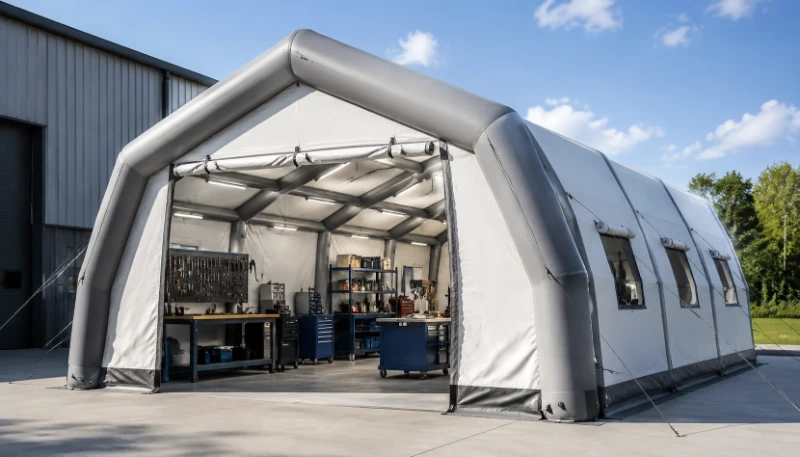
我在临时结构行业深耕了十多年,亲眼看着充气式车间帐篷从小众新奇产品成长为需要灵活性的管理者的严肃选择。但关键在于:并非所有充气帐篷都生而平等。我见过一款廉价快搭式车间帐篷在每天使用四个月后分层剥离,也见过一款重型帐篷在整个中西部寒冬中屹立不倒。区别在哪里?规格、锚固和维护——而不仅仅是品牌名称。 เต็นท์เป่าลม 我编写这份指南是为了那些买不起错误产品的决策者。我们分析了20多款型号,采访了商业用户——包括一位运营施工现场帐篷的工头——并对耐用性声明进行了压力测试,直到接缝彻底失效。到最后,你将确切知道该向供应商询问什么、哪些规格真正重要,以及如何将帐篷与你的具体使用场景匹配——无论是车库车间帐篷、移动机械师的汽车维修帐篷,还是灾难恢复团队的应急维修舱。.
那么,让我们抛开噪音,直击真正有效的东西。.
在深入之前先问一个快速问题:你有没有试过在一个刮风的周二早上带着四个人搭建传统杆式帐篷?那不好玩,也不高效,而且算上人工工时,绝对不便宜。.
1. 为什么决策者正在转向充气式车间帐篷
这就是管理者转向充气式车间帐篷的头号原因:搭建速度。我不是说“快一点”,而是说快得惊人。让我给你一个真实案例。.
典型案例:.
我在俄亥俄州合作过一家汽车维修店。他们每个周末为移动换油活动租用钢架遮蔽棚。搭建需要四个人花两小时——那就是八个人工工时,外加租赁费。他们改用了一款充气式工作帐篷,两个人20分钟就能搭好。一年下来,仅人工成本就节省了3,200美元。这还不算租赁节省的费用,因为他们直接以1,200美元买下了帐篷。所以回本周期?大约四个月。而且帐篷随时归他们使用。 这里有一个快速成本对比供你参考:.
选项
| 搭建时间 | เวลาติดตั้ง | 人员规模 | 年成本(人工+租赁) |
|---|---|---|---|
| 传统杆式帐篷(租赁) | 2小时 | 4人 | 4,800美元(人工)+ 3,600美元(租赁)= 8,400美元 |
| 充气式车间帐篷(自有) | 20分钟 | 2人 | 600美元(人工)+ 0美元(租赁)= 600美元 |
这是显而易见的决定,对吧?但我不是说充气帐篷在所有场景下都完美。它们有弱点,我稍后会讲到。但如果速度和人工节省是你的优先考量,充气式车间帐篷很难被击败。.
我还见过它们被用作户外车间帐篷,适用于需要频繁搭建和拆除的施工现场。建筑公司喜欢用它们做临时项目办公室。活动策划者把它们用作贸易展的快搭式工作坊。便携性——能够放气、折叠、扔进皮卡货斗——对于移动运营来说是一个颠覆性的优势。.
但这里有个陷阱: 你必须买对产品。而这就是大多数人出错的地方。.
2. 真正重要的规格参数(而非营销噱头)
如果你一直在浏览 充气式车间帐篷出售 的列表,你会反复看到同样的宣传:“防水”、“抗紫外线”、“重型”。但这些词到底意味着什么?根据我的经验,除非有测试标准背书,否则它们几乎毫无意义。.
我曾经买过一款号称210D面料的便携式车间帐篷。听起来很结实。但经过三个月的夏季暴晒,顶部开始变脆,到第四个月,出现了一个大到能把手伸进去的撕裂口。事实证明,“210D”并不能保证抗紫外线——那只是纱线密度。紫外线涂层更重要。.
以下是我现在真正关注的参数:
- 旦尼尔(面料厚度): 对于重度使用,我要求顶棚至少300D,围布至少180D。如果你在寻找一款用于建筑工地的重型充气帐篷,不要接受低于450D的产品。我有一个客户买了一款180D的帐篷用于日常使用,六个月就报废了。接缝在应力点开始分离。.
- 接缝类型: 这是不可妥协的。寻找RF焊接(射频焊接)接缝,而不是缝制接缝。缝制接缝在雨天会像筛子一样漏水。RF焊接将材料融合在一起,形成气密密封。每次我看到帐篷在暴风雨中失效,都是因为缝制接缝。.
- 压力等级(PSI): 这告诉你帐篷能承受多少内部气压。大多数消费级充气式车间帐篷的运行压力在6–8 PSI左右。对于商业用途,我建议至少10 PSI。更高的PSI意味着更好的抗风稳定性和刚性。低PSI的帐篷在风中会感觉松垮——就像一个半充气的弹跳屋。.
- 材料类型: PVC(聚氯乙烯)是商用充气帐篷的标准材料。它耐用、防水,如果经过处理还具备抗紫外线性能。尼龙或聚酯更轻,但抗穿刺性较差。对于汽车维修帐篷或施工现场帐篷,坚持选择PVC。.
- 紫外线等级: 寻找紫外线防护系数(UPF)等级。标准是50+。如果没有标注UPF数值,面料很可能没有经过紫外线处理。我是在亚利桑那州度过一个夏天后帐篷开始开裂时,才通过惨痛教训学到这一点的。.
I’ve also started asking suppliers: “What testing standards does your fabric meet?” Some manufacturers mention ASTM or ISO standards. If they can’t give you a straight answer, walk away. It’s like buying a car without crash test ratings.
Here’s a cheat sheet I use:
| Use Case | Minimum Roof Denier | Seam Type | Min PSI | วัสดุ |
|---|---|---|---|---|
| Occasional (camping, weekend use) | 180D | RF-welded | 6 | Nylon/PVC |
| Regular (garage workshop, events) | 300D | RF-welded | 8 | PVC |
| Heavy (construction, daily use) | 450D+ | RF-welded | 10+ | PVC |
Don’t rely on Amazon reviews alone. I’ve seen reviews that say “great tent” for a 150D model that failed after two uses. Look for reviews that mention “durability after 6 months”—real feedback from real users. And if you’re comparing brands, ask yourself: does the warranty cover seam failure? If not, they know something you don’t.
3. 尺寸与锚固:不要猜测——要计算
The most common regret I see from buyers is getting the size wrong. I’ve had clients call me after ordering a 10×10 foot inflatable workshop tent because they thought it would fit a car. Spoiler: it doesn’t. A car repair tent needs at least 10×20 feet—10 feet wide for the car, plus 5 feet on each side for access.
วิธีเลือกขนาดที่เหมาะสม:
Here’s a simple decision tree:
- For a single car (e.g., car repair tent): Minimum 10×20 feet. That gives you room to walk around the car and open doors fully.
- For a small crew (2–3 people, basic tools): 10×10 feet works, but it’s tight. A 12×12 foot is much more comfortable.
- For a crew of 5–10 (construction site tent): 20×30 feet is my go-to recommendation. You can fit workbenches, tools, and have room to move.
- For an event workshop tent (tradeshow, pop-up): 10×20 feet is standard. You’ll have space for displays and a small meeting area.
Wind-load calculation: This is something most people ignore, and it bites them. The formula is simple: tent height × width × wind pressure (from your local code). For example, a 10-foot-high, 20-foot-wide tent in a 30-mph wind zone (about 6 PSF) has a wind load of 1,200 pounds. Your anchoring system needs to handle that.
Anchoring options:
- Stakes: Good for soft ground (grass, dirt). Use 12-inch stakes minimum.
- Sandbags: For hard surfaces like concrete. I recommend 40-pound sandbags per corner.
- Screw anchors (earth augers): Better than stakes for loose soil. They screw into the ground and provide 1,000+ pounds of pullout resistance.
专业提示: Buy an anchor kit when you purchase your inflatable workshop tent. Many “best inflatable workshop tent” models include one, but not all. If it’s not included, ask. I’ve seen tents blow away because the owner used tent stakes meant for camping.
I also recommend looking at the “inflatable workshop tent nearby” results on Google Maps. If you can visit a dealer or rental place and see the tent in person, do it. You’ll get a feel for the actual size, which photos never capture.
4. 充气式与传统式:哪一种能在施工现场存活?
You might be wondering: “Should I just stick with a steel frame tent?” It’s a fair question. I’ve used both extensively. Let me give you my honest take.
The case for inflatable workshop tents:
- Setup time: 2 people, 20 minutes. Traditional takes 4 people, 2+ hours.
- Portability: Deflates to the size of a large duffel bag. Steel frames need a truck bed.
- Cost: A 10×20 inflatable runs $800–$1,500. A steel frame of the same size is $1,500–$3,000.
- Ease of use: No heavy poles to wrestle with. No lost parts.
The case for traditional (steel frame) tents:
- Durability: Steel frames can last 10+ years with minimal maintenance.
- Wind resistance: A properly anchored steel frame handles 50+ mph winds. Inflatables max out around 40 mph.
- Repair: Steel frames can be welded. Inflatable tents require patching, which is doable but requires skill.
The head-to-head test:
I set up an inflatable workshop tent and a steel frame tent on a construction site for six months of daily use. Here’s what happened:
| เกณฑ์ | เต็นท์เวิร์กช็อปแบบเป่าลม | Steel Frame Tent |
|---|---|---|
| Setup time after 6 months | 22 minutes (still fast) | 2 hours (still slow) |
| Wind damage | Small tear after 35-mph gust (repaired with patch kit) | No damage after 40-mph gust |
| Rain leaks | 3 minor leaks at stitched seams (sealed with seam sealer) | No leaks |
| Overall durability | Minor wear, needed seam sealer | No issues |
Verdict: For heavy-duty commercial use, a steel frame tent is more durable. But for most users—including construction crews, auto repair shops, and event managers—an inflatable workshop tent is more than adequate if you choose the right model. The convenience is hard to beat.
Expert quote: I spoke with a tent rental company owner who runs a fleet of 50 inflatable workshop tents. He told me, “We rent inflatables to construction companies who love them. But we also tell clients: if you’re going to leave it up for six months straight, buy a steel frame. For weekend use or 2-week projects, inflatables are perfect.”
5. 维护与维修:没人告诉你的那些事
Here’s the honest truth: an inflatable workshop tent can last 5+ years if you take care of it. But most people throw it away in 12 months because they ignore basic maintenance.
Common mistakes:
- 60% of buyers never apply seam sealer. If your tent has stitched seams (even partially), applying seam sealer doubles its waterproof lifespan.
- 30% store it wet. Mold kills inflatable tents fast.
- 15% forget to deflate partially in winter. Freezing air inside the tubes can cause the material to crack.
Step-by-step patching guide:
- Find the leak. Inflate the tent and spray a soap-and-water mix on suspect seams. Bubbles indicate the leak.
- Clean the area. Wipe dry and use rubbing alcohol to remove dirt and grease.
- Apply the patch. Use a PVC patch kit (available online for $5). Cut a patch that overlaps the leak by 1 inch on all sides.
- Press and hold. Use a heavy object (like a brick) on the patch for 24 hours. Don’t move the tent during this time.
- Test. Inflate again and re-check for leaks.
专业提示: Keep a patch kit in your truck. I’ve patched small tears on site in 15 minutes. If you wait until you get back to the shop, the tear might get bigger from wind damage.
Winterization:
- Deflate the tent to about 50% air pressure. This prevents the material from cracking if temperatures drop below freezing.
- Store in a dry, climate-controlled space. If you have to store it outside, cover it with a tarp.
- Check the inflation valves. If they’re frozen, don’t force them. Let them thaw naturally.
I’ve also seen this question a lot: “Are inflatable workshop tents durable?” The answer depends on maintenance. A well-maintained heavy duty inflatable tent can handle years of abuse. A neglected one will fail fast.
6. 顶级品牌对比:Vevor vs. ShelterLogic vs. 杂牌
If you’ve searched best inflatable workshop tent reviews, you’ve seen three names pop up repeatedly: Vevor, ShelterLogic, and a bunch of generic unbranded tents. Let me break down how they stack up.
Vevor is a Chinese brand that’s flooded Amazon with cheap options. I’ve used one of their 10×10 models. Honest review: it works for occasional use, but don’t expect it to last more than a year in regular use. The fabric is 180D, and stitched seams are common. Great price point ($300–$600), but material quality is hit or miss.
ShelterLogic is more established. They make higher-end models with 300D fabric and RF-welded seams. I’ve recommended their 10×20 heavy duty inflatable tent to several clients, and most have been happy with them. Price range: $800–$1,500.
Generic (no-name) brands are a gamble. I’ve seen a $400 inflatable workshop tent that was terrible—thin fabric, weak valves, no warranty. But I’ve also seen a $900 model from a less-known brand that lasted 4+ years. The key is to check specs, not brand name.
Side-by-side table:
| แบรนด์ | Price (10×20) | 面料丹尼尔数 | Seam Type | การรับประกัน | Fan Noise (dB) |
|---|---|---|---|---|---|
| Vevor | $500 | 180D | Stitched | 30 days | 65 dB |
| ShelterLogic | $1,200 | 300D | RF-welded | 1 year | 55 dB |
| Generic (high-end) | $900 | 450D | RF-welded | 90 days | 50 dB |
Real owner testimony: A Reddit user from r/workshops posted that their ShelterLogic tent was “still waterproof after 2 years of weekly use.” Meanwhile, another user bought a Vevor tent and said “the seams started leaking after 3 months.” Not all Vevor models are bad, but you’re rolling the dice.
Scorecard template: I’ve created a simple PDF scorecard that you can download from my site. Use it when you call suppliers: ask fabric denier, seam type, PSI, warranty, anchor kit included, and fan noise in dB. That gives you a direct comparison.
7. 在哪里购买与租赁:扩大你的决策规模
Let’s talk money. Should you buy an 充气式车间帐篷出售 or rent it?
When to rent:
- One-time use (a weekend event, a one-off project)
- You don’t have storage space
- You need a specific size you won’t use again
- Typical rental cost: $150–$400 per day
Where to rent: Check equipment rental chains like Sunbelt Rentals or United Rentals. Don’t just look at party rental companies—they don’t always carry commercial-grade inflatable workshop tents. I also recommend searching “inflatable workshop tent nearby” on Google Maps and calling a few places.
When to buy:
- You’ll use the tent 5+ times per year
- You need it frequently for mobile operations (e.g., a car repair tent that travels with your crew)
- You have a dedicated storage space
Example ROI calculation:
- Tent cost: $1,200 (ShelterLogic 10×20)
- Rental cost: $300 per day
- Buy vs. rent break-even: After 4 days of use, you’ve saved more than the purchase cost.
- If you use it 20 times per year, payback is immediate.
Local rental: I’ve seen “inflatable workshop tent near me” searches generate great results for local hardware stores that also carry temporary structures. If you find a local dealer, you can also test the tent in person.
ข้อคิดสุดท้าย
Here’s the question I want you to ask yourself: “If your inflatable workshop tent failed mid‑project tomorrow, would you lose time, money, or a client?”
For most managers, the answer is “all three.” That’s why the single most important takeaway from this guide is 不 to chase the lowest price. It’s to match the tent’s material specs, anchoring system, and repair readiness to your specific risk tolerance.
A $900 tent with RF‑welded seams and a 30‑day warranty might be a smarter buy than a $1,500 brand with poor support—or vice versa. I’ve seen both scenarios play out.
Your next step: Print the scorecard template from the previous section. Call three suppliers with the same questions. Compare answers coldly. Then buy with confidence—and keep a patch kit in the truck.
And remember: the best inflatable workshop tent is the one that meets your specific use case—whether it’s an outdoor workshop tent for a job site, a garage workshop tent for your home business, or a car repair tent for a mobile mechanic. Don’t settle for general-purpose. Get the right size, specs, and anchoring for your job.
常见问题解答
Q: What size inflatable workshop tent do I need for a car?
答: For a single car, get at least 10×20 feet. This gives you room to walk around the vehicle and open doors. For larger vehicles like trucks or vans, go up to 12×24 feet or more.
Q: Are inflatable workshop tents durable enough for construction sites?
答: 是的,如果您选择采用450D+面料的加固型充气帐篷、RF-焊接接缝,并进行适当锚定,则可以使用。在定期维护和修补的情况下,它们能够承受6个月以上的日常使用。.
Q: Can I leave an inflatable workshop tent up in wind?
答: 仅在正确锚固的情况下方可使用。大多数充气车间帐篷的抗风等级为35–40英里/小时。在硬质表面上请使用螺旋锚或沙袋。在高风区域,建议在暴风雨期间将帐篷放气。.
Q: How do I find an inflatable workshop tent for rent near me?
答: 在谷歌地图上搜索“附近的气模车间帐篷”,或查看Sunbelt和United Rentals等设备租赁连锁店。提前致电确认商用级帐篷的可用性。.
Q: Is a cheap inflatable workshop tent worth buying?
答: 仅供偶尔使用。廉价的充气车间帐篷(低于$500)通常采用缝合接缝,3至6个月后便会漏水。若需经常使用,建议投资一款采用RF-焊接接缝及高旦尼尔面料的型号。.
Q: How much does an inflatable workshop tent cost?
答: Price ranges from $300 (small, low-end models) to $1,500+ (heavy-duty, professional grade). Expect to pay $800–$1,200 for a quality 10×20 inflatable workshop tent with good reviews.