快速解答
The best blow up tents manufacturer depends on your market: China dominates on cost and customization (MOQ often as low as 1 piece), while US and UK suppliers win on lead time and domestic compliance. Vet certifications (CE, NFPA, UL), request samples, and never pick on price alone.
If you’ve ever bought inflatable tents at scale, you know the drill. You send out ten inquiries, and nine replies read exactly the same — “professional factory, high quality, competitive price, 10 years experience.” Copy. Paste. Repeat.
So how do you actually tell a real blow up tents manufacturer from a trading company reselling someone else’s work? That’s the question I get most from event companies, rental operators, and brand managers. And honestly, after years of sourcing in this space, I still see buyers get burned by the same three things: vague MOQs, missing certifications, and quotes that hide the real cost until you’ve already committed.
Here’s what I’ll do in this piece: give you a straight comparison of the top manufacturers, the vetting checklist I actually use, and real pricing ranges. No fluff, no “contact us for details.”
Top Blow Up Tents Manufacturers Compared (2025)
Let me be upfront — there’s no single “best” blow up tents manufacturer. It depends on whether you’re buying 1 unit for a trade show or 500 for a rental fleet. But here’s how the major players stack up.
| ผู้ผลิต | ภูมิภาค | MOQ | ใบรับรอง | ระยะเวลาการผลิต | Price Range (per unit) |
|---|---|---|---|---|---|
| KCCE (Dongguan Dacheng) | จีน | 1 piece | CE, RoHS | 15–30 days | $300–$2,500 |
| Airquee | UK | แตกต่างกันไป | CE | 4–8 weeks | $1,500–$8,000 |
| Landmark Creations | สหรัฐอเมริกา | Custom quote | UL, NFPA | 6–10 weeks | $3,000–$15,000 |
| Blofield Inflatables | UK | แตกต่างกันไป | CE | 4–6 weeks | $1,200–$6,000 |
| Guangzhou-based OEMs | จีน | 1–10 pieces | CE (varies) | 20–40 days | $250–$2,000 |
| US rental-grade suppliers | สหรัฐอเมริกา | 1–5 pieces | NFPA 701 | 2–4 weeks | $2,000–$10,000 |
A few notes on this table, because numbers alone lie.
KCCE — that’s Dongguan Dacheng Outdoor Products, established in 2006 — runs a facility with production machines and skilled staff, according to the brand. They state CE and RoHS compliance and ship internationally. with Europe and the US as primary markets. Their MOQ starts at 1 piece, which is unusual for a factory of that size. If you want to see what that looks like in practice, their inflatable tent range is a decent starting point.
The US-domestic side is thin. That’s the honest truth. There just aren’t many American factories doing high-volume inflatable tent production — most “US manufacturers” are either custom shops with long lead times or importers with a domestic warehouse. You might be wondering why that matters. It matters because if you need NFPA 701 compliance for a US venue, you’re often paying a premium for a domestic supplier who’s essentially doing the importing for you.
How to Vet a Blow Up Tents Manufacturer
This is where most buyers lose money. Here’s the checklist I run every supplier through before I commit a single dollar.
The 8-question supplier checklist:
- What’s your actual MOQ? If they say “flexible” without a number, they’re a trader.
- Which certifications do you hold? CE for Europe, NFPA 701 for US flame resistance, UL where electrical blowers are involved. Ask for certificate numbers, not just logos.
- What’s your production lead time in writing? “Usually 20 days” means nothing. Get it in the contract.
- Can I get a sample before a bulk order? A real factory will say yes. A reseller will stall.
- Who actually welds the seams? This separates real manufacturers from assemblers.
- What’s the warranty, and what voids it? UV damage and improper storage are common exclusions — know them upfront.
- Can you show me a recent client in my region? References beat brochures.
- What’s your defect rate? Anyone claiming zero is lying.
Notice I didn’t ask about price first. That’s deliberate.
When you’re sourcing custom blow up tents or buying wholesale, price is the last variable, not the first. A supplier quoting 30% less usually cut something — thinner PVC, single-stitched seams, a cheaper blower that dies in six months. I’ve watched rental companies replace an entire fleet in under two years because they chased the lowest bid. Don’t be that company.
Inflatable vs. Blow Up Tents: What Buyers Must Know
Let’s clear up the terminology mess first, because it trips up a lot of first-time buyers.
“Blow up tent,” “inflatable tent,” and “air tent” all refer to the same category — a structure that holds its shape through air pressure rather than poles. The confusion comes from two sub-types that behave very differently.
Sealed (airtight) inflatables use a valve system and hold air without continuous inflation. You pump them once, and they stay up. Great for portability, but they can lose pressure over time and are harder to repair.
Constant-blower inflatables stay inflated because a blower runs continuously. These are what you see at commercial inflatable tents for events, trade shows, and rentals. They’re more stable and easier to repair, but they need power at all times.
Material matters just as much. You’re choosing between:
- PVC — heavier, more durable, better for long-term commercial use. Handles UV and weather far better.
- Oxford fabric — lighter, cheaper, easier to transport. Fine for occasional use, but it won’t survive years of outdoor abuse.
Seam construction is the detail nobody asks about and everybody regrets ignoring. Heat-welded seams outperform stitched-and-glued seams in every stress test I’ve seen. If a supplier can’t tell you how they weld, walk away.
Regional Sourcing: China vs. USA vs. UK Manufacturers
This is the trade-off that defines your entire project.
จีน — lowest cost, widest customization, longest lead time. A blow up tents manufacturer china buyers typically work with can hit MOQs as low as 1 piece and offer full custom printing. The catch is shipping time, customs, and the fact that quality varies wildly between factories.
สหรัฐอเมริกา — fastest lead time, strongest domestic compliance, highest cost. If you need a blow up tents manufacturer usa-based for a venue that mandates NFPA 701, this is often your only clean path. But selection is limited, and you’re paying for it.
UK — a middle ground. Solid CE compliance, reasonable lead times, and a mature events industry. Blofield and Airquee are established names here.
Here’s the gap nobody talks about: the US-domestic scarcity problem. There simply aren’t enough American inflatable tent factories to meet demand, which is why so many “US manufacturers” are really importers. If domestic sourcing is a hard requirement for you, verify the factory address. Actually verify it.
Pricing: What Blow Up Tents Actually Cost
Let’s talk money, because this is where most articles go quiet.
Ballpark ranges, based on what I’ve seen in real quotes:
- Small event tents (3x3m to 4x4m): $300–$800 from Chinese factories, $1,500+ domestic
- Mid-size marquee tents (6x6m to 10x10m): $800–$2,500 China, $3,000–$8,000 domestic
- Large commercial units (custom builds): $2,500–$10,000+, heavily spec-dependent
MOQ pricing tiers usually work like this: 1–5 units at list price, 6–20 units at a discount, 20+ units negotiated case by case. That’s common industry practice, not a hard rule.
Notice that only a handful of suppliers publish any pricing at all. That’s a real problem — it forces buyers into a slow inquiry loop just to get a ballpark. KCCE is one of the few that lists products with visible MOQ and pricing structure, which saves everyone time. If you’re comparing options, their event tent lineup is worth a look precisely because you don’t have to beg for numbers.
Blower and pump specs also hit your budget. A commercial unit needs a blower matched to the tent’s volume — undersize it and the structure sags. Ask for the CFM rating and the power draw before you buy.
Customization & Durability for Commercial Use
Custom blow up tents manufacturer work usually covers three things: printing, sizing, and structure.
การพิมพ์ — full-color dye-sublimation or digital print on the panels. Logos, brand colors, even full photographic wraps. This is where a factory’s real capability shows, because cheap printing fades within a season.
Sizing — most factories can build to your dimensions, but the cost curve isn’t linear. A 20% size increase can add 40% to the price because of material waste and seam complexity.
Structure — arches, tunnels, enclosed walls, integrated flooring. This is custom fabrication, and not every factory can do it.
On durability: a well-made PVC commercial inflatable tent, stored and cleaned properly, typically lasts several years in regular rental use. Oxford fabric units in occasional use might see several years. UV exposure is the killer — if your tents live outdoors, UV-resistant coating isn’t optional.
One more thing worth knowing: KCCE has been building inflatables since 2006, and their airtight shelter design has been in production since 2008 — a useful reference point for how long a properly built unit can stay in a catalog.
What Is an Inflatable Tent? How It Works and Core Structure
An inflatable tent replaces rigid aluminum or fiberglass poles with air beams — typically tubes of a certain diameter — that hold shape once pressurized to around 0.2–0.5 bar (3–7 psi). Most models use a double-layer construction: an outer Oxford or PVC shell and an internal TPU or PVC air bladder, connected via a zipper or welded seam so the bladder can be replaced without scrapping the whole tent.
The core structure has four parts: the air beam frame (often a spider or A-frame layout), the skin (roof and walls), the anchoring system (guy lines, D-rings, ballast weights), and the inflation valve. A single electric pump at around 1,100–1,800W can inflate a 5x5m tent in roughly 8–15 minutes; deflation takes about 5–10 minutes.
Two failure points matter most in the field. First, seam welds — high-frequency welded seams may hold significantly longer than stitched-and-taped seams under repeated inflation cycles. Second, valve quality — a Boston or C7 valve that leaks at 0.1 bar will leave you re-inflating every few hours. Ask any manufacturer which welding method they use before you talk price.
Inflatable Tents vs Traditional Frame Tents: A Comparison
The trade-off is setup labor versus wind performance. A 6x3m inflatable tent can go up in about 10–15 minutes with two people; an equivalent aluminum-frame marquee may take roughly 45–90 minutes with three to four. For rental fleets doing multiple events per weekend, that labor delta is the whole business case.
| 因素 | เต็นท์เป่าลม | Traditional Frame Tent |
|---|---|---|
| Setup time (6x3m) | 10–15 min | 45–90 min |
| Packed volume | 30–40% smaller | Bulkier, rigid poles |
| ระดับความแรงลม | Stable to ~60–80 km/h (anchored) | Stable to ~80–100 km/h |
| Puncture repair | Bladder swap, 15 min | Pole replacement, 30 min |
| Unit cost (same size) | $400–$1,500 | $600–$2,500 |
| อายุขัย | 3–7 years | 5–10 years |
The honest caveat: inflatables lose on lifespan and high-wind capability. Above 80 km/h, a frame tent with proper ballast outperforms most air-beam designs unless you’re using a high-pressure (0.8 bar) system. If your market is calm-weather events, rentals, or emergency response where speed wins, inflatables are the better buy. If it’s storm-season outdoor weddings, go frame.
Main Inflatable Tent Types and Product Lines
Suppliers typically organize product lines by geometry, not just size. The five you’ll see quoted most:
Base models — single-skin or double-skin cube/rectangular tents, 3x3m to 6x6m, one inflation point. Entry price $250–$700. Best for markets, storage, and short-term rental.
Extended models — add a connected awning, side room, or tunnel connector. Common in event and exhibition use, $600–$1,800.
Plus models — heavier 0.55–0.9mm PVC, reinforced seams, higher pressure rating, often with replaceable bladders and printed branding. $1,200–$2,500.
Hexagonal tents — six-sided dome shape, popular for VIP lounges, product launches, and glamping. 4–8m diameter, $1,500–$4,000.
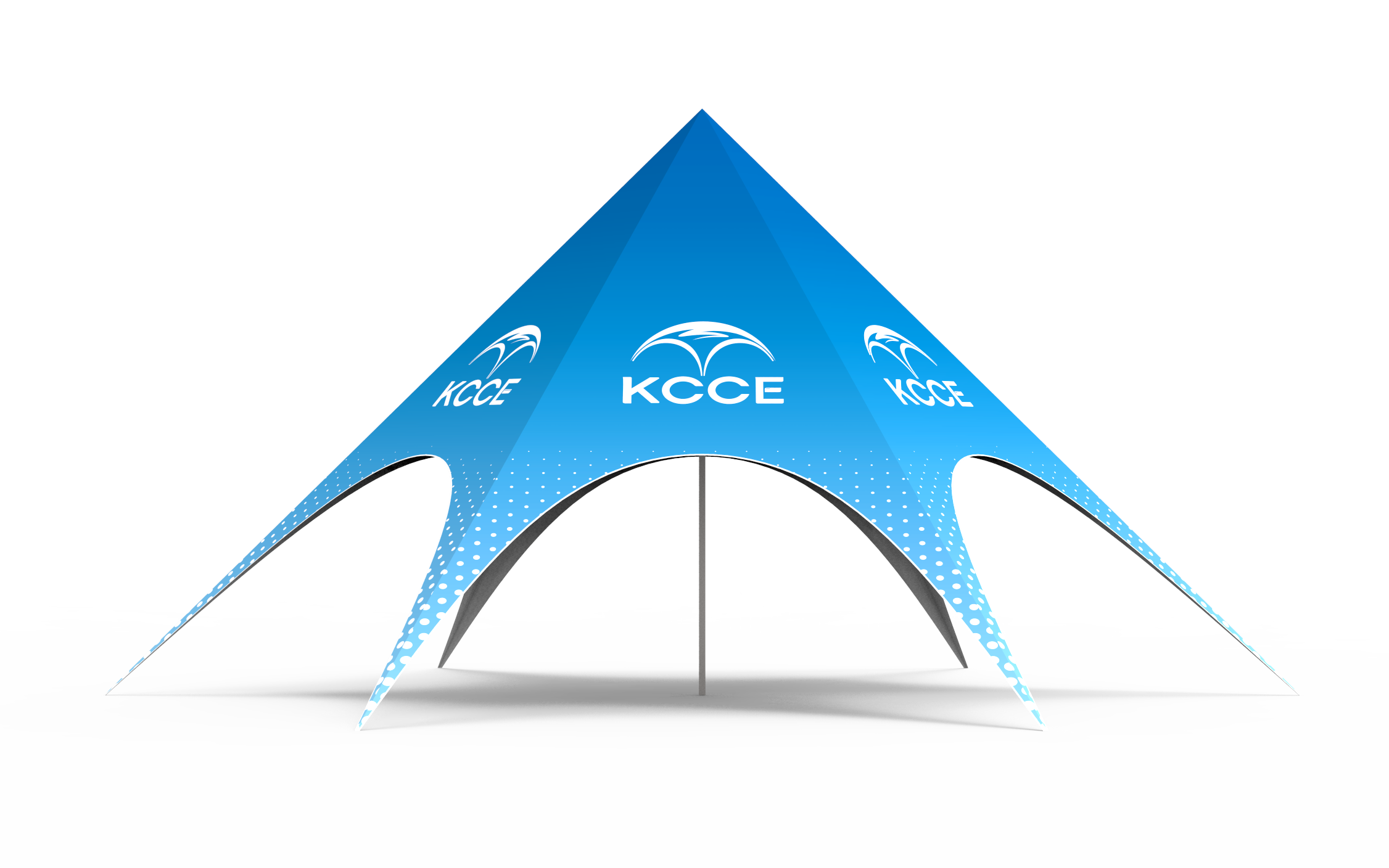
Star-shaped tents — multi-point promotional structures, usually custom-printed, used for brand activations. $2,000–$6,000 depending on span.
Ask for the packed weight and inflation point count on each. A “6x6m tent” from two suppliers can differ by 40kg and three inflation valves — that’s the difference between a 10-minute setup and a 25-minute one.
Key Materials and Manufacturing Processes
The shell is almost always Oxford polyester with a PVC or PU coating, or PVC-coated tarpaulin for heavier models. Coating weight matters more than fabric denier: A certain fabric weight is often considered standard for rental-grade tents, while a lighter weight is entry level.
Air tightness comes from the welding method. High-frequency (RF) welding fuses PVC layers at the molecular level and is the industry benchmark; hot-air welding is second; stitched-and-taped seams are the weakest and most common on cheap imports. Ask for a 24-hour pressure-hold test result — a good tent loses minimal pressure in 24 hours.
Weather resistance is rated by UV exposure and temperature range. Look for UV-stabilized coatings rated for 2,000+ hours (roughly 3–5 years of outdoor use) and operating ranges of -20°C to +70°C. Flame retardancy should meet NFPA 701 (US), EN 13501-1 B-s1,d0 (EU), or CPAI-84 for camping tents. Certificates should carry a test report number, not just a logo.
Typical Applications for Inflatable Tents
The application drives the spec more than anything else.
Emergency response — shelters for displaced populations, typically 4x5m to 6x8m, requiring rapid deployment and often UNHCR or IFRC spec compliance (e.g. 0.45mm PVC, 3-year minimum lifespan).
Military — command posts, field hospitals, and decontamination units. Specs often reference MIL-PRF standards, with blackout liners and EMI shielding options.
การแพทย์ — negative-pressure isolation tents and triage shelters. These need HEPA filtration ports and airtight zipper entries, usually certified to ISO 13485 supply chains.
Industrial — temporary workshops, sandblasting enclosures, and hazardous-material containment. Often custom-sized with ventilation duct ports.
Events and activations — branded domes, exhibition halls, and VIP structures. Print quality and structural span drive the spec.
露营 — consumer-grade inflatables, 2–8 person, typically 150D–300D polyester, CPAI-84 compliant, $80–$400 retail.
A tent specced for a wedding will fail as a field hospital. Match the application to the certification before you match it to the price.
How to Choose a Reliable Inflatable Tent Manufacturer
Quality, price, customization, and after-sales — in that order, but weighted by your market.
คุณภาพ — demand the welding method, fabric weight in g/m², valve brand, and a pressure-hold test report. A manufacturer who can’t produce these three documents in 48 hours is a trader.
价格 — FOB China for a 5x5m double-skin tent is often quoted in a certain range; the same spec from a UK or US supplier typically runs higher. The gap is labor and compliance overhead, not necessarily quality.
การปรับแต่ง — real factories offer custom sizing, printing, and valve placement at MOQ 1–10 pieces. Trading companies route these through a third party and add a markup.
After-sales — ask for the warranty terms in writing: what’s covered (seam failure, valve defects), what voids it (UV damage, improper storage), and the spare parts lead time. A 12-month warranty with 7-day spare parts shipping beats a 24-month warranty with a 6-week wait.
Run one sample order before a bulk commitment. It costs $200–$500 and tells you more than any brochure.
The Complete Inflatable Tent Procurement Guide
Here’s the process I actually run, step by step.
1. Requirements analysis (week 1). Define size, application, certification, quantity, and target landed cost. Write it down — this becomes your RFQ.
2. Supplier shortlist (week 1–2). Source 8–12 candidates from Alibaba, trade shows (Canton Fair, IAAPA), and industry referrals. Filter to 4–6 based on certification and MOQ.
3. RFQ and quote comparison (week 2–3). Send identical specs. Compare FOB price, lead time, warranty, and payment terms side by side. Flag any quote more than 20% below the median — it usually means thinner fabric or stitched seams.
4. Sample order (week 3–6). Order one unit. Inspect fabric weight with a scale, test inflation time, and run a 24-hour pressure hold.
5. Factory audit (week 5–7). Either visit or hire a third-party inspector (SGS, Bureau Veritas, at a typical cost). Check welding machines, QC logs, and export records.
6. Contract and deposit (week 7). 30% deposit standard; never pay 100% upfront. Specify Incoterms (FOB, CIF, or DDP), inspection rights, and penalty clauses for late delivery.
7. Production and pre-shipment inspection (week 8–12). AQL 2.5 inspection before balance payment.
8. Logistics (week 12–15). Sea freight for bulk (25–35 days), air for samples (5–8 days). Confirm HS code (6306.22 for tents) and destination duties before shipping.
TCO and ROI Analysis for Inflatable Tents
Purchase price is roughly 40–50% of true cost. Here’s a rental-fleet example for a 5x5m tent.
| Cost Item | Amount |
|---|---|
| Purchase price | $600 |
| Freight and duties | $120 |
| Pump and accessories | $80 |
| Annual maintenance (patches, valves) | $40/yr |
| Storage and handling | $30/yr |
| Replacement after 4 years | $600 |
4-year TCO: ~$1,080, or $270/year. At an illustrative rental rate and event frequency, gross revenue can be estimated — payback may be in under a few months, with ROI potentially well above 400%. over the tent’s life.
The variables that wreck ROI: cheap fabric that fails in year 1 (doubles replacement cost), missing certifications that block venue access (zero revenue), and slow spare-parts shipping (idle fleet). Buy on TCO, not unit price.
2026 Industry Trends and Technical Innovation
Three shifts are worth watching.
Recycled and bio-based fabrics. Several EU suppliers are moving to rPET Oxford (recycled polyester) with TPU coatings, cutting embodied carbon 30–40%. Expect price premiums in the coming years before scale brings them down.
Smart inflation systems. Integrated pressure sensors with auto top-up pumps are appearing on mid-to-high-end models. A sensor that triggers the pump at a set pressure keeps the tent rigid without manual checks — useful for multi-day deployments.
Modular and hybrid structures. Air beams combined with aluminum ridge poles are closing the wind-performance gap, pushing inflatable ratings toward higher wind speeds.
Digital compliance. QR-coded certification labels linking to test reports are becoming standard for EU and US venue acceptance, cutting the document-verification friction that slows procurement.
Ask any supplier what percentage of their 2025 output used recycled content. The answer tells you whether they’re tracking the market or selling last year’s catalog.
常见问题解答
Q: Who is the best blow up tent manufacturer?
答: There’s no universal winner — it depends on your market. For cost and customization, Chinese factories like KCCE offer MOQs from 1 piece with CE and RoHS compliance. For fast domestic delivery and NFPA 701 compliance, US suppliers win. UK manufacturers like Airquee and Blofield sit in the middle. Match the manufacturer to your compliance needs, not just your budget.
Q: Are blow up tents durable for commercial use?
答: Yes, if you buy the right spec. PVC commercial inflatable tents with heat-welded seams typically last 5–8 years in rental use. Oxford fabric is lighter but shorter-lived. The two biggest durability killers are UV exposure and improper storage — both are preventable with UV-resistant coatings and dry, clean packing.
Q: Where are blow up tents manufactured?
答: China produces the vast majority of the world’s inflatable tents, with major clusters in Guangdong province. The UK has a solid manufacturing base for events-grade units. US-domestic production exists but is limited, which is why many “American” suppliers are actually importers with local warehouses.
Q: Can you customize a blow up tent?
答: Almost always. Custom blow up tents typically cover full-color printing, custom dimensions, and structural changes like arches or enclosed walls. Most factories require a design file and a sample approval before production. Be aware that size increases don’t scale linearly in cost — expect a steeper price curve than you’d guess.
Q: Who makes the best blow up tents?
答: The honest answer is that “best” depends on your use case. For rental fleets, durability and repairability matter most. For trade shows, print quality and setup speed win. For camping, weight and pack size dominate. Rank your priorities first, then match the manufacturer — don’t start with brand names.
Q: Who are the top 10 tent manufacturers?
答: The inflatable tent space doesn’t have a clean top-10 list the way traditional pole tent manufacturing does. The recognized names include KCCE (Dongguan Dacheng), Airquee, Blofield Inflatables, and Landmark Creations, alongside numerous regional OEMs. Most “top 10” lists you’ll find online mix pole tents and inflatables, which makes them nearly useless for inflatable buyers.
Q: Are blowup tents any good?
答: For commercial and event use, absolutely — they set up in minutes with an electric pump, pack down small, and handle branding better than pole tents. For backpacking, they’re heavier than traditional tents, which is the main complaint. Match the type to the job and they perform well.
Q: Who sells blow up tents?
答: You can buy direct from manufacturers, through wholesale platforms, or from regional distributors. Buying direct usually gets you better pricing and full customization, but requires more vetting. Distributors cost more but handle logistics and local compliance. For wholesale orders, going factory-direct is almost always cheaper at volume.
บทสรุป
Here’s the insight that took me years to fully appreciate: the cheapest quote almost never wins. It wins the purchase order, then loses you money on replacements, downtime, and unhappy clients. Vet certifications first, price second.
Your next step is simple. Shortlist three suppliers, request samples and certificate numbers, and compare them side by side before you commit. And ask yourself one question — does your current supplier show pricing upfront, or are you still waiting on a quote?
อ้างอิง
1. Blow (film) – en.wikipedia.org
2. Blow (2001) – imdb.com
3. Frederic C. Blow | Faculty – medschool.umich.edu
4. How Do I Become a Blow-Dry Stylist? – dial.iowa.gov