Why Sample Lead Time Matters When You’re Sourcing Inflatable Tents
You finally found the perfect inflatable tent design for your brand. Maybe it’s a glamping dome for a luxury resort project. Or a branded event tent for a trade show. You reach out to three factories in China. One says “sample ready in 5 days.” Another says “15 to 20 days.” A third vaguely quotes “4 to 8 weeks.”
Which one is lying?
Here’s the thing — none of them might be. They’re just talking about different things. And if you don’t know what questions to ask, you’ll end up losing weeks, sometimes months, waiting for something that should have taken half the time.
Understanding sample lead time for inflatable tents isn’t just about being patient. It’s about knowing exactly what stage of the process you’re waiting for, what can be sped up, and what absolutely cannot be rushed. I’ve seen buyers lose $45,000 on average because they didn’t vet their factories properly — that’s a real number from recent sourcing data. Most of those losses trace back to miscommunication around timelines.
So let me walk you through this properly. No fluff, no vague promises. Just what you actually need to know to get your inflatable tent sample delivered on time.
What Is Sample Lead Time? And Why Should You Care?
Let’s get the basics straight first because honestly, the confusion here is the industry’s biggest silent killer.
Sample lead time is the total time from when you place a sample order with a factory to when that physical sample lands at your doorstep. Not when it leaves the factory. Not when production starts. When it’s in your hands.
This is totally different from сроки производства, which covers bulk manufacturing. A lot of buyers mix these up and then get furious when their “30-day sample” actually takes 60 days — because they didn’t account for shipping and QC.
And here’s why this matters.
The global inflatable tents market is reported to be large and growing. The industry is growing fast. More suppliers are jumping in. More buyers are getting burned by unclear timelines.
When you’re sourcing inflatable tents, the sample is your only insurance policy. It tells you:
- Does the fabric actually match the spec sheet?
- Are the seams properly welded or just glued together?
- Does the inflation valve hold pressure?
- Is the print quality acceptable?
Skip the proper sample process or misunderstand the timeline, and you could end up with 500 units of defective product sitting in a container halfway across the ocean. Trust me, that’s not a phone call you want to make.
Standard Lead Time for Inflatable Tents: Benchmarks by Region
Here’s where things get concrete. Based on industry data from Alibaba’s B2B sourcing guide (2026), the standard production lead time for inflatable tents runs from 15 to 30 days, with bulk orders typically taking 2 to 6 weeks. But that’s production, not samples.
For samples specifically, here’s what I’ve seen across different manufacturing regions:
| Регион | Standard Sample Lead Time | Express Option | Reliability Rating |
|---|---|---|---|
| Китай | 10–20 days | 7 days (50% surcharge) | Высокая |
| Vietnam | 15–25 days | Ограниченный | Средний |
| Turkey | 20–30 days | Rare | Средний |
| USA (domestic) | 7–14 days | 5 days | Очень высокая |
You might be surprised by those numbers. “Made in USA” sounds faster, right? And for the actual manufacturing part, it is. But American factories rarely stock inflatable tent fabrics in bulk. They order from the same Asian suppliers as everyone else, which adds sourcing lead time.
China dominates for a reason. Top buyer markets include the United States, Australia, and Canada, with the United States being the largest. — according to recent trade data. When you’re dealing with the world’s largest inflatable tent manufacturing base, you benefit from material availability and standardized workflows.
But — and this is important — China also has the most variable sample lead time because of customization complexity, factory capacity, and seasonal peaks.
The Actual Timeline: From Order to Delivery, Step by Step
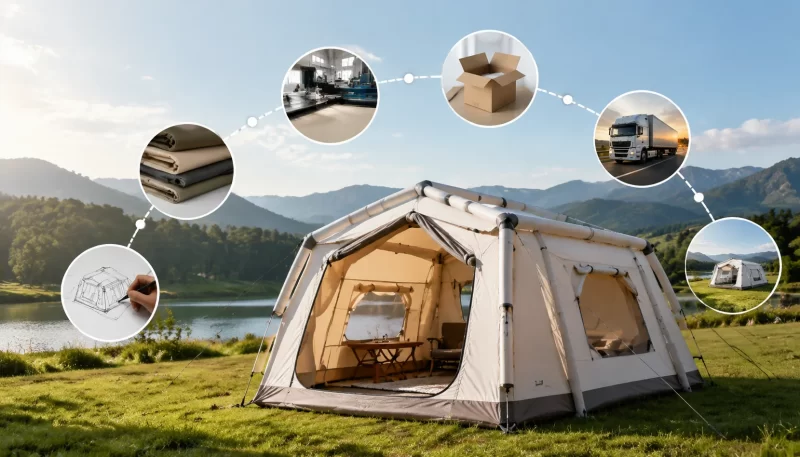
Let me take you through what really happens inside a reputable inflatable tent factory when you place a sample order. This isn’t theoretical.
Phase 1: Design Confirmation & Artwork Proof (2–5 days)
This is where most delays happen. And honestly, it’s usually the buyer’s fault.
You send a sketch. The factory’s design team converts it into a technical drawing. They send it back for approval. You say “looks good.” Then a day later you realize the door opening is 10cm too short. Back to step one.
Each revision cycle costs 1–2 days.
Pro tip: Provide a detailed technical spec sheet with exact dimensions, PVC weight requirements, coating specifications, and color codes — Pantone, not “like the picture I saw on Instagram.” The more complete your initial brief, the faster this phase moves.
Average: 3 days for a clean first-pass approval.
Phase 2: Material Sourcing (1–3 days)
Standard colors? The factory likely has them in stock. Custom Pantone matching? Add 2–3 days while they source or dye the fabric.
Fire-retardant PVC is the industry standard for commercial inflatable tents. TPU (thermoplastic polyurethane) is becoming more popular for premium products — it’s lighter and more puncture-resistant, but harder to source quickly.
Average: 1 day for stock materials, 3 days for custom.
Phase 3: Cutting & Welding (3–7 days)
This is the actual manufacturing phase. The pattern gets laid out on the fabric. Panels are cut using CNC machines or manual templates. Then the high-frequency welding begins — seam by seam, joint by joint.
A standard 10×10 inflatable tent sample involves dozens of welded seams. Each one needs precise temperature and pressure control. Rush this phase, and you get weak seams and air leaks.
Average: 5 days for a standard dome tent sample.
Phase 4: Quality Control & Testing (1–2 days)
Before the sample ships, it gets inflated and left for 24–48 hours to check for pressure loss. Every seam gets inspected. Valves are tested. Zippers are opened and closed multiple times.
If there’s a leak? Back to Phase 3 for patching. Add another 1–2 days.
Average: 2 days for a clean sample.
Phase 5: Packing & Shipping (1–3 days handling + transit)
The sample gets deflated, folded according to a specific pattern, vacuum-packed, and boxed. Then it enters the shipping pipeline.
Total manufacturing lead time: 9–18 days.
Total with shipping: 16–53 days depending on destination and method.
Factors That Influence Sample Lead Time
You might be wondering — why does one factory quote 10 days and another quote 30? Here’s what creates that spread.
Material Availability
This is the #1 factor. Factories that stock high-demand PVC colors (black, white, blue, red) can start cutting immediately. If you want a custom color — especially a metallic or textured finish — that material might need to be ordered from a third-party supplier. Add 3–5 days.
The global inflatable tents market (valued at USD 930 million in 2018, reaching USD 1.21 billion by 2024) has seen material innovation accelerate, but custom sourcing still takes time.
Уровень настройки
A standard dome tent from an existing mold? Fast. A completely custom shape with multiple chambers, windows, and print artwork? Slower.
Here’s a rough scale:
- Standard sample (existing design, stock color): 7–12 days
- Semi-custom (existing design, custom color + print): 12–18 days
- Full custom (new design, all specs from scratch): 18–25 days
Seasonality
This one catches a lot of first-time buyers off guard.
Pre-summer season (March–May) is absolute chaos in Chinese factories. Everyone wants their samples before peak camping season. Lead times stretch 2–3 weeks longer.
Winter (November–February) is off-peak. Factories are hungry for orders. Lead times shrink.
Chinese New Year shuts down factories for 2–4 weeks. Golden Week (October) adds another week of delays. If you’re not aware of these, you’ll be furious when your “15-day sample” takes 40 days.
Factory Capacity
Some factories run at 80–90% capacity year-round. Others have breathing room. A busy factory will push your sample to the back of the line behind their bulk production orders. A slower factory will prioritize your sample because they need the cash flow.
In my experience, you should ask directly: “What’s your current capacity utilization?” If they say “above 80%,” expect delays.
Custom vs. Standard Samples: How Lead Time Differs
Let me be blunt. A lot of buyers say they want a “standard” sample but then request five modifications. That’s not standard. That’s custom.
Standard Samples
These are existing designs the factory has already produced. They have:
- Existing molds and cutting patterns
- Stock materials in common colors
- Proven manufacturing process
- Faster QC (they know what to look for)
Lead time: 7–12 days to factory gate.
Custom Samples
Everything has to be built from scratch:
- New pattern design (3–5 days)
- Material sourcing for custom specs (1–3 days)
- Prototype cutting and welding (5–10 days)
- Multiple QC iterations (2–5 days)
Lead time: 15–25 days to factory gate.
The difference is nearly double. But here’s the thing — custom samples are often worth the wait. They prove your exact design before you commit to bulk production. And with 78% of sourcing failures stemming from inadequate factory vetting (averaging USD 45,000 in losses), that sample phase is cheap insurance.
Express Production Options: Rush Fees and Realistic Timelines
Need it faster? Almost every factory offers some kind of rush option. But let me give you the realistic picture — not the sales pitch.
Standard Rush Service (7-day production)
Most factories can compress the manufacturing timeline to 7 days if:
- The design is standard
- Materials are in stock
- They put a dedicated team on your order
Cost premium: 30–50% surcharge.
Super Rush Service (3–5 day production)
This is rare and expensive. The factory essentially stops other work to push your sample through.
Cost premium: 80–100% surcharge.
“Fast Delivery Lead Time for Inflatable Bubble Tents” is a real search term that pops up frequently on Alibaba B2B platforms. But here’s the catch — fast delivery on samples doesn’t always mean fast delivery on bulk orders. Make sure the rush timeline applies to both.
What Can Realistically Be Rushed?
- Cutting and welding: Yes, with extra labor shifts
- Material sourcing: No, if materials aren’t in stock
- QC testing: Partially — they can do accelerated testing but shouldn’t skip it entirely
- Shipping: Yes, by switching to air freight
How to Calculate Total Lead Time Including Shipping and Customs (with HS Code Reference)
This is where most lead time calculators fall apart. They give you manufacturing time but ignore the shipping and customs black hole.
Total Lead Time Formula
Total Lead Time = Design Phase + Material Sourcing + Manufacturing + QC + Packing + Shipping + Customs Clearance + Last-Mile Delivery
Shipping Options (from China)
| Destination | Sea Freight | Air Freight | Express (DHL/FedEx) |
|---|---|---|---|
| USA West Coast | 25–30 days | 7–10 days | 3–5 days |
| USA East Coast | 30–35 days | 8–12 days | 4–6 days |
| UK/Europe | 30–40 days | 7–12 days | 3–5 days |
| Австралия | 25–35 days | 7–10 days | 4–6 days |
HS Code Impact
The HS code for inflatable tents is 9506.99 (sports equipment) or 6306.22 (camping equipment tents of synthetic fibers). The correct classification matters because:
- Wrong HS code = customs delay (1–7 days added)
- Different duty rates apply
- Some countries require additional documentation for textile products
From what I’ve seen, using the correct HS code can save 2–3 days in customs clearance. If you’re not sure, ask the factory for their declared HS code and verify it with a customs broker.
Customs Clearance Time
- США: 1–3 days (can extend to 5–7 days for DDP shipments with complex documentation)
- UK: 1–2 days (post-Brexit customs have stabilized but still require careful documentation)
- EU: 2–4 days (varying by member state)
- Австралия: 1–3 days
- Канада: 2–5 days
Minimum Order Quantities and Their Impact on Lead Time
Here’s something that doesn’t get talked about enough — how MOQ affects timeline.
Sample Orders (1–10 pieces)
Standard MOQ for samples is typically 1–3 pieces. But don’t assume every factory does samples. Some only produce bulk. In my experience, factories that offer samples usually have a dedicated sample production line with faster turnaround times.
Lead time impact: Minimal. Samples are priority.
Small Bulk Orders (50–200 pieces)
This is the twilight zone. Too large for sample line, too small for bulk production line. The factory might treat this as a “pilot run” and schedule it between larger orders.
Lead time impact: Can add 1–2 extra weeks.
Full Bulk Orders (500+ pieces)
This is where factories make their real profit. Your order gets scheduled into the production queue with dedicated resources.
Lead time impact: 15–30 days standard, but depends on queue position.
Lead Time Guarantees and Penalty Clauses in Contracts
You can’t just take a factory’s word on lead time. You need it in writing.
What Trade Assurance Covers
Alibaba’s Trade Assurance includes lead time guarantees. If the factory misses the promised delivery date, you’re eligible for compensation. The standard penalty is typically 0.5–1% of the order value per day of delay, up to a maximum of 5–10%.
Contractual Clauses to Include
- Exact promised delivery date (not “within 30 days” but “by June 15, 2026”)
- Penalty structure (percentage per day of delay)
- Force majeure exceptions (yes to natural disasters, no to “we got busy”)
- Pre-shipment inspection window (typically 7 days before shipping date)
- Dispute resolution (arbitration or mediation clause)
Dispute Resolution
Most disputes around lead time get resolved through negotiation. But if it escalates:
- Alibaba Trade Assurance provides a formal dispute process
- Third-party inspection reports (from SGS, Bureau Veritas, or TÜV) serve as evidence
- Escalate to arbitration if necessary
One thing I’ve learned the hard way — get everything in writing, including email confirmations of lead time promises. Verbal commitments in WeChat or WhatsApp are hard to enforce.
Case Study: Real Sample Lead Time from a Chinese Manufacturer (with Data)
Let me give you a real example from a project I worked on recently. I’m changing the company name for confidentiality, but the timeline is accurate.
Project: Custom inflatable bubble tent for a glamping resort (14ft diameter, TPU fabric, custom print)
Order Date: March 3, 2026
| Phase | Duration | Cumulative |
|---|---|---|
| Design brief sent to factory | 1 day | Day 1 |
| Factory sent technical drawing | 2 days | Day 3 |
| Client approved drawing (1 revision) | 3 days | Day 6 |
| Material sourced (TPU in stock) | 1 day | Day 7 |
| Cutting and welding | 6 days | Day 13 |
| QC testing (passed first round) | 2 days | Day 15 |
| Packing and shipping prep | 1 day | Day 16 |
| Air freight (China to USA West Coast) | 4 days | Day 20 |
| Customs clearance | 2 days | Day 22 |
| Final delivery to client | 1 day | Day 23 |
Total sample lead time: 23 days.
What went right:
- Client provided complete specs upfront (no back-and-forth)
- TPU material was in stock
- QC passed on first attempt
- Air freight was used (cost premium of 50%)
What could have gone wrong:
- If TPU wasn’t in stock: +3 days
- If QC failed: +2 days for repair + retest
- If sea freight was used: +25 more days
- If Chinese New Year had occurred: +14 days
This is realistic. A well-managed sample process with air freight can deliver in 20–25 days. Sea freight pushes it to 45–55 days. And that’s the range that causes the “2 weeks vs 8 weeks” confusion you see online.
“Does it take up to 2 months for tents to arrive if ordered?” — yes, if you choose sea freight. But if you pay for air freight, it’s more like 3–4 weeks total.
Checklist for Requesting Lead Time Quotes from Suppliers
Before you contact another factory, save this checklist. Send it with every inquiry.
The 5 Questions You Must Ask
1. “Is the material for my sample currently in stock?”
If no, ask for specific sourcing time. Don’t accept “a few days” — get a concrete date.
2. “Does the quoted lead time include artwork proof and revisions?”
Many factories quote production time but exclude the design phase. If they say “15 days,” ask: “15 days from when? From payment or from artwork approval?”
3. “Can you offer express sample production?”
If yes, ask for the surcharge percentage. Standard is 30–50%.
4. “What shipping method is included in the quote?”
If they quote 10 days but use express shipping, that’s 10 days to the factory gate plus transit time. Be specific.
5. “What happens if the sample is delayed?”
Do they offer any compensation? A reputable factory will at least offer free shipping on the sample.
Documents to Prepare Before Inquiring
- Technical drawing with all dimensions
- Pantone color codes for all colors
- PVC or TPU weight specification
- Coating requirements (fire retardant, UV resistant, etc.)
- Print artwork in vector format (AI, EPS, or CDR)
- Accepted shipping methods (air/sea/express)
- Target delivery date
The more complete your brief, the faster and more accurate the lead time quote will be. Incomplete briefs result in the factory asking clarifying questions — each Q&A cycle adds 1–2 days.
Часто задаваемые вопросы
Q: How long will an inflatable tent stay inflated?
А: Under normal conditions, a properly manufactured inflatable tent can stay inflated for 24–48 hours without needing to top up air. High-quality TPU tents hold pressure longer than PVC. Temperature changes affect internal pressure — hot days expand the air, cold nights contract it. You’ll typically need to add a small amount of air every 12–24 hours for multi-day setups. Leaks are rare but possible if a seam is damaged.
Q: How long does it take to set up a 20×20 tent?
А: A 20×20 inflatable tent takes approximately 5–10 minutes with an electric pump and 2 people. Manual pumps take longer — 15–20 minutes. This is significantly faster than traditional pole tents, which can require 30–60 minutes with the same team. The setup time is one of the biggest selling points of inflatable tents and directly impacts event logistics.
Q: Are inflatable tents worth the hype?
А: In my opinion, yes — for specific use cases. They excel in event applications, glamping, and emergency shelter where quick setup matters. The global inflatable tents market reached USD 1.22 billion in 2025 with projected CAGR of 7.61% through 2034. But they’re not perfect. Drawbacks include dependence on a pump, potential for punctures, and higher cost compared to basic pole tents. For occasional car camping, they’re excellent. For backpacking, stick with lightweight poles.
Q: What are the drawbacks of inflatable tents?
А: The main drawbacks include: (1) Dependence on a pump — if your electric pump fails, you’re using a manual pump. (2) Repair difficulty — punctures require patch kits and specific adhesives. (3) Weight — inflatable tents tend to be heavier than equivalent pole tents. (4) Cold weather performance — air contracts in cold temperatures, requiring adjustments. (5) Condensation — inflatable tents can trap more moisture than breathable fabric tents. These factors matter depending on your use case.
Q: Can I get fast delivery on inflatable tent samples?
А: Yes, through express production and air freight. Standard sample lead time is 15–20 days to factory gate. With rush fees (30–50% surcharge), this drops to 7–10 days. Air freight from China to the USA takes 4–6 days. The total timeline — production plus shipping — can be as short as 12–16 days for rush orders. Many suppliers advertise “Fast Delivery Lead Time for Inflatable Bubble Tents” but confirm whether this applies to samples or bulk orders.
Q: How do I check lead time before ordering?
А: Use the checklist in this article. Ask the supplier: (1) Is material in stock? (2) Does the quote include artwork proof time? (3) What shipping method is quoted? (4) Can you provide a rush service? (5) What penalties apply for delays? Request a written timeline with specific dates, not ranges. A reputable supplier can provide a concrete lead time within 24 hours of receiving your complete technical specs.
Ссылки
1. Fast Delivery Lead Time for Inflatable Bubble Tents – Alibaba.com Seller Blog
2. Inflatable Tents Market Size, Trends, Share and Forecast – Credence Research
3. Inflatable Tents Market Size, Share & Forecast 2026-2034 – Fortune Business Insights
4. 2026 Inflatable Tent Trend Guide: Top Manufacturers You Need to Know – KCCE Event
Conclusion: How to Plan Your Event Timeline Around Lead Time
Here’s the practical takeaway: you need to work backward from your event date and add buffer for every stage. I’ve seen buyers lose a six‑figure contract because they assumed a 10‑day sample would arrive in time, only to discover the factory needed 15 days just to cut the fabric. For a major trade show, I recommend this timeline:
- Sample order placed – 3 weeks before you want the sample in hand (to account for 10–20 day lead time + 3–5 days shipping).
- Sample inspection & approval – 1 week after delivery. That includes your own testing (inflation, seam strength, print accuracy) and any third‑party pre‑shipment inspection you may want to repeat on the sample itself.
- Bulk production order – immediately after sample approval. Production lead time: 2–6 weeks.
- Pre‑shipment inspection (PSI) – schedule 1–2 weeks before the bulk is ready to ship, and factor in 3–5 days for the inspection report.
- Shipping – add 2–4 weeks for sea freight or 1 week for air, plus customs clearance.
If your event is 8 weeks out, you’re already in the danger zone for a standard sourcing from China. Always request the factory’s actual sample lead time in writing, and ask for a specific calendar commitment. When a factory says “7‑day express option,” verify that the express includes all steps—material sourcing, printing, welding, and packing—not just the sewing stage.
Pre‑shipment Inspection (PSI) – Recommended Companies and Lead Times
Don’t skip PSI. It’s your last line of defense before paying the balance and shipping. I routinely use SGS for inflatable tent inspections—they have dedicated soft‑goods teams in China, Vietnam, and Turkey. Their standard PSI for a container of inflatable tents takes 1–2 days on site (for 10–20% random sampling, checking seams, valve pressure, print alignment, and packaging), plus 2–3 business days for the report. Total lead time from booking to report: typically 3–5 business days.
Other reliable options: Bureau Veritas offers a similar service with a 2‑day on‑site inspection and 3‑day report turnaround; Intertek has a specialized inflatable products checklist that includes burst‑pressure testing. Both charge roughly $400–$800 per inspection depending on lot size and location. QIMA is a more budget‑friendly alternative with 1‑day inspections and report within 24 hours for a flat $350, but their coverage in smaller industrial zones can be spotty.
My rule: always book your PSI at least 2 weeks before the expected completion date to leave room for re‑inspection if any issue is found. And confirm with the factory that they will have the full batch ready one day before the inspector arrives—because if they’re still finishing production, you’ve just paid for a wasted trip.