I still remember the tent I bought before my first serious camping trip. It was cheap, it was heavy, and it collapsed at 2 AM when a surprise storm rolled through the valley. I spent the rest of the night in the car, watching my “shelter” flap around like a wounded bird. That experience cost me about a hundred bucks and a whole lot of dignity.
You might be wondering why I’m telling you this. Because that mistake is exactly why I’m such a firm believer in the advantages of using a dome tent. If I had known then what I know now, I would have saved myself the misery. Dome tents aren’t just the most common shape on the campsite—they’re the most proven, the most forgiving, and honestly, the smartest choice for the vast majority of campers.
This isn’t a fluff piece. I’ve spent years in the outdoor industry, and I’ve tested more shelters than I care to count. Below, I’m breaking down the real, data-backed reasons why dome tents dominate the market, where they fall short, and exactly how to pick the right one without getting ripped off.
Quick Answer
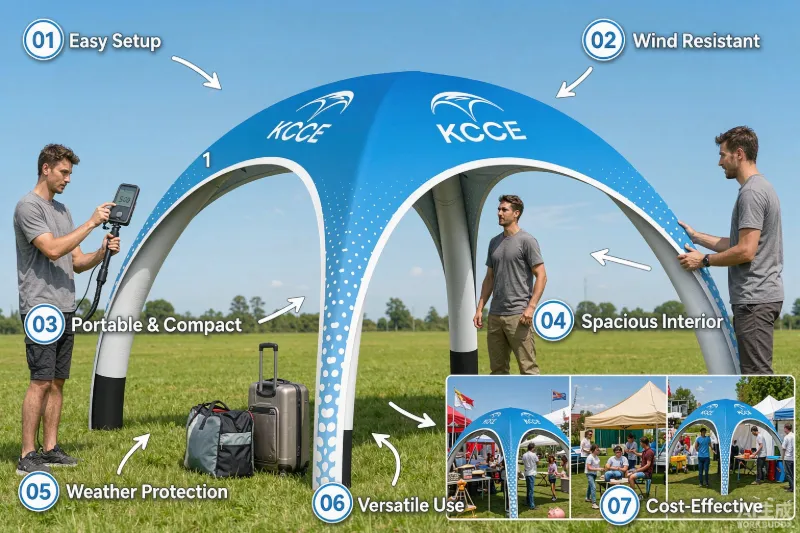
A dome tent uses two or more crossing poles to create a self-supporting, geometric arch that sheds wind and rain exceptionally well. Its advantages include superior wind resistance, fast setup times, lightweight packability, and a high strength-to-weight ratio, making it the best all-around choice for most camping scenarios.
What Is a Dome Tent? (Quick Definition)
Before we get into the weeds, let’s define the subject. A dome tent is a freestanding shelter characterized by poles that cross over the top of the structure, forming an arch or a hemisphere. Unlike cabin tents that rely on vertical walls and heavy frames, the dome relies on tension. The poles bend, the fabric stretches, and the whole thing becomes a single, unified structure that distributes stress evenly.
The design isn’t new. It’s been refined over decades. The basic geometry—a triangle or a series of triangles—is what gives the dome its incredible strength. When wind hits a flat wall, it pushes hard. When wind hits a curve, it flows around it. That’s physics, and it’s the foundation of every advantage we’re about to discuss.
When you search for the features of a dome tent, you’ll usually find a list that includes a rainfly, mesh panels, and a bathtub floor. But the defining feature is the pole structure. Most consumer domes use two to four poles. The more poles, the more complex the geometry, and the closer you get to a geodesic design—which we’ll touch on later.
Dome Tent Advantages: The 7 Core Benefits
Let’s get to the meat of this. If you’re weighing the pros of dome tents against other styles, these are the seven factors that matter most.
1. Superior Wind Resistance
This is the big one. Because of the curved shape, a dome tent deflects wind rather than catching it. In my experience, a well-staked dome with a low profile can handle gusts that would flatten a cabin tent instantly.
While specific mph ratings vary wildly by model and manufacturer, the structural advantage is undeniable. The geodesic variants of the dome—which use intersecting triangles—are the gold standard for expedition use. If you’re camping in exposed areas, this is the shape you want. We’ll dive deeper into the numbers in the comparison section below.
2. Fast and Intuitive Setup
Time is precious when you arrive at camp after a long drive. The dome tent setup process is famously simple. Most two-pole domes can be pitched by one person in a short time, and by two people in even less time.
I’ve timed myself. Solo, with a standard two-pole dome, I’m usually inside with a beer in a short time. There’s no confusion about which pole goes where—they cross in the middle, you clip the body, you stake the corners. Done. This simplicity is a huge part of why dome tents for camping remain the default rental and retail option.
3. Lightweight and Packable
For backpackers, weight is currency. Dome tents offer the best strength-to-weight ratio in the industry. Because the structure is based on tension rather than heavy frames, manufacturers can use thinner poles and lighter fabrics without sacrificing integrity.
This is why the dome tent is the undisputed king of the trail. If you’re looking for a dome tent for backpacking, you’ll find models that pack down smaller than a loaf of bread. That portability is a game-changer when every ounce counts.
4. Decent Headroom (For the Size)
Okay, let’s be realistic. A dome tent isn’t a ballroom. But the arching roof provides more usable vertical space than a tunnel tent of the same length. You can sit up in most models, which is more than you can say for some coffin-like bivy sacks.
The central peak is where the height lives. You won’t be standing up to change clothes, but you won’t be crawling on your belly either. For a balance of weight and comfort, the dome hits a sweet spot.
5. Excellent Value for Money
Walk into any outdoor retailer and look at the price tags. Dome tents are almost always cheaper than tunnel or cabin tents of equivalent quality. Why? Less material, simpler manufacturing, and massive economies of scale.
You can get a reliable, entry-level dome for a price that won’t make you wince. This affordability makes the advantages of using a dome tent accessible to everyone, from weekend warriors to seasoned pros.
6. Freestanding Versatility
Most dome tents are freestanding, meaning they hold their shape without stakes. This is a massive advantage. It means you can pick the tent up and move it to sweep the floor, or you can pitch it on a platform, on sand, or even on concrete (with weights).
This feature also makes them ideal for beach camping, where sand stakes are notoriously unreliable. You can load the corners with rocks or gear bags instead.
7. Easy to Repair and Maintain
When something breaks on a dome, it’s usually a single pole segment or a guyline. These are cheap and easy to replace. The simple geometry means there are fewer moving parts and fewer stress points that can fail catastrophically.
In contrast, repairing a complex cabin frame or a tunnel’s airbeam system often requires specialized parts and professional help. The dome is the workhorse of the tent world—it just keeps going.
Dome Tent vs Tunnel Tent: Key Differences
This is the classic debate. Both are excellent shelters, but they excel in different conditions. If you’re trying to decide between a dome vs tunnel tent, here’s the honest breakdown.
Tunnel tents are long, tube-like structures that rely on a series of hoops. They offer massive living space for their weight, which makes them popular for family campers and cyclists. However, their elongated shape is their Achilles’ heel.
Here’s where the dome tent wind resistance comes into play. A tunnel tent must be pitched into the wind. If the wind shifts and hits it broadside, it catches the wind like a sail. This is why tunnel tents must be guyed out meticulously. A dome, on the other hand, presents a similar profile from every direction. It doesn’t care which way the wind is blowing.
| Característica | Dome Tent | Tunnel Tent |
|---|---|---|
| Wind Stability | Excellent (omnidirectional) | Good (only when pitched head-on) |
| Interior Space | Moderado | Excellent (long, wide) |
| Peso | Low to Medium | Medium to High |
| Setup Complexity | Very Simple | Moderate (needs specific orientation) |
| Preço | Generally Lower | Generally Higher |
Minha opinião: For exposed, windy sites, the dome wins every single time. For a basecamp where you’re staying put and the weather is stable, a tunnel tent offers more luxury for the weight. But for all-around versatility, the dome is the safer bet.
Dome Tent vs Cabin vs Geodesic: Which Wins?
Now, let’s clarify the hierarchy. People often confuse a standard dome with a geodesic dome tent, and they wonder where cabin tents fit in.
Cabin tents are the RV of the tent world. They have near-vertical walls and tons of headroom. They’re fantastic for car camping with the family. But they are heavy, bulky, and terrible in the wind. A strong gust can snap poles or tear the fabric. They are for fair-weather camping in established campgrounds, not for storms.
Geodesic tents are the overachievers of the dome family. They use multiple intersecting poles to create a network of triangles that cover the entire structure. This distributes stress incredibly well, making them the only choice for high-altitude expeditions and winter camping. A dome tent for winter camping should ideally be a geodesic or semi-geodesic design.
So, which wins? It depends on the job:
- For storm-proofing: Geodesic tent > Standard Dome > Cabin.
- For living space: Cabin > Geodesic/Dome.
- For cost: Cabin is often cheaper per square foot, but Geodesic is the most expensive due to pole count.
If you’re buying your first tent or need a versatile three-season shelter, a standard dome is the right choice. Don’t overpay for a geodesic if you’re only camping in mild conditions. And don’t buy a cabin if you value your sleep during a windy night.
When to Choose a Dome Tent (Use Cases)
So, where does the dome shine? Let’s look at specific scenarios to answer the question of where to use a dome tent.
- Mochilão: This is the dome’s home turf. Lightweight, compact, and strong enough for ridge-line camping.
- Festivais: Setup speed is critical when you’re arriving late and leaving early. The dome’s simple pitch is perfect. Plus, they’re usually cheap enough that you won’t cry if they get damaged.
- Camping na Praia: The freestanding nature is a lifesaver in sand. You don’t need to rely on stakes that won’t hold.
- Camping Econômico: If you’re just starting out, the low entry price of a dome tent is unbeatable.
- Solo Trips: A small 1-2 person dome is the lightest and most efficient way to sleep outdoors.
When NOT to choose a dome:
Honestly, if you’re setting up a basecamp for a week with a large family, the lack of vertical walls in a standard dome gets old fast. You can’t stand up, and the sloping walls eat into usable floor space near the edges. For that specific need, a cabin tent or a large tunnel tent is more comfortable. Also, if you’re planning a serious winter expedition above the treeline, you should step up to a geodesic, not a standard dome.
What to Look For: Dome Tent Buying Guide
If you’re ready to buy, here’s what actually matters. Don’t get distracted by marketing buzzwords. Focus on these four things:
Pole Material
- Fiberglass: Cheap and heavy. It flexes, but it can splinter and break in cold weather. Fine for occasional car camping.
- Aluminum: The industry standard for quality. It’s lighter, stronger, and more durable than fiberglass. Look for 7000-series aluminum if you can.
Fabric Denier
This measures the thickness of the fabric. A higher denier (e.g., 68D or 75D) means a tougher, heavier fabric. A lower denier (e.g., 15D or 20D) is ultralight but requires more care. For many campers, a 40D to 75D polyester or nylon is often considered a good balance.
Waterproofing (Dome Tent Waterproof)
Look for the hydrostatic head rating. This is measured in millimeters (mm).
- 1,000mm: Light shower resistant. Not suitable for real rain.
- 1,500mm – 2,000mm: Good for most three-season camping.
- 3,000mm+: Excellent for heavy, sustained rain.
Also, check if the seams are taped. A dome tent rainfly that reaches the ground is crucial for keeping water out in a storm.
Ventilation
Condensation is the enemy of a good night’s sleep. You need mesh panels and a rainfly that can be staked out away from the inner tent. Look for vents at the top of the fly to let hot, moist air escape. Good dome tent ventilation is non-negotiable.
Price Tiers:
- Under $50: Expect a basic, heavy fiberglass dome. It will keep you dry in a light shower but will struggle in wind. It’s a fair-weather friend.
- $150 – $250: This is the sweet spot. You get aluminum poles, better fabric, and a design that can handle most weather. This is where I tell most people to start.
- $300+: You’re paying for ultralight materials or expedition-grade construction. You get the best weight-to-strength ratios, but you pay a premium for it.
If you’re planning large events or need a quick, stable shelter that isn’t for sleeping, you might also consider inflatable options. Companies like KCCE make barracas infláveis that set up in minutes without poles, which are fantastic for events and temporary staging areas, though they serve a different purpose than a backpacking dome.
Dome Tent Limitations: Honest Trade-Offs
I promised you an honest breakdown, so here it is. The dome isn’t perfect. Let’s talk about the downsides.
Headroom and Space
The sloping walls are the biggest complaint. You lose usable space near the edges. If you’re sitting up in the middle, it’s fine. But if you’re trying to sit against the wall to read, you’ll be hunched over. This is the trade-off for wind resistance.
Condensation
Because the shape is aerodynamic, it can sometimes suffer from poor airflow if you don’t set up the rainfly correctly. When you exhale, moisture rises. If it hits a cold rainfly and there’s no ventilation, it will rain on you from the inside. This is a common issue with dome tent condensation.
Mitigation: Always open the vents. Stake the rainfly out as wide as possible to create a gap between the fly and the inner tent. If it’s not raining, sleep with the fly off to let everything breathe.
Side-Wall Space
This ties back to headroom, but it’s worth mentioning. You can’t store gear upright against the walls. Everything has to lie flat on the floor, which can make the tent feel cramped with multiple people.
What About Inflatable Alternatives?
Before we wrap up, I want to touch on a modern twist. While the classic pole dome is fantastic, the industry has seen a rise in inflatable structures. If you’re dealing with event logistics, or you simply hate dealing with poles, an inflatable might be worth a look.
For example, KCCE offers a range of display frames e inflatable shapes that are used for branding and events. They also have a unique product called the Air Tight X Tent, which was developed back in 2008 and is designed to be completely airtight, waterproof, and bug-proof. You can read more about that specific design in their Air Tight X Tent Review. It’s a different beast than a standard camping dome, but it shows how the principles of tension and air pressure are being used to solve similar problems.
O Resultado Final
So, what’s the verdict? The advantages of using a dome tent are clear: they offer the best balance of wind resistance, weight, simplicity, and cost. They are the jack-of-all-trades that masters most of them. For the vast majority of campers—from first-timers to weekend regulars—the dome is simply the smartest choice.
Are there better tents for specific jobs? Sure. A cabin is more comfortable. A tunnel has more space. A geodesic is stronger. But the dome is the best all-rounder. It’s the tent I recommend to friends, the tent I grab for my own trips, and the tent that will probably serve you well for a decade.
Here’s the thought-provoking question I promised: What’s your priority—living space or storm-proofing? If you answered “storm-proofing,” you already know which tent to buy.
Your next step: Don’t overthink it. Set a budget, check the specs I outlined, and pick a dome from a reputable brand. Get out there and use it. The best gear is the gear you actually take camping.
Referências
1. What is Advantages of Using Dome Tents for Outdoor Events – GAXDome
2. Top 10 Benefits of Using a Hexagon Dome Tent for Camping – Luxo Tent
3. 6 Big Pros of Choosing an Event Dome Tent for Outdoor Events – Gaxtent
4. The Best Camping Tents of 2024 – OutdoorGearLab
5. Dome Tents vs. Tunnel Tents: Which is Right for You? – SectionHiker
Perguntas Frequentes
Here are the answers to the questions I get asked most often, straight from the search queries people use.
Q: What are the downsides of using a dome tent?
R: The main downsides are limited headroom and sloping walls that reduce usable floor space near the edges. They can also suffer from condensation if ventilation isn’t managed properly. Compared to cabin tents, they offer less livable space for their footprint, making them less ideal for long-term basecamp setups where you spend a lot of time inside.
Q: When should you use a dome tent?
R: You should use a dome tent for most three-season camping scenarios, especially when wind resistance and packability are priorities. They are ideal for backpacking, hiking, and general campsite use. If you’re camping in exposed areas, on the beach, or at a festival, the dome’s freestanding design and stable geometry make it a superior choice.
Q: What are the disadvantages of domes?
R: The disadvantages largely revolve around interior volume. The angled walls make it difficult to use the full floor area for sitting or storage. Additionally, a standard dome is not typically suited for extreme winter conditions or heavy snow loads; that requires a geodesic or expedition-grade design. They are a compromise between weight, space, and strength.
Q: How long do dome tents last?
R: With proper care, a good-quality dome tent is often reported to last several years of regular use. The lifespan depends heavily on fabric type, pole quality, and how well you maintain it. Ultralight tents with thin fabrics will wear out faster than heavier car-camping models. Always dry the tent before storing it to prevent mold and fabric degradation.
Q: Are dome tents good in wind?
R: Yes, this is one of their primary strengths. The curved shape deflects wind effectively, and a properly staked dome can handle substantial gusts. For extreme conditions, a geodesic dome tent offers even greater wind resistance due to its intersecting pole structure. Always orient the tent with the lowest profile facing the prevailing wind and use all guylines.
Q: How stable is a dome tent?
R: A dome tent is very stable because of its tension-based structure. The crossing poles create a rigid frame that distributes stress evenly across the whole structure. It doesn’t have flat walls for the wind to push against. However, stability depends on proper staking and guying out, especially in exposed locations.
Q: How long does a dome tent typically last?
A: With proper care—clean, dry storage and avoiding prolonged UV exposure—a quality dome tent from a reputable brand can last 5 to 10 years of regular seasonal use. Cheaper models may only hold up for a few seasons, while premium tents with heavier fabrics can last even longer.
Q: Can a dome tent withstand heavy rain and wind?
A: Yes, most dome tents handle moderate to heavy rain and wind well, especially if they have a full-coverage rainfly and guy-out points. For severe storms, a geodesic or expedition tent is stronger, but a well-pitched dome with taut guylines will comfortably survive a typical thunderstorm or windy night.
Q: Are dome tents easy to set up alone?
A: Absolutely. Most dome tents can be pitched solo in under 10 minutes, especially freestanding models. The two-pole crossing design is intuitive—lay the poles, insert them into the grommets, and clip the body. You don’t need a partner, though it helps with larger 6-person models.
Q: What’s the difference between a dome and a cabin tent?
A: Cabin tents have near-vertical walls and a flat ceiling, offering far more headroom and interior space—but they’re heavier, bulkier, and catch wind badly. Dome tents are lighter, more aerodynamic, quicker to pitch, and far more stable in wind. If you car-camp with lots of gear and prioritize comfort over portability, a cabin might suit you; otherwise, the dome wins.