

Inflatable Tent for a Car Dealership: Forecourt Display & Launch Events
A dealership lot is the most expensive advertising space the business owns, and most of it sits empty between the road and the showroom door. An inflatable tent turns one bay of it into a covered, printed pitch — up in a morning, weighted rather than staked, and packed away when the event ends. 20 years of manufacturing experience.

Quick Answer: What is an inflatable tent for a car dealership?
Een inflatable tent for a car dealership is a printed, self-standing structure a dealer pitches on its own lot — over a display bay, at a launch, at the test-drive collection point, over a handover bay or along the service lane. It stands on a welded TPU air tube inside an Oxford cloth cover, so there is no scaffold, no groundwork and nothing drilled into the tarmac: the legs are weighted with sand bags or water weights, and the whole unit packs into one bag when the event finishes. Because the canopy is the largest printable surface on the site, it carries the dealer group's name rather than the car marque's.
What a Dealership Actually Buys
A dealer does not buy a tent because the site needs shelter. The site already has a showroom, a workshop and a canopy over the fuel pumps. What the lot does not have is a printable surface at ground level, close to the road, that can be moved between jobs.
That is the gap an inflatable tent for a car dealership fills. It is a self-standing structure on a welded TPU tube inside an Oxford cloth cover: inflate it and it holds its own shape, with nothing to erect around it and nothing fixed to the ground. On a forecourt that matters twice — the surface is finished and often leased, so the fixing has to be weight rather than stakes, and the pitch has to come down again without leaving a mark that a landlord will photograph.
Compared with a pop-up gazebo, the difference is size and print. A gazebo covers a table; an inflatable canopy covers a car, or a car and the people standing round it, and the whole canopy takes print rather than just a front panel. Compared with a marquee, the difference is the crew: no frame sections, no ballast discussion with a hire company and no rigging certificate, which is why a car dealership inflatable tent gets used for one-day events that a marquee could never justify.
Wording varies more than the product does. A single-franchise site, a multi-marque group and a van centre all end up describing the same requirement, and an inflatable tent for auto dealership brief read by one dealer is usually the same document another would call an event canopy. What changes between them is the print and the surface, not the structure.
The other reason dealers keep one on site is the calendar. Registration plate changes, model-year launches, clearance weekends, manufacturer visit days and seasonal events all need a covered branded pitch at short notice, on a lot that cannot be dug up. The same unit covers a dealership forecourt bay on a Saturday and the delivery bay on the Monday, because what changes is the ground it sits on, not the structure.
When dealers compare suppliers, the questions that separate a supplier from a trading company are narrow and practical: which surfaces the legs can be weighted on, what fixing kit comes with the unit, how the print is proofed against the group's colour references, and whether a date is confirmed in writing rather than promised. A car dealer buying for one site and a group buying for six tend to ask the same four questions — which is why a custom inflatable tent for car dealership use is normally specified once and then repeated across sites as the campaign calendar rolls on.
Key Takeaways
- It is a printed structure pitched on the dealer's own lot — display bay, launch, check-in, handover bay or service lane.
- Legs are weighted with sand bags or water weights on tarmac and block paving; nothing is staked into a finished forecourt.
- The canopy is the largest printable surface on site, so it carries the dealer group's name rather than the franchise marque.
- KCCE builds the X, X6, XII, XL-A and XL-B ranges to order, with a minimum order of one unit.
Six Places a Dealer Uses One
Every one of these happens on ground the dealer already controls. An inflatable tent for dealership forecourt use is not brought in for a site — it is brought out of the store and pitched on the lot.
Forecourt Display Bay
The car nearest the road sells the rest of the lot. A tent over one display bay changes what a passing driver sees: a lit, covered pitch with the model and the finance headline on the canopy, instead of a car sitting in the open behind a row of others.
- One bay, one canopy
- Readable from the road
- Moves between bays
New Model Launch & Reveal
A launch evening needs a covered area before anyone stands in it. The tent holds the queue before the cover comes off, gives the car a frame in photographs, and gives the sales team somewhere to talk to people who arrive early.
- Queue shelter before reveal
- Photo backdrop
- Works after dark with lights
Test-Drive Check-In
Handing keys over in the open means paperwork in the wind and a customer standing in the rain while the car is brought round. A tent at the collection point gives the hand-over a desk, a seat and a place to wait that is not the showroom floor.
- Desk and seating
- Wet-weather handover
- Briefing point before drive
New-Car Handover Bay
The delivery photograph is the moment a customer posts about. A printed tent over the handover bay gives that photograph a clean, branded background instead of a workshop door and a wheelie bin.
- Clean photo background
- Keys and documents under cover
- Repeatable for every delivery
Weekend Sales & Clearance Events
A three-day event needs the structure up on Friday and down on Monday. Sealed models inflate once and hold, so the pitch stays standing through the weekend without a blower running all night.
- Up Friday, down Monday
- No overnight blower
- Same unit, next weekend
Service Drive & Collection Lane
Service customers arrive in the rain all year. A tent over the collection lane keeps the conversation about the invoice dry, and keeps the lane clear when two cars are handed back at the same time.
- Covered hand-back lane
- Two cars at once
- Year-round use
Models & Sizes for a Dealership Lot
Five KCCE models cover the footprints a car lot actually has. Every size below is the manufacturer specification for that model — nothing is rounded up. For an inflatable tent for car showroom frontage, the practical question is which footprint you repeat along the road; for a dealer running an auto show stand off-site, it is which model still fits in a van.
X Opblaasbare Tent

The short-cover option. Sizes from 3M to 8M with modular aluminium connectors, so one unit covers a single display bay or a small check-in desk without eating into the customer parking rows.
X6 Opblaasbare Tent

Five to eight metres on six air chambers. The wider footprint is the one that suits a featured car plus a barrier and a standing salesperson underneath at the same time.
XII Opblaasbare Tent

Four to ten metres with nine air chambers inflated in numbered order. This is the launch-night unit: it covers a vehicle on a turntable, the people standing around it and the roped edge next to it.
XL-A Opblaasbare Tent
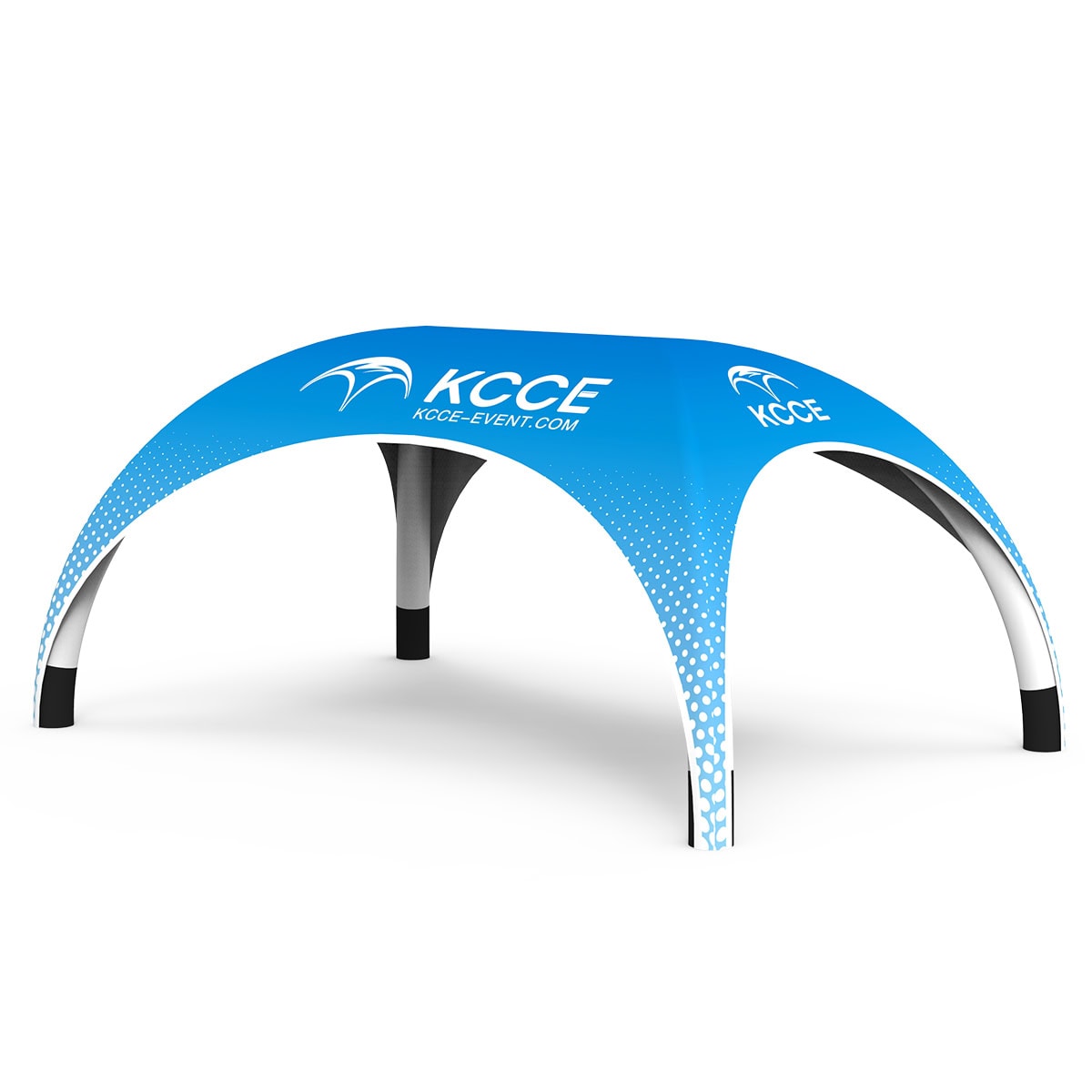
Rectangular sizes up to 7.5 by 4.8 metres, with wide and narrow awnings plus connecting cloth. Built for a line of units along a frontage rather than a single standalone pitch.
XL-B Opblaasbare Tent

Eight by 4.5 and 9.4 by 5.5 metres on a six-leg frame. The extra legs are what make it sit still on an open tarmac apron where there is nothing to tie back to.
Matching the Footprint to the Lot
Start from the job, then from the paint markings. A tent that straddles two bays costs you a parking space every day it stands. An inflatable tent for test drive event check-in and an inflatable tent for car handover bay usually come out at the same size: one car, one desk, and one person standing beside it.
Single display bay
A 3M to 4M unit covers one car and the person selling it. This is the size that fits between existing parking markings without a re-plan of the lot, so the display bay can go up and come down around normal trading.
Featured car plus barrier
5M to 6M gives room for the vehicle, a rope or barrier line and a standing conversation at the same time. If the car has its doors open for customers to sit in, take the larger end of that range.
Launch night with a crowd
8M to 10M, or two units joined with connecting cloth. Judge it by the number of people standing around the car at the peak moment, not by the car itself — the vehicle takes up far less floor than the queue watching it.
Row along the frontage
Two or more rectangular units in a line, joined with connecting cloth, read as one continuous branded frontage from the road. This is the arrangement that makes a small lot look larger than it is.
Fixed service-lane cover
The footprint here follows the lane, not the car: measure the width of the lane plus the walkway beside it, then pick the model that spans both. Tell us the lane width in the quote request and we match it to a size.
Dealer Branding & Print
Dealer signage is not free-form design — it usually sits inside a manufacturer's identity manual and a group's own guidelines at the same time. The print brief starts there, not at the colour wheel — and for an inflatable tent for car launch build it is written before the artwork is drawn, not after the proof comes back wrong.
Dealer name, not just the car brand
The canopy is the only surface on the lot that can carry the dealer group's name at the size of the building. Most dealer orders print the group name on the canopy and leave the franchise marque for the fascia, so the tent does not read as manufacturer signage.
Colour matching to the CI manual
Oxford cloth takes full-colour dye-sublimation printing. Send the CMYK or Pantone references from the brand manual and KCCE returns a proof before production — print on fabric never matches a screen, so the proof is the step that decides the colour.
Model and price messaging
A valance or a front panel is where the offer lives: model name, finance headline, event dates. Printed panels can be produced as separate pieces so next quarter's offer replaces a panel rather than the whole canopy.
Private label for dealer groups
A group buying for several sites, or a distributor reselling into dealerships, can order a white label inflatable tent for a car dealership with its own packaging and insert card. The private-label minimum order is 100 units, discussed against the artwork.
The Advertising Rules Around a Dealer Canopy
This is the section most tent suppliers cannot help with, and it is the one that sends a printed canopy back to the printer. Manufacturer co-op advertising programmes usually specify how the marque appears, how large it is relative to the dealer name, and which claims may not be made. Those rules apply to a printed canopy exactly as they apply to a press advert.
Get the identity rules before the artwork
Ask the manufacturer's marketing or co-op desk for the current identity and advertising rules for point-of-sale material first. Clear space around the marque, minimum size and approved lock-ups all change between brand years, and a canopy printed to last year's manual is a canopy that gets rejected at claim stage.
Separate panels for a reason
Printing the offer on a removable panel, rather than into the roof, is what lets a dealer change the message without re-printing the canopy — and what keeps a finance headline from being locked into a structure that outlives the campaign.
Claims that need backing
Price, finance and stock claims printed on a canopy are advertising claims. Whatever goes on the fabric should already be approved for use in the market you trade in, and the same wording should appear in the showroom — a canopy that contradicts the window poster is a problem for the dealer, not the printer. On an inflatable tent for car sales event weekend the offer panel is the piece that gets scrutinised, which is why it is printed as a separate panel rather than into the roof.
One artwork for several sites
A group running the same canopy across sites wants one approved artwork and one proof, then repeats against it. Ask the printer to keep the file and the colour record, so site four is printed from the same reference as site one rather than from a photograph of site one.
What Goes Wrong on a Car Lot
Almost every problem here is a site problem that shows up after the tent is up. All six are cheaper to settle before the order than after the event. An inflatable tent for auto show stand adds a seventh: the venue's own rules on inflatables, which are written for the hall rather than for your lot.
Anchoring on tarmac you cannot drill
A forecourt is finished surface and often leased. Stake nothing. Use sand bags or water weights, and state the surface in the quote request so the fixing kit is quoted with the tent rather than improvised on the day.
Wind across an open apron
A dealership lot is usually the most exposed piece of ground on the street. No inflatable structure should be left standing in conditions the manufacturer has not rated — agree a deflate trigger before the event, not during it.
Vehicle movement and the pitch layout
The tent has to sit outside the turning circle of customer cars. Mark the pitch on the ground first and walk a car round it; a canopy that blocks the exit route gets taken down on day one.
Power for lighting and blowers
Sealed models need air once. Blower-driven models need a live supply for the whole event, so the pitch must be within reach of an outdoor socket and the cable routed where no car will drive over it.
Overnight security
A printed canopy is advertising and it is also a large piece of fabric sitting on a lot overnight. Decide in advance whether the pitch stays up between event days or comes down, and who is responsible for it either way.
Local rules on temporary structures
A temporary structure on a commercial frontage is not always treated the same way as fixed signage. Check what the local authority and the site landlord require before the first inflate, particularly where the lot fronts a public highway.
The Morning of the Event
Plan backwards from the time the first customer walks in, not forwards from the time the van arrives. The inflation is the quick part; clearing the pitch is what eats the morning.
Confirm the pitch and the surface
Walk the spot the week before. Check the surface (tarmac, block paving, gravel), the distance to a power point, and whether the pitch sits inside a vehicle turning circle.
Move the cars and mark the footprint
Clear the bay or lane the night before if the site allows it. Marking the footprint on the ground saves an argument on the morning, when customers are already arriving.
Inflate and fix
Sealed models inflate once from a pump and hold; blower-driven models run from a socket. Weight the legs before anything else — an inflated canopy with nothing on the legs is the one thing that goes wrong on a windy morning.
Dress the pitch before the doors open
Tables, barriers, lighting and the car itself go in after the structure is fixed, never during inflation. Leave the last half hour empty: it is the buffer that absorbs a late delivery or a flat pump.
Pricing & Minimum Order
A quote is built from four things: the model, the footprint, how much of the canopy is printed, and the fixing kit for your surface. That is why an inflatable tent for car dealership price comes back as a project quote rather than a catalogue figure — the same model is a different job on grass than on a leased tarmac apron.
| Item | MOQ | Terms |
|---|---|---|
| Single printed tent, dealer branding | 1 unit | Quoted per project (FOB) |
| Multiple units, same artwork (frontage row / group sites) | Discussed against quantity | Quoted per project (FOB) |
| OEM / ODM private label for groups and distributors | 100 units | Discussed |
| Doorlooptijd | — | Confirmed in writing after design approval |
Final pricing is confirmed in writing after design approval, and quote requests are answered within 24-48 hours. If the canopy is going out for a fixed event date or a plate-change weekend, send the date with the enquiry so production and freight are planned against it. Groups and distributors asking about white label inflatable tent for car dealership stock are quoted on a separate line, against packaging and insert cards.
Printed Canopies on Real Ground
Three deliveries photographed on site. These are customer builds for events and promotional stands rather than dealership lots — they are here to show print coverage, leg weighting and spacing, and the first one is the closest to a forecourt arrangement: an arch standing on finished paving with cars parked alongside.

A Marque Arch on a Paved Lot
A delivered arch standing on finished paving with cars parked alongside it — the arrangement a dealer is buying when the tent has to sit on hardstanding without being staked.
- Paved surface
- Weighted legs
- Printed counter

Yellow Block Print, Full Canopy
Full-coverage printing across the roof and the legs. This is the print coverage a launch event asks for when the canopy has to read from a distance rather than up close.
- Full wrap print
- Roof and legs
- Grass fixing

Dark Canopy, Printed Flank
A dark canopy with a single printed flank and flags beside it. Dealers use the same layout for a clearance weekend, where the offer panel changes and the structure does not.
- Single-flank print
- Flags & panel
- Reusable frame
Veelgestelde Vragen
Canopies We Have Delivered
Photographs from KCCE customer installations, taken from the product pages. Read the ground under each one, because that is what decides whether the legs are weighted or staked. The shots here are lawn and open field; a forecourt is the harder case, since there is nothing to tie to and every leg has to carry weight on finished paving.

Cyan Canopy with a Working Awning
A wide canopy with a projecting awning on the front. The awning is the part that keeps a desk dry when the rain comes in sideways — worth having if the pitch doubles as a check-in point.

Multi-Colour Panels on One Canopy
Each panel printed in a different colour. For a dealer this is how a group with several franchises shows them at one event without ordering a tent per marque.

One Unit, Four Legs, Open Sides
The simplest arrangement: four legs, open sides, nothing to rig. A car can be driven under it and out again without dismantling anything, which is what a display bay actually needs.

Wide Span, Low Profile
A low, wide arch that keeps the roofline below the sightline from the road. On a lot with neighbouring buildings, that is what stops the structure blocking the dealership fascia.
Gradient Panels as a Brand Device
A gradient rather than a flat colour across the canopy. It reads as a brand device from a distance, which is the job the canopy does when the car underneath is only visible up close.

