Snel antwoord
The industries getting the most out of inflatable advertising tents? Automotive dealerships, real estate, food and beverage, retail, sports and fitness, hospitality, and construction trades. And they all come back to the same reason: branding that people actually notice, that goes up fast, and travels light.
Here’s a number that ought to make any marketing manager pay attention. The global promotional inflatables market is estimated at over a billion dollars and is expected to grow further by 2035. That’s not a niche trend anymore. That’s a real budget line.
So who’s driving that growth? Not just festival organizers. From what I’ve seen working with event and brand teams, the buyers are far more varied than most people assume — car dealers, realtors, gym chains, CPG brands, even construction firms. Inflatable tents are shaking up outdoor brand advertising because they solve a problem traditional booths never could: you get a structure that’s genuinely eye-catching, goes up in minutes, and packs into a car trunk.
Below, I’ll break down the top industries leveraging inflatable advertising tents, one by one, with real use cases. No fluff.
Topsectoren die gebruikmaken van Opblaasbare Reclame Tenten
Here’s the short version before we dig in. Seven verticals dominate this space right now:
- Automotive — dealership lot promotions, test-drive events, seasonal sales
- Real estate — open houses, on-site branding, lead capture
- Food & beverage — festivals, pop-ups, sampling activations
- Retail & consumer brands — pop-up shops, mall roadshows, product launches
- Sports & fitness — marathons, race-day branding, gym promos, fan zones
- Hospitality & tourism — resort activations, welcome zones
- Construction & trades — job-site branding, trade show booths
Each one uses tents differently. A car dealer cares about lot visibility. A food vendor cares about setup speed. Let’s take them one at a time.
Real Estate: Open Houses That Stop Traffic
Real estate marketing has a brutal visibility problem. You can have the perfect listing, but if nobody notices the open house sign, you’ve wasted a weekend.
This is where inflatable advertising tents earn their keep. A branded tent on the lawn does something a yard sign can’t — it reads as an event, not just a sign. People slow down. Some stop. And once they’re under the canopy, you’ve got a captive audience for your brochure, your QR code, and your sign-in sheet.
From what I’ve seen, the smart play is a mid-size tent with a large printed panel facing the street. Put your brokerage logo, the price point, and “OPEN TODAY” in big letters. Inside, you set up a small table with our inflatable furniture — a branded sofa or table makes the space feel intentional rather than improvised.
The lead-capture angle matters too. A tent gives buyers a reason to linger, and lingering is when conversations turn into appointments.
Automotive: Dealership Events & Test-Drive Promos
If any industry was built for custom inflatable tents, it’s auto dealerships.
Think about the physical reality of a car lot. It’s a big, flat, boring expanse of asphalt. A row of cars and a flagpole. That’s it. Now drop a huge branded inflatable tent in the middle and you’ve created a focal point from half a mile away.
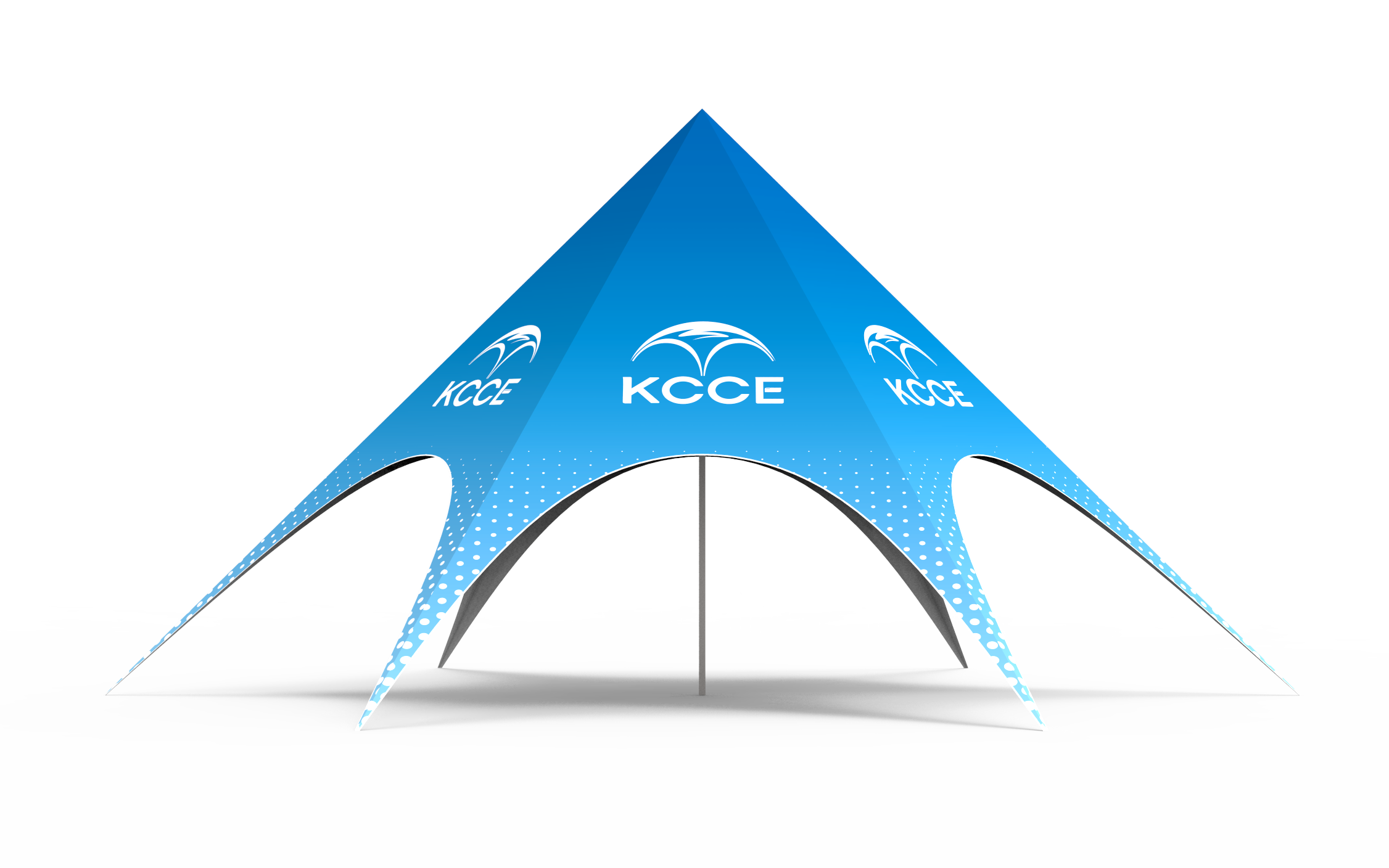
Auto dealership events lean on this hard. Seasonal sales, model launch days, test-drive promotions — all of them benefit from a branded showroom that sits outside. And here’s the practical part: tents can be produced in custom shapes and sizes for this exact scenario. KCCE, for instance, makes a car show inflatable marquee and gazebo tent designed for outdoor promotional events and roadshows — the kind of thing you’d set up for a weekend sales push and tear down Sunday night.
One thing I’d flag: don’t cheap out on anchoring. A dealership lot is open ground, and wind is not your friend. More on that later.
Food & Beverage: Festivals, Pop-Ups & Brand Activations
Food festival branding lives and dies on speed and hygiene.
A vendor arriving at 6 a.m. with a pole tent and a bag of hardware is already behind. An inflatable setup changes that math — inflate, anchor, done. For promotional inflatable tents, that speed is the whole selling point.
Beverage brands use these heavily for sampling. A branded tent with a bar counter setup turns a random patch of grass into a legitimate activation space. Custom airtight inflatable bar counters with TPU bladders exist specifically for outdoor events — you inflate them, and they hold their shape without a constant air pump running. That matters when you’re running a generator or working off battery.
The other thing food and bev brands get from tents: shade and weather cover. Sampling stalls can’t operate in direct sun or rain. A tent is both your branding and your operating permit, practically speaking.
Retail & Consumer Brands: Pop-Up Shops & Roadshows
Inflatable tents for retail solve a very specific headache — how do you take a store to where the customers already are?
Mall parking lots, outside big-box stores, college campuses, music festivals. Brands set up mobile storefronts under inflatable canopies and sell directly. No lease, no buildout, no contractor.
For brand activation teams, the appeal is the same as it’s always been: you control the environment. A tent with printed walls, branded flooring, and product shelving becomes a miniature flagship store. Product launches especially benefit — you want a crowd, and a big inflatable structure draws a crowd by default.
You might be wondering whether these hold up for repeated roadshow use. Honestly? It depends on the material and how you store them. More on that in the selection section.
Sports, Fitness & Outdoor Events
Marathons, triathlons, fun runs, gym promos, fan zones — this is one of the biggest categories, and it’s where event inflatable tents have become almost standard equipment.
Race-day branding is the obvious use. Start and finish lines need arches and structures that are visible from a distance and safe for crowds to pass under. That’s a well-established product category now. KCCE manufactures custom racing event tents and advertising inflatable tents for marathons, plus start/finish line arch gates for racing sports events — the kind of branded gate you see at the front of a 10K.
Gyms and fitness brands use tents differently. They set up at community events, offer free class demos, hand out trial passes. A branded tent with an open front becomes a mini studio. Add a fan, some mats, and you’re running a class in a parking lot.
Fan zones at stadiums are another angle. Pre-game and halftime activations under branded canopies keep people on-site and spending.
Hospitality, Tourism & Construction/Trades
I’m grouping these three because they share a common thread: they use trade show inflatable tents and branded structures to signal presence in places that aren’t naturally branded.
Hospitality and tourism brands set up at travel expos, resort entrances, and city events. A resort activation tent at a tourism fair gives you a physical footprint that a booth can’t match. Some properties use them as seasonal welcome zones or poolside bars.
Construction and trades use them for job-site branding and trade show booths. A general contractor’s branded tent at a home show says “we’re established.” On active job sites, tents serve double duty as covered staging areas with the company logo printed on every panel — branding that also happens to be functional.
For trade shows specifically, the pitch is simple: inflatable booths are lighter, ship cheaper, and set up faster than modular hard-wall systems. For teams doing multiple shows a season, that adds up.
What Makes Inflatable Tents Effective Across Industries?
You’ll see a lot of generic lists about “benefits of inflatables.” Most of them miss the point. The benefits only matter in context, so let me tie them to actual use cases.
Visibility. This is the core benefit for automotive and real estate. A large, bright, unusually shaped structure interrupts visual patterns. Drivers notice things that don’t look like everything else on the street.
Installatiesnelheid. Critical for food vendors and roadshow teams. If you’re doing 20 events a year, the difference between a 45-minute setup and a 15-minute setup is dozens of hours annually.
Draagbaarheid. Retail pop-ups and touring activations live or die on logistics. Inflatable structures deflate into compact bags. A single person can often transport one in a normal vehicle.
Maatwerk. This is where branding and promotional events get their value. Full-surface printing means every square foot of the tent is a billboard. Logos, colors, messages, even custom shapes.
Weather resistance. For sports events and outdoor activations, a tent is shelter. Rain delays don’t kill the event if vendors and participants have cover.
How effective are inflatables for advertising, really? In my view, effectiveness comes down to one thing: dwell time. Inflatables don’t just get noticed — they pull people toward them. That’s the difference between an ad people drive past and an ad people walk into.
How to Choose the Right Tent for Your Industry
This is where most buyers get it wrong. They pick a tent based on price, then discover it doesn’t fit their use case. Let’s fix that.
Start with size. A real estate open house needs something modest — 10×10 or 10×20 feet is plenty. A car dealership event or festival vendor needs more. The classic 10×20 blow up tent comes up constantly in event forums, and for good reason: it’s the workhorse size for craft shows, vendor stalls, and mid-size activations. Go bigger only if you’re doing fan zones or major brand activations.
Then design and branding. Decide what needs to be readable from a distance. For automotive and real estate, that’s your logo and one key message, huge. For retail, you may want full-wall graphics and interior branding.
Then durability. Ask about the material, the seams, and the anchoring system. This is where the real-world pain points show up — people worry about stability in wind and how the tent holds up after a season of use. A good supplier will walk you through anchoring options for different ground types: grass, asphalt, concrete.
Then the practical stuff. How long does inflation take? Does it need a continuous blower, or is it airtight? Airtight designs hold pressure without a pump running, which is a genuine advantage for events without reliable power.
If you want to see how custom inflatable advertising tents are actually built — materials, printing, structure — it’s worth looking at how KCCE approaches inflatable product design. Seeing the design process makes the spec sheet make more sense.
One more tip: buy for your heaviest use case, not your lightest. If you do one big event a year and ten small ones, size for the big one.
Market Trends & What’s Next
A few things are clearly shifting in the inflatable tent market.
Sealed-air (airtight) construction is gaining ground. Instead of running a blower constantly, these tents hold air like a paddleboard. Quieter, no power dependency, cleaner look. The tradeoff is cost and inflation effort.
LED integration is the other big one. Printed graphics work in daylight; LED-lit tents work at night. For evening activations, night races, and festival environments, this extends your usable hours dramatically.
Duurzaamheid is showing up in material choices and manufacturing claims. Buyers — especially brand-side marketers with ESG reporting — are asking harder questions about materials and lifespan.
And the market data backs the direction. With the promotional inflatables market size tracking toward $2.1 billion by 2035, this isn’t a fading tactic. If you want the fuller picture on formats and design approaches, there’s a useful angle in the idea of Inflatable Tents Promotional Best Designs: A Complete Guide — the range of shapes and configurations available now is genuinely wider than it was five years ago.
Speaking of which — if you’re researching this space, you’ll run into a few recurring names and questions. Instent Industries is one supplier people mention for custom inflatables across many event types. Inventini has published on the practical side too, including a piece on the 5 Benefits of Using Inflatables for Advertising that covers similar ground to what I’ve laid out here. And if you’re looking for inspiration, the theme of 3 Memorable Custom Inflatables That Have Built Brand Recognition is worth exploring — the best activations tend to be the ones where the structure itself becomes the photo people share.
Inflatable Tents: Fast Setup and Portability Advantages
Setup speed is where inflatable tents genuinely embarrass traditional frame tents. A typical 20×20 inflatable can go from bag to fully standing in a relatively short time with two people and a blower — one person can often manage it alone. Compare that to a same-size pole tent, which generally takes much longer with a three-person crew. plus stake layout, pole assembly, and guy-line tensioning.
The reason is simple: no frame, no hardware, no loose parts. You unroll, zip the bladder, attach the blower, and watch it rise. Most units run on a standard 110V blower drawing roughly 6–9 amps. so a single household circuit or a small generator handles it.
Portability follows from the same design. A deflated 20×20 packs to about the size of a large duffel — typically around 60–80 lbs. — and fits in a sedan trunk or SUV cargo area. No trailer, no roof rack, no box truck. For roadshow teams doing three cities in a week, that’s the difference between renting a van and just checking a bag.
One practical note: keep a spare blower. It’s the only moving part, and a dead blower means a dead tent. Teams that carry two never think about it again.
Visual Impact and Brand Exposure
The exposure math is what sells these to brand managers. A 20×20 inflatable presents roughly 400 square feet of printable surface. — walls, canopy valance, and often the roof itself. That’s not a banner; that’s a building with your logo on it.
Height matters more than people expect. Inflatables commonly run 10–13 feet tall at the peak. which puts branding above eye level and above most crowd sightlines. At a trade show or festival, that’s the difference between being seen from 30 feet and being seen from 300.
The shape flexibility compounds it. Custom inflatable tents can be produced as replicas — a giant product box, a bottle, a car silhouette — which traditional tents simply can’t do. A branded replica tent gets photographed and posted organically, and that earned reach is where the real impression count comes from.
From what I’ve seen, the strongest performers combine three elements: a large logo panel facing the main traffic flow, a secondary panel facing the entry queue, and interior branding so people standing underneath are still inside the message. Most teams only do the first one and leave half the surface unused.
Inflatable vs. Traditional Tents
Here’s the honest comparison, because inflatables aren’t automatically the right call.
| Factor | Opblaasbare | Pole/Frame Tent |
|---|---|---|
| Setup time (20×20) | 8–12 min | 45–90 min |
| Crew needed | 1–2 | 2–3 |
| Verpakkingsgrootte | Car trunk | Truck or trailer |
| Windclassificatie | Needs continuous air; tie-downs critical | Structurally independent |
| Custom shapes | Yes, fully custom | Limited to rectangles |
| Power requirement | Blower, ~6–9A continuous | Geen |
| Typical cost | Higher upfront | Lower upfront |
The trade-offs are real. Inflatables need constant power and proper anchoring — a blower failure in wind is a genuine risk, so backup blowers and weighted ballast aren’t optional. Traditional tents are slower but stand on their own once up.
Where inflatables win: high-visibility brand moments, roadshows, and anywhere the tent itself is the advertisement. Where traditional wins: multi-day events with unreliable power, or situations where you need a structure up for a week with minimal attention. Most serious brand teams end up owning both and choosing by event type.
ROI Analysis and Payback Cases
The numbers are more concrete than most people assume. A custom-printed 20×20 inflatable advertising tent typically costs more than a comparable custom-printed frame tent with full-wall branding, depending on print coverage and shape complexity. — cheaper upfront, but you’re paying for it in labor every single event.
That labor gap is where ROI turns. If a two-person crew spends 60 extra minutes per event on traditional setup and teardown, that’s two labor-hours. At a typical loaded rate, setup labor can add up per event. Run multiple events a year and the setup labor cost alone becomes significant. — which erases the upfront savings entirely inside twelve months.
The exposure side is harder to pin down but directionally clear. A branded tent at a three-day festival with a large attendance can generate impressions in the tens of thousands. when you count foot traffic, photos, and social posts. Against a tent cost amortized over several years and multiple events, the per-event cost can be relatively low. for the structure itself.
One dealership case I’ve seen cited: A weekend test-drive promotion with a branded inflatable marquee reportedly generated a strong number of test-drive signups over two days, against a tent cost that was relatively modest. At average dealership lead values, that’s a payback inside a single event. Your mileage varies by vertical, but the structure cost is rarely the bottleneck.
Sustainability and Environmental Advantages
Sustainability claims in event marketing deserve scrutiny, so here’s what actually holds up.
The strongest argument is reuse. A well-made inflatable tent in 420D or 600D Oxford polyester with TPU coating is designed for many event cycles over a multi-year lifespan. A single-use vinyl banner or a disposable pop-up canopy that dies after a season doesn’t come close on a per-event footprint basis.
Material-wise, TPU (thermoplastic polyurethane) coatings are increasingly preferred over PVC because they’re chlorine-free and can be recycled in dedicated streams, whereas PVC is notoriously difficult to process. If a supplier offers TPU, it’s worth the modest premium.
There’s also a transport argument that gets overlooked. Because inflatables pack small and light, a roadshow team can move three tents in one vehicle instead of renting a box truck — which cuts fuel and freight emissions per event meaningfully across a season.
The weak spot is end-of-life. Most inflatables still aren’t widely recyclable in municipal streams, so the honest position is: buy for longevity, repair rather than replace, and ask suppliers about take-back or recycling programs. Repair patches and replacement bladders extend service life considerably and are the single most effective sustainability move available.
Veelgestelde Vragen
Q: Who are the top 10 tent manufacturers?
A: That depends on whether you mean camping tents or promotional structures — they’re different industries. For inflatable advertising tents specifically, the manufacturing base is heavily concentrated in China, with suppliers like KCCE (Dongguan Kaicheng Outdoor Products) producing inflatable tents, arches, columns, and custom shapes for events and exhibitions. When evaluating manufacturers, look at verified business licenses, review scores, and whether they handle custom printing in-house.
Q: Who are some leading tent manufacturers in the USA?
A: The US market has a mix of domestic fabricators and importers. Many American event companies source inflatable advertising tents from overseas manufacturers and handle branding and distribution locally. If US-based production matters to you — for lead times or compliance reasons — ask suppliers directly about their manufacturing location and whether they hold relevant certifications. Availability of air tents in the US has improved, though buyers still report limited selection compared to camping gear.
Q: What is the largest inflatable tent available?
A: Sizes vary widely by manufacturer and use case. Custom inflatable tents can be produced at very large scales for festivals, fan zones, and major brand activations — essentially, the limit is engineering and anchoring, not a standard catalog size. For most business use cases, though, the practical sweet spot is 10×20 feet or smaller. Oversized tents need serious anchoring plans and often professional installation.
Q: Are the inflatable tents any good?
A: For advertising and event use, yes — with caveats. They set up fast, pack small, and deliver unmatched visibility. The common complaints from real users are weight, pack size, hand-inflation time, and uncertainty about durability in wind. Those are solvable with the right material, anchoring system, and a bit of practice. For car camping, they’re bulky. For brand activations, they’re excellent.
Q: How effective are inflatables for advertising compared to traditional booths?
A: In my experience, the difference is dwell time. A standard booth is a destination — people come if they already want to. An inflatable tent is a draw — it pulls people in who weren’t planning to stop. For outdoor brand advertising, that passive pull is the whole value. Add full-surface custom printing and you’ve turned the structure itself into the ad.
Q: What are the top benefits of using advertising inflatables?
A: Five stand out: visibility from a distance, fast setup and teardown, compact transport and storage, full customization for branding, and weather shelter that extends your operating window. For teams doing multiple events per year, the setup-time savings alone often justify the investment. What Are The Top Benefits Of Using Advertising Inflatables? — that’s the question to answer against your own event calendar.
Q: What are the top 5 reasons to choose an inflatable tent for your next event?
A: Speed, portability, branding surface, crowd-drawing power, and weather protection. Top 5 Reasons To Choose Inflatable Tent For Your Next Event usually comes down to these. If your event is outdoors, recurring, and brand-driven, an inflatable tent is hard to beat. If it’s a one-off indoor trade show with a hard-wall booth already booked, the math changes.
Q: Do inflatable tents work for branding and promotional events specifically?
A: That’s arguably their best use case. Branding and promotional events need structures that photograph well, set up fast in unfamiliar locations, and carry a logo across every visible surface. Inflatable tents do all three. Many events can benefit from custom inflatables — from product launches to race-day fan zones — because the structure doubles as both shelter and signage.
Wrapping Up
Match the tent to the use case, not the other way around. A 10×20 for the craft show, a custom marquee for the dealership lot, an airtight bar counter for the sampling activation. Ask yourself one question: is your brand visible where your buyers actually are? If the answer is no, an inflatable advertising tent is one of the cheapest ways to fix that. Next step — request a custom design quote and spec it against your event calendar.
Referenties
1. kcce-event.com – kcce-event.com