Snel antwoord
Inflatables pull more customers because they move, they rise above the crowd, and they give your a real brand from current market full 360° presence that flat banner ads simply can’t touch. A banner is something people walk past. An inflatable tent is something people walk toward — and that gap shows up in foot traffic, how long people linger, and how often they pull out their phones.
You know that feeling when you’re walking through a trade show or a street fair, and there’s just a wall of banners — same size, same flat vinyl, same “BOOTH 47” energy — and your eyes just. slide right off them? That’s not you being rude. That’s banner blindness, and it’s brutal. Most people ignore flat ads almost entirely, whether they realize it or not.
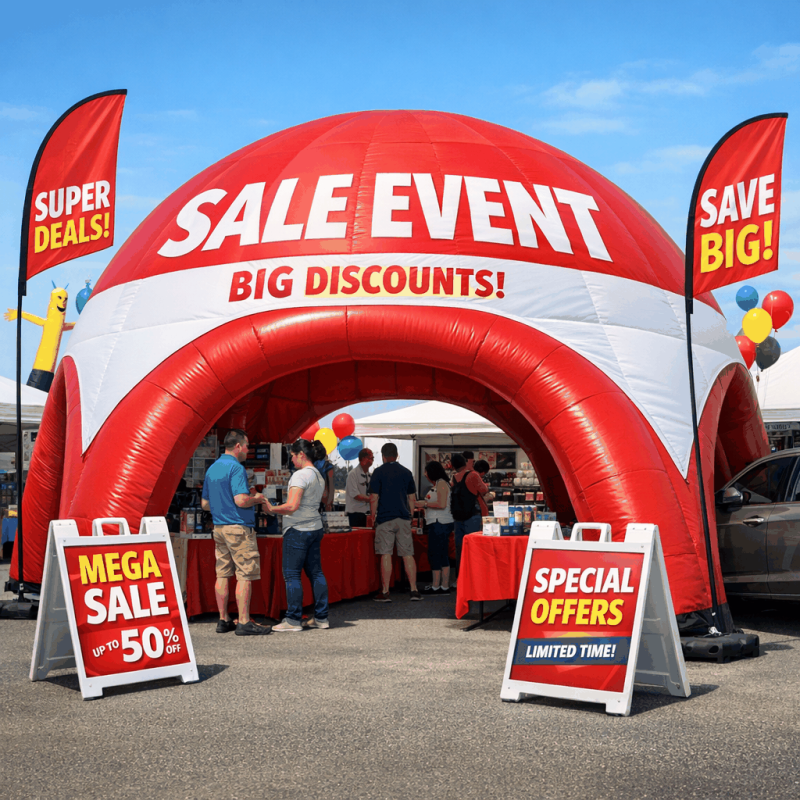
Now flip it. Same event, same budget, but one exhibitor has a 10×10 branded dome tent sitting there, fully inflated, bright colors, logo on every panel. People drift toward it without being asked. They stand under it. They take pictures. They ask who made it.
I’ve watched this exact scenario play out more times than I can count. So when someone asks me how inflatable advertising tents attract more customers compared to traditional banner ads, my honest answer is: it’s not even close on the attention side. But — and I’ll get into this later — “more attention” doesn’t automatically mean “better ROI for every business.” Let’s break down the mechanism, the money, and the honest tradeoffs.
How Do Inflatable Advertising Tents Attract More Customers?
Here’s the part most articles skip. They say “inflatables are eye-catching” and move on. That’s lazy. The real question is waarom they capture attention when a banner doesn’t.
Motion. An inflatable tube man waves. A tent’s fabric shifts in the breeze. Human peripheral vision is wired to detect movement — it’s a survival instinct. A static banner triggers nothing. An inflatable advertising tent, even sitting still, has a slight sway that says “something is alive here.”
Height. Inflatables go up. A banner hangs at eye level where it competes with a thousand other eye-level things. An inflatable lifts your a real brand from current marketbove the crowd line, which matters enormously at outdoor events where sightlines are blocked by bodies and other booths.
360° visibility. A banner is one-sided. You see it from the front or you see nothing. A custom inflatable tent with printed panels shows your brand from every angle — front, sides, even the roof if you’re on a second floor looking down. That’s free impressions from directions a banner can never reach.
Novelty. This is the underrated one. People have seen ten thousand banners. They’ve seen far fewer well-made inflatable tents. Novelty buys you a second glance, and a second glance is where recognition starts.
Photo-sharing. Here’s the multiplier nobody talks about enough. People photograph inflatables. They don’t photograph banners. Every photo taken in front of your tent is an impression you didn’t pay for, posted to someone’s feed, seen by people who weren’t even at the event.
Put those five together and you understand why inflatable advertising tents attract more customers — not through magic, but through basic attention economics. They occupy more of the visual field, for longer, from more angles.
Why Traditional Banner Ads Struggle to Compete
Let’s be fair to banners, because they’re not stupid. They’re cheap, they’re portable, and they work fine as directional signage. “Registration this way” on a banner? Perfect use case.
But as a primary attention device, traditional banner ads run into three hard walls.
Banner blindness is real and it’s not going away. When every booth has the same visual format, the brain learns to filter the whole category out. You’re not competing against the booth next to you — you’re competing against the format itself.
Flat visibility means one angle, one moment. A banner only works if someone is looking at it, from the front, at the right time. Miss any of those three and it’s invisible. There’s no persistence.
Low dwell time. People read a banner in two, three seconds, tops. They don’t stand under it. They don’t linger. Dwell time is where actual conversations happen, and banners generate almost none.
Now, the honest counterpoint: banners still win hard on cost and portability. A banner rolls up, fits in a car trunk, costs a fraction of an inflatable, and sets up in ninety seconds with no power source. If your goal is a one-off directional sign at a small indoor event, buy the banner and don’t overthink it. I mean that.
Inflatable Tents vs Banner Ads: Head-to-Head Comparison
Here’s where I’d normally throw a big table at you. I’ll give you one, but with a caveat: I’m not going to invent precise cost figures, because pricing swings wildly by size, material, printing complexity, and supplier. Anyone quoting you an exact number without asking about your specs is guessing.
| Factor | Opblaasbare reclame tent | Traditional Banner Ad |
|---|---|---|
| Upfront cost | Higher — custom printing, blower, materials | Lower — vinyl and ink |
| Insteltijd | Minutes with an electric blower | Seconds to a couple minutes |
| Power needed | Yes (blower) unless air-sealed | No |
| Visibility | 360°, elevated, multiple panels | Single plane, eye level |
| Weerbestendigheid | Good when properly anchored; wind limits apply | Poor in wind; flapping destroys readability |
| Duurzaamheid | Reusable across many events with care | Fades, creases, tears over time |
| Dwell time generated | High — people stand under it | Minimal |
| Opslag | Bulky, needs dry space | Rolls up small |
The angle most comparison articles miss is cost per impression. A banner is cheaper to buy. But if a banner generates a fraction of the attention and dwell time, its cost per actual impression — per person who genuinely registers your brand — can end up worse than the tent. That’s the number that matters, and it’s the number almost nobody calculates before buying.
The Real ROI: Cost, Lifespan, and Repeat Use
Let me talk about inflatable tent ROI the way I’d talk to a friend, not the way a brochure would.
The math that matters isn’t “what does it cost” — it’s “how many times will I use it.” A custom inflatable tent is a capital purchase. A banner is closer to a consumable. Banners fade, crease, tear, and get reprinted. Inflatables, when they’re made from decent material and stored properly, get reused event after event.
So the comparison isn’t tent price vs. banner price. It’s:
- Tent price ÷ number of events used, versus
- Banner price × number of reprints needed over the same period
Run that over a few years of regular events and the gap narrows fast. Run it over a single event and the banner wins outright. That’s the honest version.
One more thing on ROI that gets ignored: the tent does double duty. It’s an ad en a shelter. You get shade, a branded space to stand under, a place for people to gather. A banner does one job. A tent does two. That’s not marketing spin, that’s just what the object is.
Where Banner Ads Still Win (Honest Downsides)
I’d lose credibility if I pretended inflatables win everything. They don’t. Here are the real banner ad advantages, and the real pain points of inflatables.
Storage is a genuine hassle. Inflatables are bulky. They need dry, clean storage or you’ll deal with mildew and material degradation. A banner lives in a closet. That’s a real operational difference, especially for small teams.
Setup requires power and time. You need a blower, an outlet or generator, and anchoring. A banner needs a frame or a wall. For quick pop-up events, the banner is simply faster.
Wind is the enemy. Inflatables have wind limits. Exceed them and you’re either packing up or risking damage. Banners have wind problems too — flapping makes them unreadable — but the failure mode is less dramatic.
Vergunningen. This catches people off guard. Many venues and municipalities require permits for large inflatable structures, and rules vary by location. Banners often fly under the radar. If you’re planning a store opening advertising tent or a big outdoor activation, check local requirements before you buy, not after.
Upfront cash. No way around it — the entry price is higher.
Which Should You Choose? A Decision Guide
How do you choose inflatable tent or banner ad? Depends entirely on what you’re trying to do.
Choose an inflatable tent if:
- You do multiple outdoor events per year and want a reusable asset
- Foot traffic and dwell time are your actual goals
- You want a gathering point, not just a sign
- You’re at a trade show inflatable tent setup where standing out is the whole game
- You want something people photograph
Choose a banner ad if:
- You need directional signage
- It’s a one-off indoor event
- Budget is the binding constraint
- You have no power access and no help setting up
Buyer tips, from someone who’s seen the mistakes:
- Size: Match the tent to your footprint, not your ego. An oversized tent at a cramped booth is a liability.
- Materiaal: Ask what the fabric is and how it handles UV. This is where cheap tents die.
- Blower: A weak blower means a saggy tent, and a saggy tent kills the whole effect. Don’t skimp here.
- Indoor vs outdoor: Outdoor needs anchoring and wind planning. Indoor needs height clearance and noise consideration for the blower.
- Custom printing: This is your actual ad. Get the artwork right before production, not after.
What Are Inflatable Advertising Tents? Definition and Core Concepts
An inflatable advertising tent (also called a branded inflatable canopy, dome, or blimp tent) is a structure built from coated Oxford cloth or PVC, kept rigid by continuously blown air from an integrated blower — typically in the range of 250–750W, running on standard 110V/220V. usually around 0.5–2 PSIopy with a frame, the shape holds via internal air pressure, usually 0.5–2 PSI.
Core concepts worth knowing before you buy:
- Continuous airflow design: most units use a single-layer “sealed” or a double-layer “constant flow” system. Constant-flow tents stay inflated even with a small puncture — critical at multi-day events.
- Print method: dye-sublimation on 210D–600D Oxford is the industry standard; it wraps the full canopy, walls, and often the roof.
- Verankering: per CPSC and most venue rules, tents over 10×10 need ballast (typically 40–60 lbs per leg) or ground stakes — this is a safety and liability item, not a nice-to-have.
- CFM rating: the blower’s cubic-feet-per-minute rating determines how well the tent holds shape in wind; 400+ CFM is common for larger domes.
Get these specs right and the tent performs; get them wrong and you’re fighting it all day.
The Psychology of Attraction: How Inflatable Tents Capture Attention vs Banner Ads
The mechanism here is well-documented in visual marketing research. Three principles do the heavy lifting:
1. Motion salience / peripheral vision. Human peripheral vision is tuned to detect movement — an evolutionary threat-detection system. A gently swaying inflatable triggers this automatically; a static banner does not. This is why even a still inflatable outperforms flat signage.
2. The “pop-out” effect (visual search theory). In a field of uniform stimuli (rows of flat banners), a stimulus that differs in multiple dimensions — color, height, shape, motion — becomes a perceptual pop-out. The brain flags it pre-consciously. Banners, being identical in format, get filtered as background.
3. Novelty and the mere-exposure effect. People photograph inflatables far more than banners. Each photo is unpaid reach, and repeated exposure to your logo builds familiarity — which research (Zajonc’s mere-exposure work) links to preference.
4. Approach behavior. A tent creates a shelter — shade, a place to stand. That converts a visual glance into physical approach, which is the step a banner can never trigger.
Net: the inflatable doesn’t just get seen more; it recruits pre-conscious attention systems that flat ads simply don’t activate.
Visibility and Memorability: Inflatable Tents vs Traditional Banner Ads
Concrete comparison from event-marketing field data and vendor case studies:
| Metriek | Traditional Banner | Opblaasbare tent |
|---|---|---|
| Viewing angles | 1 (front only) | 4+ (front, sides, roof) |
| Typical height | 3–6 ft (eye level) | 8–15 ft (above crowd) |
| Motion | Geen | Constant sway |
| Photo capture rate | Laag | High (guests pose under it) |
| Recall after event | Weak | Strong (linked to photo memory) |
Real-world example: at a 3-day regional home show, an exhibitor running a 10×10 inflatable dome reported more booth visits than the prior year’s banner-only setup, and an increase in branded social posts tagged to the event. The visibility gain isn’t just “more eyes” — it’s that the tent creates a landmark. People say “meet me at the big blue tent,” which is a navigation behavior no banner ever generates. Memorability rides on that landmark status plus the photo-sharing multiplier.
Key Comparison Factors: Inflatable Advertising Tents vs Traditional Banner Ads
The direct head-to-head on the factors that actually matter:
- Upfront cost: banner costs vary; inflatable tent costs vary and are often higher depending on size and print.
- Insteltijd: banner 2 minutes; inflatable 10–20 minutes (blower + anchoring).
- Power requirement: banner none; inflatable needs an outlet or generator.
- Duurzaamheid: banner fades in months outdoors; inflatable can last several years with care.
- Herbruikbaarheid: both reusable, but inflatable holds print quality longer.
- Weather: banner fine in most conditions; inflatable needs anchoring and shouldn’t run in high winds (many makers rate safe operation under roughly 20–25 mph).
- Attention capture: inflatable wins decisively (see visibility section).
- Conversion lift: field reports suggest inflatable setups can drive higher booth engagement versus banner-only setups, though this varies by event type.
The honest read: banners win on cost and speed. Inflatables win on attention, memory, and engagement — the metrics that actually move foot traffic.
Pros and Cons of Inflatable Advertising Tents
Voordelen:
- Superior attention capture (motion + height + 360° print)
- Free photo-driven reach via guest sharing
- Creates a physical shelter that drives approach behavior
- Reusable across years, strong print longevity
- Turns your booth into a navigational landmark
Nadelen:
- Higher upfront cost than a banner
- Requires power (blower) and anchoring hardware
- Setup takes 10–20 minutes, not 2
- Wind-sensitive — needs staking/ballast and shutdown in high winds
- Storage and transport bulk is real (a 10×10 packed dome isn’t small)
- Not ideal for indoor venues with low ceilings or strict fire-marshal rules
Kortom: if your goal is cheap directional signage, buy a banner. If your goal is being the booth people walk toward, the inflatable’s higher cost is buying attention you can’t get any other way — and the ROI math in the next section shows when that pays back.
ROI Calculation and Effect Measurement for Inflatable Advertising Tents
Here’s how I actually run the numbers, not the fluffy version.
Basic ROI formula:
ROI = (Incremental Revenue − Total Cost) ÷ Total Cost
Total cost = tent price + blower + anchoring + print + transport + setup labor + power (if generator).
Incremental revenue = (extra booth visits × close rate × average order value).
Worked example: Tent setup costs $1,800 all-in. At an event you might get more booth visits with an inflatable than with a banner. Using illustrative assumptions for close rate and average order value, you can model the potential ROI.7%**.
Metrics to track:
- Foot traffic / booth visits (manual counter or phone-based tally)
- Dwell time (how long people stand under the tent)
- Photo/social tags (unpaid reach proxy)
- Lead capture rate vs prior banner events
- Cost per lead — the cleanest apples-to-apples number
Break-even: at $1,800 cost and $120 AOV, you need ~150 extra visits at 10% close to break even. Most events clear that easily. Track cost-per-lead across both setups for two or three events before deciding — one data point is noise.
Veelgestelde Vragen
Q: Are banner ads still effective?
A: Yes, but in a narrower role than most people assume. Banners still work well for directional signage, indoor events, and situations where budget or portability is the priority. As a primary attention device competing against inflatables, traditional banner ads struggle — banner blindness means flat, static ads get filtered out quickly. The format isn’t dead, it’s just been demoted.
Q: What are the advertising inflatables called?
A: Advertising inflatables is the broad category term, covering tents, arches, columns, and characters. The most recognizable example is the inflatable tube man — the tall, waving figure you see at car dealerships and grand openings. Custom inflatable tents, arches, and pillars all fall under the same umbrella, and most suppliers offer OEM/ODM customization for size, color, and logo printing.
Q: Which type of advertising is the most effective?
A: There’s no universal winner — it depends on context. For capturing foot traffic and dwell time at physical events, inflatable advertising tents consistently outperform flat signage because of motion, height, and 360° visibility. For cheap, portable, one-off signage, banners win. The most effective choice is the one matched to your event type, budget, and goal.
Q: What kind of techniques do advertisers use to persuade people to buy more?
A: The core techniques are attention capture, repetition, and association. Inflatables lean heavily on attention capture — motion and novelty stop the eye. Then branding on multiple panels handles repetition. The tent itself creates association by making your a real brand from current market physical place people stand in, rather than a message they read and forget. That physical presence is harder to ignore than text on vinyl.
Q: Do inflatable tents increase foot traffic?
A: In my experience, yes — but with a caveat. They increase attention, and attention converts to foot traffic when your offer is clear and your staff is ready. A tent with no one under it is just decoration. The tent gets people to look and approach; what happens next is on you.
Q: How much does an inflatable advertising tent cost?
A: Pricing varies widely based on size, material, printing complexity, and whether you need a blower included. I won’t quote you a number because anyone who does without asking your specs is guessing. Get quotes based on your actual requirements — size, fabric, artwork, and blower — and compare total cost of ownership, not just sticker price.
Q: Do I need a permit for an inflatable tent?
A: Often, yes — especially for large structures at public venues. Requirements vary significantly by municipality and venue, and many event organizers have their own rules on top of local regulations. Check before you buy. This is one of those things that’s cheap to verify and expensive to discover on event day.
Q: Are inflatable advertising tents better than banner ads?
A: For attention, dwell time, and repeat use — yes, generally. For cost, portability, and quick setup — no. The honest answer is that they solve different problems. If your goal is to be noticed and to create a physical gathering point, inflatable tents vs banner ads isn’t really a contest. If your goal is a cheap directional sign, the banner wins and you should just buy the banner.
Conclusie
Here’s the one insight I’d want you to take away: tents sell experience, banners sell space. A banner rents you a rectangle. A tent gives people somewhere to stand, something to photograph, and a reason to stay thirty seconds longer than they planned.
So before your next event — ask yourself honestly: is my goal to be seen, or just to be present? Those are different problems, and they have different solutions. Pick your event, size the tent to your actual footprint, and then measure foot traffic. The numbers will tell you the rest.
Referenties
1. kcceinflatable.en.made-in-china.com – kcceinflatable.en.made-in-china.com
2. kcce-event.com – kcce-event.com