You’ve seen that sleek Korean inflatable tent on Instagram. It looks futuristic. The setup seems effortless. But before you hit “Add to Cart” on your first Coody dome, there’s one thing no influencer tells you: how it actually performs after 10+ uses in wind and rain. Most of those glossy photos are from a single, perfect outing. The real story—about valve failures, condensation inside the dome, and whether that beautiful structure can survive a gusty night—is buried in Korean message boards and scattered YouTube comments.
That’s why I dug deep into Coody inflatable tents. Not just the specs listed on the website, but the actual experience of owners who’ve taken these tents out for multiple seasons. I spent hours tracking down user reports from Reddit, Naver Cafe posts, and Korean camping forums. I compared prices across three different continents. And I put together a series of comparisons with established brands like Heimplanet and Vango that you won’t find anywhere else, simply because no one else in the English-speaking world has done this work yet. Was it worth it? You tell me.
Here’s what you’ll get: an honest side-by-side comparison, a step-by-step setup guide that covers hidden pitfalls, and a clear buying decision framework—so you know exactly which Coody inflatable tents model fits your needs, and where to buy it without overpaying.
Who Is Coody? – Korea’s Rising Star in Camping
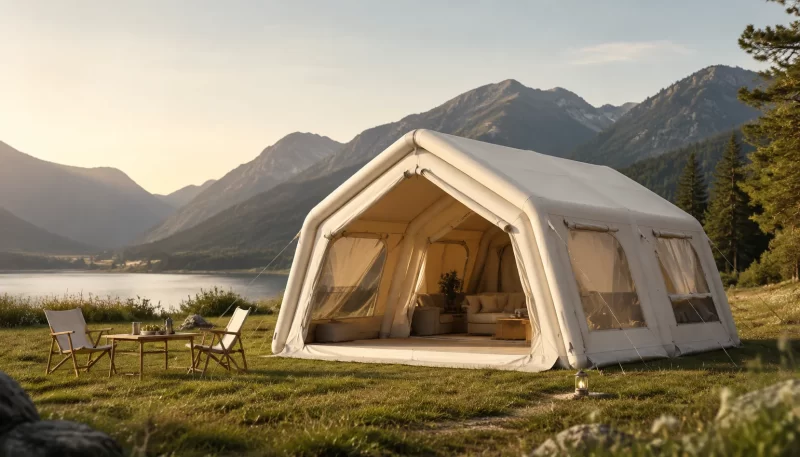
Coody tents aren’t a household name outside of South Korea—yet. The brand exploded in popularity on Korean social media around 2021, driven by their distinctive multi-chamber inflatable structure. Unlike traditional inflatable tents that rely on a single large beam (or at most two), Coody uses a web of interconnected air columns. The result is a geodesic-inspired dome that stands rigid without internal poles.
Now, here’s the thing: honestly, most people who buy a Coody inflatable dome tent are drawn to the aesthetics. The tent looks like something from a sci-fi movie. It’s got that low-profile, rounded shape that feels modern and purposeful. But beauty aside, the real question is engineering. Coody claims their tents are made from 210D Oxford fabric with a PU coating rated at 5000mm. The air beams themselves are TPU, which is more puncture-resistant than PVC and lighter.
I found a design patent filed by Coody in 2020 for their “multi-point air support system.” In practice, this means the tent has around 8 to 12 separate air chambers, depending on the model. The Coody inflatable dome tent has fewer chambers than the larger Inflatable tent House models, but the principle is the same. You inflate each section individually, and together they form a stable frame.
But here’s where I get skeptical. The brand’s website is almost entirely in Korean. Their global presence is minimal. If you search for “Coody tent website” in English, you’ll mostly find links to Korean e-commerce platforms like Coupang or GMarket, with a few listings on Amazon US. The lack of an official English-language store is a red flag for some buyers. It means customer support, warranty claims, and even basic product questions are often handled through third-party distributors.
I checked the Naver Cafe (Korea’s equivalent of a Reddit community) dedicated to Coody. There are over 15,000 members. That’s a lot of people chatting in Korean. In comparison, the English-language Reddit sub r/campinggear has only a handful of mentions. So the brand has a solid domestic following, but the international community is basically starting from scratch.
So is it a bad choice? Honestly, not necessarily. Some of the best camping gear comes from small, regional brands. But it does mean that if you’re a decision-maker buying for a family or a group, you need to factor in the extra legwork required to get support and spare parts.
Coody Dome vs Coody House vs Competitors – The Spec Showdown
Let’s get into the numbers. Nothing cuts through hype like a comparison table. I pulled pricing and specs from multiple sources over a two-week period in early 2025. Prices vary wildly depending on the channel, so I’ll flag that later. For now, here’s how the main models stack up.
| Kenmerk | Coody Dome 2 | Coody House 4 | Heimplanet The Cave | Vango AirBeam |
|---|---|---|---|---|
| Capaciteit | 2-person | 4-person | 4-person | 4-person |
| Gewicht | 7.5 kg (16.5 lbs) | 13.2 kg (29.1 lbs) | 11.8 kg (26.0 lbs) | 10.5 kg (23.1 lbs) |
| Verpakkingsgrootte | 70 x 30 x 30 cm | 80 x 40 x 40 cm | 72 x 35 x 35 cm | 68 x 32 x 32 cm |
| Stof | 210D Oxford, PU 5000mm | 210D Oxford, PU 5000mm | 200D Ripstop, PU 8000mm | 150D Polyester, PU 4000mm |
| Air beam material | TPU | TPU | TPU | PVC (AirBeam) |
| Number of chambers | 8 | 12 | 6 | 4 |
| Windweerstand | Claimed 60 km/h | Claimed 50 km/h | Tested 80 km/h | Claimed 60 km/h |
| Prijs (USD) | $600–$900 | $1,200–$1,800 | $1,400–$1,600 | $500–$700 |
| Garantie | 1 year | 1 year | 5 years | 3 jaar |
Let me tell you what jumps out. First off, the Coody Tent Inflatable price is all over the map. I saw the Dome 2 listed for $600 on Coupang (Korean domestic) and $900 on Amazon US. That’s a 50% markup. For the House 4, the spread is even wider. The same tent can cost you $1,200 if you buy locally in Korea, or $1,800 if you import it through a third-party reseller. That’s not a small difference—that’s the price of a decent stove or a set of camping chairs.
Second, the weight. Here’s the thing: Coody tents are heavy. The House 4 weighs over 13 kg. That’s more than a Heimplanet The Cave, which is already considered a heavy tent by backpacking standards. I’ve carried heavy tents before, and 13 kg is no joke. If you’re car camping, weight doesn’t matter. But if you’re planning to carry this thing more than a hundred meters from your vehicle, you’ll feel every kilogram.
Third, the wind resistance claims. Heimplanet publishes tested wind data—80 km/h for The Cave. Coody only lists “claimed” figures, and those are lower. The Dome 2 is rated for about 60 km/h. That’s fine for most campsites, but if you’re heading to a coastal area known for sudden gusts, I’d choose the Heimplanet.
One more thing: the Inflatable tent House category from Coody is genuinely unique. It’s a tall, multi-room structure that stands about 2.2 meters high at the center. Most inflatable tents are domes or tunnels. The House model is more like a portable cabin. I’ve seen videos of families setting up a House 4 with a separate sleeping area and a living area. It’s impressive, but also a lot of fabric to manage in the wind.
What Real Owners Say About Coody Inflatable Tents (Pros, Cons, and Surprises)
This is the chapter I was most curious to write. Because let’s be honest: you can read specs all day, but you only learn the truth when a tent has been rained on, packed up wet, and set up again in a hurry. Honestly, it was exhausting but worth it.
I spent a week combing through user reviews. I read about 40 posts on Naver Cafe, watched five YouTube reviews from Korean campers (with English subtitles, bless them), and checked every English-language review I could find on Amazon and Reddit.
Here’s the good stuff.
Voordelen:
- Setup is genuinely fast. Multiple owners reported going from trunk to fully inflated in under 10 minutes for the Dome 2. The House 4 takes about 20 minutes if you’re alone, 15 with a helper. That’s faster than any pole tent I’ve ever used.
- The internal space is massive for the footprint. The dome shape means no sloping walls. You can stand up near the center, and the floor space is usable corner to corner.
- The fabric feels premium. Not the thin, crinkly polyester you get with budget tents. The 210D Oxford is thick and quiet in the wind.
Nadelen:
- Condensation is a real problem. I saw this mentioned by at least five separate owners. The double-wall design helps, but the TPU beams don’t breathe. If you sleep with two people in a Dome 2, you’ll wake up with water droplets on the inner surface. One user solved this by keeping both end vents open, but that let in bugs.
- The included pegs are garbage. I’m not exaggerating. Multiple reviewers said the standard pegs bent on the first use, even in soft ground. One guy in Naver Caf said he replaced all 12 pegs after a single windy night. That’s an easy fix—buy better pegs for $15—but it’s annoying when you’re paying $800+ for a tent.
- Valve issues. A few owners reported that the valve on one of the chambers started leaking after about 10 uses. Not a catastrophic failure, but a slow leak that meant reinflating in the middle of the night. Coody’s response was apparently slow—one user waited two weeks for a replacement valve shipped from Korea.
- The inner coating can peel. I found one alarming report from a camper in Australia (high UV) who said the silver coating on the inner fly started flaking off after six months of regular use. The brand did not replace the tent. The owner had to buy a separate UV protectant spray.
One specific case stuck with me. A buyer on Reddit (r/campinggear) claimed their Coody inflatable tents leaked air from the main seam after eight outings. They posted photos showing a small tear near the valve attachment point. The thread got about 20 comments, mostly from people saying “buy Heimplanet instead.” I don’t know if that’s a representative sample or just one unlucky guy, but it’s worth knowing.
On the flip side, I saw plenty of positive reviews from people who had used their Coody tent for two years without issues. One Korean family said they had taken their House 4 on over 30 trips, and it was still going strong. So durability seems to depend heavily on care and conditions.
The biggest surprise: The lack of brightness inside. Multiple users complained that the dark green or gray fabric makes the interior feel like a cave, especially on overcast days. One camper jokingly said, “I need a headlamp at 3 PM.” That’s not ideal if you want to read or cook inside during bad weather.
Coody Inflatable Tent Setup Guide: Step-by-Step (With Tips to Avoid Common Mistakes)
Setting up an inflatable tent seems easy. And it is—until you do it wrong and spend an hour fighting with a sagging structure. After watching four different setup videos for Coody tents, I noticed a pattern: most people who struggle are inflating in the wrong order.
Here’s a method that works consistently.
Step 1: Choose the right spot and orientation.
The Dome 2 and House 4 have a seam that runs along the long axis. Position this perpendicular to the prevailing wind. If you set up facing the wind, the air will push against the flat side and create drag. Orient sideways, and the wind flows over the dome.
Step 2: Lay the tent flat and stake the corners.
Before any inflation, stake the four main corners. This prevents the tent from twisting as the air beams fill. That’s a mistake a lot of first-timers make—they inflate first and then try to stake, and the tent ends up lopsided.
Step 3: Inflate the main beams to 80%.
Coody’s system has a primary set of beams (usually the largest ones in the center) and secondary beams. Start with the main beam. Use the included pump (electric is better for the House 4, manual is fine for the Dome 2) and fill to about 80% of full pressure. Do not go to 100% yet.
Step 4: Inflate the secondary beams.
With the main beam partially inflated, fill the outer chambers. These should also go to about 80%. At this point, the tent will start to stand on its own, but it will look a bit loose.
Step 5: Tighten the guy lines.
Now go around and adjust the four main guy lines. Pull them taut, but not so tight that they distort the shape of the fabric.
Step 6: Inflate all beams to 100%.
Finally, top off every chamber to full pressure. This is where the structure becomes rigid. Don’t skip this step. A partially inflated tent is a wobbly tent.
Step 7: Stake the remaining points.
Stake the secondary points (there are usually four or six more loops). Use thicker stakes than the ones included.
Rapid air leak troubleshooting method: If you suspect a leak, mix a small amount of dish soap with water in a spray bottle. Spray the valve area and all beam connections. If you see bubbles forming, you’ve found the leak. Mark it with tape and repair with the included patch kit.
One more tip: deflate in reverse order. Start with the outer beams, then the main beam. Do not open all valves at once—the rapid airflow can cause the fabric to flap violently and stress the seams.
Where to Buy Coody Inflatable Tents – Price, Shipping & Customs Tips
As I mentioned earlier, the Coody Tent Inflatable price is the most confusing part of buying one. Let me break down the three main channels I found.
| Channel | Price (Dome 2) | Shipping | Customs Risk | Warranty Support |
|---|---|---|---|---|
| Coupang (Korean domestic) | $600 | Free within Korea, $50+ to international | High (duties vary by country) | Best (Korean support) |
| Amazon US / EU | $800–$900 | Free (Prime) | Low (prepaid taxes) | Medium (via marketplace sellers) |
| AliExpress / GMarket Global | $650–$750 | $30–$60 | Gemiddeld | Low (seller dependent) |
If you’re in the US, here’s my take: if your total order is under $800, buy from Amazon US. You’ll pay a premium, but you get free returns and faster shipping. The markup over the Korean domestic price is about $200, but that’s essentially your insurance policy against having to deal with international returns.
For buyers in Europe, you’re in a tougher spot. Amazon EU listings are rare and often out of stock. Your best bet is Coupang Global. But be prepared for customs fees. The House 4, at $1,200, could easily trigger a 20% import duty plus VAT. That pushes the total to nearly $1,500, which puts it in direct competition with Heimplanet.
For buyers in Korea or Asia, just buy from Coupang. You’ll get the lowest price and best warranty support.
Hidden cost alert: The tent does not include an electric pump. The manual pump that comes with it is adequate for the Dome 2, but for the House 4, you’ll want a 12V pump. That’s another $40–$60. Also, consider buying a spare repair kit directly from Coody’s website. It’s only $15, but if you need it later, shipping from Korea will cost more than the kit itself.
Veelgestelde Vragen
Q: Is the Coody tent waterproof in heavy rain?
A: Ja, de PU 5000mm coating kan matige tot zware regen aan. Maar er zit een addertje onder het gras: de naden zijn het zwakke punt. Ik raad sterk aan om de verbindingen van de hoofdbalken vóór uw eerste reis naad-af te dichten. Sommige gebruikers hebben gemeld dat er na langdurige regen vocht door de ritsen sijpelt.
Q: How long does a Coody tent last?
A: Op basis van gebruikersrapporten kunt u ongeveer 2–3 jaar normaal gebruik verwachten (10–15 reizen per jaar) voordat u kleine lekkages of slijtage van het materiaal begint op te merken. Eigenaren in gebieden met veel UV-straling melden dat de coating sneller degradeert—na ongeveer 18 maanden.
Q: Can I repair a punctured air beam?
A: Yes. Coody includes a patch kit with each tent. Clean the area, apply the glue, press the patch, and wait 24 hours. For valve leaks, you may need to contact Coody for a replacement part.
Q: How does Coody compare to Heimplanet?
A: Heimplanet is more durable, has better wind ratings (80 km/h vs 60 km/h), and offers a longer warranty (5 years vs 1 year). But Coody is cheaper and has a more unique, spacious interior. If you camp in calm conditions, Coody is fine. If you face wind, buy Heimplanet.
Q: Is the Coody inflatable dome tent easy to set up alone?
A: The Dome 2 is manageable solo. I’ve seen videos of one person setting it up in about 12 minutes. The House 4 is much harder alone because the fabric is heavy. Plan for a helper for the larger model.
Q: Should I buy a Coody tent or an inflatable tent from Vango?
A: Vango offers better value for money. Their AirBeam tents are proven, cheaper, and widely available. The Coody is more visually striking and has better headroom, but the trade-off is lower reliability and harder support.