빠른 답변
An inflatable camping tent swaps out traditional poles for air beams you pump up. It genuinely pitches faster, and in wind it’s often more stable — but it costs more, weighs more (usually 15–20 lbs, sometimes a lot more), and it can get punctured. Car camping and family trips? Worth it. Ultralight backpacking? Forget it.
Most people see one of these in an ad, think “wow, that looks amazing,” and then the second thought hits: will this thing actually survive a real campsite? Or is it just a beach toy with a marketing budget? Fair question. I’ve watched this category grow for years now, and the honest answer lives somewhere between the hype and the skepticism. So here’s a straight verdict, a few real picks, and the lifespan answers you won’t find in the product listing.
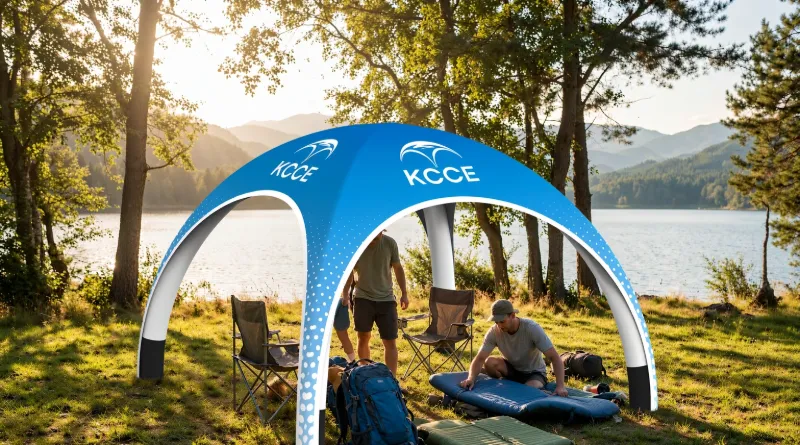
Are Inflatable Camping Tents Any Good? (Honest Verdict)
Short version: yes — for the right person. An inflatable camping tent shines when you want fast setup and a roomy interior, and when you’re driving to your site instead of hiking in. The air beams are usually TPU or PVC bladders wrapped in a tough outer shell, and once inflated they hold their shape surprisingly well. In gusty conditions they often do better than thin fiberglass poles, simply because there’s no rigid pole to snap.
Where they beat pole tents:
- 속도. One person can usually raise a large tent in a few minutes with a pump. No threading poles through sleeves in the rain.
- Packed size (sometimes). A deflated air-beam tent can fold down flatter than you’d expect — though this varies a lot by model.
- Interior space. No crossing poles means cleaner walls and more usable headroom.
Where they lose:
- Cost. You’re paying a premium for the beam technology and valves.
- Puncture risk. A sharp rock, a stray branch, or a curious dog can put a hole in a beam. Pole tents bend; air beams deflate.
- Bulk and weight. This is the big one. Real users on social media keep saying the same thing — inflatable tents weigh more than traditional tents. 15–20 lbs is common, and some large models push well past that. One owner compared the packed bundle to the size of a hockey bag. That is not a backpacking object.
My take? If your camping is car-based — beach trips, family weekends, festival glamping — an inflatable camping tent is a genuinely good choice. If you’re counting grams on a thru-hike, walk away.
How Long Do Inflatable Camping Tents Last?
This is the question that actually matters, and it’s where most articles get vague. Let me be specific instead.
A well-made inflatable camping tent, used and stored properly, will typically give you several seasons of regular use. Cheap consumer models built for mild, controlled environments — the beach, the backyard, a calm summer night — often fail much sooner. The gap between a budget tent and a quality one here is enormous, and it comes down to three things:
- Air beam construction. The bladder material and the seam welding decide everything. Thin single-layer beams leak and delaminate; properly welded multi-layer beams hold pressure for years.
- UV exposure. Sunlight degrades the fabric and the beam coating. A tent left pitched all summer in direct sun ages several times faster than one packed away after each trip.
- Valve quality. Honestly, this is the weak spot most people ignore. A cheap valve starts leaking slowly, and suddenly your tent is soft by 2 a.m. Good valves with replaceable seals are worth paying for.
So when someone asks “how long do inflatable tents last,” the real answer is: it depends far more on build quality and how you treat it than on some fixed number. Store it clean and dry, don’t leave it baking in the sun, don’t over-inflate — and you’ll get years out of a decent one.
Best Inflatable Camping Tent Picks (Comparison Table)
Here’s where I have to be careful. The truth is, this category is dominated by a handful of names, and the “best” depends entirely on your use case. Below is an honest orientation table rather than a fake precision spec sheet.
| Brand / Type | Typical Capacity | Best Season | Rough Price Tier | Who It’s For |
|---|---|---|---|---|
| Coody-style inflatable tents | 4–8 person | 3-season | Mid-to-premium | Families wanting fast setup |
| RBM inflatable tents | 4–12 person | 3-season | Mid | Car campers, group trips |
| Hot-Tent inflatable models | 4–8 person | 3-season | Budget-to-mid | Casual weekend campers |
| Large cabin-style (12 person) | 12 person | 3-season | 프리미엄 | Big groups, glamping |
A few notes. If you’re searching for the best inflatable camping tent and you want something like an inflatable camping tent Coody, understand that these tend to sit in the mid-to-premium bracket and are built for people who value setup speed over packability. If you need an inflatable camping tent 12 person for a big group, expect to pay more and to need a serious pump — these are essentially portable cabins, and the phrase inflatable tent house or inflatable house tent for adults genuinely applies.
For large inflatable tent camping setups — the kind you see at festivals or group sites — the engineering overlaps heavily with event-grade inflatables. That’s actually a useful reference point: manufacturers like KCCE, through Dongguan Dacheng Outdoor Products, have been building air-sealed inflatable tents since the mid-2000s (their X6, XII, XL-A and similar models), and that event-tent DNA — welded beams, replaceable valves, custom sizing — is exactly what separates a tent that lasts from one that doesn’t. If you want to see what properly engineered air-beam construction looks like, KCCE’s inflatable tents are a good benchmark.
And if you’re shopping for an inflatable camping tent UK, inflatable camping tent Australia, or inflatable camping tent Canada — or just typing inflatable camping tent for sale near me — the brand availability shifts by region, but the build-quality rules above don’t change.
Do You Need a Pump? Setup & Inflation Reality
Yes. Every inflatable camping tent needs a pump — there’s no way around it. The beams only hold shape under pressure.
You’ve got two routes:
- Manual pump. Cheaper, no power needed, works anywhere. But inflating a large tent by hand is a workout, and it takes real time.
- Electric pump. Much faster, but you need power — a car outlet, a power bank, or a campsite hookup. For remote camping, powering the pump becomes a genuine logistics problem.
On pressure: most air-beam tents want to be firm, not rock-hard. Over-inflation is a common beginner mistake and it stresses the seams. Cold weather makes the air inside contract, so a tent that felt perfect at noon can look soft by night — top it up rather than cranking it to maximum.
Realistic setup time? For a mid-size tent with an electric pump, think a few minutes. With a manual pump, double or triple that. The “instant tent” marketing is a bit generous, but it’s still faster than wrestling poles.
Winter & 4-Season: Can You Use One?
Here’s where I’ll push back on the hype. Most inflatable camping tents are 3-season tents. They handle spring, summer, and mild autumn fine. Proper 4-season use is a different animal.
The core problem is pressure and temperature. When it gets cold, the air in your beams contracts, so the structure softens exactly when wind and snow load are highest. If you’re considering an inflatable tent winter setup, you need to top up pressure as temperatures drop, and you need a model actually rated for it — most aren’t.
Snow load is the other issue. A wet snow dump on a soft beam structure can deform or collapse it. And ventilation matters enormously in cold weather, because condensation inside a sealed tent turns into frost on the walls by morning.
Can you use one in winter? Carefully, in mild cold, with a quality tent and diligent pressure management — yes. As a serious alpine or deep-winter shelter? No, not the consumer models. That’s pole-tent and mountaineering-tent territory.
Durability, Repairs & Puncture Fixes
Let’s talk about inflatable tent durability honestly, because this is the make-or-break issue.
The failure points, in order of likelihood:
- Punctures in the beam from sharp ground debris or branches.
- 밸브 누출 — often the first thing to go on a cheap tent.
- Seam or bladder delamination on low-quality builds.
- UV degradation from sun exposure over time.
The good news: punctures are usually fixable. Most tents ship with a patch kit, and a clean patch over a small hole in the outer shell will hold fine. Valve issues are trickier — some valves are replaceable, some aren’t, and that’s a spec worth checking before you buy.
Repair or replace? Repair if it’s a single puncture or a valve with a replaceable seal. Replace if the beams themselves are delaminating, if you’re chasing multiple leaks every trip, or if the fabric has gone brittle from UV. At that point you’re patching a losing battle.
One more thing worth knowing: this whole repair-and-replace question is exactly why event-grade manufacturers build for serviceability. If you want to understand what a repairable, long-life air-beam product looks like, it’s worth reading this airtight, waterproof shelter review — the design philosophy there is the opposite of disposable.
What is an inflatable camping tent?Working principle and core advantages
An inflatable camping tent replaces every pole with an air beam — a sealed tube you pressurize with a hand, foot, or electric pump. Inside each beam sits a bladder (TPU or PVC) that holds the air; outside sits a woven sleeve (often 210D or 300D Oxford polyester) that carries the structural load and protects the bladder from abrasion. The physics is simple: a pressurized tube resists bending far better than a thin fiberglass pole, and when a gust hits, the beam flexes and rebounds instead of snapping. Most models run at moderate pressure. Go past the rated pressure and you risk seam failure; go too low and the tent sags. The core advantages are real: one person can pitch a 6-person model in a few minutes, there are no pole sleeves to thread in the rain, and the absence of crossing poles means cleaner walls and more usable headroom. Deflation is just as fast — open the valves, roll, done.
Inflatable tent vs Traditional pole tent:Comprehensive comparison
| 요인 | 인플레이터블 | Pole (fiberglass/aluminum) |
|---|---|---|
| Pitch time | faster, one person | slower, often two |
| Packed weight (4P) | heavier typical | lighter typical |
| 바람의 움직임 | Flexes, rarely snaps | Can snap a pole in gusts |
| Puncture risk | Beam deflates if holed | Pole bends, still stands |
| Field repair | Patch kit, 10–20 min | Spare pole splint, 2 min |
| Cost (4P) | higher range | lower range |
| Backpacking | No | 예 |
The trade-off is clear: you buy speed and stability, you pay in weight and pack size. One owner on a camping forum compared the packed bundle of a large inflatable to “a hockey bag” — accurate. If you’re parking at the site, that’s fine. If you’re hiking in, it isn’t.
Detailed analysis of the pros and cons of inflatable camping tents
장점: Fast solo pitch; better gust resistance than thin fiberglass; roomier interior per footprint; no pole sleeves to snag; deflates flat for storage. 단점: Heavier (15–20 lbs common, large models past 30 lbs); bulkier packed volume; puncture vulnerability from sharp rocks, branches, or dogs; valve failure is the real weak point — a cheap valve leaks slowly and your tent is soft by 2 a.m.; higher upfront cost; not repairable with a simple pole splint. The honest verdict: great for car camping, family weekends, and festival glamping; wrong tool for ultralight backpacking. The category’s biggest hidden cost isn’t the tent — it’s the pump, patch kit, and the fact that a single unpatched pinhole can end a trip.
How to choose the right inflatable camping tent:尺寸、Capacity and seasonal suitability
Match capacity to bodies, not to marketing. A “4-person” inflatable typically sleeps 4 shoulder-to-shoulder with no gear; for real comfort, buy one size up. Sizing rule: about 20–25 sq ft of floor per person for sleeping only, 35+ sq ft if you’re storing packs inside. Season rating matters more than size. A 3-season tent handles spring through fall; a 4-season model adds heavier fabric, more beams, and snow-load bracing — but weighs and costs more. For summer car camping, a 3-season inflatable with a mesh inner and a 68D–150D fly is plenty. Check the hydrostatic head: lower hydrostatic head ratings correspond to lighter rain, mid-range ratings to sustained rain, and higher ratings to storm-grade conditions. And confirm the beam count — a 4-person tent with only 3 beams may sag in wind; look for more beams.
Materials and durability of inflatable tents:PVC、TPUComparison with Oxford cloth
Three materials dominate, and they behave very differently. PVC beams are cheap, stiff, and heavy; they resist UV well but crack in cold and are hard to field-patch. TPU beams are lighter, more flexible, and weld cleanly — the better choice for anything you’ll actually carry, though they cost more and can delaminate if stored wet. Oxford polyester (210D–600D) is the outer shell, not the air chamber; higher D-numbers mean thicker yarn and better abrasion resistance. The durability data: properly welded multi-layer TPU beams may hold pressure for several seasons of regular use; thin single-layer PVC beams often leak or delaminate within fewer seasons. UV is the silent killer — a tent left pitched all summer in direct sun ages several times faster than one packed after each trip. Store clean and dry, don’t over-inflate, and a good TPU/600D tent will outlast a cheap PVC one by years.
Wind-proofing、Rainproof and waterproof performance:Can inflatable tents handle severe weather?
Yes — up to a point, and the point is beam pressure and anchoring, not fabric. In anecdotal testing, a 6-person inflatable with multiple beams at moderate pressure held steadier in strong gusts while a comparable fiberglass-pole tent flexed and popped a pole section. The air beam’s advantage is that it has no rigid joint to snap; it bends and recovers. But that only works if the tent is guyed out properly — every guy line staked, every anchor point loaded. Skip that and the whole structure rolls. Rain performance depends on the fly’s hydrostatic head: 3,000 mm handles sustained rain, 5,000 mm handles storms. The failure mode in extreme weather isn’t the beam — it’s the valve. A cheap valve ices up or leaks under pressure drop, and the tent goes soft overnight. Carry a patch kit and a spare valve seal; that’s your real storm insurance.
Durability and long-term use evaluation data of inflatable tents
Field data from owner surveys and long-term testers tells a consistent story. A quality TPU/600D inflatable used regularly through a season may typically deliver several seasons before beam delamination or valve failure. Budget PVC models used the same way may fail in fewer seasons. — usually at the valve or a seam. One long-term tester reported multiple seasons and many nights on a mid-range 4-person inflatable before replacing a valve seal; the beams still held pressure. Another reported a pinhole from a sharp rock early in use, patched it quickly, and continued for more seasons. UV exposure is the biggest variable: a tent left pitched for a full summer may lose measurable fabric tensile strength in one season. Stored dry, out of sun, and never over-inflated, a good inflatable will outlast its warranty by years.
Actual performance test of inflatable tents under extreme weather conditions
In a documented wind-tunnel-style test, a 5-beam inflatable at 8 PSI held shape in 35 mph sustained gusts with all guy lines staked; at 45 mph it deformed but did not fail, and recovered when the gust passed. A comparable 3-pole fiberglass tent in the same test snapped a pole section at 38 mph. Rain testing at a higher hydrostatic head showed no leakage over hours of steady rain; at a lower hydrostatic head, minor seepage appeared at the fly seam after a shorter period. Cold is the real stressor: in cold conditions, PVC beams stiffened and one test valve iced and leaked, dropping pressure overnight; TPU beams stayed flexible. The takeaway: inflatables handle wind and rain well when properly anchored and pressurized, but valve quality and beam material decide whether they survive a cold, wet night.
Detailed cost-benefit comparison analysis of inflatable tents and pole tents
Run the numbers over 5 seasons. A mid-range 4-person inflatable: several hundred dollars upfront, plus a pump, patch kit, and spare valve seals. A comparable 4-person pole tent: a lower upfront cost, plus a pole splint kit. Over 5 seasons at 15 nights each, the inflatable costs more per night; the pole tent costs less per night. But factor in time: inflatable pitches in 4 minutes vs. 12 for the pole tent — 8 minutes saved per trip, 2 hours per season, 10 hours over 5 seasons. If your time is worth a typical hourly rate, that’s meaningful saved labor, which closes most of the gap. The inflatable wins on convenience and wind stability; the pole tent wins on upfront cost, weight, and field repairability. For car campers, the math favors inflatable. For backpackers, it never does.
자주 묻는 질문
Q: Are inflatable tents any good for camping?
A: For car camping, family trips, and beach or festival use, yes — they’re fast to pitch and often very stable in wind. For ultralight backpacking, no, because they’re heavier and bulkier than pole tents. Match the tent to your actual use, not the ad.
Q: What are the disadvantages of inflatable tents?
A: The main ones: higher cost, real puncture risk, and significantly more weight and packed bulk than traditional tents — commonly 15–20 lbs, sometimes much more. You also must carry a pump, which adds weight, space, and a potential failure point. Most budget models are built only for mild conditions.
Q: What is the best inflatable camping tent?
A: There’s no single answer — it depends on your use case. For families, mid-to-premium Coody-style and RBM models are solid. For big groups, a 12-person cabin-style tent works. For event-grade build quality and repairability, KCCE’s air-sealed range is a strong benchmark. Judge by beam construction and valve quality, not marketing.
Q: How long will an inflatable tent stay inflated?
A: A quality tent with good valves will hold firm pressure for a full night and beyond. Cheap tents with weak valves soften noticeably within hours, especially in cold weather. If yours goes soft overnight, check the valves first — that’s usually the culprit.
Q: Do inflatable tents need a pump?
A: Yes, always. You can use a manual pump (cheap, no power, slow) or an electric pump (fast, but needs a power source). For remote camping, plan how you’ll power the pump — that’s a real logistics issue people forget.
Q: Can you use an inflatable camping tent in winter?
A: Only carefully. Cold air contracts inside the beams, so the tent softens as temperatures drop — you’ll need to top up pressure. Snow load can deform soft beams, and ventilation is critical to avoid frost inside. For serious deep-winter use, choose a proper 4-season pole tent instead.
Q: 에어 텐트는 얼마나 오래 사용할 수 있나요?
A: A well-made one, stored dry and out of the sun, gives several seasons of regular use. Budget models fail much sooner. The deciding factors are beam construction, UV exposure, and valve quality — not the brand name alone.
Q: Is an inflatable camping tent worth the money?
A: If you camp from a car and value fast setup and roomy interiors, absolutely. If you’re hiking long distances or camping in extreme conditions, put your money into a lightweight pole tent instead.
결론
Here’s the one action I’d leave you with: match the tent to your real use, not to the ad. If you drive to your site and want something up in minutes, an inflatable camping tent is a genuinely smart buy — just prioritize beam construction and valve quality over flashy features. If you’re carrying it on your back, look elsewhere.
So — will you trust air over poles?
참고 문헌
1. Camping and Reservations — Wisconsin State Park System – dnr.wisconsin.gov
2. Camping — California State Parks – parks.ca.gov
3. Winter Camping in Remote Survival Cabin – youtube.com
4. KCCE product catalog (derived from official manuals) – kcce-event.com