Do You Offer Anti-Graffiti Inflatable Advertising Tents Coatings?
Short answer: yes. If you’re putting a tent in a park, a plaza, or a transit hub where nobody’s watching it overnight, you can spec an inflatable advertising tent with a sacrificial or permanent anti-graffiti coating. I’ve watched too many buyers learn this the hard way — they order a beautiful printed tent, drop it in a public space, and three weeks later it’s covered in marker tags and spray paint. By then, nobody’s talking about coatings anymore. They’re talking about replacement.
So let me actually answer the question, because “yes” on its own doesn’t help you buy anything.
빠른 답변
Yes — inflatable advertising tents with anti-graffiti coatings exist for public-area use. You pick between sacrificial coatings (peel or wash off, reapply periodically) and permanent coatings (polyurethane or silicone-based, chemically bonded). Either way, they go on over printed PVC or oxford fabric, and either way your custom branding stays intact underneath.
What Anti-Graffiti Coatings Actually Are
Here’s where most buyers get confused, and honestly, vendors don’t always explain it well. There are two families, and they behave nothing alike.
Sacrificial coatings are a clear layer sitting on top of the printed surface. When someone tags the tent, you don’t scrub the graffiti off — you remove the coating itself, either by peeling it or washing it away with a stripping agent. The ink goes with it. Then you reapply. Think of it as a shield you’re expected to lose.
Permanent (or semi-permanent) coatings are polyurethane or silicone-based films that chemically bond to the substrate. Graffiti doesn’t soak in. You clean it off with solvent, and the surface underneath stays intact. They last longer, but they cost more and demand more careful cleaning.
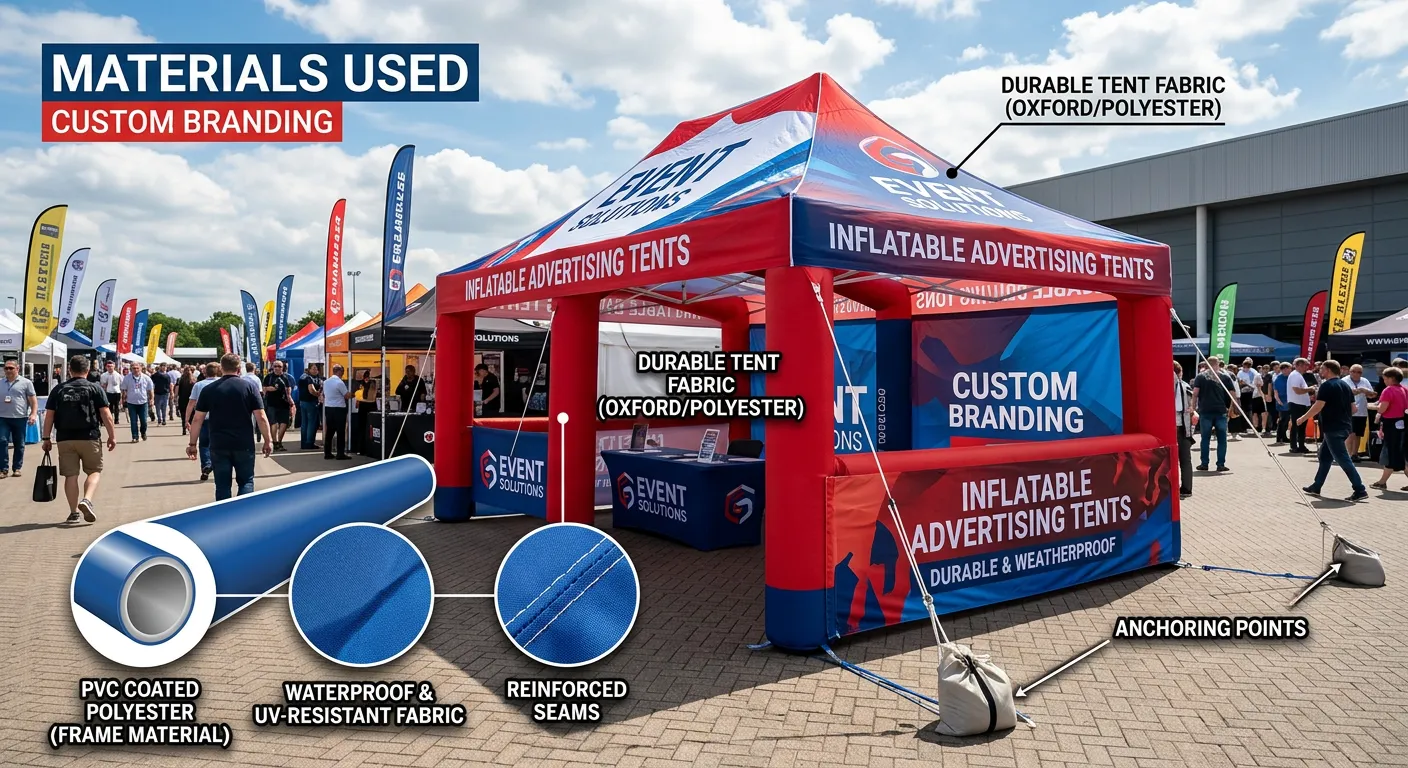
Application matters as much as chemistry. On a PVC tent skin, the coating gets sprayed or rolled on after printing and curing. On oxford fabric — the 400D oxford you’ll see in a lot of advertising tents — the weave means you need a heavier coat, and the finish tends to come out a bit more matte. If a supplier tells you they can apply an anti-graffiti coating in the same pass as the print, ask them to explain how. Usually that’s a sign they’re describing a clear topcoat, not a true anti-graffiti system.
Why Public Areas Demand Anti-Graffiti Protection
A trade show tent lives a pampered life. It’s up for eight hours, someone’s always within arm’s reach, and it goes back in the bag at night. Public areas are the opposite.
Parks, plazas, transit hubs, festival grounds, sidewalk activations — unsupervised, exposed overnight. Vandalism isn’t a rare event there; it’s a predictable cost of doing business. I’d rather budget for a coating than budget for a replacement tent every season.
And it’s not just spray paint. Public-area tents deal with:
- Permanent marker tags
- Adhesive stickers and flyers
- Scuffing from foot traffic and equipment
- Bird droppings and tree sap
- Whatever else a city throws at you
The contrast is stark. A supervised trade show tent might go three seasons without a scratch on the print. The same tent, same fabric, in an unsupervised public plaza, can look rough in a month. Same product. Different environment. That’s the whole argument for coating.
Coating Impact on Branding and Print Quality
You might be wondering whether a coating dulls your logo. Fair question, and the answer is: it depends on which finish you pick.
Gloss coatings keep colors punchy and make the tent look “new” longer, but they show scratches and smudges more readily. Matte coatings hide wear better and photograph well, but they can mute saturated colors slightly. If your brand relies on a very specific spot color, ask for a physical sample of the coated print before you approve the run. Screens lie.
The good news is that coatings don’t interfere with the printing itself. Digital and screen printing both happen first; the coating goes on top. So your custom branding — logos, taglines, QR codes, full-bleed graphics — survives intact. Same logic behind the best custom canopy tents designed for branding and outdoor use, where the print has to hold up under sun and handling, not just look good in a catalog photo.
One thing I’d push back on, though: don’t let a vendor sell you a coating as a substitute for good print quality. It isn’t. A cheap print under a premium coating is still a cheap print.
Durability, Cleaning, and Maintenance in Public Use
Let’s talk numbers, or rather, the honest absence of universal ones. Coating lifespans vary enormously by product and environment, so treat any single “X years” claim with suspicion unless the vendor ties it to a specific use case. What I can tell you is how the maintenance actually works.
Wind and structure. Coatings don’t change the tent’s wind rating — that’s about anchor points, blower capacity, and shape. Public setups need proper ballast and tie-downs regardless of coating. For a deeper look at how wind ratings interact with setup, that’s a topic worth its own guide, and there’s good material in the setup and wind ratings discussions floating around buyer resources.
Cleaning graffiti. For sacrificial coatings: peel or strip, then reapply. For permanent coatings: use the solvent the manufacturer specifies, work in small sections, and don’t let solvent pool. Never use abrasive pads — you’ll scratch the coating and create a foothold for the next tag.
Repairability. PVC tents patch easily with a heat weld or patch kit. Coated oxford is trickier; you’ll want patch material with matching coating. Ask your supplier for a repair kit at the time of order, not after the first tear.
보관. Clean and dry before packing. A coated tent stored damp will grow mildew under the coating, and that’s a problem you can’t clean your way out of.
This is what inflatable tent durability really means in practice — not a single rating, but how the whole system holds up to cleaning cycles, weather, and handling.
Cost Factors for Anti-Graffiti Inflatable Tents
I’m not going to hand you a fake price table, because coating add-on pricing depends on tent size, fabric, coating type, and order volume. What I can do is frame the decision correctly.
Base tent cost is your starting point. The coating is an add-on — typically a percentage on top of the base, with permanent coatings costing more than sacrificial ones. Then factor in reapplication. Sacrificial coatings are cheaper upfront but you’ll reapply them, so the lifetime cost can end up higher.
Now the other side of the ledger. What does it cost to replace a vandalized tent? Not just the tent — the reprint, the shipping, the downtime, the event you cover with a wrinkled backup. In my experience, one avoided replacement usually pays for the coating. Two, and it’s not even close.
If you’re pricing this out, get quotes for both coated and uncoated versions of the same tent. The gap will tell you more than any article can. For broader budgeting context, the conversations around inflatable trade show tents costs are a useful reference point, since public-area tents share a lot of the same cost drivers.
How to Choose a Vendor for Public-Area Tents
This is the part that actually protects you. When you’re talking to a supplier, ask these directly:
- What coating system do you use — sacrificial or permanent? Name the chemistry.
- Is the coating applied after printing and curing, or is it a topcoat?
- What’s the warranty on the coating itself, and does it cover graffiti damage?
- What’s the reapplication process, and can I do it on-site?
- Can you send a coated sample of my actual print before production?
If a vendor can’t answer 1 through 3 without checking, that tells you something. The coating warranty is the one buyers skip and regret. Get it in writing, including whether reapplication is covered or billable.
For context on what a serious supplier looks like: KCCE (Dacheng outdoor products LTD.), established in 2006, runs a 2,800 square meter facility with over 70 production machines and roughly 40 skilled staff, holds CE and RoHS compliance, and ships to 75 countries with Europe and the US as primary markets. That’s the kind of profile where you can actually get a coating spec sheet and a straight answer about application method. Their inflatable advertising tent line includes custom branding options on premium oxford fabric and 400D oxford builds with free 3D design — the sort of product base you’d specify a coating onto.
Whoever you choose, ask for the coating spec sheet before you ask for the quote. It changes the conversation.
자주 묻는 질문
Q: Are inflatable tents durable for public outdoor use?
A: Yes, with the right spec. Durability in public areas comes down to fabric weight, anchoring, and surface protection. A coated tent on quality oxford or PVC, properly ballasted, handles unsupervised outdoor exposure far better than an uncoated one. The coating specifically addresses the vandalism risk that trade-show tents never face.
Q: Can logos be printed over anti-graffiti coatings?
A: The order is reversed — printing happens first, then the coating goes on top. Your custom branding stays fully visible and protected underneath. Gloss finishes keep colors vivid; matte finishes hide wear better. Always approve a physical coated sample of your actual print before full production, since screens can’t show finish accurately.
Q: How much do coated inflatable tents cost?
A: Coating is an add-on to base tent cost, priced as a percentage that varies by size, fabric, and coating type. Permanent coatings cost more upfront than sacrificial ones, but sacrificial coatings need periodic reapplication. Compare a coated and uncoated quote for the same tent — the gap is usually smaller than one replacement tent.
Q: Do coatings withstand wind and weather?
A: Coatings are chemical surface treatments; they don’t change wind ratings, which depend on anchoring, ballast, and structure. What coatings do handle well is UV, rain, and grime. For public setups, pair any coating with proper tie-downs and ballast — the coating protects the print, not the frame.
Q: How do you clean graffiti off inflatable tents?
A: Sacrificial coatings are peeled or stripped away, taking the graffiti with them, then reapplied. Permanent coatings are cleaned with the manufacturer’s specified solvent, worked in small sections. Never use abrasive pads — they scratch the coating and give the next tag something to grip.
Q: Can you paint a canopy tent?
A: You can, but it’s rarely the right move on a coated advertising tent. Adding paint over an anti-graffiti coating defeats the coating’s purpose and usually voids its warranty. If you want a different color or graphic, order it printed from the factory. For touch-ups on uncoated fabric, use manufacturer-approved fabric paint only.
Q: Can you put a tent up in a public park?
A: Often yes, but permits are usually required, and rules vary by jurisdiction. Beyond permission, public parks are exactly where anti-graffiti coatings earn their keep — overnight exposure, foot traffic, and no supervision. Check local regulations first, then spec the tent for the environment you’re actually placing it in.
Q: Where can I find a custom canopy tent in the 10×10 size?
A: Most established inflatable and canopy manufacturers offer 10×10 as a standard footprint, including custom-branded versions. Ask specifically whether the 10×10 build supports coating application, since smaller panels sometimes limit finish options. Request the coating spec sheet alongside the size confirmation.
Q: What is the best canopy for art shows?
A: Art shows combine public exposure with high-value contents, so prioritize a coated, well-anchored canopy with a clean print and easy-clean surface. Matte finishes photograph better for vendor booths. Weather resistance and quick setup matter as much as looks — you’re often setting up alone, on grass, in unpredictable conditions.
결론
Before you sign any quote for a public-area tent, ask one question: “Can you send me the coating spec sheet?” If they can, you’re talking to a real supplier. If they can’t, you’re about to buy a tent twice — once now, and once after the first tag. The coating premium is almost always cheaper than the replacement. Almost always.
참고 문헌
1. kcceinflatable.en.made-in-china.com – kcceinflatable.en.made-in-china.com