Most buyers overpay for a custom canopy tent 10×10. Why? Because every brand hides the price behind “get a quote.” You fill out a form, wait two days, get a number with no context, and have no idea if it’s fair. I’ve watched purchasing managers sign off on $1,200 tents that a $500 frame would have matched — and I’ve watched them buy $200 tents that shredded in the first rainstorm. So here’s the buyer’s comparison I wish someone had handed me years ago: real price tiers, frame specs, printing methods, lead times, and where the free shipping and USA-made flags actually matter.
빠른 답변
A custom canopy tent 10×10 typically runs from roughly $200 at the economy end to around $1,200 for heavy-duty commercial builds with full dye-sublimation printing. What drives the price? Frame gauge, fabric denier and coating, print method, and whether you buy a full tent or a replacement custom tent cover.
What a Custom Canopy Tent 10×10 Actually Costs (Price Tiers)
Let’s start with the number everyone wants and nobody publishes. The custom canopy tent 10×10 price question is the single most common one I hear, and the honest answer is that the market spans a wide range — Social media buyers regularly report seeing quotes ranging from about $200 up to $1,200 for what sounds like the same product. That gap isn’t random. It maps to tiers.
Economy tier (roughly $200–$400). Lightweight frames, thinner legs, single-color or basic printing. Fine for a one-off weekend event, a school fair, a pop-up at a farmer’s market. Not fine if you’re doing 15 shows a year.
Commercial tier (roughly $400–$700). This is where most businesses should land. Thicker steel legs, better fabric coating, dye-sublimation printing with full-color logos. It’ll survive a season of regular use if you treat it reasonably.
Heavy-duty tier (roughly $700–$1,200). Reinforced frames, higher-denier fabric, UV-resistant and waterproof coatings, longer warranties. This is the custom canopy tent 10×10 heavy duty bracket — built for weekly setups, trade show circuits, and curbside programs that run rain or shine.
Printing is the other cost lever. Dye-sublimation — the method Master Canopy highlights for full Pantone color support and accurate brand colors across multiple seasons — handles multi-color logos at basically one price. Screen printing can be cheaper for a single flat color but gets expensive fast with additional colors. If your logo has more than two colors, dye-sub almost always wins on value.
Budget by use case: trade show events, plan commercial tier and up — you’re buying repeat exposure, not shelter. Product sampling and curbside, heavy-duty pays for itself because downtime costs more than the tent.
Frame Specs That Separate Cheap From Heavy-Duty
Here’s where I get opinionated. The frame is the tent. Fabric gets the attention because it’s what you see, but the frame decides whether you’re still using this thing in year three.
Leg thickness and gauge are the first things to compare. Thicker-walled steel legs in square or hexagonal profiles are what Master Canopy points to as the reliable choice for frequent event use — strong and still portable. Thin round tube legs on economy tents flex under wind load. You’ll feel it the first time a gust hits.
Wind rating and warranty length are your proof points. A manufacturer confident in its frame backs it with a multi-year warranty; a cheap frame gets a season or nothing. Ask for both numbers in writing before you buy a custom canopy tent 10×10 heavy duty. If a seller can’t tell you the leg gauge, walk.
My minimum spec checklist before buying:
- Steel legs, square or hexagonal profile, with a stated wall thickness
- High-denier polyester top with UV-resistant and waterproof coatings
- Frame warranty stated in years, not “limited”
- Weighted base options or stake kits included
- Replacement parts available — because a bent leg shouldn’t kill a $700 tent
That last one matters more than people think. A 10×10 Canopy Tent Heavy Duty is only heavy-duty if you can service it.
Printing Methods & Logo Artwork: What You Get
If you want a Custom 10×10 Canopy Tent with company logo, the print method is what determines whether your brand colors look right at the show or slightly off in a way nobody can name.
Dye-sublimation is the standard for quality work. The ink bonds into the fabric rather than sitting on top, so it holds up across seasons of outdoor use and handles gradients and multi-color logos cleanly. Screen printing lays ink on the surface — cheaper for one flat color, but it can crack over time and every added color adds cost.
Free artwork proofs are the norm in this industry, and you should never approve a proof without asking these questions:
- Is this a dye-sub or screen print proof, and what’s the color-matching process?
- What file format do you need — vector, or will you redraw my logo?
- Will the proof show the actual print area dimensions on the 10×10 canopy?
- What happens if the delivered print doesn’t match the approved proof?
That last one is your leverage. Get the reprint policy in writing. I’ve seen buyers stuck with a washed-out logo because they approved a low-res mockup and nobody owned the mistake.
Lead Times, Shipping & USA-Made Options
Standard production on custom printed tents runs a few weeks, then shipping on top of that. Rush options exist and they cost more — sometimes meaningfully more, because rush means your job jumps the queue at the print shop.
Two flags to check on any product page: free shipping and USA made. Master Canopy, for example, advertises free shipping on orders over $99, and Sign Shark bundles free design and shipping into its promotions. Free shipping on a tent this size is real money — a 10×10 canopy ships in a long box and freight isn’t trivial. USA-made matters if you’re buying for government work, need tighter quality control, or just want a domestic warranty contact.
For event season, work backward. If your first show is in April, order in February. Custom canopy tent 10×10 for sale online listings often quote production windows that don’t include transit time — ask for the door-to-door date, not the ship date.
Cover-Only vs. Full Tent: Which Buyers Need What
You might be wondering whether you need a whole new tent or just a top. Plenty of buyers already own a frame and only need a Custom Tent Cover — and that’s a much cheaper way to refresh branding.
The catch is compatibility. Frame brands differ in leg spacing, peak height, and valance attachment, so a cover built for one frame brand often won’t fit another cleanly. Before ordering a replacement top, confirm:
- Your frame’s brand and model, or measure leg-to-leg spacing and peak height
- How the top attaches — velcro, zipper, or sleeve
- Whether the seller offers covers for your specific frame
First-time buyers should just get the full tent. The frame-plus-cover bundle is priced to make that the obvious choice, and you avoid the fit gamble entirely.
The Shortlist: Cheapest, Heaviest-Duty, Fastest-Ship
No fake model tables here — I won’t invent specs I can’t verify. Instead, here’s how to pick by buyer type, and what “best custom 10×10 canopy tent” means for each:
- Cheapest that’s still sane: economy tier, single-color print, one or two events a year. Verify the leg gauge anyway.
- Heaviest-duty: commercial or heavy-duty tier with square steel legs, high-denier coated fabric, and a multi-year frame warranty. This is the custom canopy tent 10×10 heavy duty pick for trade show circuits.
- Fastest-ship: ask every vendor for door-to-door dates and rush pricing before you compare anything else. The cheapest tent that arrives late is the most expensive tent you’ll buy.
- Replacement buyers: cover-only from the maker of your existing frame. Cheapest path to fresh branding.
Where to buy a custom 10×10 canopy tent with logo? Request quotes from two or three vendors, ask for artwork proofs from each, and compare frame specs side by side. If a vendor won’t share leg gauge and warranty terms before you commit, that tells you something.
What Is a 10×10 Custom Canopy Tent? Full Use-Case Breakdown
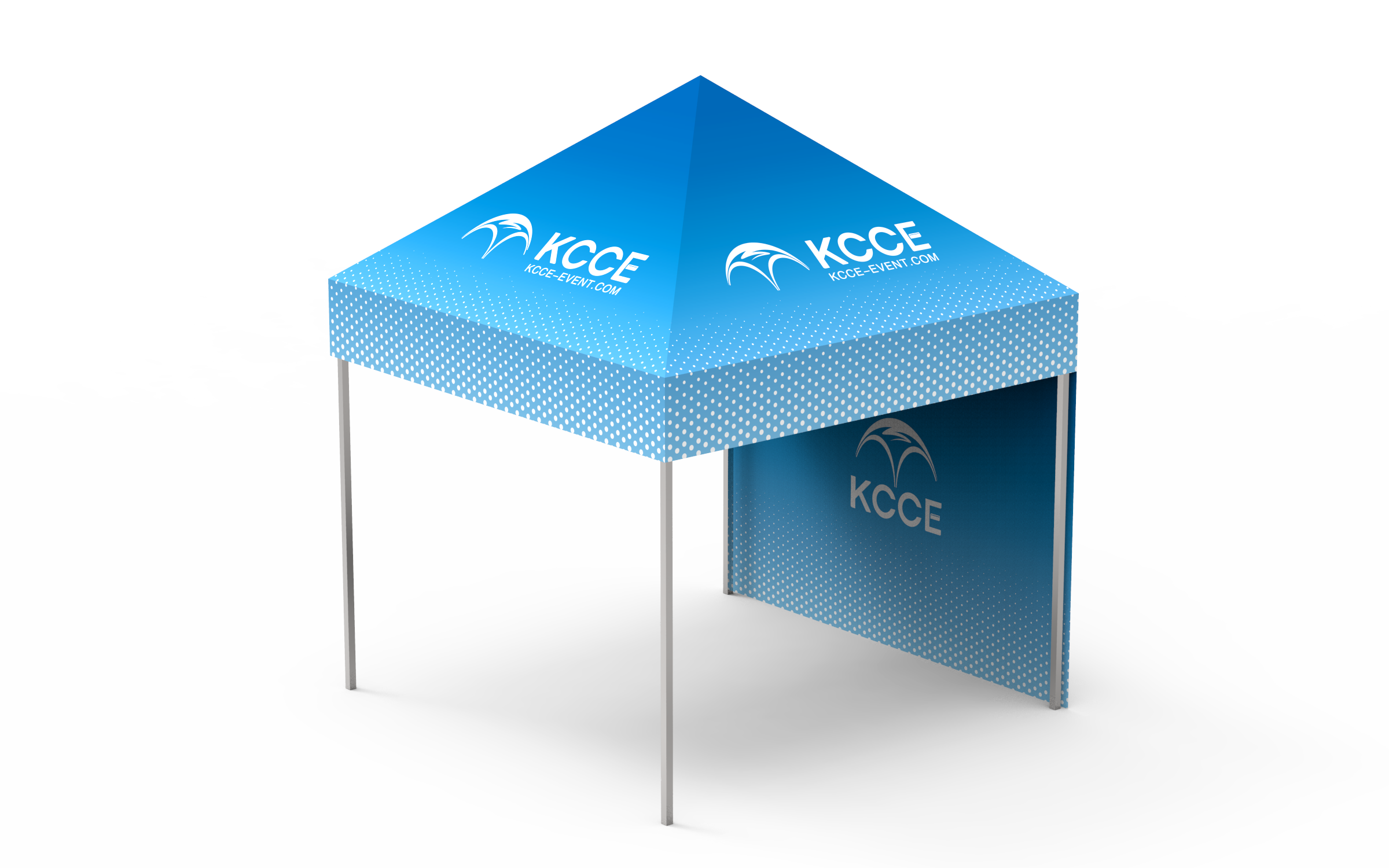
A 10×10 custom canopy tent is a 10-foot by 10-foot pop-up shelter — 100 square feet of footprint — with your branding printed on the top, valance, or sidewalls. The frame is usually steel or aluminum with a scissor-style truss that expands from a collapsed bundle in under two minutes with two people. The “custom” part is what separates it from a hardware-store ez-up: the canopy is printed to your artwork and color-matched, not just slapped with a stick-on banner.
Where it actually earns its keep: outdoor trade shows and craft fairs (standard 10×10 booth allotments fit this size exactly), farmers markets and product sampling, race-day and sponsorship activations, restaurant curbside and pickup lanes, school and charity fundraisers, and dealership or real-estate open houses. It’s also the default rental-tier size for event planners, which is why replacement tops and sidewalls sell as standalone SKUs.
The size matters for logistics, too. A collapsed 10×10 frame typically runs roughly 60–64 inches long and 8–10 inches square. so it fits in the bed of a pickup or the back of an SUV with the seats down. If you’re hauling weekly, confirm the collapsed length against your vehicle before you buy — this is the single most common “it doesn’t fit” complaint I hear.
Why Choose a Custom Logo Canopy? Brand Marketing Value and ROI
Run the math before you run the logo. A commercial-tier custom tent at roughly $550, used at 20 events a year for three seasons, works out to a modest per-event cost. — cheaper than a single Facebook ad click in most metro markets, and it puts your brand in front of foot traffic that already showed up interested.
The exposure compounds differently than digital. At a typical weekend trade show, a 10×10 booth sees a meaningful share of attendees walk past within reading distance of your valance. Over a 60-event lifespan, that adds up to a substantial number of impressions. plus the tent doubles as a photo backdrop — buyers post booth selfies, and your logo rides along for free.
The ROI case gets stronger when the tent is reusable across configurations. One printed top plus interchangeable sidewalls lets you swap from open-air sampling to a semi-enclosed consultation space without buying a second unit. And unlike a banner that gets tossed after one season, a well-built frame with a replacement cover keeps earning — which is exactly why the heavy-duty tier pays back faster than the economy tier for anyone doing more than a handful of events.
10×10 Custom Canopy Core Specs Explained (Frame Material, Fabric, Dimensions)
Here’s the spec sheet language that actually matters, translated.
Frame. Look for steel legs in square or hexagonal profile with a stated wall thickness — 0.8mm is often cited as the practical floor for regular commercial use, and heavier builds push past 1.0mm. Aluminum is lighter and rust-proof but flexes more; steel is stronger per dollar. Truss bars should be nylon or metal-reinforced at the joints, not bare plastic.
Fabric. The top is almost always polyester, and denier is the durability number. 300D is economy weight; 500D–600D is often considered the commercial sweet spot.; heavier Oxford weaves show up in the heavy-duty bracket. Coating matters as much as denier — a UV-resistant outer treatment plus a waterproof PU or PVC backing is the combination to confirm. Look for a stated water-resistance rating and UV block percentage.
Dimensions. A true 10×10 gives 100 sq ft of shade with A peak height around 10–11 feet and valance clearance near 6.5–7 feet at the eaves. Confirm the footprint is measured at the frame base, not the fabric overhang — Some “10×10” tents are actually about 9.5 feet across the legs.
Commercial-Grade vs Recreational: How to Choose the Right 10×10 Tent
This is the decision that saves or costs you the most money, so here’s the comparison I’d want in front of me.
| Spec | Recreational | Commercial-Grade |
|---|---|---|
| Leg wall thickness | ~0.5–0.6mm | 0.8–1.2mm |
| Fabric weight | 200–300D | 500–600D+ |
| 풍력 등급 | Often unstated | Typically rated to 25–35 mph (anchored). |
| Frame warranty | 90 days–1 year | 3–5 years |
| Setup cycles | Occasional/weekend | Weekly, season after season |
| Typical use | One-off events, backyard | Trade show circuits, curbside, rentals |
The rule of thumb: count your annual setups. Under five events a year, recreational is defensible. Five to fifteen, go commercial. More than fifteen, or any program that runs rain or shine, buy heavy-duty — downtime at a paid booth costs more than the tent upgrade. And check the warranty terms, not just the length: a multi-year frame warranty that excludes “wind damage” is worth less than it looks. Ask what’s actually covered before you sign.
Customization Options: A Complete Guide to Logos, Colors, Sidewalls, Valances, and Peak Configurations
The tent is a billboard with parts, and each part is a separate decision.
Logo printing. The canopy top is the main canvas — full-color artwork printed across the roof panels, sized so it reads from 20–30 feet out. Keep critical text large; fine print on a canopy roof is unreadable at booth distance.
Colors. Custom canopy color is usually matched to a Pantone reference. Confirm the printer supports Pantone matching rather than “close enough” CMYK, and ask for a physical proof or a photo of a prior run in your color — screen colors lie.
Sidewalls. Options run from plain solid walls to half-walls, mesh walls, and full printed walls. Mesh keeps airflow and visibility; solid walls create a professional enclosure for consultations. Most buyers order one printed front wall and leave the rest open.
Valances. The hanging skirt around the eaves — 6 to 12 inches deep — is prime real estate for your URL or phone number, and it’s readable at eye level as people walk past.
Peak configurations. Standard flat or peaked roofs are the default; reinforced peak caps and vented peaks help with wind and heat. A printed peak cap adds branding visible from a distance.
Printing Methods Compared: Heat Transfer, Screen Printing, and Digital Printing
Three methods dominate, and picking wrong is how buyers end up with a logo that fades by August.
Heat transfer (dye-sublimation). Your artwork is printed onto transfer paper and heat-pressed into the fabric fibers. It handles full-color, multi-color logos at essentially one price, produces sharp photographic detail, and because the ink bonds into the polyester rather than sitting on top, it resists cracking and peeling. This is the default for anything with more than two colors — and the method to specify if brand-color accuracy across seasons matters.
Screen printing. Ink pushed through a mesh stencil, one screen per color. Cheapest per unit for single flat colors at volume, and durable — but costs climb with each added color, and gradients or photos aren’t practical. Ask about setup fees per screen; they’re often hidden until the quote stage.
Digital printing (direct-to-fabric). Best for short runs, one-offs, and complex artwork without setup charges. Colorfastness on outdoor fabric is the weak point — confirm the ink and coating are rated for UV exposure, and expect a shorter outdoor lifespan than dye-sub.
My call: dye-sublimation unless you have a one-color logo and a large order.
10×10 Tent Setup Steps and Safety Notes
Setup is a two-person job, and skipping the anchoring step is how tents end up in the next county.
Steps. (1) Lay the collapsed frame flat and unlock the leg extensions; (2) with one person at each end, walk the frame open until the truss clicks into place — never force a stuck joint; (3) extend legs to height and lock each pin; (4) drape the canopy over the frame peak-first, then pull the corners down over the leg tops; (5) secure the valance and attach sidewalls last; (6) anchor before you do anything else.
안전성. Anchor every time — stake kits on grass, Weighted base plates (typically 25–40 lbs per leg). on pavement. Most frame warranties and event-insurance policies require anchoring, and many venues mandate it in their vendor agreements. Don’t leave a tent up overnight unmonitored, and take it down when sustained winds approach the frame’s rated limit — a 25 mph rating means exactly that, not 25 plus gusts. Keep the canopy clear of overhead power lines, and inspect truss joints and leg pins before each setup; a bent pin is a collapse waiting to happen.
자주 묻는 질문
Q: How much does a custom 10×10 canopy tent cost?
A: Real-world quotes span roughly $200 to $1,200 depending on tier. Economy builds sit at the low end, commercial mid-range, and heavy-duty commercial tents with full dye-sublimation printing at the top. Frame gauge, fabric coating, and print method drive the difference — compare tiers, not single quotes.
Q: What is the best custom 10×10 canopy tent for trade shows?
A: For a trade show schedule, prioritize a heavy-duty frame with square or hexagonal steel legs, high-denier waterproof fabric, and a multi-year warranty. Master Canopy notes that steel frame construction in these profiles delivers strong, reliable portability for frequent event use. Skip economy frames if you’re setting up more than a few times a year.
Q: Where can I buy a custom 10×10 canopy tent with logo?
A: Most custom tent suppliers sell direct online and include free artwork proofs. Request quotes from two or three vendors, compare frame specs and warranty terms side by side, and confirm lead times door-to-door. A Custom 10×10 Canopy Tent with company logo is a multi-season purchase — treat the quote process accordingly.
Q: Is a custom canopy tent 10×10 heavy duty actually waterproof?
A: Heavy-duty tents typically use high-denier polyester with UV-resistant and waterproof coatings, per Master Canopy’s guidance on all-weather use. That handles rain, not standing water or extreme wind. Always stake or weight the frame, and never leave a canopy up unattended in a storm.
Q: Do custom tent orders come with free shipping or USA-made options?
A: Some do. Master Canopy advertises free shipping on orders over $99, and Sign Shark bundles free design and shipping into its promotions. USA-made options exist but are less common — ask directly if domestic manufacturing or a domestic warranty contact matters to you.
Q: Can I buy just a Custom Tent Cover instead of a whole tent?
A: Yes, and it’s the cheaper route if your frame is sound. The catch is fit — covers are built for specific frame brands and attachment styles. Confirm your frame’s brand and model, or measure leg spacing and peak height, before ordering a replacement cover.
Q: What printing method should I choose for my logo?
A: Dye-sublimation is the standard for multi-color logos and long-term color accuracy — the ink bonds into the fabric and holds up across seasons. Screen printing can be cheaper for a single flat color but adds cost per color and can crack over time.
결론
The trap isn’t price — it’s price opacity. Every brand hides the number, so buyers can’t tell a fair quote from a padded one. Fix that by comparing tiers instead of single quotes, and by putting frame gauge, wind rating, warranty length, and door-to-door lead time side by side before you sign. Request two or three artwork proofs, ask each vendor for their leg specs in writing, and buy the tier that matches how often you actually set up. That one habit will save you more than any discount code.
참고 문헌
1. How can I find a 10×10 custom canopy tent? – quora.com