
Inflatable Tent Supplier to the UK
Tents, arches and columns made in our own works and handed over FOB to the UK forwarder you already run with. Artwork set in the spelling and colour your brand uses, MOQ from 1 unit, and 20 years of making them.

KCCE is an inflatable tent supplier to the UK working from the factory gate rather than from a UK warehouse: canopies in Oxford cloth over welded TPU air tubes, printed to your artwork, then handed over FOB at the Chinese port your forwarder names — Felixstowe, Southampton or London Gateway all work. Your UK importer clears the entry; we supply the commercial invoice, packing list and packing marks the declaration needs.
Inflatable Tents Delivered into the UK
Structures supplied to UK buyers and set up at UK venues. The photos show deliveries that had to work with local ground conditions and site rules.

White Spider Tent on a Grass Pitch
A white spider inflatable tent with a high peak, set on a grass pitch where sightlines behind the structure matter.

Cabin-Style Inflatable Tent with a Walk-Through Front
A white inflatable tent with straight side walls and an open front, pitched on grass at a public event. The boxy footprint gives more usable floor area than a dome of the same span.

Four-Leg Canopy Printed for a Beach Activation
A blue and white inflatable canopy with four arched legs, printed for a seaside brand activation. The arched legs keep the print panel readable from the side.

Peak Spider Tent for Open-Air Events
A white spider tent with a high central peak and pointed legs, set on a lawn where a low-clearance structure would not fit the crowd.
Pair of Printed Half-Dome Tents on a Show Field
Two branded half-dome tents standing side by side on grass, each carrying the same artwork so a pair reads as one set.

Large Printed Event Tent Over a Trade Stand
A wide printed canopy tent covering an exhibition stand, with visitors walking through the middle. The flat roof panel carries the brand across the whole frontage.
What an Inflatable Tent Supplier to the UK Actually Handles
A supplier working from China and a supplier holding UK stock are two different trades. This page is about the first one, because that is what we do — and it is what most UK event contractors actually want once their volumes justify a container.
インフレータブル広告テント inflatable tent supplier to the UK sits at the front of your freight chain. We build and print the canopy, pack the unit against its manual, and hand it over FOB at the port of loading. From that point the sailing, the UK entry and the inland delivery are arranged by the forwarder and the broker you nominate — which is why UK buyers who already import from Asia get a straightforward answer and buyers who have never imported need the paperwork conversation first.
The division of labour matters more after Brexit than it did before, because the UK entry is now a separate customs event with its own data requirements. A supplier that cannot produce a clean commercial invoice, an accurate packing list and consistent packing marks will slow your clearance down regardless of how good the tent is. We build those documents against your broker’s checklist before the container is sealed.
What we do not do is hold stock in the UK, quote landed duty-paid prices, or act as importer of record. Saying that plainly is more useful than a vague promise: it tells you where your responsibility starts, and it keeps the price at factory level rather than at a UK warehouse level.
重要ポイント
Who in the UK Orders Inflatable Tents From Us
Four types of buyer account for most UK enquiries, and each one puts pressure on a different part of the order. The specification conversation starts there.
Event and activation agencies
Campaign tents where the canopy carries a client brand for one weekend or one touring season. Artwork changes between campaigns, so re-skinnable canopies matter more than stock depth.
Exhibition stand contractors
Booth footprints that have to clear a venue floor plan at the NEC or ExCeL, with columns and arches ordered alongside the tent so a stand can be rebuilt show to show.
Brands buying their own kit
Marketing teams who have rented for years and now want the tent in their own livery, stored at their own yard and installed by their own crew.
UK distributors and resellers
Buyers who place a first order to test the print quality and then re-order against the same approved layout, with packing marks their own customers can read.
Custom Inflatable Tent UK Builds: Six Models We Supply
These six cover most UK orders, from a single branded dome on a promenade to a festival main stage. Each card opens the model page with its own size list taken from the manual.

X
Modular aluminium connectors, awnings and banner walls. The model UK agencies pick when one tent has to grow into two for the next activation without a second order.
X6
Six ports let the frame go up in stages, so a two-person crew can raise a wide span without waiting for extra hands or a forklift to reach the site.

XII
The widest span we build, with nine ports inflated in numbered order. Specified for festival main stages and exhibition footprints that cannot be split.

N
Rectangular footprints from 3x3M up to 5x10M, which sit inside stand boundaries better than a round span and line up along a venue wall.

XL-A
Wide and narrow awning options plus connecting cloth, used where a branded frontage has to follow the shape of a building rather than a field.

AII
Single-port dome whose canopy lifts off on Velcro, so a new campaign means new artwork rather than a new tent.
Printing for UK Programmes: Artwork, Colour and Spelling
Most print problems on imported tents are not printing problems, they are proofing problems. Four things get settled before anything is cut.
Full-canopy heat-transfer print
Colour goes into the canopy fabric itself rather than onto a banner hung in front of it, so a logo holds up whether it is read from the roof, from a wall or from across a crowd. The X series canopy is the documented 400D Oxford cloth.
British spelling set at proof stage
Programme, colour, metre, organisation. If your brand uses British spelling we set the proof that way before printing, because a reprint for one letter is an expensive correction.
Colour matching against a brand guide
Send the brand guide or a physical reference and the print is matched to it. Colour blocking and two-tone panel splits are common on UK retail and sponsorship tents.
Removable canopies for re-skinning
On the AI and AII the canopy attaches with Velcro, so an agency can change artwork for the next campaign and keep the same air frame, which is the cheapest way to stay on brand.
Sizes and Inflation Data Taken From the Manuals
Two things in this table are read wrongly so often that they are worth stating: the installer column is the crew the manual specifies to inflate the tent, and it is not a seating or sleeping capacity.
| モデル | Optional sizes | Installers to inflate | Inflation ports |
|---|---|---|---|
| AI | 2.5M / 3M | 1 | 4, reducible to 1 |
| AII | 3M / 4M | 1 | 1 |
| U | 3M / 4M / 5M | 1 to 2 | 2 |
| 六 | 4M / 5M / 6M | 1 to 3 | 3 |
| VII | 5M / 6M | 1 to 3 | 3, reducible to 1 |
| F | 3x3M / 4x4M | 2 to 3 | 2 |
| N | 3x3M / 4x4M / 5x5M / 4x6M / 5x10M | 3 to 4 | 2 |
| X | 3M / 4M / 5M / 6M / 7M / 8M | 2 to 5 | see manual |
| X6 | 5M / 6M / 7M / 8M | 2 to 4 | 6 |
| XII | 4M / 6M / 8M / 10M | 1 to 6 | 9, in numbered order |
| XL-A | 4.5x3M / 6x4M / 7.5x4.8M | 1 to 3 | 5, reducible to 3 or 1 |
| XL-B | 8x4.5M / 9.4x5.5M | 2 to 3 | 7, reducible to 3 or 1 |
If the footprint you need is not on the list, that is a conversation rather than a refusal. Tell us the stand boundary or the site plan and we will confirm which listed size comes closest, in writing.
Inflatable Tent Shipping to the UK: Ports and Handover
For inflatable tent shipping to the UK, the only decision that really changes the cost is who books the freight. We quote FOB, so the routing, the carrier and the inland delivery stay in your hands and in your forwarder’s system.
| Mode | 最適な用途 | Who arranges what |
|---|---|---|
| Sea freight, LCL | First order or a single unit | Groupage to a UK port; your forwarder books the sailing and the inland leg. |
| Sea freight, FCL | A season of events or a fleet | One container, one packing list, delivered to the port you nominate. |
| Air freight | Samples and fixed launch dates | For units that cannot wait for a sailing; quoted per project. |
UK buyers nominate the port that suits their forwarder or their own yard. Felixstowe and Southampton take most deep-sea groupage; London Gateway suits buyers whose inland leg runs into the South East; northern importers often route through a northern port and trunk it from there. We do not insist on a port — we hand over where your forwarder asks us to.
Every unit travels packed against its own manual: canopy and detachable legs in the storage bag, ground stakes, guy ropes, repair patches and spare valves in the accessory bag, and a printed setup sheet inside. Packing marks are set to whatever your warehouse or your customer needs to read on arrival, which matters when a pallet has to be split across several sites.
Clearing the UK Border After Brexit
Since the UK left the customs union, an arriving container is a customs event in its own right. None of it is complicated, but all of it has to be right the first time or the goods sit at the port.
| Step | Who owns it | What it needs |
|---|---|---|
| Importer of record | Your UK company or your freight forwarder | Needs an EORI number before the first entry is filed. |
| Customs entry | Your broker, filed through the UK customs system | Commodity code, value and origin come from our invoice, not from a catalogue. |
| Import VAT | Accounted for on the entry, or deferred under postponed accounting | Your broker chooses the method; it is a cash-flow decision, not a product one. |
| Documents we supply | Commercial invoice, packing list, packing marks | Checked against your broker’s checklist before the container is sealed. |
Two failure modes account for most delayed UK clearances on event kit. The first is a commercial invoice that describes the goods too loosely to classify — a tent, an arch and a column are different lines, and printed canopies are not the same line as unprinted ones. The second is a packing list that does not match what is in the container, usually because spares were added after the list was issued.
We close both gaps before shipment: the invoice lists each line with its own description and value, and the packing list is reissued if anything changes after the units are final. If your broker needs a document we have not mentioned, say so at quotation stage and it is prepared with the order rather than after the vessel sails.
On conformity paperwork we are deliberately careful: we supply the documents a UK importer asks us for, and we do not claim marks or approvals that we cannot put in writing. If your client or your insurer requires a specific certificate, raise it before the order is placed so it can be answered honestly rather than assumed.
From Enquiry to a Delivered UK Order
Six stages from the first email to the first installation. Nothing moves to the next stage until the previous one is agreed in writing, which is what keeps an import predictable when the goods are yours and the freight is your forwarder’s.
| Stage | What happens | What is confirmed |
|---|---|---|
| Enquiry | Purpose, footprint and unit count — three answers are enough to quote. | A quote or a clarification inside 24-48 hours. |
| Artwork and proof | Your logo laid onto the real canopy panels, spelling and colour checked. | Proof approved by you in writing before anything is cut. |
| Production | Printing, air-frame welding and final assembly, built to the approved proof. | Lead time confirmed in writing after proof approval. |
| 梱包 | Storage bag and accessory bag per unit, with stakes, guy ropes and patches inside. | Units checked against the model’s own packing list. |
| FOB handover | Units delivered to your forwarder at the named port of loading. | Your broker files the UK entry and controls the inland leg. |
| Re-order | Same layout, same panels, no re-proof from scratch. | Spares and single replacement units orderable on their own. |
Where These Tents Get Installed
Three site types, photographed on location. Grass, paved and working sites are what most UK briefs fall into, and each one changes the fixing kit more than it changes the tent.

Field and park sites
An open span on grass with guy lines out and clear space around it. This is the layout most park and festival briefs start from, and the one that needs the least ballast.
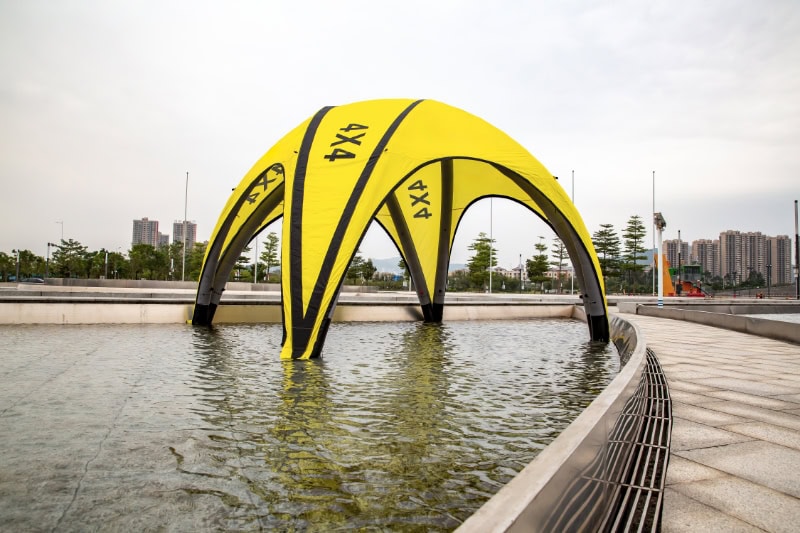
Promenades and city sites
A paved site next to water, where ground stakes are not an option and the unit is held on ballast instead. Common on UK city-centre and waterside activations.

Compound and contractor use
Tents on a working site with plant moving around them: a compound brief where the unit has to survive daily handling and be moved without a dedicated crew.
Configurations We Have Shipped
Delivered units, photographed on site. UK programmes follow the same build and the same print process; these three configurations are the ones most often specified for British briefs.

A branded dome for a regional event series
A full red dome with the client name across the roof and both visible walls. Round spans like this read from a distance, which is why they turn up on roadside and event-village briefs.

An arch inside a working venue
An arch set under a grandstand, in a space with a fixed structure overhead and a crowd route through it. The print has to work from close range and from the stand.

A clean single unit with sidewalls
One rectangular unit with sidewalls closed, set on its own. The simplest configuration we ship, and the one most first-time buyers start with before scaling to a fleet.
Pricing, MOQ and What Changes the Number
There is no list price for a printed tent, and any supplier who publishes one is quoting a specific configuration. Here is what actually moves the figure.
| 項目 | Detail | Note |
|---|---|---|
| What sets the price | Model, footprint, printed panels, accessories | Four variables, and the quote is built from them line by line. |
| What does not | Quantity discounts on a first unit | A single unit is priced as a single unit, not discounted to look competitive. |
| Currency and terms | Quoted per project (FOB) | No UK VAT is charged by us; import VAT is handled on your entry. |
| リードタイム | Confirmed in writing after design approval | We will not put a number on it before the proof is approved. |
Custom print starts from 1 unit, so a single branded unit is a normal order rather than a favour. What a single unit cannot have is a container rate: if the budget is tight, the honest lever is the footprint and the number of printed panels, not the quantity.
Setting Up on UK Ground: Stakes, Ballast and Surface
A large share of UK sites are paved. That single fact changes the fixing specification more often than the tent model does, so it belongs in the first conversation rather than the last.
Stakes where the ground allows it
On grass or soil the manual’s standard fixing applies: guy ropes and ground stakes driven at an angle, with the load spread along the line rather than at one point.
Ballast where it does not
Tarmac, paving and indoor floors take no stakes. Sand bags, water ballast and bar bags are the documented alternatives, and on some models a bar bag is standard rather than optional.
Sidewalls when the forecast turns
The manuals list lateral, window and door walls, which close an open span into a room you can keep using when the weather does what it usually does. Add them at order stage rather than retrofitting a wall to a canopy already in service.
Inflation in the manual’s order
Ports are opened in the sequence the manual sets — on the XII that sequence is numbered and has to be followed. Stop at the safety valve, cap it, then move on.
Tell us the surface when you enquire — grass, tarmac, paving, decking or indoor floor — and the fixing kit is quoted with the tent instead of being improvised on site.
The UK Event Calendar Drives the Order Date
UK buying is seasonal in a way that is easy to underestimate. The order date is set by the first show, not by the day someone signs the quote.
| Setting | Typical venues | What it changes in the order |
|---|---|---|
| Exhibition halls | NEC Birmingham, ExCeL London, Olympia London | Booth footprints and shell-scheme stands, where the tent has to clear a floor plan. |
| Outdoor and festival sites | Park and greenfield sites, racecourses, county shows | Open spans on grass, ordered in multiples and often re-used across a season. |
| City and waterside pitches | Paved squares, promenades and forecourts | Ballast instead of stakes, with the unit sized to the available frontage. |
| Sports and race venues | Stadium concourses and infield areas | Arches and infield tents that are rebuilt at every round of a series. |
Two patterns repeat every year. Exhibition contractors order once the floor plan is confirmed and need the tent in the yard before build-up, which pulls the whole chain earlier than buyers expect. Outdoor and festival buyers order against a season rather than a date, so a single container is usually split between several units and sometimes between several clients.
Both are easier to plan backwards from a fix date than forwards from a purchase order. Tell us the first date the tent has to be standing and the rest of the timetable follows — including whether a sailing still works or whether the order needs to fly.
Six Things to Ask a UK Supplier For
Whether the supplier is in China or in the Midlands, these are the six answers that separate a workable import from an expensive lesson.
よくある質問(FAQ)
A: Yes. We quote FOB in China and hand the order to the forwarder you nominate for your UK port. Groupage covers a first unit, a full container covers a season, and air freight is used where a fixed date leaves no room for a sailing.
A: There is no single price for a printed tent: the model, the footprint, the printed area and the accessories each move it, so the figure is built line by line from those four. Send them and the quote comes back in 24-48 hours.
A: Your importer of record, through the broker you nominate. That party needs an EORI number and files the entry. We supply the commercial invoice, the packing list and the packing marks the declaration is built from.
A: No. We are not a UK-established supplier and do not charge UK VAT. Import VAT is accounted for on your customs entry, through whichever method your broker uses.
A: Yes, and it is set at proof stage. Programme, colour, metre and organisation are corrected before printing rather than after, because a reprint for one letter is an expensive fix.
A: Custom print starts from 1 unit, so a single branded tent can be ordered as a trial before a fleet order. That is the usual route for a UK agency testing a supplier for the first time.
A: Yes, with ballast instead of stakes. Sand bags, water ballast and bar bags are the documented alternatives, and on some models a bar bag is standard. Tell us the surface and the fixing kit is quoted with the tent.
A: The date is put in writing once the proof is signed off. Before the model, the printed area and the unit count are locked there is nothing honest to promise, so ask for it with the quotation rather than after the order.
A: Yes. OEM and private-label packing are part of the standard offer alongside custom printing, and the arrangement is discussed per programme rather than fixed in advance.
A: Yes. Repair patches, bar bags, connection cloth and replacement canopies can be ordered separately, which is why we suggest listing uprights and ballast apart from the canopy on the first order.


