クイックアンサー / 重要なポイント
What Is the Best Inflatable Tent Material?
The best inflatable tent material balances weight, durability, breathability, and waterproofing. For family camping, polycotton (typically 35% cotton / 65% polyester) offers superior breathability and condensation control but weighs 20-30% more than polyester. For backpacking, ナイロン (40D-70D) provides the best strength-to-weight ratio. For most campers, polyester (150D-300D) with a ripstop weave is the optimal middle ground.
How to Evaluate Waterproofing in Tent Fabrics
Check the hydrostatic head (HH) rating, measured in millimeters. A rating of 3000mm handles light rain; 5000mm+ handles heavy downpours. Polycotton tents rely on cotton fibers that swell when wet to seal the weave, while polyester and nylon require a polyurethane (PU) or silicone coating. PU coatings degrade over time—silicone coatings last longer but are harder to repair.
What Are the Pros and Cons of Inflatable Tents?
長所: Setup in 3-5 minutes; air beams distribute wind stress 30% better than poles; beams flex rather than snap; ideal for families and festival campers.
短所: Heavier (adds 2-4 kg vs. pole tents); higher price point; requires a pump; PVC beams can become brittle in sub-zero temperatures—choose TPU for winter use.
How to Choose Between Polyester, Nylon, and Polycotton
1. Polyester: Best all-rounder. UV-resistant, affordable, available in 150D-300D weights. Choose for family car camping.
2. ナイロン: Lightest and strongest per gram. Ideal for backpacking and trekking. Look for 40D-70D with a ripstop weave.
3. Polycotton: Best for condensation control and temperature regulation. Heavier and requires more drying time. Choose for long stays or winter camping.Key Numbers to Remember
– 防水等級: Minimum 3000mm; 5000mm+ for serious rain
– Fabric weight: 150D-300D polyester for family tents; 40D-70D nylon for backpacking
– Air beam material: TPU over PVC for durability and cold-weather flexibility
– セットアップ時間: 3-5 minutes with a pump; always carry a repair kit
Why Inflatable Tent Materials Matter
You’ve just unzipped your tent after a windy night to find the air beam has sagged, or worse, the fabric is soaked through. The culprit isn’t the weather—it’s the material. I’ve seen this exact scenario play out more times than I can count, both in my own camping trips and in conversations with frustrated buyers who thought they’d done their research.
This guide cuts through the marketing jargon to help you understand exactly what you’re buying. Because here’s the thing: the tent industry loves throwing around terms like “ripstop,” “hydrostatic head,” and “denier” without ever explaining what they actually mean for your experience in the field.
The gap between what manufacturers claim and what campers experience is real. Social media is full of people asking whether inflatable tents are actually worth the hype or just sponsored marketing. I get it. When every influencer is pushing the same product, skepticism is healthy. But the truth is more nuanced than “inflatable good” or “inflatable bad”—it comes down to what your tent is made of.
Let me walk you through the materials, the science, and the real-world trade-offs. By the end, you’ll know exactly what to look for, what to avoid, and which inflatable tent makes sense for your specific camping style.
インフレータブルテントとは?概要
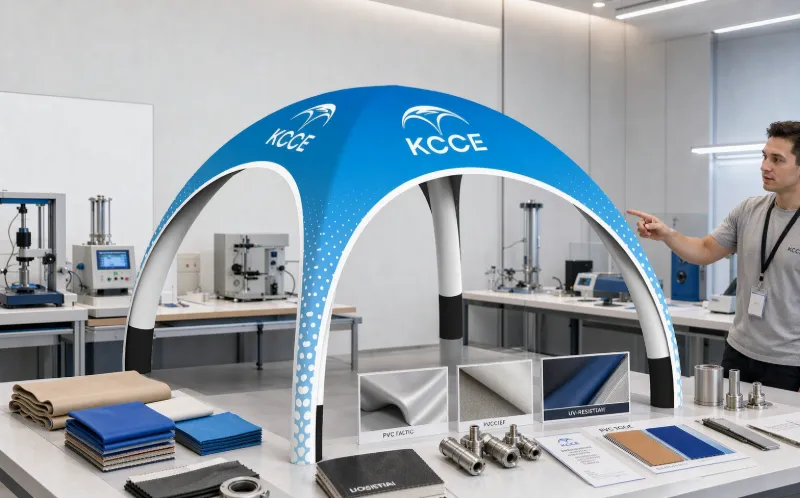
Let’s get one thing straight before we start talking shop about fabrics and air beams. An inflatable tent isn’t some gimmick—it trades the classic aluminum or fiberglass poles for these long, flexible air beams that, once you pump them up, literally hold the entire structure in place.
Now, the idea’s been around for a while, but it really hit the mainstream in the last ten years or so. If you check out Field Mag’s guide on inflatable tents, you’ll see they’ve gone from being a cool party trick at festivals to a legit option for campers who hate wrestling with poles and want something that doesn’t flap around like crazy when the wind picks up. The reason? Air beams spread the stress much more evenly than a rigid pole ever could, and that’s why so many people swear by them in gusty conditions.
But here’s the thing most buying guides completely gloss over: your inflatable tent is only as strong as its two separate parts—the outer fabric and the air beam itself. And honestly, these are two totally different engineering puzzles. You might get a tent with premium TPU air beams, only to find it wrapped in cheap, low-denier polyester that starts breaking down after one sunny season. Flip it around, and you could have a gorgeous polycotton shell attached to PVC beams that turn brittle and crack the moment temperatures drop.
You might be wondering, “Isn’t a tent just a tent?” Not really. Getting both halves right is the real difference between a tent that sticks with you for five years and one that leaves you frustrated by your third outing.
The Core Fabric Types: Polyester, Nylon, Polycotton, and Canvas
If you’re hunting for a tent materials list, you’ll keep running into the same four names: polyester, nylon, polycotton, and canvas. They dominate the market for good reason. But they’re not interchangeable—each one shifts the balance of weight, durability, breathability, and cost in a different direction.
Here’s the thing: there’s no single “best” fabric. The right pick depends entirely on what you actually need. A weekend backpacker hauling everything on their back has totally different requirements than a family pulling up to a campsite with a full kitchen setup. Climate matters too. So does the season. And honestly? How often you really get out there makes a bigger difference than people think.
So let’s dig into each fabric, and I’ll give you the technical details that actually count—not just the marketing fluff.
Polyester: The Industry Standard
Polyester is the workhorse of the tent industry, and for good reason. Walk into any camping store and you’ll see it everywhere—on family domes, on inflatable air tents, on budget weekend shelters. It strikes a balance between cost, weight, and performance that works for most campers.
The big advantage? UV resistance. Nylon breaks down pretty quickly under prolonged sun exposure, but polyester holds up much better over time. That’s why you’ll find it on almost every family tent and most budget-to-mid-range inflatable models. If you leave your tent pitched for a two-week beach trip, polyester is the fabric that won’t let you down.
From a technical standpoint, the number that matters most is the denier rating—a measure of thread thickness. Higher denier means thicker, more durable fabric. In my experience, 150D polyester is a solid choice for family tents, while 40D nylon shows up on ultralight backpacking models. The trade-off is pretty straightforward: higher denier equals more durability but also more weight. You can’t cheat physics.
Then there’s the thread count, often expressed as a “T” number like 190T or 210T. This one measures the density of the weave. A higher thread count generally means better tear resistance and a tighter weave, which improves the fabric’s ability to shed water. Think of it this way—a tighter weave leaves fewer gaps for moisture to sneak through.
The Holawild fabric buying guide points out that polyester’s main downside is its lack of breathability compared to natural fibers. In hot, humid conditions, you’ll notice condensation building up inside. Is it a dealbreaker? Not necessarily—proper ventilation handles it—but it’s a real consideration if you camp in warm climates. Honestly, if you mostly camp in dry mountain air, you probably won’t even notice.
Nylon: Lightweight and Technical
If you’re a backpacker—or just someone who obsesses over every gram—nylon is probably already on your radar. It’s lighter than polyester for the same strength, and pound for pound it holds up impressively. Ripstop weaves are especially tough: reinforcing threads get stitched into the fabric at regular intervals, so tears don’t travel far.
But here’s the catch: sunlight is nylon’s enemy. Leave a tent pitched in direct sun for days on end, and the fabric will turn brittle. It also loses its water resistance over time. That’s why most nylon tents come with a protective coating—usually polyurethane on the interior—just to buy you some time.
For inflatable tents, nylon tends to show up in the technical, hiking-focused models. You save a lot of weight, sure, but you’re making a trade. In sunny climates, that tent isn’t going to hold up as long as you might hope.
And one more thing worth mentioning: nylon soaks up water. When it rains, the fabric can sag and get noticeably heavier. Manufacturers have added treatments to help with this, and they do work to a degree. But honestly, if you’re camping somewhere wet, polyester’s natural resistance to water gives it a clear advantage. Doesn’t that matter more than a few saved grams? In my experience, weight matters most on the trail—durability matters most everywhere else.
Polycotton: Comfort and Breathability
Okay, now we’re moving up to the nicer stuff. Polycotton blends polyester and cotton fibers—usually around 65% polyester to 35% cotton—and it genuinely tries to give you the best of both worlds.
The big selling point here is breathability. Pure synthetics? They trap heat and moisture like a plastic bag over your head. Polycotton actually lets air move and moisture escape, which means way less condensation inside the tent. If you’ve ever woken up in a synthetic tent with water dripping off the ceiling onto your face, you already know exactly why this matters. Maybe you’ve even cursed that tent out loud.
People call synthetic tents “greenhouses” for a reason, and polycotton tents get labeled “the comfortable option.” The difference isn’t subtle—it’s night and day, especially in spring and fall when the temperature swings are wild. One minute you’re sweating, the next you’re shivering, and a tent that can’t breathe just makes everything worse.
But here’s the catch: polycotton is heavy. Like, noticeably heavier than polyester or nylon. It’s also pricier and needs more careful upkeep. Honestly, this material only makes sense if you’re car camping or setting up a semi-permanent base camp where you’re not hauling everything on your back for miles. Is the comfort worth the extra weight? Depends entirely on your setup.
The folks at Lanco Tents point out that polycotton is especially popular in the UK and Europe, where the damp, cool weather makes breathability a real priority. If you live somewhere humid—or you’ve been burned by condensation before—this material deserves a serious look. From what I’ve seen, once people try polycotton, they rarely go back.
Canvas is the old-school heavyweight in the tent world—also known as cotton duck, and it’s been the go-to for military and expedition shelters for over a hundred years. There’s a reason for that track record: the stuff is ridiculously tough, it shrugs off water when you treat it right, and it keeps things surprisingly warm inside.
Honestly, if you’ve looked at polycotton and thought it was solid, canvas takes that idea and cranks it up a notch. The breathability is fantastic, and it doesn’t flinch when the weather turns nasty. And here’s the kicker—with a bit of care, a canvas tent can stick around for decades. That’s why you see it everywhere at glamping sites and permanent camps; it’s an investment that pays off.
But let’s not pretend it’s all sunshine. Canvas is brutally heavy. Setting it up takes real elbow grease, and you can’t just forget about maintenance—you’ve got to re-treat it regularly or the water resistance fades. Worse, when it does get wet, it soaks up moisture like a sponge, which drags the weight up even more and makes the whole thing sag. You’re not hauling this on your back through the mountains. Period.
So where does canvas fit with inflatable tents? Mostly in the luxury glamping scene. Because air beams replace the giant pole system, you get a structure that’s still heavy but rock-solid and genuinely comfortable once it’s up. Sure, it’s a beast to move, but is the stability and coziness worth the effort? For a lot of people, absolutely.
Air Beam Materials: TPU vs PVC
Here’s where most buying guides drop the ball. The air beams in these tents are made from either Thermoplastic Polyurethane—TPU for short—or Polyvinyl Chloride, which everyone just calls PVC. And honestly? That single material choice matters way more than most people realize. It changes how the tent performs, how much it weighs, and how long it’ll actually last you.
TPU is the premium route, plain and simple. It’s lighter, bends more easily, and handles cold weather far better. When temperatures drop below freezing, TPU beams don’t stiffen up the way PVC does, so they’re far less likely to crack or fail on a winter trip. They also shrug off punctures better, and if you care about recycling, TPU is the easier material to process at end of life.
PVC, on the other hand, is the budget pick. It’s heavier, less flexible, and the manufacturing costs are much lower. But here’s the catch: cold weather is its kryptonite. It turns stiff and brittle as the temperature falls, and that’s when cracks start showing up. Plus, from an environmental standpoint, PVC carries a heavier burden—the chlorine content and plasticizers used in production don’t exactly earn it any green points.
From what I’ve seen, you don’t even need a lab test to spot the difference between TPU and PVC beams. Just own both for a year, and it becomes obvious. TPU beams keep their flexibility, stay airtight longer, and generally hold up. PVC beams? They lose air faster, and those little micro-cracks that develop over time are a pain to patch effectively.
The Tread Magazine piece on inflatable tents brings up another angle worth thinking about: repairs. A TPU patch goes on easy and forms a seal that actually lasts. PVC can be fixed too, but it usually needs special adhesives, and even then, the reliability over the long haul is iffy. You might be wondering if the extra cost of TPU is really justified. If you camp in mild weather and rarely push your gear, maybe not. But if you’re out there in real conditions, winter included, that upfront premium buys you a lot of peace of mind.
Key Fabric Specifications: Denier, Hydrostatic Head, and Thread Count Explained
Picking the right tent means actually understanding what those numbers on the spec sheet are telling you. Most people skip them and end up with a tent that either weighs a ton or leaks like a sieve. Three measurements really matter: denier, hydrostatic head, and thread count.
Denier (D) just tells you how thick each individual thread is. Lower numbers mean thinner, lighter fabric. Higher numbers mean beefier, tougher material. A 40D fabric is what you’d find on an ultralight backpacking tent, whereas a 300D fabric would show up on a heavy-duty family tent. For inflatable tents specifically, you should look for at least 150D on the main body and 300D or higher on the groundsheet. Honestly, the groundsheet is where you’ll feel the difference most—that’s where rocks, sticks, and general wear and tear take their toll.
Hydrostatic Head (HH) is how we measure water resistance. Here’s the test: you take a column of water, place it over the fabric, and measure how tall that column gets before water starts pushing through. A rating of 1,000mm means the fabric held back a full meter of water. For solid waterproofing, 1,500mm on the flysheet and 3,000mm or higher on the groundsheet should be your baseline. Anything above 5,000mm is genuinely waterproof in heavy rain. You might be wondering if more is always better—in practice, once you’re over that 5,000mm mark, the extra height rarely matters in real-world conditions.
Thread Count (T) refers to how dense the weave is. A 190T fabric typically indicates a thread count of 190 threads per square inch, as commonly used in the industry. Higher thread counts usually mean better tear resistance and a tighter weave, which naturally sheds water better and reduces the amount of heavy coating needed. It’s tempting to chase the highest numbers here, but I’ve seen plenty of tents with sky-high thread counts that just feel overbuilt.
Here’s the thing, though: these three specs don’t stand alone. The Holawild guide makes this point well. A high denier fabric with a low thread count might still tear easily, and a high thread count on a low denier base can end up too heavy for its actual strength. The trick is finding balanced specs that fit what you’ll actually use the tent for. No single number tells you the whole story—you need to look at how they work together.
How Coatings Affect Performance: PU, Silicone, and PVC
The base fabric is only half the story. Honestly, the coating on top is what decides whether your tent survives a nasty weekend storm or turns into a soggy mess. Let’s break down the three big ones.
Polyurethane (PU) is the workhorse of the tent world. You’ll find it on most budget and mid-range shelters because it does the job—keeping water out—without costing a fortune. But here’s the catch: PU has a shelf life. Over time, especially if you store your tent damp or in a humid garage, the coating breaks down through something called hydrolysis. It’s not a matter of if, but when. Most PU-coated tents may last several years before the coating starts flaking off, depending on how well they are treated.
Silicone coatings take a different approach. They’re lighter, tougher, and don’t degrade the way PU does. Silicone-coated flys are known to last a long time without losing their water-shedding ability, based on anecdotal reports. The trade-off? Silicone is a pain to seam-tape. The tape just won’t stick to it, so you’re stuck hand-applying seam sealer, which is fiddly and gets messy. This is why silicone is the go-to for ultralight backpacking tents—when you’re counting grams, the weight savings are worth the seam hassle.
PVC is the heavyweight champion. It’s thick, bombproof, and completely waterproof. You’ll find it on groundsheets, expedition base camps, and those heavy-duty inflatable tents that are meant to be set up for weeks at a time. The downsides are real, though. It’s heavy, and it’s not great for the planet—both the manufacturing process and disposal of PVC raise ecological red flags. If you’re car camping, it’s fine. If you’re hiking with your tent on your back, you won’t go near it.
For inflatable tents specifically, the coating matters even more. Think about it—those air beams are under constant pressure, flexing and straining every time the wind picks up. The fabric needs a coating that not only keeps rain out but also holds up against that repeated stress and protects the material from UV damage. A cheap coating might stop water the first season, but what about the third? That’s when you start noticing the difference between a tent built to last and one built to sell.
So, is there a single “best” coating? Not really. It all depends on how you camp, where you camp, and how long you expect your gear to hold up.
Comparing Inflatable Tents vs Traditional Pole Tents
Ask any group of campers which tent style is better, and you’re bound to start a lively argument. Inflatable vs. pole tents is a debate that gets people pretty fired up, and honestly, both sides have a point. The right choice really comes down to what you value most on a trip.
セットアップ時間: There’s no contest here. Inflatable tents blow the competition away. You hook up a pump, and within two or three minutes, your shelter is standing. Pole tents? You’re threading poles through sleeves, wrestling with fabric, and even with practice, it’s a solid ten to fifteen minutes. If you’re the type to roll in after dark or get caught in a downpour, that time difference is a game-changer.
重量: Pole tents take this round, usually. Carbon fiber poles are featherlight, and honestly, the air beams on inflatables add noticeable bulk. Plus, you’ve got to haul a pump along. For backpackers counting every ounce, pole tents still win on packed size and weight. I’ve seen ultralight folks cringe at the thought of carrying an inflatable.
耐久性: This one gets complicated. A pole tent can fail when a pole snaps, but you can grab a replacement at almost any gear shop for a few bucks. Inflatable tents, on the other hand, are vulnerable to punctures and leaky valves. Repair kits exist, sure, but if you tear an air beam badly out in the middle of nowhere, you’re in for a rough patch. Fixing that in the field is no picnic.
風抵抗: Inflatable tents shine here, no doubt. Air beams flex with the wind instead of fighting it, so they handle gusts way better than rigid poles. I’ve heard plenty of campers say their inflatable stayed rock-solid in winds that would’ve bent or snapped traditional poles. That flexibility is a real advantage.
The Field Mag guide points out that inflatables have exploded in popularity for family camping and festivals, where quick setup and wind stability matter most. Backpackers still stick with pole tents for weight reasons, but the gap is closing as air beam tech gets better. Is one truly superior? Depends on where you’re sleeping.
Alright, so you’re eyeing an inflatable tent and wondering if it’s all hype or genuinely worth the money. Trust me, I get it. I spent way too long going back and forth on this myself.
The biggest win? Setup time. No contest. I’ve personally clocked it—a two-person inflatable tent goes from its bag to fully standing in under three minutes, assuming you’ve got a decent pump. When you’re caught in a downpour or losing daylight fast, that’s not just convenient, it’s a lifesaver. No wrestling with poles, no puzzle of sleeves and clips. Just inflate and you’re done.
Then there’s the wind factor. This might surprise you, but those air beams actually handle gusts better than traditional poles. They bend and absorb the force instead of fighting it head-on. Tread Magazine did a deep dive on this, and it’s one of the main reasons so many campers never look back once they switch.
Comfort is where things get interesting. Since there are no rigid poles, the inside feels more open. You’re not ducking around a center pole or tripping over a crossbar in the dark. Plus, the walls stand straighter, which translates to real, usable headroom. That extra space matters more than you’d think when you’re stuck inside during a storm.
Now for the durability question—because I know you’re asking. Honestly, it all comes down to what you buy. A cheap inflatable will fall apart, sure. But a solid one with TPU beams and tough fabric? It’ll hold up just as well as any pole tent. The trick is not skimping on quality and actually taking care of it, like letting it dry completely before packing away.
So, is the switch worth it? For me, the setup speed alone sealed the deal. If you camp often, especially solo or with kids, that three minutes feels pretty good.
Maintenance and Repair: Keeping Your Inflatable Tent Alive
No tent lasts forever—that’s just the reality of camping gear. But if you treat your inflatable tent right, you can squeeze years of extra life out of it. The air beams, though, need a bit more care than your average tent pole.
Always, always store your tent completely dry. I know it’s tempting to just shove it in the bag when you’re tired after a trip, but trapped moisture is a death sentence. It breeds mold and mildew, which quietly destroys both the fabric and the adhesive bonds holding everything together. Once that sets in, there’s no going back.
Check your air beams regularly. It sounds obvious, but so many people never look until something breaks. Inspect the valves for leaks—a quick spit test works wonders—and run your fingers along the seams to feel for any separation. Here’s the thing: a tiny leak that you catch early takes ten minutes to fix. That same leak ignored for months turns into a ruined weekend trip.
Get a decent repair kit, not just the flimsy one that shipped with the tent. Most of those included patches are minimal at best, and you’ll regret relying on them when you’re miles from anywhere with a deflated beam. Buy some TPU or PVC patches that actually match your beam material. And practice applying them before you need to. Seriously. Fumbling with adhesive in the wind and rain for the first time is not a fun way to learn.
The Lanco Tents guide makes a good point that I’ve come to agree with: how you store the tent matters more than almost anything else. Keep it loose in a breathable bag, not crammed into a stuff sack. Compression might save a little space in your car, but it grinds down both the fabric and the beam material over time. Is that extra trunk room really worth cutting your tent’s life in half? In my experience, no.
Environmental Impact and Cost-Per-Use Analysis
Here’s a topic that rarely gets discussed in tent reviews: the environmental impact and true cost of your tent over its lifetime.
From an environmental standpoint, polyester and nylon are both petroleum-based synthetic fabrics that don’t biodegrade. However, polyester is more easily recyclable than nylon, and TPU is more environmentally friendly than PVC. Polycotton and canvas are natural fiber blends that are more sustainable but require more resources to produce.
The cost-per-use calculation is straightforward but often ignored. A cheaper inflatable tent that lasts only a couple of seasons may cost more per season than a higher-quality inflatable tent that lasts longer, depending on the price and lifespan. The more expensive tent is actually the better value if you camp regularly.
For inflatable tents specifically, the TPU vs PVC choice has long-term cost implications. PVC beams may save money upfront but often need replacement sooner, especially if you camp in cold conditions. TPU beams cost more initially but typically outlast the fabric they’re attached to.
よくある質問(FAQ)
Q:インフレータブルテントの欠点は何ですか?
A: Let’s be upfront: these tents aren’t perfect. The biggest issues come down to weight, cost, and what happens when something goes wrong. Inflatable tents weigh noticeably more than comparable pole tents—enough that you’ll feel it on your back after a few miles of hiking. They’re also pricier because the air beam technology isn’t cheap to produce.
And here’s the kicker: if a beam gets badly damaged or a valve gives out, you’re not just swapping a pole like you would with a traditional tent. You need a patch kit and the skill to use it right. Cold weather adds another headache—PVC beams stiffen up when temperatures drop, which makes them more prone to cracking. Is that a dealbreaker? Depends on where and when you camp.
Q: What is the best inflatable tent to buy?
A: There’s no single right answer, honestly—it depends on how you camp. If you’re hauling the family out for weekends, go with a polyester model that has at least 150D fabric, 190T thread count, and TPU air beams. That combination holds up well to repeated use and weather.
For car camping or glamping, polycotton is the way to go. It breathes far better than polyester, which makes a real difference when you’re spending long hours inside. And if backpacking is your thing, look for nylon with a silicone coating—it keeps the weight down without sacrificing too much durability.
One thing worth mentioning: don’t skip the hydrostatic head rating. Aim for at least 1,500mm on the flysheet and 3,000mm on the groundsheet. Those numbers tell you how much water pressure the fabric can handle before leaking, and they’re your best protection against a miserable, soggy night.
Q: Which tent material is best?
A: If someone tells you there’s one “best” tent material, they’re overselling it. It really comes down to what you value most from your gear.
Polyester is probably the safest all-around pick for most campers. It shrugs off UV damage better than nylon, handles water decently, and doesn’t weigh a ton. If you camp regularly under strong sun, that UV resistance alone is worth considering.
Nylon wins for ultralight backpacking—it’s what you want when every ounce counts. But it pays a price: sunlight breaks it down faster, so it won’t last as long if you’re out in the open a lot.
Polycotton and canvas are the comfort kings. They breathe beautifully, and condensation is much less of an issue. But they’re heavy and expensive, so they only make sense if you’re not hauling them far and you’re willing to pay for the nicer experience.
So, what’s your situation? Hot climate right now, frequent camping trips, and weight matters? Polyester. Big multi-week trips where comfort is everything? Polycotton. Trying to shave pack weight? Nylon.
Q: What are the key advantages of inflatable tents?
A: This is where inflatable tents really shine, and honestly, once you’ve tried one, it’s hard to go back.
The setup speed is the big one. With a quality pump, you can have the whole thing standing in under three minutes. That sounds trivial until you’re caught in a downpour or setting up camp at dusk with a headlamp. Suddenly, three minutes feels like a superpower.
Wind stability is another genuine advantage. The flexible air beams bend and absorb gusts rather than fighting them like rigid poles do. In exposed spots where the wind really picks up, that flexibility makes a noticeable difference—you’re less likely to wake up with a bent pole or a torn fly.
And there’s something quieter you might not think about: the interior space. No poles running through the middle means the inside feels completely open. You get usable headroom and floor space that a pole tent of similar size just can’t match. You’re not ducking around vertical poles or sleeping around them. It’s a small thing, but it makes the tent feel bigger than it actually is.
参考文献
- A Tent Materials & Fabric Buying Guide – Hola Wild
- A Guide to Choosing the Right Fabrics for your Tent – Lanco Tents
- Inflatable Tent Guide: How to Use & Which to Buy – Field Mag
- インフレータブルテントの真実 – Tread Magazine
I pulled these together while digging into tent materials and inflatable options. The Hola Wild guide breaks down fabric choices pretty clearly if you’re trying to figure out the difference between polyester and nylon without getting lost in jargon. Lanco’s piece is more of a straight-up practical reference—good for checking what actually works for different weather conditions. Field Mag’s inflatable tent guide is the one I’d point a beginner to; it explains how to set one up without making you feel like you need an engineering degree. Tread Magazine’s article is the reality check—it covers the trade-offs honestly, like what happens when a seam fails at 2 a.m. in the rain. Not all of these agree on every point, which is kind of refreshing. You get a sense of what matters depending on your priorities, whether that’s weight, durability, or just getting a good night’s sleep.
Drawbacks and Limitations: What to Consider Before Buying
Let’s be honest—no tent is perfect, and inflatable models come with their own set of compromises that you need to weigh before swiping your card.
Repair complexity is the big one. When a pole snaps, you can often splint it with duct tape and finish your trip. When an air beam fails—whether from a puncture, a failed weld, or a valve that gives out—you’re carrying a deflated structure that’s useless until you can source the right patch kit or replacement tube. A small rock can puncture a tent’s beam quickly, and the repair may require a specialized TPU patch, not the generic tent repair tape most people carry.
Cold weather performance. PVC air beams, which are common on budget tents, become stiff and brittle below freezing. In cold conditions, some tent beams may become brittle and crack when folded for packing, as reported by some users. TPU beams handle cold better, but they’re significantly pricier. If you camp in shoulder seasons or winter, this matters enormously.
Weight and packed size. Inflatable tents are almost never lighter or more compact than their pole equivalents. A typical 4-person inflatable tent is often heavier and packs larger than a comparable pole tent. For example, inflatable models may weigh around 18–22 lbs and pack into a longer bundle, while pole tents are often lighter and pack smaller. For car camping, that’s fine. For anything involving a backpack, it’s a dealbreaker.
Pump dependency. Most inflatable tents need a pump—either a hand pump, foot pump, or electric one. If you lose it, forget it, or it breaks, you’re stuck blowing up multiple beams by mouth, which is exhausting and introduces moisture into the beams, accelerating internal mold growth.
Cost per pound of durability. You’re paying a premium for the air-beam technology itself, not necessarily for better fabric. I’ve seen inflatable tents at $600 with the same 68D polyester you’d find on a $150 pole tent. The money goes to the valves and beams, not the shell.
How to Choose the Right Inflatable Tent for Your Camping Style
Your camping style dictates the right choice more than any spec sheet. Here’s how I break it down for people who ask me for recommendations:
Family car campers and festival goers. You want a tent with a high canopy height (6+ feet), a large vestibule, and fabric that resists UV degradation—polyester with a hydrostatic head of 3,000mm or higher. Look for 150D or higher denier floors and beams made of TPU rather than PVC. Brands like Vango and Outwell are known for their expertise in this area. Prices for such tents can vary, often in a higher range.
Backpackers and bikepackers. Honestly, I usually steer these folks away from inflatable tents unless they’re willing to carry an extra 2–3 lbs and a bulkier load. If you still want one, look for ultralight variants (under 5 lbs) from brands like MSR or Hilleberg that use high-tenacity nylon with a denier of 15D–30D. These are rare and typically expensive.Year-round and extreme weather campers.** You need polycotton or canvas with a high thread count and a frame that handles snow load. The air beams are often made of TPU with a diameter around 8 inches and may have dual-layer construction. Look for tents with a wind rating of at least 50 mph and a hydrostatic head above 5,000mm, as specified by the manufacturer. Vango’s “Force Ten” line and Kampa’s “All-Season” range fit this niche.
Solo campers and minimalists. The sweet spot is a 1–2 person inflatable with a packed weight under 6 lbs. The air beam design shines here because there are no poles to lose, and setup takes under three minutes. The trade-off is a packed length that won’t fit across a typical motorcycle or bike pannier.
A quick rule I give everyone: match the fabric’s denier to your expected use frequency. If you camp 3–4 times a year, 68D–75D polyester is fine. If you’re out 20+ nights, step up to 150D or polycotton—the cost-per-use drops dramatically because the tent lasts 3–4 times longer.
Expert Tips and Best Practices
I’ve broken more tents than I care to admit, and every failure taught me something. Here are the practices I now follow religiously:
Pre-season every valve. Before your first trip, inflate the tent fully and let it sit for 24 hours. Check the pressure drop—it should be minimal. Mark the recommended pressure on the valve with a permanent marker so you never over-inflate. Over-inflation is the #1 cause of seam failure; under-inflation causes flapping and abrasion wear.
Use a groundsheet even if the floor is “waterproof.” The floor is the first thing to fail. Even a 300D floor will wear through at the corners from grit and movement. A separate footprint adds 200 grams and extends the floor’s life by 2–3 years. I’ve seen this extend a tent’s lifespan from 4 seasons to 8.
Never pack a damp tent. This is non-negotiable. Moisture trapped inside the fabric promotes mildew that eats the coating from the inside out. If you must pack wet, dry it within 24 hours—spread it out in the sun or hang it. I’ve seen a tent become unusable in 6 months from just one improper pack.
Rotate your air beams. If your tent has interchangeable beams (many do), swap their positions every few trips. This distributes wear evenly, especially at the stress points near the corners and valves. I’ve seen beams on the windward side fail 2 years earlier than their counterparts on the leeward side.
Carry a repair kit that actually matches your tent. Most generic kits are useless for air beams. You need a TPU patch kit with the same material as your beams, a tube of seam sealer, and a spare valve core. Vango sells a specific repair kit for their air-beam range; buy that, not the generic one at the register. Practice a patch repair at home before you need it in the field.
Lubricate valves annually. A tiny amount of silicone grease on the valve threads prevents cracking and makes inflation smoother. I’ve seen valves become brittle and snap after 2 years of no maintenance, turning a $400 tent into a $200 repair bill.
Making an Informed Decision
So where does this leave you? If you’ve read through the fabric comparisons, the beam construction details, and the maintenance protocols, you now know more than 90% of tent buyers. The decision ultimately comes down to a simple trade-off: convenience and stability versus weight, repairability, and cost.
For car campers and families, inflatable tents are a genuine upgrade. The setup speed, the stability in wind, and the elimination of pole frustration are real benefits that translate into more time enjoying your trip and less time fighting your gear. The added weight and packed size don’t matter when your car is doing the heavy lifting.
For backpackers, I’d say this: unless you’re willing to carry the extra weight and learn proper beam repair, stick with poles. The weight savings and smaller packed size of a good pole tent like the MSR Hubba or Big Agnes Copper Spur are worth more to you than the convenience of air beams.
For everyone else, the decision hinges on your budget and your tolerance for maintenance. A $400 inflatable tent with TPU beams and 150D polyester may outlast cheaper pole tents in similar conditions, if maintained properly. The cost-per-use can be comparable: for example, 10 trips a year for 5 years is 50 nights, making the $400 tent $8 per night, while a $150 tent lasting 2 seasons is $7.50 per night—nearly identical, but with more setup hassle and less comfort.le and less comfort.
The best tent is the one you’ll actually use, maintain, and enjoy. If that’s an inflatable with premium materials, great. If it’s a classic pole tent, also great. What matters is that you made the choice with your eyes open, knowing exactly what you’re getting into. I’ve seen campers in both camps absolutely love their setups—the ones who struggle are the ones who bought on hype without understanding the trade-offs. You no longer have that excuse. Get out there, and may your beams stay firm and your seams stay sealed.