Most inflatable tent custom package pages hide pricing behind a “Get A Quote” button, and honestly, that might be the single most annoying thing about this whole industry. You’re the decision-maker. You’ve got a budget meeting Thursday. You need a number, not a sales pitch. I get it—I’ve sat on your side of that table more times than I care to count. So this guide is my attempt to fix that frustration. I’m going to break down what’s actually inside an inflatable tent custom package, what you’ll realistically pay across common sizes, and how seven major vendors compare once you strip away the marketing fluff. We’ll cover lead times, printing quality, blower reliability, and the stuff nobody mentions until after you’ve signed the PO.
クイックアンサー
An inflatable tent custom package bundles the tent body, a continuous-duty blower, stakes, a repair kit, and a carry bag—with pricing often scales from roughly $1,500 for a 10×10 up to $6,000 or more for a 30×30, based on typical market rates depending on fabric denier, print complexity, and blower quality. The cheapest quote is rarely the best value.
Why an Inflatable Tent Custom Package Beats Traditional Frame Tents
Let’s start with the obvious question: why would you even consider an inflatable tent custom package when frame tents have been around forever? The answer comes down to physics, logistics, and first impressions.
Frame tents are heavy. I remember helping a client load a 10×20 frame tent into a Sprinter van a few years back—the steel poles alone weighed more than I’d like to admit, and we were sore for two days. Inflatable structures, by contrast, use air beams instead of rigid poles. A single person can often carry the entire tent in a duffel bag. Setup time drops from hours to minutes. You’re not wrestling with snap-together poles or trying to remember which crossbar goes where. You stake it down, attach the blower, and watch it rise in about two to three minutes.
That speed matters more than you might think. For event staff who set up and tear down multiple times per week, the difference between a 45-minute frame assembly and a 5-minute inflation is the difference between a paid crew and a volunteer crew. It’s the difference between arriving at a festival at 6 AM and being ready for breakfast by 6:15.
Portability is only half the story. The branding impact is where inflatable tents genuinely shine. A frame tent is a structure. An inflatable tent is a billboard. The air beams themselves can be printed with your branding, which means your logo isn’t just on the sidewall—it’s part of the tent’s skeletal structure. From a distance, the smooth, curved silhouette reads differently than a straight-edged frame tent. It’s more eye-catching, more modern, more “event” in the best sense of the word.
Now, let’s address the elephant in the room: wind resistance. I’ve seen claims on both sides, and the truth is nuanced. Frame tents with proper anchoring are generally more rigid in sustained high winds because the frame is solid. Inflatable tents, however, have a secret advantage: they flex. The air beams absorb gusts rather than fighting them. That said, this only works if you’re using a quality blower that maintains pressure and if you’ve properly staked the tent. A cheap inflatable tent in a 30 mph gust can become unstable. A well-built one with a continuous-duty blower will stand firm. According to Custom Tent With Logo’s blog on the top five reasons to choose inflatable tents, these structures are presented as a convenient and reliable option for event organizers, especially in inclement weather—which aligns with what I’ve seen in the field.
Storage footprint is another win. When the event is over, you deflate the tent, fold it, and stuff it into a bag that fits in a closet. Frame tents require storage space for poles, which is often a surprising pain point for companies that don’t have a warehouse. If you’re a marketing manager storing event assets in a shared office closet, the inflatable option is practically the only choice.
Cost-per-use is where the math gets interesting. A quality inflatable tent with proper care can last three to five years. If you’re doing a dozen events a year, that’s 36 to 60 uses. Spread the initial cost across that many activations, and the per-event cost becomes very reasonable compared to renting a frame tent each time. Rentals add up fast, and you never build equity in the asset.
There’s also a “wow” factor that’s hard to quantify but impossible to ignore. When a 20×20 inflatable tent rises from a flat pile of fabric to a fully-branded structure in under five minutes, people stop and watch. That’s free marketing. That’s the moment someone pulls out their phone and posts a video. You can’t buy that with a frame tent.
What’s Actually Inside an Inflatable Tent Custom Package
Here’s where things get tricky, because not every vendor includes the same items in their inflatable tent custom package. I’ve seen quotes that look cheap until you realize the blower costs an extra $300 and the carry bag is “sold separately.” Let’s break down what should be in the box.
Core Components (Non-Negotiable)
- Tent Body: The main structure, made from PVC or oxford fabric with welded or sewn air beams. This is the bulk of your cost and the part that matters most.
- ブロワー: The heart of the system. A continuous-duty blower runs for hours without overheating. A cheap intermittent blower will shut off every 20 minutes, and your tent will collapse mid-event. This is not the place to save money.
- Stakes and Guy Lines: Ground anchoring is essential for outdoor use. Quality stakes are long, thick, and angled for grip.
- 修理キット: Accidents happen. A patch kit with adhesive and spare fabric for emergency fixes is a must-have.
- Carry Bag: A durable duffel-style bag with wheels or shoulder straps. If the bag rips on the first trip, you’ll be annoyed every single time you move the tent.
Optional Add-Ons (Often Negotiable)
- Flooring: Some packages include a fitted floor, others offer it as an upgrade. For trade shows and indoor events, flooring is often optional. For outdoor festivals, it’s practically essential.
- Lighting: Internal LED lighting kits can transform the tent’s evening presence. Some vendors bundle these, many don’t.
- Sidewalls: Removable walls that convert your open-air canopy into an enclosed space. Great for privacy, weather protection, or just defining the space.
- Weight Bags: For indoor events where staking isn’t an option, sandbags or water weights keep the tent grounded.
When you’re comparing custom inflatable tent accessories across vendors, the key question isn’t “what’s included?”—it’s “what’s included at the price you quoted me?” I’ve seen package inclusions vary wildly. One vendor’s “complete package” might include the blower and bag, while another’s “complete package” requires you to buy those separately. Always ask for a line-item breakdown. If a vendor won’t give you one, that’s a red flag.
Package inclusions also vary in quality. A “repair kit” might be a tiny patch and a tube of glue, or it might be a proper kit with multiple patches, adhesive, and instructions. A “carry bag” might be a thin nylon sack or a reinforced wheeled case. The difference matters when you’re hauling this thing across a parking lot at 11 PM after a long event day.
My advice: when you get a quote, immediately ask for the spec sheet on the blower and the fabric denier of the tent body. These two items tell you more about the tent’s quality than anything else in the package. A 210D oxford fabric is generally more durable and tear-resistant than a 110D fabric. A blower with a metal impeller and a continuous-duty motor will outlast a plastic-fan unit by years.
Inflatable Tent Custom Package Pricing: What You’ll Really Pay
Alright, let’s talk numbers. I’ll caveat this by saying that pricing varies by vendor, by season, and by the specific features you choose. But based on common industry practice and the ranges I’ve seen across the market, here’s what you should expect.
Price Ranges by Size
- 10×10: $1,500 – $2,500
- 10×20: $2,500 – $4,000
- 20×20: $4,000 – $6,000
- 30×30: $6,000 – $10,000+
These are ballpark figures, not gospel. I’ve seen 10×10 packages quoted at $1,200 and others at $3,000. The spread comes down to three main factors: fabric quality, print complexity, and blower grade.
Why Prices Vary
Fabric Denier: Higher denier equals thicker, tougher fabric. A 210D oxford or a 500D PVC-coated polyester will cost more than a lighter fabric. The difference matters for durability, especially if the tent will see frequent setup/teardown cycles. Cheaper fabric might save you $500 upfront but could mean replacing the tent in two years instead of five.
印刷品質: Dye sublimation printing allows full-color, edge-to-edge graphics that are embedded into the fabric itself. This is the gold standard for branded inflatable tents. It’s more expensive than vinyl graphics applied to the surface, but it won’t peel or crack with repeated folding and unfolding. If your tent will be folded and transported frequently, dye sublimation is worth the premium.
Blower Type: This is the hidden cost driver. A continuous-duty blower can cost $200-$500 on its own, depending on the model. Some vendors include a decent blower in the package; others offer a bare-bones unit and upsell you to the good one. Always check the blower spec before you sign anything. A collapsed tent at a client event is a nightmare you don’t want to experience.
The Real Cost of “Cheap”
Let me tell you about a client who bought a cheap custom pop up tent package from an online marketplace. The price was very competitive—about 40% less than the next quote, according to the buyer. Six months later, at a major industry trade show, the blower died mid-morning. The tent sagged, the branding looked pathetic, and the client spent the rest of the day trying to find a replacement blower in an unfamiliar city. They ended up buying a blower from a local supplier for around $400 that didn’t even fit properly. Total savings from the original purchase: about $300, as reported. Total cost of the disaster: lost credibility, a stressed-out marketing team, and a tent that was never quite right again.
That’s the thing about inflatable tent pricing—the cheap option is only cheap if nothing goes wrong. And something always goes wrong eventually.
7 Top Vendors Compared: Inflatable Tent Custom Package Options
I’ve spent a lot of time researching the vendors in this space, and I want to share some notes on seven companies that consistently come up in conversations about inflatable tent custom packages. This isn’t an exhaustive list, and my opinions are based on my experience and what I’ve seen in the market.
| Vendor | Price Transparency | リードタイム | Package Components | Quality Indicators |
|---|---|---|---|---|
| West Shade | 中程度 | 2~4週間 | Tent, blower, stakes, bag | Fabric options, custom shapes |
| TentCraft | 低 | 3〜6週間 | Custom quotes | Strong on design inspiration |
| Look Our Way | 中程度 | 2-5 weeks | Varies by product | Free design in 1 hour |
| Custom Tent With Logo | 高い | 2~4週間 | Tent, blower, bag, stakes | $100 off over $2000, free shipping |
| KCCE | 中程度 | 2-5 weeks | Tent, blower, stakes, bag | Custom inflatable tents, furniture, shapes |
| Vendor 6 | 低 | 4-8 weeks | Quote-based | Niche focus |
| Vendor 7 | 低 | 3〜6週間 | Quote-based | Unknown |
Vendor Notes
West Shade: They offer free shipping on orders over $299, which is a nice touch. Their custom inflatable tent page covers multiple shapes and sizes, and they have a phone number and email for direct contact. Their FAQ section is helpful for first-time buyers. Weakness: pricing requires a quote, so comparing them to others takes an extra step.
TentCraft: Their blog post on the nine best branded inflatable tent designs is genuinely useful for inspiration. They emphasize how inflatable tents match the “vibe” of high-energy athletic events, motor sport activations, and music festivals. Weakness: their pricing is not transparent, and lead times can stretch to six weeks.
Look Our Way: They offer a “free custom design in 1 hour” which is a strong value-add if you need a mockup quickly. Their catalog includes inflatable tube men alongside tents, so they’re a one-stop shop for event branding. Weakness: package components vary by product, so read the fine print.
Custom Tent With Logo: They’re the most transparent on pricing, offering $100 off plus free shipping on orders over $2,000 with code FIRSTORDER. Their blog on inflatable tent benefits is practical and grounded. Weakness: their product range is more focused on pop-up tents than full inflatable structures.
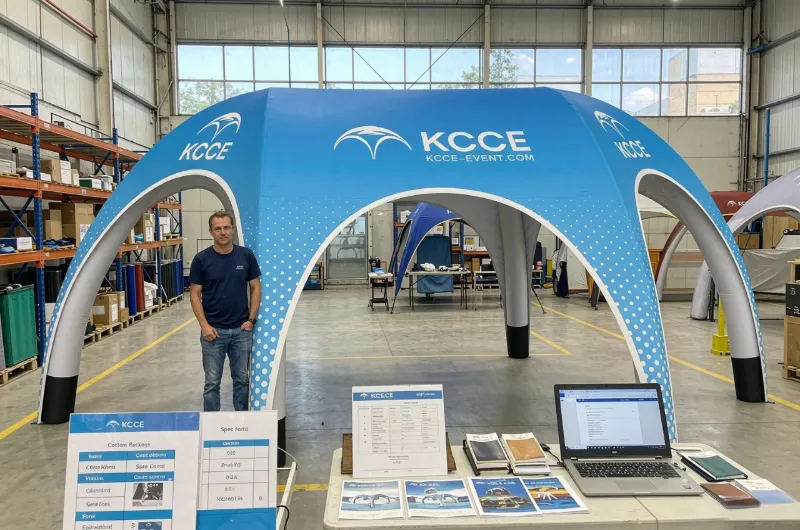
KCCE: This is a manufacturer based in Dongguan, China, that I’ve come across in my research. They produce custom inflatable tents alongside custom inflatable shapes and other event structures. Being a manufacturer means they can often offer better pricing than resellers, but lead times and shipping from China are factors to consider. Their founder story is interesting—it’s always good to know who’s behind the products you’re buying.
Vendor 6 and Vendor 7: These are smaller players I’ve seen in the market, but I don’t have enough direct experience with them to give a fair assessment. If you’re considering them, ask for client references and check their reviews independently.
How to Choose the Right Inflatable Tent Custom Package Size
Size matters, but not in the way you might think. The right size for your inflatable tent custom package depends less on the physical footprint and more on your event type, your audience, and your space constraints.
Sizing Guide by Footprint
- 10×10: This is the standard trade show booth size. It fits a small display table, a couple of staff, and a modest product display. If you’re doing a mall activation, a small festival booth, or a single-brand sampling station, this is your size.
- 10×20: Double the length, same depth. This is a popular size for larger trade show booths, food vendor stations, and sports event tents. You can fit a more substantial display, a small seating area, or a demo station.
- 20×20: This is where things get serious. A 20×20 tent can accommodate a small stage, a product launch, or a hospitality area. It’s the size you want for a music festival sponsor tent or a major brand activation.
- 30×30: This is a large structure. Think event headquarters, a VIP lounge, or a multi-zone activation space. It requires more setup space and more anchoring, but it makes a statement.
Match Size to Event Type
Trade Shows: A 10×10 or 10×20 is usually sufficient. You’re working within a booth space, and the tent needs to fit within your allocated area. Check the show’s rules on inflatable structures before you commit.
Sports Events: Consider a 10×20 or 20×20 for team tents, sponsor activations, or fan zones. The tent needs to withstand wind and foot traffic, so quality matters.
Festivals: A 20×20 or 30×30 can serve as a stage, a brand lounge, or a central gathering point. Festival sites are often uneven, so make sure your package includes proper stakes and leveling options.
Camping and Outdoor Events: If you’re using the tent for camping or small gatherings, a 10×10 is plenty. It’s portable, easy to set up, and provides shelter without being overkill.
Here’s a rule of thumb I use: A common guideline is to multiply your expected peak audience by 10 square feet per person for a standing event, or by 15 square feet per person for a seated event. That gives you the minimum footprint. So, for 50 people standing, you need at least 500 square feet—which is roughly a 20×25 area. That might mean a 20×20 tent plus some overflow space, or a 30×30 if you want breathing room.
Event tent dimensions also matter for logistics. Can you fit the packed tent in your vehicle? Will it fit through the venue’s doorways? Is there enough space on the event floor to anchor it properly? These are the questions that determine whether your size choice is practical, not just theoretical.
Custom Printing on Inflatable Tents: What to Know Before Ordering
Custom printed inflatable tents are the whole point, right? You’re not buying a plain white tent—you’re buying a branded structure that screams your company’s name. But the printing process has its own set of rules, and knowing them before you order will save you headaches.
Print Methods: Dye Sublimation vs. Vinyl Graphics
Dye Sublimation: This is the premium option. The ink is infused into the fabric at a molecular level, which means the print is part of the fabric itself. It won’t crack, peel, or fade with normal use. It handles repeated folding and unfolding beautifully. The downside: it’s more expensive, and it requires high-resolution artwork.
Vinyl Graphics: This involves printing on a vinyl film and then applying it to the tent surface. It’s cheaper and can be done quickly, but it’s less durable. Vinyl can crack when folded, peel at the edges, and deteriorate with sun exposure. For a one-off event where the tent won’t be folded and transported repeatedly, vinyl might be acceptable. For a tent you’ll use for years, spring for dye sublimation.
Resolution Requirements and File Setup
This is where I see the most mistakes from clients. They send a logo that’s 50 pixels wide and wonder why it looks blurry on a 20-foot tent. The rule of thumb: your artwork should be at least 150 DPI at the final print size, as commonly recommended. For a large tent graphic, that often means working with vector files (AI, EPS, PDF) rather than raster images (JPG, PNG).
Most vendors provide a design template you can use to position your logo and graphics. Use it. It shows you the safe zones, the fold lines, and the areas where printing isn’t possible. I’ve seen too many clients design their tent graphics without the template and then discover that their logo wraps awkwardly around the air beams or gets cut off at the seams.
設計上の制限
Here’s something that surprises people: you can’t print on every part of the tent. The air beams are structural—they’re welded or sewn into the fabric, and printing over the seams can weaken them. Most vendors will print on the main panels and leave the beams either solid color or with a simple stripe pattern. Some vendors can print on the beams themselves, but it’s a specialty service that may cost extra.
Also, consider the viewing distance. A logo that looks great on a business card might be too detailed for a tent viewed from 50 feet away. Simplify your graphics. Big, bold, simple designs read better from a distance. That’s a lesson I learned from a client who insisted on including their full product lineup on a tent sidewall. From 20 feet away, it was an unreadable mess.
Lead Times and Shipping: Planning Your Inflatable Tent Custom Package Order
Timing is everything in the events world, and lead times for custom inflatable tents can be longer than you expect. Here’s what you need to know.
Typical Production Timelines
Based on common industry practice, most vendors need 2 to 6 weeks to produce a custom inflatable tent. The exact timeline depends on:
- Complexity of the design: A simple two-color logo is faster than a full-wrap graphic.
- Fabric availability: Popular colors and fabrics are usually in stock; custom colors take longer.
- Vendor workload: Peak season (spring and summer) means longer lead times. Order during the off-season if you can.
- Print method: Dye sublimation takes longer than vinyl.
Rush Options and Their Cost Premium
Need it faster? Most vendors offer rush production for an additional fee. The premium varies, but you might pay a premium for a 2-week turnaround instead of 4-6 weeks, often 15-30% more according to industry estimates. Some vendors can do 1-week rush for a significant premium, but this is rare and usually requires that your design is simple and the fabric is in stock.
My advice: don’t plan on rush. If your event is in 6 weeks, order today. If your event is in 4 weeks, order yesterday. A difficult phone call can be to a vendor asking for a rush order when they’re already at capacity.
Shipping Considerations
Inflatable tents are bulky, even when deflated and packed. Shipping costs can be significant, especially for larger sizes. Some vendors offer free shipping (like West Shade on orders over $299, or Custom Tent With Logo on orders over $2,000), but others will quote shipping separately.
International shipping adds complexity. If you’re ordering from a manufacturer like KCCE in China, factor in customs clearance, potential duties, and longer transit times. The cost savings from manufacturing might be offset by shipping and lead times.
Also, consider the shipping method. Ground freight is cheaper but slower. Expedited shipping is faster but costs more. For a tent that needs to arrive a week before your event, you might need to pay for expedited shipping just to have a buffer.
Inflatable Tent Lifespan and Maintenance: Protecting Your Investment
You’ve spent thousands on your inflatable tent custom package. Now, how do you make it last? With proper care, a quality tent is often expected to give three to five years of service. Without it, you’ll be lucky to get two.
Expected Lifespan
The lifespan depends on several factors: fabric quality, frequency of use, storage conditions, and maintenance. A 210D oxford or PVC-coated fabric is likely to outlast a lighter material. A tent used once a month will last longer than one used every week. A tent stored in a cool, dry place will last longer than one left in a hot car trunk.
清掃
After each event, clean the tent before storing it. Use mild soap and water, and avoid harsh chemicals that can degrade the fabric or the print. Pay special attention to the air beams—dirt and grit can abrade the fabric over time. If the tent is muddy, rinse it thoroughly before folding.
保管
Heat is often considered a major challenge for inflatable tents. Storing a tent in a hot warehouse or car trunk can cause the PVC to degrade and the seams to weaken. Store the tent in a cool, dry place, ideally in its carry bag. Avoid folding it the same way every time—vary the fold pattern to prevent creases from becoming permanent.
Blower Maintenance
The blower is a mechanical device that needs occasional attention. Check the air filter regularly and clean or replace it as needed. Make sure the fan blades are free of debris. Store the blower in a dry place, and consider buying a spare blower if your events are critical. A spare blower can cost a few hundred dollars, but it’s cheap insurance compared to a collapsed tent at a client event.
修理キット
Your package should include a repair kit. Learn how to use it before you need it. Practice patching a small tear on a scrap piece of fabric. When a real emergency happens—and it will—you’ll be glad you know what you’re doing.
Durability in the Field
I’ve seen inflatable tents withstand windstorms, rain, and the general chaos of festival life. I’ve also seen cheap tents fail in mild conditions because the fabric was thin or the blower was underpowered. The difference is quality. Buy from a reputable vendor, and you’ll get a tent that holds up. Buy from a bargain bin, and you’re rolling the dice.
よくある質問(FAQ)
Q: How much does it cost to make a custom inflatable?
A: A custom inflatable tent package typically ranges from around $1,500 for a 10×10 up to $6,000 or more for a 30×30, according to industry estimates. The final price depends on fabric denier, print complexity, blower quality, and included accessories. Dye sublimation printing and continuous-duty blowers add to the cost but significantly improve durability and reliability.
Q: How much does it cost to make a custom 10×10 tent?
A: A custom 10×10 inflatable tent package often costs between $1,500 and $2,500, according to typical pricing. This typically includes the tent body, blower, stakes, repair kit, and carry bag. Optional add-ons like flooring, lighting, or sidewalls will increase the price. Prices vary by vendor, fabric quality, and print method.
Q: インフレータブルテントは購入する価値がありますか?
A: For businesses that do regular events, yes. Inflatable tents offer fast setup, portability, and strong branding impact compared to frame tents. With proper care, a quality tent can last three to five years, according to typical expectations. making the cost-per-use very reasonable. If you’re doing one event a year, renting might be better. If you’re doing multiple events, buying makes sense.
Q: How much does a custom pop-up tent cost?
A: A custom pop-up tent package can cost roughly $1,500 to $4,000 depending on size and features, according to typical market pricing. A 10×10 is on the lower end, while a 10×20 or 20×20 is on the higher end. The best inflatable tent custom package deals often bundle the tent, blower, and accessories at a discount compared to buying items separately.
Q: What is the best inflatable tent custom package for trade shows?
A: For trade shows, a 10×10 or 10×20 with dye sublimation printing and a continuous-duty blower is the sweet spot. Look for packages that include a carry bag and repair kit. Some vendors like Custom Tent With Logo offer discounts on larger orders, and KCCE offers manufacturer-direct pricing on their インフレータブルテント.
Q: How long does a custom inflatable tent last?
A: With proper care, a quality custom inflatable tent lasts three to five years. The lifespan depends on fabric quality, frequency of use, and storage conditions. Higher-denier fabrics and dye sublimation printing extend the lifespan. Regular cleaning and proper storage are essential to maximizing durability.
Q: Can you print logos on inflatable tents?
A: Yes, absolutely. Custom printed inflatable tents are the standard for branded events. Dye sublimation printing embeds the ink into the fabric for maximum durability, while vinyl graphics are a cheaper but less durable option. Use high-resolution artwork (150 DPI or higher) and follow the vendor’s design template for best results.
Q: What sizes are available for custom inflatable tents?
A: Common sizes include 10×10, 10×20, 20×20, and 30×30. Some manufacturers like KCCE offer custom sizes beyond these standards. The right size depends on your event type and audience capacity. For trade shows, 10×10 or 10×20 is typical. For festivals and large activations, 20×20 or 30×30 is more appropriate.
参考文献
1. イベント、広告、ブランディング用のカスタムインフレータブルテント – West Shade
2. 9 Branded Inflatable Tent Designs That Will Inspire Your Next Outdoor Event Activation – TentCraft
3. Custom Canopy Tent Packages | Pop-Up Event Booths – Look Our Way
4. Top 5 Reasons To Choose Inflatable Tent For Your Next Event – Custom Tent With Logo
5. Inflatable Tents & Custom Event Structures – KCCE
6. The Complete Guide to Inflatable Tents for Event Marketing – Event Marketing Insider