クイックアンサー
An inflatable medical tent is a rapid-deploy shelter used for triage, isolation, and field care. Prices range from roughly $1,000 for a small triage unit to well over $10,000 for a full negative-pressure field hospital. Most units inflate in under 10 minutes with a blower.
Here’s a frustration I hear constantly from procurement people: every supplier hides their pricing. You send five emails, you get three replies, and two of those say “contact us for a quote.” Meanwhile your deadline is Friday.
So let’s fix that. I’ve spent years sourcing and specifying shelters for emergency response, event medical coverage, and NGO field work. This guide covers what an inflatable medical tent actually is, the real price ranges, how to set one up, and how to decide between buying and renting. No gatekeeping.
What Is an Inflatable Medical Tent? (And What It’s Not)
An inflatable medical tent is a structure that holds its shape through air pressure rather than a rigid pole frame. You stake it out, connect a blower or pump, and it stands up. That’s the whole idea.
Médecins Sans Frontières (MSF) pioneered a modular inflatable hospital concept in the first decade of the 2000s. Why? Because they needed to deploy surgical and clinical capacity where roads, buildings, and infrastructure didn’t exist. That’s the origin story of the modern field hospital tent — not camping gear that got repurposed, but medical infrastructure designed from the ground up for austere environments.
What it’s not: a camping tent with a red cross printed on it. The distinction matters more than people think.
- Frame tents use aluminum or steel poles. Heavier, slower to pitch, but they don’t depend on power.
- Camping tents are for sleeping. No airflow control, no filtration, no floor integrity for clinical use.
- Inflatable medical tents are built for triage, isolation, and field care — with sealed chambers, medical-grade flooring options, and in some configurations, controlled air pressure.
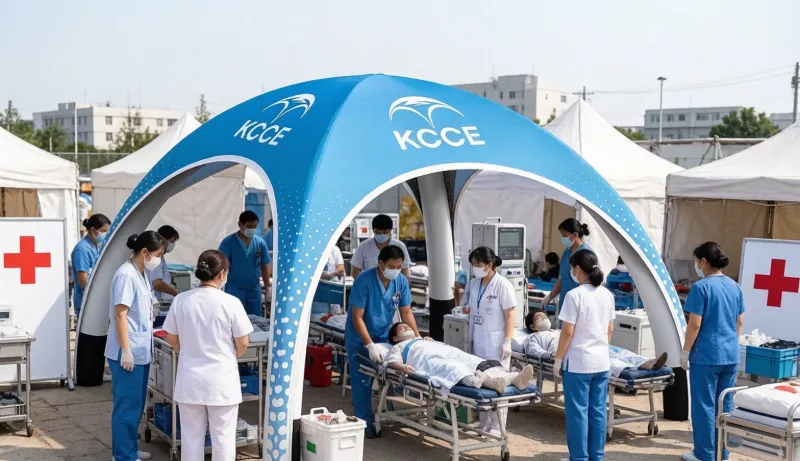
Where do they actually get used? Disaster relief after earthquakes and floods. EMS staging at major events. Military forward medical posts. NGO field hospitals in conflict zones. And increasingly, event organizers who need a rehab tent or oxygen tent on standby for marathon runners and festival crowds.
Types Compared: Positive Pressure, Negative Pressure & Standard
Three categories. Get this wrong and you’ve either wasted money or created a safety problem.
Standard Inflatable Shelter
No pressure control. Air comes in, air goes out. Fine for triage, first aid stations, rehab tents, and general shelter. This is the workhorse — probably 70% of what gets sold.
Negative Pressure Isolation Tent
The internal pressure is kept slightly lower than outside. Contaminated air can’t escape through gaps; it gets pulled through a HEPA filter before exhaust. If you’re handling suspected infectious disease cases, this isn’t optional — it’s the whole point. A negative pressure inflatable medical tent is what you want for COVID-style respiratory triage, TB screening, or any airborne-transmission scenario.
Positive Pressure Surgical Tent
The opposite logic. Internal pressure stays higher than ambient so outside contaminants can’t drift in. Used for surgical suites and sterile procedure rooms in field hospitals. Requires a higher-spec filtration setup and a reliable power supply, because losing pressure mid-procedure is a serious problem.
My take: if your use case is “we might see sick people and we don’t know what they have,” buy negative pressure. It costs more. It’s worth it.
Materials & Inflation Systems: What Actually Matters
Fabric: PVC vs. Oxford Cloth vs. TPU
- PVC — heavy, extremely durable, cheap per square meter. The default for large shelters. Downside: bulky when packed, and it smells like a new shower curtain for the first week.
- Oxford cloth — lighter, packs smaller, common in smaller emergency tents. Less abrasion resistance. Fine for short deployments, questionable for months in the field.
- TPU — the premium option. Lighter than PVC, stronger than Oxford, and it handles cold better. You’ll pay for it. KCCE, for instance, uses TPU in its airtight column systems — KCCE’s TPU airtight inflatable columns are a good reference point for what that material tier looks like in practice.
Inflation: Continuous Blower vs. Sealed Air
This is the decision that trips up most buyers.
Continuous blower means the tent stays inflated only while the blower runs. Setup is fast — minutes. But the moment you lose power, the structure starts to sag. In a disaster zone where the grid is down, that’s a real risk. You need a generator and fuel on hand.
Sealed air (airtight chambers) means you inflate once, cap it, and walk away. No power dependency after setup. Slower to inflate, and if you get a puncture, that chamber deflates. But for field hospitals where power is unreliable, airtight wins. Here’s a portable waterproof emergency shelter with air-tight chambers that illustrates the sealed-chamber approach.
The social media complaints are real, by the way. Users on camping forums say inflatable tents are “too heavy” and that “no power means no tent.” Both are legitimate. For a medical deployment, you solve the first with a vehicle and the second with either a generator or an airtight design.
And yes — are inflatable medical tents waterproof? Generally yes, if the fabric is PVC or TPU with welded seams. Oxford cloth with taped seams is water-resistant but not indefinitely waterproof. Ask for the hydrostatic head rating before you buy.
How Much Does an Inflatable Medical Tent Cost?
Let’s do the thing suppliers won’t.
Based on what I’ve seen in the market, expect these ranges:
| Configuration | 典型的な価格帯 |
|---|---|
| Small triage unit (3×3m, standard) | $1,000–$3,000 |
| Mid-size treatment tent (5×5m) | $3,000〜$8,000 |
| Negative pressure isolation unit | $6,000–$15,000 |
| Full field hospital module | $15,000–$50,000+ |
Those are ballpark figures from my own sourcing experience — not a published price list, because no manufacturer publishes one. Treat them as a budgeting starting point, not a quote.
What drives the number up?
- サイズ。 Obvious, but non-linear. Doubling floor area can more than double cost because of structural requirements.
- Pressure system. Negative pressure adds filtration, monitoring, and a sealed envelope. That’s real engineering.
- 素材。 TPU over PVC over Oxford.
- カスタマイズ。 Custom printing, custom dimensions, custom door placement — all add cost and lead time.
- Certifications. CE and RoHS compliance, fire ratings, medical device classification if applicable.
レンタル vs 購入
For a one-time event — a marathon, a festival, a single disaster response — renting usually wins. A medical tent rental might run a few hundred to a couple thousand dollars for a weekend, depending on size and whether you need negative pressure.
Buy if you’ll deploy more than three or four times a year, or if you need the tent staged and ready at all times. The breakeven is usually somewhere around the third or fourth rental.
One more thing: if you’re searching for a “medical tent rental near me” or an “inflatable tent supplier USA,” check lead times early. Custom builds can take weeks.
How to Set Up an Inflatable Medical Tent (Step-by-Step)
Nobody covers this properly, so here it is.
- Site selection. Flat ground, clear of overhead lines, drainage away from the entrance. If you’re running negative pressure, you also need space for the exhaust and filter unit.
- Unpack and orient. Lay the tent out with the door facing your patient flow. Sounds trivial. People get it wrong constantly.
- Anchor first. Stakes or ballast weights go in 前に inflation. Inflating a tent that isn’t anchored is how you end up chasing it across a field.
- Connect the blower or pump. Check your power source. Generator, mains, or manual pump — know which before you start.
- Inflate in sequence. Most designs want chambers filled in order. Follow the manufacturer’s instructions; don’t just open the valve and hope.
- Check pressure and seams. Walk the perimeter. Listen for leaks.
- Install flooring, filtration, and equipment. Only after the structure is stable.
Realistic timelines: a small triage tent, 5–10 minutes with two people. A mid-size treatment tent, 15–25 minutes. A full field hospital module with filtration and internal fit-out, 1–3 hours. Anyone promising a full surgical suite in five minutes is selling you something.
Common mistakes: skipping anchors, inflating before checking for ground hazards, forgetting the backup power plan, and not doing a dry run before the actual deployment. Do the dry run. Every time.
Weather: inflatables handle rain well. Wind is the enemy. Most manufacturers specify a maximum wind speed — respect it, and evacuate the tent if gusts exceed it.
How to Choose: Buyer’s Checklist for Decision-Makers
Run through this before you sign anything.
- Certifications. CE and RoHS at minimum. Fire retardancy certification for indoor or crowded use. Medical device classification if the tent is a regulated product in your jurisdiction.
- Fire ratings. Ask for the test standard, not just the word “fireproof.”
- Warranty. Seam and chamber warranties should be spelled out separately from general workmanship.
- Supplier track record. How long have they been operating? What countries do they ship to? A manufacturer with a decade-plus history and a broad export footprint is a lower risk than a trading company that appeared last year. KCCE, for example, has been building inflatable products for many years and exports internationally — that kind of track record is what you’re looking for. You can see their full range of inflatable tents for reference.
- Spare parts. Blowers fail. Valves leak. Can you get replacements in 48 hours?
- Repair kit. Every medical deployment should carry one.
Questions to ask before signing a PO:
- What’s the actual packed weight and volume?
- What’s the maximum wind rating?
- What’s the lead time for a replacement chamber?
- Is the blower rated for continuous operation?
- Can you provide references from comparable deployments?
- What’s the filtration spec on the negative pressure unit?
Real-World Deployments: What Field Teams Report
The MSF inflatable hospital work is the benchmark here. Their teams needed modular clinical capacity that could be transported by truck and assembled without heavy equipment — and the inflatable approach delivered that where rigid structures couldn’t.
From EMS and event medical teams, the pattern I hear repeatedly:
- Inflatables go up faster than frame tents. That’s consistent across every account.
- Frame tents win on power independence and puncture tolerance.
- Negative pressure units have become standard for respiratory triage since 2020.
- The biggest failure mode isn’t the tent — it’s the power supply for the blower.
One event medical director told me their inflatable rehab tent cut setup time substantially compared to their old pole tent. That’s the kind of number that matters when you’re staging at 5 a.m. before a race.
Inflatable Rehab Tents
A rehab tent is a recovery and treatment space, not an isolation space. You see them at marathons, triathlons, and multi-day festivals where you need somewhere to put dehydrated, hypothermic, or mildly injured people who don’t need a hospital.
Typical spec: 20–60 m², 2–4 treatment cots or massage tables, forced-air heating and cooling, and a floor that can take a stretcher wheel. They usually run at neutral or slight positive pressure — no HEPA requirement.
The practical details that matter: a minimum 2.1 m internal ridge height so staff can work standing, a zippered entry wide enough for a stretcher (900 mm+), and power for heated blankets and oxygen concentrators. At a large marathon I worked, two 40 m² rehab tents with six cots each handled a substantial number of heat-related presentations over the day.
They’re the cheapest category — small units start around $1,000–$2,500 — and they’re the most commonly rented rather than bought. If your event is one weekend a year, rent.
Negative Pressure Inflatable Medical Tents
This is the category where people get it wrong and it costs them. A negative pressure tent maintains internal pressure below ambient so air flows in, not out. Contaminated air is exhausted only through a HEPA filter.
Standards to cite when you’re writing the spec: HEPA filtration at 99.97% efficiency for particles ≥0.3 µm (the H13/H14 class under EN 1822), a minimum pressure differential of −10 Pa to −30 Pa relative to outside, and an air exchange rate of at least 12 air changes per hour (ACH) — many clinical guidelines, including CDC isolation guidance, call for 12 ACH for new construction and 6 ACH minimum for existing spaces. For a temporary tent, spec 12 ACH and don’t argue.
You need a dedicated exhaust blower, not just an inlet blower, plus a manometer or pressure gauge so staff can verify the differential is holding. If the exhaust fan dies, the tent becomes a positive-pressure room and you’ve aerosolized whatever was inside. Build in an alarm and a backup power supply. A 30 m² isolation tent typically draws 1.5–3 kW with both blowers and filtration running.
Price for a compliant unit: $8,000–$25,000 depending on size and filter configuration. Cheap ones exist. They don’t hold pressure.
結論
The cheapest tent almost never wins. What matters is total deploy cost — setup labor, power requirements, failure risk, and how fast you can get it standing when it counts.
My advice: shortlist two or three suppliers, send them the checklist above, and compare on substance rather than sticker price. And ask yourself one question before you buy anything — can your current setup deploy in under 30 minutes? If the answer is no, you’ve found your problem.
よくある質問(FAQ)
Q: Do inflatable tents really work?
A: Yes, for the right applications. MSF has deployed modular inflatable hospitals in field conditions for years. They inflate fast, pack down small, and handle rain well. The honest caveats: they’re heavier than pole tents, blower-dependent designs need reliable power, and a punctured chamber can take a section out of service. For medical use, airtight chamber designs solve most of the power-dependency concern.
Q: What is a FEMA tent?
A: A FEMA tent generally refers to the large temporary shelters used by emergency management agencies for disaster response — typically frame or inflatable structures that serve as staging areas, medical stations, or temporary accommodation. If you’re comparing an inflatable medical tent to a FEMA-style shelter, the key differences are deploy speed and power dependency. Inflatables go up faster; FEMA-style frame shelters are more power-independent.
Q: How much does an inflatable tent cost?
A: For medical use, budget roughly $1,000–$3,000 for a small triage unit, $3,000–$8,000 for a mid-size treatment tent, and $6,000–$15,000 for negative pressure isolation. Full field hospital modules run higher. Those are market ranges from sourcing experience, not published price lists. For a single event, medical tent rental is often the smarter call.
Q: What is a medical tent?
A: A medical tent is any temporary structure used to deliver clinical care — triage, first aid, isolation, treatment, or surgery. The category includes inflatable medical tents, frame tents, and hybrid designs. What separates a real medical tent from a general shelter is airflow control, flooring integrity, and equipment support. An inflatable medical tent is simply the fastest-deploying option in that category.
Q: Are inflatable medical tents waterproof?
A: PVC and TPU models with welded seams are effectively waterproof. Oxford cloth models with taped seams are water-resistant rather than fully waterproof. Always ask for the hydrostatic head rating. And check that the floor is a separate welded component — a leaky floor undermines the whole clinical environment.
Q: Can I buy an inflatable medical tent for sale in the US?
A: Yes. Several manufacturers export to the US, and lead times vary from stock to several weeks for custom builds. If you’re searching for an inflatable tent supplier USA, verify CE and RoHS compliance, ask for US references, and confirm spare part availability before committing. Import duties and shipping add to the landed cost.
Q: What’s the best inflatable medical tent for disaster relief?
A: There’s no single answer — it depends on your power situation. If you have reliable generators, a continuous-blower design is faster and cheaper. If power is uncertain, go with sealed air-tight chambers. For infectious disease response, negative pressure is non-negotiable. Size it to your patient throughput, not your budget ceiling.
Q: How do I find a good inflatable medical tent manufacturer?
A: Look for a decade-plus operating history, export reach across multiple regions, CE and RoHS certification, and a documented warranty on seams and chambers. Ask for deployment references. And request a repair kit and spare valve set with your first order — you’ll need them eventually.
参考文献
1. Innovation: Inflatable Hospital – msf.org.au
2. Dacheng outdoor products LTD. (KCCE) — Inflatable Tent Manufacturer – kcceinflatable.en.made-in-china.com
3. Inflatable Tent Range – kcce-event.com