I’ve been selling and spec’ing inflatable tents for the better part of a decade now — event activations, trade shows, a few weird desert campaigns — and I still get the same email every week. It goes something like: “Hi, we need a tent. What’s the price?” No size, no use case, no nothing.
That’s the problem with this category. Search “ad inflatable tents” and you get a wall of product pages. Alibaba listings, a few manufacturer catalogs, and almost nothing that actually helps you decide. No buying guides. No honest talk about what these things cost or where they fail. You might be wondering why — I think it’s because the B2B side of this business is quote-only by design, and the camping side gets drowned out by pop-up tent marketing.
So here’s my attempt to fix that. Prices, real use cases, and the trade-offs nobody puts on a product page.
クイックアンサー
Ad inflatable tents are airtight or constant-air structures used for two very different jobs: brand activations and events (custom-printed, quote-priced, PVC-built) and camping (air-beam, packable, roughly $200–$1,500 retail). Setup runs 5–15 minutes with a pump. They cost more upfront than pole tents but pack smaller and go up faster.
What Are Ad Inflatable Tents? (And Who They’re For)
Two markets share one search term, and that’s the root of most confusion.
The first is advertising and events. These are big, branded structures — a sealed-air spider dome at a trade show, a printed air canopy outside a retail activation, a 10×10 blow-up marquee at a motorsport event. TentCraft, a US manufacturer, describes inflatable tents as a lightweight, visually distinctive way for brands to build sampling spaces, product displays, and outdoor event environments — and notes that customers keep saying the silhouette matches the “vibe” of high-energy athletic events, motorsport activations, and music festivals. That’s the B2B side. You’re buying attention and a footprint, not shelter.
The second is camping. Here the same technology gets called an air beam tent or an inflatable camping tent — the poles are replaced by inflated tubes. Field Mag’s inflatable tent guide covers this consumer side in detail, and it’s a genuinely different product: smaller, lighter, meant to be carried in a car trunk or a pack.
Who’s actually buying?
- Event marketers and brand managers — need a custom inflatable event tent with logos, and they need it to look good in photos.
- Campers and overlanders — want fast pitching and don’t mind carrying a pump.
- 家族 — the large inflatable tent camping segment, where an inflatable tent house or an inflatable house tent for adults gives you standing room and separate rooms without a pole puzzle.
If you’re in the first bucket, keep reading — the pricing section matters most to you. If you’re in the second, skip ahead to the camping picks.
Ad Inflatable Tents vs. Traditional Pole Tents
Let me just put the comparison on the table. I’ve pitched both, in rain, at 6am, with a client watching.
| 要因 | Inflatable / Air Beam | Traditional Pole |
|---|---|---|
| セットアップ時間 | 5–15 min with a pump | 15–40 min, two people |
| 重量 | Heavier packed (pump + fabric) | Lighter for the same footprint |
| 梱包サイズ | Compresses well, no long pole bag | Long, awkward pole bundle |
| 耐久性 | Good, but puncture-sensitive | Pole breakage is the failure mode |
| Upfront cost | 高い | 低い |
| Field repair | Patch kit, slower | Spare pole section, fast |
The honest trade-off: you’re trading puncture risk and a higher upfront price for speed and packability. That’s it. There’s no free lunch here.
And the puncture worry is real but overstated. In my experience the actual failure isn’t a puncture — it’s air sag. If you don’t inflate the beams to sufficient pressure, the whole structure droops, and in wind it moves in ways that make you nervous. This is the single most common complaint I see in camping forums, right alongside “they start losing air as they get older.” Which is true. Every airtight fabric loses some pressure over a season. The question is how much, and whether the valves hold.
One more thing people don’t talk about: pumps. Some versions require big air pumps, which is genuinely inconvenient if you’re car camping with limited trunk space. We’ll get to pump compatibility later, because it matters more than most buyers expect.
How Much Do Ad Inflatable Tents Cost?
Here’s where I’ll be more transparent than most of the industry.
Consumer camping inflatable tents — roughly $200 to $1,500 depending on size, season rating, and material. A two-person air beam tent sits at the low end. A large inflatable tent camping setup with multiple rooms and a 4-season rating pushes toward the top.
B2B event and custom inflatable tents — this is where pricing goes dark. Most manufacturers, including the ones I’ve worked with, quote per project. A printed 3×3 air canopy and a 10-meter branded dome are not the same product, and no honest manufacturer publishes a flat rate for both.
Why quote-only? A few reasons, and they’re not all sinister:
- Size drives material cost more than anything else, and sizes are effectively custom.
- Print coverage — full-bleed graphics versus a logo on one wall — changes labor significantly.
- Accessories (blowers, anchoring, transport bags, lighting) get bundled.
- MOQ matters. Some suppliers run a 1-piece minimum order, which changes unit economics completely.
My advice: if a supplier won’t give you any ballpark after you’ve described your project, that’s a yellow flag. You don’t need a final number on day one, but you should get a range.
Also worth knowing where the market is heading. Future Market Insights values the global inflatable tent market at USD 1.2 billion in 2025, projecting USD 2.7 billion by 2036 at a 7.5% CAGR — and notes PVC holds a 98.4% share of the material segment in 2026. Translation: the material you’ll be quoted on is almost certainly PVC, and demand isn’t shrinking.
Best Ad Inflatable Tents for Camping
I’m not going to pretend I’ve personally field-tested every model on the market. But here’s how I’d shortlist, and the names that come up repeatedly.
Coody inflatable tent — Coody is one of the names that surfaces constantly when people search for the best inflatable camping tent, and it’s a reasonable starting point for the air beam category. Worth comparing directly against anything else on your shortlist.
Sönmez — a Turkish manufacturer that shows up in the camping air tent conversation. If you’re in Europe, logistics may work in your favor.
Inflatable hot tent options — this is the sub-category I’d watch most closely. An inflatable hot tent with a stove jack changes what “3-season” means. Heat retention and cold-weather performance are exactly where the community says data is missing, so test claims carefully.
What to check on any pick:
- Setup time claim. “5-minute setup” is a marketing number. Realistically, 5 minutes is a small tent with a good pump and one person who’s done it before. Budget 10–15.
- Season rating. A true 4-season inflatable tent needs higher pressure ratings and stronger fabric. Don’t assume.
- Capacity. Listed capacity is optimistic. A “4-person” tent is comfortable for 2 adults plus gear.
If you’re searching for an inflatable camping tent near me, that’s usually a sign you want to see it pitched before buying — find a dealer or a show, and watch someone inflate it.
Best Ad Inflatable Tents for Events & Brand Activations
This is the side I know best.
Airdome-style sealed-air structures — the classic brand activation piece. Sealed air means no constant blower running, which matters enormously at an event where power is limited and noise is a problem.
Extreme Canopy-style printed canopies — modular, graphics-forward, built for retail and sampling setups.
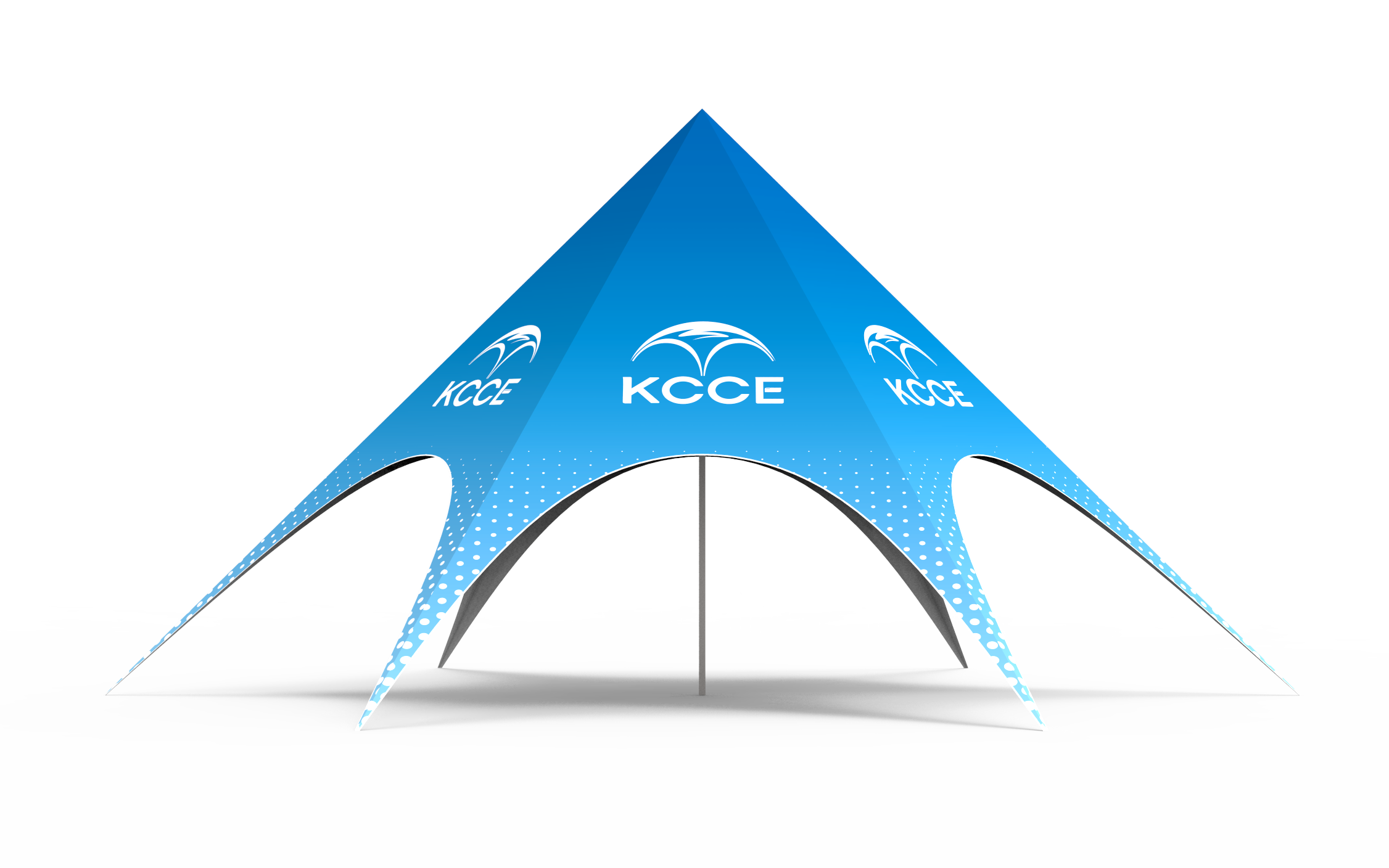
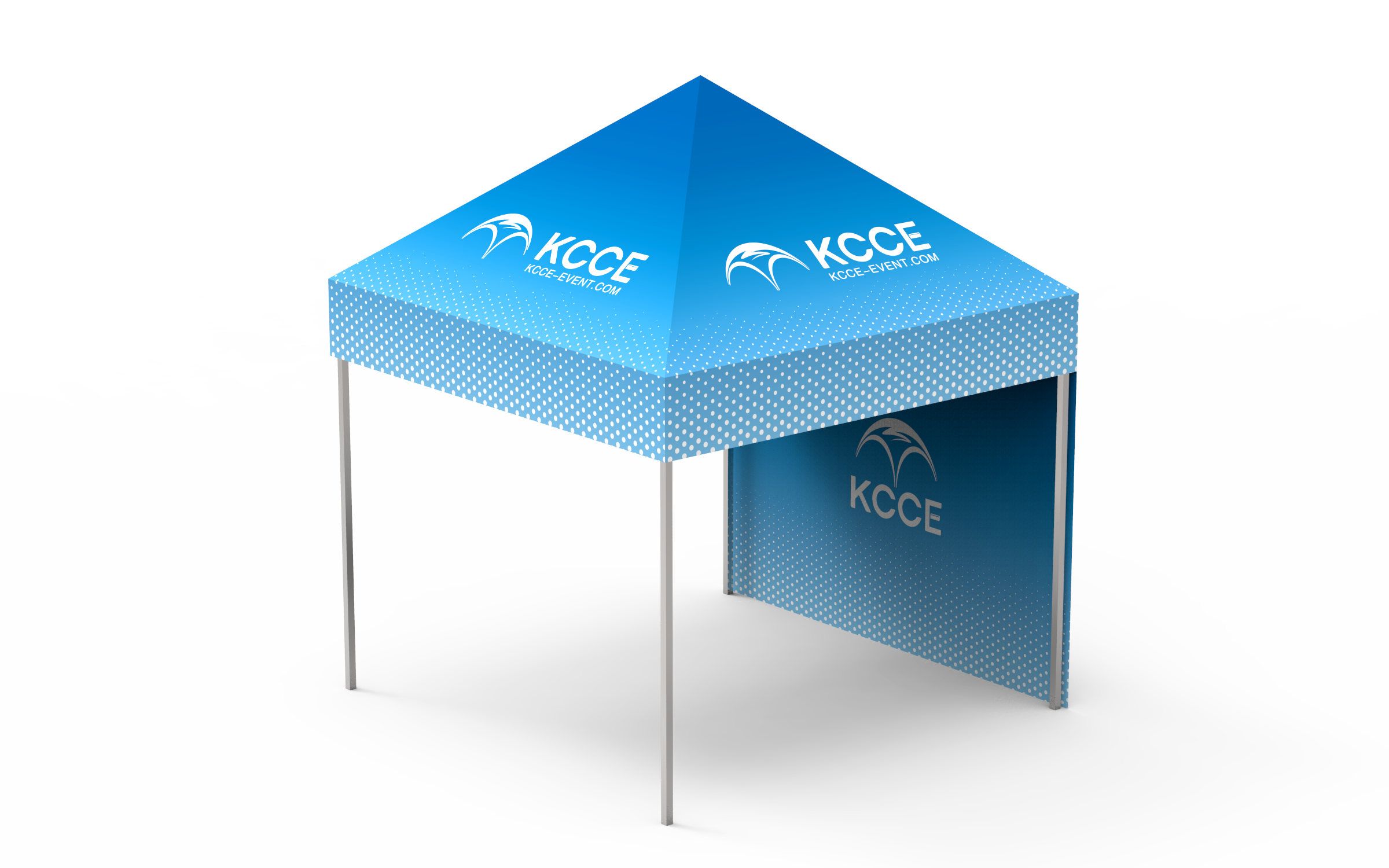
KCCE — full disclosure, this is the manufacturer behind the site hosting this article, so weigh that accordingly. That said, their range is representative of what’s available: a full custom high-visibility inflatable shelter for events, sealed-air spider dome gazebos, heat-transfer printed air canopy tents for brand activations, and customized-graphics modular canopy tents. They also run a 1-piece MOQ, which is unusual and useful if you’re testing a concept before rolling it out nationally.
What actually matters when you’re buying B2B:
- カスタマイズ。 Full-bleed print, heat-transfer print, or plain fabric with an applied logo — different cost tiers.
- Lead time. Ask explicitly. Custom print runs don’t ship in a week.
- Branding surface. How much of the structure is printable? A dome gives you a lot. A narrow canopy gives you almost nothing.
- アンカリング。 Outdoor events need ballast or stake systems. Ask what’s included.
Speaking of which — if you’re doing a multi-day activation, don’t forget the inside. An empty branded tent looks like a warehouse. We’ve used インフレータブル家具 for seating and product display in exactly this setup, and it photographs better than folding chairs.
Are Inflatable Tents Good? Durability & Winter Use
Short answer: yes, for the right job. Long answer depends on three things.
Materials. PVC dominates for a reason — it’s tough and printable. The trade-off is weight. Lighter fabrics pack better but abrade faster. Check the denier and the seam construction, not just the material name.
Pressure discipline. This is the one people get wrong. Under-inflate and you get air sag. Over-inflate and you stress seams. Learn your tent’s target pressure and use a pump with a gauge. In the community, people talk about optimal inflation pressure for air beam tents. — but check your specific manufacturer’s spec, because it varies and getting it wrong is how tents die early.
Winter use. A 4-season inflatable tent can handle cold, but “4-season” on a product page means different things. Look for a stove jack if you want a hot tent, higher pressure ratings, and reinforced guy points for snow load. Air beams actually handle snow load reasonably well because they flex — but they need to be at full pressure.
Care basics: dry it fully before storing, keep a patch kit, and check valves at the start of every season. Air loss over time is normal; sudden air loss is a valve or seam problem.
How to Choose an Ad Inflatable Tent
Here’s the checklist I’d actually use. Call it your ad inflatable tents buying guide.
- Use case first. Brand activation or camping? These have almost nothing in common beyond the word “inflatable.”
- サイズ。 Measure your footprint, not your ambition. A 10×10 is bigger than it sounds.
- Season rating. Match it to your real use, not your optimistic use.
- Budget. Camping: $200–$1,500. Events: get a quote and compare at least three.
- Warranty and spares. Ask about patch kits, valve replacements, and blower availability.
- Pump compatibility. Can you run it off a 12V car pump, a SUP inflator, or a hand pump? Ask before you buy, not after.
Red flags:
- No pricing と no specs. One or the other is normal. Neither is a problem.
- Vague materials. “High-quality fabric” tells you nothing. You want a material name and a weight.
- No pressure spec. If they can’t tell you the target PSI, they don’t know their own product.
- No lead time commitment on custom work.
Main Types of Inflatable Tents and Their Applications
After a decade of spec’ing these, I sort them by use case, not by product name.
Event activations and promotions. Sealed-air (constant-air) PVC structures, typically 3x3m to 10x10m, custom-printed with full-color dye-sublimation or digital print. A 5x5m branded air marquee runs roughly $2,500–$6,000 depending on print coverage. and whether you need a sealed or constant-air blower. These are your sampling booths, retail pop-ups, and motorsport footprints.
Camping. Air-beam nylon/polyester tents, 2–8 person, $200–$1,500 retail. Vango, Heimplanet, and Quechua dominate here. The AirBeam tech (Vango’s trademark) uses TPU tubes at 6–8 PSI.
Exhibitions and trade shows. Often sealed-air spider domes or inflatable arches used as booth frames — 4–8m span, indoor, low wind load. Weight matters more than wind rating here because you’re hauling it through a loading dock.
Sporting events and races. Start/finish arches, 8–15m, constant-air with a backup blower. These run on 110V/220V and need a generator or site power.
Extreme weather. This is where spec sheets lie. A sealed-air structure rated to Beaufort 6 (roughly 24–30 mph). is not the same as surviving a desert dust storm or a coastal squall. For anything above 30 mph sustained, you need constant-air with dual blowers, guy-line anchors at every leg, and ballast (water barrels, ~200kg per corner). I’ve seen a 6x6m sealed-air canopy fold in a 35 mph gust because nobody ballasted it.
Inflatable Tent Setup and Teardown: Step-by-Step and Practical Tips
Here’s the sequence I give every client. It’s the same whether it’s a 3m camping tent or a 10m branded marquee.
Setup:
- Site check. Clear the footprint of sharp debris. Lay a groundsheet. For events, mark anchor points first — you can’t reposition once it’s inflated.
- Unroll and orient. Find the inflation valves (usually one per beam, or a single manifold on camping models). Unzip all doors and vents — trapped air needs somewhere to go.
- Anchor before inflating. Stake or ballast the corners first. Inflating an unanchored structure is how it ends up in a neighboring field.
- Inflate. Use the supplied pump (camping: hand or foot pump, 5–10 min to 6–8 PSI; event: electric blower, 3–8 min). Watch the beams — they should go rigid, not drum-tight. Over-inflation is the #1 cause of seam failure.
- Check pressure and tension. Walk the perimeter. Re-stake guy lines at 45°.
Teardown: Open valves, let it deflate fully (don’t force-fold), wipe down, roll toward the valves so trapped air escapes. Fold to the packed size, not smaller.
Common faults: slow deflation means a stuck valve; uneven beams mean a blocked manifold; a beam that won’t hold pressure overnight usually means a pinhole at a seam — patch kit, 20 minutes.
Maintenance, Care, and Troubleshooting
Treat the fabric like a wetsuit, not a tarp.
After every use: wipe with fresh water and a mild soap (no solvents — they degrade PVC and TPU coatings). Dry fully before packing. Store rolled, not folded, in a dry space away from UV.
Monthly in season: check every seam and valve. Soapy-water test on valves — bubbles mean a leak.
年次: re-apply UV protectant on PVC structures that live outdoors. Replace blower filters (constant-air units) every 6–12 months.
Common failures and fixes:
- Slow leak at a seam — patch kit (PVC cement or TPU patch), cures in 20–30 min.
- Valve won’t seal — replace the valve core; most are standard and cost under $10.
- Blower overheating — clogged filter or undersized circuit. A 10x10m constant-air tent draws roughly 1.5–2 kW.; a 15A/110V circuit will trip.
- Mold — happens when you pack damp. Once it’s there, it’s permanent. Prevention is the whole game.
保管: out of direct sun, off concrete (moisture wicks), ideally on a shelf.
Long-Term Cost and TCO: Inflatable vs. Traditional
This is where the spreadsheet gets interesting. Numbers below are from a 5x5m event canopy, 3-year horizon, based on my own client data.
| Cost line | Inflatable (sealed-air) | Traditional pole tent |
|---|---|---|
| Upfront | $4,000 | $1,800 |
| Setup labor (2 people, 15 min vs 40 min) | ~$1,200/yr | ~$3,200/yr |
| Transport | Fits in a van | Needs a trailer or truck |
| 保管 | ~0.4 m³ packed | ~1.2 m³ |
| メンテナンス | $300/yr (patches, blower) | $150/yr (pole sections) |
| Replacement cycle | 3–5 yrs | 5–8 yrs |
The break-even is often reached within a couple of years if you deploy more than twice a month. Below that cadence, pole tents win on pure cost. Above it, the labor savings on setup alone — roughly 25 minutes per event, two people. — pays for the inflatable.
The hidden cost nobody quotes: blower power. A constant-air unit running an 8-hour event draws a significant amount of electricity. At commercial rates, that can add up per event. trivial — until you’re running ten of them.
結論
Match the tent to the use case, not the hype. If you’re camping, you want a packable air beam tent and you should care about pressure specs and pump options. If you’re running brand activations, you want a custom printed structure and you should care about lead time, print coverage, and anchoring. Same word, different purchase.
So — camping or brand activation? Which one do you actually need? Answer that honestly and the shortlist writes itself.
Next step: pick two or three options, put the specs side by side, and compare setup time, pressure rating, and warranty directly. Don’t compare marketing copy.
よくある質問(FAQ)
Q: Where can I buy Atik Ailesi tents?
A: I can’t verify current retail availability for every regional brand, and I’d rather say that than send you somewhere wrong. For any specific brand, go direct to the manufacturer’s site or an authorized dealer. If you’re in the market for an ad inflatable tent for events, working directly with a manufacturer — KCCE included — is usually faster and cheaper than going through a reseller, especially for custom print work.
Q: 最高のインフレータブルテントを作っているのは誰ですか?
A: Depends entirely on which market you mean. For events, TentCraft and Extreme Canopy are established names in branded structures, and KCCE manufactures sealed-air domes, printed canopies, and modular gazebos with a 1-piece MOQ. For camping, Coody and Sönmez come up repeatedly. “Best” is really about matching specs to your use case — nobody wins across both categories.
Q: Are the inflatable tents any good?
A: Yes, with caveats. The technology is proven — the global inflatable tent market was valued at USD 1.2 billion in 2025 and is forecast to reach USD 2.7 billion by 2036, per Future Market Insights, which isn’t a shrinking category. The real issues are air loss over time and air sag from under-inflation. Maintain pressure, keep a patch kit, and they hold up fine.
Q: Which is the best inflatable tent?
A: For camping, shortlist a Coody inflatable tent against a comparable air beam model and compare pressure specs, season rating, and pump compatibility. For events, the answer is whatever matches your branding surface and lead time. There’s no universal winner — an inflatable tent house for a family and a printed activation dome are solving different problems.
Q: Is an inflatable tent worth it over a pole tent?
A: If setup speed and packed size matter more than upfront cost, yes. You’ll pay more and accept some puncture risk. If budget is tight and you pitch rarely, a pole tent is still the smarter buy. I’ve used both and I don’t think either is universally better.
Q: Can inflatable tents handle winter?
A: A properly rated 4-season model can, especially with a stove jack. Air beams flex under snow load, which helps — but only at full pressure. Under-inflate in cold weather and you’ll get sag and stress on the seams.
Q: インフレータブルテントの寿命はどのくらいですか?
A: With care, several seasons. The common failure isn’t a dramatic tear — it’s gradual air loss as valves and seams age. Dry it fully before storage, check valves each season, and keep a patch kit. That routine is most of the difference between a tent that lasts three years and one that lasts eight.
Q: What pump do I need?
A: Match the pump to your valve type and power situation. A 12V car pump works for car camping, a SUP inflator often fits, and hand pumps are the fallback. For events, most sealed-air structures ship with or specify a blower. Always confirm compatibility before buying — it’s a small detail that ruins a trip.
参考文献
1. Inflatable Tent Market – futuremarketinsights.com
2. 9 Branded Inflatable Tent Designs That Will Inspire Your Next Outdoor Event Activation – tentcraft.com
3. Inflatable Tent Guide: How to Use & Which to Buy – fieldmag.com
4. Inflatable Tents Market Size, Share, Industry Report, 2035 – businessresearchinsights.com
5. Structural Design and Optimization of Separated Air-Rib Tents – mdpi.com