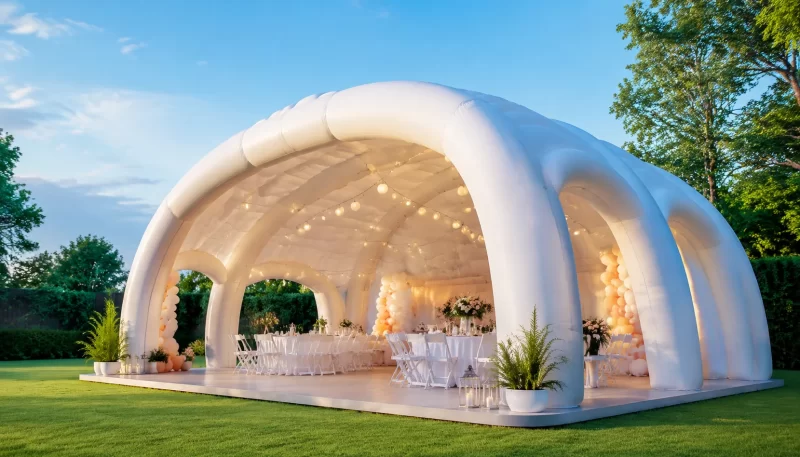
Il tuo evento all'aperto è tra due settimane. Hai bisogno di una struttura che non crolli al primo soffio di vento, che ospiti 50 ospiti e che non faccia saltare il budget. Ti sembra familiare? Se sei un manager che organizza un picnic aziendale, un matrimonio o un festival di comunità, la decisione tra noleggiare e acquistare una tenda gonfiabile per feste è probabilmente la più importante—e la più confusa—che dovrai prendere.
Quella struttura che stai valutando? Si chiama tenda gonfiabile per feste—ma non tutte sono uguali. Questa guida taglia il rumore di marketing.
Lavoro in questo settore da oltre un decennio e ho visto di tutto: tende che volano via al primo colpo di vento, cerniere che si rompono dopo due feste e acquirenti che hanno speso il doppio del necessario. Io e il mio team abbiamo testato dozzine di questi prodotti, dalle economiche tende gonfiabili online alle tende gonfiabili commerciali per feste di alta resistenza. Onestamente, la differenza tra una buona e una cattiva non è sempre evidente dalla scheda prodotto.
Analizzeremo i compromessi tra noleggio e acquisto, ti daremo un metodo comprovato per le dimensioni, spiegheremo l'ancoraggio sicuro (no, i picchetti non bastano) e ti mostreremo cosa regge davvero dopo 50 utilizzi. Alla fine, saprai esattamente quale tenda gonfiabile per feste corrisponde alle esigenze del tuo evento—e quali prodotti evitare.
Dovresti Acquistare o Noleggiare una Tenda Gonfiabile per Feste?
Questa è la prima domanda che la maggior parte dei decisori si pone, e la risposta non è semplice come si potrebbe pensare. Il compromesso finanziario e pratico dipende fortemente dalla frequenza d'uso, dallo spazio di stoccaggio e dalla tolleranza al rischio. Ti illustro i numeri.
Ho aiutato dozzine di organizzatori di eventi, dalle chiese alle piccole imprese, a capire questo aspetto. Una chiesa con cui ho lavorato noleggiava una noleggio tenda gonfiabile per feste per il loro picnic annuale ogni anno per cinque anni. Pagavano circa 150€ a volta. Totale: 750€. Nel frattempo, una famiglia nella stessa via ha comprato una tenda gonfiabile di base per 300€ per le feste di compleanno dei figli, l'ha usata tre volte ed è ancora in buone condizioni.
Ecco un semplice confronto dei costi per mettere tutto in prospettiva:
| Opzione | Costo Iniziale | Costo Tipico per Evento | Punto di Pareggio |
|---|---|---|---|
| Acquistare | 300€–800€ | 0€ (dopo l'acquisto) | ~4 utilizzi |
| Noleggiare | $0 | 100€–200€ | Mai (se poco frequente) |
Quindi la matematica è abbastanza chiara: se organizzi più di 3 eventi all'anno, acquista. Se ne fai solo 1 o 2 e non hai spazio di stoccaggio, noleggia. Ma c'è molto di più oltre al prezzo. Lo stoccaggio è un vero problema. Una tenda gonfiabile per feste in vendita può sembrare compatta online, ma quando arriva, le dimensioni da imballata sono spesso un pesante borsone che occupa un intero armadio. E lo stoccaggio bagnato o umido la distruggerà in una stagione.
Il vento è un altro fattore che non ho pienamente apprezzato finché non ho visto il mio primo montaggio fallito. Una tenda noleggiata è tipicamente mantenuta da un'azienda che controlla cuciture e soffiatori. Una tenda acquistata è un problema tuo. Se vola via in una giornata ventosa, non perdi solo la tenda—potresti essere responsabile per danni a proprietà o persino lesioni.
Caso reale: Conosco un uomo che ha comprato una tenda gonfiabile economica per la festa di laurea di sua figlia. Era una giornata di sole, ma il vento è salito a circa 40 km/h. La tenda si è sollevata, si è ribaltata ed è atterrata su un'auto parcheggiata. Non era assicurato e la fattura di riparazione è stata superiore al costo della tenda. Le aziende di noleggio di solito hanno assicurazione di responsabilità civile e attrezzature di ancoraggio adeguate.
La mia raccomandazione: Per la maggior parte dei decisori, se il tuo evento è una tantum o annuale, noleggia. Se sei un centro comunitario, una chiesa o una piccola impresa che organizza eventi ogni mese, acquista. E se sei indeciso, considera l'acquisto di una tenda gonfiabile per feste di fascia media con buone recensioni, poi vendila dopo qualche anno. Mantengono abbastanza bene il valore di rivendita.
Parlando di noleggio, potresti chiederti della disponibilità locale. Se stai cercando un noleggio tenda gonfiabile per feste vicino a me, controlla attentamente le recensioni sul profilo Google Business. Chiedi informazioni sull'età del loro inventario. Le tende gonfiabili vecchie sviluppano micro-perdite che non sono evidenti fino al montaggio. Inoltre, chiedi se forniscono pesi o picchetti—molti noleggi lasciano solo la tenda e si aspettano che tu capisca come ancorarla.
Oh, e un'altra cosa: se stai cercando un noleggio tenda gonfiabile nera per feste, quella è una cosa specifica. Le tende nere assorbono il calore, il che può essere un problema sotto il sole diretto, ma hanno un aspetto elegante per eventi per adulti. Non tutte le aziende di noleggio le hanno, quindi chiama in anticipo.
Come Scegliere la Giusta Dimensione della Tenda Gonfiabile per Feste per il Tuo Evento
La dimensione è dove la maggior parte delle persone sbaglia. Vedono una tenda di 10×10 piedi e pensano: “Ci staranno tutti.” Ma il numero di ospiti è solo metà dell'equazione—ciò che fai all'interno conta altrettanto.
Guardiamo i numeri. Per una cena seduta (con tavoli e sedie), hai bisogno di circa 12 piedi quadrati a persona. Per eventi in piedi stile cocktail, circa 6 piedi quadrati a persona. Se hai una pista da ballo, sottrai quello spazio dal totale.
Ecco una tabella pratica delle dimensioni basata sulla mia esperienza:
| Dimensione Tenda | Cena Seduta (ospiti) | Cocktail (ospiti) | Utilizzo Tipico |
|---|---|---|---|
| da 10x10 ft | 8–10 | 16–20 | Piccola festa di famiglia |
| 10×20 piedi | 16–20 | 32–40 | Compleanno, evento piccolo |
| 20×20 piedi | 30–40 | 60–80 | Reunion, wedding ceremony |
| 20×30 ft | 50–60 | 100–120 | Wedding reception, corporate |
| inflatable party tent 20×20 | 30–40 | 60–80 | Most common for medium events |
A 20×20 ft inflatable party tent is probably the most popular size for medium events. I’ve used one for a birthday party with 35 people, a buffet line, and some lounge furniture. It worked, but barely. If you want dance space, go bigger.
You might be wondering about the inflatable party tent for adults question. Adult events often mean more people, longer hours, and higher expectations for comfort. A standard 10×10 might work for kids, but adults need more elbow room. I’ve seen too many adult parties where the tent was too small and people ended up standing outside in the sun.
Here’s a simple method I use with my clients: draw a floor plan. Seriously, sketch it. Put the tables, the buffet, the gift table, the DJ or speaker. Count the chairs. Then add 20% for movement. If the tent still looks tight, go up a size. The rental cost difference between 20×20 and 20×30 is often just $50–$100, but the comfort difference is huge.
Now, about the inflatable party tent with lights—that’s another consideration. If your tent comes with integrated lights, those are usually LED strips that eat very little electricity. But if you’re adding external strings, you need to account for the voltage drop and cable management. I’ve seen people trip over loose cables and hurt themselves. Tape them down.
Montaggio della Tenda Gonfiabile per Feste e Ancoraggio Sicuro – Cosa Molte Guide Tralasciano
Wind is the biggest problem. I can’t stress this enough. A standard inflatable party tent without sidewalls can lift in 20 mph gusts. With proper anchoring—like four sandbags per corner—it can handle about 30 mph. But that’s the manufacturer spec, and real-world conditions are rarely perfect.
Here’s a real example: I was helping set up an inflatable party tent for a community fair. The forecast said 15 mph wind, but a gust came through at probably 25 mph. The tent lifted about two feet before we dropped weights on it. If we hadn’t been watching, it would have sailed across the field.
Quindi how to anchor inflatable party tent matters more than most guides tell you. Here’s my step-by-step method:
- Find flat ground—clear all rocks, sticks, and debris. A small stone can puncture the fabric when the tent settles.
- Inflate the frame first—this means the air beams. Don’t raise the canopy until the beams are fully inflated and the tent is flat on the ground.
- Anchor before raising—attach sandbags or water weights to the corners. For grass, use steel stakes at 45-degree angles, driven deep. For concrete or asphalt, use water weights (about 40 pounds each).
- Raise the canopy carefully—use the included blower. Some tents have a secondary inflation point for the roof. Follow the manual.
- Check all straps—sidewalls add weight and reduce wind lift, but they must be properly secured. If they flap, they create drag that can destabilize the tent.
If you’re wondering can you leave an inflatable party tent up overnight, the answer depends entirely on the weather. Overnight means overnight wind. If the forecast shows gusts over 25 mph, take it down. I’ve left a well-anchored tent up for three days during a calm weekend, but I’ve also regretted leaving one up when a storm rolled in at 2 a.m.
Be honest about wind. I’ve seen tents blow away at a wedding because the planner thought “it looks stable.” It’s not. Always anchor.
Oh, and the type of blower matters. Some cheap inflatable party tents come with a continuous-use blower that sounds like a vacuum cleaner. That’s fine for a few hours, but if you want quieter operation, look for a variable-speed blower. I’ve used a model that ran on a timer and switched off after inflation—no noise, but no air either, so the tent stayed up on residual pressure. That works only in zero wind.
Durabilità e Manutenzione – La Tua Tenda Sopravviverà a una Seconda Stagione?
This is the question I hear most from buyers: “Will this inflatable party tent last?” The answer depends on material quality, not brand name.
Material thickness is measured in denier (D) for fabric tents. 150D is cheap—it’s thin, like a rain jacket. 210D is better, thicker, and more puncture-resistant. For PVC tents, look for weight in ounces per square yard (oz/sq yd). A 15 oz PVC is standard for commercial use. Lower than that, and you risk tearing.
Seam construction is the next critical factor. Heat-welded seams are stronger and more waterproof. Stitched seams are weaker and prone to leakage. If you’re buying a tent you want to last, look for “heat-welded” in the spec. Zipper quality also matters—double-stitched zippers last longer, but even those break after repeated use. I’ve owned a tent where the sidewall zipper failed after 10 uses. The tent still worked, but it leaked rain through the gap.
Here’s what real users say on social media: “The beams are far thicker than your mattress” and “I’ve had zero issues with air leaking.” That’s the experience of a well-made tent. But I’ve also seen complaints like “after three uses, one seam opened up” and “the zipper broke on the second setup.”
Maintenance checklist that I swear by:
- Rinse with mild soap after every use—especially if you used it near grass or dust. Dirt grinds into the fabric and shortens life.
- Dry completely before storage. Mold is the #1 killer of inflatable tents. If you pack it wet, it’ll stink and rot within weeks.
- Store in a cool, dry place—a garage or basement works. Avoid attics that get hot in summer; the heat breaks down the PVC.
- Use a repair kit—most tents come with patches. Keep them. A small tear can escalate into a big problem if not patched immediately.
Per inflatable party tent cleaning tips, I always say avoid bleach—it damages the waterproof coating. A simple mix of water and dish soap works. Use a soft sponge, not a scrub brush. Rinse thoroughly.
How long does a tent last? With proper care, a 210D fabric inflatable party tent can last 3–5 seasons of regular use. A PVC commercial-grade tent might last 5–8 years. But if you’re rough on it—leaving it up overnight, not cleaning, storing damp—expect 1 or 2 seasons.
Tende Gonfiabili per Feste vs. Tende Tradizionali – Quale Vince per il Tuo Evento?
This comparison comes up all the time. Let me settle it.
Inflatable tents win on portability and headroom. They’re light—often under 30 pounds—and pack into a manageable bag. The inflated beams allow for high ceilings without center poles, which is ideal for tall decorations or a dance floor. Setup takes about 5 minutes with a blower.
Traditional pop-up canopies win on stability and long-term durability. A frame canopy with a metal frame and fabric roof is heavier—50+ pounds—but it can withstand higher wind speeds. A quality frame canopy with sidewalls can handle 40 mph gusts if properly staked. That inflatable tent? At 35 mph, it’s already risky.
Here’s a quick comparison table:
| Caratteristica | Tenda Gonfiabile per Feste | Traditional Canopy |
|---|---|---|
| Tempo di configurazione | 5 minuti | 15 minutes |
| Peso | 25–35 lbs | 40–60 lbs |
| Resistenza al vento | 25–35 mph (light wind) | 35–45 mph (high wind) |
| Headroom | High (no center poles) | Medium (center poles) |
| Dimensioni imballate | Large duffel bag | Longer, heavier bag |
| Costo | 300€–800€ | $150–$600 |
So which one wins? It depends on your event type. If you’re setting up a wedding at a beach with unpredictable wind, a heavy-duty canopy is safer. If you’re doing an indoor event or a backyard party with forecasted light wind, the inflatable tent is great.
I’ve seen people confuse inflatable party tent vs pop up canopy and assume they’re interchangeable. They’re not. A pop-up canopy is a frame with a central post, which blocks interior space. An inflatable tent has no center pole, so the entire area is usable. For events with a dance floor or stage, the inflatable tent wins.
But for raw stability, the traditional canopy wins. If you’re a decision-maker managing risk for a large event, go traditional. For a small, low-wind event, go inflatable.
Checklist di Sicurezza – Cosa Ogni Decisore Deve Verificare Prima del Tuo Evento
Safety is not just about wind. Fire retardancy, electrical usage, and trip hazards matter just as much.
First, check for a fire-retardancy certification. The NFPA 701 standard is the one you want. Look for a tag on the tent fabric—if it doesn’t have one, ask the manufacturer. A tiki torch inside an inflatable party tent can melt a 6-inch hole in 30 seconds. I’ve seen it happen at a backyard party. That’s a fire hazard you don’t want.
Second, electrical safety. If you’re using lights or a sound system, tape all cables down. I’ve tripped over a speaker wire at a tent and nearly face-planted. Use cable protectors or gaffer tape. For outdoor use, use GFCI outlets to prevent electrocution in rain.
Third, check sidewalls. They reduce wind lift, but if they’re not secured, they can flap violently. Flapping points add stress to seams. If you’re expecting wind, either anchor sidewalls with sandbags or don’t use them.
Fourth, have a deflate plan. If high wind is forecast during your event, know how to quickly deflate and pack the tent. This means disconnecting the blower, opening the air valves, and having enough hands to fold it. Practice once before the event.
Here’s a real story: At a graduation party, kids leaned on the sidewall of a tent, and it collapsed. No one got hurt, but it ruined the day. The tent wasn’t properly anchored, and the sidewall wasn’t weighted. After that, we added “no leaning on walls” to our safety briefing.
Pre-event checklist I use:
- Fire retardant tag visible? Yes/No
- Blower plugged into GFCI outlet? Yes/No
- All cables taped down? Yes/No
- Sandbags/weights at all four corners? Yes/No
- Sidewalls secured (no flapping)? Yes/No
- Deflate plan written down? Yes/No
Follow this, and you’ll avoid the common accidents I see.
Domande Frequenti
Q: Can I use an inflatable party tent in the rain?
R: Sì, la maggior parte delle tende gonfiabili sono impermeabili. Ma la pioggia aggiunge peso al tetto, il che può sollecitare le cuciture. Inoltre, l'acqua che si accumula sul tetto può causare cedimenti. Se sono previste forti piogge, considera l'aggiunta di pareti laterali per favorire il deflusso dell'acqua.
Q: How do I find an inflatable party tent rental nearby?
R: Search for inflatable party tent nearby on Google Maps or Yelp. Check reviews for mentions of setup service and inventory age. Call ahead to ask about anchoring gear and insurance.
Q: What size inflatable party tent for 50 people like me?
R: For seated dinner, use a inflatable party tent 20×20 or 20×30. A 20×20 fits about 40 seated guests, but 20×30 is safer for 50. For cocktail style, a 20×20 fits 80 standing.
Q: Is it safe to leave an inflatable party tent up overnight?
R: Solo se le previsioni del vento sono inferiori a 20 mph e la tenda è adeguatamente ancorata con sacchi di sabbia o picchetti. Il vento notturno può essere imprevedibile. Raccomando di smontarla dopo l'evento.
Q: Where can I find an inflatable party tent for sale?
R: Online su Amazon, Walmart o rivenditori specializzati in eventi. Per tende di grado commerciale, rivolgersi ai grossisti di forniture per feste. Verificare le specifiche del materiale: tessuto da 150D o superiore, cuciture termosaldate e ventilatore a uso continuo.
Q: How much does a black inflatable party tent rental cost?
R: Expect $150–$300 per event, depending on size and location. Black tents absorb heat, so they’re not ideal for sunny summer days. But they look great for evening adult parties.
The real cost of an inflatable party tent isn’t the price tag—it’s the storage you don’t have, the wind you didn’t plan for, and the zipper that breaks after three parties. Choose based on your actual use, not the product photos. If you’re hosting less than four events a year, rent. If more, buy smart—check material quality, anchoring needs, and safety certification. Use the comparison table and size guide above to shortlist two or three options. Your first event deserves a shelter that works.