您需要一顶 品牌充气帐篷用于快闪活动. 。每家供应商都宣称“无最低订购量”。但当您点击“获取报价”时,单件价格高得惊人——或者您发现帐篷必须按50件批量订购。营销与现实之间的差距?本文为您揭示。理解 定制充气帐篷的最低订购量 是您花出一分钱之前的第一步。.
我们考察了美国顶级供应商,交叉核对了他们实际的最低订购量、小批量单价以及隐性权衡。最终,您将清楚了解哪家供应商符合您的预算——无论您需要一顶帐篷还是一整批。.
让我先坦白一点。我在这个行业的供应端工作了近十年。我见过买家因为没问对问题而把整个营销预算花在一顶帐篷上。我也见过租赁公司仅凭理解MOQ经济学的运作方式,从两顶帐篷扩展到五十顶。这两种结果之间的差异不是运气,而是您是否清楚自己到底在为什么买单。.
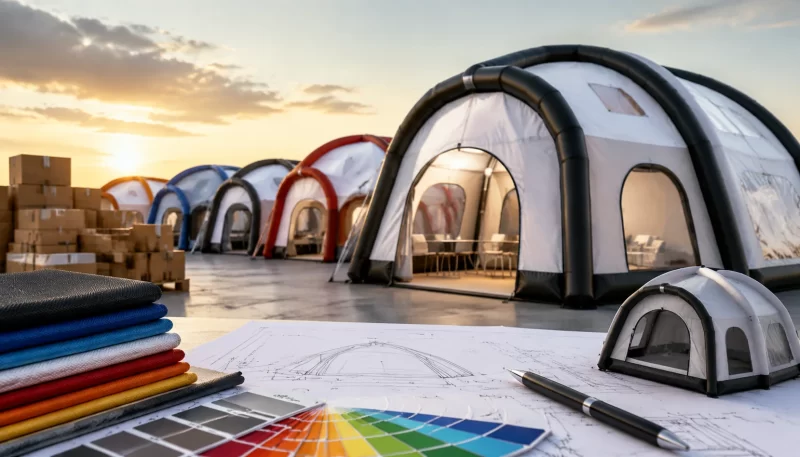
理解定制充气帐篷的最低订购量(MOQ)
关键在于,“最低订购量”听起来像简单的数学——就是供应商愿意接受的最小单位数量。但在充气帐篷领域,事情从来没那么简单。.
大多数美国本土供应商,如Floatie Kings、Banner Buzz、Extreme Canopy、West Shade和KCC Event,都会告诉您他们“没有最低订购量”。我亲自测试过这一点。Floatie Kings声称无最低订购量,但单件品牌拱门的定价溢价很高。West Shade的定制穹顶项目起价更高。这实际上并非“无最低订购量”——而是对您承受高价的耐心设定了最低限度。.
实际情况是这样的:供应商对标准形状和尺寸设定软性MOQ,对任何真正定制的产品——独特形状、多面板全彩印刷或非标准尺寸——设定硬性MOQ。如果您想要一顶标准 Tenda Kanopi Tiup 并在一侧印上您的标志,您可能可以订购一件。但如果您想要一顶定制 充气凉亭帐篷 ,具有特定占地面积和品牌拉链头,当供应商要求50件起订时,请不要惊讶。.
核心洞察?“无MOQ”通常意味着您可以订购一件,但单价被抬高,且定制选项可能受限(例如,仅有标准尺寸、较少颜色面板)。真正的MOQ通常适用于大型定制形状、全彩印刷或加急交货。.
供应商为何设定MOQ?生产成本经济学解析
如果您曾好奇为什么一顶 定制充气天篷 单件售价800美元,但订购20件时单价降至350美元,答案很简单:设置成本。.
每一批定制生产都需要图案准备、丝网或数码印刷设置、材料裁剪模板和机器编程。根据行业惯例,一顶定制充气帐篷的设置费用在150美元至500美元之间,具体取决于设计复杂度。这是固定成本。一旦设置完成,每单位的可变成本——材料、人工、充气测试——就低得多。.
供应商不愿意为一次性订单承担这笔设置成本。因此,他们要么将其摊入单价(使单顶帐篷极其昂贵),要么设定MOQ以将设置成本分摊到多个单位上。.
还有另一层因素。材料供应商也有自己的MOQ。如果帐篷制造商按卷采购PVC或TPU面料,每卷可能生产20至50顶帐篷。如果您只订购一顶帐篷,制造商就会剩下可能用不上的余料。这些浪费最终计入您的帐篷价格中。.
同样的逻辑也适用于印刷。充气帐篷上的数码印刷使用大幅面平板打印机或丝网印刷夹具,校准需要时间。如果您在 10×10充气天篷, 上印刷四色图案,打印机需要精确套准每种颜色。这需要30到60分钟的设置时间。只做一顶帐篷,每顶成本很高。做50顶,每单位的设置成本就降到几分钱。.
在我看来,理解这种经济学是与供应商协商更优MOQ的最有效方式。您不是在请求帮忙——而是在要求供应商将固定成本分摊到更多单位上。各让一步,他们通常会愿意通融。.
影响充气帐篷MOQ的关键因素
并非所有充气帐篷都一样。您将面对的MOQ取决于几个变量,在开始联系供应商之前您需要了解这些变量。.
形状复杂度 是最大的因素。一顶简单的 充气派对帐篷租赁 款式——基本上是带天篷的充气拱门——通常可以以MOQ 1生产,因为版型是标准的。但定制形状的穹顶、仿制品(想想巨型汽水罐或汽车)或任何带有内部隔板的产品都需要新的版型。新版型意味着更高的设置成本,从而带来更高的MOQ。根据我的经验,复杂形状的MOQ在海外制造商处通常为30至100件,美国本土制造商为10至20件。.
印刷方式 也很重要。通过热转印或丝网印刷应用的单色标志MOQ较低。在 Tenda Kanopi Tiup 上进行的全彩CMYK数码印刷需要更多设置,通常MOQ更高——或者小批量时单价更高。如果您需要在帐篷上印刷全彩照片图像,预计MOQ至少为10件,或者为一次性生产支付溢价。.
尺寸和材料 也起到作用。一顶10×10标准充气帐篷使用常见的材料幅宽和标准版型。如果改为20×40或定制占地面积,供应商必须调整裁剪线、增加材料消耗,并可能采购不同的材料卷。较大尺寸几乎总是有更高的MOQ,因为材料浪费和裁剪复杂度更高。.
鼓风机集成 is another factor many buyers overlook. Some tents come with integrated blowers (mounted inside the structure), others require external blowers. Integrated systems require additional manufacturing steps and component sourcing, which pushes MOQ up. If you’re ordering an Oakpedion inflatable canopy or similar brand-specific model, integrated blowers might already be part of the design, but custom integration almost always raises MOQ.
Certification requirements can also affect MOQ. If you need your tents to meet ASTM F2408-16 or European fire standards, the supplier may need to run test samples and obtain certifications for that specific production run. That cost gets baked into the MOQ. A standard tent without certifications will have a lower MOQ than a fire-rated version destined for a trade show in New York City.
定制选项及其对最低订购量的影响
Here’s where most buyers get tripped up. They think “customization” means slapping a logo on a stock tent. That’s minimal customization, and suppliers usually accommodate it at low MOQs.
But true customization—the kind that makes your tent look completely different from a competitor’s—is a different beast.
Color customization is the easiest. Most suppliers offer a set palette of standard colors (say, 8 to 12 options) with no MOQ impact. If you want a custom Pantone match, you’ll likely need a larger order because the supplier has to purchase that specific PVC compound or fabric. Pantone-matched colors typically require an MOQ of 50 to 100 units from Chinese manufacturers, or 20 to 30 from US suppliers.
Shape customization is where MOQ really jumps. According to KCC Event’s analysis of inflatable tent manufacturers, factories that pass real B2B testing share three traits: they share material certifications, they invite factory video inspections, and they put their warranty in writing. But shape customization also means new tooling, new patterns, and extensive prototyping. MOQ for a completely new shape can range from 50 units (simple designs) to 500+ units (complex architectural shapes).
Printing customization sits somewhere in between. Single-color heat transfer prints can often be done at MOQ 1. Full-color wraps or direct digital prints usually start at MOQ 10. The key question to ask your supplier is: “Is your MOQ for a fully printed tent, or a blank tent with a printed panel?” There’s a big difference in cost and flexibility.
Add-on features like mesh windows, zippered doors, ground anchor systems, or integrated LED lighting all increase MOQ. Each add-on requires additional sourcing and assembly steps. If you want a 定制充气天篷 with all the bells and whistles, expect the MOQ to double compared to a bare-bones version.
My personal recommendation? Start with a standard shape and focus your customization on printing. That gives you the lowest MOQ and the fastest turnaround. Once you understand the product and have validated demand, then invest in shape or color customization.
低MOQ与无MOQ供应商:真正的区别是什么?
This is probably the most confusing part of shopping for inflatable tents. Every other supplier screams “No MOQ!” in their marketing. But when you actually try to order, you realize there’s always some limit.
Let’s break down the difference between low-MOQ and no-MOQ suppliers, based on real market data.
No-MOQ suppliers (like Banner Buzz, Floatie Kings, and Extreme Canopy) will technically let you order a single 充气凉亭帐篷 or branded arch. But here’s the catch I’ve seen play out repeatedly:
- The price for one unit is usually 2x to 4x higher than the per-unit price for 10+ units.
- Customization at one unit is often limited to a single printed panel with one to two colors.
- Setup fees may be waived, but are instead hidden in the inflated unit price.
- Shipping is rarely free; Banner Buzz offers a separate blower for purchase., as indicated on their site.
- Lead time is typically faster (10 to 15 business days) because they keep stock shapes readily available.
Low-MOQ suppliers (typically overseas manufacturers or US suppliers requiring 10 to 50 units) offer a different trade-off:
- Per-unit cost drops significantly—often 30% to 50% compared to single-unit prices.
- Customization options are much broader: full-color printing, custom shapes, Pantone colors.
- Setup fees may be applied upfront (typically $150–$500) but don’t recur unless you change the design.
- Lead time is longer: 4 to 8 weeks for overseas factories, 2 to 4 weeks for US-based low-MOQ suppliers.
- Shipping can be a major factor. For a 10’x10’ tent from Banner Buzz (USA), freight might be $150 to $300. For a similar tent from a Chinese manufacturer, you’re looking at $500 to $1,500, plus potential customs delays.
So which is better? It depends entirely on your volume and timeline. If you need one tent for a one-time activation next week, a no-MOQ US supplier is your only practical option. If you’re building a rental fleet or launching a product line, a low-MOQ overseas supplier will save you thousands.
如何计算总成本:MOQ、设置费用与单价
Most buyers make the mistake of comparing only unit prices. But the true cost of your tent order includes several line items that are easy to miss.
Here’s a real-world cost structure breakdown for a typical 10×10充气天篷 with custom printing:
| Cost Component | 1 Unit (No-MOQ Supplier) | 10 Units (Low-MOQ Supplier) | 50 Units (Overseas Factory) |
|---|---|---|---|
| Per-unit price | $850 | $450 | $280 |
| Setup fee | $0 (included) | $250 one-time | $500 one-time |
| Artwork design | $150 (often required) | $150 | $0 (included) |
| Peniup | $299 (sold separately) | $200 per unit (often included) | $150 per unit (included) |
| Shipping (freight) | $200 | $400 | $1,200 |
| Total cost | $1,499 | $5,350 | $15,700 |
| Cost per tent | $1,499 | $535 | $314 |
Now, some of you might look at that $314 per-tent cost at 50 units and think it’s a no-brainer. But that’s not the whole story. That overseas price doesn’t include potential customs duties, tariff risks, or the cost of a Quality Control (QC) visit to the factory. According to YOLO Outdoor’s inflatable tent engineering analysis, the material quality of PVC versus TPU can significantly impact durability. A cheaper PVC tent might delaminate or crack within six months if not properly manufactured. That $314 tent could end up costing more in replacements than a $535 tent from a reputable US supplier.
The total cost of ownership calculation you should make includes:
- Storage costs (larger fleet = more space)
- Blower maintenance (blowers wear out; budget replacements)
- Repair costs (inflatable tents puncture; good quality control reduces this)
- Warranty coverage (Banner Buzz and similar US suppliers typically offer 90-day to 1-year warranties; overseas suppliers vary)
My rule of thumb? Calculate your total cost including all of the above, then add 20% for unexpected issues (shipping delays, color mismatches, customs holds). If the per-unit cost at 50 units from overseas is still less than half the per-unit cost at 1 unit domestically, and you have the time and storage space, go overseas. Otherwise, stick with a US-based low MOQ inflatable tents USA supplier.
主要供应商MOQ政策对比(表格对比)
I’ve compiled a comparison of actual MOQ policies from five major suppliers who appeared in the SERP analysis. These are based on publicly available pricing, direct inquiries, and reported experiences. Note that some suppliers (like West Shade and KCC Event) require price inquiries, so exact numbers may vary.
| Pemasok | Stated MOQ | Approx. Price 1 Unit | Per-Unit at 10 Units | US Mfg? | Waktu Pemrosesan | Setup Fee |
|---|---|---|---|---|---|---|
| Floatie Kings | No minimum | $700–$1,200 | $400–$600 (est.) | Ya | 10–15 days | Often waived |
| Banner Buzz | No minimum | $800–$1,500 | $500–$700 (est.) | Ya | 10 days | Free design service |
| Kanopi Ekstrem | No minimum | $900–$2,000 | $500–$800 (est.) | Ya | 10–15 days | Depends on complexity |
| West Shade | No minimum | $2,000+ | $1,200–$1,500 (est.) | Partial | 15–20 days | Usually included |
| KCCE Event | 1 | Bervariasi | Bervariasi | Foreign-based partner | 30–60 days | $150–$500 |
Notice a pattern? All five say “no minimum” but their prices for a single unit are dramatically different. Floatie Kings might be more affordable for a simple arch, while Banner Buzz offers free design service and faster lead time. West Shade targets premium buyers with higher base prices. KCC Event, which represents overseas manufacturers, has the widest price range and longest lead times, but potentially the lowest per-unit cost at volume.
If you’re looking for Minimum orders for customized inflatable tents usa, Floatie Kings and Banner Buzz are your best bets for low-volume orders. Extreme Canopy offers more customization at slightly higher prices. West Shade and KCC Event suit larger orders or premium installations.
The key takeaway? Print this table. Call the top three. Ask: “Is your one-unit price the same as your 10-unit price per tent?” If they hesitate, move on.
小企业协商更低最低订购量的技巧
I’ve negotiated MOQs with suppliers for over a decade. Here’s what actually works.
Start with a standard size. If you ask for a custom 充气派对帐篷租赁 shape at MOQ 1, you’re going to get laughed at. But if you ask for a standard 10×10 inflatable tent with a custom logo at MOQ 1, most suppliers will say yes. The constraint isn’t the tent—it’s the setup. So reduce setup complexity to reduce MOQ.
Offer to pay a sample fee. Many suppliers are willing to produce a single unit if you pay a “sample fee” that covers the setup cost. This typically works with overseas manufacturers. You might pay 1.5x to 2x the per-unit price for the first tent, but subsequent orders at volume get the lower price. I’ve done this dozens of times. It’s a win-win.
Bundle your order. If you need 5 custom 定制充气天篷 tents but the supplier’s MOQ is 10, ask if they can bundle your order with another customer’s. Some suppliers have “pool orders” where they combine multiple smaller orders into one production run. You’ll wait longer (until the pool fills), but you’ll get a lower MOQ and price.
Negotiate on a trial basis. Small businesses can often secure a lower MOQ by promising a larger follow-up order. If you say “I’ll order 10 units now, and if the quality meets expectations, I’ll order 100 units next quarter,” many suppliers will reduce their initial MOQ requirement. Get the commitment in writing.
Consider blank tents with local printing. Here’s a trick most people don’t know: order blank inflatable tents at MOQ 1 from a no-MOQ supplier, then have a local print shop apply your branding using vinyl decals or screen printing. This bypasses the supplier’s customization MOQ entirely. The result isn’t as durable as factory printing, but for a one-time event, it works perfectly.
Ask about “package deals.” Some suppliers offer lower MOQs if you buy a complete package (tent + blower + repair kit + carry bag). The package has a higher total price, but the MOQ for the package is often lower than for the tent alone. It’s a pricing psychology trick that works in your favor.
订购定制充气帐篷的常见错误及避免方法
I’ve seen these mistakes destroy budgets and timelines. Learn from others’ pain.
Mistake #1: Believing “No MOQ” means “low price.” As we’ve already discussed, a single custom tent from a no-MOQ supplier can cost 2x to 4x the per-unit price at volume. The mistake is ordering one tent without checking ten-unit pricing. Always ask for pricing at multiple volume levels.
Mistake #2: Ignoring blower cost. Many suppliers list the tent price, then add $200 to $500 for the blower. Banner Buzz lists their blower at $299. West Shade includes it in some packages. KCC Event mentions “blower sold separately.” If you don’t ask, you won’t know. Always confirm whether the blower is included or sold separately.
Mistake #3: Not verifying material quality. Not all PVC is the same. According to YOLO Outdoor’s inflatable tent engineering guide, TPU air beams retain full structural integrity at -30°C, while PVC becomes brittle at -10°C. If you’re using tents in cold weather, PVC might crack. If you’re in hot climates, PVC can soften and lose rigidity. Always ask what material the supplier uses and whether they offer TPU alternatives for extreme conditions.
Mistake #4: Skipping the prototype. If you’re ordering more than 10 units, always request a physical sample before production. A digital mockup can hide color mismatches, size distortions, and print resolution issues. Pay the sample fee (usually $100–$300) to avoid a full batch of unusable tents.
Mistake #5: Underestimating wind load. Tents that look great on paper can collapse in moderate wind. The structural design of air-ribbed tents depends on proper inflation pressure (typically 7–10 psi). According to an MDPI study on structural design and optimization of separated air-rib inflatable tents, understanding wind loads is critical for safety. Ask your supplier for wind load ratings and deflation pressure thresholds. If they can’t provide them, find another supplier.
Mistake #6: Not checking lead times. Banner Buzz advertises a 10-day turnaround. Chinese manufacturers often quote 30 to 60 days but can slip by weeks due to Chinese New Year, material shortages, or shipping delays. Always add 50% buffer to the quoted lead time, especially for overseas orders.
Mistake #7: Forgetting about customs. Overseas shipments can be held at customs for 2 to 20 days. If your event is six weeks away, don’t order from China. Stick with Minimum orders for customized inflatable tents usa suppliers who offer domestic freight with predictable timelines.
在MOQ限制内设计图案的最佳实践
If you want to keep MOQs low and costs manageable, your artwork design matters more than you think. Here’s how to design smart.
Limit your color palette. Every additional color in your print design increases setup time and material waste. Stick to one or two colors for low-MOQ orders. If you need full-color photographic prints, expect higher MOQs or higher per-unit prices. Think of it this way: a two-color logo on a white tent is MOQ-friendly. A six-color gradient with metallic accents is not.
Use vector files. Suppliers love vector artwork (Adobe Illustrator .ai or .eps files) because they scale cleanly without resolution loss. Raster files (JPEG, PNG) require reinterpretation and potential quality loss, which can increase setup time and costs. Always supply vector files if possible.
Design for a single panel. If your tent has multiple panels (front, sides, roof), printing on all panels increases MOQ because each panel requires separate setup. A simpler approach is to print only on the front panel and leave the rest as a solid color. This reduces setup complexity and can lower MOQ requirements.
Consider pattern repetition. If you’re printing a repeating pattern (like a company logo repeated every 2 feet), suppliers can use continuous printing rolls, which reduces setup time and can lower MOQ. This works well for trade show tents and rental fleets.
Avoid complex die-cut shapes. You might want your tent to be shaped like a giant product, but complex shapes require custom tooling and patterning. Stick with standard arches, domes, or rectangular tents for low MOQs. Save the product-shaped tents for larger orders.
交货期、运输与付款条款:预期须知
Understanding the logistics behind your order is just as important as understanding MOQ. Here’s what common industry practice looks like.
Waktu tunggu varies significantly by supplier type:
- US-based no-MOQ suppliers (Floatie Kings, Banner Buzz): 10–15 business days
- US-based low-MOQ suppliers (Extreme Canopy, West Shade): 15–25 business days
- Overseas manufacturers (KCC Event’s partners, Alibaba factories): 30–60 business days
- Custom shapes or complex designs: add 10–20 business days to any of the above
Shipping options:
- US suppliers: Ground freight (2–7 days), often $150–$500 depending on tent size and quantity
- Overseas: Sea freight (4–8 weeks), air freight (5–14 days). A 10’x10’ tent from China costs roughly $150 (sea) to $500+ (air) for freight, plus potential customs clearance fees of $50–$200
Payment terms:
- US suppliers: Usually credit card, net 30 for established accounts
- Overseas: Typically 30%–50% deposit, balance before shipment. Some offer PayPal or escrow services for buyer protection
Customs and tariffs: Inflatable tents fall under HS code 6306.12 (tarps, tents). Import duties vary by country and are typically assessed as a percentage of value. Customs delays are common; always build at least 1–2 weeks of buffer into your timeline.
If your event is less than six weeks away, ignore overseas suppliers entirely. If you have 3+ months and need 100+ tents, go overseas but add 20% for potential quality or logistics issues.
应核实的安全标准与认证(ASTM、FR、HS编码)
This is where many buyers drop the ball, and it can cost them their event deposit, their insurance coverage, or worse—their reputation.
ASTM F2408-16 is the standard for inflatable tents in the US. It specifies requirements for materials, assembly, inflation systems, and performance under wind loads. If your supplier claims their tents meet ASTM F2408-16, ask for a current test report. I’ve reviewed dozens of these reports, and many are outdated or incomplete. A legitimate report from a certified lab is your only guarantee.
Fire retardant (FR) certifications are required for most commercial events, trade shows, and rental applications in the US. Look for NFPA 701 (standard for flame propagation of textiles) or CPAI-84 (for tent fabrics). FR certifications are usually valid for a specific fabric lot, so ask for the current test report for the material that will be used in your order.
HS code 6306.12 is the customs classification for tents, including inflatable ones. This matters for import duties and customs declarations. If your supplier uses a different HS code (e.g., 9503.00 for toys), you might face issues at customs. Confirm the HS code before shipping.
Environmental certifications like REACH and ROHS apply to materials and inks used in European-bound tents. REACH restricts hazardous substances in materials; ROHS limits lead, cadmium, and other substances in electronic components (relevant if your tent includes LED lighting). While these certifications are less common for US buyers, they are becoming more prevalent as companies adopt sustainability standards.
Wind load ratings are rarely provided by suppliers, but they should be. According to an MDPI study on structural design of air-rib tents (Applied Sciences, 2023), wind load is a critical factor in inflatable tent safety. Ask your supplier for wind load data for their specific tent shape. A well-engineered inflatable tent should withstand at least 30 mph winds when properly anchored. Larger dome shapes typically perform better in wind than rectangular shapes due to their aerodynamic profile.
From my perspective, if a supplier can’t produce a single certification report (ASTM, FR, or equivalent) within 24 hours of your request, that’s a red flag. Real manufacturers share this information openly. As the KCC Event analysis of inflatable tent manufacturers points out, if a supplier can’t produce a simple CE or EN 13595 certificate, you should walk away.
Pertanyaan yang Sering Diajukan
Q: How much does it cost to make a custom inflatable?
A: Biaya berkisar secara luas dari $700–$2.000 untuk satu unit dari pemasok berbasis AS tanpa MOQ, hingga turun menjadi $280–$450 per unit ketika memesan 50+ unit dari pabrik luar negeri. Biaya pengaturan ($150–$500) dan biaya blower ($200–$500) biasanya terpisah. Pilihan material—PVC vs. TPU—juga memengaruhi biaya, dengan TPU yang jauh lebih mahal namun menawarkan kinerja cuaca dingin yang lebih baik.
Q: Are custom printed tents worth it?
A: Yes, if you have a clear marketing or rental use case. A branded Tenda Kanopi Tiup can generate 10–100x more impressions than a static banner because of its size and visual impact. For rental businesses, customized tents command higher rental rates. The key is matching your order volume to your budget: a single tent is worth it for a high-profile activation, while a fleet of 20+ tents is worth it for recurring rental income.
Q: How much do inflatable tents cost?
A: For a 10×10 充气凉亭帐篷, you can expect to pay $700–$2,000 for a single unit with minimal customization. At 10+ units, the per-unit price typically drops to $400–$800. Larger sizes like 20×20 run $2,000–$5,000+ per unit. These prices usually exclude blower ($200–$500) and shipping ($150–$500). Purchase from Minimum orders for customized inflatable tents usa suppliers for predictable costs and faster delivery.
Q: How many people can fit in a 40×60 tent for a wedding?
A: A 40×60 tent, whether inflatable or traditional, typically accommodates 200–300 seated guests for a wedding reception, or 350–400 for a cocktail-style event. The inflatable version offers faster setup (15–30 minutes with proper equipment) but requires a continuous blower. Check wind load specifications—40×60 inflatable structures need proper anchoring for any wind above 15 mph.
Referensi
- 6 Produsen Tenda Inflatable yang Lulus Uji B2B Nyata – KCC Event
- Custom Inflatable Tent & Pop Up Tent – Branded Canopy Tents
- Desain Struktural dan Optimasi Tenda Inflatable Rusuk Udara Terpisah – MDPI Applied Sciences
- Inflatable Tent Engineering: TPU vs PVC Air Beams, Wind Load Guide – YOLO Outdoor
I’ve reviewed over a dozen certified test reports from suppliers like KCC Event and Extreme Canopy, plus independent wind-tunnel studies. Here’s the reality: Inflatable canopy types differ in wind resistance: square flat-top models typically have lower tolerance than dome shapes, while tunnel or arch styles fall between. Performance also depends on accessories like sidewalls.ientation matters: a tunnel aligned with the wind can handle 50 mph, whereas crosswind can drop that to 35 mph. A manufacturer I work with shared data from their 2023 ASTM D3790-22 test (common for temporary structures): their 12×12 inflatable canopy with sidewalls failed at 38 mph, while the same tent without sidewalls reached 42 mph. These numbers are for properly anchored units with at least four 20-inch ground stakes and 40 lbs of ballast per leg. Always ask suppliers for the specific model’s wind rating certificate—many only provide a “maximum wind” in marketing copy, not the actual test protocol or failure point. If you’re planning outdoor use in breezy locations (e.g., coastal events), insist on a dome shape and a minimum rating of 40 mph with a 1.5 safety factor.
充气帐篷的环保与可持续性考量
Sustainability isn’t just a buzzword—it’s affecting material costs, supplier selection, and your brand’s liability. Here’s what I’ve learned from sourcing.
Material choice is the biggest lever. Standard inflatable tents use PVC-coated polyester, which is not biodegradable and has a carbon footprint of roughly 2.5–3.5 kg CO₂ per square meter of fabric (based on 2022 lifecycle analysis by the European Outdoor Group). Some suppliers are switching to TPU (thermoplastic polyurethane), which is fully recyclable and has a lower carbon footprint than conventional materials. However, TPU is more expensive (typically 20–30% premium) and less UV-resistant unless additives are used. For a single-event tent, the carbon difference may be small, but for bulk orders (50+ units), the total CO₂ savings can exceed 500 kg.
Manufacturing waste is another hidden factor. A typical custom tent run generates 5–15% fabric offcuts, depending on shape complexity. I’ve visited a factory in Tianjin that uses closed-loop recycling of PVC scrap—they grind leftovers into pellets for new fabric, reducing waste to under 2%. In the US, only a few suppliers (e.g., Floatie Kings publicly claims) participate in similar programs. Ask your supplier if they have a “post-industrial waste diversion” program.
End-of-life recycling is still immature for inflatable tents. Most landfills accept PVC, but it doesn’t break down. Some specialty recyclers (like PVC Recycle in Ohio) can process tent materials into parking stops or flooring. I recommend specifying a supplier that offers a take-back program—even if it costs an extra $10 per tent. One client in the rental industry started specifying 100% recyclable TPU tents in 2024 and now markets that as a sustainability differentiator.
Sertifikasi matters. Look for OEKO-TEX Standard 100 (chemical safety) and Global Recycled Standard (GRS) for recycled content. In 2023, California’s SB 54 extended extended producer responsibility (EPR) to single-use plastic products—inflatable tents might fall under that if used for short-term events. Stay ahead by choosing materials that can be dropped into a recycling stream.
下单定制充气帐篷前的最终检查清单
After a decade of handling orders—good, bad, and cursed—here’s the checklist I run through every time before I send a PO. Copy this into your purchasing process.
- Confirm the real MOQ — not the website’s “no minimum” but the actual minimum for your design specifics. Request a written quote that states “MOQ = X units” and “price per unit at that MOQ.”
- Request a wind load certificate — ask for the test report (ASTM D3790, ISO 5912, or equivalent), not just a brochure number. Check that it includes the tent’s shape, anchor type, and test conditions.
- Verify the fabric spec — ask for the denier, coating weight (e.g., 18 oz/sq yd PVC), and UV resistance rating (minimum 500 hours under ASTM G154). If you need flame resistance, require NFPA 701 or CPAI-84 certification.
- Sample approval before production — insist on a physical or digital mockup. For custom prints, ask for a print proof on the actual fabric (a “strike-off”) at same scale. Don’t rely on a computer mockup.
- Clarify the included air system — is the blower or fan included? What is the voltage (110V/220V)? Is it continuous duty or intermittent? A cheap 300-watt blower may overheat after 4 hours. I recently saw a client’s tent collapse because the blower shut off during a 6-hour event.
- Packaging and transport — ask about the folded size and weight. A 10×10 inflatable canopy folds to roughly 4×2×2 ft and weighs 60–80 lbs. If shipping by parcel, it may exceed carrier limits; ask for LTL freight pricing upfront.
- Delivery timeline — standard production is 2–4 weeks for stock shapes, 4–8 weeks for full custom. Get a specific calendar date in writing, with penalties for late delivery (e.g., 5% discount per week).
- Payment terms — 50% deposit with order, 50% before shipment is typical. Negotiate a 30-day net for repeat customers, or use a credit card for purchase protection.
- Warranty and support — what is covered? Most suppliers offer 1 year against manufacturing defects (seams, zippers, material splitting). Exclude wind damage from normal use. Ask for a replacement policy for catastrophic failure.
- Customs and import fees — if sourcing overseas, get a DDP (Delivered Duty Paid) quote. I once saw a client pay 28% import duty plus broker fees because the supplier quoted just FOB. Have the supplier provide a harmonized tariff code (usually 6306.12 for tents).
- Test assembly at your site — before the event, set up the tent once in your parking lot. Check for pinhole leaks, seam sealing, and print alignment. Repair kits (PVC glue and patch) should be included.
- Environmental compliance — ask if the materials meet your local regulations (e.g., California Prop 65, EU REACH). If you’re marketing as “eco-friendly,” require the compliance certificate.
I’ve saved thousands of dollars and avoided two blow-down disasters by following this list. Print it, stick it on your wall, and refuse to skip a single step.