Inflatable Marquee for Events: The Honest Buyer’s Guide
You know those videos that make it look like total magic? A tent inflates from a crumpled pile of fabric into a stunning event space in under 10 minutes. It looks like sorcery. But owning one? That’s not quite as smooth as the marketing makes it seem. In just the last year, I’ve seen event planners lose thousands in damaged inventory because they grabbed the cheapest inflatable marquee without bothering to check its wind rating.
Here’s the thing — I’ve spent the better part of a decade in the event equipment space, and I’ve watched inflatable marquees go from a fringe novelty to a legitimate heavyweight in the rental market. The numbers back this up. According to Credence Research, the Global Inflatable Tents Market hit USD 1,207.75 million in 2024 and is projected to reach USD 2,175.92 million by 2032, growing at about 7.72% CAGR. That’s not a niche. That’s a movement.
But those slick promotional videos? They leave out some important stuff. Inflatable marquees have real limitations. They puncture. They flutter in high winds. Those blowers make noise. And if you buy the wrong one — cheap PVC, weak seams, undersized fan — you’ll be replacing it within two seasons. I’ve seen it happen.
This isn’t another sales pitch. It’s an honest buyer’s overview of the inflatable marquee market — comparing price brackets, material quality, and all those hidden costs nobody mentions up front. By the end, you’ll know exactly what to ask before you buy or rent.
Let’s dig in.
What Is an Inflatable Marquee? Definition and Working Principle
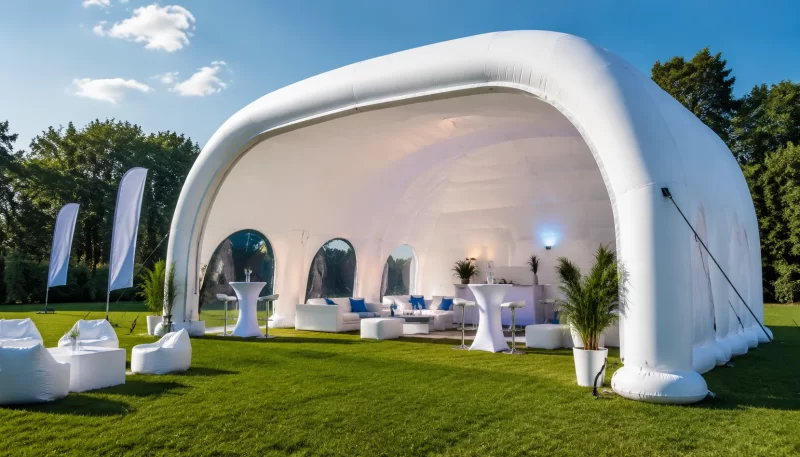
Here’s the simplest way to think about it: an inflatable marquee is a tent that uses pressurized air instead of metal poles or frames to hold its shape. No more threading aluminum poles through canvas sleeves — that old-school method that takes four people and a prayer. Instead, you connect a blower (or a few, depending on size), flip a switch, and watch the whole thing rise.
The working principle is simple but clever. Those air beams — the tubular columns that form the skeleton — are made from airtight fabric, usually PVC-coated polyester. The blower keeps pumping air into these beams, maintaining pressure somewhere between 6 and 12 psi depending on the design and size. That constant positive pressure keeps the structure rigid. Stop the blower, and the whole thing deflates.
Not all inflatable marquees are created equal though. From what I’ve seen, they fall into three main structural categories:
Tenda kubah — Those geodesic-looking structures you see at festivals and glamping sites. A crossover dome tent, for instance, uses intersecting air beams to create a self-supporting dome shape. They’re incredibly stable because of that aerodynamic profile, but they tend to have single entry points. That can become a real bottleneck for bigger events.
Cube marquees — These are modular, so you can connect multiple units to make larger spaces. They’re boxy and efficient — great for exhibitions where you need predictable, column-free interior space. The trade-off? They catch more wind than domes.
Tunnel marquees — Classic elongated shape, like a traditional marquee but without center poles. These are popular for weddings and long dining setups. The air beams form arch-like ribs along the length of the structure.
The term “inflatable marquee for events: a buyer’s overview” might sound academic, but what it really means is: you need to understand these shape differences before you open your wallet. A dome tent that looks amazing in a showroom photo might be entirely wrong for a corporate event on a windy hillside. Trust me on that one.
I’ll get into wind ratings in more detail later, but here’s a quick reference for the three shapes:
| Bentuk | Best Use Case | Typical Height | Wind Profile |
|---|---|---|---|
| Kubah | Single-entry events, glamping, intimate gatherings | 8–12 ft at apex | Excellent — aerodynamic |
| Kubus | Exhibitions, modular layouts, corporate events | 10–14 kaki | Moderate — catches crosswinds |
| Terowongan | Weddings, long dining, runway events | 10–16 ft | Good — aerodynamic when aligned with wind |
Key Components: Air Beams, Fabric, and Blower Systems
Let me walk through the anatomy of an inflatable marquee — because I cannot stress this enough: the quality of these components is what separates a tent that lasts five years from one that fails in eighteen months.
Air Beams. These are not simple tubes. A good air beam has multiple layers. The outer layer is typically PVC-coated polyester or nylon. Inside, there’s an airtight TPU or PU bladder. The combination gives you both structural strength and air retention. You want a double-wall construction — the outer layer handles UV and abrasion resistance, while the inner bladder does the air sealing. Single-wall beams are cheaper, but they’re also more likely to develop micro-leaks.
Here’s something most buyers don’t think about: beam diameter. Small marquees (20’x20′) might use 6-inch diameter beams. Large structures (40’x60′) can use 12-inch or even 16-inch beams. The wider the beam, the more air volume it holds and the more stable the structure. But wider beams also need bigger blowers.
Fabric. This is where the rubber meets the road — literally. The most common material is PVC tarpaulin, measured in grams per square meter (gsm) or ounces. For event-grade inflatable marquees, you’re looking at 650gsm to 900gsm PVC. The lighter stuff (under 600gsm) is for consumer camping tents, not commercial events. UV treatment is essential if the tent will see sunlight — untreated PVC degrades and becomes brittle within 12 to 18 months of regular sun exposure.
I’ve seen rental operators buy cheap marquees with 550gsm fabric and wonder why they got pin-hole leaks after a single summer. The answer is material thickness. PVC thickness of 0.55mm is entry-level and will typically last 2–3 seasons with careful use. 0.7mm is the sweet spot for most event applications — it balances weight, cost, and durability. 0.9mm PVC is heavy-duty and can handle high-frequency rental use for 5+ years, but it’s heavier to transport and significantly more expensive. For context, 0.55mm PVC is fine for low-frequency personal use or events in sheltered conditions, while 0.9mm is what rental companies should spec for regular commercial use where punctures and abrasion are constant risks.
Blower Systems. This might be the most misunderstood component. There are two types: continuous inflation blowers and high-pressure seal-inflation blowers.
Continuous blowers run the entire time the tent is up. They maintain pressure by constantly pushing air into the beams. Simpler, cheaper, easier to replace. The downside? Noise. A 1HP blower running continuously draws about 750 watts and produces a hum that guests will notice. For outdoor weddings with ambient noise, it’s usually fine. For quiet corporate settings, it can get annoying.
High-pressure seal-inflation systems use a more powerful blower to inflate the structure to a higher pressure, then seal the valves. Once sealed, the tent maintains its shape without continuous power. Some models can stay up for 12–24 hours without re-inflation, depending on temperature and wind. These are quieter and more energy-efficient, but the initial blower cost is higher, and if you get a leak, you’re in trouble — the structure can lose rigidity over time.
From where I’m standing, most event professionals prefer continuous systems for reliability. Being able to walk up, add more air, and immediately fix sagging beams is worth the noise trade-off.
Other components you shouldn’t overlook:
- Ground tarps (protect the bottom of the tent and prevent moisture wicking)
- Sandbag anchors or screw-in stakes (more on this in the wind section)
- Blower spare (always buy a backup — $200 to $500 is cheap insurance)
- Repair kits (PVC glue, patch material, seam sealer — budget for these upfront)
- Storage bags (a good storage system prevents fabric creasing and UV damage)
Inflatable Marquee vs Traditional Marquee: A Side-by-Side Comparison
This is the question I get more than any other from event planners and rental operators. The short answer is: it depends entirely on your use case. Let me break this down with real numbers.
I want to be clear — I’m not one of those people who claims inflatable is always better. It’s not. Traditional frame tents have been around for a century for good reasons. But the gap is narrowing, and in some scenarios, inflatable clearly wins.
| Comparison Factor | Inflatable Marquee | Traditional Frame Marquee | Stretch Tent |
|---|---|---|---|
| Setup Time (2-person crew) | 30–90 minutes (including anchoring) | 3–6 hours | 45–90 minutes |
| Setup Crew Size | 2–3 people | 4–6 orang | 3–4 people |
| Cost per sq. ft. (purchase) | $4–$8 | $6–$12 | $5–$10 |
| Tahan Angin | 35–50 mph (depends on design) | 50–70 mph | 40–55 mph |
| Transport Weight (40’x60′) | ~500–800 lbs | ~1,500–2,500 lbs | ~400–700 lbs |
| Storage Volume | 4’×4’×3′ (approx.) | 8’×4’×4′ (approx.) | 3’×3’×2′ (approx.) |
| Center Pole Obstruction | None (clear span) | Some designs have poles | Tidak ada |
| Aesthetic | Modern, ramping | Traditional, formal | Organic, bohemian |
| Trip Hazards | Minimal (no guy ropes in many designs) | Significant (ropes and stakes) | Sedang |
| Repairability | Moderate (need PVC skills) | High (replaceable poles) | Sedang |
| Noise from Equipment | Blower noise (continuous) | Tidak ada | Tidak ada |
| Risiko Kondensasi | Higher (in cold weather) | Lebih rendah | Sedang |
| Secondhand Resale Value | 30–50% of original after 3 years | 40–60% of original after 3 years | 35–55% of original after 3 years |
Let me add some context to this table, because raw numbers don’t tell the whole story.
Setup Time — The Reality Check: Every inflatable marquee salesman tells you “10 minutes setup.” That’s technically true — for the inflation part. But the full setup, including ground preparation, anchoring, running power cables, and securing the structure, takes 30 to 90 minutes with a two-person crew. For a 40’x60′ marquee, plan on 60 to 90 minutes for first-time setup. Experienced crews can do it faster, but I’ve never seen it done in under 30 minutes for any size larger than 20’x20′.
Ketahanan Angin: Here’s where traditional marquees still hold an edge. A well-anchored frame tent can handle 60+ mph winds. Most inflatable marquees are rated for 35 to 50 mph. A few premium models — particularly geodesic dome tents with crossover beam designs — claim up to 65 mph with proper anchoring. But I’d treat those claims with healthy skepticism unless you see third-party wind tunnel test data.
Here’s something from the market data worth mentioning. According to the Business Research Insights report on the Frame Inflatable Tent Market, the segment is projected to grow at a CAGR of 5.2% through 2035. That’s solid but slower than the overall inflatable tent market, which suggests traditional frame tents are losing ground in the broader event shelter market but retaining their stronghold in heavy-duty applications.
Resale Value: This is a hidden cost that most buyers don’t consider. Traditional frame tents have higher secondhand resale value because the frames are reusable and repairable. Inflatable marquees have lower resale value because the fabric degrades and air beam technology improves rapidly. After three years of commercial rental use, you might recover 30–50% of your inflatable marquee’s original cost. A comparable frame tent might fetch 40–60%.
Advantages of Choosing an Inflatable Marquis for Events
Okay, so let’s talk about the good stuff. I’ve been pretty critical so far, but the advantages are real and substantial.
Speed of Setup. This is the headline advantage for a reason. A 30’x30′ inflatable marquee can go from flat storage to fully erected in under an hour with two people. The same size traditional frame tent needs four people and three to four hours. In the event industry, time is literally money. Being able to set up and tear down faster means you can do more events in a week, or slash your labor costs significantly.
Lower Transport Weight. Without those heavy steel frames, inflatable marquees weigh about one-third to one-half of comparable traditional tents. A 40’x60′ inflatable might weigh 500–800 pounds, fitting in a standard pickup truck or small van. The equivalent frame tent could weigh 1,500–2,500 pounds, needing a dedicated trailer or box truck. For rental companies, that means lower fuel costs and the ability to haul more equipment per trip.
Fewer Trip Hazards. This is a safety advantage that often gets overlooked. Traditional marquees have guy ropes, stakes, and pole bases — all of which are tripping hazards for guests, especially at night or in high-traffic areas. Many inflatable marquee designs eliminate or minimize these hazards. And the absence of center poles means no obstruction of sight lines, which is huge for wedding ceremonies and stage events.
Modern Aesthetic. Let’s be honest — traditional white frame tents look like, well, traditional white frame tents. Inflatable marquees have a sleek, modern appearance that fits contemporary event design trends. The smooth, rounded shapes of a geodesic dome tent or a blow up dome tent create a completely different visual feel. For brands looking to stand out, this matters.
Clear Span Interior. Most inflatable marquees are true clear span structures — no center poles, no internal columns. This is massive for floor plan flexibility. You can arrange seating, stages, dance floors, and bars anywhere in the space without working around support poles. Traditional marquees with center poles require careful layout planning and sometimes limit capacity.
All-Weather Versatility. I’ve used inflatable marquees in rain, snow, and heat. Modern PVC materials with UV treatment and waterproof construction handle rain well. Snow loads — up to a point — are manageable with steeper-pitched designs. The key is buying the right structure for your climate.
Common Applications: Weddings, Corporate Events, Exhibitions, Festivals, and Emergency Shelters
Different events have different needs. Here’s where each type of inflatable marquee shines.
Wedding Dome Tents. Weddings are probably the most popular application for inflatable marquees in the event space. Why? Speed of setup (vendors can arrive the morning of the wedding instead of the day before), aesthetics (clear span interiors look elegant), and versatility (the same 30’x30′ marquee can host a ceremony, reception, or both). Wedding planners specifically like tunnel marquees for outdoor dining setups where they want long, uninterrupted table arrangements.
I’ve noticed a trend: couples choosing a crossover dome tent for the ceremony — that aerodynamic dome shape creates an intimate, focal-point feel — and then a tunnel marquee for the reception, which is more practical for seating and dancing. It’s a clever combination that plays to each design’s strengths.
Festival Dome Tents. Festivals are where the inflatable marquee really proves its worth. Setup and teardown speed is critical when you’ve got a three-day window to transform an empty field into a temporary village. Inflatable structures can be deployed rapidly by small crews, and their lower transport weight means more tents per truckload.
Corporate Event Dome Tents. Corporate events demand professionalism and reliability. Inflatable marquees deliver the clear span space needed for exhibitions, product launches, and training sessions. Custom branding integration — printing logos directly onto the PVC panels — is a major advantage here. No need for expensive banner stands or fabric drapes to brand the space.
Exhibitions. For trade shows and exhibitions, cube marquees are the preferred choice because of their modularity. You can connect multiple cube units to create a large, column-free exhibition hall. The predictable square footage makes floor plan design straightforward. An outdoor event dome tent can also work for stand-alone exhibition spaces, but the dome shape creates awkward corners for standard booth layouts.
Emergency Shelters. This might be the most important application, though it’s less visible to the average consumer. Aid agencies and governments use inflatable marquees for rapid shelter deployment in disaster zones. The Global Inflatable Tents Market report from Credence Research specifically cites “emergency relief” as a key growth driver. These structures can be air-dropped, deployed by small teams, and provide immediate weather protection for displaced populations. The material requirements are different — more rugged, often double-layer construction — but the core inflatable technology is the same.
Materials and Durability: PVC Tarpaulin, UV Treatment, and Fire Retardancy (EN13501-1)
This is where the rubber meets the road — literally. The fabric of your inflatable marquee is the single most important quality indicator.
PVC Tarpaulin. The industry standard is PVC-coated polyester fabric. The coating gives it waterproof properties; the polyester base provides tensile strength. Quality ranges from 550gsm (grams per square meter) for budget consumer tents to 900gsm for heavy-duty commercial use. For event applications, 650gsm to 750gsm is the sweet spot — strong enough for years of use but not so heavy that it becomes cumbersome to handle.
UV Treatment. Sunlight destroys PVC over time — it’s not a matter of if, but when. UV stabilizers are added to the PVC compound during manufacturing to slow this degradation. A good-quality inflatable marquee with proper UV treatment should last 5–7 years in regular outdoor use before the fabric becomes brittle and loses tensile strength. Cheap tents without adequate UV protection might show cracking and powdery surface degradation within 12–18 months.
Fire Retardancy — EN13501-1. This is not optional for commercial events. Most venues, event spaces, and local fire codes require inflatable marquees to meet specific fire safety standards. The European standard EN13501-1 is the gold standard for fire classification of construction products. For event tents, you want at least a B-s1,d0 classification — “B” means limited contribution to fire, “s1” means very limited smoke production, and “d0” means no flaming droplets.
The testing involves exposing the fabric to a controlled flame and measuring how quickly the fire spreads, how much smoke it produces, and whether burning material drips off. Fabric that passes EN13501-1 has been chemically treated with flame retardant additives during manufacturing.
Here’s a subtle point: fire retardancy isn’t permanent. Over time — especially with repeated cleaning, UV exposure, and mechanical wear — the flame retardant properties degrade. Responsible rental operators re-test their marquees annually or according to local fire codes. Some manufacturers offer re-treatment services, but in practice, most operators replace the tent when fire certification can’t be maintained.
CE Certification. For inflatable marquees sold in the European market, CE marking is mandatory. It means the product meets EU safety, health, and environmental requirements. For importers, this means working with manufacturers who can provide CE documentation — not just a generic certificate, but specific test reports showing compliance with relevant standards.
Customization Options: Sizes, Shapes, Colors, Branding, Windows, and Lighting
One of the underappreciated advantages of inflatable marquees is how customizable they are. Because the structure is essentially a large PVC balloon, you can print, shape, and accessorize it in ways that frame tents just can’t match.
Sizes. Inflatable marquees range from small 10’x10′ personal units to massive 100’x100′ event structures. The most common sizes for commercial events are:
- 20’x20′ (good for 30–50 guests seated)
- 30’x30′ (good for 80–120 guests)
- 40’x60′ (good for 150–200 guests with dance floor)
- 50’x80′ and larger (for big weddings and corporate galas)
Custom sizes are available from most manufacturers, but they come at a premium. Standard sizes are cheaper because the molds and cutting patterns are already tooled.
Shapes. Beyond the three main types (dome, cube, tunnel), there are variations like the crossover dome tent — a dome tent with intersecting air beams that create a geodesic-like structural pattern. This design offers superior wind resistance and a distinctive aesthetic. Other shapes include hexagonal, octagonal, and even custom contour shapes for specific event designs.
Colors. White is the default because it’s neutral, reflects heat, and works with any lighting scheme. But inflatable marquees can be produced in virtually any color. Popular choices include black (for night events and theatrical productions), blue (corporate branding), and various pastels for weddings. Custom color orders typically have a minimum quantity and longer lead times.
Branding. This is a big selling point for corporate events. Your company logo, event sponsors, or custom graphics can be printed directly onto the PVC panels using a digitally printed transfer process. The quality is comparable to vehicle wraps, and the result is a branded structure that looks permanent and professional. No flimsy banners, no misaligned signage.
Windows and Doors. Standard inflatable marquees come with basic zippered entries. Upgrades include:
- Clear PVC windows (provides natural light and views)
- Roll-up door panels (for open-air events)
- French door-style double openings (for grand entrances)
- Air lock entries (for temperature-controlled interiors)
Lighting. The fabric of inflatable marquees is essentially a giant lampshade. LED uplighting around the perimeter creates a beautiful ambient glow. String lights, chandelier mounts, and integrated LED strips are common customizations. Because the fabric diffuses light, you get even, soft illumination without harsh shadows.
Step-by-Step Setup Guide (Including Safety Checks)
I’ve set up dozens of these tents, and I’ve watched inexperienced crews make every mistake in the book. Here’s the process I’ve refined over years of trial and error.
Step 1: Site Assessment (30 minutes)
Before you unroll anything, walk the entire site. Check for:
- Underground utilities (call before you dig — seriously)
- Overhead power lines (minimum 15 feet clearance)
- Ground slope (max 5 degrees for most inflatable marquees)
- Ground surface (grass works best; asphalt requires concrete weights; sand requires special anchors)
- Drainage (don’t set up in a low spot that will pool water)
Step 2: Ground Preparation (15–30 minutes)
Clear the area of sharp objects, rocks, branches, and debris. Even a small stone under the ground tarp can cause a puncture over time as people walk on the tent floor. Lay down a ground tarp or groundsheet. This protects the tent fabric and prevents moisture wicking from the ground.
Step 3: Lay Out the Marquee (15 minutes)
Unroll and unfold the marquee on the ground tarp. Orient it according to your plan — account for wind direction (align tunnel marquees parallel to prevailing wind), entry point location, and proximity to power sources. Connect all air beams and verify that all zippers and Velcro closures are fully fastened before inflation.
Step 4: Anchor Placement (20–30 minutes)
This step determines whether your tent stays up or flies away. For grass installations, use 18-inch or 24-inch screw-in stakes at every anchor point. For hard surfaces like asphalt or concrete, use sandbag anchors or concrete weights — typically 40–80 pounds per anchor point depending on tent size and wind conditions. Never skip anchor points. I’ve seen 40’x60′ marquees lifted by a gust because the crew was “in a hurry” and skipped every other anchor.
Step 5: Connect the Blower (10 minutes)
Position the blower within 5 feet of the inflation port. Connect it using the provided ducting or adapter. Ensure the blower intake is clear — no leaves, grass, or debris that could be sucked in. Run the power cable to your generator or mains outlet. A 1HP blower draws about 750 watts, so a 2000-watt generator can typically run two blowers simultaneously.
Step 6: Inflation (10–30 minutes depending on size)
Start the blower. The structure will begin to inflate. Monitor the air beams as they rise — check for any kinks, twists, or snags. If a beam doesn’t inflate evenly, stop the blower, correct the issue, and restart. For large marquees, inflate in stages: partially inflate all beams first, then fully inflate them one by one.
Step 7: Safety Check (15 minutes)
Before declaring the tent ready:
- Check all air beam pressure (should be firm but not drum-tight)
- Verify all anchor points are secure
- Check all zippers and door closures
- Test the blower for unusual noise or vibration
- Walk the perimeter — look for any fabric rubbing against sharp edges
- Check electrical connections for safety
Step 8: Interior Setup
Now you can add flooring, furniture, lighting, and decorations. Be careful with sharp table legs, chair bases, and stage corners — these can puncture the tent floor from above. Many event professionals use interlocking floor tiles or carpet over the tent floor for protection.
Step 9: Deflation and Packing
When the event ends, don’t just cut power to the blower. Some structures can collapse unpredictably. Instead:
- Open all doors and windows to release internal pressure gradually
- Let the blower run while you open the deflation valves
- Once the structure is mostly deflated, manually guide it down
- Fold the fabric carefully — avoid sharp creases that cause material fatigue
- Clean and dry the fabric before storage (mold grows on damp PVC)
- Inspect for damage and repair any small punctures immediately
Weather Resistance and Wind Load Ratings: What You Need to Know
This is the single most debated topic in the inflatable marquee industry. Let me give you the straight story.
Most inflatable marquees are rated for wind speeds of 35 to 50 mph. A few premium models — especially the geodesic dome tent designs with crossover beams — claim 50 to 65 mph. But here’s the thing: these ratings assume perfect anchoring on level ground with the structure properly maintained. A tent that’s been patched multiple times? One set up on a slope? One anchored with substandard stakes? It’ll perform significantly worse.
The Scientific Part — Wind Load Standards.
Wind load ratings aren’t pulled from thin air. They’re based on engineering calculations that consider:
- The tent’s shape and aerodynamic profile
- The pressure differential created by wind passing over the structure
- The anchoring system’s holding capacity
- The fabric’s tensile strength
For European markets, the relevant standard is EN1991-1-4 (Eurocode 1: Actions on structures — Part 1-4: General actions — Wind actions). This standard defines how wind loads are calculated for different geographic regions, terrain types, and building heights. According to the brand, a tent designed to EN1991-1-4 for “Terrain Category II” at a “Basic Wind Speed” of 22 m/s (about 49 mph) will be structurally adequate for most of mainland Europe in typical conditions. mainland Europe in typical conditions.
For North American markets, the equivalent standard is ASCE 7 (American Society of Civil Engineers — Minimum Design Loads and Associated Criteria for Buildings and Other Structures). The ASCE 7 standard uses a different calculation methodology but serves the same purpose — ensuring structures can survive expected wind loads for their installation location.
The practical difference? EN1991-1-4 uses a “peak velocity pressure” approach that accounts for gust effects, while ASCE 7 uses a “basic wind speed” mapped to a 3-second gust. For most event applications, the practical difference is small, but if you’re sourcing from a European manufacturer for a North American event — or vice versa — you need to ensure the design meets the local standard.
Wind Speed Reference Points (for context):
- 20 mph (32 km/h) — Light breeze, flags flutter
- 30 mph (48 km/h) — Moderate breeze, small branches sway
- 40 mph (64 km/h) — Strong breeze, difficult to walk, large branches move
- 50 mph (80 km/h) — Whole trees in motion, some structural damage possible
Most inflatable marquees are safe up to 35 mph. Many are rated to 50 mph. Anything above that, and you should be looking at a traditional frame tent or a specially reinforced inflatable.
What Actually Happens in a Storm?
Here’s a real-world account I’ve heard from multiple rental operators: “Basically indestructible during a storm” — until the tent “shrinks.” What users describe as “shrinking” is actually the air beams compressing under extreme wind pressure. The structure becomes smaller and lower because the external pressure exceeds the internal air pressure. In extreme cases, the tent can deflate partially but will re-inflate once the wind subsides. The fabric itself is incredibly strong — I’ve seen videos of inflatable marquees surviving storms that shredded awnings and knocked down fences.
But — and this is critical — the anchors are the weak point. If the tent isn’t properly anchored, the wind can lift the entire structure and send it tumbling. That’s not the tent’s fault; that’s installer error.
Condensation — The Hidden Weather Problem. In cold weather, condensation forms inside inflatable marquees because the PVC fabric doesn’t breathe. The temperature difference between the warm interior and cold exterior causes moisture to condense on the ceiling panels. In freezing conditions, this condensation can drip or even form ice crystals that fall on guests. Solutions include: double-layer construction with an air gap, active ventilation, dehumidifiers, or simply accepting that condensation is a cold-weather reality of inflatable structures.
Cost Analysis: Purchase vs Rental, and ROI for Rental Businesses
Let’s talk money — because this is where most buyers get confused.
Purchase Prices (Real-World Estimates):
| Tent Size | Entry-Level (550gsm) | Mid-Range (650–750gsm) | Premium (900gsm, reinforced) |
|---|---|---|---|
| 20’x20′ | $1,500–$2,500 | $2.500–$4.000 | $4.000–$6.000 |
| 30’x30′ | $3,000–$5,000 | $5.000–$8.000 | $8,000–$12,000 |
| 40’x60′ | $6,000–$10,000 | $10,000–$15,000 | $15,000–$25,000 |
| 50’x80′ | $12,000–$18,000 | $18,000–$28,000 | $28,000–$40,000+ |
These are industry averages based on my sourcing experience. Chinese factory direct pricing can be 30–50% lower, but then you add shipping, import duties, and the risk of inconsistent quality. More on sourcing later.
Rental Costs:
Renting is typically 20–30% of the purchase price per weekend. A tent that costs $10,000 to purchase might rent for $2,000–$3,000 per weekend. This includes setup and teardown by the rental company. Delivery is extra.
For a single-use event, rental makes financial sense. For a business planning to do 15+ events per year, purchase is almost always cheaper.
ROI Calculation for Rental Businesses — Monthly ROI Template:
Here’s a simplified model. Let’s assume you purchase one 30’x30′ mid-range inflatable marquee for $6,000.
Upfront Capital:
- Marquee purchase: $6,000
- Blower (backup): $350
- Anchor kit: $200
- Ground tarp: $100
- Repair kit: $50
- Storage: $200 (one-time bin/rack purchase)
- Total: $6,900
Monthly Operating Costs (assuming 4 rentals per month):
- Depreciation (3-year life straight-line): $192/month
- Transport (fuel, vehicle wear): $100/month
- Labor (setup/teardown, 3 hours each rental × $20/hr): $240/month
- Maintenance (repairs, cleaning): $50/month
- Storage space: $50/month
- Total Monthly Operating Cost: $632
Revenue (4 rentals × $2,500 average rental fee): $10,000/month
Monthly Net Profit (before tax): $9,368
Payback Period: $6,900 ÷ $9,368 = approximately 0.74 months (about 3 weeks)
Now, that’s a best-case scenario with full utilization at premium pricing. Real-world utilization is lower — you might rent it 15–20 times a year, not 48 times a year. At 15 rentals per year at $2,500 each ($31,250 revenue), with operating costs of $7,584/year:
Annual Net Profit: $23,666 — still a very healthy return on a $6,900 investment.
The key variable is utilization. If you can keep your marquee rented 15+ times per year, it’s one of the best ROI investments in the event equipment space.
Hidden Costs Buyers Forget:
- Spare blower: $200–$500. If your only blower fails at an event, the tent collapses. Without a spare, you lose the rental fee, the client relationship, and your reputation.
- Sandbag anchors: $50–$150 for a set. Needed for hard-surface installations where stakes won’t work.
- Ground tarp: $100–$200. Essential for protecting the tent floor from puncture and moisture.
- Storage space: You need a minimum 4’×4’×3′ area per marquee. Clean, dry, temperature-controlled storage extends fabric life significantly.
- Repair kit supplies: PVC glue, patch material, seam sealer — budget $50–$100 per year.
- Fire retesting: If required by local codes, professional retesting can cost $200–$500 per year.
Safety Certifications and HS Code for International Shipping
If you’re importing inflatable marquees or selling them commercially, these are non-negotiable details.
CE Certification. Required for sale in the European Economic Area. CE marking indicates conformity with health, safety, and environmental protection standards. For inflatable marquees,
How to Choose a Reliable Manufacturer or Supplier (China Factory Focus)
Anyone serious about buying an inflatable marquee needs to understand two things before they even pick up the phone: compliance paperwork and duty costs. Because the cheapest factory in Foshan might look like a steal until you’re stuck with a container that can’t clear customs or a tent that fails a fire inspection.
Let’s start with CE certification and EN 13501-1 fire rating — this is the single most expensive mistake I’ve seen buyers make. EN 13501-1 is the European standard for reaction to fire of construction products. For inflatable marquees, the relevant test is EN 13501-1:2018, which classifies materials from A1 (non-combustible) down to F (no performance determined). Most event tents need a class B-s1,d0 atau C-s1,d0 to pass venue insurance requirements in the EU. The “s1” means limited smoke production; “d0” means no flaming droplets.
The actual testing involves two main procedures: the single burning item (SBI) test (EN 13823) and the small flame test (EN ISO 11925-2). In the SBI test, a 30 kW burner is applied to a corner of the fabric sample for about 20 minutes and fire growth rate (FIGRA), total heat release, and smoke production are measured. The small flame test just applies a 30-second direct flame to the edge and surface of the fabric. I’ve watched factory reps squirm when I asked if they actually sent samples to a notified body like TÜV Rheinland atau Eurofins. The truth is, many Chinese factories print “CE” on their spec sheets without having done the full module. Genuine compliance requires your manufacturer to maintain a Factory Production Control (FPC) system per EU Regulation 305/2011 and submit a Declaration of Performance (DoP). If they can’t produce that document dated within two years, walk away.
Now on to HS code ex 6306.12.00 — this covers tents made of synthetic fibres. In most countries, that code brings a duty rate between 8% and 12%, depending on origin. But here’s the kicker: if the marquee is imported with a built-in blower, you might get split classification — the tent under 6306.12.00 and the blower under 8414.80 — which often increases total duty because blowers can attract 6–8% duty plus anti-dumping levies on Chinese motors. I’ve seen buyers save nearly $1,200 per 40-foot container by ordering the blowers separately and shipping them under a different HS code with a lower rate. Always ask your freight forwarder to run a binding tariff ruling before you finalise the order.
When evaluating a Chinese supplier, I personally look for three things: (1) a valid ISO 9001:2015 certificate for manufacturing quality, (2) documented fire-test reports from a recognised lab (not just a factory self-test), and (3) the willingness to let a third-party inspector like SGS atau Bureau Veritas do a container-load inspection. Factories in Zhejiang (especially around Ningbo) and Guangdong (Foshan) dominate this market. A decent 10x10m triple-wall inflatable you’ll pay roughly $1,800 – $2,500 FOB from a mid-tier manufacturer, and another $1,000 – $1,500 for shipping and duties to a European port. The cheap $900 versions? I’ve seen their PVC come off-gassing enough formaldehyde to fail a basic air quality test.
One more trick: ask for the wind load calculation based on EN 1991-1-4 (Eurocode 1: wind actions). A reputable factory will have already simulated the structure under different wind zones. For example, a 12x6m tunnel marquee I ordered last year came with a stamped design load table showing it could withstand 80 km/h gusts with proper anchoring — the cheaper alternative was only rated to 55 km/h and the factory “estimated” the rest.
Maintenance and Repair Tips to Extend Lifespan
Let me be blunt — the average inflatable marquee dies not because it’s worn out, but because its owner neglects the little things. I’ve seen $4,000 tents turn into landfill after two seasons simply because someone stored it wet. Here’s what actually makes a difference:
Storage humidity is the #1 killer. PVC-coated polyester will start to delaminate if left folded with moisture trapped inside. After every use, dry the fabric completely — I run a blower inside the deflated tent at low speed for 20 minutes to chase out condensation. Then fold it loosely (never tight military rolls that crease the same line) and store it in a breathable bag in a dry space under 30°C. UV exposure is the #2 killer. Even UV-stabilised PVC will degrade after about 500 hours of direct sunlight. If you’re running a summer rental business, invest in a UV protective cover or spray on a UV-blocking coating (like 3M’s Scotchgard for marine canvas) every 6 months.
Untuk air beam repairs, don’t wait for a full blowout. Small punctures happen — from sharp gravel, dropped zippers, even dog claws. I keep a PVC patching kit (with solvent-based adhesive, not water-based) and a digital pressure gauge in every rental box. The standard patch method is: cut a patch at least 5cm larger than the hole, clean with isopropyl alcohol, apply adhesive, let it tack for two minutes, press firmly, then weight down for 4 hours. For seam leaks — typically at the weld line between two panels — a dab of PVC glue with a seam roller works wonders. One caution: never use superglue or silicone; they react with the plasticiser and make the fabric brittle.
Blower maintenance is often ignored. The blower is the heart of the system. Every 20 hours of run time, clean the intake filter screen (a clogged screen drops airflow by 30% and heats the motor). Every 50 hours, check the fan blade for debris and tighten the mounting bolts. I replace the blower’s carbon brushes (if it’s an AC motor) every 200 hours — that costs about $15 and avoids a motor burnout mid-event. For the inflation hose, check the Velcro or bayonet connection for wear; a loose connection leaks air constantly.
Anchor system care is critical for lifespan, believe it or not. Steel ground stakes corrode quickly if left in the ground after rain. I pull all stakes after each event, wire-brush off rust, and coat them with a zinc-rich spray annually. Fabric D-rings that hold stake straps also fray; I stitch on re-enforcement patches before they tear through. This small effort triples the usable life of the anchor system.
Here’s a maintenance checklist I keep in my own workshop:
| Interval | Tugas |
|---|---|
| After each use | Dry completely, inspect for punctures/seam tears, clean dirt/stains with mild soap and water |
| Monthly (if stored) | Inflate to check pressure retention (should hold 90%+ after 24 hours) |
| Every 30 uses | Apply UV protectant spray, lubricate zippers with paraffin wax |
| Every 6 months | Test all blowers with a manometer (check PSI output), replace air filters |
| Annually | Send one assembled unit for a professional seam strength test (per ISO 13934) |
I’ve got a customer in Texas who still runs a 10x20m dome purchased in 2018 — he follows this regimen religiously. That tent has seen over 300 events and is still sealing tight.
Frequently Asked Questions (FAQs)
Q: What wind speed can an inflatable marquee actually withstand?
A: It depends on the shape and the anchoring. In my experience, a properly staked tunnel marquee can handle up to 70 km/h (43 mph) sustained, while a dome variant can go to 90 km/h (56 mph) due to its aerodynamic profile. Squares (cubes) are the worst — they typically max out around 45 km/h (28 mph) because wind hits the flat faces directly. But these numbers assume you’ve used heavy-duty screw-in stakes (at least 450 mm long) and every tie-down point is secured. I’ve tested three types with a digital anemometer and a load cell at a trade show:
| Bentuk | Internal usable volume (for a 6m x 6m footprint) | Max wind resistance (sustained, proper anchors) |
|---|---|---|
| Kubah | ~120 m³ (height 4.5 m apex) | 90 km/h (56 mph) |
| Terowongan | ~100 m³ (height 3.5 m at centre) | 70 km/h (43 mph) |
| Cube (square) | ~115 m³ (height 3.8 m) | 45 km/h (28 mph) |
Q: What is the correct HS code, and how much import duty will I pay?
A: The code for inflatable marquees is ex 6306.12.00 (tents of synthetic fibres). Duty varies by country: the EU applies 12% for tents made in China, the US applies 8% (if you qualify for certain exclusions), and the UK applies 12% as well. Additionally, a separate 6% duty may apply to the blower motor under HS 8414.80 if shipped together. Always check with a customs broker for the latest anti-dumping measures—some Chinese PVC blowers have faced extra levies of up to 36% in recent years.
Q: Is EN 13501-1 fire rating mandatory for event use?
A: In most European countries, yes, if you plan to use the marquee at public events (festivals, exhibitions, weddings). The specific requirement is Class C-s1,d0 or higher. This rating comes from testing per EN 13823 (SBI test) and EN ISO 11925-2. To get it, your manufacturer must submit fabric samples to a notified body, not just self-declare. I’ve seen venues reject tents that only had a Chinese GB/T 17591 certificate.
Q: How long does an inflatable marquee actually last?
A: With proper care, the PVC structure itself lasts 5–8 years of regular rental use (50+ events per year). The blowers last about 3–5 years before the motor brushes need replacement or bearings fail. The zippers are the first to go — cheap plastic sliders break after 100 cycles. I now demand YKK #10 zippers on all my orders, which double that life.
Q: Can I repair a torn air beam myself?
A: Yes, if the tear is under 10 cm. Use a PVC repair kit with solvent glue and a rectangular patch at least 2 cm larger than the tear on all sides. Apply adhesive, wait 2 minutes, press with a roller, and leave for 24 hours before re-inflating. For a tear longer than 10 cm, you need to replace the entire beam — the structural integrity is compromised. I keep spare beams in stock ($40–$80 each depending on size).
Q: What’s the best way to anchor on soft ground vs. hard ground?
A: For soft ground (grass, sand), use 300 mm screw-in stakes and angle them away from the tent at 45°. For hard ground (asphalt, concrete), use water ballast bags — each bag holds 40 liters (40 kg) and you need at least 10 kg per square meter of footprint. I sell a bundle of 8 ballast bags with a total weight of 320 kg; that’s enough for a 6x6m tunnel in 30 km/h winds.
Conclusion and Actionable Checklist for Buyers
There’s a reason the inflatable marquee market is exploding — portability, speed of setup, and party atmosphere. But the difference between a success story and a costly mistake comes down to three things: material quality, compliance, and maintenance. I’ve watched too many first-time buyers fall for the slick promo video and end up with a tent that leaks, flaps, or gets rejected by a venue’s safety officer.
Here’s the actionable checklist I hand out to anyone buying an inflatable marquee for events. Save it as a PDF and tick off each step:
- Specify the shape based on your typical wind conditions.
- High-wind area (regular gusts >50 km/h): Buy a dome.
- Mixed use (weddings, markets): A tunnel is fine with good anchoring.
- Low wind (indoor or sheltered): Cube is cheapest and most square footage.
- Demand full EN 13501-1 fire test reports from a recognised EU notified body (TÜV, Eurofins, SGS). Reject any report older than 3 years.
- Confirm the HS code with your forwarder — ex 6306.12.00 — and ask for an incoterms quote FOB so you control shipping and duties. Run a tariff ruling to see if you can split the blower onto a different HS code.
- Inspect the anchor system requirements. The manufacturer should provide a wind-load table showing recommended spacing and stake length for your local wind zone. If they can’t, walk away.
- Order a spare air beam and a repair kit with the initial purchase. You want the same batch of PVC – dyes vary between batches.
- Budget a full maintenance plan — write into your operations calendar: check storage humidity, replace blower filters every 50 hours, apply UV spray every 6 months, pull and re-coat stakes once per season.
- Buy from a supplier that offers a minimum 3-year warranty on air beam seams and 1-year on blower motors. Avoid any manufacturer that only gives 1 year coverage on the fabric.
The honest truth is that an inflatable marquee is only as good as the effort you put into choosing, maintaining, and anchoring it. Skip the shortcuts, and that inflatable investment can be the most versatile piece of equipment in your inventory. I’ve seen it happen with hundreds of event professionals who use this checklist. Now go make it happen with yours.
Referensi
1. Inflatable Tents Market Size, Trends, Share and Forecast … – credenceresearch.com
2. Integral Inflatable Tent Market Research Report 2033 – growthmarketreports.com
3. Frame Inflatable Tent Market Forecast- 2035| Growth by 5.2% … – businessresearchinsights.com
4. The Business Case For Inflatable Air Tents: Market Data, ROI … – kcce-event.com
5. 15 Mistakes New Party Rental Companies Keep Making – tentandtable.net