Quick Answer
For most inflatable advertising tent bulk orders, plan on 15–40 days from deposit to delivery. Small bulk runs (1–10 units) with simple logos usually ship in 15–20 days; larger runs (50+ units) with full custom printing can stretch to 30–40 days before freight transit. Shipping method and artwork readiness are the two biggest swing factors.
If you’ve ever booked a trade show booth, you know the feeling. Your event date is locked, the venue deposit is paid, and your supplier keeps saying “about a month” without giving you a single detail. That vague answer is exactly why I’m writing this. Search for lead time on inflatable advertising tent bulk orders and you’ll find plenty of numbers — but almost nobody explains what actually drives them.
I’ve spent years around inflatable manufacturing — sourcing, QC, the whole messy process. And here’s what most buyers learn too late: the tent itself is rarely the bottleneck. Artwork approval, printing method, and shipping are. Get those wrong and a 20-day order turns into a 50-day nightmare.
Let’s break it down properly.
What Is the Lead Time for Inflatable Advertising Tent Bulk Orders?
Straight answer: 15 to 40 days, production only. That’s before shipping.
Where you land in that range depends on three things — order quantity, printing complexity, and whether your artwork is ready to go. A 5-unit order of plain tents with a single-color logo? You’re looking at the short end. A 60-unit run with full dye-sublimation wraps and a design that still needs revisions? Welcome to the long end.
Here’s what I tell people who ask me directly: don’t anchor on a single number. Anchor on a range and then work backward from your event date. If your event is in six weeks and you haven’t ordered yet, you’re already cutting it close — especially if you’re shipping by sea.
Small bulk orders (think 1–10 units) often move faster because they fit into existing production slots. Large bulk orders need dedicated runs, more fabric cutting, more inflation testing, and more QC time. It’s not linear either — doubling quantity doesn’t double lead time, but it definitely adds days.
And one more thing: “lead time” means different things to different suppliers. Some quote you production time. Some quote production plus packing. Some quietly include their own procurement of raw materials. Always ask what’s included.
Lead Time by Order Quantity (Bulk vs. Single)
This is where it gets practical. Here’s a rough breakdown I’ve seen hold up across real orders:
| Order Size | Typical Production Lead Time | What Changes |
|---|---|---|
| 1–10 units | 15–20 days | Fits existing slots, minimal setup |
| 11–50 units | 20–30 days | Dedicated cutting/printing runs |
| 50+ units | 30–40 days | Full production line, staged QC |
A single unit and a bulk order are genuinely different animals. When you order one inflatable tent, the factory can slot it between bigger jobs. When you order 50, they have to schedule a full run — fabric procurement, cutting, stitching, printing, inflation testing — and that takes calendar time you can’t compress.
You might be wondering about MOQ thresholds. Here’s the thing: many suppliers set a minimum order quantity that, once crossed, actually changes your timeline. Cross from 10 to 11 units and you might trigger a different production tier. Cross from 50 to 51 and you might need a second production line. Ask your supplier where their tier breaks are — it matters.
For buyers sourcing custom inflatable tents in bulk, I’d honestly recommend ordering in the tier below your true need if the timeline is tight. Better to get 40 units on time than 55 units three weeks late.
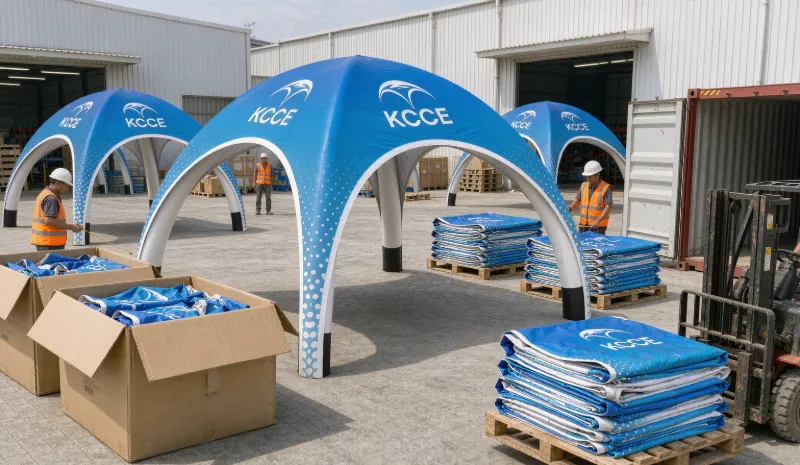
If you want to see what real production capacity looks like, KCCE’s inflatable tent range is a decent reference point — they run a 2,800 square meter facility with 70+ machines, which tells you something about how bulk runs get scheduled.
How Printing Complexity Affects Lead Time
Printing is the silent killer of timelines. I’ve watched orders sit for two extra weeks because someone decided to “just add a tagline” after approval.
Rough guide:
- 1-color logo, simple placement — adds 1–3 days
- Multi-color heat transfer printing — adds 3–7 days
- Full dye-sublimation wrap — adds 7–14 days
The gap between a single-color logo and a full wrap is enormous, and it’s not just printing time. Full wraps require the artwork to be laid out across panel seams, which means more back-and-forth. Every seam is a place your design can misalign.
Now, the artwork-readiness question. This is where I see the most pain. If you hand over print-ready vector files, you skip straight to production. If your files need design work — or worse, if you’re still deciding on colors — you can add a week or more before production even starts.
My advice? Get your artwork locked sebelum you request a quote. Not after. Suppliers who quote you a lead time based on “artwork TBD” are quoting you fiction. And when you’re comparing tenda inflatable kustom from different suppliers, always ask whether their quoted lead time assumes artwork-ready files. Most don’t.
Shipping Method Timeline Breakdown
Production is only half the story. Shipping is the other half, and it’s the one buyers underestimate most.
- Express courier — 3–7 days transit, highest cost, best for small urgent orders
- Air freight — 7–12 days transit, good middle ground
- Sea freight — 25–40 days transit, cheapest per unit, brutal for deadlines
Then add customs and port buffer. Realistically, tack on 3–7 days for customs clearance depending on your destination and how clean your paperwork is. Port congestion can add more — and it’s unpredictable.
So if you’re sourcing lead time inflatable advertising tent bulk orders USA, here’s the math that trips people up: a 20-day production run plus 30 days of sea freight plus a week of customs equals nearly two months. If your event is in eight weeks, sea freight is already off the table.
Air freight is the compromise most event marketers land on. It costs more, but it turns a two-month timeline into roughly a month. For a single critical event, that trade is usually worth it.
One practical note: inflatable tents are bulky. They don’t pack small, even deflated. That bulk directly affects your freight cost and sometimes your shipping method options. Factor it in early.
Step-by-Step Production Timeline
Here’s the actual sequence, with realistic day counts:
- Quote & confirmation — 1–3 days. Getting pricing, confirming specs, paying deposit.
- Artwork approval — 1–7 days. This is your biggest variable. Print-ready files: fast. Revisions: slow.
- Production — 10–30 days depending on quantity and printing.
- Quality control — 2–5 days. Inflation testing, seam checks, print verification.
- Packing & shipping prep — 1–3 days.
- Transit — 3–40 days depending on method.
- Delivery & customs — 3–7 days buffer.
The approval bottleneck is real, and it’s almost always on the buyer’s side. I’ve seen a production line sit idle for four days because a client’s marketing team couldn’t agree on a font. Four days. On a 20-day order, that’s 20% of your timeline gone.
Set an internal deadline for artwork approval that’s earlier than the supplier’s deadline. Give yourself a buffer. Your future self will thank you.
What Delays Inflatable Tent Bulk Orders?
Let me just list the ones I’ve actually seen blow up timelines:
- Late artwork — the number one cause, by far
- Revision loops — each round adds days
- Peak season — Q1 and pre-summer are brutal; factories are booked
- Payment delays — production doesn’t start until deposit clears
- Spec changes mid-production — this can restart part of the process
- Incomplete shipping docs — customs holds everything
Speaking of peak season — if your event is in spring or early summer, order earlier than you think you need to. Everyone else is ordering then too.
The actionable takeaway: submit print-ready files early, pay deposits fast, and freeze your specs before production starts. Those three habits eliminate most delays. And if you’re a small business worried about long lead times messing you up — you’re not alone, it’s the single most common complaint I hear. The fix is contingency planning, not hope.
Bulk Pricing & Quote CTA
Volume discounts are standard in this industry. The more units you order, the lower your per-unit cost — but the tiers vary by supplier and by tent size.
Typical structure looks like this:
- 1–10 units — base price, no discount
- 11–50 units — modest per-unit reduction
- 50+ units — best per-unit pricing, sometimes with setup fees waived
MOQ is the gatekeeper here. Many suppliers won’t quote below a certain quantity, and some MOQs are high enough to shut out small businesses entirely. If you’re a small operation, ask about mixed tent packages — combining sizes in one order can sometimes hit a better tier.
Want a real number for your event? Request a quote with your quantity, tent size, printing spec, and event date. The more specific you are, the more accurate the lead time you’ll get back.
Intinya
Lead time for inflatable advertising tent bulk orders comes down to three things: quantity, printing complexity, and shipping method. Nail down your artwork before you order, pick your shipping method based on your actual event date (not your budget alone), and build in a buffer for customs. Do those three things and you’ll rarely get burned.
The Rise of Inflatable Advertising Tents: Market Trends & Data
The numbers back up what I’ve seen on the ground. The global inflatable tent market is estimated at roughly USD 1.1–1.3 billion in 2024 and is projected to grow at a CAGR of about 6–8% through 2030. driven largely by out-of-home (OOH) advertising spend, which hit $41.4 billion globally in 2024 (Magna).
Why inflatables specifically? Three forces:
- Event marketing rebound. Post-2022, experiential activations grew double digits annually. Inflatables set up in 15–30 minutes versus 2–4 hours for frame tents — a real labor cost advantage.
- Material cost curve. PVC-coated polyester and TPU fabric prices stabilized after the 2021–2022 spike, making bulk orders more predictable to quote.
- Regulatory tailwind. In markets like the EU, inflatable structures under 100 m² often avoid the permitting burden of rigid structures under EN 14960-adjacent frameworks, letting brands deploy faster.
The catch: growth means capacity strain. Chinese factories in Guangdong and Jiangsu are reported to be running fuller order books, and peak season (Q1 for spring/summer events, Q3 for Q4 retail) can add several days to standard lead times. Order off-peak if your calendar allows.
Custom vs. Stock Inflatable Tents: Which Is Right for Bulk Orders?
This decision drives your lead time more than almost anything else. Here’s the honest comparison:
| Faktor | Stock Tents | Tenda Kustom |
|---|---|---|
| Waktu tunggu | 7–15 days | 20–40 days |
| MOQ | Often 1–5 units | Typically 10–50 units |
| Unit cost (bulk) | $180–$450 | $400–$1,200+ |
| Artwork approval | None needed | 3–7 days of back-and-forth |
| Reorder speed | Fast (same SKU) | Slower (setup repeats) |
Stock makes sense when you need tents now, your branding is generic, or you’re testing a market. Custom wins when brand consistency matters and you’re ordering enough volume to absorb the setup cost.
The mistake I see most: buyers order stock “to save time,” then pay a local printer to add logos — which costs more per unit than factory printing and often voids the tent’s warranty. If you’re ordering 20+ units, go custom from the factory. The per-unit delta shrinks fast at scale.
One negotiation tip: ask for a hybrid — stock tent body, custom-printed canopy only. You get brand visibility at 60–70% of full-custom cost and roughly half the lead time.
Breaking Down the Lead Time: From Order to Delivery
Let me give you the real timeline, not the sales version.
Production Timeline (Design, Printing, Manufacturing)
- Design & artwork approval: 3–7 days. This is where most delays hide. Every revision round adds 1–2 days. Send vector files (AI/EPS) at 300 DPI minimum.
- Printing: 2–5 days for dye-sublimation; 1–2 days for single-color screen print. Full-wrap printing on a 50-unit order can take 4–5 days alone.
- Manufacturing (cutting, stitching, assembly): 7–20 days depending on volume. A 100-unit run needs dedicated cutting tables and multiple stitching lines.
- Inflation & pressure testing: 1–3 days. Every unit should be inflated to 1.5x working pressure and held for 30+ minutes.
Quality Control & Inspection
This is non-negotiable for bulk. A proper QC protocol includes:
- Seam pull-strength testing (target: ≥ 25 N/cm per EN ISO 13934-1) – Air leakage test — max 5% pressure loss over 24 hours
- Zipper and valve cycle testing (500+ cycles)
- Flame retardancy verification to NFPA 701 atau EN 13501-1 Class B-s1,d0 for public events – Third-party inspection (SGS, Bureau Veritas, or Intertek) — costs approximately $300–$800 but catches problems before freight
Then logistics: sea freight 25–40 days (FCL cheaper, LCL slower), air freight 5–10 days, express 3–5 days. Add 3–7 days customs clearance on each end. Total door-to-door for a 50-unit custom order: 50–75 days realistically.
Bulk pricing tiers & MOQ strategy: Most factories break at 10 / 50 / 100 / 500 units. Expect roughly $450 → $380 → $320 → $260 per unit on a mid-tier custom tent. Negotiate lead time, not just price — ask for a “slot guarantee” clause with a penalty for delays. And always confirm whether MOQ is per-SKU or per-order; it changes your flexibility dramatically.
Freight comparison: Sea FCL runs approximately $2,000–$4,500 per 40ft container (holds 80–150 tents), air is about $6–$12/kg, express is about $15–$25/kg. For bulk, sea wins on cost every time — just budget the extra 30 days. Always insist on palletized, moisture-barrier-wrapped packing and buy marine cargo insurance (approximately 0.3–0.5% of declared value).
Pertanyaan yang Sering Diajukan
Q: How long do inflatable tents stay inflated?
A: Once properly inflated, a sealed inflatable tent holds air for days — sometimes longer — while a constant-blower model stays inflated only as long as the blower runs. For multi-day events, sealed designs are generally more convenient. Always confirm which type you’re ordering, because it affects both setup and your power needs on site.
Q: What is the best tent for vendor events?
A: It depends on your setup time, budget, and branding goals. Inflatable canopy tents are popular for vendor events because they’re sturdy, highly brandable, and handle wind better than basic pop-ups. If you need fast repeated setup, pop-ups win. If you want maximum visual impact and durability, inflatable is the stronger pick.
Q: What is the largest inflatable tent you can buy?
A: Sizes vary widely by manufacturer, and large custom builds are usually quoted per project rather than stocked. If you need something massive, expect longer lead times and a dedicated production run. Ask your supplier directly what their maximum build size is — it’s not a fixed industry number.
Q: Can I get a custom inflatable tent made?
A: Yes. Custom inflatable tents are the norm, not the exception. You can specify size, shape, color, and full custom printing. The main constraints are your artwork readiness and the supplier’s MOQ. Send print-ready files early and confirm the MOQ before you commit to a design.
Q: How long does it take to get custom inflatable tents in bulk?
A: Typically 15–40 days for production, plus shipping. Small bulk orders with simple logos move fastest; large orders with full dye-sublimation wraps take longest. Add transit time on top — express is days, sea freight is weeks. Always ask whether the quoted lead time includes shipping or just production.
Q: Where to buy inflatable canopy tents for events in bulk?
A: Look for manufacturers with verifiable production capacity and certifications rather than trading intermediaries. Check the facility size, machine count, and compliance standards. A supplier with real in-house production will give you more accurate lead times than a middleman who’s guessing.
Q: How much do custom inflatable tents cost for bulk orders?
A: Pricing depends on size, printing method, and quantity. Bulk orders get per-unit discounts, but the tiers vary by supplier. The biggest cost drivers are fabric type and printing complexity — a full wrap costs significantly more than a single-color logo. Request itemized quotes so you can compare apples to apples.
Q: Do inflatable advertising tents hold up over time?
A: Quality varies a lot. Well-made tents in premium Oxford fabric can last many seasons with proper care. The failure points are usually seams and blower units. For bulk orders, always insist on pre-shipment QC — inflation testing and seam checks — before the shipment leaves the factory.
Referensi
1. What Makes a Good Life? Lessons from the Longest Study… – youtube.com
2. Research – brenebrown.com