You found 10 manufacturers. Three are trading companies. One is a scam. That’s not a hypothetical scenario — that’s a pretty typical for anyone sourcing inflatable tents from China.
I’ve been in this business long enough to watch buyers stumble into the same traps, over and over. They Google “inflatable tent manufacturer in China,” land on a polished website with stock photos, wire a deposit, and then spend the next four months chasing a refund that never materializes. Or worse — they get a container of tents that deflate on the first windy night.
This guide isn’t a listicle. It’s a vetting framework — the same one I use when I’m helping clients source bulk inflatable tents for events, glamping operations, or emergency response programs. By the end, you’ll know exactly how to separate a real factory from a front, what to ask before you pay, and which technical specs actually matter.
Quick Answer
The best inflatable tent manufacturer in China is one you can audit directly — verify its business license, tour its factory floor via video, check its export history, and test samples before committing. Some factories like Derflex, Chinee, Nastocamp, KCCE, and Everich offer MOQs in the range of 50–200 units, customization options, and lead times of 15–45 days.
Why the “Top 10” Lists on Inflatable Tent Manufacturers in China Are Unreliable
Let me be blunt: most of those ranking articles you see are marketing dressed up as journalism.
Here’s how they work. A B2B platform or a content agency publishes a “Top 10 Inflatable Tent Manufacturers in China” piece. The companies listed? They either paid to be there, or they’re clients of the agency. The ranking criteria are vague — “overall score,” “reputation,” “market influence” — none of which are independently verified. I’ve seen factories with zero export track record ranked above companies shipping to 130+ countries. It makes no sense, unless you follow the money.
Self-promotion bias is rampant. Many of these lists are published by the manufacturers themselves. They create a blog, write a “Top 10” article, rank their own company #1, and then use it as a sales tool. The “comparison” is anything but objective. When you contact them, surprise — they’re the best option for everything.
Outdated information is another killer. I recently checked a list of top manufacturers and found some dead links, one company that had pivoted to selling LED screens, and another whose phone number now belongs to a noodle shop. The industry moves fast. Factories close, merge, or change their export focus. A list published six months ago might as well be ancient history.
There’s zero independent verification. Nobody audits these claims. A factory might say it’s been in business since 1997 — but a quick check of China’s business registration system could tell you it was actually founded in 2020. (That’s a real example I encountered with a supplier claiming extensive experience. Their registration said otherwise.)
So what do you do? You stop relying on lists and start doing your own homework. Which brings me to the actual verification process.
How to Verify a Legitimate Inflatable Tent Manufacturer in China
Verification isn’t glamorous. It’s paperwork, video calls, and cross-referencing databases. But it’s the difference between a smooth transaction and a costly lesson.
Check the Business License Through China’s NEEQ System
China’s National Enterprise Credit Information Publicity System (often shortened to NEEQ) is a public database of every registered company in the country. You can look up a factory by its Chinese name or unified social credit code. What you’re looking for:
- Registration date: Is it consistent with what the company claims?
- Registered capital: Higher isn’t always better, but a company with 50,000 CNY registered capital might not have the financial muscle for large production runs.
- Business scope: Does it actually include manufacturing, or just trading and sales?
- Legal representative: Note the name. You’ll want to confirm this person exists and is involved.
The catch: the system is in Chinese, and you need the company’s exact Chinese name. Most reputable factories will provide their business license upon request. If they hesitate — that’s a red flag.
Request a Factory Audit or Video Walkthrough
A real factory won’t bat an eye at a video call. In fact, most will be happy to show you around. You want to see:
- The production floor with machinery running (not a showroom)
- RF welding machines — the equipment that fuses PVC, which is the backbone of quality inflatable tent manufacturing
- Storage areas with raw materials (PVC rolls, fabric, zippers)
- Workers, not just a manager walking through an empty space
I always ask for a live walkthrough with a timestamp — like holding up today’s newspaper. It sounds paranoid, but it eliminates the possibility of pre-recorded footage. Some factories will even do a live test inflation of a tent on camera. That’s a good sign.
Verify Export History via Customs Data
This is the step most buyers skip, and it’s the most revealing. Platforms like ImportYeti and Panjiva track U.S. customs import records. You can search by company name and see:
- How many shipments they’ve made
- Which ports they ship from (Shanghai, Ningbo, Guangzhou are the big ones)
- Who they ship to
- What products they’re declared as
A factory with consistent export history is a factory that knows how to handle international logistics, documentation, and compliance. A factory with zero export record might be perfectly fine for domestic orders, but you don’t want to be their first international experiment.
One note: customs data isn’t always complete. Small shipments under a certain value might not appear. But it’s an excellent cross-reference tool.
Key Technical Differences: What Separates a $500 Tent From a $5,000 One
Here’s where things get interesting. The price difference between inflatable tents isn’t arbitrary markup. It’s materials, engineering, and quality control. And if you’re sourcing from an inflatable tent manufacturer in China, you need to understand what you’re paying for.
RF Welding vs. Stitching
The single biggest quality differentiator is how the tent is constructed.
RF welding (radio frequency welding) uses electromagnetic energy to fuse PVC layers together. The result is a molecular bond — there’s no thread to rot, no needle holes for water to seep through. This is the gold standard for professional inflatable tents. It’s stronger, more waterproof, and lasts significantly longer.
सिलाई is what you see on cheaper tents. Threads create needle holes, and those holes are entry points for water and air. Even with seam sealing, stitched seams are a weak point. For a cheap camping tent that’s used twice a year? Fine. For a commercial inflatable tent that gets inflated and deflated weekly? Not acceptable.
When you’re talking to a factory, ask specifically: “Are your seams RF welded or stitched?” The answer tells you more than any brochure.
PVC Thickness and Tensile Strength
The material spec sheet might as well be hieroglyphics if you don’t know what to look for. Two numbers matter most:
- Thickness: Measured in millimeters or gauge. Commercial-grade inflatable tents typically use PVC in the range of 0.5mm to 0.9mm. Thicker isn’t always better — it adds weight and cost — but for heavy-duty applications like military or industrial use, you want the thicker end of the range.
- Tensile strength: Measured in Newtons per 5cm or similar. This tells you how much force the fabric can withstand before tearing. Higher tensile strength means the tent handles wind loads better.
Don’t just take the factory’s word for it. Ask for test reports or material certificates. A reputable manufacturer will have them on file.
Air Pressure Systems and Safety Valves
The air beam system is the heart of any inflatable tent. A $500 tent might have a single basic blower. A $5,000 tent has: dual blowers, pressure relief valves, air pressure monitoring, and multiple independent air chambers.alves** that prevent over-inflation
- Air pressure monitoring systems that alert you to leaks
- Multiple independent air chambers — so a puncture in one section doesn’t collapse the whole tent
For applications like emergency shelter or military use, these safety features aren’t optional. They’re life-safety equipment.
The Top 5 Inflatable Tent Manufacturers in China (Objective Comparison)
I’m going to name names here. These are the factories I’ve either worked with directly or have enough industry knowledge to recommend. This isn’t an official ranking — it’s based on my experience and what I’ve seen work for different types of buyers.
Derflex — Best for Industrial and Military Tents
Derflex has built its reputation on heavy-duty, technical inflatable structures. If you need a tent that can survive extreme conditions — military deployments, disaster response, industrial storage — this is a strong candidate. Their focus on engineering and material quality comes at a price, but for mission-critical applications, you don’t want to cut corners.
Chinee — Best for Glamping and Custom Shapes
Glamping is where inflatable tents shine, and Chinee has carved out a niche in premium, aesthetically-driven designs. If you need custom shapes, unique colorways, or branded structures for a high-end resort or event, Chinee’s design capabilities are worth exploring. They understand that in glamping, the tent isn’t just shelter — it’s part of the experience.
Nastocamp — Best for Budget Bulk Orders
If you’re looking for bulk inflatable tents for camping at a competitive price point, Nastocamp is worth a look. They focus on production efficiency and cost control. The trade-off is that you might have less flexibility on customization and premium finishes. But for standard designs at scale, they deliver value.
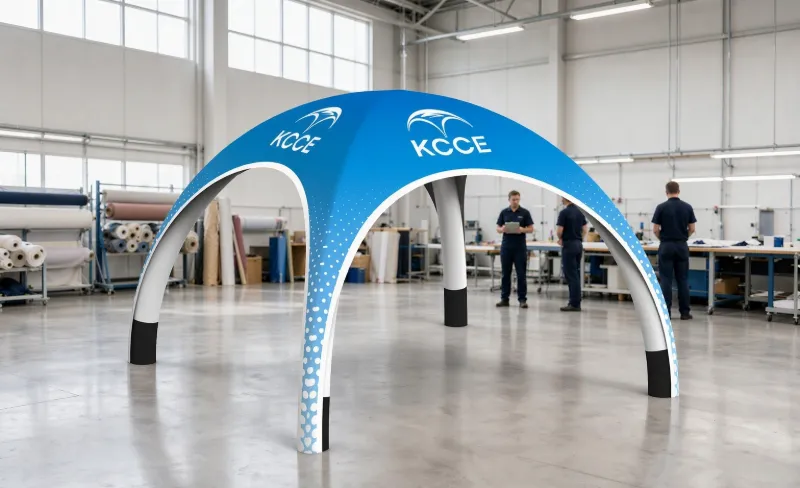
KCCE — Best for Event and Party Tents
This is where I need to disclose something: KCCE is the company behind this website. But I’m including them for a reason. KCCE specializes in event-focused inflatable products — everything from inflatable tents for festivals and exhibitions to inflatable shapes and display frames that help brands stand out. Their founder has been designing inflatable products for many years., and they’ve built a solid reputation for quality and customization in the event industry. If you’re planning an event and need a tent that’s both functional and visually striking, their team understands the specific demands of that market.
Everich — Best for Quick Turnaround
Speed matters, especially when you’re planning an event on a tight timeline. Everich is known for efficient production scheduling and faster lead times than many competitors. If you’re in a pinch and need inflatable tents delivered in weeks rather than months, they’re a practical choice.
Now, here’s the honest caveat: these aren’t the only good manufacturers in China. There are dozens of capable factories that don’t have the same online presence. And there are also plenty of companies that look great on paper but fall short in practice. Which is why the vetting process I described earlier matters more than any list.
MOQ, Pricing, and Incoterms: What to Ask Before You Pay
Money conversations are where deals fall apart. Let’s walk through the numbers and terms you need to understand.
MOQ Ranges: 50–200 Units
Many established Chinese inflatable tent factories have a minimum order quantity between 50 and 200 units. The exact number depends on:
- Complexity of the design: Standard shapes have lower MOQs. Custom shapes with unique patterns or branding require higher MOQs because of the tooling and setup costs.
- Material costs: Tents using premium PVC or specialized fabrics might have lower MOQs because the per-unit cost is higher.
- Factory’s production capacity: Large factories can absorb smaller orders more easily. Smaller factories might need bigger minimums to make a production run worthwhile.
If a factory quotes you an unusually low MOQ, be suspicious. Either they’re a trading company that will just forward your order to another factory, or they’re desperate for business — neither is a good sign.
FOB vs. EXW vs. DDP: Which is Safer?
You’ll see three main Incoterms when dealing with Chinese suppliers:
- EXW (Ex Works): You’re responsible for everything after the goods leave the factory — transportation to the port, export clearance, ocean freight, import clearance, and final delivery. This is the cheapest price but the most work and risk for you.
- FOB (Free on Board): The factory handles inland transportation and export clearance, and the goods are yours once they’re on the ship. This is the most common arrangement for Chinese exports. You’ll need to arrange ocean freight and handle import clearance on your end.
- DDP (Delivered Duty Paid): The factory handles everything, including import duties and delivery to your door. This is the most convenient but also the most expensive — and it requires the factory to have a solid understanding of your country’s import regulations.
For first-time buyers, FOB is usually the sweet spot. It balances cost and control. DDP can be tempting, but if the factory miscalculates your import duties, you could end up with unexpected charges.
Payment Terms: TT, LC, and Escrow
- T/T (Telegraphic Transfer): The most common method. Typically, you’ll pay a deposit and the balance before shipment. The risk is that you’re trusting the factory to deliver after you’ve paid the deposit. That’s why verification matters so much.
- L/C (Letter of Credit): More common for large orders or new relationships. A bank guarantees payment once the shipping documents are presented. It’s safer but more expensive and paperwork-heavy.
- Escrow services: Platforms like Alibaba offer escrow, where funds are held until you confirm receipt of goods. This adds a layer of protection but comes with fees.
My advice: never pay 100% upfront. A 30/70 split is standard. And if a factory insists on 50% or more upfront, ask why. Established factories can usually work with standard terms.
Red Flags: How to Spot a Scam or Trading Company Disguised as a Factory
Social media is full of horror stories about “Chinese trash tents” and buyers getting burned. Here’s how to avoid becoming one of those stories.
Reverse Image Search Their Product Photos
This is the easiest check you’ll ever run. Take the factory’s product photos and run them through Google Images or TinEye. If the same photos appear on multiple websites — especially with different company names — you’re dealing with a trading company that’s using stock images. A real factory has its own photos, its own workshop, its own products.
Ask for a Video Call Inside the Actual Factory Floor
I touched on this earlier, but it deserves emphasis. A trading company can’t show you a production line because they don’t have one. They might show you their office, or a warehouse, or a video of someone else’s factory. Insist on a live, real-time video call where you can see machinery running and workers on the floor. Ask to see the specific tent you’re interested in being made.
Beware of “Free Samples” with High Shipping Fees
This is a classic scam. The factory offers “free samples” — but the shipping fee is $200, $300, even $500 for a small package that should cost $50. They’re not giving you anything free; they’re charging you for the sample and hoping you’ll be too embarrassed to complain. A legitimate factory will either charge a fair price for samples (which is often credited toward your order) or offer genuinely free samples with reasonable shipping.
Other Red Flags to Watch For
- Vague answers: If they can’t clearly explain their manufacturing process, materials, or quality control, they’re probably not a manufacturer.
- No physical address: A real factory has a physical address you can verify. Be suspicious of PO Boxes or virtual offices.
- Pressure tactics: “This price is only valid for 48 hours” is a sales tactic, not a legitimate business practice.
- Inconsistent communication: If their English suddenly gets much better when discussing payment, that’s a sign you’re talking to a salesperson, not an engineer.
Shipping and Logistics: Lead Times and Ports You Need to Know
Once you’ve placed your order, the clock starts. Here’s what to expect.
Typical Lead Times: 15–45 Days After Deposit
Many Chinese inflatable tent manufacturers quote lead times between 15 and 45 days after receiving the deposit. The variance depends on:
- Order size: A 50-unit order might take a few weeks. A 200-unit order with custom printing could take over a month.
- Customization: Standard designs are faster. Custom shapes, colors, and branding add time.
- Seasonal demand: Orders placed before peak seasons (spring for camping, summer for events) might face longer queues.
Always get the lead time in writing, and build in a buffer. Add 2 weeks to whatever they quote — that’s your safety margin.
Major Export Ports: Shanghai, Ningbo, Guangzhou
Most inflatable tent factories are clustered in the manufacturing hubs of Guangdong and Hebei provinces. The goods typically ship from one of these major ports:
- Shanghai: The busiest container port in the world. If your factory is in Jiangsu or Zhejiang, this is likely your port.
- Ningbo: Just south of Shanghai, Ningbo is another major export hub with excellent connectivity.
- Guangzhou: The primary port for factories in Guangdong province, where many tent manufacturers are based.
Your freight forwarder will handle the specifics, but knowing which port your goods are shipping from helps you estimate transit times and costs.
Sea vs. Air Freight
For bulk inflatable tents, sea freight is almost always the answer. It’s significantly cheaper per unit, and tents are bulky but not heavy — which means you’re paying for volume, not weight. A 20-foot container can hold a surprising number of deflated tents.
Air freight is only worth it for urgent orders or small quantities. The cost per unit is dramatically higher — often several times sea freight. I’ve seen buyers panic and air-freight a small order to meet an event deadline, and the shipping cost alone exceeded the value of the tents.
Case Study: How a U.S. Event Company Vetted Their Inflatable Tent Manufacturer in China
Let me walk you through a real scenario — the kind of thing that happens when you do the vetting process properly.
A U.S. event production company — let’s call them EventCo — needed 80 custom inflatable tents for a series of corporate activations. They had a three-month timeline and a budget that was firm but not extravagant. They shortlisted three factories from online research and asked each for a quote.
Factory A responded within 24 hours with a detailed quote and a spec sheet. Their prices were mid-range, and they offered free samples. But when EventCo asked for a video walkthrough, the sales rep went silent for three days. When they finally connected, the “factory tour” was a 10-minute video of a warehouse with no production equipment visible. Red flag.
Factory B was cheaper — significantly cheaper. Their MOQ was just 30 units, which was attractive. But their business license check showed the company was registered in 2021, despite claiming “10 years of experience.” Their customs data showed only two export shipments, both under $5,000. Another red flag.
Factory C was the most expensive of the three. Their quote was higher than Factory B’s. But they provided their business license within an hour of the request. Their customs data showed consistent monthly shipments to the U.S., UK, and Australia. They scheduled a video walkthrough for the next day — and delivered — showing their RF welding machines, PVC storage, and a live inflation test of a similar tent. They also provided material certificates and a detailed production timeline.
EventCo went with Factory C. The tents arrived in 6 weeks, met all specifications, and the client was happy. The extra upfront cost saved them from what could have been a major disaster.
The lesson? Price is the last thing you should optimize for, not the first.
Quality Control: What to Inspect Before and After Production
You’ve found a factory, negotiated terms, and placed your order. The work isn’t done. Quality control is an ongoing process.
Pre-Production Inspection
- Material verification: Confirm the PVC thickness and type before production starts. Ask for a small swatch to test yourself.
- Sample approval: Always get a pre-production sample approved before the factory starts the full run. This is non-negotiable.
- Production schedule: Agree on milestone dates — when materials arrive, when production starts, when it finishes.
During Production
- Mid-production inspection: If you have a third-party inspection service (like SGS or Bureau Veritas), schedule a mid-production check. They can verify that materials match the spec and that workmanship is on track.
- Photo updates: Ask the factory to send photos of your order at each stage. Most reputable factories are happy to do this.
Pre-Shipment Inspection
- Random sampling: Inspect a random sample of finished tents. Check for:
- Consistent seam welding
- No leaks or weak points
- Zippers function properly
- Print quality (if branding is included)
- Overall workmanship
- Inflation test: Every tent should be inflated and held for a set period to check for air retention. This is the most important test — a tent that can’t hold air is worthless.
常见问题解答
Q: Who are some famous Chinese inflatable manufacturers?
答: Several Chinese manufacturers have strong reputations in the inflatable tent space. Derflex is known for industrial and military-grade inflatable structures. Chinee excels in glamping and custom-shaped tents. Nastocamp focuses on budget-friendly bulk production for camping. KCCE specializes in event and party tents, and Everich is recognized for quick turnaround times. Each has different strengths, so your choice should depend on your specific application.
प्रश्न: सबसे अच्छे इन्फ्लेटेबल टेंट कौन बनाता है?
答: “Best” depends entirely on your use case. For heavy-duty applications like emergency shelters or military use, Derflex’s engineering focus makes them a top contender. For premium glamping experiences where aesthetics matter as much as function, Chinee is strong. For event organizers needing reliable, visually appealing structures, KCCE’s event-specific expertise is worth considering. Evaluate factories against your specific requirements rather than looking for a single “best.”
Q: Who are some major tent manufacturers in China?
答: Beyond the inflatable-specific manufacturers, China’s broader tent industry includes major players like Liri Architecture Technology, founded in 1997, which produces modular aluminum alloy tents, large air domes, and glamping tents. Liri exports to many countries and has served numerous temporary space projects. The market also includes Hebei Jiayouding Technology, registered in 2020, and Xiamen Marvelous Outdoor Technology, both active in the camping and outdoor shelter space.
Q: What are some popular brands of inflatable tents?
答: In the consumer market, Western brands like Vango and Outwell are well-established, though many of their products are manufactured in China through OEM arrangements. On the Chinese manufacturing side, brands like Derflex, Chinee, Nastocamp, and KCCE are gaining recognition. For those looking for custom inflatable tents with OEM service from a China supplier, these factories offer design and branding flexibility that consumer brands don’t.
Q: Are Chinese inflatable tents good quality?
答: Quality varies dramatically between factories. A well-vetted Chinese manufacturer using RF welding, quality PVC, and proper quality control can produce tents that match or exceed Western brand quality — often at a lower cost. The problem is that the market also has low-quality producers cutting corners on materials and workmanship. That’s why verification and sample testing are essential. The quality isn’t determined by geography; it’s determined by the specific factory you choose.
Q: What is the minimum order quantity for inflatable tents from China?
答: Most established factories require a minimum order quantity between 50 and 200 units. Custom designs with unique shapes or branding typically require higher MOQs due to tooling and setup costs. Standard designs are more likely to have lower minimums. If a factory quotes an MOQ of 10 units or less, it’s likely a trading company rather than a manufacturer, or they’re not selective about their clients.
संदर्भ
1. Clear Span Tent Manufacturer — Liri Tent – Liri Architecture Technology (Guangdong) Co., Ltd.
2. 2026 Top 10 Inflatable Tent Manufacturers in China – B2B Data (AIPage)
3. Five Reputable Camping Tent Manufacturers in China 2026 – EINPresswire
4. How to Choose a Camping Air Tent Factory and Supplier in China – RealMe Outdoor