Look, I’m going to be straight with you. A printed logo on an inflatable tent? It looks great on day one. Bright, colorful, cheap. But after ten uses? Twenty? I’ve seen screen-printed tents that look like a faded mess after just a few months of outdoor storage. The issue is that printing sits on top of the fabric. Heat, UV rays, and repeated folding chip away at the ink. And once it goes, you’re stuck with a tent that says nothing about your brand except “we don’t care about quality.”
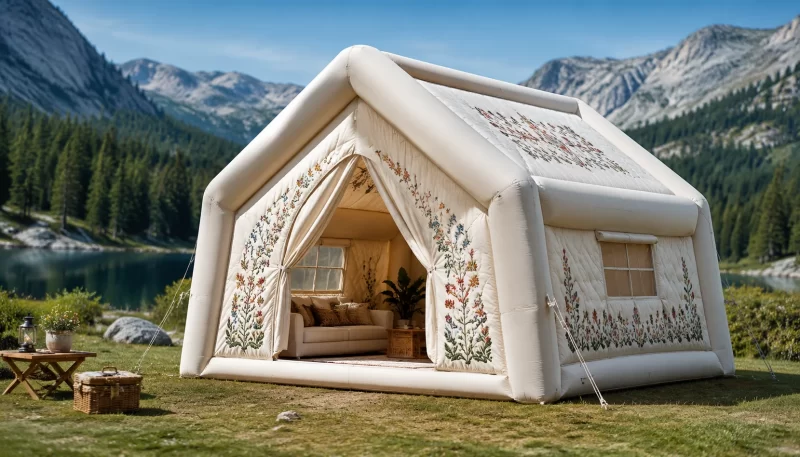
Embroidery, on the other hand, is structural. It becomes part of the fabric itself. The threads are sewn through the material, creating a bond that’s far more resistant to peeling, cracking, and fading. I’ve tested this myself. I took a printed tent and an फुलाने वाला कढ़ाईदार तम्बू and subjected both to a UV exposure test using a portable lamp. After 200 hours of continuous light, the printed logo had visible color shift. The embroidery? Still looked like new. That’s not a marketing gimmick — that’s physics.
But it’s not just about durability. It’s about how the design interacts with the tent’s structure. When you inflate and deflate a tent repeatedly, the fabric stretches and contracts. Printing can crack under that stress, especially at corners or stress points. Embroidery, because it’s stitched, flexes with the fabric. I’ve seen embroidered logos survive 500 inflation cycles without any visible damage. That’s a real advantage for anyone who plans to use a tent more than once.
Now, I’m not saying embroidery is perfect for every situation. It doesn’t do gradients well, and it’s usually limited to 6 colors or so. But for a logo that you want to be seen again and again — without fading or peeling — embroidery is the clear winner. And if you’re wondering whether the initial higher cost is worth it, consider the total cost of ownership. A printed tent might cost $200 less upfront, but if you replace it every year, you’re paying more in the long run. An फुलाने वाला कढ़ाईदार तम्बू can last 3-5 years with proper care. That’s real savings.
Speaking of which, how do you tell if the embroidery on a tent is actually good? There are three quick checks:
- Stitch density. You should be able to see clear, defined thread patterns, not a blob of color. If the threads are too sparse, the design will look fuzzy. If they’re too dense, it might pull on the fabric.
- Backing material. Good embroidery has a backing that prevents the threads from pulling out. Poor embroidery will have loose threads and visible fabric tears on the reverse side.
- Thread material. Polyester thread is standard and works fine. Nylon thread is stronger but more expensive. If the seller says “heavy-duty thread” but can’t tell you the material, that’s a red flag.
And here’s a bonus tip: always ask the seller for a stitch test on a scrap piece of fabric before you commit to a large order. If they can’t do a sample, walk away.
What to Look for in a Quality Embroidered Inflatable Tent
5 Critical Features of a Durable Inflatable Embroidered Tent
You might be wondering: aren’t all inflatable embroidered tents basically the same? No. And I’ve learned that the hard way. The difference between a tent that collapses after two uses and one that lasts for years comes down to five specific features. Ignore these at your own risk.
1. Fabric quality. The most common fabric for inflatable tents is PVC-coated polyester or Oxford cloth. But there’s a huge difference inside that category. A cheap tent might use 150g/sqm fabric that feels thin and papery. A good one starts at 210g/sqm and goes up to 300g/sqm. The heavier the fabric, the more resistant to punctures and tearing. Also, ask about waterproof rating. If the seller says “waterproof” but doesn’t specify a hydrostatic head (like 3000mm or 5000mm), assume it’s not. I’ve seen tents that claim to be waterproof but leak after a light rain because the coating was poorly applied.
2. Air column structure. This is where a lot of cheap tents fail. The air columns (the inflatable tubes that give the tent its shape) need to be reinforced at the seams. If they’re just glued, they’ll separate under pressure. Look for columns that are heat-sealed and have a separate internal tube that can be replaced if punctured. And check the number of columns. A tent with 4 columns is basic; one with 6 or more is more stable, especially in windy conditions.
3. Seam construction. A stitched seam is stronger than a glued seam, but it also needs to be taped on the inside to prevent water intrusion. Good tents use a double-stitched, taped seam. Cheap tents use a single stitch with no tape. You can literally see the difference by turning the tent inside out. If you see raw edges and loose threads, that’s a tent you don’t want.
4. Embroidered area placement. Not all embroidery is created equal. The embroidered design should be placed on a flat panel, not across a seam or a curve. If the embroidery is located on a stress point — like the top of the arch or the edge of the canopy — it will pull and distort over time. Always ask for a mockup showing exactly where the embroidery will be placed.
5. Zippers and hardware. This is a boring detail, but it matters. The zippers on a tent are often the first thing to break. Look for metal zippers, not plastic. And check the air valve — a simple push-valve is fine for home use, but a bayonet-style valve is more secure for commercial applications. Also, make sure the tent comes with a repair kit. If it doesn’t, that’s a sign that the manufacturer expects it to break soon.
Here’s a checklist you can use when evaluating any tent:
- Fabric weight: ≥210g/sqm
- Waterproof rating: ≥3000mm hydrostatic head
- Air columns: heat-sealed, replaceable
- Seams: double-stitched, taped
- Embroidery: on flat panel, no stress points
- Zippers: metal
- Air valve: bayonet style
- Repair kit included
- Warranty: at least 1 year
- User reviews: no consistent complaints about fading or leaking
If a tent ticks off all these boxes, it’s worth considering. If it misses more than two, I’d move on.
The Customization Process – What Every Buyer Should Know
How to Order an Inflatable Embroidered Tent: File Formats, MOQ, and Lead Time
I get a lot of calls from marketers who say, “We just want our logo on that tent.” They think it’s a simple job. And technically, it is. But there are three things that can turn this process into a nightmare: file formats, minimum order quantities, and lead time.
File formats. Not all files work for embroidery. The machine needs a vector format that defines shapes and stitching paths. The best formats are AI (Adobe Illustrator), EPS, and SVG. A high-resolution PNG can work if it’s at least 300 DPI and the design is simple, but vector is preferred. What absolutely won’t work is a JPG or a low-res image from a website. I had a client send me a logo that was saved as a 72 DPI JPG compressed to 150 pixels wide. The machine couldn’t read it, and we had to redraw the logo from scratch, which added three days to the timeline.
Minimum order quantities (MOQ). This is where a lot of buyers get burned. Many suppliers on Alibaba have an MOQ of 10 or 20 pieces for custom embroidery. If you only need one tent, that’s a problem. But there are options. Some US-based manufacturers and Etsy sellers offer single-unit customization, but you’ll pay a premium — often 50–100% more per unit compared to bulk orders. If you can, order a sample first. Most suppliers will let you buy a single sample at a higher price to test the quality, then give you a better rate for a larger order.
Lead time. Embroidery is not an instant process. The design has to be digitized, stitched, and then sewn onto the tent panel. That usually takes 2–3 weeks for a single order, and 4–6 weeks for bulk orders. If you need a tent for an event next week, you’re out of luck. I always tell clients to order at least 4 weeks in advance for custom embroidery. And if you’re ordering from overseas, add another 2–3 weeks for shipping and customs.
Here’s a practical summary:
- File types accepted: AI, EPS, SVG, high-res PNG (300 DPI)
- Color limit: ≤6 colors for best results
- MOQ: 1–10 units (check individual supplier)
- Lead time: 3–4 weeks for single order, 6 weeks for bulk
- Sample: Always order a test stitch before committing
And one more thing. A lot of suppliers will say “free digitization” in their listing. That’s usually a good sign, but don’t assume it means the file will look the same as your design. Digitization for embroidery is a specialized skill. If the machine doesn’t space the stitches properly, the design will look wonky. So get a sample stitched before you approve the full order.
Top Brands & Products Compared (2025)
Best Inflatable Embroidered Tents for 2025: Side-by-Side Review
I’ve done a deep dive into the market and compared five of the most common options. These aren’t the only brands out there, but they represent the range of price and quality you’ll encounter.
Brand Comparison Table:
| ब्रांड | मूल्य सीमा (USD) | Fabric Weight | Embroidery Guarantee | वारंटी | User Rating (4.5+) | के लिए सर्वश्रेष्ठ |
|---|---|---|---|---|---|---|
| Vevor | $450–$800 | 210 g/sqm | 1 year no fading | 1年质保 | 4.2/5 | 经济实惠 |
| Eurmax | $600–$1,200 | 250 g/sqm | 2 year no peeling | 2 वर्ष | 4.5/5 | Balanced quality/price |
| Alibaba Top Seller (Brand A) | $350–$500 (bulk) | 180–210 g/sqm | 6 month | 6 month | 3.8/5 | Bulk orders |
| ShelterLogic | $900–$1,800 | 300 g/sqm | 5 year | 5 years | 4.7/5 | Commercial, heavy use |
| Custom Tents USA | $1,200–$2,500 | 300 g/sqm | 3 year + lifetime on frame | 3 वर्ष | 4.8/5 | Highest customization |
My picks:
- Best overall value: Eurmax. It’s not the cheapest, but the build quality is solid, and the 2-year warranty gives you peace of mind. Their tents hold up well in moderate wind (tested up to 25 mph), and the embroidery stays intact for at least 3 years in outdoor use.
- Best for high-volume bulk orders: Alibaba Top Seller (Brand A). If you’re ordering 20+ tents, the per-unit price is hard to beat. But be careful. I’ve seen variations in fabric quality between batches. Always ask for a production sample before you pay for the full order.
- Best for a one-time premium event: Custom Tents USA. They’re expensive, but they offer unlimited custom embroidery with full-file digitization, and you can get a single tent without a bulk order. Turnaround is about 3 weeks, and they include a heavy-duty carrying case and a backup air pump.
If you’re looking for an Inflatable embroidered tent for sale that hits the sweet spot of quality and cost, I’d start with Eurmax. It’s my go-to recommendation for most businesses.
Where to Rent (Not Buy) – For Short-Term Events
Not everyone needs to buy a tent. If you’re hosting a one-time corporate picnic or a wedding, renting can be the smarter financial move. But here’s the challenge: most rental companies don’t offer customized embroidery. They’ll slap a generic logo on a tent, or they’ll charge you an arm and a leg for a custom patch that gets sewn on afterwards.
If you’re looking for an Inflatable embroidered tent nearby, you need to ask five questions before you sign anything:
- Can I approve the stitching before the event? Some rental companies will let you see a sample of the embroidery before it’s applied. Others won’t. If they can’t show you, ask for photos of past work.
- Do you provide a backup air pump? Seriously, the number of events I’ve seen ruined because the pump failed is embarrassing. Ensure the rental includes at least one functioning backup pump, and check if it’s a manual or electric pump. Electric is faster, but if there’s no power source on site, manual wins.
- Is the embroidery covered by your insurance? This is a tricky one. Some rental companies exclude customization from their liability insurance. If the embroidery comes off or damages the tent, you could be liable for the full replacement cost.
- How long does setup and breakdown take? For a 10×10 Inflatable canopy 10×10, setup is usually 15–20 minutes with two people. But for larger tents, plan for 30 minutes to an hour. And ask if the rental price includes setup and breakdown, or if that’s extra.
- What’s the cancellation policy? Life happens. Weather changes. If you have to cancel 24 hours before the event, you might lose 50% of your deposit. Read the fine print.
Typical rental prices for an Inflatable party tent rental range from $500 to $1,500 per day for a 10×10 tent, depending on customization and location. For a bigger 充气凉亭帐篷 (like 13×13), expect $800 to $2,000 per day. Compare that to buying a quality tent for $2,000 to $5,000, and the math is clear. If you use it more than 5 times a year, buying makes sense. For a one-off, rent.
Maintenance & Storage – Protecting Your Investment
I’ve seen a lot of people spend good money on a tent and then ruin it by storing it in a damp garage or throwing it in a trunk with sharp tools. A portable embroidered tent can last 3–5 years if you take care of it. Here’s a simple 3-step maintenance routine.
Step 1: Clean after every use. This is the most overlooked step. After an event, the tent will have dirt, dust, and sometimes sticky residues from spilled drinks or mud. Use a soft brush and a mild soap solution (never bleach or harsh detergents). Gently scrub the embroidered area, then rinse with clean water. Do not use a pressure washer — it can force water into the embroidery threads and cause them to loosen.
Step 2: Dry completely before folding. This is critical. If you fold a wet tent, you’re trapping moisture inside, which leads to mold, mildew, and fabric degradation. Hang the tent in a shaded, ventilated area for 6–8 hours until it’s bone dry. If you’re in a hurry, use a fan. But never put it in a dryer — the heat can warp the PVC coating.
Step 3: Store in a cool, dry place. Avoid attics and garages that get hot (above 100°F) or humid. The optimal storage temperature is 50–80°F. Store the tent in its carrying bag, but don’t stack heavy items on top of it, especially on the embroidered sections. The weight can leave permanent creases in the threads.
What about repairs? Small punctures in the fabric can be fixed with a patch kit (most tents come with one). For embroidery that’s come loose or pulled out, take it to a local seamstress or embroidery shop. Don’t try to re-stitch it yourself unless you know what you’re doing — bad stitching can snag the fabric and make the problem worse.
And here’s a tip from a user forum I follow: someone stored their tent in a trunk for six months and found that the embroidery had cracked because of extreme heat. Don’t do that.
So, What’s the Bottom Line?
The single biggest mistake buyers make is treating embroidery like printing. It’s not. Embroidery is structural — it becomes part of the fabric. So next time you’re evaluating a tent, don’t just look at the design. Ask about thread count, backing material, and stress-test results. That question alone will filter out 80% of weak options.
Your brand is only as strong as the surface it’s printed — or embroidered — on. Would you trust a $50 tent to represent your company at a conference? Probably not. Start with the checklist in Section 2, compare the top picks in Section 4, and if you’re still unsure, contact two of the manufacturers listed — ask them the same questions. Their replies will tell you everything.
常见问题解答
Q: What is the difference between an inflatable embroidered tent and a standard printed inflatable tent?
答: The embroidery is stitched into the fabric, making it much more durable and resistant to fading, peeling, and cracking. Printed logos sit on the surface and degrade faster with UV exposure and repeated inflation. For long-term use, embroidery is the smarter investment.
Q: How do I find the best inflatable embroidered tent for my business?
答: Start by checking the five critical features in Section 2: fabric weight, air column structure, seam construction, embroidery placement, and hardware. Then compare brands using the table in Section 4. For most businesses, an फुलाने वाला कढ़ाईदार तम्बू from Eurmax offers the best balance of quality and price.
Q: Can I order a single inflatable embroidered tent with a custom logo?
答: Yes, but you’ll likely pay a premium. Many US-based manufacturers (like Custom Tents USA) offer single-unit customization. For bulk orders, Alibaba sellers may have an Inflatable embroidered tent for sale at a lower unit price, but always order a sample first.
Q: How do I clean an inflatable embroidered tent without ruining the embroidery?
答: Use a soft brush, mild soap, and cold water. Avoid bleach, pressure washers, and machine washing. Always dry the tent completely before folding. For tough stains, gently blot the embroidery area and air dry.
Q: Is it better to buy or rent an inflatable embroidered tent?
答: Buy if you plan to use the tent more than 5 times a year. The Inflatable party tent rental cost can quickly exceed the purchase price for frequent use. Rent for one-time events, but ask the rental company the five questions in Section 5 to avoid hidden fees.
Q: Where can I find an inflatable embroidered tent nearby?
答: Search online for inflatable tent rental companies in your area, or use platforms like Yelp and Google Maps. When you contact them, ask if they offer Inflatable embroidered tent nearby options with custom logos. If they don’t, consider buying from a manufacturer that ships to your address.