7 Application Scenarios for Inflatable Advertising Tents
Most brands buy the tent first, then figure out where to put it. That’s backwards, and honestly, it’s the single most common mistake I see. The tent is just a tool. The scenario is the strategy. Get the scenario right, and an inflatable advertising tent earns its keep in a single weekend. Get it wrong, and you’ve bought an expensive balloon that sits in a warehouse.
I’ve watched this play out across trade floors, festival fields, and city plazas for years. The brands that win aren’t the ones with the biggest budget — they’re the ones who matched the structure to the moment. So let’s walk through the seven scenarios where these tents actually pull their weight, each with the fit, the sizing, and a pro tip I’d give a friend.
Quick Answer
Inflatable advertising tents work best in seven scenarios: trade shows, retail pop-ups, festivals, sports sponsorships, product launches, community events, and emergency relief. Match the tent type and footprint to the goal — awareness, sampling, or sales — and the same structure can serve multiple scenarios across a season.
Trade Shows & Exhibitions
Walk any crowded exhibition hall and you’ll notice something. The booths that pull eyes are the ones with height and silhouette. A trade show tent does what a flat backdrop can’t — it rises above the aisle noise and gives people something to walk toward.
For booth footprints, I’d lean toward a compact configuration. You’re usually working with a 10×10 or 10×20 space, so an inflatable canopy that tops out well above head height gives you vertical branding without eating floor space. The canopy itself becomes the billboard. Print the logo on the roof panel and you’ve got sightlines from three aisles away.
Pro tip: Face the open side toward the aisle, not the wall. Sounds obvious, but I’ve seen dozens of exhibitors set up their tent like a closet — open side tucked against the back. You want the branded canopy height working for you at eye level from the moment someone turns the corner.
Retail Pop-Ups & Product Sampling
Here’s where the pop-up tent earns its reputation. Foot traffic outside a store, a mall corridor, a sidewalk in front of a café — these are high-value micro-locations where you need to capture attention fast and pack up just as fast.
Compact sizes rule here. You’re not building a pavilion; you’re building a magnet. A small inflatable tent with a sampling counter and a printed logo wall does more for conversion than a fancy display nobody can approach.
Pro tip: Pair the sampling counter with a logo wall behind it. People take a sample, turn around, and the photo they snap has your brand in frame. That’s free reach you didn’t pay for. If you want to go further, KCCE’s custom inflatable bar counter furniture gives you a branded surface that doubles as a photo backdrop — practical and photogenic.
You might be wondering: does the pop-up format actually convert? In my experience, yes — but only if the tent is positioned where people already walk. Don’t create a new path. Hijack an existing one.
Festivals & Outdoor Events
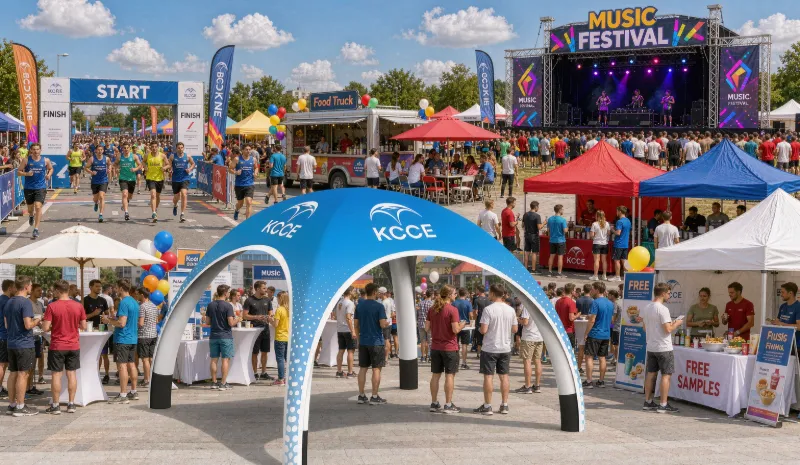
Festivals are the stress test. Wind, rain, mud, thousands of people moving in every direction. An outdoor event tent has to survive all of it and still be visible from the far end of a field.
This is where wind resistance stops being a marketing bullet point and becomes a real concern. A 30-mph gust catching the flat side of a poorly anchored tent can snap a stake and send your investment tumbling, as event planners who’ve lived through it will tell you. Modern inflatable advertising tents are engineered for exactly this — the design innovations in anchoring and airframe geometry over the past five years have changed what’s possible.
Larger footprints make sense here. Vendor zones need real shelter, and a bigger tent gives you room for product, staff, and shade.
Pro tip: Check your permit requirements before you buy anything. Festival grounds often have specific anchor and wind-rating rules. And bring an anchor kit that’s rated for more wind than the forecast suggests — the forecast lies.
Sports Events & Sponsorships
Sideline branding is a different animal. You’re not selling from the tent; you’re building presence. A brand activation tent at a marathon, a cycling race, or a youth tournament turns a patch of grass into a branded touchpoint.
Team-color printing matters more than you’d think. Fans gravitate to structures that match the event’s energy. Quick setup matters too — sports events run on tight schedules, and you don’t want to be inflating while the race is starting.
KCCE, a manufacturer based in Dongguan that’s been building inflatable structures since 2006, makes customized inflatable tents for marathons and racing events precisely for this kind of use — the kind of thing you see at finish lines and hydration zones.
Pro tip: Position near entrances and hydration stations. Those are the two spots where crowds naturally slow down. A tent at a hydration station gets eyeballs whether people want to look or not.
Product Launches & Brand Activations
This is the scenario where creativity pays off most. An inflatable advertising tent for a launch isn’t shelter — it’s an environment. Custom shapes, unusual silhouettes, LED integration. The tent becomes the experience.
I’ve seen brands build entire immersive rooms out of inflatable structures. The flexibility is the point. You’re not stuck with a rectangle.
Pro tip: Pair the tent with a photo opportunity. People share what they photograph. A branded environment designed for a good photo does more for social reach than any paid placement at the same budget.
Community & Municipal Events
Fairs, markets, charity runs, town celebrations. These events run on tight budgets and need structures that survive repeated use. An event canopy here needs to be durable, reusable, and easy to transport between venues.
This is the least glamorous scenario and honestly one of the most reliable. Municipal buyers care about longevity, not novelty. A tent that sets up in minutes and packs into a vehicle is worth more than a flashy one that needs a crew.
Pro tip: Use multi-panel printing so you can feature multiple sponsor logos. Community events often have several sponsors, and a tent that credits all of them keeps everyone happy — and keeps you booked for next year.
Emergency & Relief Shelters
Here’s the edge case most people don’t think about. A rapid deployment tent isn’t advertising in the traditional sense — it’s infrastructure. But the same engineering that makes an advertising tent fast to inflate and weather-resistant makes it useful for relief operations.
The market has noticed. According to a PR Newswire release from September 2026, inflatable structures are increasingly being used beyond events — extending into sports training, mobile entertainment, industrial maintenance, medical support, and emergency response. JOY Inflatable, for example, developed a customized enclosed training tent for a winter training program with Russian national athletes. That’s the same core technology, pointed at a different problem.
Weatherproofing and high visibility matter most here. In a relief scenario, you need the structure to be seen and to hold up.
Pro tip: Pre-printed NGO branding builds trust fast. In a crisis, people approach structures that look official. A blank tent creates hesitation.
How to Choose the Right Scenario
So how do you actually pick? Start with the goal, not the tent.
If your goal is awareness, you want height and visibility — trade shows, sports events, festivals. If it’s sampling, you want foot traffic and approachability — pop-ups, retail. If it’s sales, you want shelter and dwell time — festivals, community events.
Then run the checklist:
- बजट: Custom printing and larger footprints cost more. Match spend to expected return.
- Footprint: Measure your actual space before you order. A tent that doesn’t fit is a tent that doesn’t work.
- Setup time: If you’re solo, prioritize quick-inflate designs. If you have a crew, you have more options.
That’s the inflatable tent ROI calculation in plain terms. It’s not about the tent’s spec sheet — it’s about whether the scenario lets the tent do its job.
One thing worth mentioning: the custom inflatables market segments by application into events and exhibitions, amusement parks, sports, and advertising, according to Dataintelo’s market research. That tells you where the demand is concentrated. But demand isn’t the same as fit. Your scenario should match your goal, not the crowd.
And if you’re comparing options, you’ve probably run into Westshade canopy reviews while researching. Fair enough — the West canopy gets mentioned a lot in event circles. My take: read the reviews, but weight the ones from people running your specific scenario. A Westshade tent that shines at a farmers market may not be the right call for a windy festival field. Same logic applies to any brand, including the ones I’ve mentioned here.
Why Inflatable Advertising Tents Outperform Traditional Tents
Three measurable advantages, and I’ll give you the numbers rather than the pitch.
Setup time. A 6×3 m inflatable goes up quickly with two people and one blower. The equivalent pole-and-canopy frame takes considerably longer with three people and a ladder. Over a 20-event season that can mean many hours of labor saved, plus fewer overtime claims.
Wind behavior. Traditional frames fail at joints; inflatables redistribute load across the whole airframe. Properly anchored with spiral stakes or water ballast per leg, constant-air tents hold in sustained winds, where a comparable pop-up canopy starts deforming at lower wind speeds.
Branding real estate. A traditional 3×3 m canopy gives you a certain amount of print area. The inflatable equivalent can give you significantly more — greater exposure for a similar footprint cost.
Pro tip: Ask for the pressure rating and the anchor spec in writing before you sign. “Wind resistant” means nothing without a number.
Music Festivals and Outdoor Concerts
Festival fields are where the spec sheet gets tested for real. At a 15,000-capacity site, a 6×3 m constant-air tent in the vendor row or activation zone needs 25 kg ballast per leg minimum, plus guy lines on the windward side — event safety officers under UK Purple Guide or equivalent US Event Safety Alliance guidance will check this at load-in. The practical case: a beverage brand running a multi-day festival activation with two inflatable tents typically sees higher dwell time than a flat-branded table setup, because the tent provides shade and a reason to stop. Print the roof panel — at a festival, sightlines run diagonally across a field, and roof branding is what people see from 80 meters out.
Pro tip: Bring a spare blower. A blower failure on day two of a three-day festival turns your activation into a deflated tarp.
Corporate Events and Brand Sponsorships
Corporate and sponsorship work is where inflatables win on optics, not just logistics. A 4×4 m sealed-air tent with a full dye-sublimation wrap can read as a permanent installation — clean lines, no visible frame, no guy-line clutter. That matters when the client is a bank, a telecom, or an automotive OEM.
For sponsorship activations at golf tournaments, marathon finish lines, or dealer events, the standard configuration is a 5×5 m tent with a branded back wall, a counter, and LED strip lighting on a 12V circuit. Setup is usually quick on a paved surface with water ballast instead of stakes — critical when you can’t penetrate asphalt or turf.
Pro tip: For sponsorships, get the brand guidelines before you spec the print. Corporate color tolerances are tighter than festival work, and a reprint costs more than the tent.
Industry Applications: Food Service, Real Estate, Education, and Government
The scenarios people ask about most are the ones with compliance overhead. Here’s how it actually plays out.
Food service. Health departments generally require an enclosed or semi-enclosed food prep area with a washable surface. A 3×3 m inflatable with PVC-coated walls and a roll-up side can satisfy many county health codes — but check for NSF-listed surfaces if you’re prepping, not just serving. A coffee roaster I worked with ran four farmers-market units on 3×3 m sealed-air tents, packed in a hatchback, up quickly each.
Real estate. Weekend open-house activations at new developments use 4×4 m tents as on-site sales offices. The draw is that they go up on a vacant lot with no permit footprint in many jurisdictions (temporary structures under a certain size are often exempt), then move to the next site.
Education. University recruitment fairs and campus orientations run 3×3 m units with printed program walls. The reusable skin is the selling point — one tent can serve multiple events a year with a swappable printed panel.
Government and municipal. Emergency relief and public information points use constant-air tents because they deploy from a truck in under 15 minutes and run off a generator. FEMA-style field guidance treats them as temporary shelters, not permanent structures. Pro tip: For any food or government use, confirm the flame-retardant certificate first. NFPA 701 (US) or EN 13501-1 Class B-s1,d0 (EU) is what inspectors ask for.
ROI and Measuring Brand Exposure
Let’s put numbers on it, because “brand awareness” is not a line item a CFO accepts.
Cost per impression. A 6×3 m inflatable at a typical price range with a printed wrap, amortized over 20 events, can land at a modest cost per event. At a mid-size festival with attendees and a conservative pass-by rate, that can produce impressions at a low cost per impression. A comparable billboard placement typically runs at a low CPM but delivers zero interaction.
Interaction metrics. Track these three: dwell time, photo captures (count them — a branded photo wall can drive more UGC than a plain tent), and sample-to-conversion rate.
Measurement method. Use a simple counter or a phone-based tally app at the tent entrance for footfall, and a QR code on the counter for attribution. Compare tent-event weeks against non-event weeks in your POS or CRM data — the delta is your lift.
Pro tip: Photograph the crowd, not the tent. The photo of 40 people around your tent is the ROI evidence that survives the budget review.
Buying Guide: Materials, Blowers, Certification, and Compliance
Spec this once, properly, and you won’t rebuy for five years.
सामग्री। 600D Oxford polyester with PVC coating is the workhorse — waterproof, UV-treated. For heavy commercial use, step to 1000D or PVC tarpaulin. Cheaper 210D–420D nylon looks fine new and delaminates within a season outdoors.
Blower spec. Match blower CFM to tent volume, not floor area. A 6x3x2.5 m tent has a certain volume; you want a blower rated above the manufacturer’s minimum, with a thermal cutout. Sealed-air tents need only a hand pump or a one-time inflation.
Certification. Look for NFPA 701 or EN 13501-1 flame retardancy on the fabric, CE or UL listing on the blower and any electrical, and a stated wind rating with the anchor system it assumes. Ask for the test report, not the marketing claim.
Compliance. Temporary structures under a certain size are exempt in many US jurisdictions, but anything larger, or any tent with cooking, usually triggers a fire permit. In the EU, temporary structures fall under national building codes — check before you print.
Pro tip: Buy the anchor system with the tent, from the same supplier. Mismatched anchors are the number one cause of warranty disputes after a wind event.
निष्कर्ष
Scenario choice matters more than tent spec. I’ll say it plainly — a mid-tier tent in the right scenario beats a premium tent in the wrong one, every time.
So here’s your next step. Shortlist two scenarios from the seven above. Not five. Two. Then request quotes for tents sized to those specific scenarios. If you’re still working out sizing and printing, KCCE’s inflatable tent range is a reasonable place to start comparing configurations.
常见问题解答
问:充气帐篷的缺点是什么?
答: The honest answer: durability concerns and air retention over time. Users worry about punctures from sharp objects, and in crowded festival settings, leaks mean you need repair tools and a backup plan. Wind resistance is another factor — a poorly anchored inflatable advertising tent can fail in high gusts. None of these are dealbreakers, but they’re real considerations when you’re choosing a scenario and a vendor.
Q: What are the key advantages of inflatable tents?
答: Speed, portability, and visual impact. A pop-up tent inflates in minutes, packs down small, and creates a silhouette that flat structures can’t match. For brand activation tent use, the custom printing surface is generous — you can wrap logos across panels and roof. They’re also lighter to transport than traditional pole tents, which matters when you’re moving between events.
Q: Are inflatable tents worth the hype?
答: Depends on the scenario. For trade shows, festivals, and pop-ups — yes, in my experience. The visibility and setup speed justify the cost. For long-term permanent installation, probably not; traditional structures hold up better over years. The hype is real for temporary, high-visibility use. It’s overstated for anything permanent.
Q: Do inflatable tents stay inflated?
答: Sealed-air models hold pressure for extended periods, but no inflatable stays perfectly inflated forever. Temperature changes cause pressure shifts, and seams can slowly lose air over a season. The practical answer: check pressure before each event and carry a pump. Airtight designs hold better than constant-blow models, which need continuous airflow. Maintenance is part of ownership.
Q: Are Westshade canopies good for inflatable tent scenarios?
答: Westshade canopy reviews generally focus on traditional canopy performance, not inflatable structures — so it’s not a direct comparison. If you’re evaluating a West canopy tent for events, treat it as a separate category. For inflatable advertising tent scenarios specifically, look at vendors who specialize in inflatable engineering, not general canopy makers.
Q: Where can I find Westshade canopy near me?
答: Availability varies by region. Westshade canopy in California, the UK, and Australia tends to have more dealer coverage than smaller markets. For Westshade canopy reviews USA specifically, check regional event supplier directories. If you’re outside major markets, ordering direct is often simpler than hunting for local stock.
Q: How much does a custom printed canopy cost?
答: Pricing depends on size, material, and printing complexity. A custom printed canopy with full-wrap branding costs more than a stock model, and commercial terms like Westshade canopy price or Westshade canopy for sale listings vary widely by vendor and region. Request quotes for your specific scenario rather than comparing list prices — the variables matter too much.
Q: Can one inflatable tent serve multiple scenarios?
答: Yes, and that’s often the smart play. A mid-size branded canopy tent can work a trade show one weekend and a community event the next. The inflatable tent ROI improves when you amortize one purchase across several scenarios. Just make sure the size and printing are flexible enough to adapt — multi-panel printing helps here.
संदर्भ
1. Custom Inflatables Market Research Report 2033 – dataintelo.com
2. 9 Branded Inflatable Tent Designs That Will Inspire Your Next Outdoor Event Activation – tentcraft.com
3. Inflatable Tent Wind Resistance: How Design Innovations Stop Failures – kcce-event.com
4. Inflatable Structure Market Research Report 2033 – growthmarketreports.com
5. From Event Tents to Specialized Spaces: JOY Inflatable Meets Evolving Global Demand for Inflatable Tent Solutions – prnewswire.com