
Inflatable Tent Manufacturer for Germany Buyers
Custom-printed inflatable tents, arches and columns built in our own factory and shipped to the German port your forwarder nominates. Full-canopy branding, MOQ from 1 unit, and 20 years of manufacturing experience.

KCCE is an inflatable tent manufacturer for Germany buyers, producing custom-printed clear-span tents, arches and columns on an Oxford-cloth canopy over welded TPU air tubes. Orders are produced to your artwork and handed over FOB in China to the forwarder you nominate for the German port, with custom print available from 1 unit.
What an Inflatable Tent Manufacturer for Germany Buyers Actually Does
Buying from an inflatable tent manufacturer for Germany events removes the import-and-resell layer between you and the production floor: the same team that prints your canopy also controls the welding, the accessory pack and the export handover.
Most German buyers arrive with the same three questions: what will the tent look like with our brand on it, what does a custom order require, and how does the unit reach our venue. KCCE answers them in that order. Artwork is mapped onto the actual canopy panel layout before production, the order is built to that approved layout, and the finished units are handed to your forwarder at the named port of loading rather than dropped into a retail channel.
Because every unit is built after approval, a German programme can start with one printed tent for a single activation and scale to a multi-unit fleet for a season of trade fairs without changing supplier or re-approving the design. That continuity is the practical difference between ordering from a manufacturer and re-ordering from a catalogue.
Germany is also where the documentation matters as much as the product. A Messe order, a municipal event and a retail forecourt each hand the buyer a different file: a stand plan, a site permission, a technical datasheet. An inflatable tent manufacturer for Germany trade fairs is therefore asked for the same things every time — the drawing, the packed dimensions, the fixing method for the surface and a lead time confirmed in writing — and this page is built around those four documents.
Key Takeaways
Who Orders Inflatable Tents for German Events
Four buyer types account for most German enquiries. Each one stresses a different part of the order, so the specification conversation starts there.
Trade fair and event agencies
Stand builders and event agencies that need one printed canopy per client, changed between shows. Re-skinning options matter more than stock availability.
Retail, dealership and roadside campaigns
Forecourt and roadside units that stay up for weeks, so the print, the canopy attachment and the ballast system are chosen for weather and for repeated installs.
Rental and rental-contract companies
Fleet buyers who install and strike the same footprint across a season, so matched units, spare canopies and a documented setup routine decide the total cost.
Sports events and race series
Infield tents, spectator shade and branded arches where the same footprint is rebuilt at every round of a series and spares have to be replaceable between events.
Custom Inflatable Tent for German Programmes: Models We Build
These six covers most German orders: single-unit activations, series tents and booth footprints. Each card links to the model page with its own manual-based size list.
X
Modular aluminum connectors, awnings and banner walls. The model most often specified when a German brand needs one tent that can be extended or joined at the next event.

X6
Six inflation ports and modular connectors, so a larger span can be inflated in stages by a small crew instead of one long run.

XII
The widest span in the range, with nine ports inflated in numbered order. Chosen for main-stage and exhibition footprints that cannot be broken up.

N
Rectangular footprints including 4x6M and 5x10M, which suit booth-style layouts and long spectator lines better than a round span.

XL-B
A long, shallow footprint with connecting cloth, used where the tent runs along a fence line or a building frontage.

AII
Single-port dome with a Velcro-attached canopy, so artwork can be swapped between campaigns without replacing the air frame.
Printing and Branding for the German Market
Print is the reason most German buyers come to a manufacturer rather than a rental house. Four options cover nearly every brief.
Full-canopy heat-transfer print
Artwork is printed onto the Oxford-cloth canopy rather than patched on as a banner, so the brand reads across the roof and the walls as one surface. On the X series the canopy is the documented 400D Oxford cloth.
Colour-block and two-tone layouts
Panels can be split into two or more colours to match a palette, which is how most German retail and sports brands keep a tent readable from a distance.
Awnings, banners and connection cloth
The X and XL families accept awnings, banner walls and connecting cloth, so a branded canopy can be extended into a shaded queue line or joined to a second unit.
Removable canopies for re-skinning
On the AI and AII the canopy attaches with Velcro, so a German agency can change artwork between campaigns and keep the same air frame in service.
Model and Size Reference
Sizes and inflation-port counts below are taken from the printed product manuals. Installer counts are the crews the manual specifies to inflate the tent, not a seating or sleeping capacity.
| דגם | Optional sizes | Installers to inflate | Inflation ports |
|---|---|---|---|
| AI | 2.5M / 3M | 1 | 4, reducible to 1 |
| AII | 3M / 4M | 1 | 1 |
| U | 3M / 4M / 5M | 1 to 2 | 2 |
| וייטנאמית | 4M / 5M / 6M | 1 to 3 | 3 |
| VII | 5M / 6M | 1 to 3 | 3, reducible to 1 |
| F | 3x3M / 4x4M | 2 to 3 | 2 |
| N | 3x3M / 4x4M / 5x5M / 4x6M / 5x10M | 3 to 4 | 2 |
| X | 3M / 4M / 5M / 6M / 7M / 8M | 2 to 5 | see manual |
| X6 | 5M / 6M / 7M / 8M | 2 to 4 | 6 |
| XII | 4M / 6M / 8M / 10M | 1 to 6 | 9, in numbered order |
| XL-A | 4.5x3M / 6x4M / 7.5x4.8M | 1 to 3 | 5, reducible to 3 or 1 |
| XL-B | 8x4.5M / 9.4x5.5M | 2 to 3 | 7, reducible to 3 or 1 |
A footprint that is not on the list is a conversation, not a rejection: tell us the venue and we will confirm which listed size comes closest in writing.
Inflatable Tent Shipping to Germany: How the Handover Works
With inflatable tent shipping to Germany, everything starts from one decision: who books the freight. We quote FOB, which keeps the routing, the carrier and the delivery window under your control.
| Mode | הכי טוב עבור | Who arranges what |
|---|---|---|
| Sea freight, LCL | First order, single units, test tents | You nominate the forwarder and the German port; we hand over FOB in China. |
| Sea freight, FCL | Fleet orders and multi-unit programmes | Same handover, consolidated into one container for a season of trade fairs. |
| Air freight | Samples and hard launch dates | Reserved for units that cannot wait for a sailing; quoted per project. |
Hamburg and Bremerhaven are the ports most German buyers nominate, but any German port works and the process is identical. Each set is packed with its accessory bag, the TPU repair patches listed in the manual and a printed setup sheet, so a German crew that has never seen the model can still install it from the packing list.
Import clearance stays on your side of the handover. We prepare the export documents against your broker’s checklist and confirm the shipping plan in writing before production closes; the import declaration, any import duty and the VAT handling are then settled by the party who knows the German procedure, not by the factory.
The same process runs for buyers across the DACH region. German, Austrian and Swiss orders differ in the port and the broker, not in how the tent is built or handed over, so a single approved design can serve a fair in Munich and a series in Zurich.
From Enquiry to a Delivered German Order
Six stages, each ending in something you can check: a quote, an approved proof, a written lead time, a packing list, a handover receipt.
| Stage | What you get | What is confirmed |
|---|---|---|
| Enquiry | Three questions: what the tent is for, the footprint, and how many units. | Reply with a quote or a clarification inside 24-48 hours. |
| Artwork and proof | Your logo mapped onto the real canopy panel layout. | Print layout approved by you in writing before anything is cut. |
| Production | Canopy print, air-frame welding and assembly to the approved layout. | Lead time confirmed in writing after design approval. |
| אריזת | Accessory bag, repair patches and setup sheet per unit. | Units checked against the model’s packing list. |
| FOB handover | Units delivered to your forwarder at the named port of loading. | You or your broker control the sailing and the German delivery. |
| Re-order | Same design, same panels, no re-approval from scratch. | Spares and single replacement units orderable separately. |
What a German Order Paper-Trails
For a German buyer the documents are part of the product: a stand plan has to be readable by the stand builder, a site permission has to name the structure, and a reorder has to reference the first order without a new negotiation. The paperwork is agreed at the enquiry, not invented at the handover.
The drawing and layout
The canopy panel layout with the artwork positioned on it, plus the footprint and the leg positions for the surface. This is what a stand builder and a site team actually work from, so it is drawn before production rather than after.
Packed dimensions
The packed size of each unit and of the accessory bag, so the freight, the storage room and the stand's load-in can be planned before the container lands. Packed dimensions are a document, not a number remembered from a call.
Fixing method for the surface
Weights for paving, stakes for grass, and the specific kit the model uses. On a German event site the ground is often a hall floor, a paved square or a lawn, and the fixing changes with each one.
Export documents
Prepared against your broker’s checklist, with the shipping plan confirmed in writing before production closes. The import declaration and the VAT handling stay on your side of the handover.
Artwork proof
The print layout approved by you in writing before anything is cut. This is the document a reorder references, so a second order does not start from a screenshot of the first.
What you provide
The stand plan, the site rules, the broker’s document list and the artwork files. Everything else is built from those four, which is why the enquiry asks for them first.
Where German Programmes Install These Tents
Real installations, photographed on site. Three configurations cover most German briefs: a full-graphic print structure, an arch on a hardstanding and a canopy on a poolside terrace.
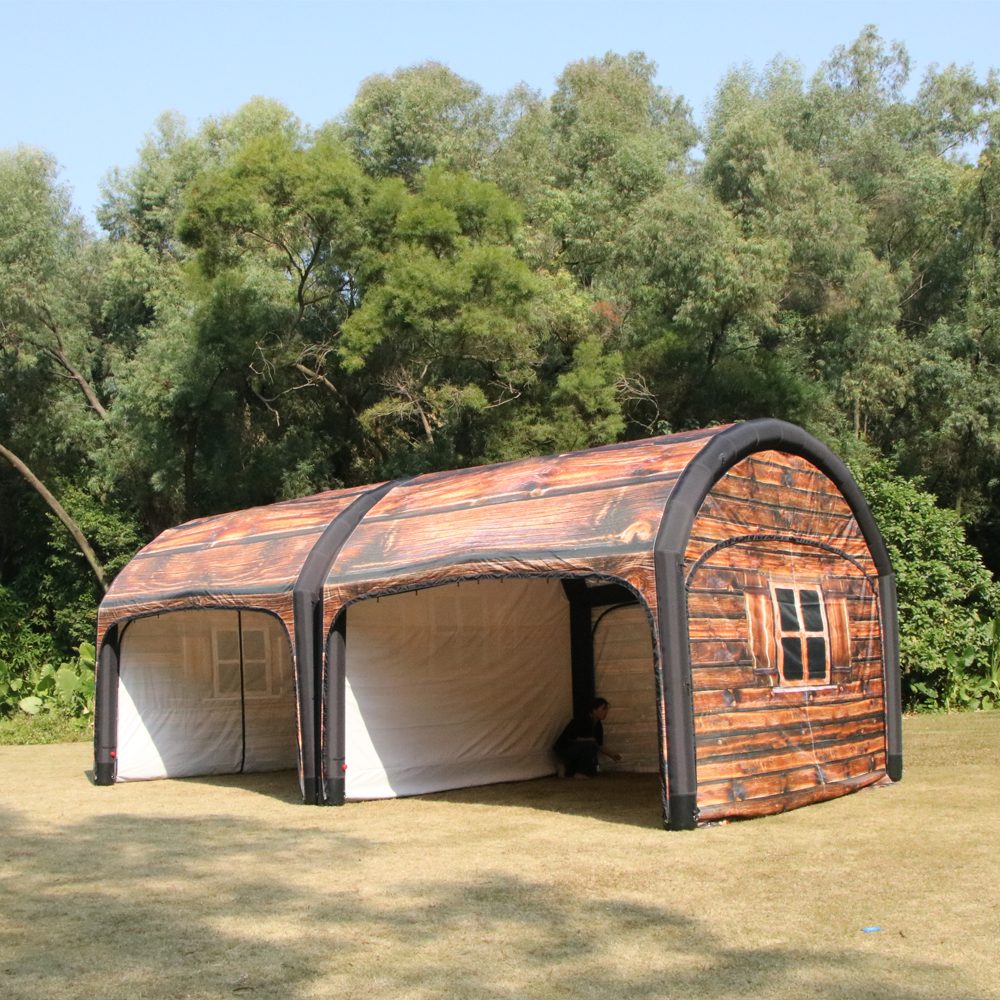
Print That Covers Every Surface
A full-graphic print across roof and walls rather than a single front panel. For a German brand that wants the structure to read as one object from across a hall or a field, this is the configuration that does it.
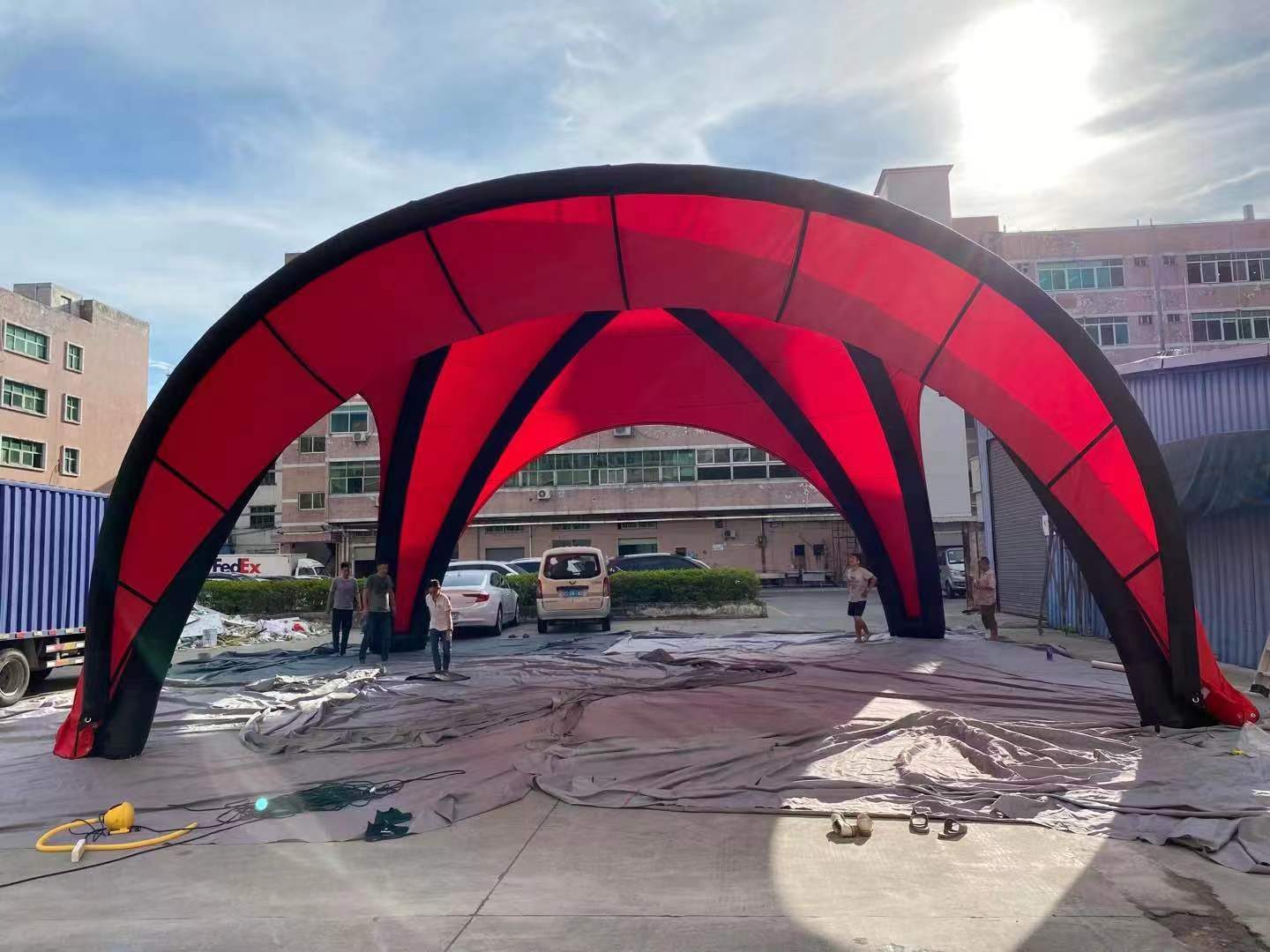
Standing on a Working Yard
An arch on a concrete yard with the workshop behind it. For a German manufacturer or contractor the structure is usually specified against a hardstanding, so the fixing kit is quoted with weights rather than stakes.
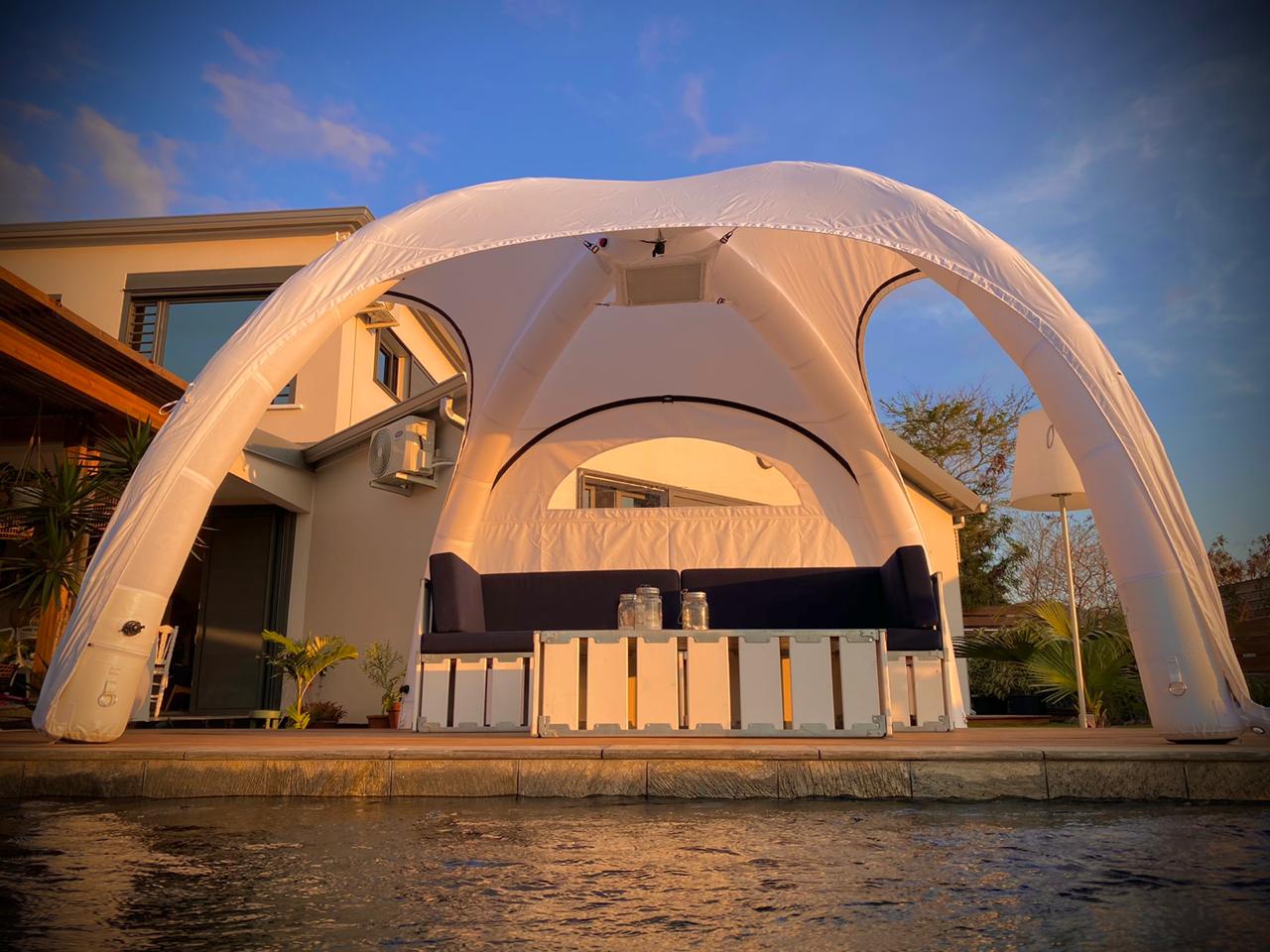
A Canopy on the Terrace
A canopy on a paved terrace beside a pool. Paved sites take weights rather than stakes, so the fixing kit is quoted with the unit rather than being decided on the morning.
Printed Tents in the Field
Three handovers, three different print briefs. Each photo is the delivered unit on site, not a mock-up.
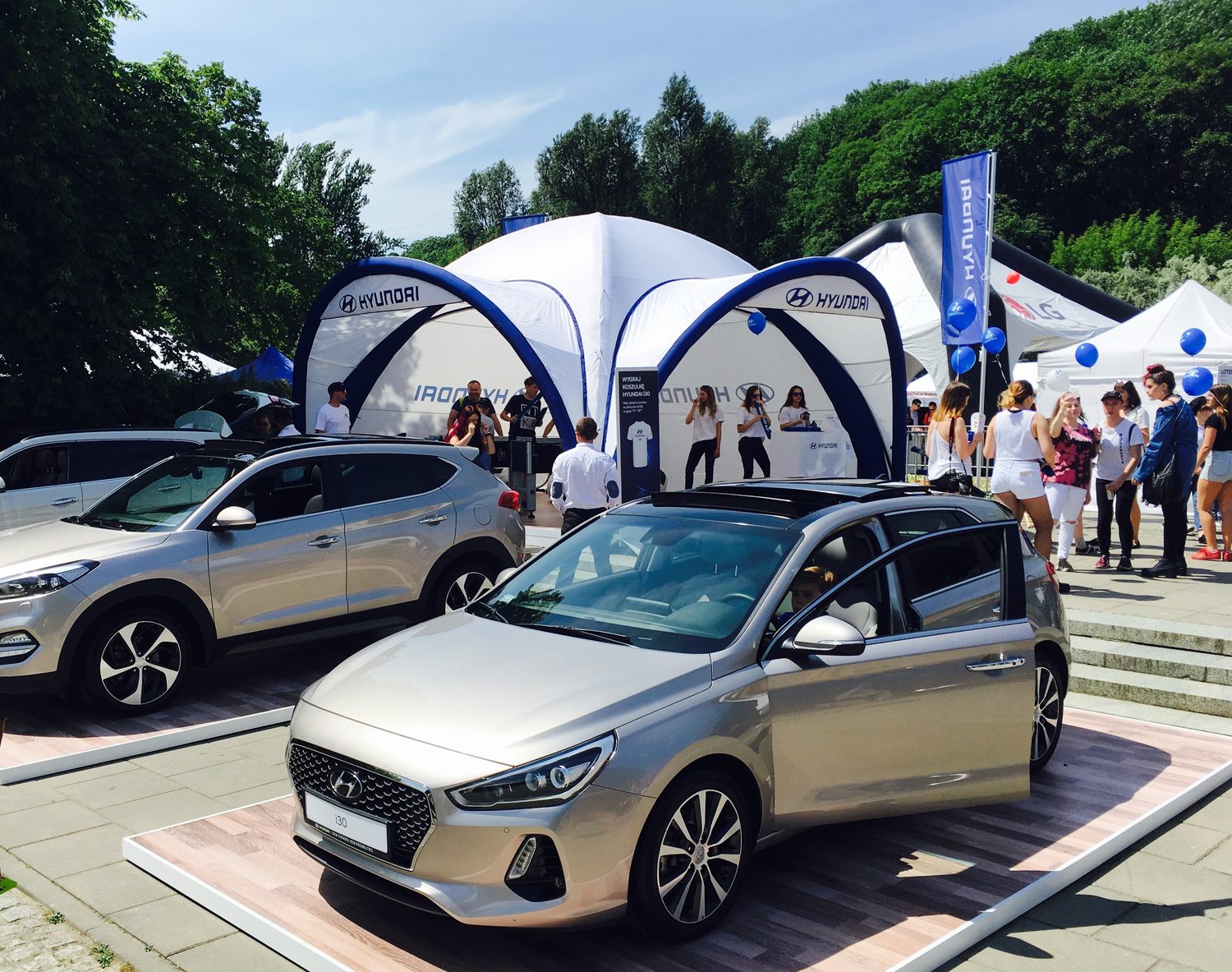
Two Desks, One Frontage
A matched pair on paving. Two services sharing one day reads as one organisation when the canopies are printed alike, instead of two neighbouring queues with two different colours.
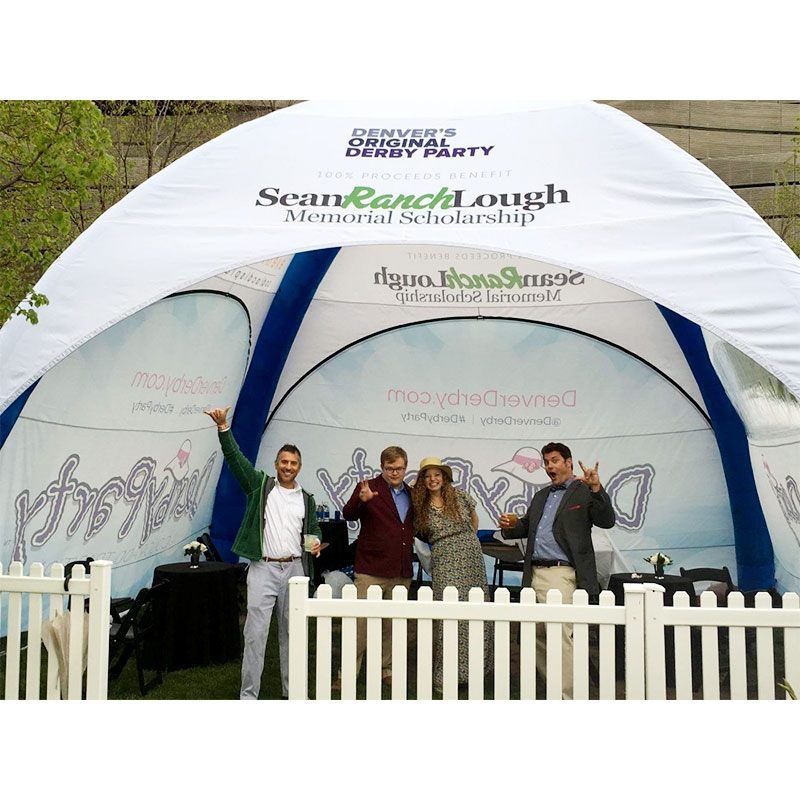
One Printed Panel, Read at Distance
The message sits at eye level and the roof stays plain. For a service point that is the cheapest print that still works, and it keeps the interior bright for staff reading documents all afternoon.
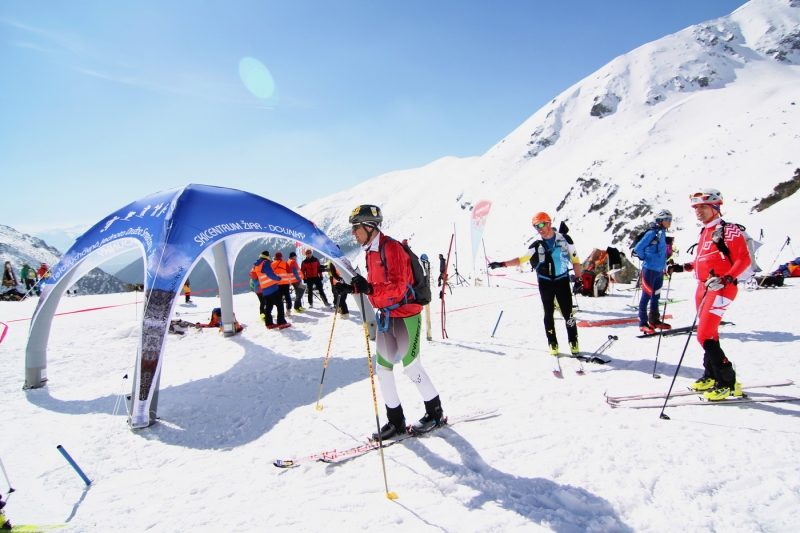
Standing Through a Cold Snap
Snow, a mountain slope and a crowd that arrived on skis. Cold ground is still ground: the legs are staked or ballasted the same way, and what changes is who reads the forecast and when the call to deflate gets made.
Canopies We Have Delivered
Three deployments, three different site problems. A printed dome on paving where a queue has to run along one side, a multi-unit frontage in front of a public building, and an open-front dome on mown grass.
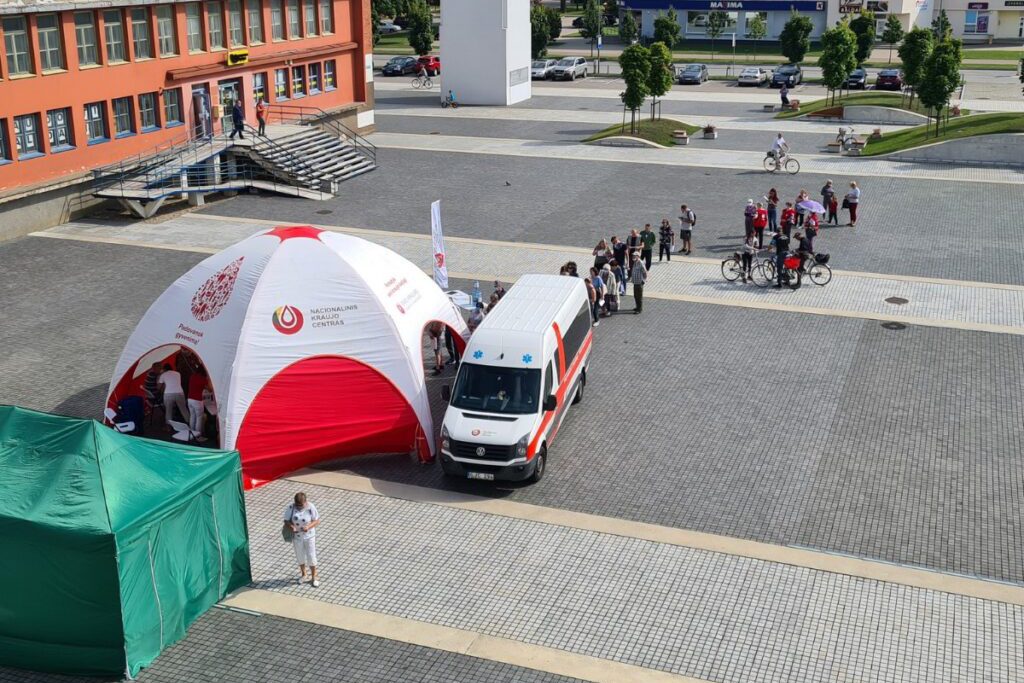
A Queue on Paving, Not on Grass
A printed dome on a paved square with a queue running along one side. Paving takes weights rather than stakes, which is why the fixing kit is quoted with the unit instead of being decided on site.
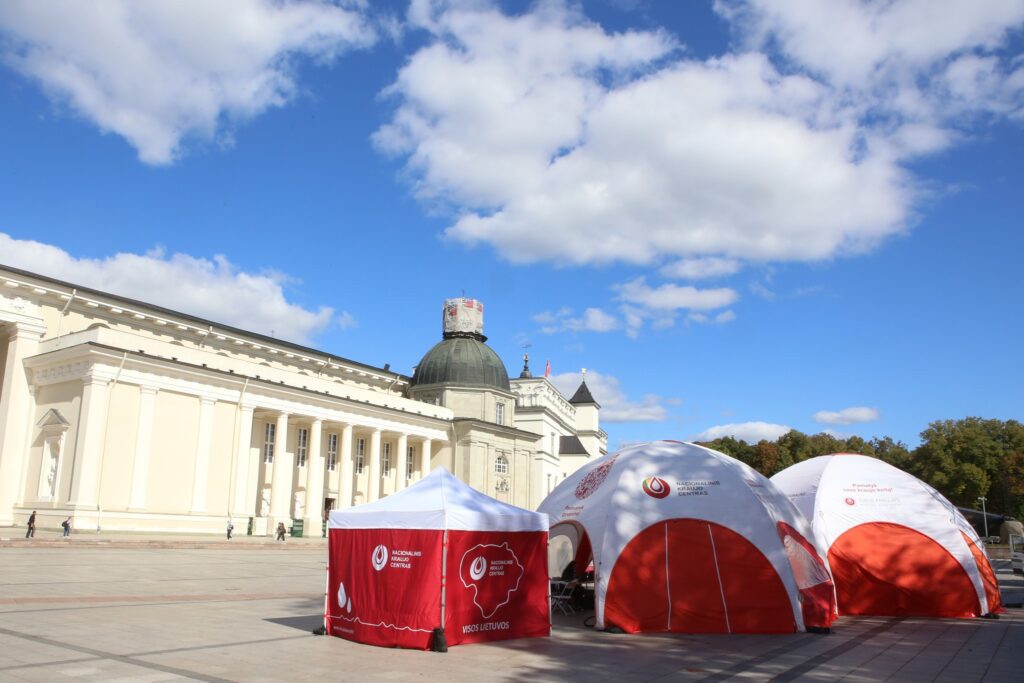
Three Units, One Frontage
A small red canopy and two white domes in a line in front of a public building. A multi-unit layout reads as one event when the prints are matched and the heights are kept level.
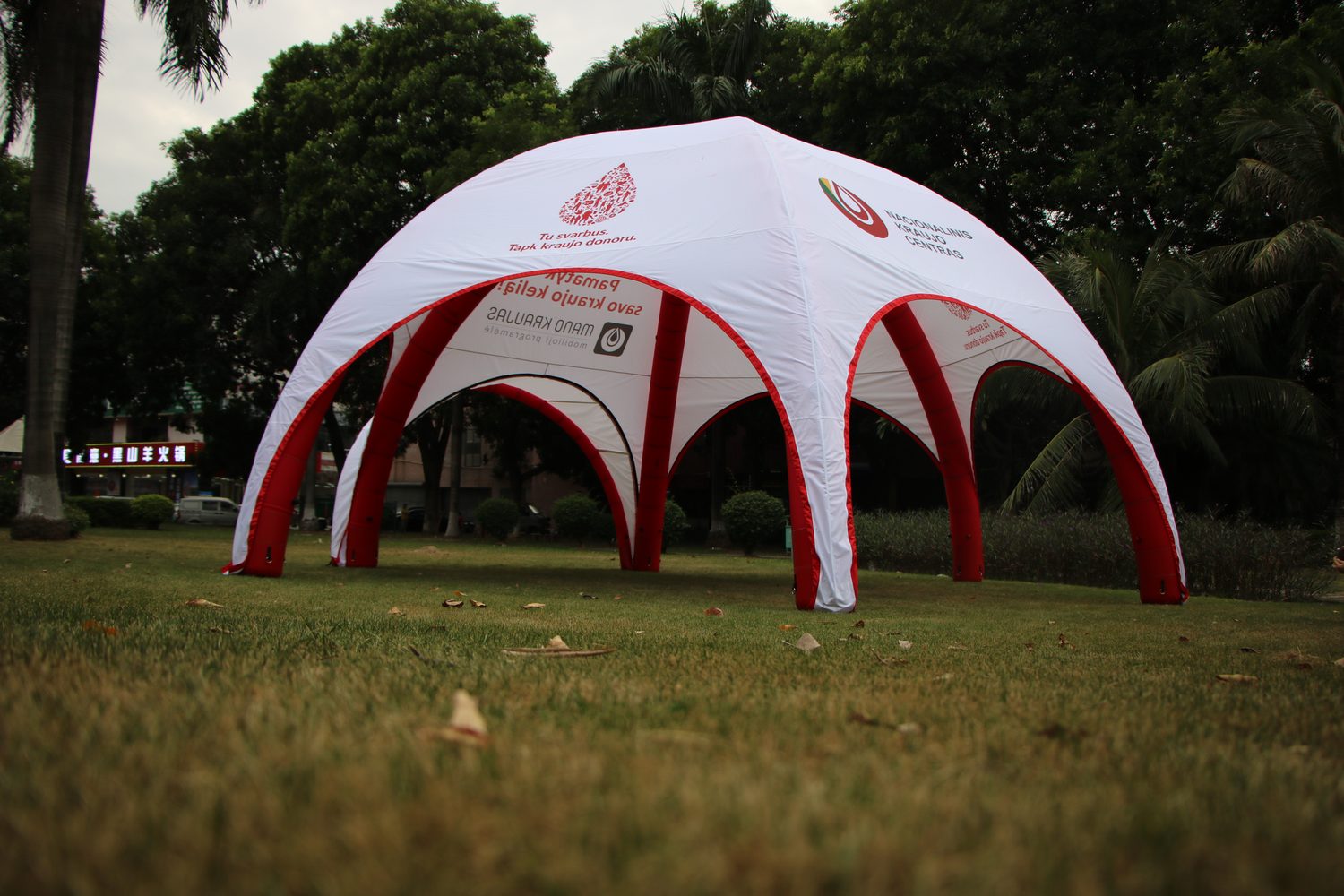
A Service Point on Grass
A printed dome on mown grass with the legs staked rather than weighted. The ground under a German event is often lawn or parkland, and the fixing kit has to match it rather than be improvised on the morning.
Pricing, MOQ and Lead Time
There is no published price list, because a printed canopy is priced per project: model, footprint, number of print panels and accessories all move the number. What is fixed is how the quote is built and how fast you get it.
| Programme | מינימום הזמנה | Lead time | Price basis |
|---|---|---|---|
| Custom printed, single unit | 1件起订 | Confirmed in writing after design approval | Quoted per project (FOB) |
| Multi-unit fleet, one design | Discuss | Confirmed in writing after design approval | Quoted per project (FOB) |
| OEM / private-label programme | Discuss | Confirmed in writing after design approval | Quoted per project (FOB) |
| Spares and replacement canopy | Discuss | Confirmed in writing after design approval | Quoted per project (FOB) |
Send the footprint, the number of units and the artwork and the quote comes back in 24-48 hours with the print panels itemised.
Setup and Inflation
Three stages, all of them documented in the manual that ships with the tent. The installer count in the size table above is the crew the manual specifies for each model, so a German crew can be sized before the unit lands.
Position and ballast
Spread the footprint on level ground and ballast it. Depending on the model the manual specifies bar bags, sand bags or iron blocks; the X series adds modular aluminum connectors when units are joined.
Inflate in the manual’s order
Each model lists its ports and, where it matters, the order to use them: the XII is inflated through nine ports in numbered sequence, while the AII fills from a single port.
Dress the canopy and add walls
Once the frame is up, the canopy is dressed and the awnings, banner walls or connecting cloth are added. On the AI and AII the canopy is Velcro-attached, so this last step is also how artwork is changed.
Inflatable Tent for German Trade Show Booths
An inflatable tent for German trade show floors is usually bought to fit a stand allocation, not a field. That makes the size list the first thing to check.
Germany hosts the trade fairs most European buyers plan their year around, and the stands themselves are built to a stand plan rather than to a tent. The N series 3x3M is the footprint most often chosen where the unit has to stay inside a compact shell-scheme bay; larger stands are usually better served by the N 4x6M or the XL-A 4.5x3M, both of which give a long branded face to the aisle.
Where the stand has to be reconfigured between shows, columns and arches can be ordered with the tent so the same branded surfaces are reused in a different arrangement. Two practical notes for show orders: ask for the uprights and the ballast to be listed separately from the canopy, so a damaged panel does not sideline the whole stand; and confirm the printed panels against the stand plan before production, because a stand that overhangs its allocation is a problem on the floor, not in the container.
How to Vet an Inflatable Tent Supplier for German Orders
Six questions separate a factory from a reseller, and each one has an answer you can verify before placing an order.
שאלות נפוצות
A: Yes. We quote FOB in China and hand the order to the forwarder you nominate for your German port. Hamburg and Bremerhaven are the most common, but any German port works. Sea freight covers first orders and fleet runs, and air freight is used for samples or hard launch dates.
A: You do, through your customs broker. We prepare the export documents against your broker’s checklist and hand over FOB at the port of loading, so the import declaration, any import duty and the VAT handling stay with the party who knows the German procedure.
A: Pricing is quoted per project on an FOB basis, because the number depends on the model, the footprint, how many panels carry print and which accessories you add. Send those four details and the quote comes back in 24-48 hours.
A: Custom print starts from 1 unit, so a single branded tent can be ordered as a test before a fleet order is placed for a season of trade fairs.
A: The N series 3x3M is the footprint most often chosen where the stand has to stay inside a compact shell-scheme bay. Larger stands are usually better served by the N 4x6M or the XL-A 4.5x3M, both of which give a long printed face to the aisle.
A: Yes. Artwork is heat-transfer printed onto the Oxford-cloth canopy, including the roof and walls, rather than applied as a separate banner. The X series canopy is the documented 400D Oxford cloth.
A: The lead time is confirmed in writing after design approval, once the model, the print panels and the quantity are fixed. We do not quote a lead time before artwork is approved.
A: Yes. OEM and private-label packing are part of the standard offer alongside custom printing, and the minimum is discussed per programme rather than fixed.
A: The manuals specify an installer count per model, from one installer on the AI, AII and U up to a larger crew on the XII and the long XL-B. The size table above lists the figure for each model.
A: Yes. Repair patches, bar bags, connection cloth and replacement canopies can be ordered separately, which is why we recommend listing the uprights and the ballast apart from the canopy on the first order.
A: Yes. Orders across the DACH region follow the same route: approved proof, production, packing, then FOB handover to the forwarder you nominate. Only the port and the customs broker change.
A: We do not make certification claims on this page. If your order requires a specific test report or declaration, send the requirement with the enquiry and we will confirm in writing what the factory can provide.


