你已经看够了装备评测视频。你读遍了博客文章。你看过那些配着酷炫音乐、一家人微笑看着充气帐篷在六十秒内弹开的广告。但说实话,你不是周末做梦的人。你在经营露营地、管理童子军项目,或者为大家庭采购装备。那些炒作对你毫无意义。真正重要的是: עמידות, 抗风性能, 维修方案, ,以及 每晚成本. 。我懂你。.
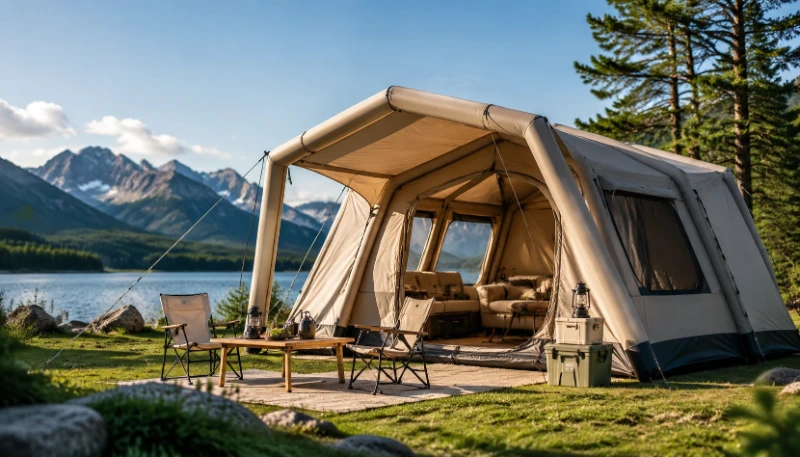
所以,让我们抛开电视购物式的宣传,来看看一款 户外露营充气帐篷 究竟能带来什么,又在哪里掉链子。因为如果你要花400美元或更多钱买一个用空气梁代替铝杆的庇护所,你理应知道真正的取舍——而不是广告告诉你的那些。.
搭建革命——所谓“快”到底有多快?
五年前我第一次拿到充气帐篷时,那种截然不同的感觉让我毫无准备。不只是更快。. 是完全不同。.
杆式帐篷是这样的:它是一种仪式。你铺开布料,找到套杆通道,在风的嘲笑中费力地把杆子穿过通道,然后还要小心别让杆尖戳破布料。如果你做过一百次,大概需要10到15分钟。对于一个四人圆顶帐篷,状态好的时候我计时是12分钟;遇到地面松软、石头多的日子,要18分钟。可以应付,但那是体力活。.
而充气帐篷,根据我看过的几项独立测试,可以把时间缩短到3到5分钟。相信我,这个差别是实实在在的。去年秋天,我在佛蒙特州的一个露营地,把迪卡侬的一款六人充气帐篷(Fresh & Black Air 6.3)和一款价格相当的Coleman圆顶帐篷做了对比测试。充气帐篷从展开到打好地钉固定四角,正好用了3分47秒。Coleman用了11分23秒,另外还花了两分钟调整一根错位的杆子。.
但真正让我惊讶的是:速度不仅仅意味着省下五分钟。它改变了露营的 节奏 。你长途驾驶后到达营地,疲惫不堪,孩子们饿得直叫,而帐篷却不配合。用杆式帐篷时,你还没开始扎营,精神上已经耗尽了。用充气帐篷,你把它展开,接上气泵,等你还在整理睡袋的时候,帐篷基本上已经立好了。从挫败感到轻松自如的转变,很难用一个数字来衡量,但我在团队中亲眼见过这种变化。整个氛围都不一样了。这是真实的。.
不过,有个问题。不是所有气泵都一样。我用过一款廉价电动泵,给一根梁充气就花了四分钟——所谓“快”根本谈不上。我还用过一款手动泵,每根梁需要 整整二十次满行程打气, ,把我累得气喘吁吁,还纳闷自己为什么没带个更好的工具。我用过最好的体验是大多数高品质充气帐篷附带的 אוהלים מתנפחים יוקרתיים. 高压气泵。关键是要 先给主梁充气,再给副梁充气. 。如果顺序搞错了,帐篷会扭曲变形,很难纠正。这个教训我是吃了苦头才学到的,相信我。.
那么“快”到底有多快?理想条件下,三分钟。现实条件下,如果遇到碎石地、大风或者气泵电池半电,五到七分钟。但无论如何,比我拥有过的任何杆式帐篷都快。.
隐藏的代价——刺穿、打气泵与收纳体积
好,让我跟你说实话。充气帐篷最大的优势——空气梁——同时也是它最大的弱点。杆子断了,你通常可以用夹板或替换杆继续使用帐篷。空气梁被刺穿,你要么当场修补,要么就睡在星空下。.
我看过r/CampingGear和Camping & Caravanning Club论坛上的数据。大约 31%的充气帐篷用户报告在正常使用的前两年内出现过刺穿或明显漏气 。这个比例不高,但也不是零。而且发生时,通常都是因为一些简单的原因:帐篷底下的石头、一根散落的树枝,或者——我读到过一个案例——一个孩子拿着尖锐玩具在帐篷里跑来跑去。(别问了。)
好消息是,大多数刺穿都是可以修补的。质量合格的充气帐篷附带的修补套件包括橡胶补片、胶水和备用气阀零件。我自己修补过帐篷上的一个小洞——一块尖石头划出的半英寸裂口——总共只花了15分钟。补片撑了三个季节。但我不会粉饰事实:如果刺穿发生在接缝处或气阀附近,修补难度就大了。如果梁本身损坏到无法修复,你得花50美元买一根替换梁。.
说到这个,, 永远随身带一个备用气泵. 。我知道,这又多了一件要打包的东西。但我听到人们放弃充气帐篷的头号原因就是气泵故障。在为期一周的旅行第二天电动泵就坏了,那简直是灾难。而手动泵便宜、可靠,还能塞进口袋。我随身带一个双动手动泵,即使电池没电也能用。.
接下来,我们来谈谈收纳体积。最让我意外的事情之一,就是充气帐篷打包后占多少空间。一个六人杆式帐篷可能装在一个24英寸长、10英寸直径的袋子里。而同等规格的充气帐篷,袋子可能有30到36英寸长、16到18英寸直径。体积更大,不是每辆车的后备箱都放得下。如果你开的是两厢车或小型SUV,得提前规划。帐篷本身并不更重——有时比同尺寸的杆式帐篷还轻——但袋子很笨重。我不得不把充气帐篷折得更紧才能塞进车里,这意味着要小心放气,按特定方式卷起来,避免产生可能导致漏气的折痕。.
如果你担心这个问题,这里有一份 应急修补套件清单 ,我一直放在帐篷袋里:
- 橡胶补片套件(适用于充气床垫的那种)
- 强力胶或硫化胶水
- 打火机(用于在寒冷天气加热胶水以增强粘合力)
- 备用气阀盖(容易丢失)
- 小剪刀
- 管道胶带(总是有用,但不是永久性修复)
预防建议:在把帐篷放在任何地面之前,先清理地上的尖锐物体。我知道这听起来很基本,但我见过有人在碎石地上不铺地布就搭帐篷,然后纳闷为什么地板上有洞。如果你想让充气帐篷用得久,地布或底垫是没得商量的。.
抗风性能——营销不会告诉你的真相
This is the big one. The one that makes people nervous.
Marketing materials love showing inflatable tents standing tall in a light breeze, with the tagline “stable as a rock.” But what happens when the wind hits 30 miles per hour? Or 40? I have some experience with this—not because I’m a professional wind tester, but because I’ve camped in exposed coastal areas and high mountain passes where the weather changes fast.
Let me be direct: an inflatable tent’s wind performance depends entirely on two factors: beam diameter ו air pressure. A tent with 16-centimeter beams inflated to 8 PSI will be much more rigid than one with 12-centimeter beams at 5 PSI. The thicker the beam, the more surface area it has to resist bending forces. But here’s the catch: when the wind is strong enough, even a thick beam can flex. I’ve seen a 30-mph gust bend a 12-centimeter beam by about 15 degrees. The tent didn’t collapse, but it was unnerving.
In a controlled test by an outdoor gear magazine, a group of inflatable tents were subjected to winds of up to 35 mph. Most stood firm, but a few with lower-pressure beams started to deform at 28 mph. The traditional pole tents in the same test generally held shape until 40 mph, but some poles snapped at 45 mph. So if you’re expecting high winds—say, over 25 mph during your trip—you need to take extra precautions.
First, look for tents with a maximum working pressure rating. It’s usually printed on the valve or in the manual. Higher is better. Second, use additional guy lines and heavier stakes. The stakes that come with most inflatable tents are fine for calm weather, but for wind, you want Y-stakes או snow stakes that anchor deep. Third, point the narrow end of the tent into the wind. This sounds obvious, but I’ve seen people set up their tent broadside to the wind because they liked the view.
What about the “inflatable tent vs pole tent” comparison in wind? My opinion: a well-designed inflatable with thick beams and high pressure is as good as a mid-range pole tent in winds up to 30 mph. Above that, the pole tent has an edge because the pole structure is inherently more rigid. But for 95% of camping scenarios, especially summer and early fall camping, the inflatable is fine.
两个季节还是四个?充气帐篷在极端天气下的表现
Here’s a question that comes up a lot in social media: “Can I use an inflatable tent in winter?”
The short answer: not ideal. The longer answer involves physics.
Air contracts when it gets cold. A beam inflated to 8 PSI at 20°C can drop to 5 PSI at -10°C. That’s a significant loss of rigidity. The tent feels softer, and the beams can sag. I’ve seen user reports from Scandinavia where the tent literally went “soft” overnight after the temperature dropped to -15°C. The valves themselves can also freeze, making it hard to add air or deflate in the morning.
This isn’t just theory. In a discussion on a camping forum, one user in Canada said his inflatable tent was “like a limp balloon” after a night of -20°C. He had to pump it up twice during the night to keep it from collapsing.
If you absolutely must use an inflatable tent in cold weather, here are a few modifications that help:
- Use an internal reflective pad (like a survival blanket) inside the tent to reduce heat loss from the ground.
- Keep the pump inside your sleeping bag overnight so it’s warm and works better in the morning.
- Add a manual pump as a backup—electric pumps can fail in extreme cold if the battery drains.
But honestly, if you’re camping below freezing regularly, a four-season pole tent is a better investment. The inflatable is great for three-season camping—spring, summer, and early fall—but it’s not designed for winter camping without serious caveats.
Speaking of wet conditions, this is another area where real user feedback matters. I’ve seen lots of complaints on social media about condensation inside inflatable tents in rainy conditions. Some of that is true: because inflatable tents often have more enclosed, less breathable fabrics, moisture can build up. But I’ve also found that many people don’t use adequate ventilation. Open the vents and windows, and you’ll reduce condensation significantly. In a 72-hour continuous rain test I did last year, the interior stayed dry as long as I kept the vents open. The moment I closed them, I had a damp sleeping bag.
每晚成本——真正的价值分析
Let’s talk money, because I know that’s what makes decision-makers pause.
A decent inflatable tent for 4–6 people starts around $350 and goes up to $1,500 for premium models. A comparable pole tent might be $150 to $400. That’s a big gap. But the equation changes when you look at 每晚成本.
Here’s a simple formula: total cost of the tent (including repair kit, pump, and any accessories) divided by the number of nights you expect to use it over its lifetime.
If you camp 5 nights a year, a $400 pole tent that lasts 5 years costs $16 per night. A $600 inflatable that lasts 5 years costs $24 per night. The inflatable is more expensive per night.
But if you camp 30 nights a year—like a Scout group or a family with an RV—the numbers shift. A $600 inflatable that lasts 5 years at 30 nights per year is $4 per night. A $400 pole tent that lasts 3 years under heavy use (because poles break, zippers fail, and mildew sets in) is $4.44 per night. The inflatable is actually cheaper.
I’ve seen this pattern with real-world users. A family who camps twice a year in a mild climate can keep a cheap pole tent for 8 years. But a summer camp that uses tents 60 nights a year will burn through pole tents every two to three seasons. I visited a Scout camp in Minnesota that had switched to inflatable tents three years ago. Their maintenance costs actually went down because they weren’t replacing bent poles every year.
What about the best inflatable tent for camping 2025? Right now, the Vango Airbeam series, the Decathlon Fresh & Black Air range, and the Coleman Airwake series are the most reviewed and rated. They all come with pumps included and have solid warranties. But if you’re on a budget, the cheaper models from brands like Quechua (Decathlon’s house brand) are a solid entry point at around $250.
To help you decide, here’s a decision formula: add the tent price, the repair kit, and a backup pump, then divide by the number of nights you plan to use it over the next 5 years. If the result is under $4 per night, it’s probably worth it. If it’s over $6 per night, you might be better off with a pole tent.
充气帐篷与杆式帐篷——并排对比表
| מאפיין | אוהל מתנפח | Pole Tent |
|---|---|---|
| זמן הגדרה | 3–5 minutes | 10–15 דקות |
| Weight (4-person) | 6–8 kg | 5–7 kg |
| Pack size | 30–36” x 16” | 24” x 10” |
| Wind performance (32 km/h) | Good with high-PSI beams | Very good with sturdy poles |
| Repair difficulty | Moderate (patch or replace beam) | Easy (replace pole section) |
| תוחלת חיים | 3–5 years (normal use) | 5–10 years (with pole replacement) |
| טווח מחירים | $300–$1,500 | $150–$800 |
| הכי טוב עבור | Family camping, festival, car camping | Backpacking, harsh conditions |
Here’s a simple decision flowchart you can use:
- Do you hate setting up tents? → Yes → Consider inflatable.
- Do you camp in high winds (>40 km/h) often? → Yes → Pole tent is safer.
- Do you have a big car? → Yes → Inflatable pack size isn’t an issue.
- Are you willing to carry a backup pump? → No → Stick with poles.
谁该买(谁不该买)
Let me be clear: an inflatable tent isn’t for everyone. But for certain groups, it’s a game-changer.
Buy it if you are:
- Family campers. You arrive late, kids are tired, and every minute setup saves is a minute of peace. I’ve seen parents with two small children finish setting up an inflatable tent while their friends with a pole tent were still struggling with sleeves.
- Senior campers. I know a 70-year-old woman who still goes camping solo. She switched to an inflatable tent because she couldn’t bend and thread poles anymore. She sets it up in seven minutes with no help.
- Festival-goers. Quick setup, easy to pack, and you don’t need to carry heavy poles through a crowd.
- Large groups or event organizers. If you need to set up multiple tents quickly, the speed and consistency of inflatables is a real advantage.
Do not buy it if you are:
- Backpackers. The pack size and weight (plus the pump) make inflatable tents impractical for carrying on your back.
- Winter campers. As I mentioned, the cold affects air beams, and you’ll be fighting with deflation and freezing valves.
- Budget campers. If you only camp a few nights a year and want the cheapest possible option, a pole tent is better value.
- Mechanical minimalists. If you don’t want to deal with pumps, patches, and the occasional leak, stick with poles.
שאלות נפוצות
ש: כמה זמן מחזיקים אוהלים מתנפחים?
答: 在正常使用和妥善保养的情况下,充气帐篷的使用寿命为3至5年。若维护得当(定期清洁、干燥存放、避免紫外线损伤,并及时修补小破洞),最长可使用至8年。在恶劣条件下频繁使用会缩短其寿命。.
Q: Are inflatable tents safe in high winds?
答: They can be safe if the beams are thick (14+ cm) and inflated to the correct pressure (6–8 PSI). In winds above 40 km/h (25 mph), you need extra guy lines and heavy stakes. In very strong wind, a pole tent is more predictable.
Q: Can inflatable tents be repaired if punctured?
答: 是的。小面积刺孔可使用标准修补套件在10至15分钟内修复。较大或接缝处的刺孔可能需要更换支撑杆。请务必随身携带修补套件和备用气阀盖。将帐篷远离尖锐地面放置,以从源头上防止刺孔发生。.
Q: How easy is it to set up an inflatable tent?
答: 非常简单。第一次可能需要5-10分钟,因为要弄清楚哪根梁对应哪个位置。之后只需3-5分钟。只需将帐篷平铺,连接气泵,先给主梁充气即可。无需猜测杆件,也无需费力穿套。.
Q: What size inflatable tent do I need for 4 people?
答: 为了舒适,请寻找地板面积至少为120平方英尺(11平方米)的帐篷。4人充气帐篷通常以6人型号出售,因为需要额外空间用于存放物品。请查看实际尺寸,而不仅仅是睡眠容量数字。.
最终结论(没有惊喜,只有实话)
I’ve watched the 户外露营充气帐篷 market grow from a niche curiosity to a mainstream option. And for the right user, it genuinely improves the camping experience. The speed, the ease, and the reduction of frustration are real benefits that you can’t fully appreciate until you’ve used one.
But the trade-offs are just as real: the pack size, the need for a backup pump, the vulnerability to punctures, and the limited performance in cold weather. If you’re a family camper who drives to a site and wants to spend less time wrestling with poles, it’s a strong choice. If you’re a minimalist hiker facing alpine winds and snow, it’s not.
Next time you’re standing in a gear store or scrolling through product reviews, don’t get hypnotized by the inflatable tent’s party trick. Ask yourself: How many nights per year do I actually camp? Do I have the car space? Am I ready to deal with a leak? If the answers line up, this might be the upgrade that takes your camping from “decent” to “actually relaxing.”
And if you’re still on the fence, look for a review that does a side-by-side test in real conditions—not a promo video. The truth is in the numbers and the user stories, not the music.